chapter 13 FIAT UNO 1983 Service Manual Online
[x] Cancel search | Manufacturer: FIAT, Model Year: 1983, Model line: UNO, Model: FIAT UNO 1983Pages: 303, PDF Size: 10.36 MB
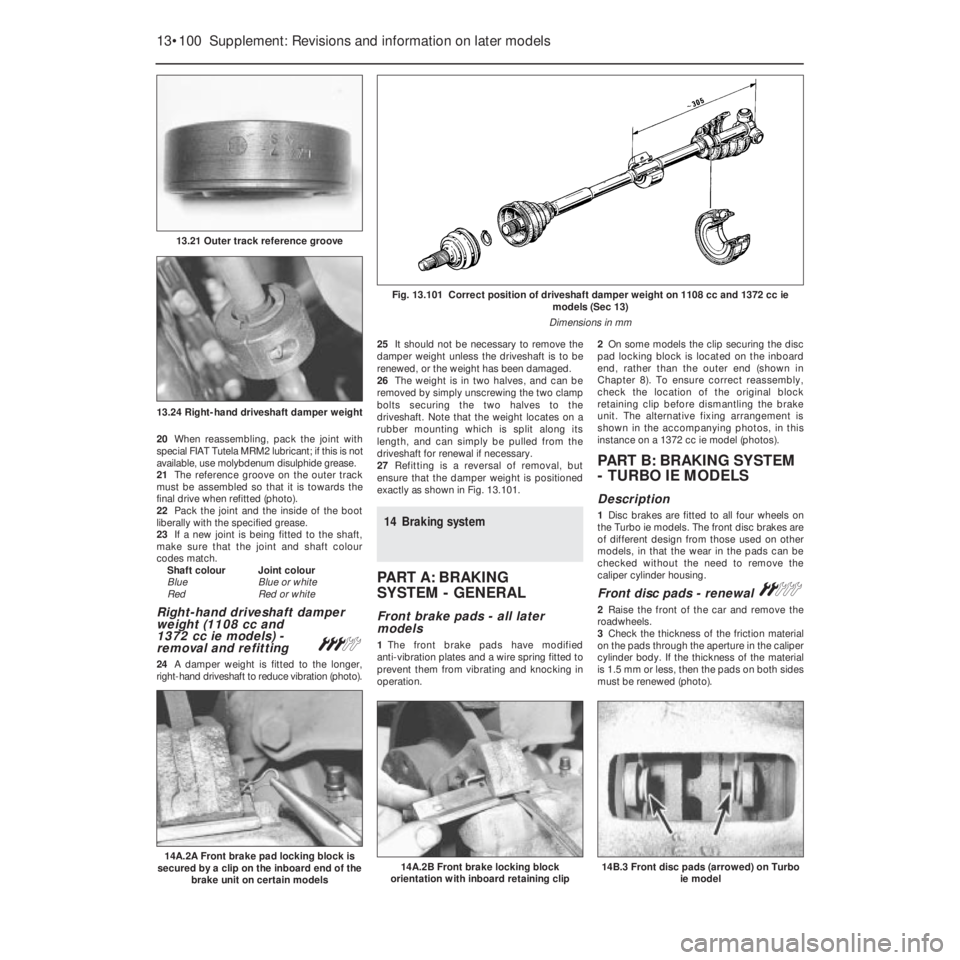
Page 215 of 303
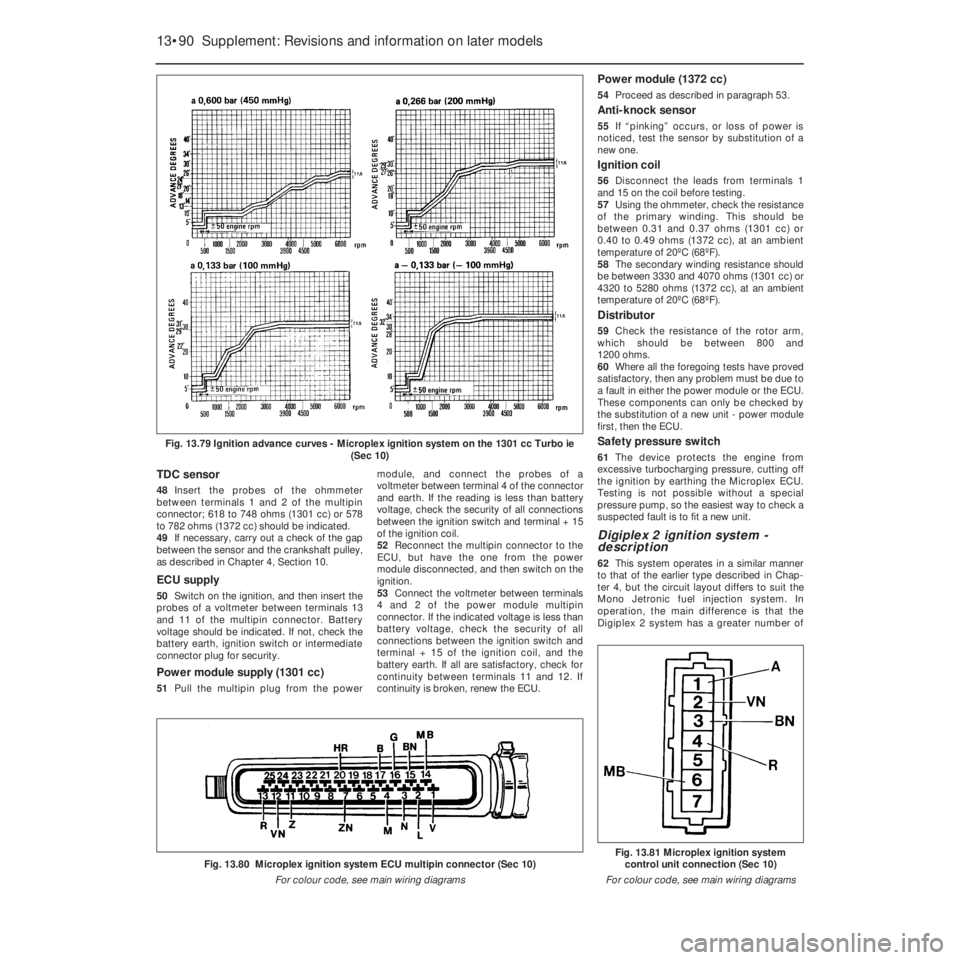
TDC sensor
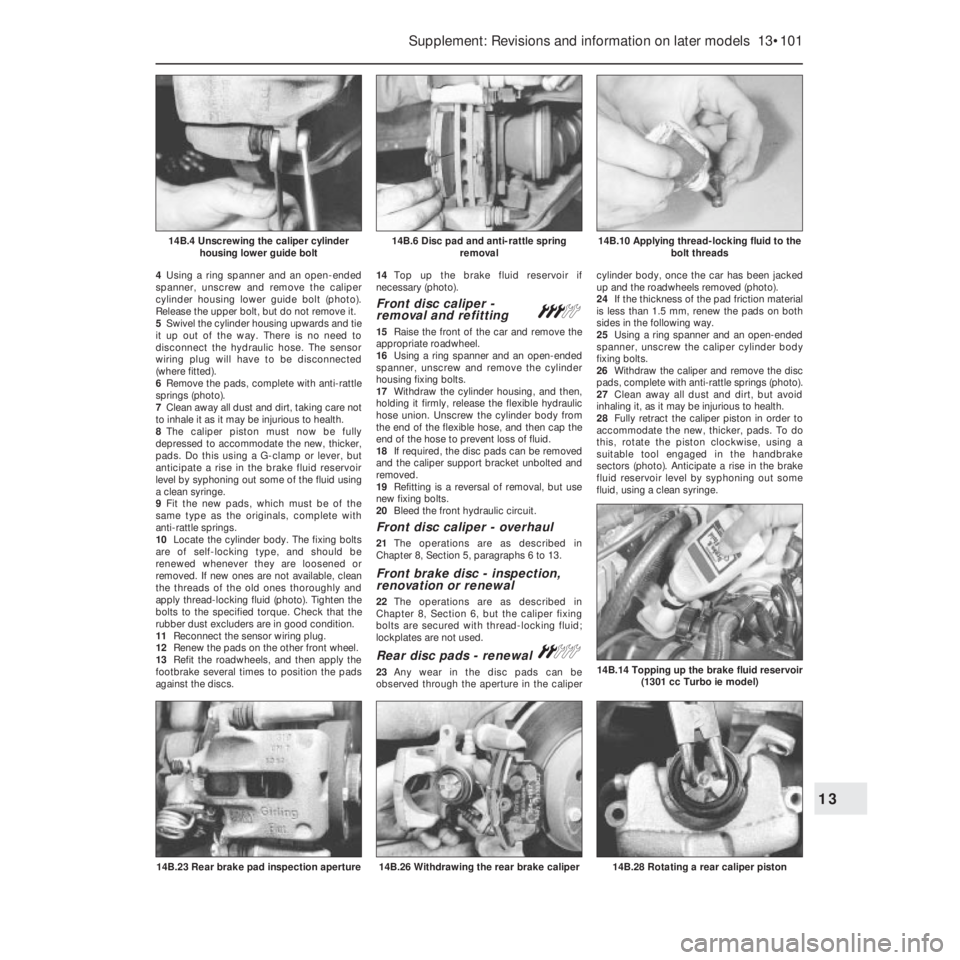
48Insert the probes of the ohmmeter
between terminals 1 and 2 of the multipin
connector; 618 to 748 ohms (1301 cc) or 578
to 782 ohms (1372 cc) should be indicated.
49If necessary, carry out a check of the gap
between the sensor and the crankshaft pulley,
as described in Chapter 4, Section 10.
ECU supply
50Switch on the ignition, and then insert the
probes of a voltmeter between terminals 13
and 11 of the multipin connector. Battery
voltage should be indicated. If not, check the
battery earth, ignition switch or intermediate
connector plug for security.
Power module supply (1301 cc)
51Pull the multipin plug from the powermodule, and connect the probes of a
voltmeter between terminal 4 of the connector
and earth. If the reading is less than battery
voltage, check the security of all connections
between the ignition switch and terminal + 15
of the ignition coil.
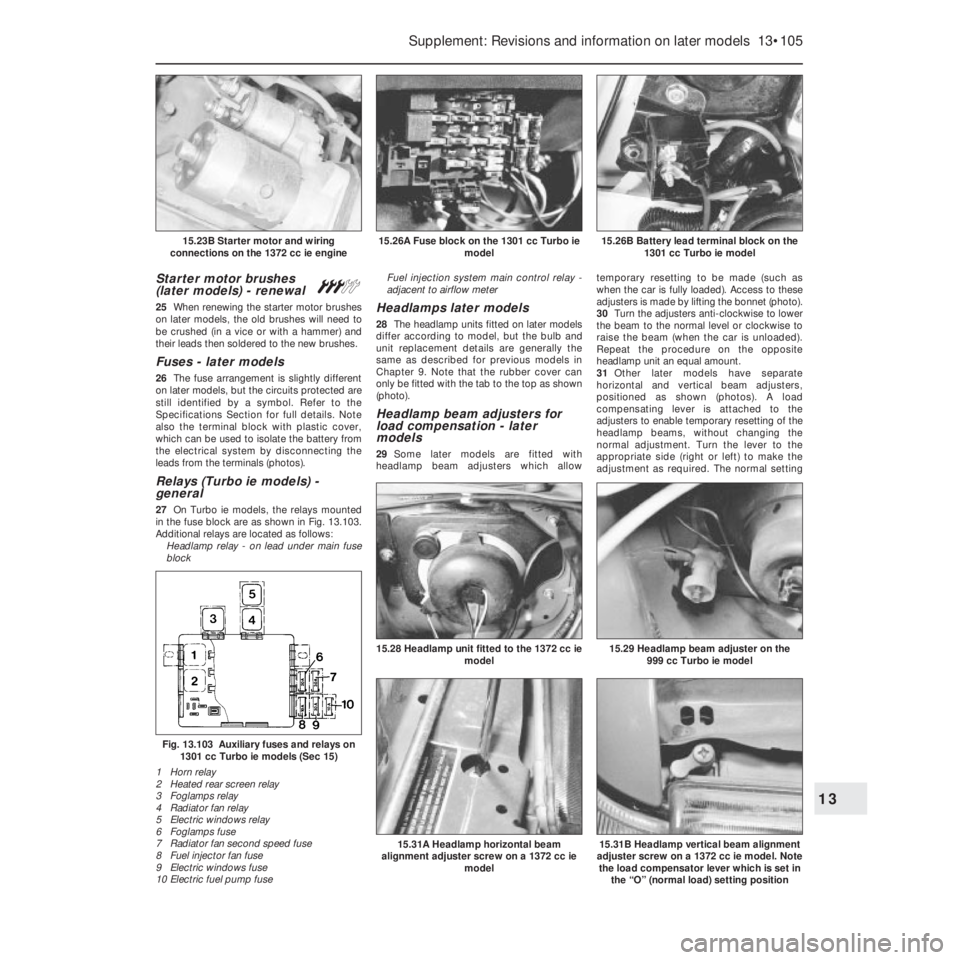
52Reconnect the multipin connector to the
ECU, but have the one from the power
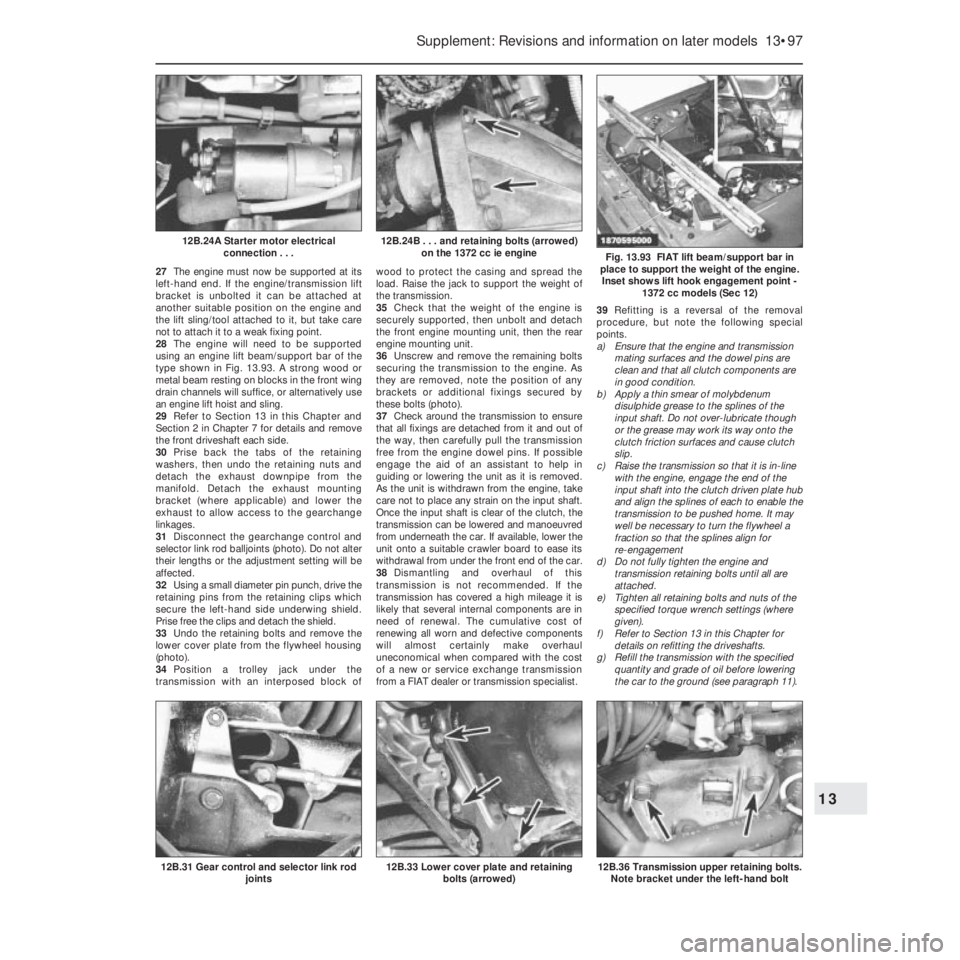
module disconnected, and then switch on the
ignition.
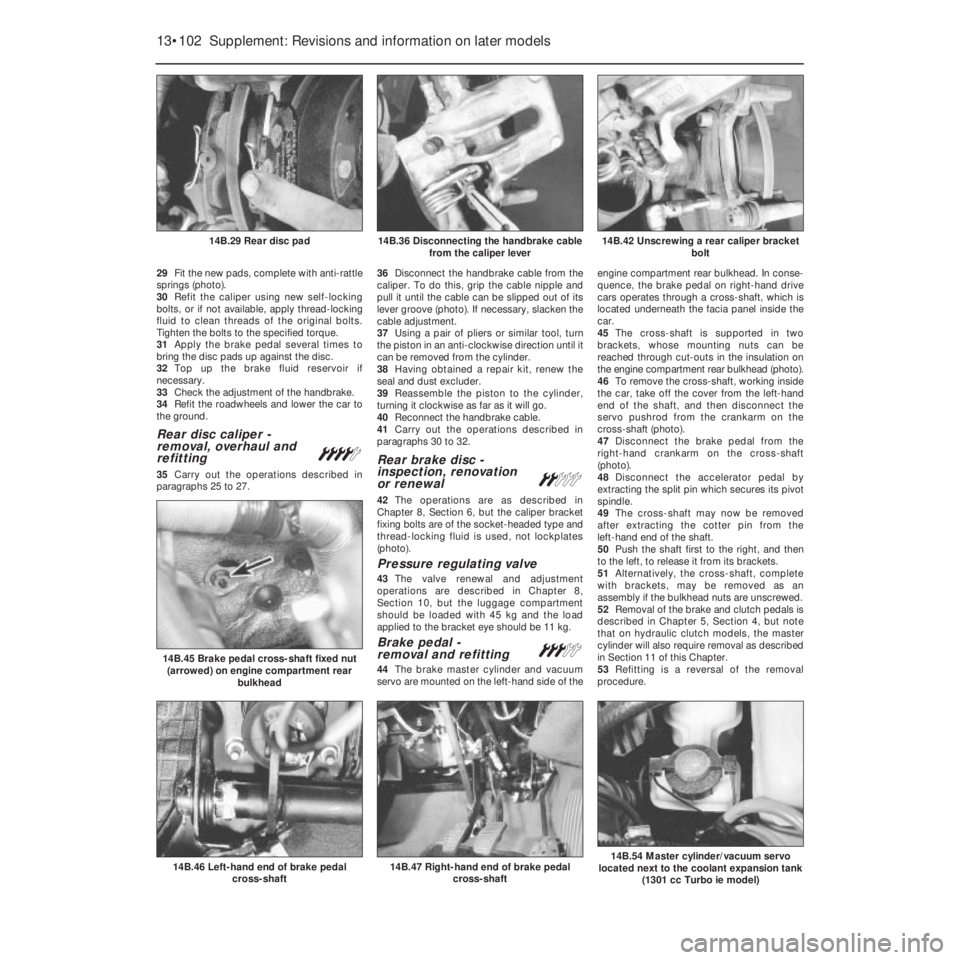
53Connect the voltmeter between terminals
4 and 2 of the power module multipin
connector. If the indicated voltage is less than
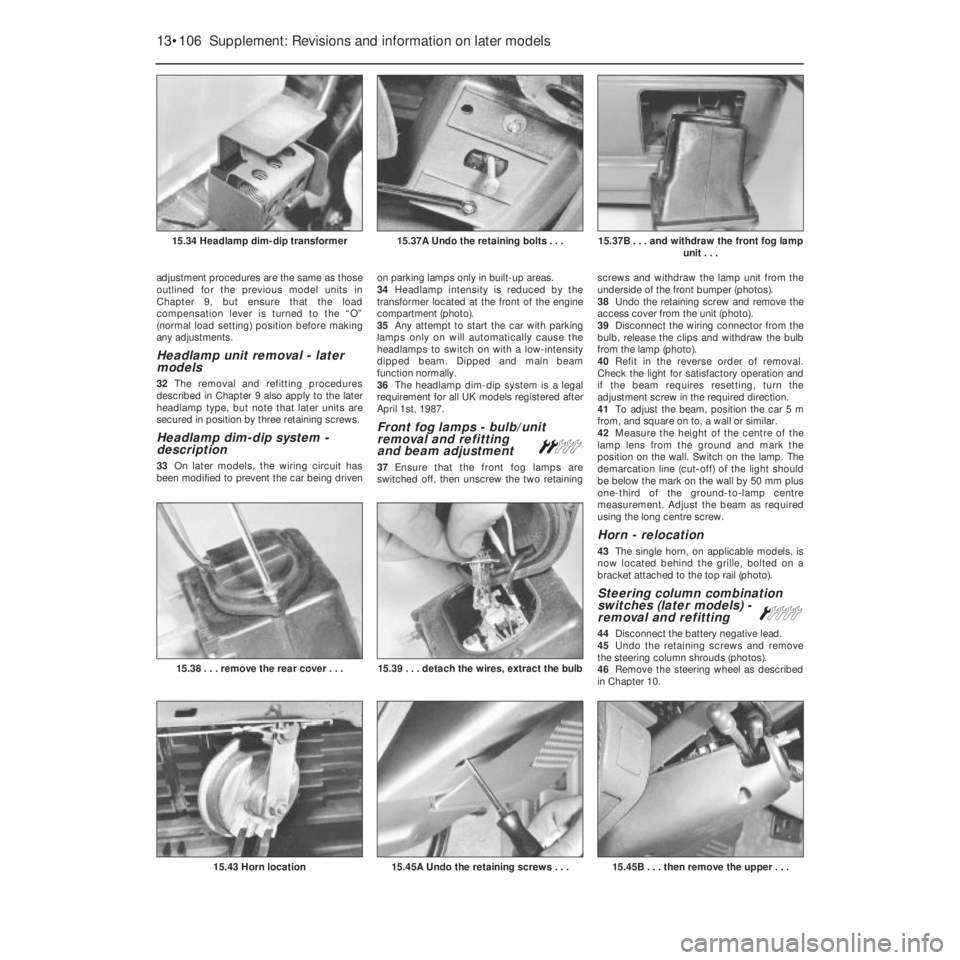
battery voltage, check the security of all
connections between the ignition switch and
terminal + 15 of the ignition coil, and the
battery earth. If all are satisfactory, check for
continuity between terminals 11 and 12. If
continuity is broken, renew the ECU.
Power module (1372 cc)
54Proceed as described in paragraph 53.
Anti-knock sensor
55If “pinking” occurs, or loss of power is
noticed, test the sensor by substitution of a
new one.
Ignition coil
56Disconnect the leads from terminals 1
and 15 on the coil before testing.
57Using the ohmmeter, check the resistance
of the primary winding. This should be
between 0.31 and 0.37 ohms (1301 cc) or
0.40 to 0.49 ohms (1372 cc), at an ambient
temperature of 20ºC (68ºF).
58The secondary winding resistance should
be between 3330 and 4070 ohms (1301 cc) or
4320 to 5280 ohms (1372 cc), at an ambient
temperature of 20ºC (68ºF).
Distributor
59Check the resistance of the rotor arm,
which should be between 800 and
1200 ohms.
60Where all the foregoing tests have proved
satisfactory, then any problem must be due to
a fault in either the power module or the ECU.
These components can only be checked by
the substitution of a new unit - power module
first, then the ECU.
Safety pressure switch
61The device protects the engine from
excessive turbocharging pressure, cutting off
the ignition by earthing the Microplex ECU.
Testing is not possible without a special
pressure pump, so the easiest way to check a
suspected fault is to fit a new unit.
Digiplex 2 ignition system -
description
62This system operates in a similar manner
to that of the earlier type described in Chap-
ter 4, but the circuit layout differs to suit the
Mono Jetronic fuel injection system. In
operation, the main difference is that the
Digiplex 2 system has a greater number of
13•90 Supplement: Revisions and information on later models
Fig. 13.81 Microplex ignition system
control unit connection (Sec 10)
For colour code, see main wiring diagramsFig. 13.80 Microplex ignition system ECU multipin connector (Sec 10)
For colour code, see main wiring diagrams
Fig. 13.79 Ignition advance curves - Microplex ignition system on the 1301 cc Turbo ie
(Sec 10)
Page 216 of 303
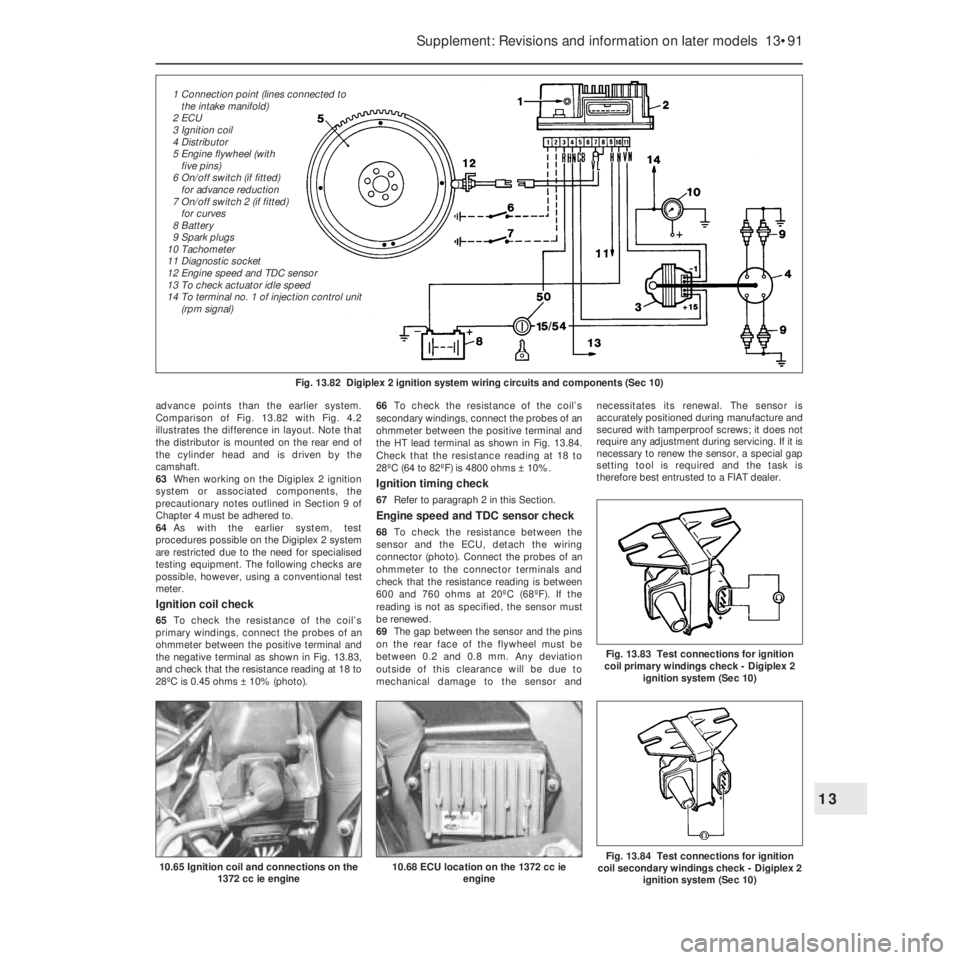
advance points than the earlier system.
Comparison of Fig. 13.82 with Fig. 4.2
illustrates the difference in layout. Note that
the distributor is mounted on the rear end of
the cylinder head and is driven by the
camshaft.
63When working on the Digiplex 2 ignition
system or associated components, the
precautionary notes outlined in Section 9 of
Chapter 4 must be adhered to.
64As with the earlier system, test
procedures possible on the Digiplex 2 system
are restricted due to the need for specialised
testing equipment. The following checks are
possible, however, using a conventional test
meter.
Ignition coil check
65To check the resistance of the coil’s
primary windings, connect the probes of an
ohmmeter between the positive terminal and
the negative terminal as shown in Fig. 13.83,
and check that the resistance reading at 18 to
28ºC is 0.45 ohms ± 10% (photo).66To check the resistance of the coil’s
secondary windings, connect the probes of an
ohmmeter between the positive terminal and
the HT lead terminal as shown in Fig. 13.84.
Check that the resistance reading at 18 to
28ºC (64 to 82ºF) is 4800 ohms ± 10%.
Ignition timing check
67Refer to paragraph 2 in this Section.
Engine speed and TDC sensor check
68To check the resistance between the
sensor and the ECU, detach the wiring
connector (photo). Connect the probes of an
ohmmeter to the connector terminals and
check that the resistance reading is between
600 and 760 ohms at 20ºC (68ºF). If the
reading is not as specified, the sensor must
be renewed.
69The gap between the sensor and the pins
on the rear face of the flywheel must be
between 0.2 and 0.8 mm. Any deviation
outside of this clearance will be due to
mechanical damage to the sensor andnecessitates its renewal. The sensor is
accurately positioned during manufacture and
secured with tamperproof screws; it does not
require any adjustment during servicing. If it is
necessary to renew the sensor, a special gap
setting tool is required and the task is
therefore best entrusted to a FIAT dealer.
Supplement: Revisions and information on later models 13•91
Fig. 13.82 Digiplex 2 ignition system wiring circuits and components (Sec 10)
10.68 ECU location on the 1372 cc ie
engine10.65 Ignition coil and connections on the
1372 cc ie engineFig. 13.84 Test connections for ignition
coil secondary windings check - Digiplex 2
ignition system (Sec 10)
Fig. 13.83 Test connections for ignition
coil primary windings check - Digiplex 2
ignition system (Sec 10)
13
1 Connection point (lines connected to
the intake manifold)
2 ECU
3 Ignition coil
4 Distributor
5 Engine flywheel (with
five pins)
6 On/off switch (if fitted)
for advance reduction
7 On/off switch 2 (if fitted)
for curves
8 Battery
9 Spark plugs
10 Tachometer
11 Diagnostic socket
12 Engine speed and TDC sensor
13 To check actuator idle speed
14 To terminal no. 1 of injection control unit
(rpm signal)
Page 219 of 303
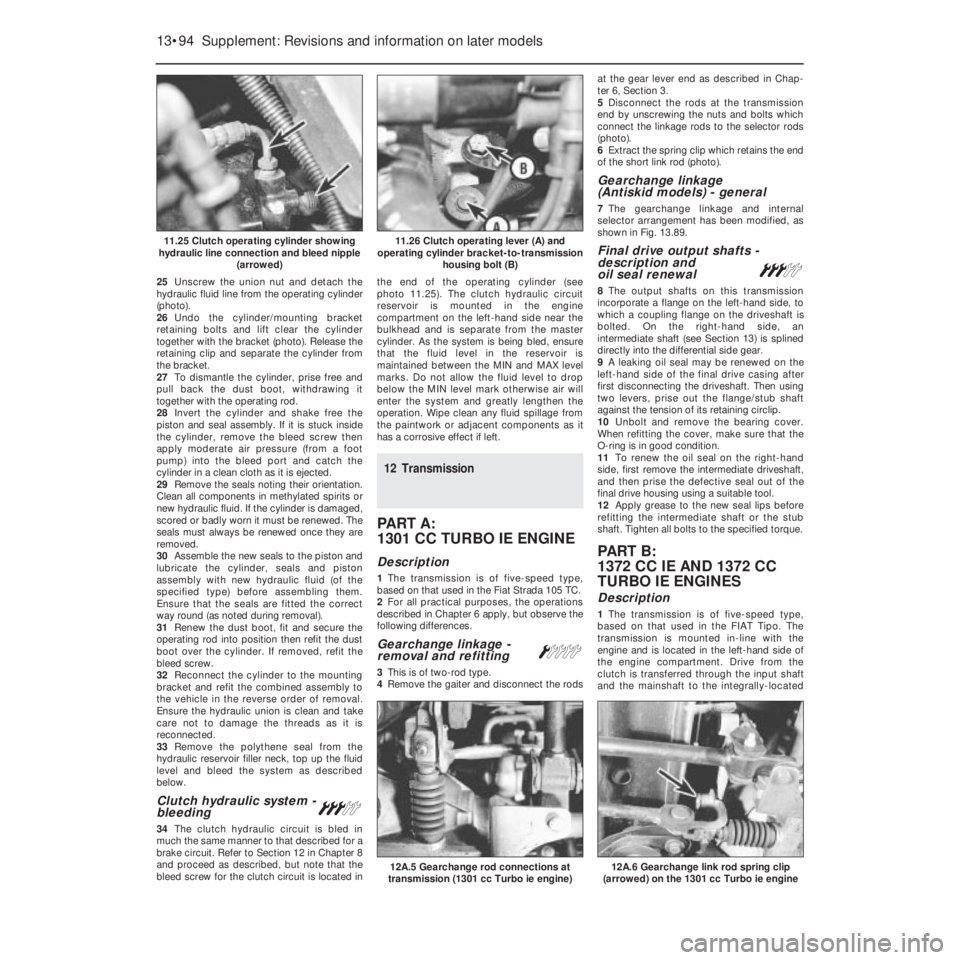
25Unscrew the union nut and detach the
hydraulic fluid line from the operating cylinder
(photo).
26Undo the cylinder/mounting bracket
retaining bolts and lift clear the cylinder
together with the bracket (photo). Release the
retaining clip and separate the cylinder from
the bracket.
27To dismantle the cylinder, prise free and
pull back the dust boot, withdrawing it
together with the operating rod.
28Invert the cylinder and shake free the
piston and seal assembly. If it is stuck inside
the cylinder, remove the bleed screw then
apply moderate air pressure (from a foot
pump) into the bleed port and catch the
cylinder in a clean cloth as it is ejected.
29Remove the seals noting their orientation.
Clean all components in methylated spirits or
new hydraulic fluid. If the cylinder is damaged,
scored or badly worn it must be renewed. The
seals must always be renewed once they are
removed.
30Assemble the new seals to the piston and
lubricate the cylinder, seals and piston
assembly with new hydraulic fluid (of the
specified type) before assembling them.
Ensure that the seals are fitted the correct
way round (as noted during removal).
31Renew the dust boot, fit and secure the
operating rod into position then refit the dust
boot over the cylinder. If removed, refit the
bleed screw.
32Reconnect the cylinder to the mounting
bracket and refit the combined assembly to
the vehicle in the reverse order of removal.
Ensure the hydraulic union is clean and take
care not to damage the threads as it is
reconnected.
33Remove the polythene seal from the
hydraulic reservoir filler neck, top up the fluid
level and bleed the system as described
below.
Clutch hydraulic system -
bleeding#
34The clutch hydraulic circuit is bled in
much the same manner to that described for a
brake circuit. Refer to Section 12 in Chapter 8
and proceed as described, but note that the
bleed screw for the clutch circuit is located inthe end of the operating cylinder (see
photo 11.25). The clutch hydraulic circuit
reservoir is mounted in the engine
compartment on the left-hand side near the
bulkhead and is separate from the master
cylinder. As the system is being bled, ensure
that the fluid level in the reservoir is
maintained between the MIN and MAX level
marks. Do not allow the fluid level to drop
below the MIN level mark otherwise air will
enter the system and greatly lengthen the
operation. Wipe clean any fluid spillage from
the paintwork or adjacent components as it
has a corrosive effect if left.
12 Transmission
PART A:
1301 CC TURBO IE ENGINE
Description
1The transmission is of five-speed type,
based on that used in the Fiat Strada 105 TC.
2For all practical purposes, the operations
described in Chapter 6 apply, but observe the
following differences.
Gearchange linkage -
removal and refitting Á
3This is of two-rod type.
4Remove the gaiter and disconnect the rodsat the gear lever end as described in Chap-
ter 6, Section 3.
5Disconnect the rods at the transmission
end by unscrewing the nuts and bolts which
connect the linkage rods to the selector rods
(photo).
6Extract the spring clip which retains the end
of the short link rod (photo).
Gearchange linkage
(Antiskid models) - general
7The gearchange linkage and internal
selector arrangement has been modified, as
shown in Fig. 13.89.
Final drive output shafts -
description and
oil seal renewal
#
8The output shafts on this transmission
incorporate a flange on the left-hand side, to
which a coupling flange on the driveshaft is
bolted. On the right-hand side, an
intermediate shaft (see Section 13) is splined
directly into the differential side gear.
9A leaking oil seal may be renewed on the
left-hand side of the final drive casing after
first disconnecting the driveshaft. Then using
two levers, prise out the flange/stub shaft
against the tension of its retaining circlip.
10Unbolt and remove the bearing cover.
When refitting the cover, make sure that the
O-ring is in good condition.
11To renew the oil seal on the right-hand
side, first remove the intermediate driveshaft,
and then prise the defective seal out of the
final drive housing using a suitable tool.
12Apply grease to the new seal lips before
refitting the intermediate shaft or the stub
shaft. Tighten all bolts to the specified torque.
PART B:
1372 CC IE AND 1372 CC
TURBO IE ENGINES
Description
1The transmission is of five-speed type,
based on that used in the FIAT Tipo. The
transmission is mounted in-line with the
engine and is located in the left-hand side of
the engine compartment. Drive from the
clutch is transferred through the input shaft
and the mainshaft to the integrally-located
13•94 Supplement: Revisions and information on later models
12A.6 Gearchange link rod spring clip
(arrowed) on the 1301 cc Turbo ie engine12A.5 Gearchange rod connections at
transmission (1301 cc Turbo ie engine)
11.26 Clutch operating lever (A) and
operating cylinder bracket-to-transmission
housing bolt (B)11.25 Clutch operating cylinder showing
hydraulic line connection and bleed nipple
(arrowed)
Page 221 of 303
require maintenance other than general
inspection for wear in the linkage joints. If
excessive wear is found in any of the joints, they
can be individually detached and renewed.
13Access to the control rods is eased by
detaching and lowering the exhaust system
from the exhaust manifold.
14If a new adjustable control rod is to be
fitted, remove the original rod as a unit, but do
not alter its adjustment for length. The new
rod can then (if required) be set to the same
length as the original in order to maintain the
original setting. Do so by loosening off the
locknut and turning the balljoint as required;
ensure that the angle of the joint is correct
before tightening the locknut.
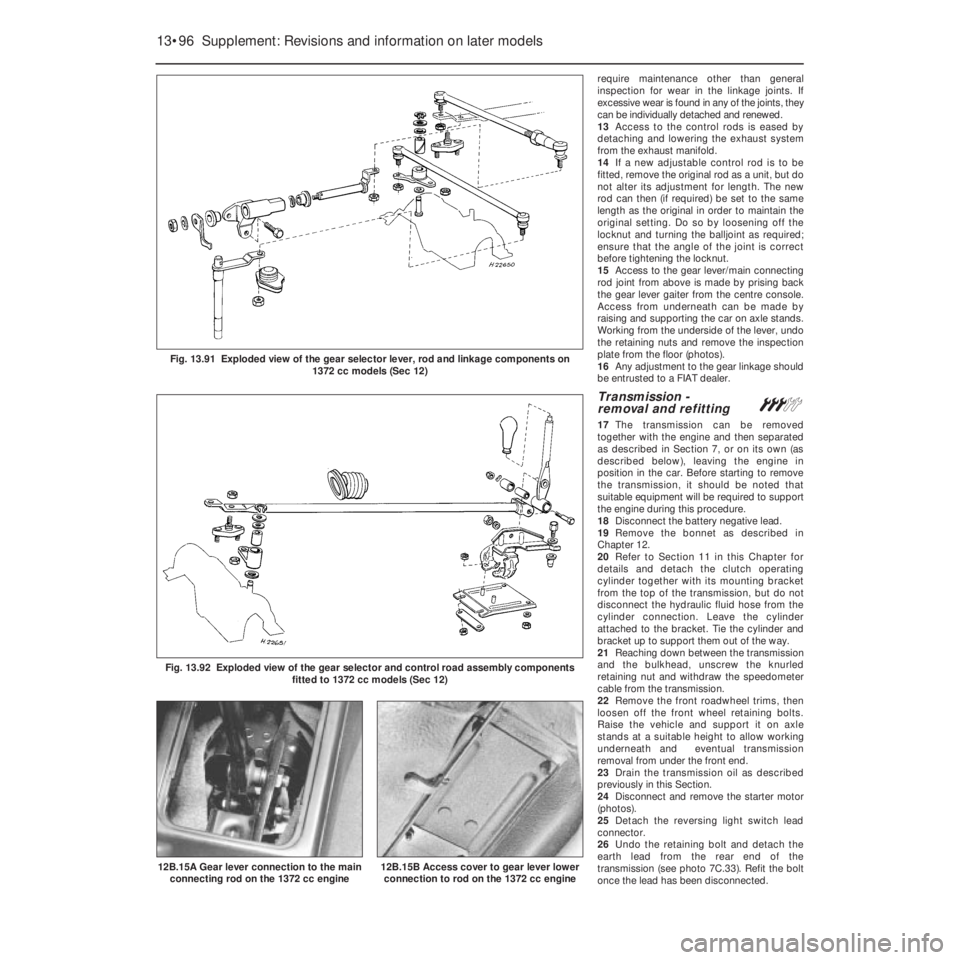
15Access to the gear lever/main connecting
rod joint from above is made by prising back
the gear lever gaiter from the centre console.
Access from underneath can be made by
raising and supporting the car on axle stands.
Working from the underside of the lever, undo
the retaining nuts and remove the inspection
plate from the floor (photos).
16Any adjustment to the gear linkage should
be entrusted to a FIAT dealer.
Transmission -
removal and refitting#
17The transmission can be removed
together with the engine and then separated
as described in Section 7, or on its own (as
described below), leaving the engine in
position in the car. Before starting to remove
the transmission, it should be noted that
suitable equipment will be required to support
the engine during this procedure.
18Disconnect the battery negative lead.
19Remove the bonnet as described in
Chapter 12.
20Refer to Section 11 in this Chapter for
details and detach the clutch operating
cylinder together with its mounting bracket
from the top of the transmission, but do not
disconnect the hydraulic fluid hose from the
cylinder connection. Leave the cylinder
attached to the bracket. Tie the cylinder and
bracket up to support them out of the way.
21Reaching down between the transmission
and the bulkhead, unscrew the knurled
retaining nut and withdraw the speedometer
cable from the transmission.
22Remove the front roadwheel trims, then
loosen off the front wheel retaining bolts.
Raise the vehicle and support it on axle
stands at a suitable height to allow working
underneath and eventual transmission
removal from under the front end.
23Drain the transmission oil as described
previously in this Section.
24Disconnect and remove the starter motor
(photos).
25Detach the reversing light switch lead
connector.
26Undo the retaining bolt and detach the
earth lead from the rear end of the
transmission (see photo 7C.33). Refit the bolt
once the lead has been disconnected.
13•96 Supplement: Revisions and information on later models
12B.15B Access cover to gear lever lower
connection to rod on the 1372 cc engine
Fig. 13.92 Exploded view of the gear selector and control road assembly components
fitted to 1372 cc models (Sec 12)
12B.15A Gear lever connection to the main
connecting rod on the 1372 cc engine
Fig. 13.91 Exploded view of the gear selector lever, rod and linkage components on
1372 cc models (Sec 12)
Page 222 of 303
27The engine must now be supported at its
left-hand end. If the engine/transmission lift
bracket is unbolted it can be attached at
another suitable position on the engine and
the lift sling/tool attached to it, but take care
not to attach it to a weak fixing point.
28The engine will need to be supported
using an engine lift beam/support bar of the
type shown in Fig. 13.93. A strong wood or
metal beam resting on blocks in the front wing
drain channels will suffice, or alternatively use
an engine lift hoist and sling.
29Refer to Section 13 in this Chapter and
Section 2 in Chapter 7 for details and remove
the front driveshaft each side.
30Prise back the tabs of the retaining
washers, then undo the retaining nuts and
detach the exhaust downpipe from the
manifold. Detach the exhaust mounting
bracket (where applicable) and lower the
exhaust to allow access to the gearchange
linkages.
31Disconnect the gearchange control and
selector link rod balljoints (photo). Do not alter
their lengths or the adjustment setting will be
affected.
32Using a small diameter pin punch, drive the
retaining pins from the retaining clips which
secure the left-hand side underwing shield.
Prise free the clips and detach the shield.
33Undo the retaining bolts and remove the
lower cover plate from the flywheel housing
(photo).
34Position a trolley jack under the
transmission with an interposed block ofwood to protect the casing and spread the
load. Raise the jack to support the weight of
the transmission.
35Check that the weight of the engine is
securely supported, then unbolt and detach
the front engine mounting unit, then the rear
engine mounting unit.
36Unscrew and remove the remaining bolts
securing the transmission to the engine. As
they are removed, note the position of any
brackets or additional fixings secured by
these bolts (photo).
37Check around the transmission to ensure
that all fixings are detached from it and out of
the way, then carefully pull the transmission
free from the engine dowel pins. If possible
engage the aid of an assistant to help in
guiding or lowering the unit as it is removed.
As the unit is withdrawn from the engine, take
care not to place any strain on the input shaft.
Once the input shaft is clear of the clutch, the
transmission can be lowered and manoeuvred
from underneath the car. If available, lower the
unit onto a suitable crawler board to ease its
withdrawal from under the front end of the car.
38Dismantling and overhaul of this
transmission is not recommended. If the
transmission has covered a high mileage it is
likely that several internal components are in
need of renewal. The cumulative cost of
renewing all worn and defective components
will almost certainly make overhaul
uneconomical when compared with the cost
of a new or service exchange transmission
from a FIAT dealer or transmission specialist.39Refitting is a reversal of the removal
procedure, but note the following special
points.
a) Ensure that the engine and transmission
mating surfaces and the dowel pins are
clean and that all clutch components are
in good condition.
b) Apply a thin smear of molybdenum
disulphide grease to the splines of the
input shaft. Do not over-lubricate though
or the grease may work its way onto the
clutch friction surfaces and cause clutch
slip.
c) Raise the transmission so that it is in-line
with the engine, engage the end of the
input shaft into the clutch driven plate hub
and align the splines of each to enable the
transmission to be pushed home. It may
well be necessary to turn the flywheel a
fraction so that the splines align for
re-engagement
d) Do not fully tighten the engine and
transmission retaining bolts until all are
attached.
e) Tighten all retaining bolts and nuts of the
specified torque wrench settings (where
given).
f) Refer to Section 13 in this Chapter for
details on refitting the driveshafts.
g) Refill the transmission with the specified
quantity and grade of oil before lowering
the car to the ground (see paragraph 11).
Supplement: Revisions and information on later models 13•97
Fig. 13.93 FIAT lift beam/support bar in
place to support the weight of the engine.
Inset shows lift hook engagement point -
1372 cc models (Sec 12)
12B.24B . . . and retaining bolts (arrowed)
on the 1372 cc ie engine12B.24A Starter motor electrical
connection . . .
12B.36 Transmission upper retaining bolts.
Note bracket under the left-hand bolt12B.33 Lower cover plate and retaining
bolts (arrowed)12B.31 Gear control and selector link rod
joints
13
Page 225 of 303
20When reassembling, pack the joint with
special FIAT Tutela MRM2 lubricant; if this is not
available, use molybdenum disulphide grease.
21The reference groove on the outer track
must be assembled so that it is towards the
final drive when refitted (photo).
22Pack the joint and the inside of the boot
liberally with the specified grease.
23If a new joint is being fitted to the shaft,
make sure that the joint and shaft colour
codes match.
Shaft colour Joint colour
Blue Blue or white
Red Red or white
Right-hand driveshaft damper
weight (1108 cc and
1372 cc ie models) -
removal and refitting
#
24A damper weight is fitted to the longer,
right-hand driveshaft to reduce vibration (photo).25It should not be necessary to remove the
damper weight unless the driveshaft is to be
renewed, or the weight has been damaged.
26The weight is in two halves, and can be
removed by simply unscrewing the two clamp
bolts securing the two halves to the
driveshaft. Note that the weight locates on a
rubber mounting which is split along its
length, and can simply be pulled from the
driveshaft for renewal if necessary.
27Refitting is a reversal of removal, but
ensure that the damper weight is positioned
exactly as shown in Fig. 13.101.
14 Braking system
PART A: BRAKING
SYSTEM - GENERAL
Front brake pads - all later
models
1The front brake pads have modified
anti-vibration plates and a wire spring fitted to
prevent them from vibrating and knocking in
operation. 2On some models the clip securing the disc
pad locking block is located on the inboard
end, rather than the outer end (shown in
Chapter 8). To ensure correct reassembly,
check the location of the original block
retaining clip before dismantling the brake
unit. The alternative fixing arrangement is
shown in the accompanying photos, in this
instance on a 1372 cc ie model (photos).
PART B: BRAKING SYSTEM
- TURBO IE MODELS
Description
1Disc brakes are fitted to all four wheels on
the Turbo ie models. The front disc brakes are
of different design from those used on other
models, in that the wear in the pads can be
checked without the need to remove the
caliper cylinder housing.
Front disc pads - renewalª
2Raise the front of the car and remove the
roadwheels.
3Check the thickness of the friction material
on the pads through the aperture in the caliper
cylinder body. If the thickness of the material
is 1.5 mm or less, then the pads on both sides
must be renewed (photo).
13•100 Supplement: Revisions and information on later models
14B.3 Front disc pads (arrowed) on Turbo
ie model14A.2B Front brake locking block
orientation with inboard retaining clip14A.2A Front brake pad locking block is
secured by a clip on the inboard end of the
brake unit on certain models
Fig. 13.101 Correct position of driveshaft damper weight on 1108 cc and 1372 cc ie
models (Sec 13)
Dimensions in mm
13.24 Right-hand driveshaft damper weight
13.21 Outer track reference groove
Page 226 of 303
4Using a ring spanner and an open-ended
spanner, unscrew and remove the caliper
cylinder housing lower guide bolt (photo).
Release the upper bolt, but do not remove it.
5Swivel the cylinder housing upwards and tie
it up out of the way. There is no need to
disconnect the hydraulic hose. The sensor
wiring plug will have to be disconnected
(where fitted).
6Remove the pads, complete with anti-rattle
springs (photo).
7Clean away all dust and dirt, taking care not
to inhale it as it may be injurious to health.
8The caliper piston must now be fully
depressed to accommodate the new, thicker,
pads. Do this using a G-clamp or lever, but
anticipate a rise in the brake fluid reservoir
level by syphoning out some of the fluid using
a clean syringe.
9Fit the new pads, which must be of the
same type as the originals, complete with
anti-rattle springs.
10Locate the cylinder body. The fixing bolts
are of self-locking type, and should be
renewed whenever they are loosened or
removed. If new ones are not available, clean
the threads of the old ones thoroughly and
apply thread-locking fluid (photo). Tighten the
bolts to the specified torque. Check that the
rubber dust excluders are in good condition.
11Reconnect the sensor wiring plug.
12Renew the pads on the other front wheel.
13Refit the roadwheels, and then apply the
footbrake several times to position the pads
against the discs.14Top up the brake fluid reservoir if
necessary (photo).
Front disc caliper -
removal and refitting#
15Raise the front of the car and remove the
appropriate roadwheel.
16Using a ring spanner and an open-ended
spanner, unscrew and remove the cylinder
housing fixing bolts.
17Withdraw the cylinder housing, and then,
holding it firmly, release the flexible hydraulic
hose union. Unscrew the cylinder body from
the end of the flexible hose, and then cap the
end of the hose to prevent loss of fluid.
18If required, the disc pads can be removed
and the caliper support bracket unbolted and
removed.
19Refitting is a reversal of removal, but use
new fixing bolts.
20Bleed the front hydraulic circuit.
Front disc caliper - overhaul
21The operations are as described in
Chapter 8, Section 5, paragraphs 6 to 13.
Front brake disc - inspection,
renovation or renewal
22The operations are as described in
Chapter 8, Section 6, but the caliper fixing
bolts are secured with thread-locking fluid;
lockplates are not used.
Rear disc pads - renewal ª
23Any wear in the disc pads can be
observed through the aperture in the calipercylinder body, once the car has been jacked
up and the roadwheels removed (photo).
24If the thickness of the pad friction material
is less than 1.5 mm, renew the pads on both
sides in the following way.
25Using a ring spanner and an open-ended
spanner, unscrew the caliper cylinder body
fixing bolts.
26Withdraw the caliper and remove the disc
pads, complete with anti-rattle springs (photo).
27Clean away all dust and dirt, but avoid
inhaling it, as it may be injurious to health.
28Fully retract the caliper piston in order to
accommodate the new, thicker, pads. To do
this, rotate the piston clockwise, using a
suitable tool engaged in the handbrake
sectors (photo). Anticipate a rise in the brake
fluid reservoir level by syphoning out some
fluid, using a clean syringe.
Supplement: Revisions and information on later models 13•101
14B.10 Applying thread-locking fluid to the
bolt threads14B.6 Disc pad and anti-rattle spring
removal14B.4 Unscrewing the caliper cylinder
housing lower guide bolt
14B.28 Rotating a rear caliper piston14B.26 Withdrawing the rear brake caliper14B.23 Rear brake pad inspection aperture
14B.14 Topping up the brake fluid reservoir
(1301 cc Turbo ie model)
13
Page 227 of 303
14B.54 Master cylinder/vacuum servo
located next to the coolant expansion tank
(1301 cc Turbo ie model)
29Fit the new pads, complete with anti-rattle
springs (photo).
30Refit the caliper using new self-locking
bolts, or if not available, apply thread-locking
fluid to clean threads of the original bolts.
Tighten the bolts to the specified torque.
31Apply the brake pedal several times to
bring the disc pads up against the disc.
32Top up the brake fluid reservoir if
necessary.
33Check the adjustment of the handbrake.
34Refit the roadwheels and lower the car to
the ground.
Rear disc caliper -
removal, overhaul and
refitting
¢
35Carry out the operations described in
paragraphs 25 to 27.36Disconnect the handbrake cable from the
caliper. To do this, grip the cable nipple and
pull it until the cable can be slipped out of its
lever groove (photo). If necessary, slacken the
cable adjustment.
37Using a pair of pliers or similar tool, turn
the piston in an anti-clockwise direction until it
can be removed from the cylinder.
38Having obtained a repair kit, renew the
seal and dust excluder.
39Reassemble the piston to the cylinder,
turning it clockwise as far as it will go.
40Reconnect the handbrake cable.
41Carry out the operations described in
paragraphs 30 to 32.
Rear brake disc -
inspection, renovation
or renewal
ª
42The operations are as described in
Chapter 8, Section 6, but the caliper bracket
fixing bolts are of the socket-headed type and
thread-locking fluid is used, not lockplates
(photo).
Pressure regulating valve
43The valve renewal and adjustment
operations are described in Chapter 8,
Section 10, but the luggage compartment
should be loaded with 45 kg and the load
applied to the bracket eye should be 11 kg.
Brake pedal -
removal and refitting#
44The brake master cylinder and vacuum
servo are mounted on the left-hand side of theengine compartment rear bulkhead. In conse-
quence, the brake pedal on right-hand drive
cars operates through a cross-shaft, which is
located underneath the facia panel inside the
car.
45The cross-shaft is supported in two
brackets, whose mounting nuts can be
reached through cut-outs in the insulation on
the engine compartment rear bulkhead (photo).
46To remove the cross-shaft, working inside
the car, take off the cover from the left-hand
end of the shaft, and then disconnect the
servo pushrod from the crankarm on the
cross-shaft (photo).
47Disconnect the brake pedal from the
right-hand crankarm on the cross-shaft
(photo).
48Disconnect the accelerator pedal by
extracting the split pin which secures its pivot
spindle.
49The cross-shaft may now be removed
after extracting the cotter pin from the
left-hand end of the shaft.
50Push the shaft first to the right, and then
to the left, to release it from its brackets.
51Alternatively, the cross-shaft, complete
with brackets, may be removed as an
assembly if the bulkhead nuts are unscrewed.
52Removal of the brake and clutch pedals is
described in Chapter 5, Section 4, but note
that on hydraulic clutch models, the master
cylinder will also require removal as described
in Section 11 of this Chapter.
53Refitting is a reversal of the removal
procedure.
13•102 Supplement: Revisions and information on later models
14B.47 Right-hand end of brake pedal
cross-shaft14B.46 Left-hand end of brake pedal
cross-shaft
14B.45 Brake pedal cross-shaft fixed nut
(arrowed) on engine compartment rear
bulkhead
14B.42 Unscrewing a rear caliper bracket
bolt14B.36 Disconnecting the handbrake cable
from the caliper lever14B.29 Rear disc pad
Page 230 of 303
Starter motor brushes
(later models) - renewal#
25When renewing the starter motor brushes
on later models, the old brushes will need to
be crushed (in a vice or with a hammer) and
their leads then soldered to the new brushes.
Fuses - later models
26The fuse arrangement is slightly different
on later models, but the circuits protected are
still identified by a symbol. Refer to the
Specifications Section for full details. Note
also the terminal block with plastic cover,
which can be used to isolate the battery from
the electrical system by disconnecting the
leads from the terminals (photos).
Relays (Turbo ie models) -
general
27On Turbo ie models, the relays mounted
in the fuse block are as shown in Fig. 13.103.
Additional relays are located as follows:
Headlamp relay - on lead under main fuse
blockFuel injection system main control relay -
adjacent to airflow meter
Headlamps later models
28The headlamp units fitted on later models
differ according to model, but the bulb and
unit replacement details are generally the
same as described for previous models in
Chapter 9. Note that the rubber cover can
only be fitted with the tab to the top as shown
(photo).
Headlamp beam adjusters for
load compensation - later
models
29Some later models are fitted with
headlamp beam adjusters which allowtemporary resetting to be made (such as
when the car is fully loaded). Access to these
adjusters is made by lifting the bonnet (photo).
30Turn the adjusters anti-clockwise to lower
the beam to the normal level or clockwise to
raise the beam (when the car is unloaded).
Repeat the procedure on the opposite
headlamp unit an equal amount.
31Other later models have separate
horizontal and vertical beam adjusters,
positioned as shown (photos). A load
compensating lever is attached to the
adjusters to enable temporary resetting of the
headlamp beams, without changing the
normal adjustment. Turn the lever to the
appropriate side (right or left) to make the
adjustment as required. The normal setting
Supplement: Revisions and information on later models 13•105
15.26B Battery lead terminal block on the
1301 cc Turbo ie model15.23B Starter motor and wiring
connections on the 1372 cc ie engine
15.31B Headlamp vertical beam alignment
adjuster screw on a 1372 cc ie model. Note
the load compensator lever which is set in
the “O” (normal load) setting position15.31A Headlamp horizontal beam
alignment adjuster screw on a 1372 cc ie
model
15.29 Headlamp beam adjuster on the
999 cc Turbo ie model15.28 Headlamp unit fitted to the 1372 cc ie
model
15.26A Fuse block on the 1301 cc Turbo ie
model
13
Fig. 13.103 Auxiliary fuses and relays on
1301 cc Turbo ie models (Sec 15)
1 Horn relay
2 Heated rear screen relay
3 Foglamps relay
4 Radiator fan relay
5 Electric windows relay
6 Foglamps fuse
7 Radiator fan second speed fuse
8 Fuel injector fan fuse
9 Electric windows fuse
10 Electric fuel pump fuse
Page 231 of 303
adjustment procedures are the same as those
outlined for the previous model units in
Chapter 9, but ensure that the load
compensation lever is turned to the “O”
(normal load setting) position before making
any adjustments.
Headlamp unit removal - later
models
32The removal and refitting procedures
described in Chapter 9 also apply to the later
headlamp type, but note that later units are
secured in position by three retaining screws.
Headlamp dim-dip system -
description
33On later models, the wiring circuit has
been modified to prevent the car being drivenon parking lamps only in built-up areas.
34Headlamp intensity is reduced by the
transformer located at the front of the engine
compartment (photo).
35Any attempt to start the car with parking
lamps only on will automatically cause the
headlamps to switch on with a low-intensity
dipped beam. Dipped and main beam
function normally.
36The headlamp dim-dip system is a legal
requirement for all UK models registered after
April 1st, 1987.
Front fog lamps - bulb/unit
removal and refitting
and beam adjustment
ª
37Ensure that the front fog lamps are
switched off, then unscrew the two retainingscrews and withdraw the lamp unit from the
underside of the front bumper (photos).
38Undo the retaining screw and remove the
access cover from the unit (photo).
39Disconnect the wiring connector from the
bulb, release the clips and withdraw the bulb
from the lamp (photo).
40Refit in the reverse order of removal.
Check the light for satisfactory operation and
if the beam requires resetting, turn the
adjustment screw in the required direction.
41To adjust the beam, position the car 5 m
from, and square on to, a wall or similar.
42Measure the height of the centre of the
lamp lens from the ground and mark the
position on the wall. Switch on the lamp. The
demarcation line (cut-off) of the light should
be below the mark on the wall by 50 mm plus
one-third of the ground-to-lamp centre
measurement. Adjust the beam as required
using the long centre screw.
Horn - relocation
43The single horn, on applicable models, is
now located behind the grille, bolted on a
bracket attached to the top rail (photo).
Steering column combination
switches (later models) -
removal and refitting
Á
44Disconnect the battery negative lead.
45Undo the retaining screws and remove
the steering column shrouds (photos).
46Remove the steering wheel as described
in Chapter 10.
13•106 Supplement: Revisions and information on later models
15.45B . . . then remove the upper . . .15.45A Undo the retaining screws . . .15.43 Horn location
15.39 . . . detach the wires, extract the bulb15.38 . . . remove the rear cover . . .
15.37B . . . and withdraw the front fog lamp
unit . . .15.37A Undo the retaining bolts . . .15.34 Headlamp dim-dip transformer