cooling FIAT UNO 1983 Service Workshop Manual
[x] Cancel search | Manufacturer: FIAT, Model Year: 1983, Model line: UNO, Model: FIAT UNO 1983Pages: 303, PDF Size: 10.36 MB
Page 205 of 303
operation twice. Also prior to making
adjustments ensure that the supplementary
air valve pipe is in good condition, with no
leaks. Compress the air valve pipe using a
pair of grips to prevent incorrect adjustment
caused by a defective supplementary air
valve.
15The air cleaner must be connected when
checking and/or adjusting the engine idle
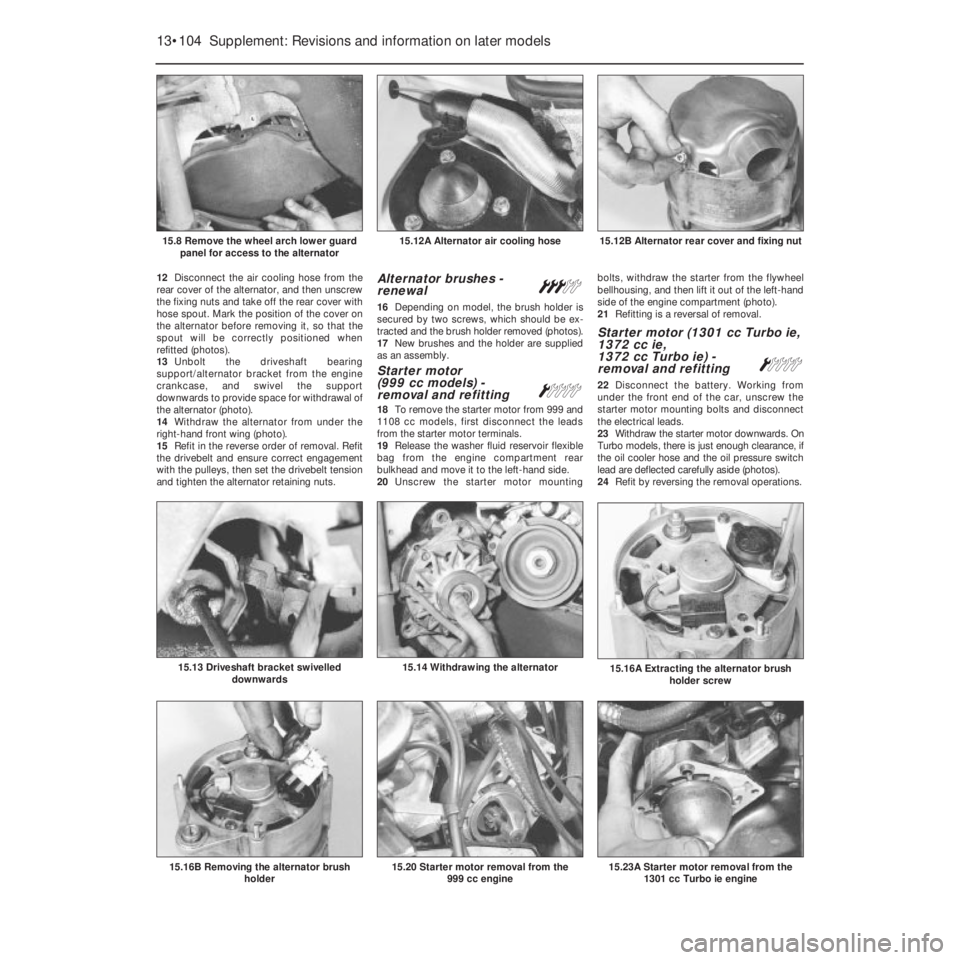
speed. To adjust, turn the adjuster screw in
the required direction to set the engine idle
speed to that specified.
16It is unlikely that the mixture will require
adjustment and unless this is proven by
measuring the exhaust gases using a CO
content analyser, its setting should not be
altered. As with idle speed adjustment, the
engine must be at its normal operating
temperature when making this check and
adjustment. It is also necessary to ensure that
the ignition idle advance is as specified.
Checking and adjustment must not be made
with the engine cooling fan, air conditioning
(where fitted) or other related items switched
on.
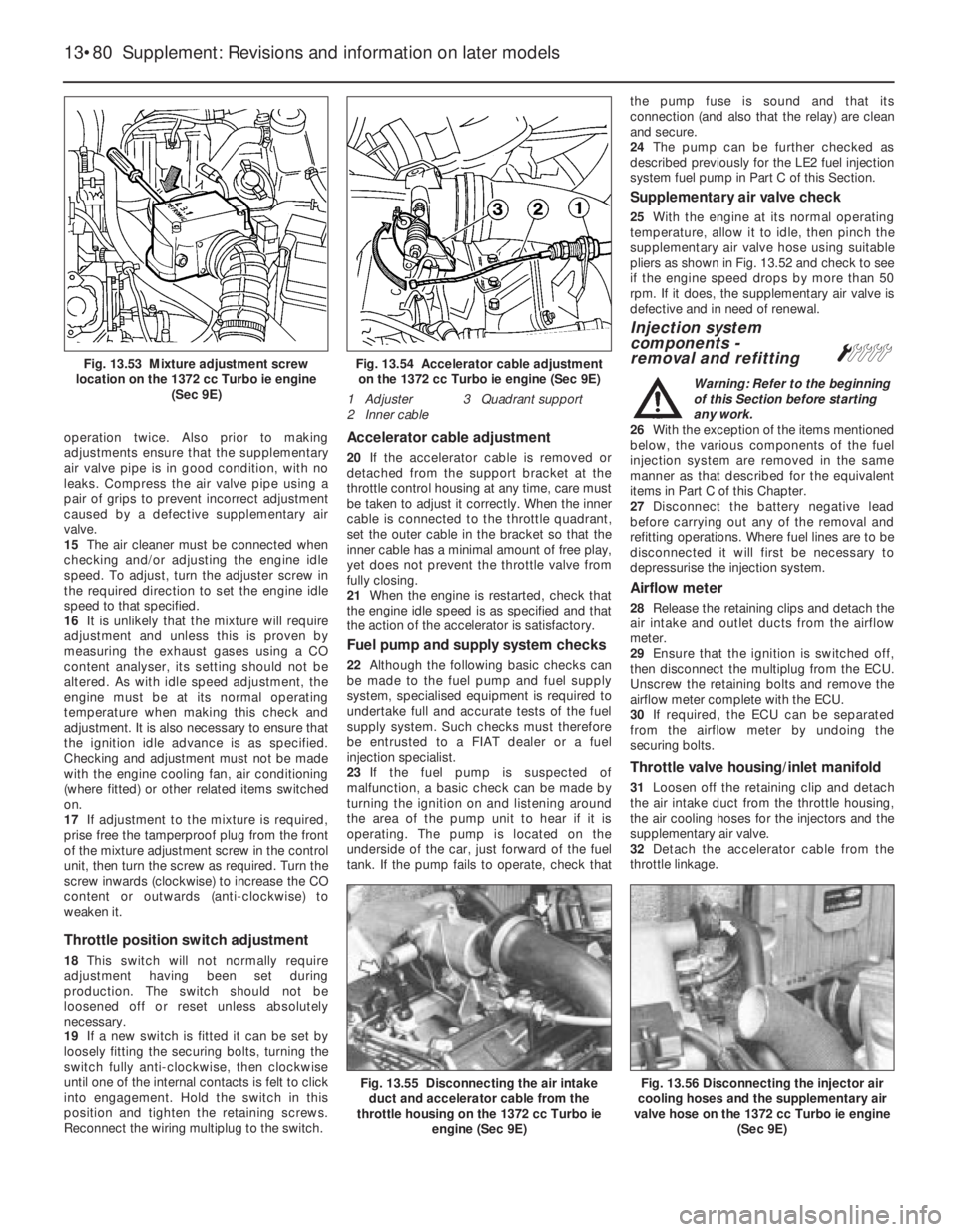
17If adjustment to the mixture is required,
prise free the tamperproof plug from the front
of the mixture adjustment screw in the control
unit, then turn the screw as required. Turn the
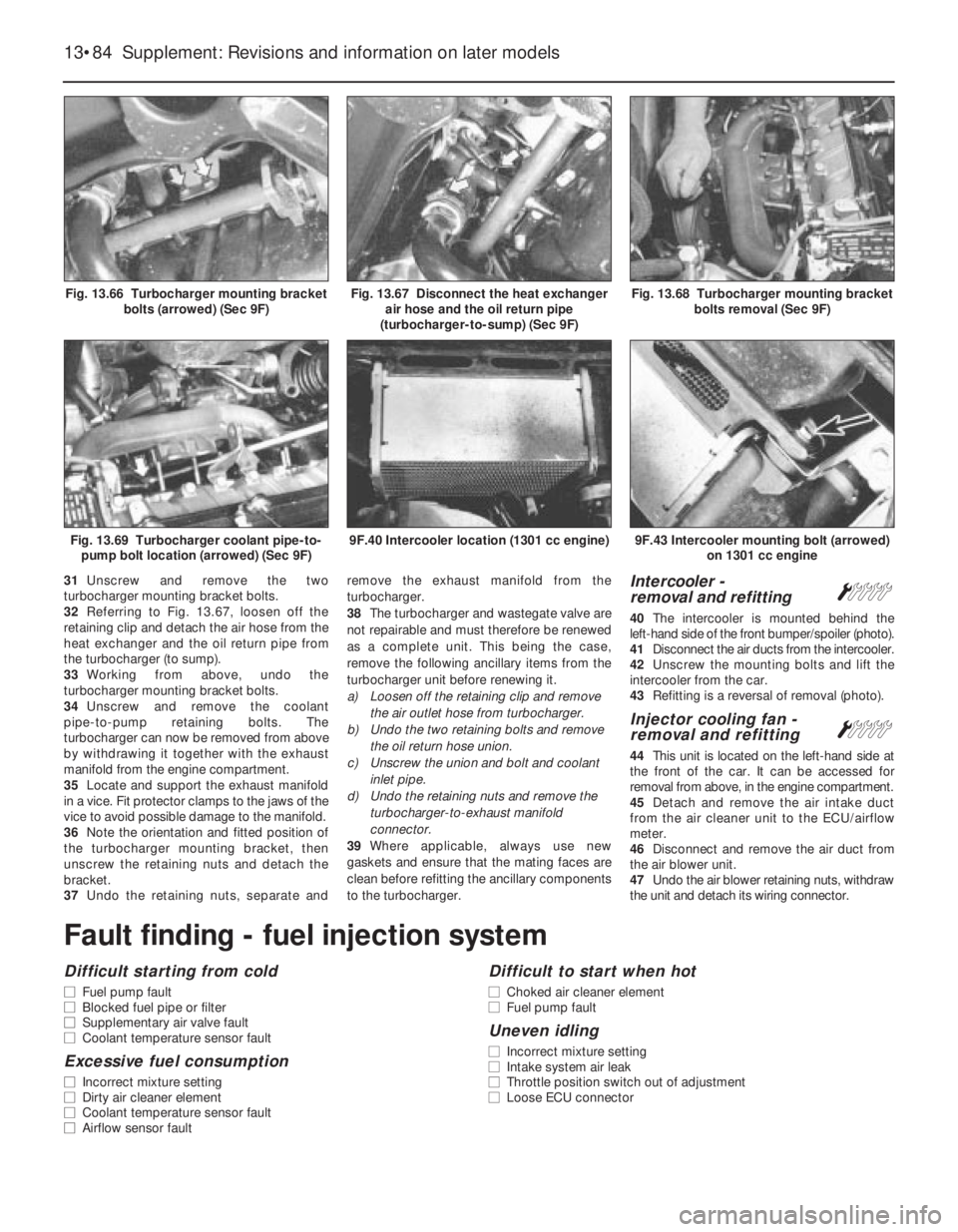
screw inwards (clockwise) to increase the CO
content or outwards (anti-clockwise) to
weaken it.
Throttle position switch adjustment
18This switch will not normally require
adjustment having been set during
production. The switch should not be
loosened off or reset unless absolutely
necessary.
19If a new switch is fitted it can be set by
loosely fitting the securing bolts, turning the
switch fully anti-clockwise, then clockwise
until one of the internal contacts is felt to click
into engagement. Hold the switch in this
position and tighten the retaining screws.
Reconnect the wiring multiplug to the switch.
Accelerator cable adjustment
20If the accelerator cable is removed or
detached from the support bracket at the
throttle control housing at any time, care must
be taken to adjust it correctly. When the inner
cable is connected to the throttle quadrant,
set the outer cable in the bracket so that the
inner cable has a minimal amount of free play,
yet does not prevent the throttle valve from
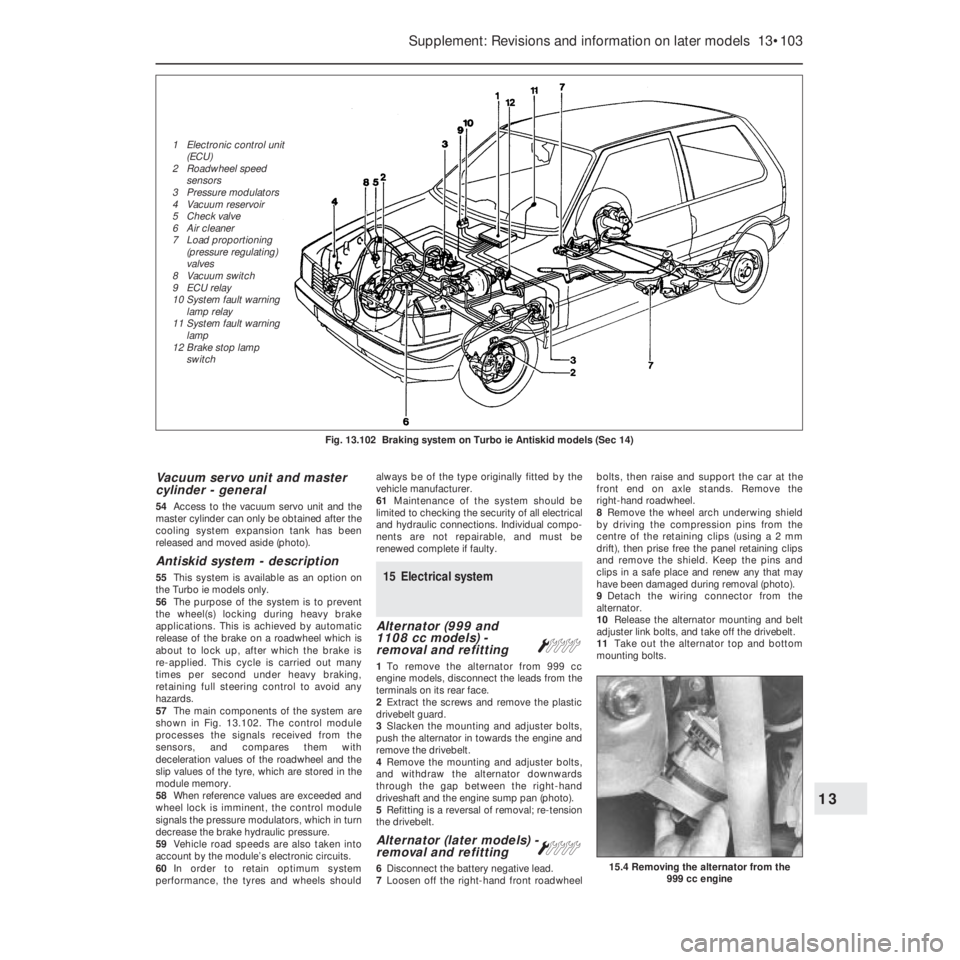
fully closing.
21When the engine is restarted, check that
the engine idle speed is as specified and that
the action of the accelerator is satisfactory.
Fuel pump and supply system checks
22Although the following basic checks can
be made to the fuel pump and fuel supply
system, specialised equipment is required to
undertake full and accurate tests of the fuel
supply system. Such checks must therefore
be entrusted to a FIAT dealer or a fuel
injection specialist.
23If the fuel pump is suspected of
malfunction, a basic check can be made by
turning the ignition on and listening around
the area of the pump unit to hear if it is
operating. The pump is located on the
underside of the car, just forward of the fuel
tank. If the pump fails to operate, check thatthe pump fuse is sound and that its
connection (and also that the relay) are clean
and secure.
24The pump can be further checked as
described previously for the LE2 fuel injection
system fuel pump in Part C of this Section.
Supplementary air valve check
25With the engine at its normal operating
temperature, allow it to idle, then pinch the
supplementary air valve hose using suitable
pliers as shown in Fig. 13.52 and check to see
if the engine speed drops by more than 50
rpm. If it does, the supplementary air valve is
defective and in need of renewal.
Injection system
components -
removal and refitting
Á
Warning: Refer to the beginning
of this Section before starting
any work.
26With the exception of the items mentioned
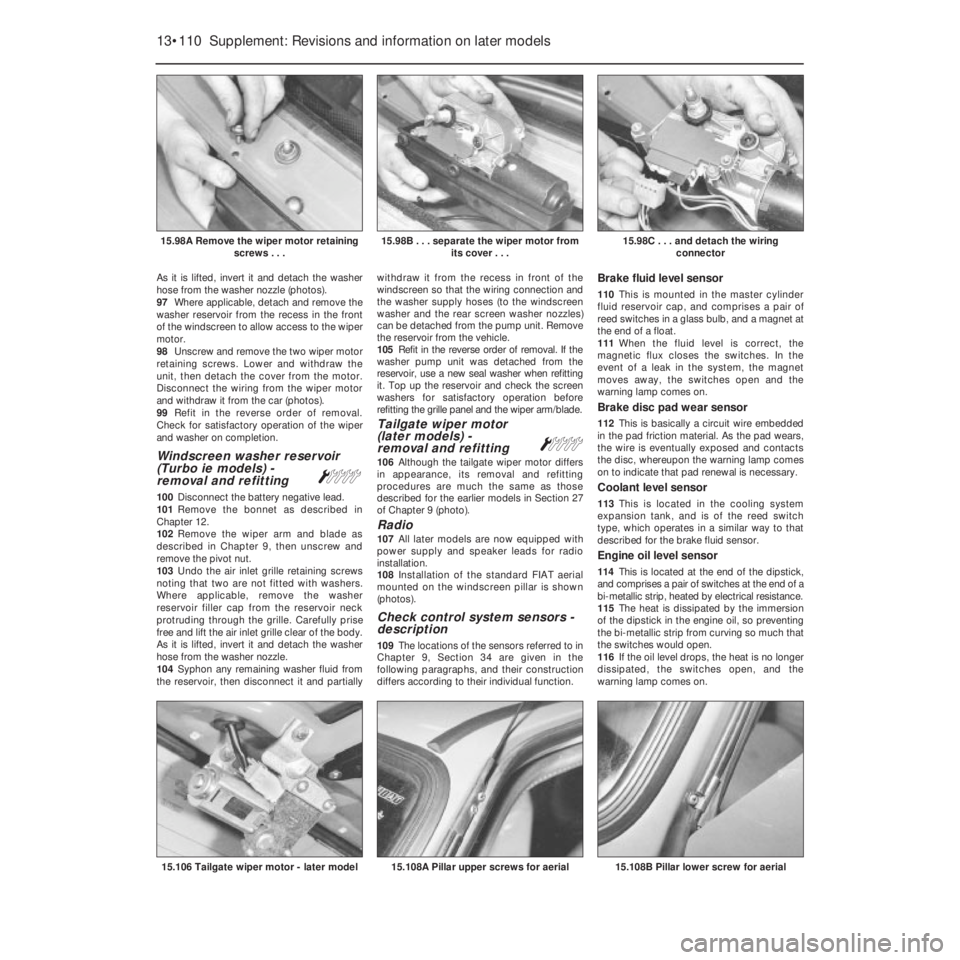
below, the various components of the fuel
injection system are removed in the same
manner as that described for the equivalent
items in Part C of this Chapter.
27Disconnect the battery negative lead
before carrying out any of the removal and
refitting operations. Where fuel lines are to be
disconnected it will first be necessary to
depressurise the injection system.
Airflow meter
28Release the retaining clips and detach the
air intake and outlet ducts from the airflow
meter.
29Ensure that the ignition is switched off,
then disconnect the multiplug from the ECU.
Unscrew the retaining bolts and remove the
airflow meter complete with the ECU.
30If required, the ECU can be separated
from the airflow meter by undoing the
securing bolts.
Throttle valve housing/inlet manifold
31Loosen off the retaining clip and detach
the air intake duct from the throttle housing,
the air cooling hoses for the injectors and the
supplementary air valve.
32Detach the accelerator cable from the
throttle linkage.
13•80 Supplement: Revisions and information on later models
Fig. 13.56 Disconnecting the injector air
cooling hoses and the supplementary air
valve hose on the 1372 cc Turbo ie engine
(Sec 9E)Fig. 13.55 Disconnecting the air intake
duct and accelerator cable from the
throttle housing on the 1372 cc Turbo ie
engine (Sec 9E)
Fig. 13.54 Accelerator cable adjustment
on the 1372 cc Turbo ie engine (Sec 9E)
1 Adjuster 3 Quadrant support
2 Inner cableFig. 13.53 Mixture adjustment screw
location on the 1372 cc Turbo ie engine
(Sec 9E)
Page 206 of 303
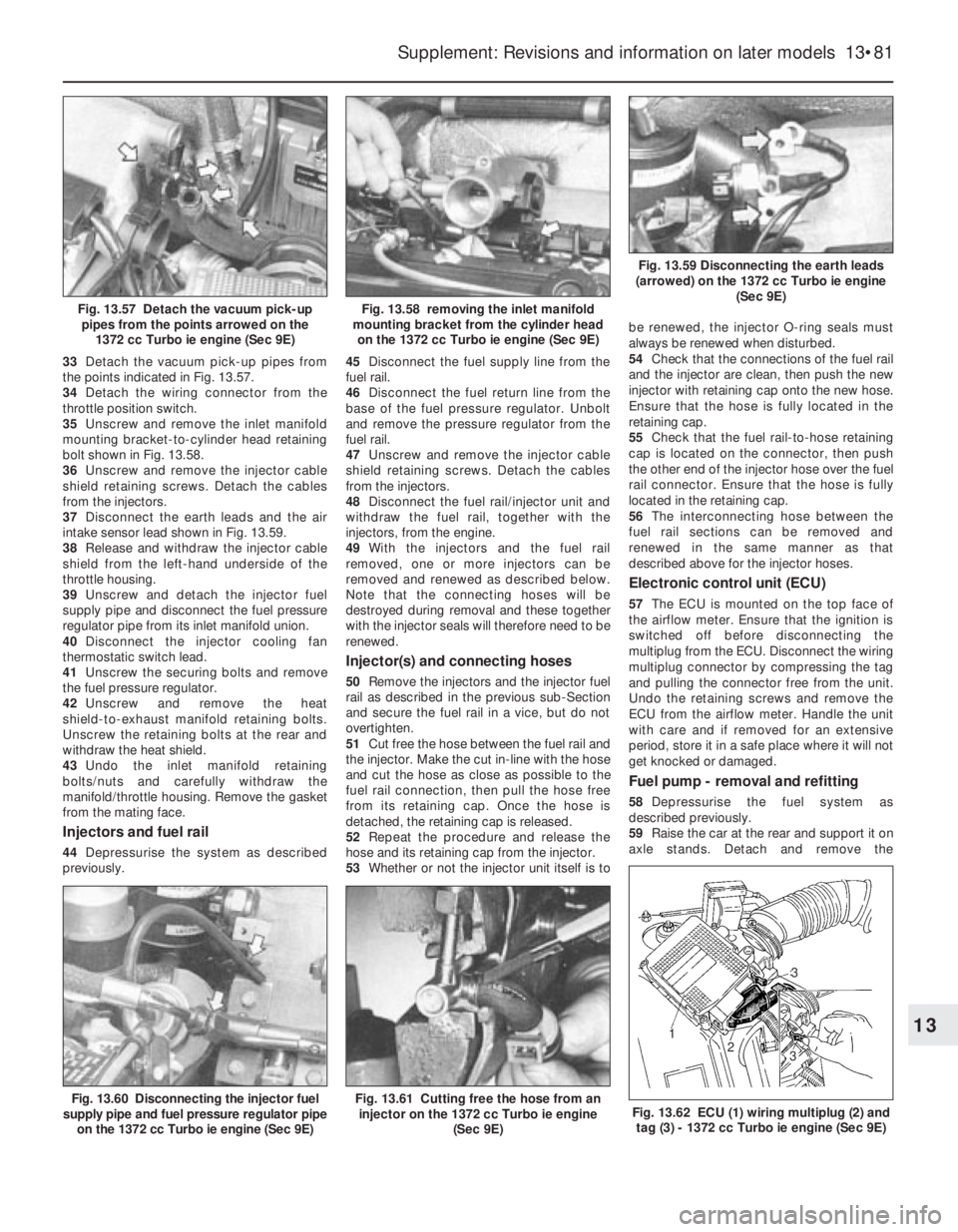
33Detach the vacuum pick-up pipes from
the points indicated in Fig. 13.57.
34Detach the wiring connector from the
throttle position switch.
35Unscrew and remove the inlet manifold
mounting bracket-to-cylinder head retaining
bolt shown in Fig. 13.58.
36Unscrew and remove the injector cable
shield retaining screws. Detach the cables
from the injectors.
37Disconnect the earth leads and the air
intake sensor lead shown in Fig. 13.59.
38Release and withdraw the injector cable
shield from the left-hand underside of the
throttle housing.
39Unscrew and detach the injector fuel
supply pipe and disconnect the fuel pressure
regulator pipe from its inlet manifold union.
40Disconnect the injector cooling fan
thermostatic switch lead.
41Unscrew the securing bolts and remove
the fuel pressure regulator.
42Unscrew and remove the heat
shield-to-exhaust manifold retaining bolts.
Unscrew the retaining bolts at the rear and
withdraw the heat shield.
43Undo the inlet manifold retaining
bolts/nuts and carefully withdraw the
manifold/throttle housing. Remove the gasket
from the mating face.
Injectors and fuel rail
44Depressurise the system as described
previously. 45Disconnect the fuel supply line from the
fuel rail.
46Disconnect the fuel return line from the
base of the fuel pressure regulator. Unbolt
and remove the pressure regulator from the
fuel rail.
47Unscrew and remove the injector cable
shield retaining screws. Detach the cables
from the injectors.
48Disconnect the fuel rail/injector unit and
withdraw the fuel rail, together with the
injectors, from the engine.
49With the injectors and the fuel rail
removed, one or more injectors can be
removed and renewed as described below.
Note that the connecting hoses will be
destroyed during removal and these together
with the injector seals will therefore need to be
renewed.
Injector(s) and connecting hoses
50Remove the injectors and the injector fuel
rail as described in the previous sub-Section
and secure the fuel rail in a vice, but do not
overtighten.
51Cut free the hose between the fuel rail and
the injector. Make the cut in-line with the hose
and cut the hose as close as possible to the
fuel rail connection, then pull the hose free
from its retaining cap. Once the hose is
detached, the retaining cap is released.
52Repeat the procedure and release the
hose and its retaining cap from the injector.
53Whether or not the injector unit itself is tobe renewed, the injector O-ring seals must
always be renewed when disturbed.
54Check that the connections of the fuel rail
and the injector are clean, then push the new
injector with retaining cap onto the new hose.
Ensure that the hose is fully located in the
retaining cap.
55Check that the fuel rail-to-hose retaining
cap is located on the connector, then push
the other end of the injector hose over the fuel
rail connector. Ensure that the hose is fully
located in the retaining cap.
56The interconnecting hose between the
fuel rail sections can be removed and
renewed in the same manner as that
described above for the injector hoses.
Electronic control unit (ECU)
57The ECU is mounted on the top face of
the airflow meter. Ensure that the ignition is
switched off before disconnecting the
multiplug from the ECU. Disconnect the wiring
multiplug connector by compressing the tag
and pulling the connector free from the unit.
Undo the retaining screws and remove the
ECU from the airflow meter. Handle the unit
with care and if removed for an extensive
period, store it in a safe place where it will not
get knocked or damaged.
Fuel pump - removal and refitting
58Depressurise the fuel system as
described previously.
59Raise the car at the rear and support it on
axle stands. Detach and remove the
Supplement: Revisions and information on later models 13•81
Fig. 13.59 Disconnecting the earth leads
(arrowed) on the 1372 cc Turbo ie engine
(Sec 9E)
Fig. 13.58 removing the inlet manifold
mounting bracket from the cylinder head
on the 1372 cc Turbo ie engine (Sec 9E)Fig. 13.57 Detach the vacuum pick-up
pipes from the points arrowed on the
1372 cc Turbo ie engine (Sec 9E)
Fig. 13.62 ECU (1) wiring multiplug (2) and
tag (3) - 1372 cc Turbo ie engine (Sec 9E)Fig. 13.61 Cutting free the hose from an
injector on the 1372 cc Turbo ie engine
(Sec 9E)Fig. 13.60 Disconnecting the injector fuel
supply pipe and fuel pressure regulator pipe
on the 1372 cc Turbo ie engine (Sec 9E)
13
2
3
3
1
Page 207 of 303
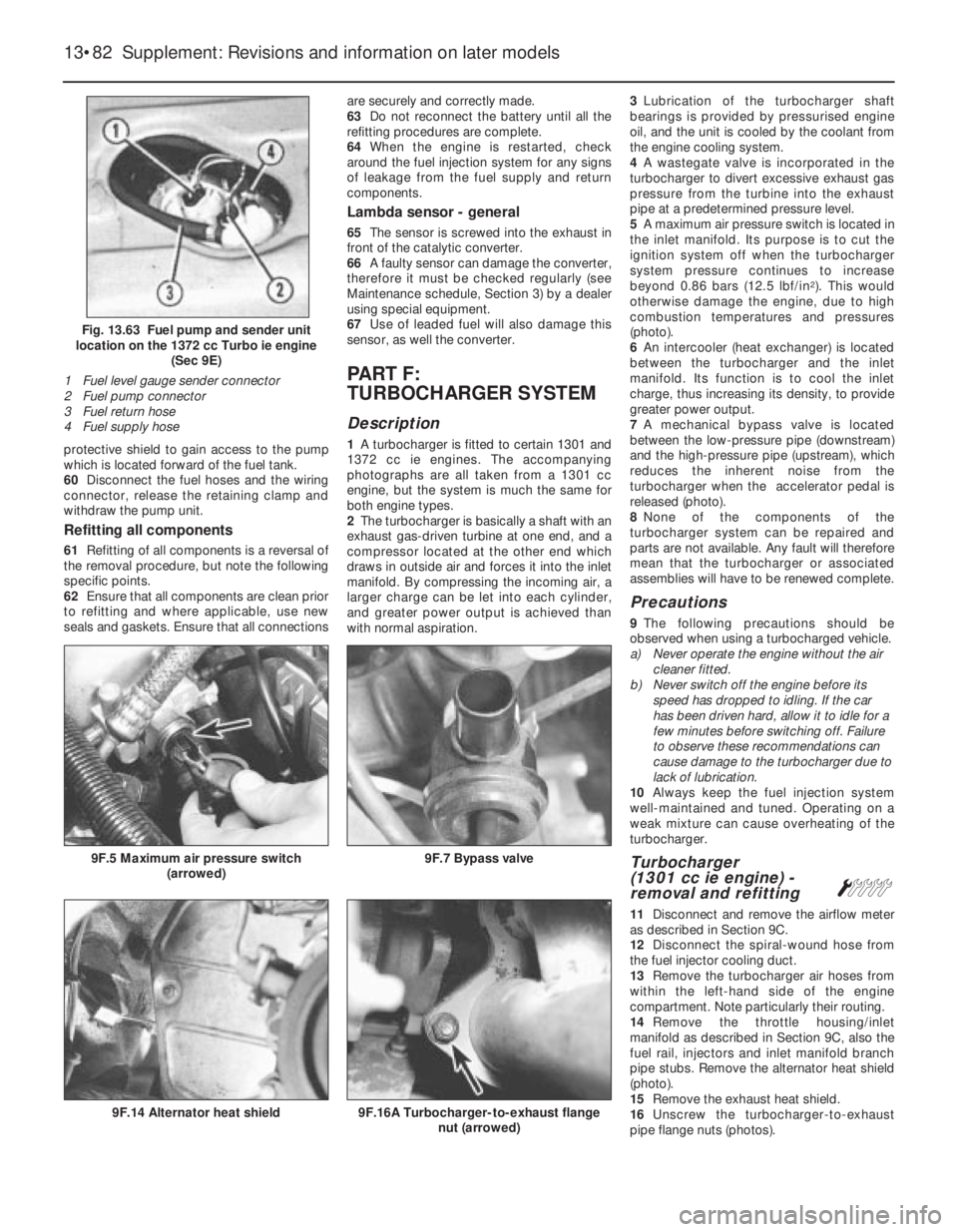
protective shield to gain access to the pump
which is located forward of the fuel tank.
60Disconnect the fuel hoses and the wiring
connector, release the retaining clamp and
withdraw the pump unit.
Refitting all components
61Refitting of all components is a reversal of
the removal procedure, but note the following
specific points.
62Ensure that all components are clean prior
to refitting and where applicable, use new
seals and gaskets. Ensure that all connectionsare securely and correctly made.
63Do not reconnect the battery until all the
refitting procedures are complete.
64When the engine is restarted, check
around the fuel injection system for any signs
of leakage from the fuel supply and return
components.
Lambda sensor - general
65The sensor is screwed into the exhaust in
front of the catalytic converter.
66A faulty sensor can damage the converter,
therefore it must be checked regularly (see
Maintenance schedule, Section 3) by a dealer
using special equipment.
67Use of leaded fuel will also damage this
sensor, as well the converter.
PART F:
TURBOCHARGER SYSTEM
Description
1A turbocharger is fitted to certain 1301 and
1372 cc ie engines. The accompanying
photographs are all taken from a 1301 cc
engine, but the system is much the same for
both engine types.
2The turbocharger is basically a shaft with an
exhaust gas-driven turbine at one end, and a
compressor located at the other end which
draws in outside air and forces it into the inlet
manifold. By compressing the incoming air, a
larger charge can be let into each cylinder,
and greater power output is achieved than
with normal aspiration.3Lubrication of the turbocharger shaft
bearings is provided by pressurised engine
oil, and the unit is cooled by the coolant from
the engine cooling system.
4A wastegate valve is incorporated in the
turbocharger to divert excessive exhaust gas
pressure from the turbine into the exhaust
pipe at a predetermined pressure level.
5A maximum air pressure switch is located in
the inlet manifold. Its purpose is to cut the
ignition system off when the turbocharger
system pressure continues to increase
beyond 0.86 bars (12.5 lbf/in
2). This would
otherwise damage the engine, due to high
combustion temperatures and pressures
(photo).
6An intercooler (heat exchanger) is located
between the turbocharger and the inlet
manifold. Its function is to cool the inlet
charge, thus increasing its density, to provide
greater power output.
7A mechanical bypass valve is located
between the low-pressure pipe (downstream)
and the high-pressure pipe (upstream), which
reduces the inherent noise from the
turbocharger when the accelerator pedal is
released (photo).
8None of the components of the
turbocharger system can be repaired and
parts are not available. Any fault will therefore
mean that the turbocharger or associated
assemblies will have to be renewed complete.
Precautions
9The following precautions should be
observed when using a turbocharged vehicle.
a) Never operate the engine without the air
cleaner fitted.
b) Never switch off the engine before its
speed has dropped to idling. If the car
has been driven hard, allow it to idle for a
few minutes before switching off. Failure
to observe these recommendations can
cause damage to the turbocharger due to
lack of lubrication.
10Always keep the fuel injection system
well-maintained and tuned. Operating on a
weak mixture can cause overheating of the
turbocharger.
Turbocharger
(1301 cc ie engine) -
removal and refitting
Á
11Disconnect and remove the airflow meter
as described in Section 9C.
12Disconnect the spiral-wound hose from
the fuel injector cooling duct.
13Remove the turbocharger air hoses from
within the left-hand side of the engine
compartment. Note particularly their routing.
14Remove the throttle housing/inlet
manifold as described in Section 9C, also the
fuel rail, injectors and inlet manifold branch
pipe stubs. Remove the alternator heat shield
(photo).
15Remove the exhaust heat shield.
16Unscrew the turbocharger-to-exhaust
pipe flange nuts (photos).
13•82 Supplement: Revisions and information on later models
9F.16A Turbocharger-to-exhaust flange
nut (arrowed)9F.14 Alternator heat shield
9F.7 Bypass valve9F.5 Maximum air pressure switch
(arrowed)
Fig. 13.63 Fuel pump and sender unit
location on the 1372 cc Turbo ie engine
(Sec 9E)
1 Fuel level gauge sender connector
2 Fuel pump connector
3 Fuel return hose
4 Fuel supply hose
Page 208 of 303
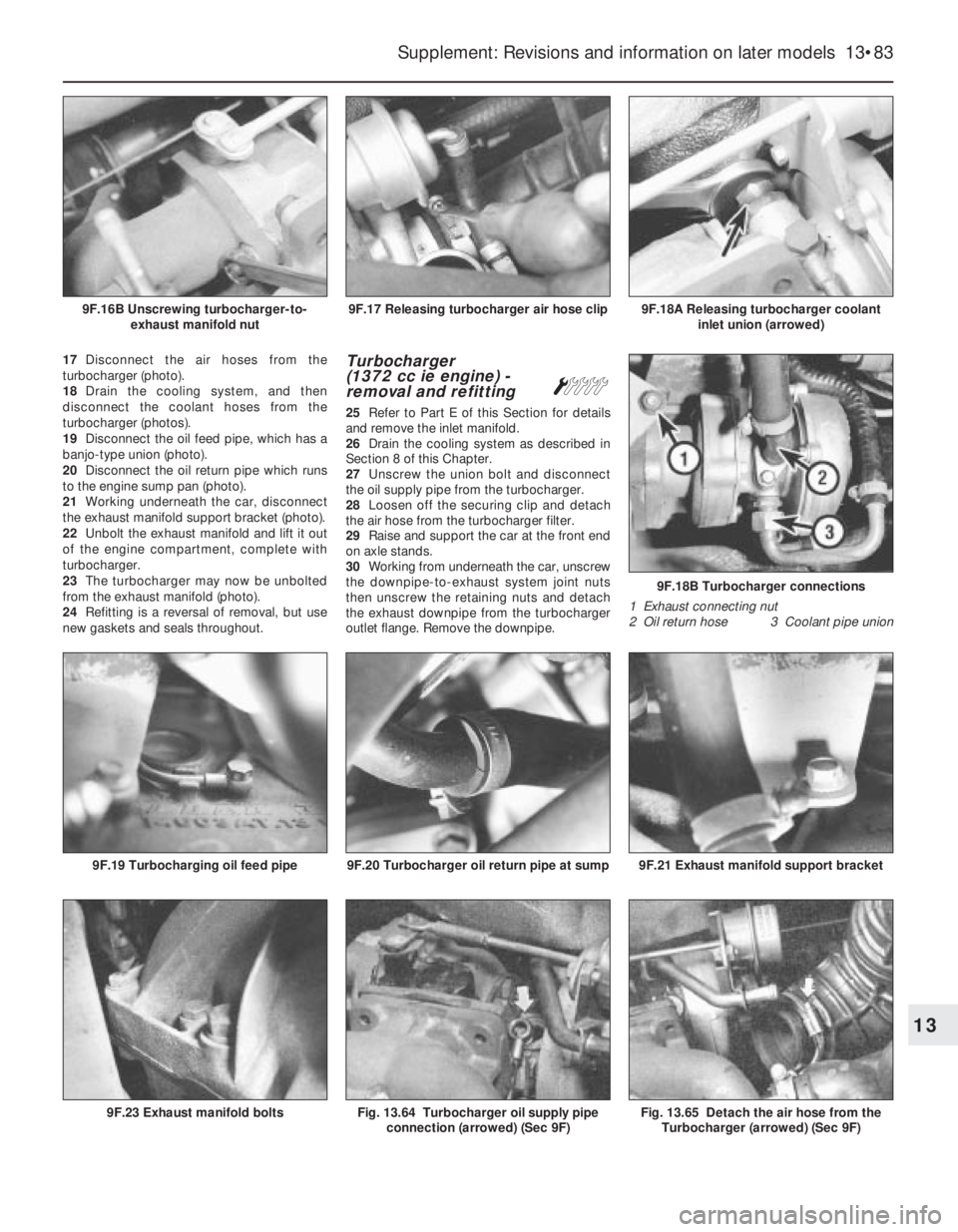
17Disconnect the air hoses from the
turbocharger (photo).
18Drain the cooling system, and then
disconnect the coolant hoses from the
turbocharger (photos).
19Disconnect the oil feed pipe, which has a
banjo-type union (photo).
20Disconnect the oil return pipe which runs
to the engine sump pan (photo).
21Working underneath the car, disconnect
the exhaust manifold support bracket (photo).
22Unbolt the exhaust manifold and lift it out
of the engine compartment, complete with
turbocharger.
23The turbocharger may now be unbolted
from the exhaust manifold (photo).
24Refitting is a reversal of removal, but use
new gaskets and seals throughout.Turbocharger
(1372 cc ie engine) -
removal and refitting
Á
25Refer to Part E of this Section for details
and remove the inlet manifold.
26Drain the cooling system as described in
Section 8 of this Chapter.
27Unscrew the union bolt and disconnect
the oil supply pipe from the turbocharger.
28Loosen off the securing clip and detach
the air hose from the turbocharger filter.
29Raise and support the car at the front end
on axle stands.
30Working from underneath the car, unscrew
the downpipe-to-exhaust system joint nuts
then unscrew the retaining nuts and detach
the exhaust downpipe from the turbocharger
outlet flange. Remove the downpipe.
Supplement: Revisions and information on later models 13•83
9F.18A Releasing turbocharger coolant
inlet union (arrowed)9F.17 Releasing turbocharger air hose clip9F.16B Unscrewing turbocharger-to-
exhaust manifold nut
Fig. 13.64 Turbocharger oil supply pipe
connection (arrowed) (Sec 9F)9F.23 Exhaust manifold bolts
9F.21 Exhaust manifold support bracket9F.20 Turbocharger oil return pipe at sump9F.19 Turbocharging oil feed pipe
9F.18B Turbocharger connections
1 Exhaust connecting nut
2 Oil return hose 3 Coolant pipe union
13
Fig. 13.65 Detach the air hose from the
Turbocharger (arrowed) (Sec 9F)
Page 209 of 303
31Unscrew and remove the two
turbocharger mounting bracket bolts.
32Referring to Fig. 13.67, loosen off the
retaining clip and detach the air hose from the
heat exchanger and the oil return pipe from
the turbocharger (to sump).
33Working from above, undo the
turbocharger mounting bracket bolts.
34Unscrew and remove the coolant
pipe-to-pump retaining bolts. The
turbocharger can now be removed from above
by withdrawing it together with the exhaust
manifold from the engine compartment.
35Locate and support the exhaust manifold
in a vice. Fit protector clamps to the jaws of the
vice to avoid possible damage to the manifold.
36Note the orientation and fitted position of
the turbocharger mounting bracket, then
unscrew the retaining nuts and detach the
bracket.
37Undo the retaining nuts, separate andremove the exhaust manifold from the
turbocharger.
38The turbocharger and wastegate valve are
not repairable and must therefore be renewed
as a complete unit. This being the case,
remove the following ancillary items from the
turbocharger unit before renewing it.
a) Loosen off the retaining clip and remove
the air outlet hose from turbocharger.
b) Undo the two retaining bolts and remove
the oil return hose union.
c) Unscrew the union and bolt and coolant
inlet pipe.
d) Undo the retaining nuts and remove the
turbocharger-to-exhaust manifold
connector.
39Where applicable, always use new
gaskets and ensure that the mating faces are
clean before refitting the ancillary components
to the turbocharger.Intercooler -
removal and refitting Á
40The intercooler is mounted behind the
left-hand side of the front bumper/spoiler (photo).
41Disconnect the air ducts from the intercooler.
42Unscrew the mounting bolts and lift the
intercooler from the car.
43Refitting is a reversal of removal (photo).
Injector cooling fan -
removal and refitting Á
44This unit is located on the left-hand side at
the front of the car. It can be accessed for
removal from above, in the engine compartment.
45Detach and remove the air intake duct
from the air cleaner unit to the ECU/airflow
meter.
46Disconnect and remove the air duct from
the air blower unit.
47Undo the air blower retaining nuts, withdraw
the unit and detach its wiring connector.
13•84 Supplement: Revisions and information on later models
9F.43 Intercooler mounting bolt (arrowed)
on 1301 cc engine9F.40 Intercooler location (1301 cc engine)Fig. 13.69 Turbocharger coolant pipe-to-
pump bolt location (arrowed) (Sec 9F)
Fig. 13.68 Turbocharger mounting bracket
bolts removal (Sec 9F)Fig. 13.67 Disconnect the heat exchanger
air hose and the oil return pipe
(turbocharger-to-sump) (Sec 9F)Fig. 13.66 Turbocharger mounting bracket
bolts (arrowed) (Sec 9F)
Fault finding - fuel injection system
Difficult starting from cold
m mFuel pump fault
m mBlocked fuel pipe or filter
m mSupplementary air valve fault
m mCoolant temperature sensor fault
Excessive fuel consumption
m
mIncorrect mixture setting
m mDirty air cleaner element
m mCoolant temperature sensor fault
m mAirflow sensor fault
Difficult to start when hot
m
mChoked air cleaner element
m mFuel pump fault
Uneven idling
m
mIncorrect mixture setting
m mIntake system air leak
m mThrottle position switch out of adjustment
m mLoose ECU connector
Page 228 of 303
Vacuum servo unit and master
cylinder - general
54Access to the vacuum servo unit and the
master cylinder can only be obtained after the
cooling system expansion tank has been
released and moved aside (photo).
Antiskid system - description
55This system is available as an option on
the Turbo ie models only.
56The purpose of the system is to prevent
the wheel(s) locking during heavy brake
applications. This is achieved by automatic
release of the brake on a roadwheel which is
about to lock up, after which the brake is
re-applied. This cycle is carried out many
times per second under heavy braking,
retaining full steering control to avoid any
hazards.
57The main components of the system are
shown in Fig. 13.102. The control module
processes the signals received from the
sensors, and compares them with
deceleration values of the roadwheel and the
slip values of the tyre, which are stored in the
module memory.
58When reference values are exceeded and
wheel lock is imminent, the control module
signals the pressure modulators, which in turn
decrease the brake hydraulic pressure.
59Vehicle road speeds are also taken into
account by the module’s electronic circuits.
60In order to retain optimum system
performance, the tyres and wheels shouldalways be of the type originally fitted by the
vehicle manufacturer.
61Maintenance of the system should be
limited to checking the security of all electrical
and hydraulic connections. Individual compo-
nents are not repairable, and must be
renewed complete if faulty.15 Electrical system
Alternator (999 and
1108 cc models) -
removal and refitting
Á
1To remove the alternator from 999 cc
engine models, disconnect the leads from the
terminals on its rear face.
2Extract the screws and remove the plastic
drivebelt guard.
3Slacken the mounting and adjuster bolts,
push the alternator in towards the engine and
remove the drivebelt.
4Remove the mounting and adjuster bolts,
and withdraw the alternator downwards
through the gap between the right-hand
driveshaft and the engine sump pan (photo).
5Refitting is a reversal of removal; re-tension
the drivebelt.
Alternator (later models) -
removal and refitting Á
6Disconnect the battery negative lead.
7Loosen off the right-hand front roadwheelbolts, then raise and support the car at the
front end on axle stands. Remove the
right-hand roadwheel.
8Remove the wheel arch underwing shield
by driving the compression pins from the
centre of the retaining clips (using a 2 mm
drift), then prise free the panel retaining clips
and remove the shield. Keep the pins and
clips in a safe place and renew any that may
have been damaged during removal (photo).
9Detach the wiring connector from the
alternator.
10Release the alternator mounting and belt
adjuster link bolts, and take off the drivebelt.
11Take out the alternator top and bottom
mounting bolts.
Supplement: Revisions and information on later models 13•103
15.4 Removing the alternator from the
999 cc engine
Fig. 13.102 Braking system on Turbo ie Antiskid models (Sec 14)
13
1 Electronic control unit
(ECU)
2 Roadwheel speed
sensors
3 Pressure modulators
4 Vacuum reservoir
5 Check valve
6 Air cleaner
7 Load proportioning
(pressure regulating)
valves
8 Vacuum switch
9 ECU relay
10 System fault warning
lamp relay
11 System fault warning
lamp
12 Brake stop lamp
switch
Page 229 of 303
15.23A Starter motor removal from the
1301 cc Turbo ie engine15.20 Starter motor removal from the
999 cc engine
12Disconnect the air cooling hose from the
rear cover of the alternator, and then unscrew
the fixing nuts and take off the rear cover with
hose spout. Mark the position of the cover on
the alternator before removing it, so that the
spout will be correctly positioned when
refitted (photos).
13Unbolt the driveshaft bearing
support/alternator bracket from the engine
crankcase, and swivel the support
downwards to provide space for withdrawal of
the alternator (photo).
14Withdraw the alternator from under the
right-hand front wing (photo).
15Refit in the reverse order of removal. Refit
the drivebelt and ensure correct engagement
with the pulleys, then set the drivebelt tension
and tighten the alternator retaining nuts.Alternator brushes -
renewal#
16Depending on model, the brush holder is
secured by two screws, which should be ex-
tracted and the brush holder removed (photos).
17New brushes and the holder are supplied
as an assembly.
Starter motor
(999 cc models) -
removal and refitting
Á
18To remove the starter motor from 999 and
1108 cc models, first disconnect the leads
from the starter motor terminals.
19Release the washer fluid reservoir flexible
bag from the engine compartment rear
bulkhead and move it to the left-hand side.
20Unscrew the starter motor mountingbolts, withdraw the starter from the flywheel
bellhousing, and then lift it out of the left-hand
side of the engine compartment (photo).
21Refitting is a reversal of removal.
Starter motor (1301 cc Turbo ie,
1372 cc ie,
1372 cc Turbo ie) -
removal and refitting
Á
22Disconnect the battery. Working from
under the front end of the car, unscrew the
starter motor mounting bolts and disconnect
the electrical leads.
23Withdraw the starter motor downwards. On
Turbo models, there is just enough clearance, if
the oil cooler hose and the oil pressure switch
lead are deflected carefully aside (photos).
24Refit by reversing the removal operations.
13•104 Supplement: Revisions and information on later models
15.16B Removing the alternator brush
holder
15.16A Extracting the alternator brush
holder screw15.14 Withdrawing the alternator15.13 Driveshaft bracket swivelled
downwards
15.12B Alternator rear cover and fixing nut15.12A Alternator air cooling hose15.8 Remove the wheel arch lower guard
panel for access to the alternator
Page 235 of 303
As it is lifted, invert it and detach the washer
hose from the washer nozzle (photos).
97Where applicable, detach and remove the
washer reservoir from the recess in the front
of the windscreen to allow access to the wiper
motor.
98Unscrew and remove the two wiper motor
retaining screws. Lower and withdraw the
unit, then detach the cover from the motor.
Disconnect the wiring from the wiper motor
and withdraw it from the car (photos).
99Refit in the reverse order of removal.
Check for satisfactory operation of the wiper
and washer on completion.
Windscreen washer reservoir
(Turbo ie models) -
removal and refitting
Á
100Disconnect the battery negative lead.
101Remove the bonnet as described in
Chapter 12.
102Remove the wiper arm and blade as
described in Chapter 9, then unscrew and
remove the pivot nut.
103Undo the air inlet grille retaining screws
noting that two are not fitted with washers.
Where applicable, remove the washer
reservoir filler cap from the reservoir neck
protruding through the grille. Carefully prise
free and lift the air inlet grille clear of the body.
As it is lifted, invert it and detach the washer
hose from the washer nozzle.
104Syphon any remaining washer fluid from
the reservoir, then disconnect it and partiallywithdraw it from the recess in front of the
windscreen so that the wiring connection and
the washer supply hoses (to the windscreen
washer and the rear screen washer nozzles)
can be detached from the pump unit. Remove
the reservoir from the vehicle.
105Refit in the reverse order of removal. If the
washer pump unit was detached from the
reservoir, use a new seal washer when refitting
it. Top up the reservoir and check the screen
washers for satisfactory operation before
refitting the grille panel and the wiper arm/blade.
Tailgate wiper motor
(later models) -
removal and refitting
Á
106Although the tailgate wiper motor differs
in appearance, its removal and refitting
procedures are much the same as those
described for the earlier models in Section 27
of Chapter 9 (photo).
Radio
107All later models are now equipped with
power supply and speaker leads for radio
installation.
108Installation of the standard FIAT aerial
mounted on the windscreen pillar is shown
(photos).
Check control system sensors -
description
109The locations of the sensors referred to in
Chapter 9, Section 34 are given in the
following paragraphs, and their construction
differs according to their individual function.
Brake fluid level sensor
110This is mounted in the master cylinder
fluid reservoir cap, and comprises a pair of
reed switches in a glass bulb, and a magnet at
the end of a float.
111When the fluid level is correct, the
magnetic flux closes the switches. In the
event of a leak in the system, the magnet
moves away, the switches open and the
warning lamp comes on.
Brake disc pad wear sensor
112This is basically a circuit wire embedded
in the pad friction material. As the pad wears,
the wire is eventually exposed and contacts
the disc, whereupon the warning lamp comes
on to indicate that pad renewal is necessary.
Coolant level sensor
113This is located in the cooling system
expansion tank, and is of the reed switch
type, which operates in a similar way to that
described for the brake fluid sensor.
Engine oil level sensor
114This is located at the end of the dipstick,
and comprises a pair of switches at the end of a
bi-metallic strip, heated by electrical resistance.
115The heat is dissipated by the immersion
of the dipstick in the engine oil, so preventing
the bi-metallic strip from curving so much that
the switches would open.
116If the oil level drops, the heat is no longer
dissipated, the switches open, and the
warning lamp comes on.
13•110 Supplement: Revisions and information on later models
15.108B Pillar lower screw for aerial15.108A Pillar upper screws for aerial15.106 Tailgate wiper motor - later model
15.98C . . . and detach the wiring
connector15.98B . . . separate the wiper motor from
its cover . . .15.98A Remove the wiper motor retaining
screws . . .
Page 240 of 303
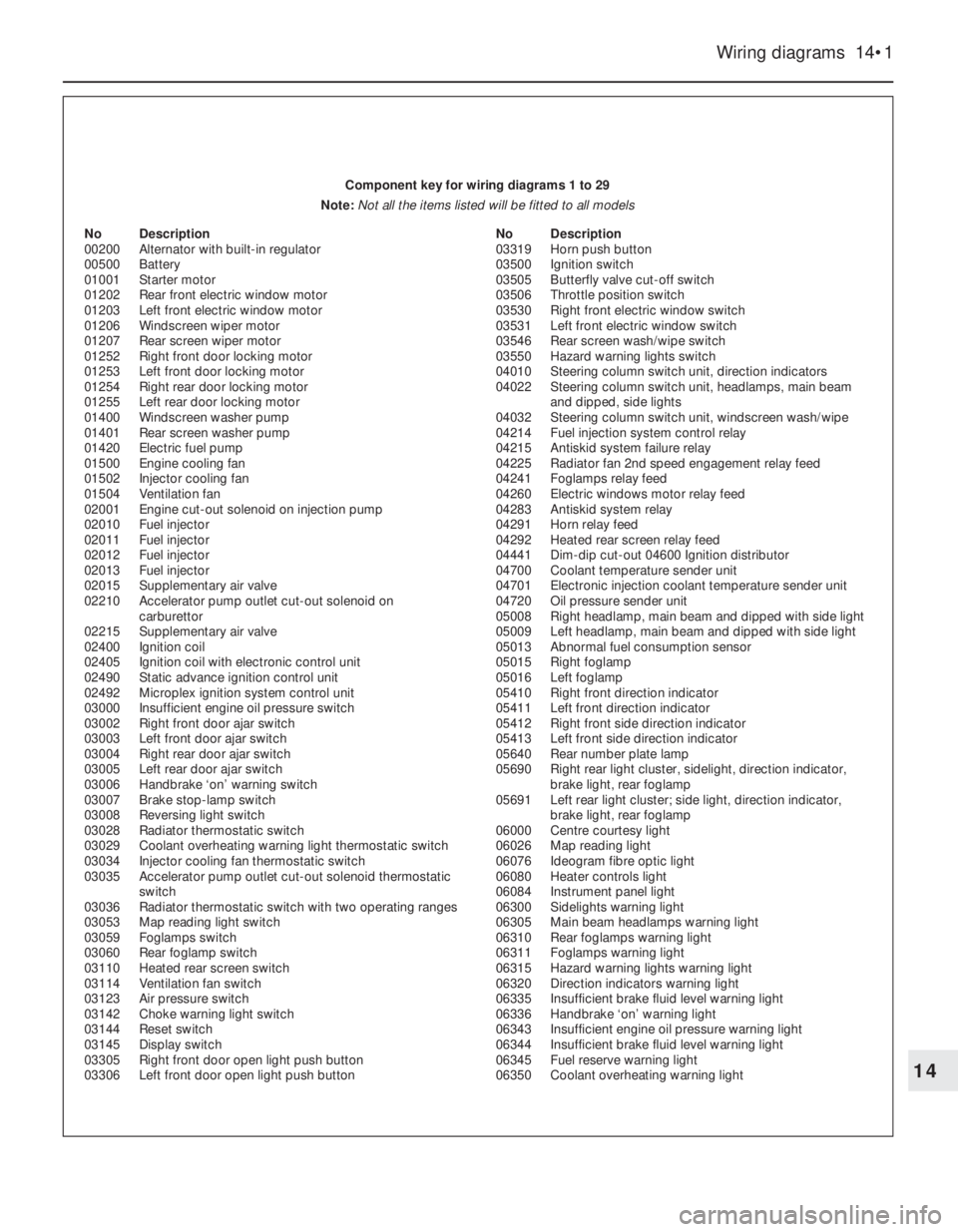
Wiring diagrams 14•1
14
Component key for wiring diagrams 1 to 29
Note: Not all the items listed will be fitted to all models
No Description
00200 Alternator with built-in regulator
00500 Battery
01001 Starter motor
01202 Rear front electric window motor
01203 Left front electric window motor
01206 Windscreen wiper motor
01207 Rear screen wiper motor
01252 Right front door locking motor
01253 Left front door locking motor
01254 Right rear door locking motor
01255 Left rear door locking motor
01400 Windscreen washer pump
01401 Rear screen washer pump
01420 Electric fuel pump
01500 Engine cooling fan
01502 Injector cooling fan
01504 Ventilation fan
02001 Engine cut-out solenoid on injection pump
02010 Fuel injector
02011 Fuel injector
02012 Fuel injector
02013 Fuel injector
02015 Supplementary air valve
02210 Accelerator pump outlet cut-out solenoid on
carburettor
02215 Supplementary air valve
02400 Ignition coil
02405 Ignition coil with electronic control unit
02490 Static advance ignition control unit
02492 Microplex ignition system control unit
03000 Insufficient engine oil pressure switch
03002 Right front door ajar switch
03003 Left front door ajar switch
03004 Right rear door ajar switch
03005 Left rear door ajar switch
03006 Handbrake ‘on’ warning switch
03007 Brake stop-lamp switch
03008 Reversing light switch
03028 Radiator thermostatic switch
03029 Coolant overheating warning light thermostatic switch
03034 Injector cooling fan thermostatic switch
03035 Accelerator pump outlet cut-out solenoid thermostatic
switch
03036 Radiator thermostatic switch with two operating ranges
03053 Map reading light switch
03059 Foglamps switch
03060 Rear foglamp switch
03110 Heated rear screen switch
03114 Ventilation fan switch
03123 Air pressure switch
03142 Choke warning light switch
03144 Reset switch
03145 Display switch
03305 Right front door open light push button
03306 Left front door open light push button No Description
03319 Horn push button
03500 Ignition switch
03505 Butterfly valve cut-off switch
03506 Throttle position switch
03530 Right front electric window switch
03531 Left front electric window switch
03546 Rear screen wash/wipe switch
03550 Hazard warning lights switch
04010 Steering column switch unit, direction indicators
04022 Steering column switch unit, headlamps, main beam
and dipped, side lights
04032 Steering column switch unit, windscreen wash/wipe
04214 Fuel injection system control relay
04215 Antiskid system failure relay
04225 Radiator fan 2nd speed engagement relay feed
04241 Foglamps relay feed
04260 Electric windows motor relay feed
04283 Antiskid system relay
04291 Horn relay feed
04292 Heated rear screen relay feed
04441 Dim-dip cut-out 04600 Ignition distributor
04700 Coolant temperature sender unit
04701 Electronic injection coolant temperature sender unit
04720 Oil pressure sender unit
05008 Right headlamp, main beam and dipped with side light
05009 Left headlamp, main beam and dipped with side light
05013 Abnormal fuel consumption sensor
05015 Right foglamp
05016 Left foglamp
05410 Right front direction indicator
05411 Left front direction indicator
05412 Right front side direction indicator
05413 Left front side direction indicator
05640 Rear number plate lamp
05690 Right rear light cluster, sidelight, direction indicator,
brake light, rear foglamp
05691 Left rear light cluster; side light, direction indicator,
brake light, rear foglamp
06000 Centre courtesy light
06026 Map reading light
06076 Ideogram fibre optic light
06080 Heater controls light
06084 Instrument panel light
06300 Sidelights warning light
06305 Main beam headlamps warning light
06310 Rear foglamps warning light
06311 Foglamps warning light
06315 Hazard warning lights warning light
06320 Direction indicators warning light
06335 Insufficient brake fluid level warning light
06336 Handbrake ‘on’ warning light
06343 Insufficient engine oil pressure warning light
06344 Insufficient brake fluid level warning light
06345 Fuel reserve warning light
06350 Coolant overheating warning light
Page 241 of 303
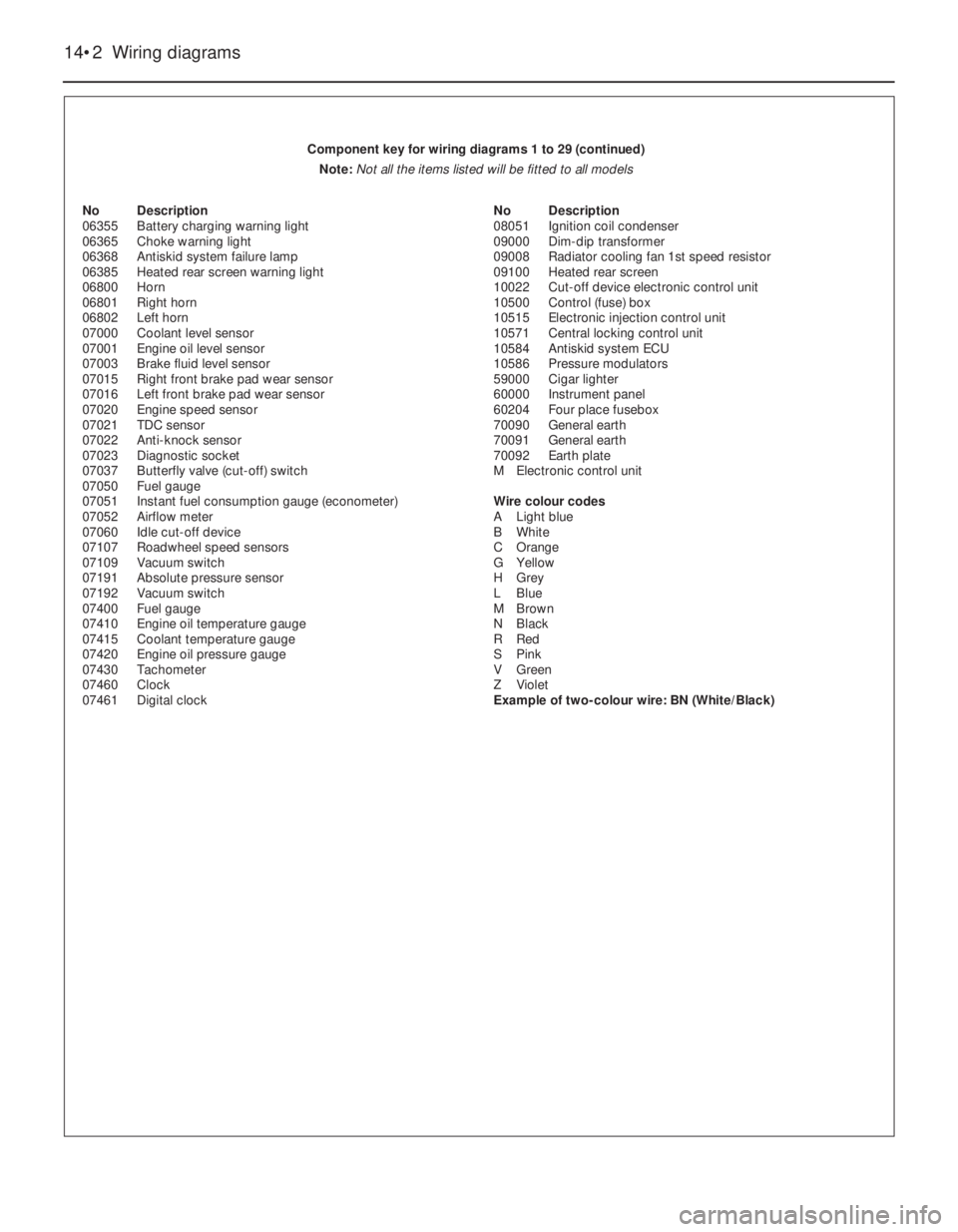
14•2 Wiring diagrams
No Description
06355 Battery charging warning light
06365 Choke warning light
06368 Antiskid system failure lamp
06385 Heated rear screen warning light
06800 Horn
06801 Right horn
06802 Left horn
07000 Coolant level sensor
07001 Engine oil level sensor
07003 Brake fluid level sensor
07015 Right front brake pad wear sensor
07016 Left front brake pad wear sensor
07020 Engine speed sensor
07021 TDC sensor
07022 Anti-knock sensor
07023 Diagnostic socket
07037 Butterfly valve (cut-off) switch
07050 Fuel gauge
07051 Instant fuel consumption gauge (econometer)
07052 Airflow meter
07060 Idle cut-off device
07107 Roadwheel speed sensors
07109 Vacuum switch
07191 Absolute pressure sensor
07192 Vacuum switch
07400 Fuel gauge
07410 Engine oil temperature gauge
07415 Coolant temperature gauge
07420 Engine oil pressure gauge
07430 Tachometer
07460 Clock
07461 Digital clockNo Description
08051 Ignition coil condenser
09000 Dim-dip transformer
09008 Radiator cooling fan 1st speed resistor
09100 Heated rear screen
10022 Cut-off device electronic control unit
10500 Control (fuse) box
10515 Electronic injection control unit
10571 Central locking control unit
10584 Antiskid system ECU
10586 Pressure modulators
59000 Cigar lighter
60000 Instrument panel
60204 Four place fusebox
70090 General earth
70091 General earth
70092 Earth plate
M Electronic control unit
Wire colour codes
A Light blue
B White
C Orange
G Yellow
H Grey
L Blue
M Brown
N Black
R Red
S Pink
V Green
Z Violet
Example of two-colour wire: BN (White/Black) Component key for wiring diagrams 1 to 29 (continued)
Note: Not all the items listed will be fitted to all models