torque FIAT UNO 1983 Service Manual PDF
[x] Cancel search | Manufacturer: FIAT, Model Year: 1983, Model line: UNO, Model: FIAT UNO 1983Pages: 303, PDF Size: 10.36 MB
Page 171 of 303
new oil seal, ensuring that it is correctly
orientated, and drive it squarely into position.
149Refit all disturbed components.
Flywheel - removal,
inspection and refitting#
150If not already done, remove the clutch as
described in Chapter 5.
151Prevent the flywheel from turning by
jamming the ring gear teeth, or by bolting a
strap between the flywheel and the cylinder
block.
152Make alignment marks on the flywheel
and the end of the crankshaft, so that the
flywheel can be refitted in its original position.
153Unscrew the securing bolts and remove
the washer plate, then withdraw the flywheel.
Do not drop it, it is very heavy.
154With the flywheel removed, the ring gear
can be examined for wear and damage.
155If the ring gear is badly worn or has
missing teeth it should be renewed. The old
ring gear can be removed from the flywheel by
cutting a notch between two teeth with a
hacksaw and then splitting it with a cold
chisel. Wear eye protection when doing this.
156Fitting of a new ring gear requires heating
the ring to a temperature of 80ºC (176ºF). Do
not overheat, or the hard-wearing properties
will be lost. The gear has a chamfered inner
edge which should fit against the shoulder on
the flywheel. When hot enough, place the gear
in position quickly, tapping it home ifnecessary, and let it cool naturally without
quenching in any way.
157Ensure that the mating faces are clean,
then locate the flywheel on the rear of the
crankshaft, aligning the previously made
marks on the flywheel and crankshaft.
158Fit the washer plate, and insert the
securing bolts, then prevent the flywheel from
turning as described in paragraph 151 whilst
the bolts are tightened progressively to the
specified torque setting in a diagonal
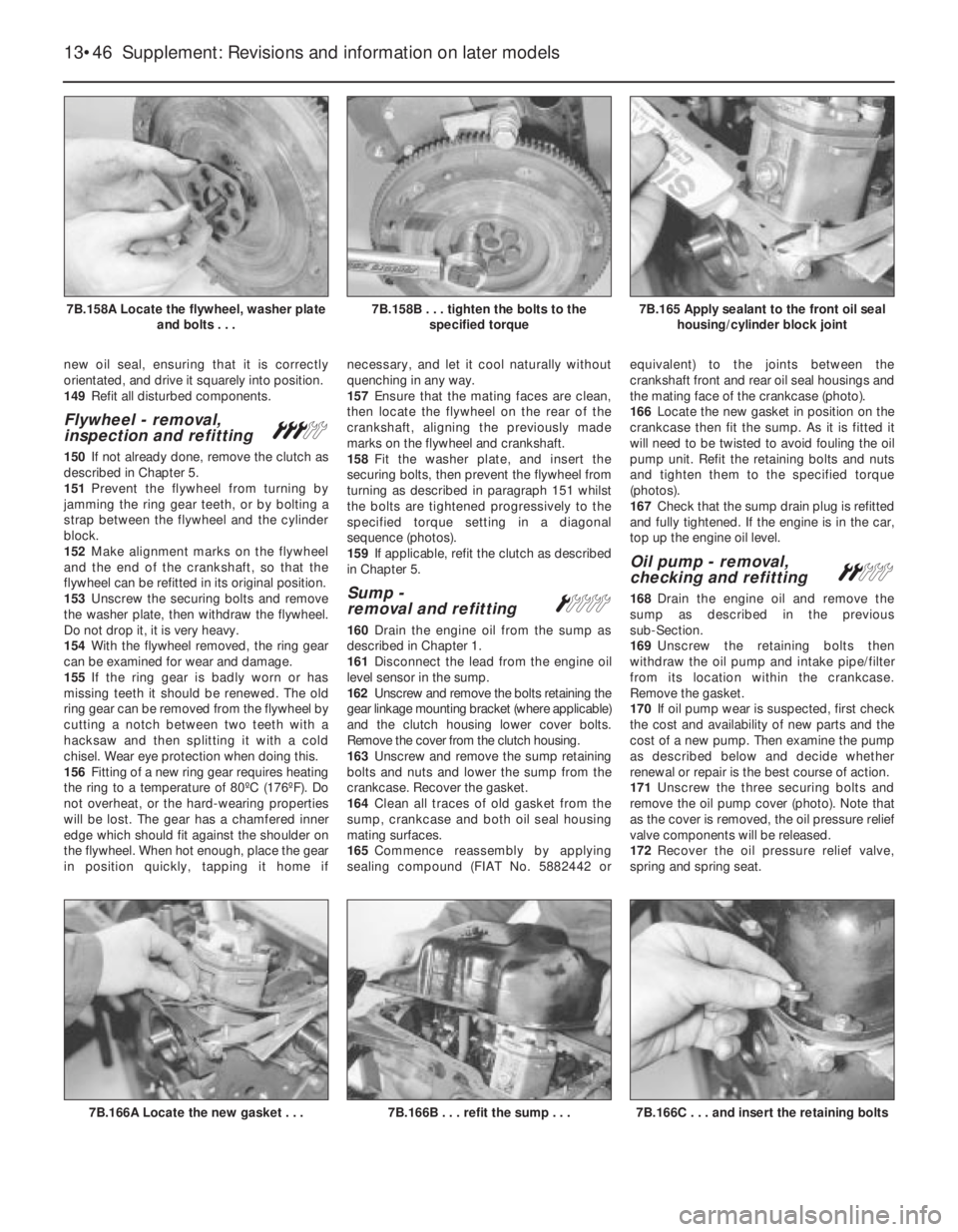
sequence (photos).
159If applicable, refit the clutch as described
in Chapter 5.
Sump -
removal and refittingÁ
160Drain the engine oil from the sump as
described in Chapter 1.
161Disconnect the lead from the engine oil
level sensor in the sump.
162Unscrew and remove the bolts retaining the
gear linkage mounting bracket (where applicable)
and the clutch housing lower cover bolts.
Remove the cover from the clutch housing.
163Unscrew and remove the sump retaining
bolts and nuts and lower the sump from the
crankcase. Recover the gasket.
164Clean all traces of old gasket from the
sump, crankcase and both oil seal housing
mating surfaces.
165Commence reassembly by applying
sealing compound (FIAT No. 5882442 orequivalent) to the joints between the
crankshaft front and rear oil seal housings and
the mating face of the crankcase (photo).
166Locate the new gasket in position on the
crankcase then fit the sump. As it is fitted it
will need to be twisted to avoid fouling the oil
pump unit. Refit the retaining bolts and nuts
and tighten them to the specified torque
(photos).
167Check that the sump drain plug is refitted
and fully tightened. If the engine is in the car,
top up the engine oil level.
Oil pump - removal,
checking and refittingª
168Drain the engine oil and remove the
sump as described in the previous
sub-Section.
169Unscrew the retaining bolts then
withdraw the oil pump and intake pipe/filter
from its location within the crankcase.
Remove the gasket.
170If oil pump wear is suspected, first check
the cost and availability of new parts and the
cost of a new pump. Then examine the pump
as described below and decide whether
renewal or repair is the best course of action.
171Unscrew the three securing bolts and
remove the oil pump cover (photo). Note that
as the cover is removed, the oil pressure relief
valve components will be released.
172Recover the oil pressure relief valve,
spring and spring seat.
13•46 Supplement: Revisions and information on later models
7B.166C . . . and insert the retaining bolts7B.166B . . . refit the sump . . .7B.166A Locate the new gasket . . .
7B.165 Apply sealant to the front oil seal
housing/cylinder block joint7B.158B . . . tighten the bolts to the
specified torque7B.158A Locate the flywheel, washer plate
and bolts . . .
Page 173 of 303
necessary renovated as described later in this
Section.
191Commence refitting as follows.
192Clean the backs of the bearing shells and
the recesses in the connecting rods and
big-end caps.
193Lubricate the cylinder bores with engine
oil.
194Fit a ring compressor to No. 1 piston, theninsert the piston and connecting rod into No. 1
cylinder. With No 1 crankpin at its lowest point,
drive the piston carefully into the cylinder with
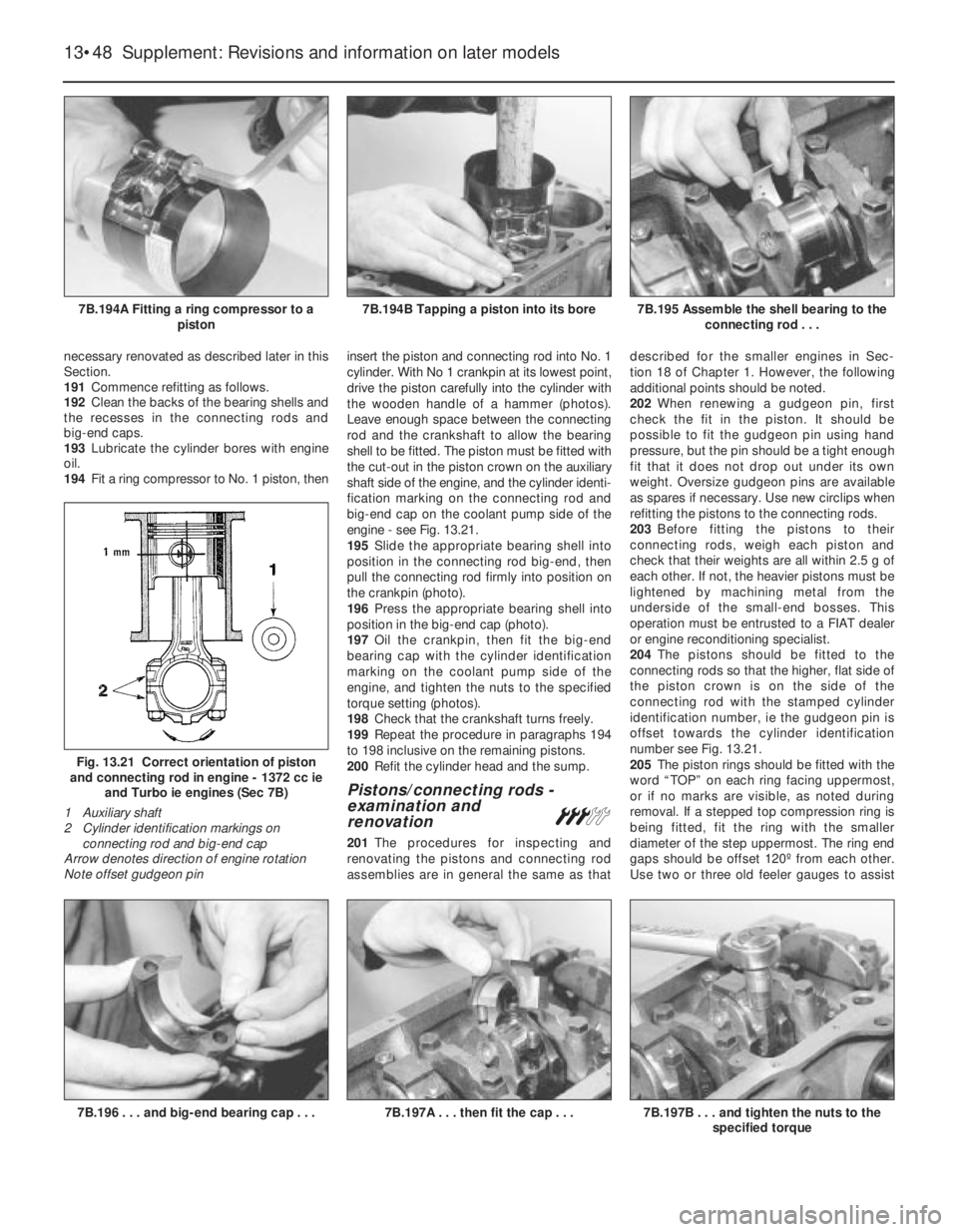
the wooden handle of a hammer (photos).
Leave enough space between the connecting
rod and the crankshaft to allow the bearing
shell to be fitted. The piston must be fitted with
the cut-out in the piston crown on the auxiliary
shaft side of the engine, and the cylinder identi-
fication marking on the connecting rod and
big-end cap on the coolant pump side of the
engine - see Fig. 13.21.
195Slide the appropriate bearing shell into
position in the connecting rod big-end, then
pull the connecting rod firmly into position on
the crankpin (photo).
196Press the appropriate bearing shell into
position in the big-end cap (photo).
197Oil the crankpin, then fit the big-end
bearing cap with the cylinder identification
marking on the coolant pump side of the
engine, and tighten the nuts to the specified
torque setting (photos).
198Check that the crankshaft turns freely.
199Repeat the procedure in paragraphs 194
to 198 inclusive on the remaining pistons.
200Refit the cylinder head and the sump.
Pistons/connecting rods -
examination and
renovation
#
201The procedures for inspecting and
renovating the pistons and connecting rod
assemblies are in general the same as thatdescribed for the smaller engines in Sec-
tion 18 of Chapter 1. However, the following
additional points should be noted.
202When renewing a gudgeon pin, first
check the fit in the piston. It should be
possible to fit the gudgeon pin using hand
pressure, but the pin should be a tight enough
fit that it does not drop out under its own
weight. Oversize gudgeon pins are available
as spares if necessary. Use new circlips when
refitting the pistons to the connecting rods.
203Before fitting the pistons to their
connecting rods, weigh each piston and
check that their weights are all within 2.5 g of
each other. If not, the heavier pistons must be
lightened by machining metal from the
underside of the small-end bosses. This
operation must be entrusted to a FIAT dealer
or engine reconditioning specialist.
204The pistons should be fitted to the
connecting rods so that the higher, flat side of
the piston crown is on the side of the
connecting rod with the stamped cylinder
identification number, ie the gudgeon pin is
offset towards the cylinder identification
number see Fig. 13.21.
205The piston rings should be fitted with the
word “TOP” on each ring facing uppermost,
or if no marks are visible, as noted during
removal. If a stepped top compression ring is
being fitted, fit the ring with the smaller
diameter of the step uppermost. The ring end
gaps should be offset 120º from each other.
Use two or three old feeler gauges to assist
13•48 Supplement: Revisions and information on later models
7B.197B . . . and tighten the nuts to the
specified torque
Fig. 13.21 Correct orientation of piston
and connecting rod in engine - 1372 cc ie
and Turbo ie engines (Sec 7B)
1 Auxiliary shaft
2 Cylinder identification markings on
connecting rod and big-end cap
Arrow denotes direction of engine rotation
Note offset gudgeon pin
7B.197A . . . then fit the cap . . .7B.196 . . . and big-end bearing cap . . .
7B.195 Assemble the shell bearing to the
connecting rod . . .7B.194B Tapping a piston into its bore7B.194A Fitting a ring compressor to a
piston
Page 174 of 303
fitting, as during removal. Note that the
compression rings are brittle, and will snap if
expanded too far.
206If new pistons are to be fitted, they must
be selected from the grades available, after
measuring the cylinder bores. Normally, the
appropriate oversize pistons are supplied by
the dealer when the block is rebored.
207Whenever new piston rings are being
installed, the glaze on the original cylinder
bores should be removed using either
abrasive paper or a glaze-removing tool in an
electric drill. If abrasive paper is used, use
strokes at 60º to the bore centre-line, to
create a cross-hatching effect.
Engine/transmission
mountings - renewalÁ
208The engine/gearbox assembly is
suspended in the engine compartment on
three mountings, two of which are attached to
the gearbox, and one to the engine.
Right-hand mounting
209Apply the handbrake, then jack up the
front of the vehicle and support it securely on
axle stands.
210Suitable lifting tackle must now be
attached to the engine in order to support it as
the engine mounting is removed. No lifting
brackets are provided, so care must be taken
when deciding on an engine lifting point. In the
workshop, a right-angled bracket was made up
by bending a suitable piece of steel plate. The
bracket was then bolted to the engine using the
rear right-hand camshaft housing securing bolt
with suitable packing washers.
211Attach the lifting tackle to the bracket on
the engine and just take the weight of the
assembly.
212Working under the vehicle, unbolt the
engine mounting bracket from the cylinder
block, and unbolt the mounting from the
body, then withdraw the bracket/mounting
assembly.
213Unscrew the nut and through-bolt,
counter holding the bolt with a second
spanner or socket, and separate the mounting
from the bracket.
214Fit the new mounting to the bracket, and
tighten the nut to the specified torque, while
counterholding the through-bolt using a
suitable spanner or socket.
215Refit the mounting bracket to the cylinder
block, and tighten the securing bolts to the
specified torque.
216Refit the mounting to the body and
tighten the securing bolts to the specified
torque.
217Disconnect the lifting tackle from the
engine, and remove the engine lifting bracket.
218Lower the vehicle to the ground.
Left-hand mountings
219Apply the handbrake, then jack up the
front of the vehicle and support it securely on
axle stands.
220Suitable lifting tackle must now be
attached to the gearbox lifting bracket inorder to support the weight of the assembly
as the mounting is removed.
221Attach the lifting tackle to the bracket on
the gearbox, and just take the weight of the
assembly.
222Working under the vehicle, unbolt the
mounting bracket from the gearbox, and
unbolt the mounting from the body, then
withdraw the bracket/mounting assembly.
223Proceed as described in paragraphs 213
and 214.
224Refit the mounting bracket to the
gearbox, and tighten the securing bolts to the
specified torque.
225Refit the mounting to the body and
tighten the mounting bolts to the specified
torque.
226Disconnect the lifting tackle from the
engine.
227Lower the vehicle to the ground.
PART C: ENGINE REMOVAL
AND DISMANTLING
Method of removal - general
1The engine (complete with transmission) is
disconnected and lowered downwards
through the engine compartment, then
withdrawn from the front underside of the car.
1372 cc engine/
transmission - removal
and separation
#
Warning: Refer to the beginning
of Section 9 before starting any
work.
2Depressurize the fuel system as described
in Section 9 of this Chapter.
3Disconnect the battery negative lead.
4Mark the position of the hinges on the
underside of the bonnet, then with the aid of
an assistant, unscrew the hinge bolts and lift
the bonnet clear of the car. Store the bonnet
in a safe area.
5Drain the engine coolant.
6Drain the engine and transmission oils.
7Disconnect and remove the air filter.
8Disconnect the coolant hoses from the
engine, including the hose to the inlet
manifold.
9Detach the ignition coil (HT) lead from the
distributor.10Compress the retaining clip and detach
the engine idle speed actuator lead from the
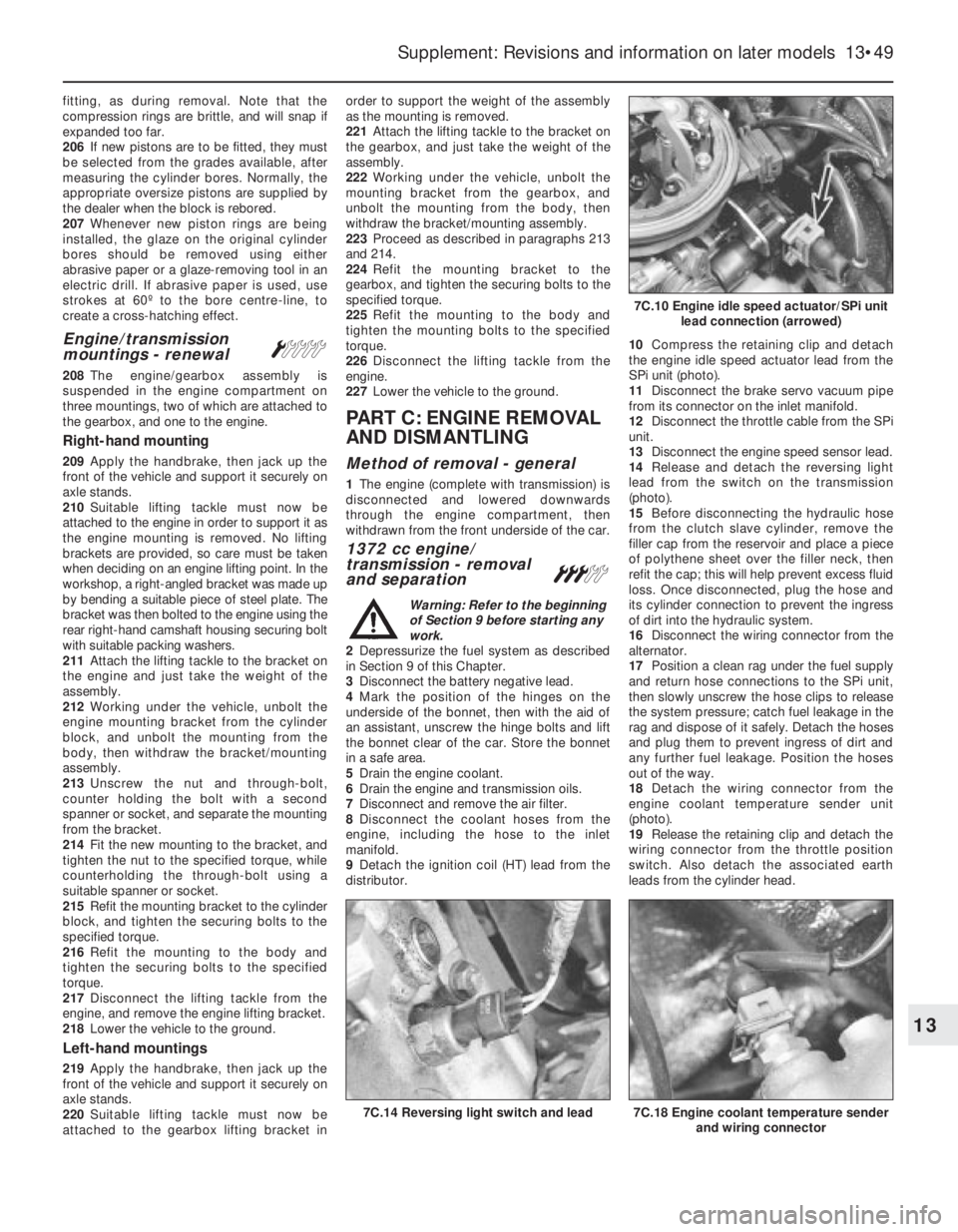
SPi unit (photo).
11Disconnect the brake servo vacuum pipe
from its connector on the inlet manifold.
12Disconnect the throttle cable from the SPi
unit.
13Disconnect the engine speed sensor lead.
14Release and detach the reversing light
lead from the switch on the transmission
(photo).
15Before disconnecting the hydraulic hose
from the clutch slave cylinder, remove the
filler cap from the reservoir and place a piece
of polythene sheet over the filler neck, then
refit the cap; this will help prevent excess fluid
loss. Once disconnected, plug the hose and
its cylinder connection to prevent the ingress
of dirt into the hydraulic system.
16Disconnect the wiring connector from the
alternator.
17Position a clean rag under the fuel supply
and return hose connections to the SPi unit,
then slowly unscrew the hose clips to release
the system pressure; catch fuel leakage in the
rag and dispose of it safely. Detach the hoses
and plug them to prevent ingress of dirt and
any further fuel leakage. Position the hoses
out of the way.
18Detach the wiring connector from the
engine coolant temperature sender unit
(photo).
19Release the retaining clip and detach the
wiring connector from the throttle position
switch. Also detach the associated earth
leads from the cylinder head.
Supplement: Revisions and information on later models 13•49
7C.14 Reversing light switch and lead7C.18 Engine coolant temperature sender
and wiring connector
7C.10 Engine idle speed actuator/SPi unit
lead connection (arrowed)
13
Page 178 of 303
bearing caps with a soft non-fluffy rag, then fit
the lower halves of the bearing shells to their
seats. Again, note that the centre (No. 3)
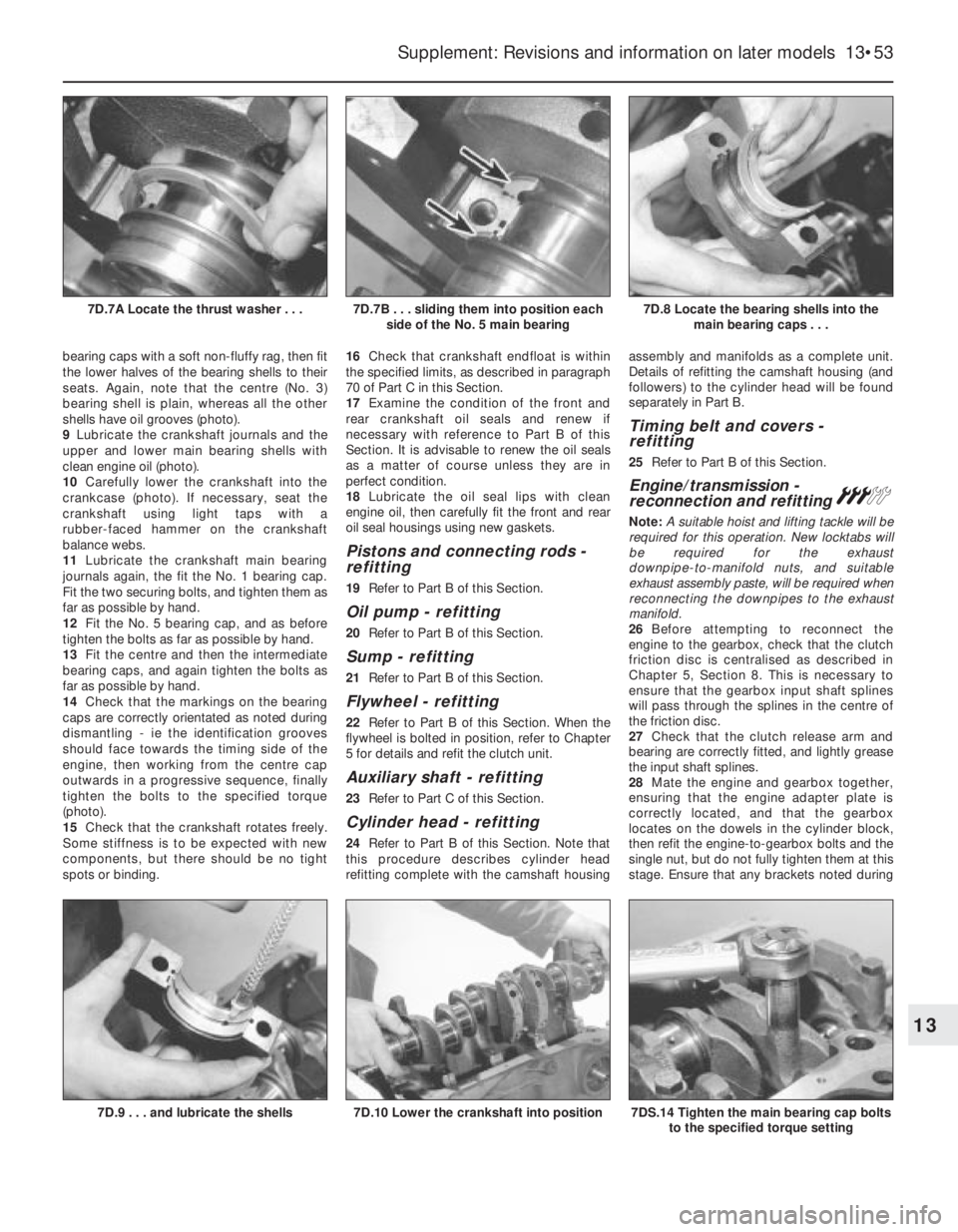
bearing shell is plain, whereas all the other
shells have oil grooves (photo).
9Lubricate the crankshaft journals and the
upper and lower main bearing shells with
clean engine oil (photo).
10Carefully lower the crankshaft into the
crankcase (photo). If necessary, seat the
crankshaft using light taps with a
rubber-faced hammer on the crankshaft
balance webs.
11Lubricate the crankshaft main bearing
journals again, the fit the No. 1 bearing cap.
Fit the two securing bolts, and tighten them as
far as possible by hand.
12Fit the No. 5 bearing cap, and as before
tighten the bolts as far as possible by hand.
13Fit the centre and then the intermediate
bearing caps, and again tighten the bolts as
far as possible by hand.
14Check that the markings on the bearing
caps are correctly orientated as noted during
dismantling - ie the identification grooves
should face towards the timing side of the
engine, then working from the centre cap
outwards in a progressive sequence, finally
tighten the bolts to the specified torque
(photo).
15Check that the crankshaft rotates freely.
Some stiffness is to be expected with new
components, but there should be no tight
spots or binding.16Check that crankshaft endfloat is within
the specified limits, as described in paragraph
70 of Part C in this Section.
17Examine the condition of the front and
rear crankshaft oil seals and renew if
necessary with reference to Part B of this
Section. It is advisable to renew the oil seals
as a matter of course unless they are in
perfect condition.
18Lubricate the oil seal lips with clean
engine oil, then carefully fit the front and rear
oil seal housings using new gaskets.
Pistons and connecting rods -
refitting
19Refer to Part B of this Section.
Oil pump - refitting
20Refer to Part B of this Section.
Sump - refitting
21Refer to Part B of this Section.
Flywheel - refitting
22Refer to Part B of this Section. When the
flywheel is bolted in position, refer to Chapter
5 for details and refit the clutch unit.
Auxiliary shaft - refitting
23Refer to Part C of this Section.
Cylinder head - refitting
24Refer to Part B of this Section. Note that
this procedure describes cylinder head
refitting complete with the camshaft housingassembly and manifolds as a complete unit.
Details of refitting the camshaft housing (and
followers) to the cylinder head will be found
separately in Part B.
Timing belt and covers -
refitting
25Refer to Part B of this Section.
Engine/transmission -
reconnection and refitting#
Note: A suitable hoist and lifting tackle will be
required for this operation. New locktabs will
be required for the exhaust
downpipe-to-manifold nuts, and suitable
exhaust assembly paste, will be required when
reconnecting the downpipes to the exhaust
manifold.
26Before attempting to reconnect the
engine to the gearbox, check that the clutch
friction disc is centralised as described in
Chapter 5, Section 8. This is necessary to
ensure that the gearbox input shaft splines
will pass through the splines in the centre of
the friction disc.
27Check that the clutch release arm and
bearing are correctly fitted, and lightly grease
the input shaft splines.
28Mate the engine and gearbox together,
ensuring that the engine adapter plate is
correctly located, and that the gearbox
locates on the dowels in the cylinder block,
then refit the engine-to-gearbox bolts and the
single nut, but do not fully tighten them at this
stage. Ensure that any brackets noted during
Supplement: Revisions and information on later models 13•53
7D.8 Locate the bearing shells into the
main bearing caps . . .7D.7B . . . sliding them into position each
side of the No. 5 main bearing
7DS.14 Tighten the main bearing cap bolts
to the specified torque setting7D.10 Lower the crankshaft into position7D.9 . . . and lubricate the shells
13
7D.7A Locate the thrust washer . . .
Page 179 of 303
removal are in place under the
engine-to-gearbox bolts. Do not allow the
weight of the gearbox to hang on the input
shaft as it is engaged with the clutch friction
disc.
29Refit the starter motor, ensuring that the
wiring harness bracket is in position on the
top bolt.
30Locate the engine/transmission unit at the
front of the car and move it into position under
the engine compartment. Attach the lifting
sling and hoist as during removal.
31Enlist the aid of an assistant to help
steady the combined units as they are raised
into position and to locate the mountings in
the engine compartment.
32Once they are located, tighten the
mountings to the specified torque settings,
then disconnect the lifting hoist and sling.
33The remainder of the refitting and
reconnection procedures are a reversal of the
removal procedure described in Part C. For
further details on reconnecting the
suspension and driveshaft components,
refer to Chapter 7 and Section 13 of this
Chapter.
34Ensure that the exhaust downpipe-to-
manifold connection is clean and renew the
gasket when reconnecting this joint. Use a
smear of exhaust assembly paste on the jointfaces. Use new lockwashers and tighten the
flange nuts securely.
35Ensure that all fuel and coolant
connections are cleanly and securely made.
36Ensure that all wiring connections are
correct and securely made.
37Top up the engine and transmission oil
levels.
38Refill the cooling system.
39Check that all connections are securely
made, then reconnect the battery negative
lead.
Initial start-up after major
overhaul
40Refer to Chapter 1, Section 45.
8 Cooling system
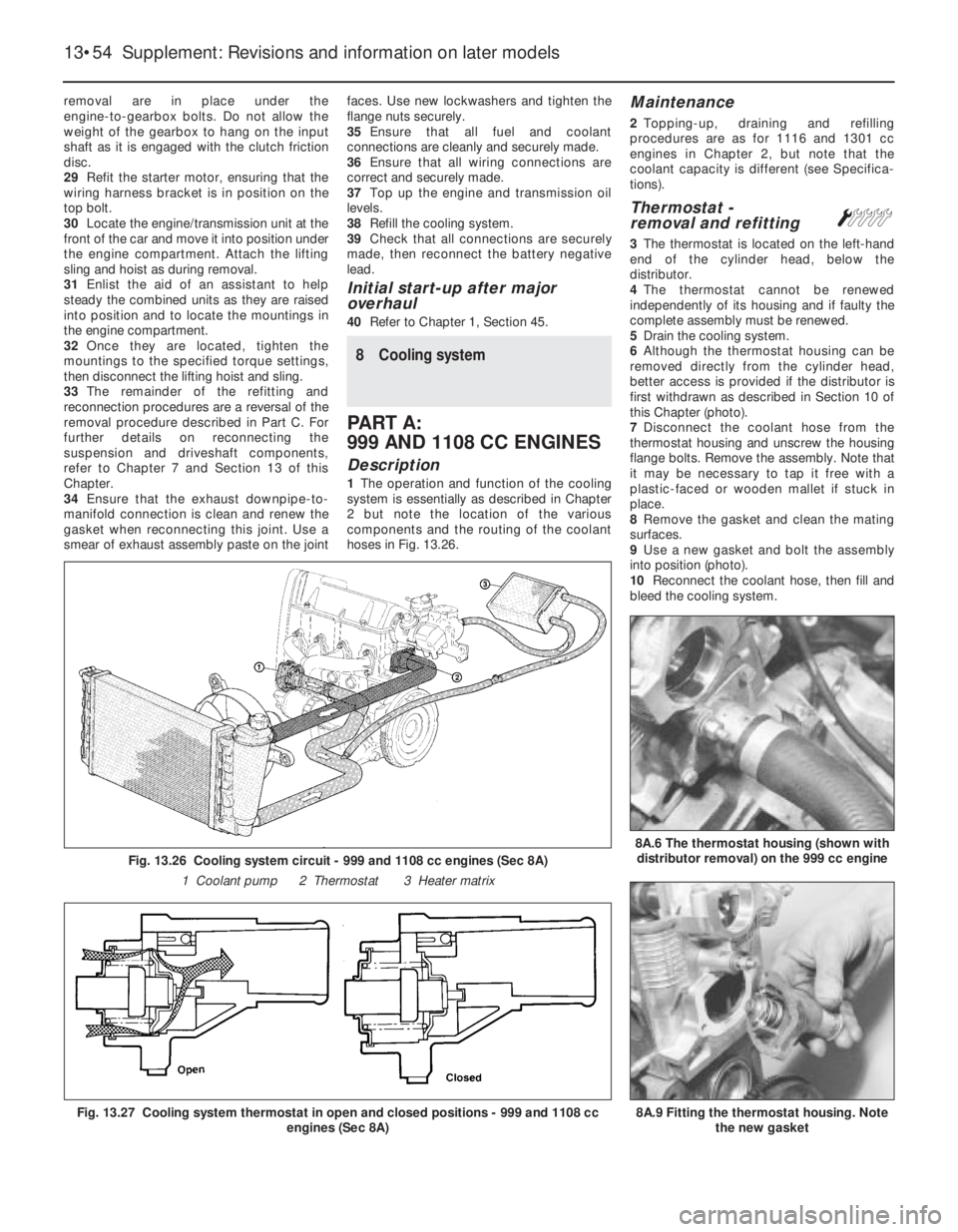
PART A:
999 AND 1108 CC ENGINES
Description
1The operation and function of the cooling
system is essentially as described in Chapter
2 but note the location of the various
components and the routing of the coolant
hoses in Fig. 13.26.
Maintenance
2Topping-up, draining and refilling
procedures are as for 1116 and 1301 cc
engines in Chapter 2, but note that the
coolant capacity is different (see Specifica-
tions).
Thermostat -
removal and refittingÁ
3The thermostat is located on the left-hand
end of the cylinder head, below the
distributor.
4The thermostat cannot be renewed
independently of its housing and if faulty the
complete assembly must be renewed.
5Drain the cooling system.
6Although the thermostat housing can be
removed directly from the cylinder head,
better access is provided if the distributor is
first withdrawn as described in Section 10 of
this Chapter (photo).
7Disconnect the coolant hose from the
thermostat housing and unscrew the housing
flange bolts. Remove the assembly. Note that
it may be necessary to tap it free with a
plastic-faced or wooden mallet if stuck in
place.
8Remove the gasket and clean the mating
surfaces.
9Use a new gasket and bolt the assembly
into position (photo).
10Reconnect the coolant hose, then fill and
bleed the cooling system.
13•54 Supplement: Revisions and information on later models
Fig. 13.26 Cooling system circuit - 999 and 1108 cc engines (Sec 8A)
1 Coolant pump 2 Thermostat 3 Heater matrix
Fig. 13.27 Cooling system thermostat in open and closed positions - 999 and 1108 cc
engines (Sec 8A)8A.9 Fitting the thermostat housing. Note
the new gasket
8A.6 The thermostat housing (shown with
distributor removal) on the 999 cc engine
Page 202 of 303
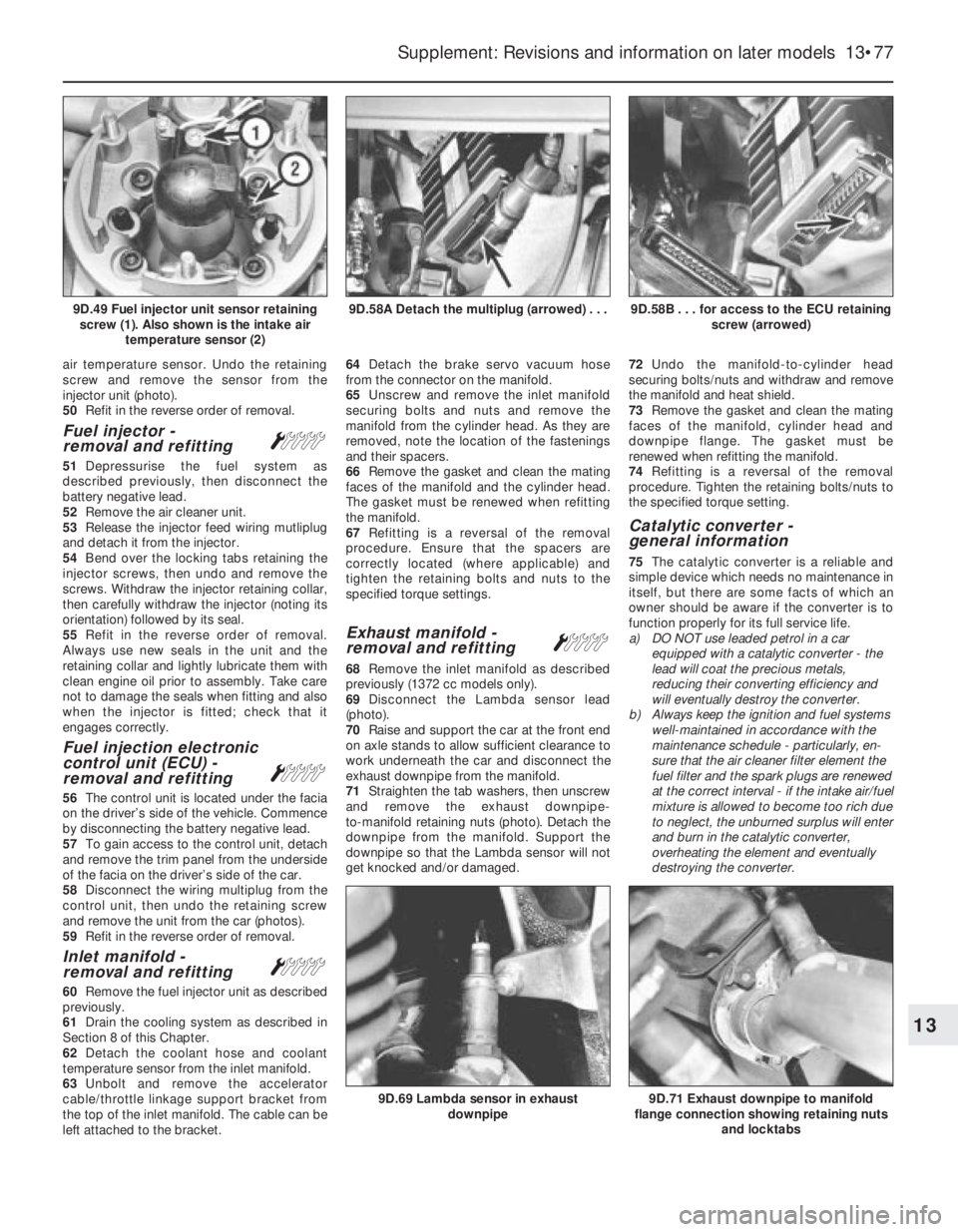
air temperature sensor. Undo the retaining
screw and remove the sensor from the
injector unit (photo).
50Refit in the reverse order of removal.
Fuel injector -
removal and refittingÁ
51Depressurise the fuel system as
described previously, then disconnect the
battery negative lead.
52Remove the air cleaner unit.
53Release the injector feed wiring mutliplug
and detach it from the injector.
54Bend over the locking tabs retaining the
injector screws, then undo and remove the
screws. Withdraw the injector retaining collar,
then carefully withdraw the injector (noting its
orientation) followed by its seal.
55Refit in the reverse order of removal.
Always use new seals in the unit and the
retaining collar and lightly lubricate them with
clean engine oil prior to assembly. Take care
not to damage the seals when fitting and also
when the injector is fitted; check that it
engages correctly.
Fuel injection electronic
control unit (ECU) -
removal and refitting
Á
56The control unit is located under the facia
on the driver’s side of the vehicle. Commence
by disconnecting the battery negative lead.
57To gain access to the control unit, detach
and remove the trim panel from the underside
of the facia on the driver’s side of the car.
58Disconnect the wiring multiplug from the
control unit, then undo the retaining screw
and remove the unit from the car (photos).
59Refit in the reverse order of removal.
Inlet manifold -
removal and refittingÁ
60Remove the fuel injector unit as described
previously.
61Drain the cooling system as described in
Section 8 of this Chapter.
62Detach the coolant hose and coolant
temperature sensor from the inlet manifold.
63Unbolt and remove the accelerator
cable/throttle linkage support bracket from
the top of the inlet manifold. The cable can be
left attached to the bracket.64Detach the brake servo vacuum hose
from the connector on the manifold.
65Unscrew and remove the inlet manifold
securing bolts and nuts and remove the
manifold from the cylinder head. As they are
removed, note the location of the fastenings
and their spacers.
66Remove the gasket and clean the mating
faces of the manifold and the cylinder head.
The gasket must be renewed when refitting
the manifold.
67Refitting is a reversal of the removal
procedure. Ensure that the spacers are
correctly located (where applicable) and
tighten the retaining bolts and nuts to the
specified torque settings.
Exhaust manifold -
removal and refittingÁ
68Remove the inlet manifold as described
previously (1372 cc models only).
69Disconnect the Lambda sensor lead
(photo).
70Raise and support the car at the front end
on axle stands to allow sufficient clearance to
work underneath the car and disconnect the
exhaust downpipe from the manifold.
71Straighten the tab washers, then unscrew
and remove the exhaust downpipe-
to-manifold retaining nuts (photo). Detach the
downpipe from the manifold. Support the
downpipe so that the Lambda sensor will not
get knocked and/or damaged.72Undo the manifold-to-cylinder head
securing bolts/nuts and withdraw and remove
the manifold and heat shield.
73Remove the gasket and clean the mating
faces of the manifold, cylinder head and
downpipe flange. The gasket must be
renewed when refitting the manifold.
74Refitting is a reversal of the removal
procedure. Tighten the retaining bolts/nuts to
the specified torque setting.
Catalytic converter -
general information
75The catalytic converter is a reliable and
simple device which needs no maintenance in
itself, but there are some facts of which an
owner should be aware if the converter is to
function properly for its full service life.
a) DO NOT use leaded petrol in a car
equipped with a catalytic converter - the
lead will coat the precious metals,
reducing their converting efficiency and
will eventually destroy the converter.
b) Always keep the ignition and fuel systems
well-maintained in accordance with the
maintenance schedule - particularly, en-
sure that the air cleaner filter element the
fuel filter and the spark plugs are renewed
at the correct interval - if the intake air/fuel
mixture is allowed to become too rich due
to neglect, the unburned surplus will enter
and burn in the catalytic converter,
overheating the element and eventually
destroying the converter.
Supplement: Revisions and information on later models 13•77
9D.58B . . . for access to the ECU retaining
screw (arrowed)9D.58A Detach the multiplug (arrowed) . . .9D.49 Fuel injector unit sensor retaining
screw (1). Also shown is the intake air
temperature sensor (2)
9D.71 Exhaust downpipe to manifold
flange connection showing retaining nuts
and locktabs9D.69 Lambda sensor in exhaust
downpipe
13
Page 219 of 303
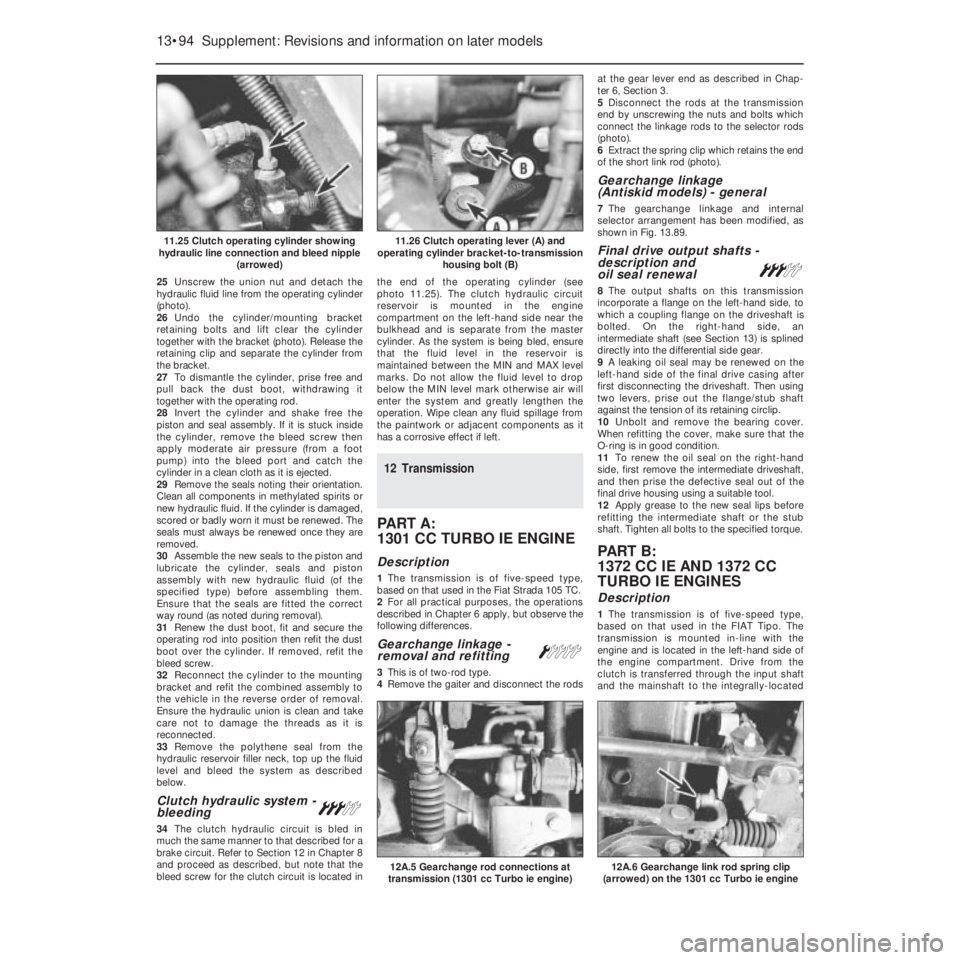
25Unscrew the union nut and detach the
hydraulic fluid line from the operating cylinder
(photo).
26Undo the cylinder/mounting bracket
retaining bolts and lift clear the cylinder
together with the bracket (photo). Release the
retaining clip and separate the cylinder from
the bracket.
27To dismantle the cylinder, prise free and
pull back the dust boot, withdrawing it
together with the operating rod.
28Invert the cylinder and shake free the
piston and seal assembly. If it is stuck inside
the cylinder, remove the bleed screw then
apply moderate air pressure (from a foot
pump) into the bleed port and catch the
cylinder in a clean cloth as it is ejected.
29Remove the seals noting their orientation.
Clean all components in methylated spirits or
new hydraulic fluid. If the cylinder is damaged,
scored or badly worn it must be renewed. The
seals must always be renewed once they are
removed.
30Assemble the new seals to the piston and
lubricate the cylinder, seals and piston
assembly with new hydraulic fluid (of the
specified type) before assembling them.
Ensure that the seals are fitted the correct
way round (as noted during removal).
31Renew the dust boot, fit and secure the
operating rod into position then refit the dust
boot over the cylinder. If removed, refit the
bleed screw.
32Reconnect the cylinder to the mounting
bracket and refit the combined assembly to
the vehicle in the reverse order of removal.
Ensure the hydraulic union is clean and take
care not to damage the threads as it is
reconnected.
33Remove the polythene seal from the
hydraulic reservoir filler neck, top up the fluid
level and bleed the system as described
below.
Clutch hydraulic system -
bleeding#
34The clutch hydraulic circuit is bled in
much the same manner to that described for a
brake circuit. Refer to Section 12 in Chapter 8
and proceed as described, but note that the
bleed screw for the clutch circuit is located inthe end of the operating cylinder (see
photo 11.25). The clutch hydraulic circuit
reservoir is mounted in the engine
compartment on the left-hand side near the
bulkhead and is separate from the master
cylinder. As the system is being bled, ensure
that the fluid level in the reservoir is
maintained between the MIN and MAX level
marks. Do not allow the fluid level to drop
below the MIN level mark otherwise air will
enter the system and greatly lengthen the
operation. Wipe clean any fluid spillage from
the paintwork or adjacent components as it
has a corrosive effect if left.
12 Transmission
PART A:
1301 CC TURBO IE ENGINE
Description
1The transmission is of five-speed type,
based on that used in the Fiat Strada 105 TC.
2For all practical purposes, the operations
described in Chapter 6 apply, but observe the
following differences.
Gearchange linkage -
removal and refitting Á
3This is of two-rod type.
4Remove the gaiter and disconnect the rodsat the gear lever end as described in Chap-
ter 6, Section 3.
5Disconnect the rods at the transmission
end by unscrewing the nuts and bolts which
connect the linkage rods to the selector rods
(photo).
6Extract the spring clip which retains the end
of the short link rod (photo).
Gearchange linkage
(Antiskid models) - general
7The gearchange linkage and internal
selector arrangement has been modified, as
shown in Fig. 13.89.
Final drive output shafts -
description and
oil seal renewal
#
8The output shafts on this transmission
incorporate a flange on the left-hand side, to
which a coupling flange on the driveshaft is
bolted. On the right-hand side, an
intermediate shaft (see Section 13) is splined
directly into the differential side gear.
9A leaking oil seal may be renewed on the
left-hand side of the final drive casing after
first disconnecting the driveshaft. Then using
two levers, prise out the flange/stub shaft
against the tension of its retaining circlip.
10Unbolt and remove the bearing cover.
When refitting the cover, make sure that the
O-ring is in good condition.
11To renew the oil seal on the right-hand
side, first remove the intermediate driveshaft,
and then prise the defective seal out of the
final drive housing using a suitable tool.
12Apply grease to the new seal lips before
refitting the intermediate shaft or the stub
shaft. Tighten all bolts to the specified torque.
PART B:
1372 CC IE AND 1372 CC
TURBO IE ENGINES
Description
1The transmission is of five-speed type,
based on that used in the FIAT Tipo. The
transmission is mounted in-line with the
engine and is located in the left-hand side of
the engine compartment. Drive from the
clutch is transferred through the input shaft
and the mainshaft to the integrally-located
13•94 Supplement: Revisions and information on later models
12A.6 Gearchange link rod spring clip
(arrowed) on the 1301 cc Turbo ie engine12A.5 Gearchange rod connections at
transmission (1301 cc Turbo ie engine)
11.26 Clutch operating lever (A) and
operating cylinder bracket-to-transmission
housing bolt (B)11.25 Clutch operating cylinder showing
hydraulic line connection and bleed nipple
(arrowed)
Page 222 of 303
27The engine must now be supported at its
left-hand end. If the engine/transmission lift
bracket is unbolted it can be attached at
another suitable position on the engine and
the lift sling/tool attached to it, but take care
not to attach it to a weak fixing point.
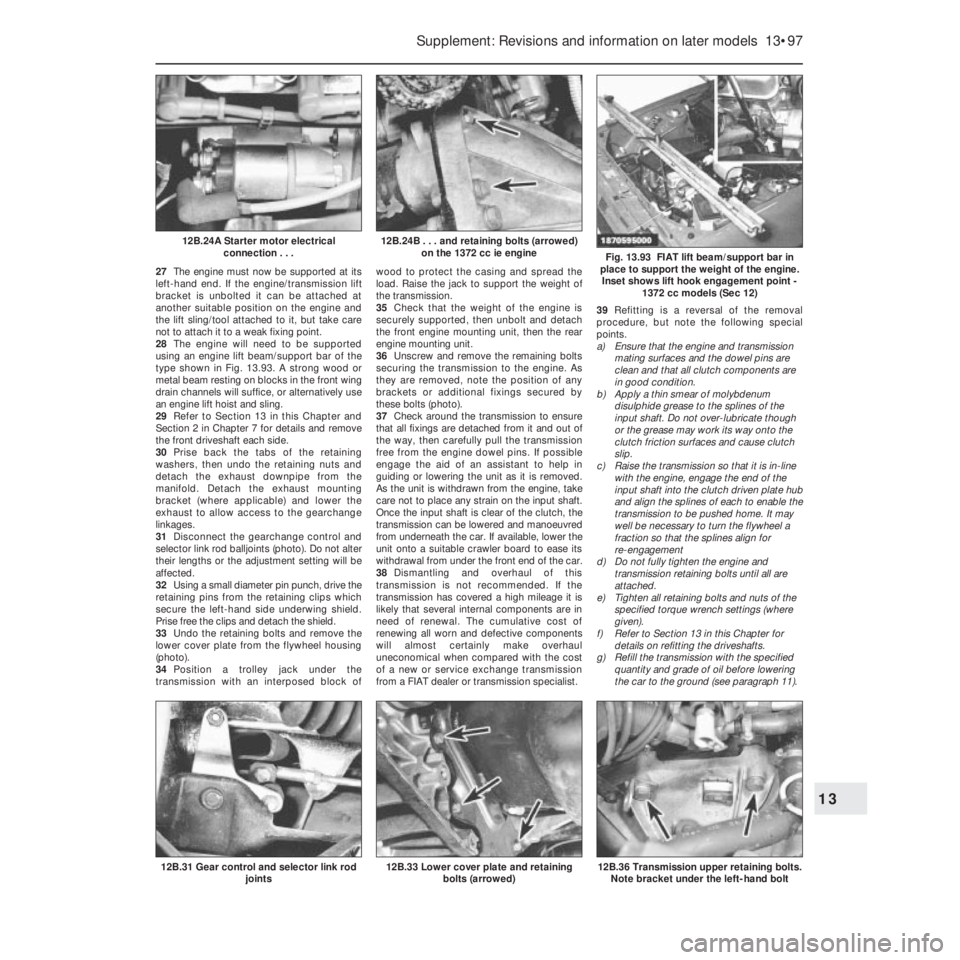
28The engine will need to be supported
using an engine lift beam/support bar of the
type shown in Fig. 13.93. A strong wood or
metal beam resting on blocks in the front wing
drain channels will suffice, or alternatively use
an engine lift hoist and sling.
29Refer to Section 13 in this Chapter and
Section 2 in Chapter 7 for details and remove
the front driveshaft each side.
30Prise back the tabs of the retaining
washers, then undo the retaining nuts and
detach the exhaust downpipe from the
manifold. Detach the exhaust mounting
bracket (where applicable) and lower the
exhaust to allow access to the gearchange
linkages.
31Disconnect the gearchange control and
selector link rod balljoints (photo). Do not alter
their lengths or the adjustment setting will be
affected.
32Using a small diameter pin punch, drive the
retaining pins from the retaining clips which
secure the left-hand side underwing shield.
Prise free the clips and detach the shield.
33Undo the retaining bolts and remove the
lower cover plate from the flywheel housing
(photo).
34Position a trolley jack under the
transmission with an interposed block ofwood to protect the casing and spread the
load. Raise the jack to support the weight of
the transmission.
35Check that the weight of the engine is
securely supported, then unbolt and detach
the front engine mounting unit, then the rear
engine mounting unit.
36Unscrew and remove the remaining bolts
securing the transmission to the engine. As
they are removed, note the position of any
brackets or additional fixings secured by
these bolts (photo).
37Check around the transmission to ensure
that all fixings are detached from it and out of
the way, then carefully pull the transmission
free from the engine dowel pins. If possible
engage the aid of an assistant to help in
guiding or lowering the unit as it is removed.
As the unit is withdrawn from the engine, take
care not to place any strain on the input shaft.
Once the input shaft is clear of the clutch, the
transmission can be lowered and manoeuvred
from underneath the car. If available, lower the
unit onto a suitable crawler board to ease its
withdrawal from under the front end of the car.
38Dismantling and overhaul of this
transmission is not recommended. If the
transmission has covered a high mileage it is
likely that several internal components are in
need of renewal. The cumulative cost of
renewing all worn and defective components
will almost certainly make overhaul
uneconomical when compared with the cost
of a new or service exchange transmission
from a FIAT dealer or transmission specialist.39Refitting is a reversal of the removal
procedure, but note the following special
points.
a) Ensure that the engine and transmission
mating surfaces and the dowel pins are
clean and that all clutch components are
in good condition.
b) Apply a thin smear of molybdenum
disulphide grease to the splines of the
input shaft. Do not over-lubricate though
or the grease may work its way onto the
clutch friction surfaces and cause clutch
slip.
c) Raise the transmission so that it is in-line
with the engine, engage the end of the
input shaft into the clutch driven plate hub
and align the splines of each to enable the
transmission to be pushed home. It may
well be necessary to turn the flywheel a
fraction so that the splines align for
re-engagement
d) Do not fully tighten the engine and
transmission retaining bolts until all are
attached.
e) Tighten all retaining bolts and nuts of the
specified torque wrench settings (where
given).
f) Refer to Section 13 in this Chapter for
details on refitting the driveshafts.
g) Refill the transmission with the specified
quantity and grade of oil before lowering
the car to the ground (see paragraph 11).
Supplement: Revisions and information on later models 13•97
Fig. 13.93 FIAT lift beam/support bar in
place to support the weight of the engine.
Inset shows lift hook engagement point -
1372 cc models (Sec 12)
12B.24B . . . and retaining bolts (arrowed)
on the 1372 cc ie engine12B.24A Starter motor electrical
connection . . .
12B.36 Transmission upper retaining bolts.
Note bracket under the left-hand bolt12B.33 Lower cover plate and retaining
bolts (arrowed)12B.31 Gear control and selector link rod
joints
13
Page 224 of 303
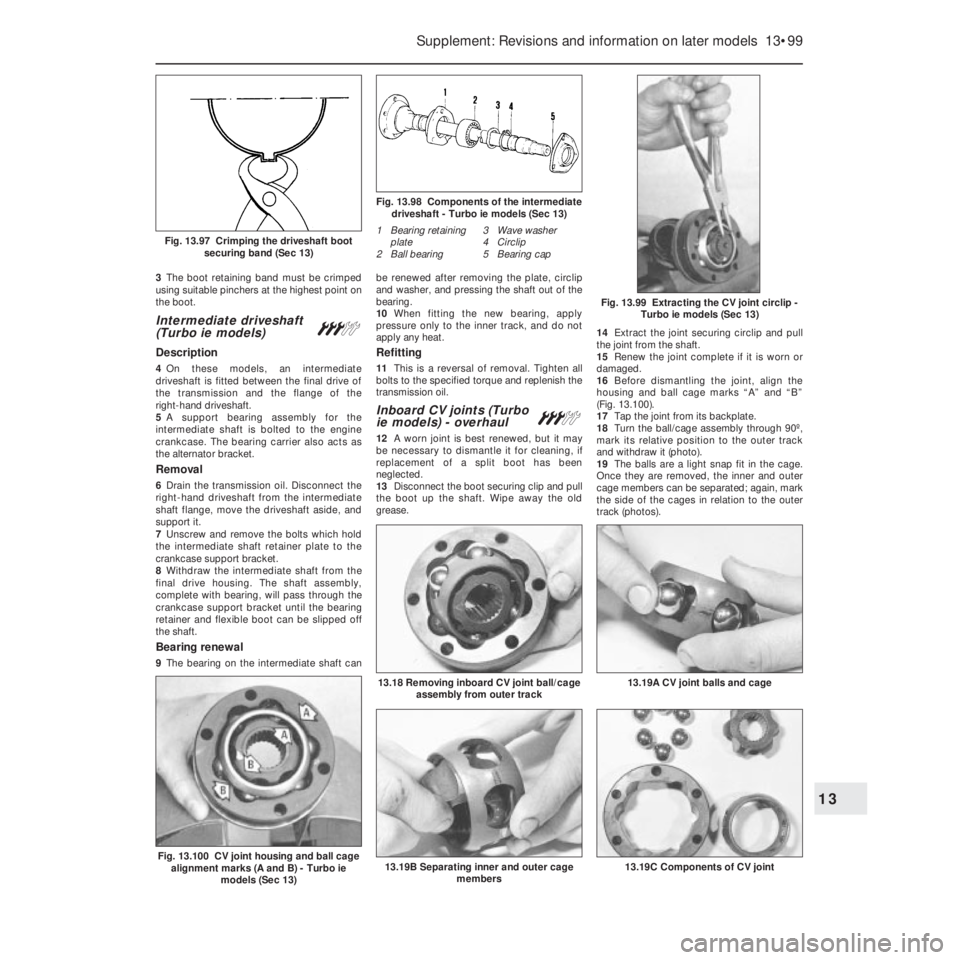
3The boot retaining band must be crimped
using suitable pinchers at the highest point on
the boot.
Intermediate driveshaft
(Turbo ie models) #
Description
4On these models, an intermediate
driveshaft is fitted between the final drive of
the transmission and the flange of the
right-hand driveshaft.
5A support bearing assembly for the
intermediate shaft is bolted to the engine
crankcase. The bearing carrier also acts as
the alternator bracket.
Removal
6Drain the transmission oil. Disconnect the
right-hand driveshaft from the intermediate
shaft flange, move the driveshaft aside, and
support it.
7Unscrew and remove the bolts which hold
the intermediate shaft retainer plate to the
crankcase support bracket.
8Withdraw the intermediate shaft from the
final drive housing. The shaft assembly,
complete with bearing, will pass through the
crankcase support bracket until the bearing
retainer and flexible boot can be slipped off
the shaft.
Bearing renewal
9The bearing on the intermediate shaft canbe renewed after removing the plate, circlip
and washer, and pressing the shaft out of the
bearing.
10When fitting the new bearing, apply
pressure only to the inner track, and do not
apply any heat.
Refitting
11This is a reversal of removal. Tighten all
bolts to the specified torque and replenish the
transmission oil.
Inboard CV joints (Turbo
ie models) - overhaul #
12A worn joint is best renewed, but it may
be necessary to dismantle it for cleaning, if
replacement of a split boot has been
neglected.
13Disconnect the boot securing clip and pull
the boot up the shaft. Wipe away the old
grease. 14Extract the joint securing circlip and pull
the joint from the shaft.
15Renew the joint complete if it is worn or
damaged.
16Before dismantling the joint, align the
housing and ball cage marks “A” and “B”
(Fig. 13.100).
17Tap the joint from its backplate.
18Turn the ball/cage assembly through 90º,
mark its relative position to the outer track
and withdraw it (photo).
19The balls are a light snap fit in the cage.
Once they are removed, the inner and outer
cage members can be separated; again, mark
the side of the cages in relation to the outer
track (photos).
Supplement: Revisions and information on later models 13•99
Fig. 13.99 Extracting the CV joint circlip -
Turbo ie models (Sec 13)
Fig. 13.98 Components of the intermediate
driveshaft - Turbo ie models (Sec 13)
1 Bearing retaining
plate
2 Ball bearing3 Wave washer
4 Circlip
5 Bearing cap
Fig. 13.97 Crimping the driveshaft boot
securing band (Sec 13)
13.19C Components of CV joint13.19B Separating inner and outer cage
members
13.19A CV joint balls and cage13.18 Removing inboard CV joint ball/cage
assembly from outer track
Fig. 13.100 CV joint housing and ball cage
alignment marks (A and B) - Turbo ie
models (Sec 13)
13
Page 226 of 303
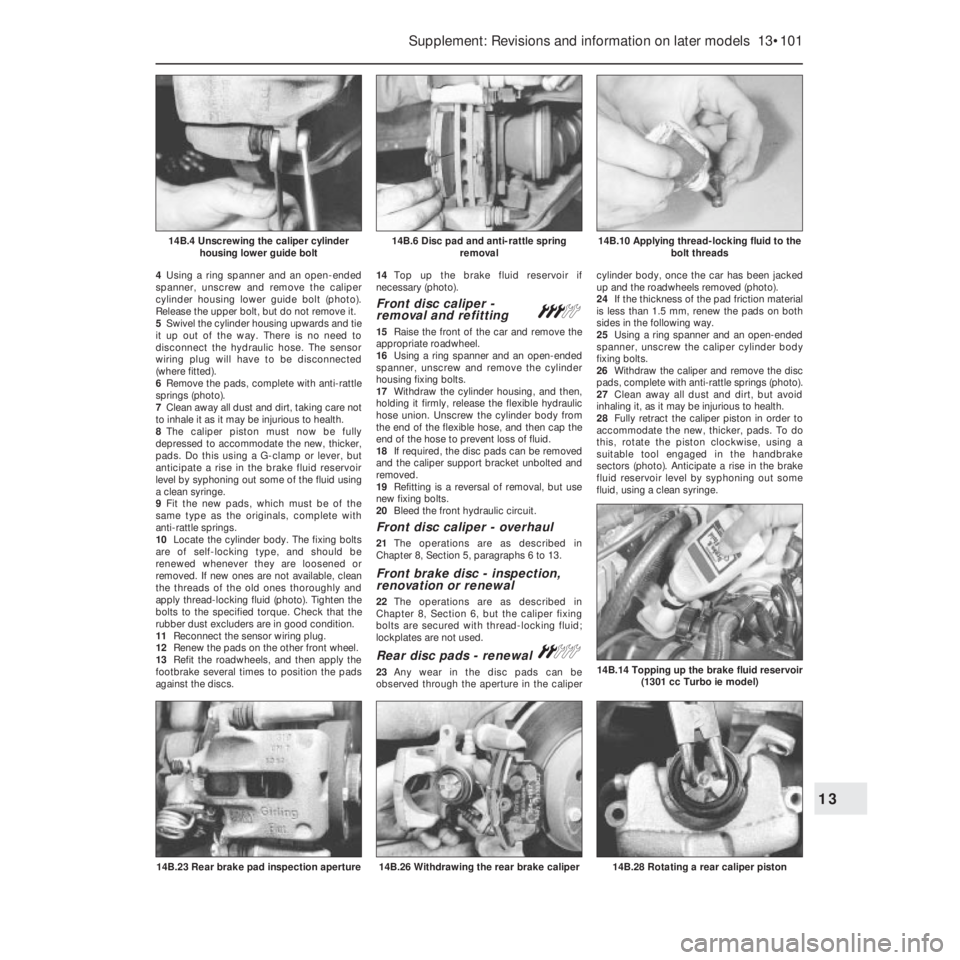
4Using a ring spanner and an open-ended
spanner, unscrew and remove the caliper
cylinder housing lower guide bolt (photo).
Release the upper bolt, but do not remove it.
5Swivel the cylinder housing upwards and tie
it up out of the way. There is no need to
disconnect the hydraulic hose. The sensor
wiring plug will have to be disconnected
(where fitted).
6Remove the pads, complete with anti-rattle
springs (photo).
7Clean away all dust and dirt, taking care not
to inhale it as it may be injurious to health.
8The caliper piston must now be fully
depressed to accommodate the new, thicker,
pads. Do this using a G-clamp or lever, but
anticipate a rise in the brake fluid reservoir
level by syphoning out some of the fluid using
a clean syringe.
9Fit the new pads, which must be of the
same type as the originals, complete with
anti-rattle springs.
10Locate the cylinder body. The fixing bolts
are of self-locking type, and should be
renewed whenever they are loosened or
removed. If new ones are not available, clean
the threads of the old ones thoroughly and
apply thread-locking fluid (photo). Tighten the
bolts to the specified torque. Check that the
rubber dust excluders are in good condition.
11Reconnect the sensor wiring plug.
12Renew the pads on the other front wheel.
13Refit the roadwheels, and then apply the
footbrake several times to position the pads
against the discs.14Top up the brake fluid reservoir if
necessary (photo).
Front disc caliper -
removal and refitting#
15Raise the front of the car and remove the
appropriate roadwheel.
16Using a ring spanner and an open-ended
spanner, unscrew and remove the cylinder
housing fixing bolts.
17Withdraw the cylinder housing, and then,
holding it firmly, release the flexible hydraulic
hose union. Unscrew the cylinder body from
the end of the flexible hose, and then cap the
end of the hose to prevent loss of fluid.
18If required, the disc pads can be removed
and the caliper support bracket unbolted and
removed.
19Refitting is a reversal of removal, but use
new fixing bolts.
20Bleed the front hydraulic circuit.
Front disc caliper - overhaul
21The operations are as described in
Chapter 8, Section 5, paragraphs 6 to 13.
Front brake disc - inspection,
renovation or renewal
22The operations are as described in
Chapter 8, Section 6, but the caliper fixing
bolts are secured with thread-locking fluid;
lockplates are not used.
Rear disc pads - renewal ª
23Any wear in the disc pads can be
observed through the aperture in the calipercylinder body, once the car has been jacked
up and the roadwheels removed (photo).
24If the thickness of the pad friction material
is less than 1.5 mm, renew the pads on both
sides in the following way.
25Using a ring spanner and an open-ended
spanner, unscrew the caliper cylinder body
fixing bolts.
26Withdraw the caliper and remove the disc
pads, complete with anti-rattle springs (photo).
27Clean away all dust and dirt, but avoid
inhaling it, as it may be injurious to health.
28Fully retract the caliper piston in order to
accommodate the new, thicker, pads. To do
this, rotate the piston clockwise, using a
suitable tool engaged in the handbrake
sectors (photo). Anticipate a rise in the brake
fluid reservoir level by syphoning out some
fluid, using a clean syringe.
Supplement: Revisions and information on later models 13•101
14B.10 Applying thread-locking fluid to the
bolt threads14B.6 Disc pad and anti-rattle spring
removal14B.4 Unscrewing the caliper cylinder
housing lower guide bolt
14B.28 Rotating a rear caliper piston14B.26 Withdrawing the rear brake caliper14B.23 Rear brake pad inspection aperture
14B.14 Topping up the brake fluid reservoir
(1301 cc Turbo ie model)
13