rims FIAT UNO 1983 Service Repair Manual
[x] Cancel search | Manufacturer: FIAT, Model Year: 1983, Model line: UNO, Model: FIAT UNO 1983Pages: 303, PDF Size: 10.36 MB
Page 107 of 303
Note: Before diagnosing steering faults, be
sure that trouble is not due to incorrect or
uneven tyre pressures, inappropriate tyre
combinations, or braking system or
suspension defects.
Car pulls to one side
m mIncorrect steering geometry
m mCollision damage
Vibration at steering wheel
m
mRoadwheels out of balance or loose
m mTyre damage
m mLoose driveshaft-to-hub nuts
Car wanders
m
mPlay in steering gear
m mWear in steering balljoints
Heavy or stiff steering
m
mLack of lubricant in steering gear or balljoints
m mIncorrect steering geometry
m mCollision damage
Play at steering wheel
m
mWear in steering rack or balljoints
m mLoose steering shaft coupling pinch-bolt or
worn splines
m mWorn steering column/shaft universal joints
Rattles from steering
m
mSteering damper defective or in need of
adjustment
m mLoose steering column mounting bolts
m mLoose steering column/shaft coupling
pinch-bolts
m mLoose steering rack housing mounting bolts
m mWorn steering shaft bushes
Excessive or uneven tyre wear
m
mIncorrect steering geometry
m mWorn steering components
m mCollision damage wear. Before considering the steering angles,
check that the tyres are correctly inflated, that
the front wheels are not buckled, the hub
bearings are not worn or incorrectly adjusted
and that the steering linkage is in good order,
without slackness or wear at the joints.
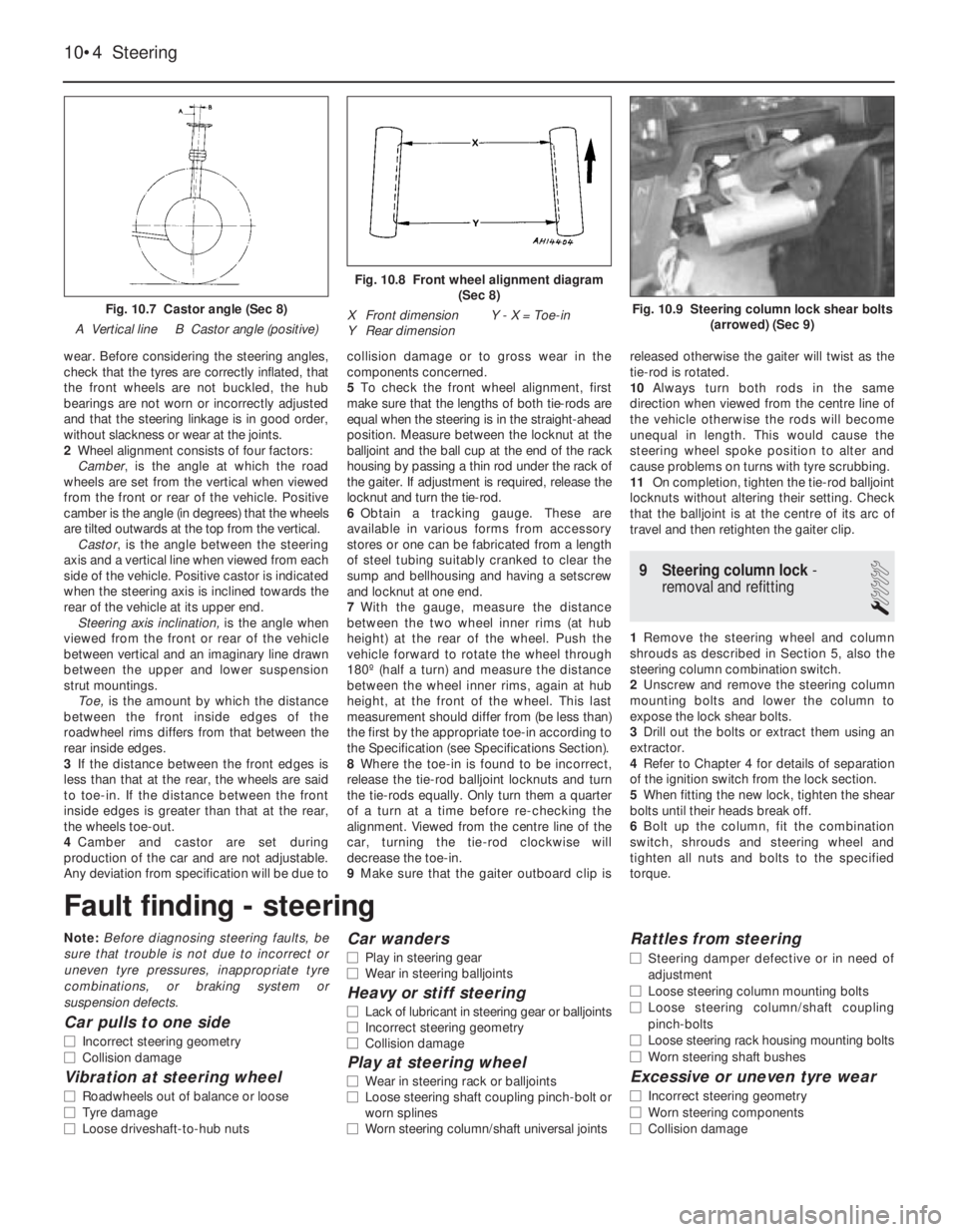
2Wheel alignment consists of four factors:
Camber, is the angle at which the road
wheels are set from the vertical when viewed
from the front or rear of the vehicle. Positive
camber is the angle (in degrees) that the wheels
are tilted outwards at the top from the vertical.
Castor, is the angle between the steering
axis and a vertical line when viewed from each
side of the vehicle. Positive castor is indicated
when the steering axis is inclined towards the
rear of the vehicle at its upper end.
Steering axis inclination, is the angle when
viewed from the front or rear of the vehicle
between vertical and an imaginary line drawn
between the upper and lower suspension
strut mountings.
Toe,is the amount by which the distance
between the front inside edges of the
roadwheel rims differs from that between the
rear inside edges.
3If the distance between the front edges is
less than that at the rear, the wheels are said
to toe-in. If the distance between the front
inside edges is greater than that at the rear,
the wheels toe-out.
4Camber and castor are set during
production of the car and are not adjustable.
Any deviation from specification will be due tocollision damage or to gross wear in the
components concerned.
5To check the front wheel alignment, first
make sure that the lengths of both tie-rods are
equal when the steering is in the straight-ahead
position. Measure between the locknut at the
balljoint and the ball cup at the end of the rack
housing by passing a thin rod under the rack of
the gaiter. If adjustment is required, release the
locknut and turn the tie-rod.
6Obtain a tracking gauge. These are
available in various forms from accessory
stores or one can be fabricated from a length
of steel tubing suitably cranked to clear the
sump and bellhousing and having a setscrew
and locknut at one end.
7With the gauge, measure the distance
between the two wheel inner rims (at hub
height) at the rear of the wheel. Push the
vehicle forward to rotate the wheel through
180º (half a turn) and measure the distance
between the wheel inner rims, again at hub
height, at the front of the wheel. This last
measurement should differ from (be less than)
the first by the appropriate toe-in according to
the Specification (see Specifications Section).
8Where the toe-in is found to be incorrect,
release the tie-rod balljoint locknuts and turn
the tie-rods equally. Only turn them a quarter
of a turn at a time before re-checking the
alignment. Viewed from the centre line of the
car, turning the tie-rod clockwise will
decrease the toe-in.
9Make sure that the gaiter outboard clip isreleased otherwise the gaiter will twist as the
tie-rod is rotated.
10Always turn both rods in the same
direction when viewed from the centre line of
the vehicle otherwise the rods will become
unequal in length. This would cause the
steering wheel spoke position to alter and
cause problems on turns with tyre scrubbing.
11On completion, tighten the tie-rod balljoint
locknuts without altering their setting. Check
that the balljoint is at the centre of its arc of
travel and then retighten the gaiter clip.
9 Steering column lock-
removal and refitting
1
1Remove the steering wheel and column
shrouds as described in Section 5, also the
steering column combination switch.
2Unscrew and remove the steering column
mounting bolts and lower the column to
expose the lock shear bolts.
3Drill out the bolts or extract them using an
extractor.
4Refer to Chapter 4 for details of separation
of the ignition switch from the lock section.
5When fitting the new lock, tighten the shear
bolts until their heads break off.
6Bolt up the column, fit the combination
switch, shrouds and steering wheel and
tighten all nuts and bolts to the specified
torque.
10•4 Steering
Fig. 10.9 Steering column lock shear bolts
(arrowed) (Sec 9)
Fig. 10.8 Front wheel alignment diagram
(Sec 8)
X Front dimension Y - X = Toe-in
Y Rear dimension
Fig. 10.7 Castor angle (Sec 8)
A Vertical line B Castor angle (positive)
Fault finding - steering
Page 221 of 303
require maintenance other than general
inspection for wear in the linkage joints. If
excessive wear is found in any of the joints, they
can be individually detached and renewed.
13Access to the control rods is eased by
detaching and lowering the exhaust system
from the exhaust manifold.
14If a new adjustable control rod is to be
fitted, remove the original rod as a unit, but do
not alter its adjustment for length. The new
rod can then (if required) be set to the same
length as the original in order to maintain the
original setting. Do so by loosening off the
locknut and turning the balljoint as required;
ensure that the angle of the joint is correct
before tightening the locknut.
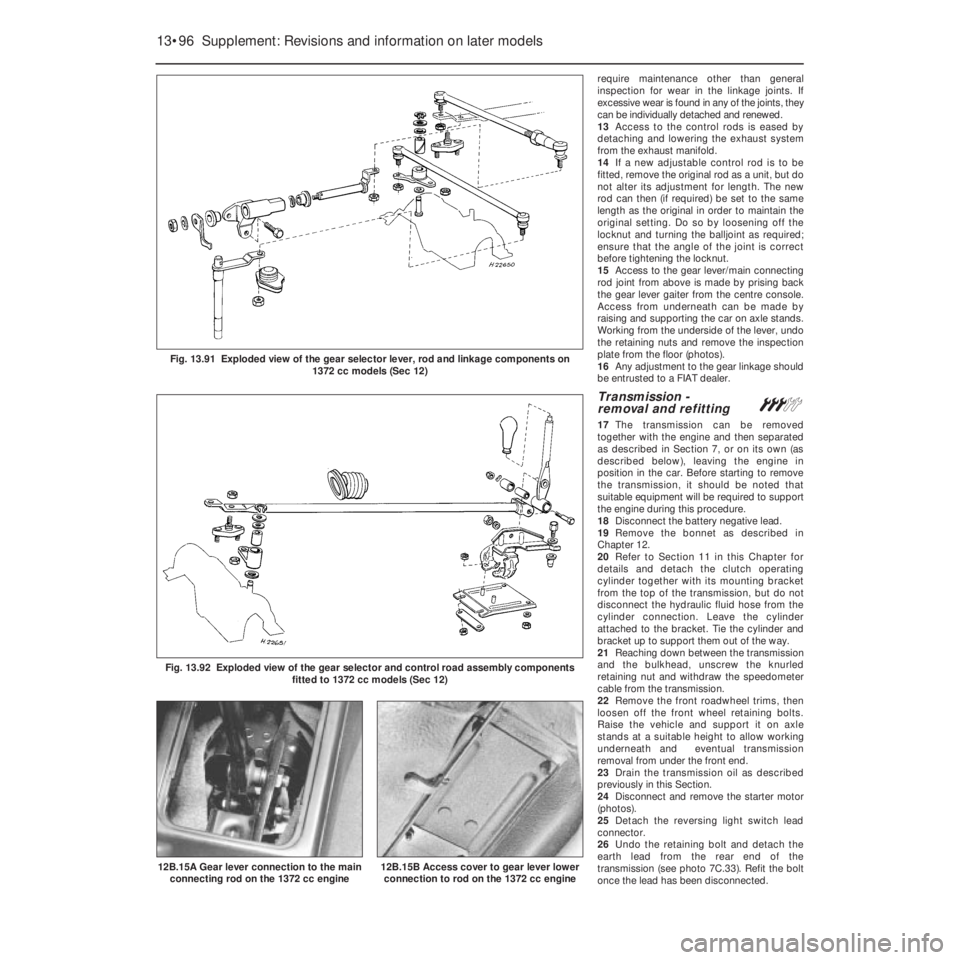
15Access to the gear lever/main connecting
rod joint from above is made by prising back
the gear lever gaiter from the centre console.
Access from underneath can be made by
raising and supporting the car on axle stands.
Working from the underside of the lever, undo
the retaining nuts and remove the inspection
plate from the floor (photos).
16Any adjustment to the gear linkage should
be entrusted to a FIAT dealer.
Transmission -
removal and refitting#
17The transmission can be removed
together with the engine and then separated
as described in Section 7, or on its own (as
described below), leaving the engine in
position in the car. Before starting to remove
the transmission, it should be noted that
suitable equipment will be required to support
the engine during this procedure.
18Disconnect the battery negative lead.
19Remove the bonnet as described in
Chapter 12.
20Refer to Section 11 in this Chapter for
details and detach the clutch operating
cylinder together with its mounting bracket
from the top of the transmission, but do not
disconnect the hydraulic fluid hose from the
cylinder connection. Leave the cylinder
attached to the bracket. Tie the cylinder and
bracket up to support them out of the way.
21Reaching down between the transmission
and the bulkhead, unscrew the knurled
retaining nut and withdraw the speedometer
cable from the transmission.
22Remove the front roadwheel trims, then
loosen off the front wheel retaining bolts.
Raise the vehicle and support it on axle
stands at a suitable height to allow working
underneath and eventual transmission
removal from under the front end.
23Drain the transmission oil as described
previously in this Section.
24Disconnect and remove the starter motor
(photos).
25Detach the reversing light switch lead
connector.
26Undo the retaining bolt and detach the
earth lead from the rear end of the
transmission (see photo 7C.33). Refit the bolt
once the lead has been disconnected.
13•96 Supplement: Revisions and information on later models
12B.15B Access cover to gear lever lower
connection to rod on the 1372 cc engine
Fig. 13.92 Exploded view of the gear selector and control road assembly components
fitted to 1372 cc models (Sec 12)
12B.15A Gear lever connection to the main
connecting rod on the 1372 cc engine
Fig. 13.91 Exploded view of the gear selector lever, rod and linkage components on
1372 cc models (Sec 12)