ECU FORD B MAX 2012 1.G User Guide
[x] Cancel search | Manufacturer: FORD, Model Year: 2012, Model line: B MAX, Model: FORD B MAX 2012 1.GPages: 256, PDF Size: 19.67 MB
Page 65 of 256
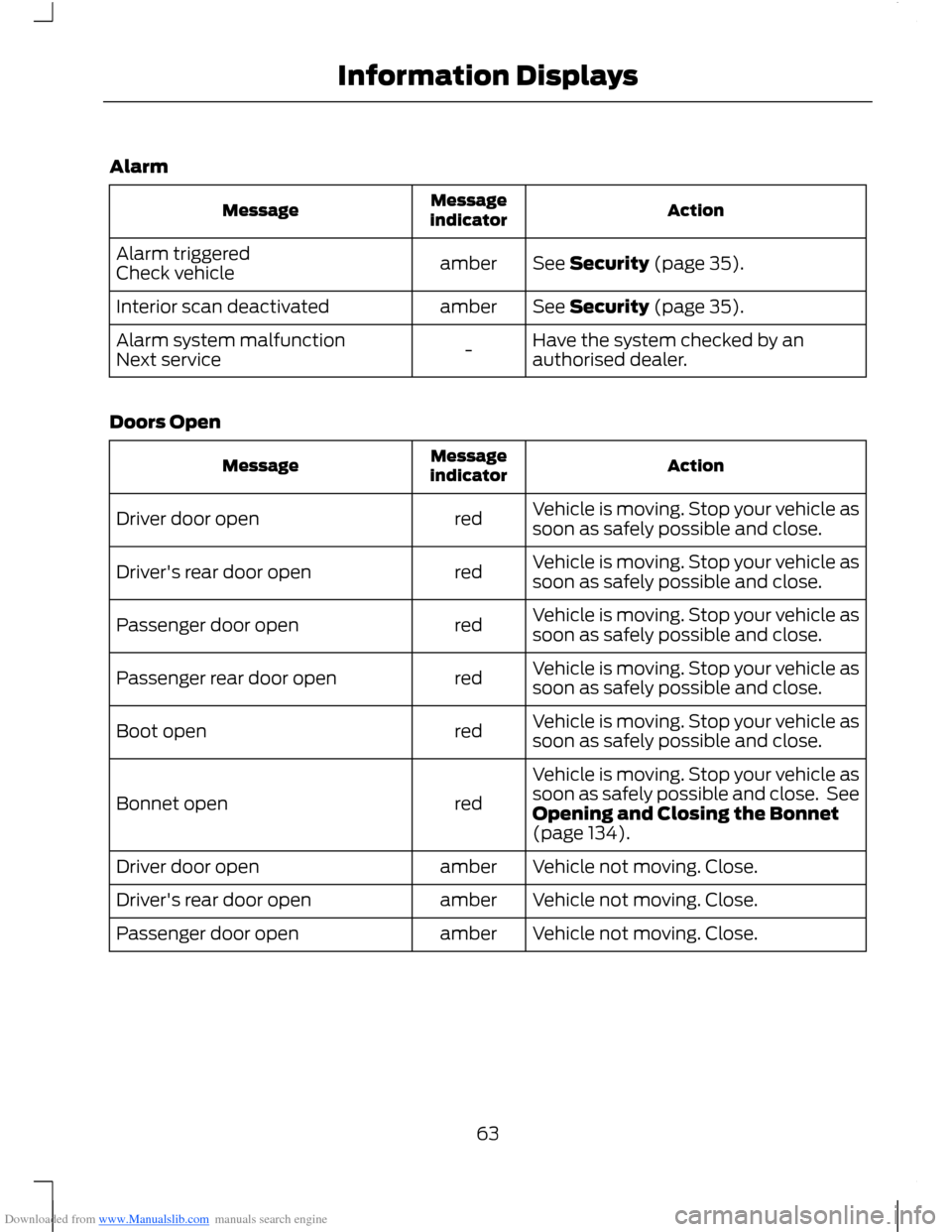
Downloaded from www.Manualslib.com manuals search engine Alarm
ActionMessageindicatorMessage
See Security (page 35).amberAlarm triggeredCheck vehicle
See Security (page 35).amberInterior scan deactivated
Have the system checked by anauthorised dealer.-Alarm system malfunctionNext service
Doors Open
ActionMessageindicatorMessage
Vehicle is moving. Stop your vehicle assoon as safely possible and close.redDriver door open
Vehicle is moving. Stop your vehicle assoon as safely possible and close.redDriver's rear door open
Vehicle is moving. Stop your vehicle assoon as safely possible and close.redPassenger door open
Vehicle is moving. Stop your vehicle assoon as safely possible and close.redPassenger rear door open
Vehicle is moving. Stop your vehicle assoon as safely possible and close.redBoot open
Vehicle is moving. Stop your vehicle assoon as safely possible and close. SeeOpening and Closing the Bonnet(page 134).
redBonnet open
Vehicle not moving. Close.amberDriver door open
Vehicle not moving. Close.amberDriver's rear door open
Vehicle not moving. Close.amberPassenger door open
63Information Displays
Page 81 of 256
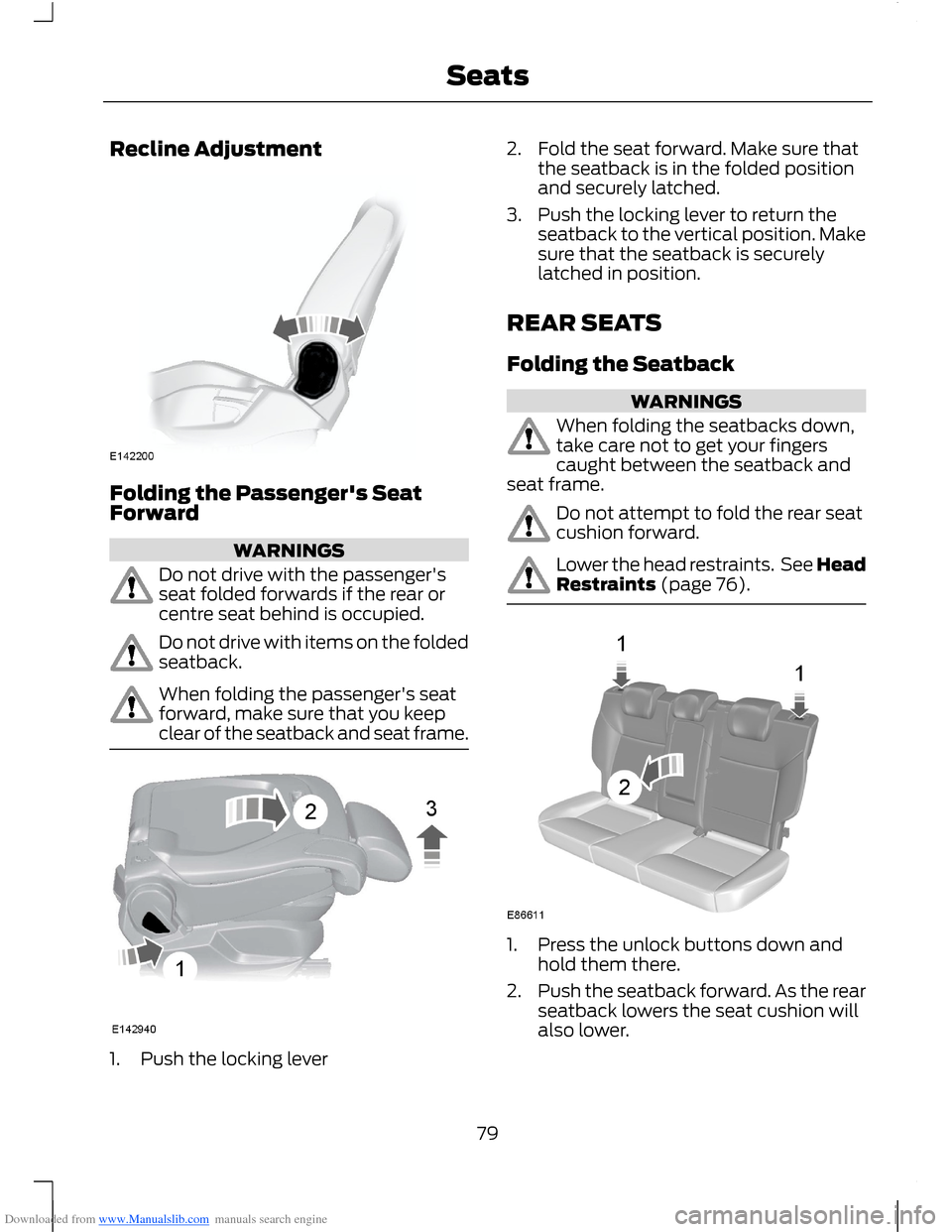
Downloaded from www.Manualslib.com manuals search engine Recline Adjustment
Folding the Passenger's SeatForward
WARNINGS
Do not drive with the passenger'sseat folded forwards if the rear orcentre seat behind is occupied.
Do not drive with items on the foldedseatback.
When folding the passenger's seatforward, make sure that you keepclear of the seatback and seat frame.
1.Push the locking lever
2.Fold the seat forward. Make sure thatthe seatback is in the folded positionand securely latched.
3.Push the locking lever to return theseatback to the vertical position. Makesure that the seatback is securelylatched in position.
REAR SEATS
Folding the Seatback
WARNINGS
When folding the seatbacks down,take care not to get your fingerscaught between the seatback andseat frame.
Do not attempt to fold the rear seatcushion forward.
Lower the head restraints. See HeadRestraints (page 76).
1.Press the unlock buttons down andhold them there.
2.Push the seatback forward. As the rearseatback lowers the seat cushion willalso lower.
79Seats
Page 82 of 256
Downloaded from www.Manualslib.com manuals search engine Unfolding the Seatback
WARNINGS
When folding the seatbacks up,make sure that the belts are visibleto an occupant and not caughtbehind the seat.
Make sure that the seats and theseatbacks are secure and fullyengaged in their catches.
HEATED SEATS
WARNING
People who are unable to feel painto their skin because of advancedage, chronic illness, diabetes, spinalcord injury, medication, alcohol use,exhaustion or other physical conditions,must exercise care when using the heatedseat. The heated seat may cause burnseven at low temperatures, especially ifused for long periods of time. Do not placeanything on the seat that insulates againstheat, such as a blanket or cushion. Thismay cause the heated seat to overheat.Do not puncture the seat with pins, needlesor other pointed objects. This may damagethe heating element which may cause theheated seat to overheat. An overheatedseat may cause serious personal injury.
Do not do the following:
•Place heavy objects on the seat.
•Operate the heated seat if water or anyother liquid is spilled on the seat. Allowthe seat to dry thoroughly.
•Operate the heated seats unless theengine is running. Doing so could drainyour vehicle battery.
For item location: See Climate Control(page 68).
The heated seat will only operate with theignition switched on.
The maximum temperature is reachedafter five or six minutes. It is regulatedthermostatically.
The heated seat will remain on until eitherthe heated seat switch or the ignition isswitched off.
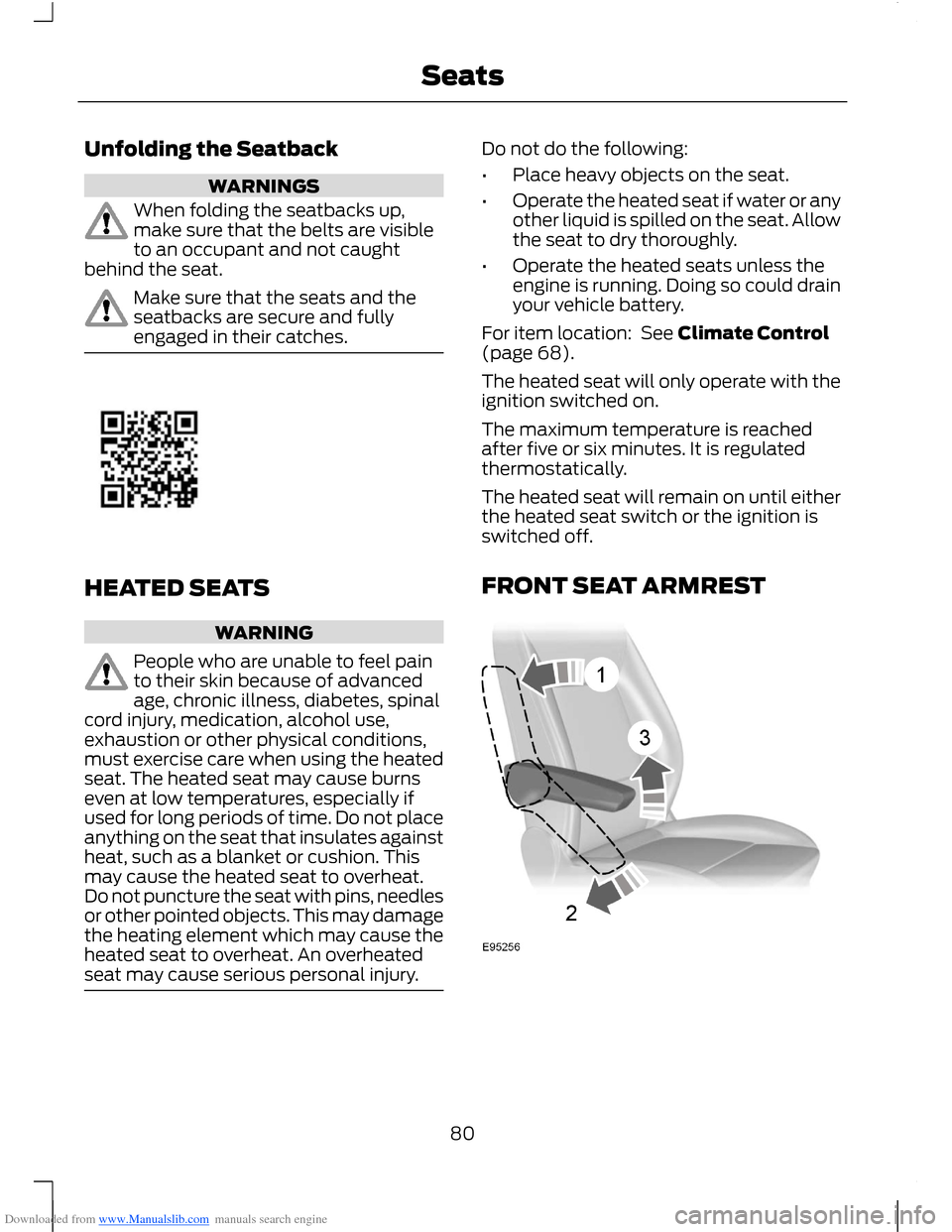
FRONT SEAT ARMREST
80Seats
Page 100 of 256
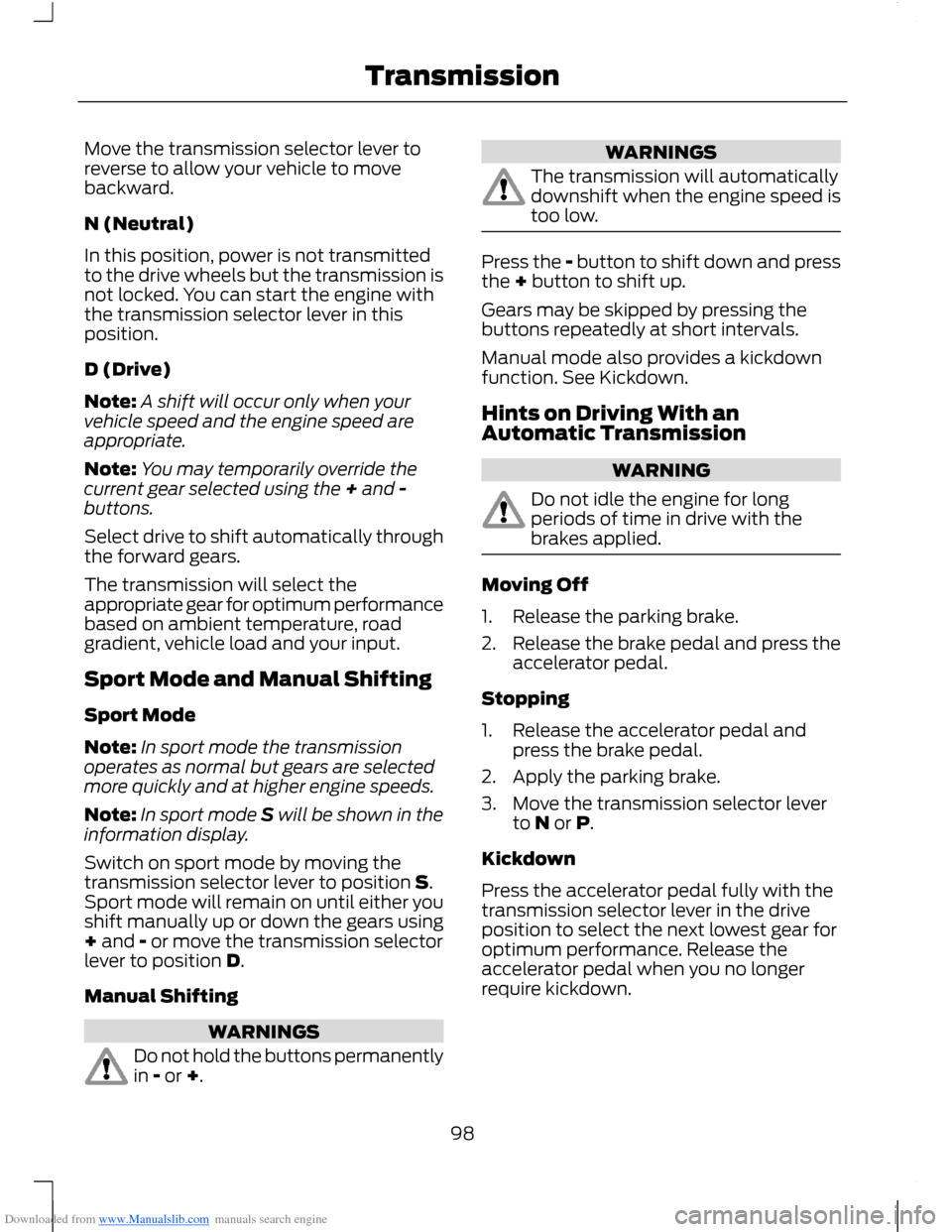
Downloaded from www.Manualslib.com manuals search engine Move the transmission selector lever toreverse to allow your vehicle to movebackward.
N (Neutral)
In this position, power is not transmittedto the drive wheels but the transmission isnot locked. You can start the engine withthe transmission selector lever in thisposition.
D (Drive)
Note:A shift will occur only when yourvehicle speed and the engine speed areappropriate.
Note:You may temporarily override thecurrent gear selected using the + and -buttons.
Select drive to shift automatically throughthe forward gears.
The transmission will select theappropriate gear for optimum performancebased on ambient temperature, roadgradient, vehicle load and your input.
Sport Mode and Manual Shifting
Sport Mode
Note:In sport mode the transmissionoperates as normal but gears are selectedmore quickly and at higher engine speeds.
Note:In sport mode S will be shown in theinformation display.
Switch on sport mode by moving thetransmission selector lever to position S.Sport mode will remain on until either youshift manually up or down the gears using+ and - or move the transmission selectorlever to position D.
Manual Shifting
WARNINGS
Do not hold the buttons permanentlyin - or +.
WARNINGS
The transmission will automaticallydownshift when the engine speed istoo low.
Press the - button to shift down and pressthe + button to shift up.
Gears may be skipped by pressing thebuttons repeatedly at short intervals.
Manual mode also provides a kickdownfunction. See Kickdown.
Hints on Driving With anAutomatic Transmission
WARNING
Do not idle the engine for longperiods of time in drive with thebrakes applied.
Moving Off
1.Release the parking brake.
2.Release the brake pedal and press theaccelerator pedal.
Stopping
1.Release the accelerator pedal andpress the brake pedal.
2.Apply the parking brake.
3.Move the transmission selector leverto N or P.
Kickdown
Press the accelerator pedal fully with thetransmission selector lever in the driveposition to select the next lowest gear foroptimum performance. Release theaccelerator pedal when you no longerrequire kickdown.
98Transmission
Page 115 of 256
Downloaded from www.Manualslib.com manuals search engine GENERAL INFORMATION
WARNINGS
Use load securing straps to anapproved standard, e.g. DIN.
Make sure that you secure all looseitems properly.
Place luggage and other loads as lowand as far forward as possible withinthe luggage or loadspace.
Do not drive with the tailgate or reardoor open. Exhaust fumes may enteryour vehicle.
Do not exceed the maximum frontand rear axle loads for your vehicle.See Vehicle Identification Plate(page 167).
Do not allow items to contact therear windows.
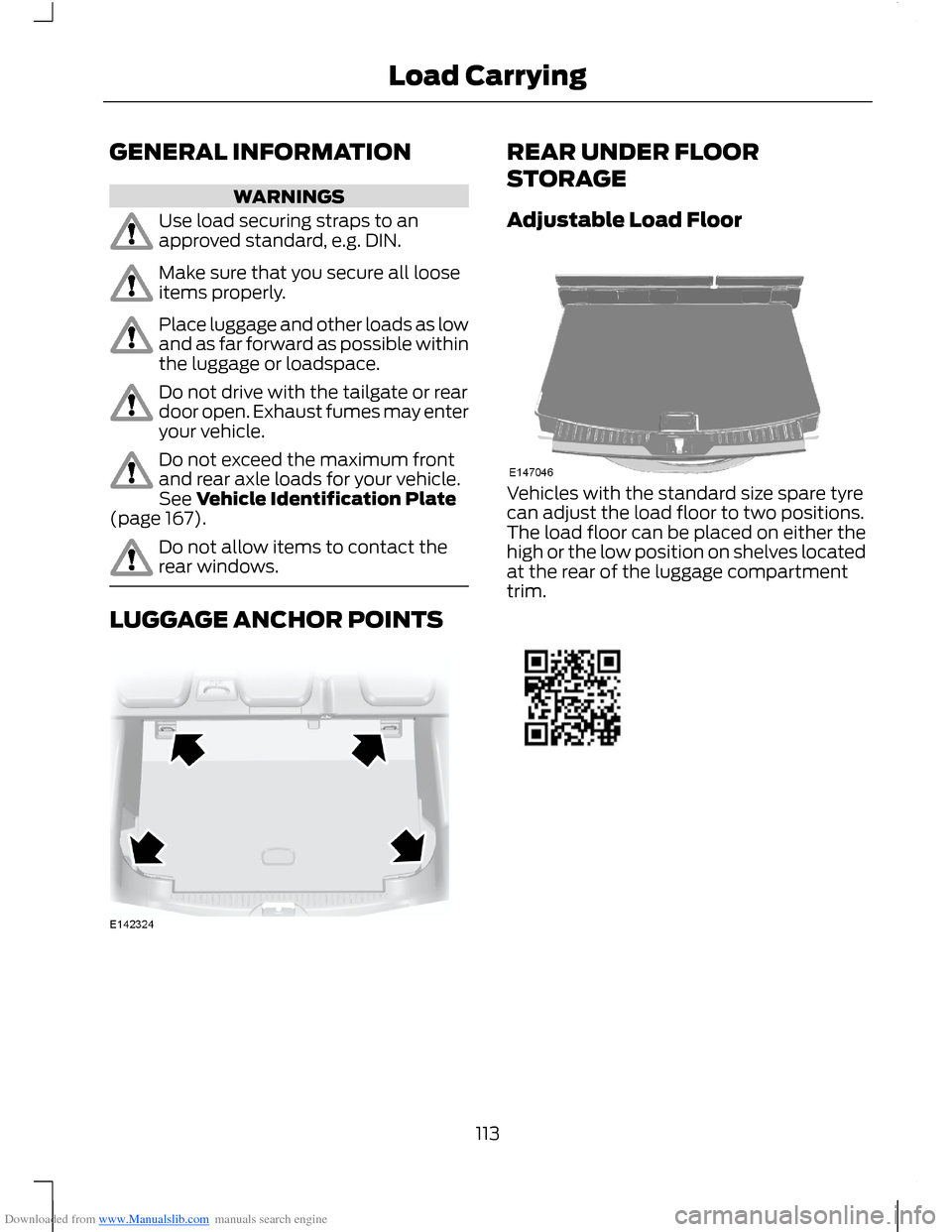
LUGGAGE ANCHOR POINTS
REAR UNDER FLOOR
STORAGE
Adjustable Load Floor
Vehicles with the standard size spare tyrecan adjust the load floor to two positions.The load floor can be placed on either thehigh or the low position on shelves locatedat the rear of the luggage compartmenttrim.
113Load Carrying
Page 116 of 256
Downloaded from www.Manualslib.com manuals search engine CARGO NETS
Installing and Removing the Net
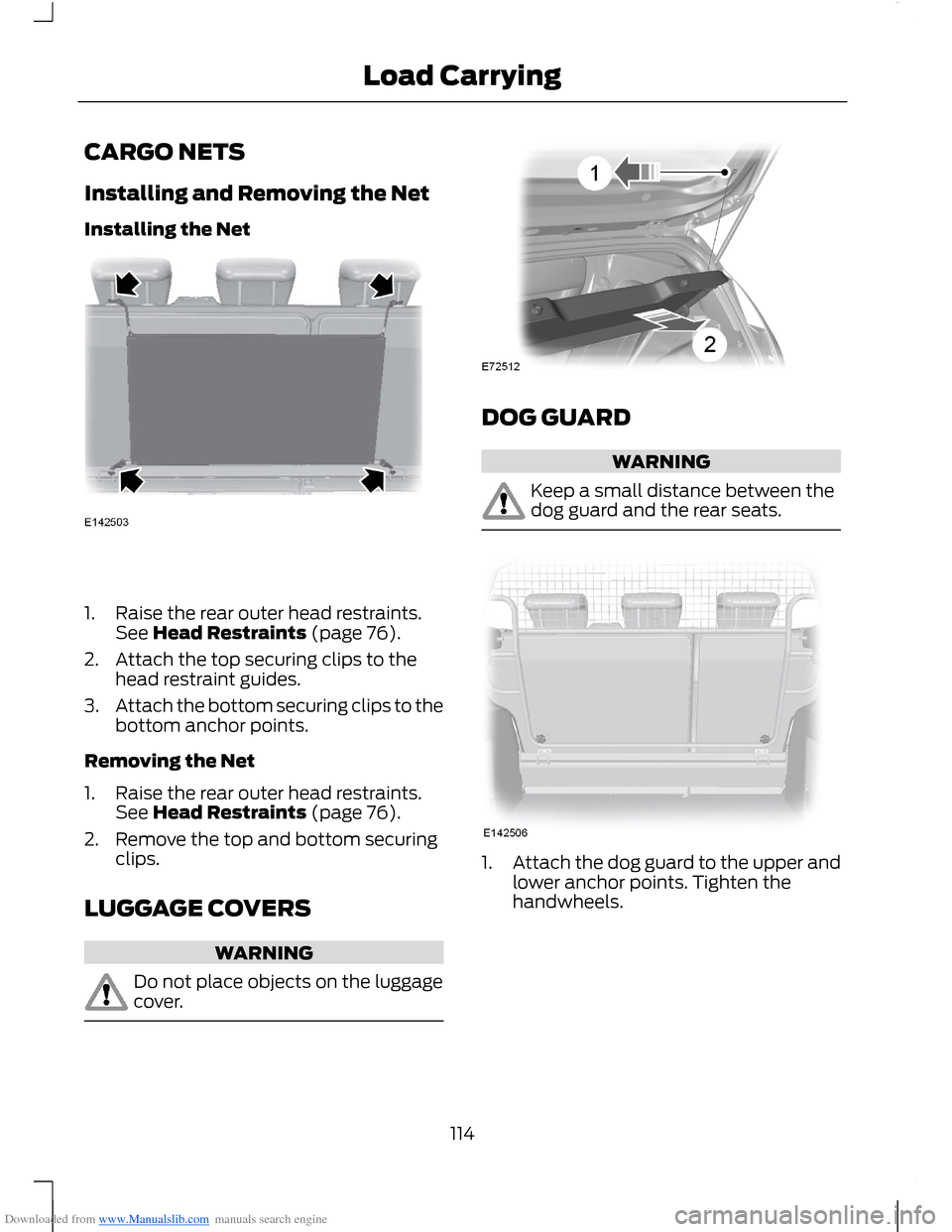
Installing the Net
1.Raise the rear outer head restraints.See Head Restraints (page 76).
2.Attach the top securing clips to thehead restraint guides.
3.Attach the bottom securing clips to thebottom anchor points.
Removing the Net
1.Raise the rear outer head restraints.See Head Restraints (page 76).
2.Remove the top and bottom securingclips.
LUGGAGE COVERS
WARNING
Do not place objects on the luggagecover.
DOG GUARD
WARNING
Keep a small distance between thedog guard and the rear seats.
1.Attach the dog guard to the upper andlower anchor points. Tighten thehandwheels.
114Load Carrying
Page 118 of 256
Downloaded from www.Manualslib.com manuals search engine TOWING A TRAILER
WARNINGS
Do not exceed 62 mph (100 km/h).
The rear tyre pressures must beincreased by 3 psi (0.2 bar) abovespecification. See TechnicalSpecifications (page 164).
Do not exceed the maximum grosstrain weight stated on your vehicleidentification plate. See VehicleIdentification Plate (page 167).
Do not exceed the maximumpermissible nose weight, i.e. verticalweight on the tow ball, of 110 pounds(50 kilogrammes).
The electrical system is not suitablefor towing trailers with more thanone rear fog lamp.
Note:Not all vehicles are suitable orapproved to have tow bars fitted. Checkwith your dealer first.
Place loads as low and central to theaxle(s) of the trailer as possible. If you aretowing with an unladen vehicle, the loadin the trailer should be placed toward thenose, within the maximum nose load, asthis gives the best stability.
The stability of your vehicle to trailercombination is very much dependant onthe quality of the trailer.
In high altitude regions above 3 281 feet (1000 metres), the stipulated maximumpermitted gross train weight must bereduced by 10% for every additional 3 281feet (1 000 metres).
Steep Gradients
WARNING
The anti-lock braking system doesnot control the overrun brake on thetrailer.
Change down a gear before you reach asteep downhill gradient.
TOW BALL
WARNINGS
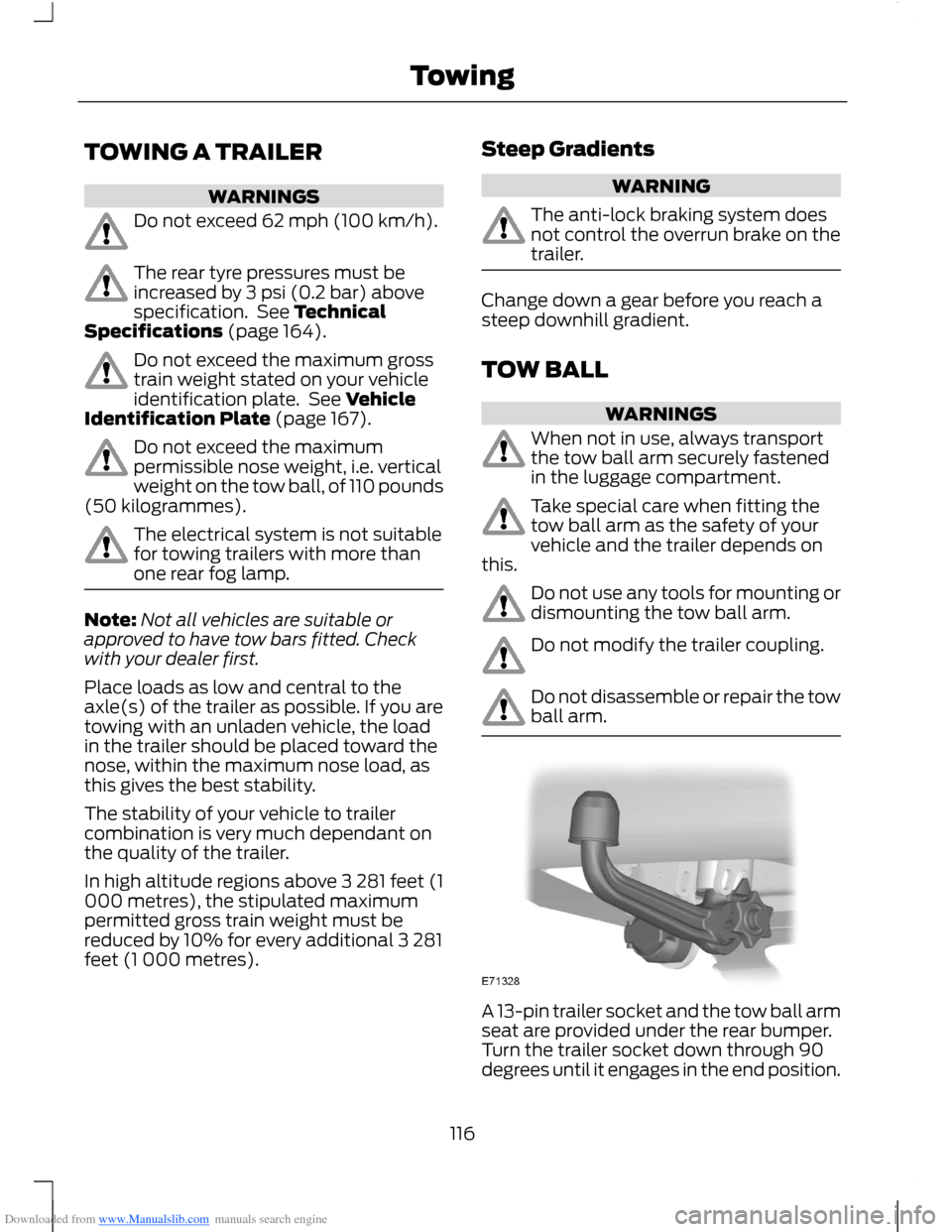
When not in use, always transportthe tow ball arm securely fastenedin the luggage compartment.
Take special care when fitting thetow ball arm as the safety of yourvehicle and the trailer depends onthis.
Do not use any tools for mounting ordismounting the tow ball arm.
Do not modify the trailer coupling.
Do not disassemble or repair the towball arm.
A 13-pin trailer socket and the tow ball armseat are provided under the rear bumper.Turn the trailer socket down through 90degrees until it engages in the end position.
116Towing
Page 120 of 256
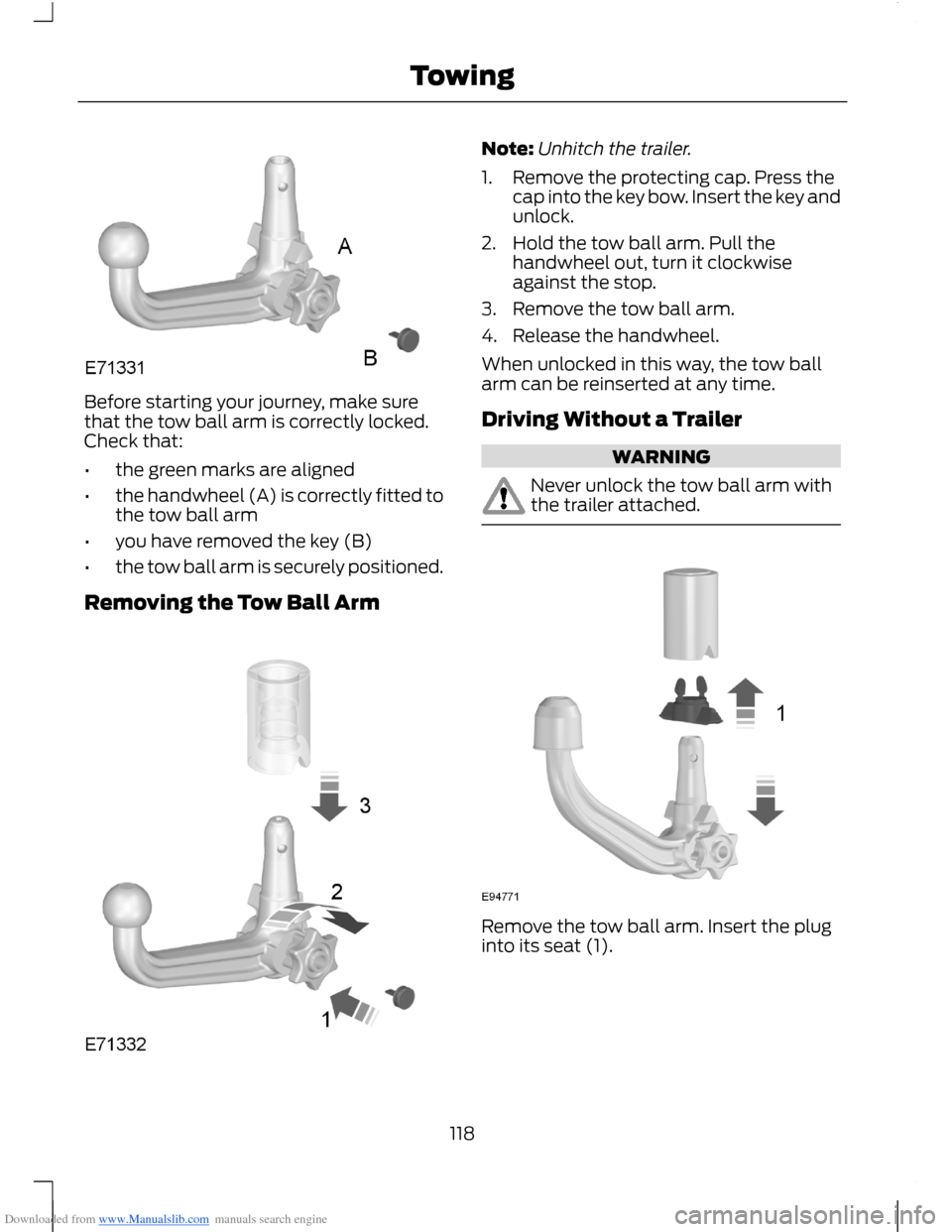
Downloaded from www.Manualslib.com manuals search engine Before starting your journey, make surethat the tow ball arm is correctly locked.Check that:
•the green marks are aligned
•the handwheel (A) is correctly fitted tothe tow ball arm
•you have removed the key (B)
•the tow ball arm is securely positioned.
Removing the Tow Ball Arm
Note:Unhitch the trailer.
1.Remove the protecting cap. Press thecap into the key bow. Insert the key andunlock.
2.Hold the tow ball arm. Pull thehandwheel out, turn it clockwiseagainst the stop.
3.Remove the tow ball arm.
4.Release the handwheel.
When unlocked in this way, the tow ballarm can be reinserted at any time.
Driving Without a Trailer
WARNING
Never unlock the tow ball arm withthe trailer attached.
Remove the tow ball arm. Insert the pluginto its seat (1).
118Towing
Page 123 of 256
Downloaded from www.Manualslib.com manuals search engine RUNNING-IN
Tyres
WARNING
New tyres need to be run-in forapproximately 300 miles (500kilometres). During this time, youmay experience different drivingcharacteristics.
Brakes and Clutch
WARNING
Avoid heavy use of the brakes andclutch if possible for the first 100miles (150 kilometres) in town andfor the first 1000 miles (1500 kilometres)on motorways.
Engine
WARNING
Avoid driving too fast during the first1000 miles (1500 kilometres). Varyyour speed frequently and changeup through the gears early. Do not labourthe engine.
COLD WEATHER
PRECAUTIONS
The functional operation of somecomponents and systems can be affectedat temperatures below -13°F (-25°C).
DRIVING THROUGH WATER
WARNINGS
Drive through water in an emergencyonly and not as part of normaldriving.
WARNINGS
Engine damage can occur if waterenters the air filter.
In an emergency, you can drive your vehiclethrough water to a maximum depth of 8inches (200 millimetres) and at amaximum speed of 6 mph (10 km/h). Youmust take extra care when driving throughflowing water.
When driving in water, maintain a lowspeed and do not stop your vehicle. Afterdriving through water and as soon as it issafe to do so:
•Depress the brake pedal lightly tocheck that the brakes are functioningcorrectly.
•Check that the horn works.
•Check that your vehicle's lamps arefully operational.
•Check the power assistanceof the steering system.
FLOOR MATS
WARNING
Make sure that the floor mat issecured properly using theappropriate fixings, and do notposition the floor mat so that it interfereswith the operation of the pedals.
121Driving Hints
Page 136 of 256
Downloaded from www.Manualslib.com manuals search engine GENERAL INFORMATION
Have your vehicle serviced regularly to helpmaintain its roadworthiness and resalevalue. There is a large network of Fordauthorised repairers that are there to helpyou with their professional servicingexpertise. Authorised repairers are bestqualified to service your vehicle properlyand expertly, with a wide range of highlyspecialised tools.
In addition to regular servicing, werecommend that you carry out thefollowing checks.
WARNINGS
Switch the ignition off beforetouching or attempting adjustmentof any kind.
Do not touch the electronic ignitionsystem parts after you have switchedthe ignition on or when the engine isrunning. The system operates at highvoltage.
Keep your hands and clothing clearof the engine cooling fan. Undercertain conditions, the fan maycontinue to run for several minutes afteryou have switched the engine off.
Make sure that you fit filler capssecurely after carrying outmaintenance checks.
Daily Checks
•Exterior lamps.
•Interior lamps.
•Warning lamps and indicators.
Check When Refuelling
•Engine oil level. See Engine Oil Check(page 139).
•Brake fluid level. See Brake andClutch Fluid Check (page 141).
•Washer fluid level. See Washer FluidCheck (page 141).
•Tyre pressures (when cold). SeeTechnical Specifications (page 164).
•Tyre condition. See Wheels and Tyres(page 155).
Monthly Checks
•Engine coolant level (engine cold). SeeEngine Coolant Check (page 140).
•Pipes, hoses and reservoirs for leaks.
•Air conditioning operation.
•Parking brake operation.
•Horn operation.
•Tightness of wheel nuts. SeeTechnical Specifications (page 164).
OPENING AND CLOSING THE
BONNET
Opening the Bonnet
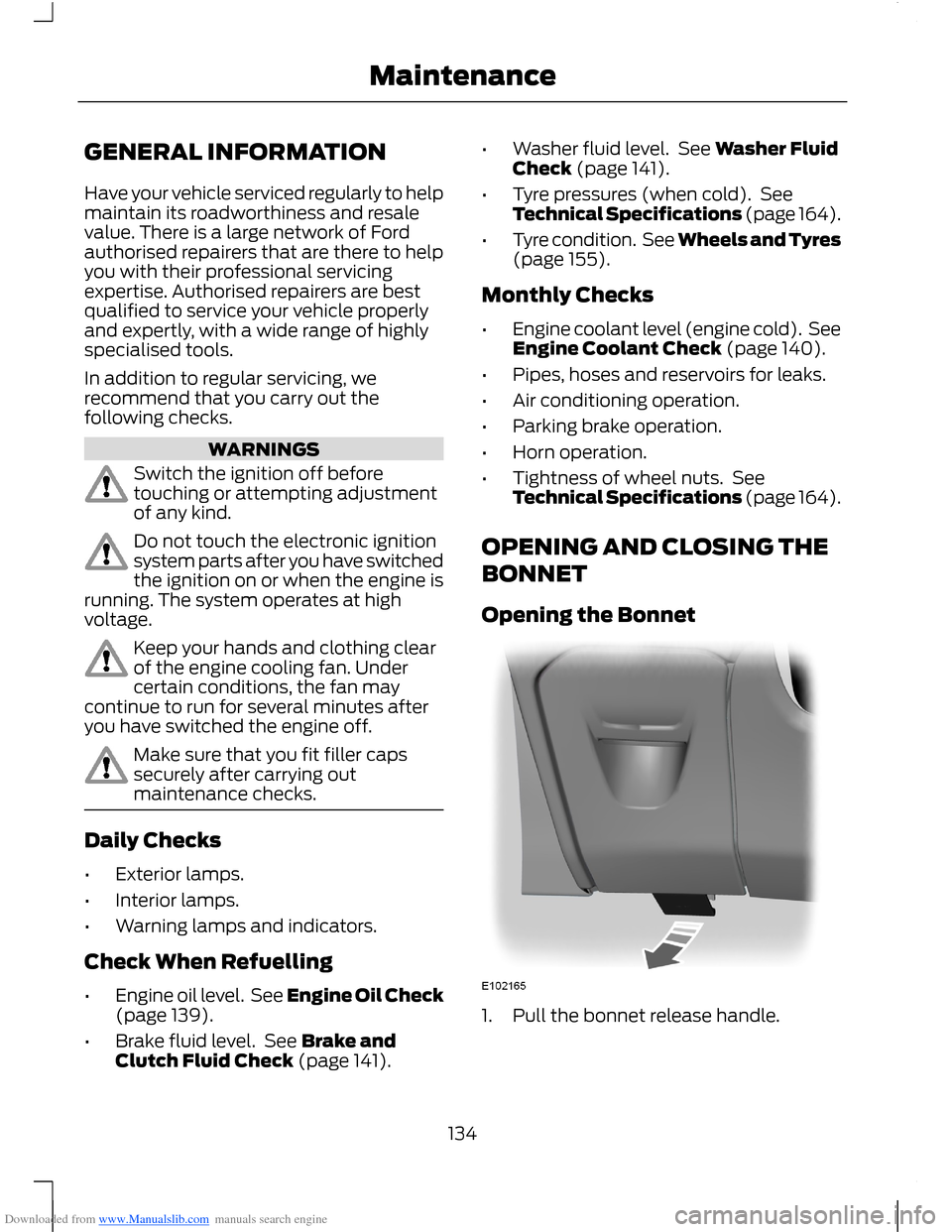
1.Pull the bonnet release handle.
134Maintenance