key FORD B MAX 2012 1.G Owner's Manual
[x] Cancel search | Manufacturer: FORD, Model Year: 2012, Model line: B MAX, Model: FORD B MAX 2012 1.GPages: 256, PDF Size: 19.67 MB
Page 67 of 256
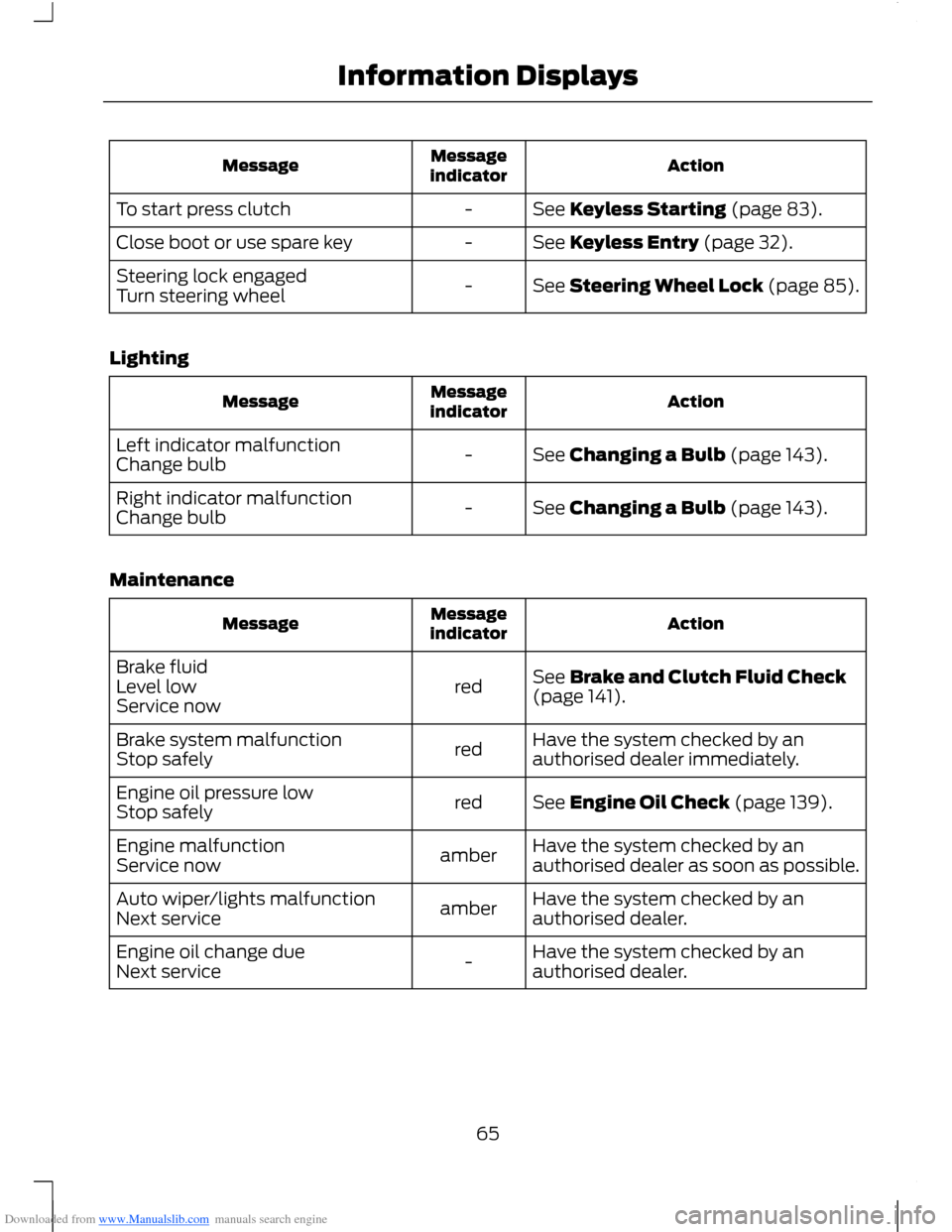
Downloaded from www.Manualslib.com manuals search engine ActionMessageindicatorMessage
See Keyless Starting (page 83).-To start press clutch
See Keyless Entry (page 32).-Close boot or use spare key
See Steering Wheel Lock (page 85).-Steering lock engagedTurn steering wheel
Lighting
ActionMessageindicatorMessage
See Changing a Bulb (page 143).-Left indicator malfunctionChange bulb
See Changing a Bulb (page 143).-Right indicator malfunctionChange bulb
Maintenance
ActionMessageindicatorMessage
See Brake and Clutch Fluid Check(page 141).redBrake fluidLevel lowService now
Have the system checked by anauthorised dealer immediately.redBrake system malfunctionStop safely
See Engine Oil Check (page 139).redEngine oil pressure lowStop safely
Have the system checked by anauthorised dealer as soon as possible.amberEngine malfunctionService now
Have the system checked by anauthorised dealer.amberAuto wiper/lights malfunctionNext service
Have the system checked by anauthorised dealer.-Engine oil change dueNext service
65Information Displays
Page 85 of 256
Downloaded from www.Manualslib.com manuals search engine GENERAL INFORMATION
If you disconnect the battery, your vehiclemay exhibit some unusual drivingcharacteristics for approximately 5 miles(8 kilometres) after you reconnect it. Thisis because the engine management systemmust realign itself with the engine. You candisregard any unusual drivingcharacteristics during this period.
WARNINGS
Extended idling at high enginespeeds can produce very hightemperatures in the engine andexhaust system, creating the risk of fire orother damage.
Do not park, idle or drive your vehicleon dry grass or other dry groundcover. The emission system heats upthe engine compartment and exhaustsystem, creating the risk of fire.
Do not start the engine in a closedgarage or in other enclosed areas.Exhaust fumes can be toxic. Alwaysopen the garage door before you start theengine.
If you smell exhaust fumes insideyour vehicle, have your vehiclechecked by your authorised dealerimmediately. Do not drive your vehicle ifyou smell exhaust fumes.
The powertrain control system meets allCanadian interference-causing equipmentstandard requirements regulating theimpulse electrical field or radio noise.
When you start the engine, avoid pressingthe accelerator pedal before and duringoperation. Only use the accelerator pedalwhen you have difficulty starting theengine.
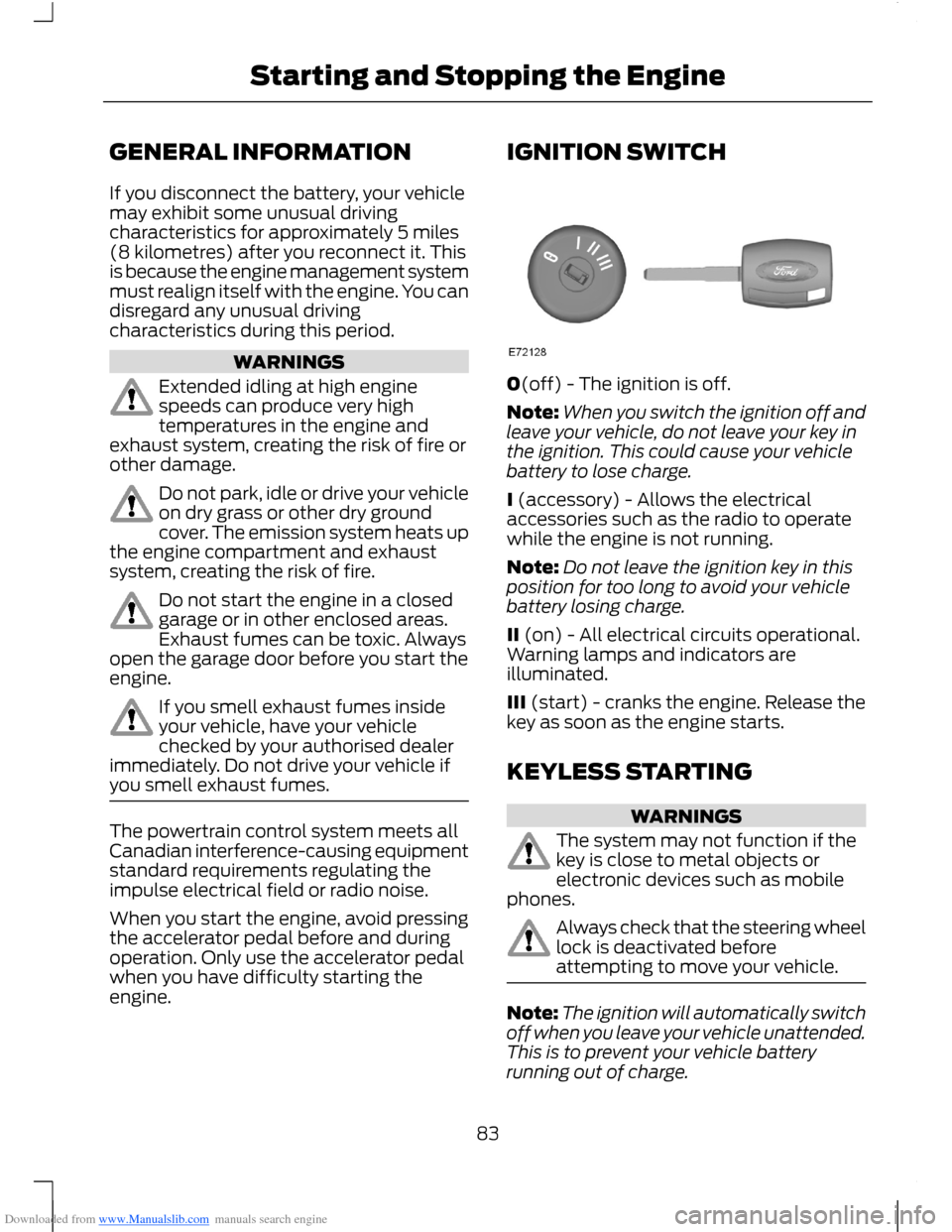
IGNITION SWITCH
0(off) - The ignition is off.
Note:When you switch the ignition off andleave your vehicle, do not leave your key inthe ignition. This could cause your vehiclebattery to lose charge.
I (accessory) - Allows the electricalaccessories such as the radio to operatewhile the engine is not running.
Note:Do not leave the ignition key in thisposition for too long to avoid your vehiclebattery losing charge.
II (on) - All electrical circuits operational.Warning lamps and indicators areilluminated.
III (start) - cranks the engine. Release thekey as soon as the engine starts.
KEYLESS STARTING
WARNINGS
The system may not function if thekey is close to metal objects orelectronic devices such as mobilephones.
Always check that the steering wheellock is deactivated beforeattempting to move your vehicle.
Note:The ignition will automatically switchoff when you leave your vehicle unattended.This is to prevent your vehicle batteryrunning out of charge.
83Starting and Stopping the Engine
Page 86 of 256
Downloaded from www.Manualslib.com manuals search engine Note:A valid key must be located insideyour vehicle to switch the ignition on andstart the engine.
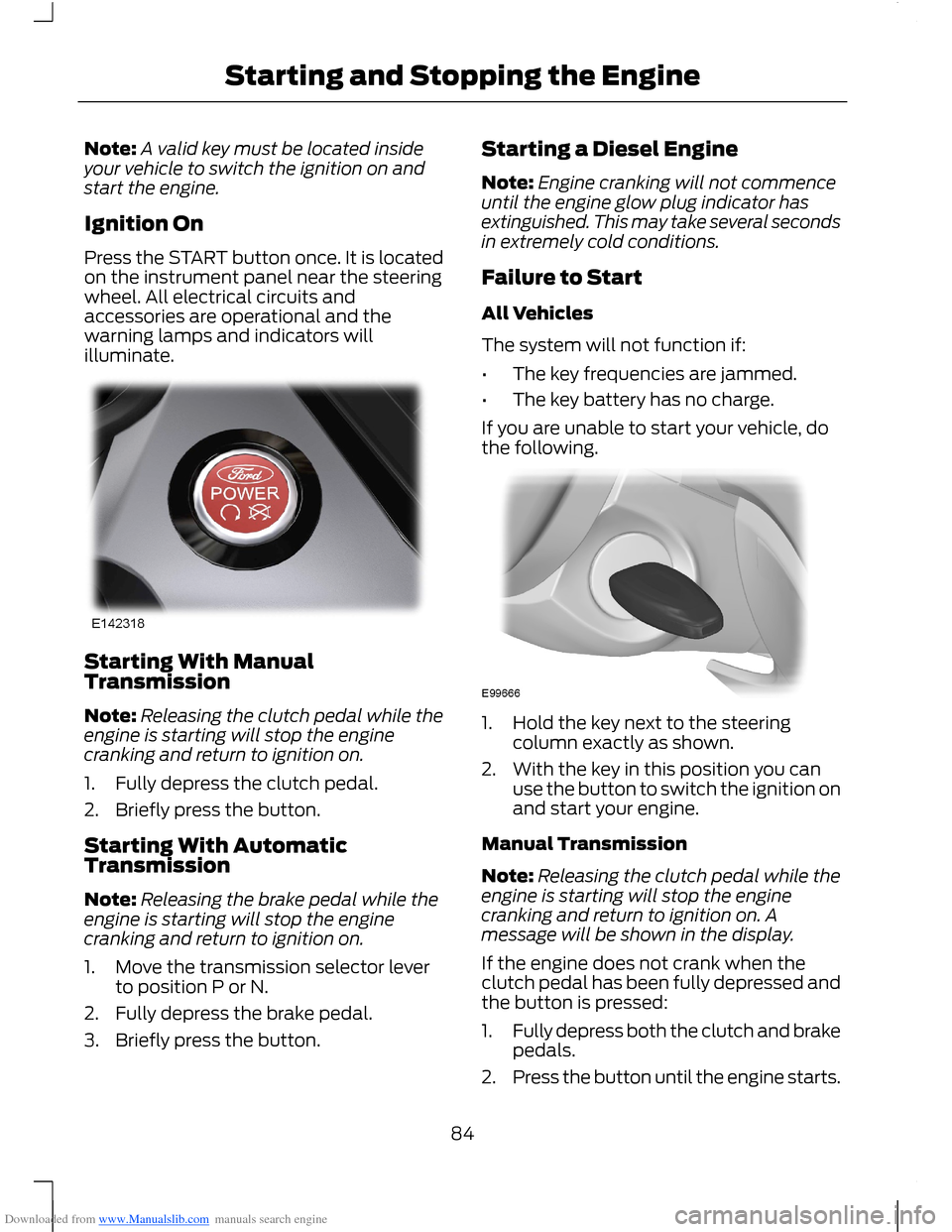
Ignition On
Press the START button once. It is locatedon the instrument panel near the steeringwheel. All electrical circuits andaccessories are operational and thewarning lamps and indicators willilluminate.
Starting With ManualTransmission
Note:Releasing the clutch pedal while theengine is starting will stop the enginecranking and return to ignition on.
1.Fully depress the clutch pedal.
2.Briefly press the button.
Starting With AutomaticTransmission
Note:Releasing the brake pedal while theengine is starting will stop the enginecranking and return to ignition on.
1.Move the transmission selector leverto position P or N.
2.Fully depress the brake pedal.
3.Briefly press the button.
Starting a Diesel Engine
Note:Engine cranking will not commenceuntil the engine glow plug indicator hasextinguished. This may take several secondsin extremely cold conditions.
Failure to Start
All Vehicles
The system will not function if:
•The key frequencies are jammed.
•The key battery has no charge.
If you are unable to start your vehicle, dothe following.
1.Hold the key next to the steeringcolumn exactly as shown.
2.With the key in this position you canuse the button to switch the ignition onand start your engine.
Manual Transmission
Note:Releasing the clutch pedal while theengine is starting will stop the enginecranking and return to ignition on. Amessage will be shown in the display.
If the engine does not crank when theclutch pedal has been fully depressed andthe button is pressed:
1.Fully depress both the clutch and brakepedals.
2.Press the button until the engine starts.
84Starting and Stopping the Engine
Page 87 of 256
Downloaded from www.Manualslib.com manuals search engine Stopping the Engine With YourVehicle Stationary
Note:The ignition, all electrical circuitswarning lamps and indicators will beswitched off.
Manual Transmission
Briefly press the button.
Automatic Transmission
1.Move the transmission selector leverto position P.
2.Press the button.
Stopping the Engine When YourVehicle is Moving
WARNING
Switching off the engine when thevehicle is still moving will result in aloss of brake and steering assistance.The steering will not lock, but higher effortwill be required. With the ignition switchedoff some electrical circuits, warning lampsand indicators may also be off.
1.Press and hold the button for at leastone second or press it three timeswithin two seconds.
2.Move the transmission selector leverto position N and use the brakes tobring your vehicle to a safe stop.
3.When your vehicle has stopped, movethe transmission selector lever toposition P or N and switch the ignitionoff.
STEERING WHEEL LOCK
WARNING
Always check that the steering isunlocked before attempting to moveyour vehicle.
Vehicles Without Keyless Starting
To lock the steering wheel:
1.Remove the key from the ignitionswitch.
2.Rotate the steering wheel slightly toengage the lock.
Vehicles With Keyless Starting
Note:The steering wheel lock will notengage when the ignition is on or yourvehicle is moving.
Your vehicle has an electronicallycontrolled steering wheel lock. Thisoperates automatically.
The steering wheel lock will engage aftera short period of time once you haveparked your vehicle and the passive key isoutside of your vehicle.
Unlocking the Steering Wheel
Vehicles With Automatic Transmission
Switch the ignition on or press the brakepedal.
Vehicles With Manual Transmission
Switch the ignition on or press the clutchpedal.
STARTING A PETROL ENGINE
Note:You can only operate the starter fora limited period of time, for example 10seconds. The number of start attempts islimited to approximately six. If you exceedthis limit, the system will not allow you totry again until a period of time has elapsed,for example 30 minutes.
Cold or Hot Engine
Vehicles with Manual Transmission
Note:Do not touch the accelerator pedal.
85Starting and Stopping the Engine
Page 88 of 256
Downloaded from www.Manualslib.com manuals search engine Note:Releasing the clutch pedal while theengine is starting will stop the enginecranking and return to ignition on.
1.Fully depress the clutch pedal.
2.Start the engine.
Vehicles with Automatic Transmission
Note:Do not touch the accelerator pedal.
1.Move the transmission selector leverto position P or N.
2.Start the engine.
All Vehicles
If the engine does not start within 10seconds, wait for a short period and tryagain.
If the engine does not start after threeattempts, wait 10 seconds and follow theflooded engine procedure.
If you have difficulty starting the enginewhen the temperature is below -13°F(-25°C), press the accelerator pedal to themid-way point of its travel and try again.
Flooded Engine
Vehicles with Manual Transmission
1.Fully depress the clutch pedal.
2.Fully depress the accelerator pedal andhold it there.
3.Start the engine.
Vehicles with Automatic Transmission
1.Move the transmission selector leverto position P or N.
2.Fully depress the accelerator pedal andhold it there.
3.Start the engine.
All Vehicles
If the engine does not start, repeat the coldor hot engine procedure.
Engine Idle Speed after Starting
The speed at which the engine idlesimmediately after starting is optimised tominimise vehicle emissions and maximisecabin comfort and fuel economy.
The idle speed will vary depending oncertain factors. These include vehiclecomponent and ambient temperatures aswell as electrical and climate systemdemands.
Failure to Start
Vehicles with Manual Transmission
If the engine does not crank when theclutch pedal has been fully depressed andthe ignition key is turned to position III.
1.Fully depress the clutch and brakepedals.
2.Turn the key to position III until theengine has started.
STARTING A DIESEL ENGINE
Cold or Hot Engine
All Vehicles
Note:When the temperature is below 5°F(-15°C), you may need to crank the enginefor up to 10 seconds.
Note:You can only operate the starter fora limited period of time.
Note:After a limited number of attemptsto start your engine, the system will notallow you to try again until a period of timehas elapsed, for example 30 minutes.
Switch the ignition on and waituntil the glow plug indicator goesoff.
Vehicles With Manual Transmission
Note:Do not touch the accelerator pedal.
86Starting and Stopping the Engine
Page 89 of 256
Downloaded from www.Manualslib.com manuals search engine Note:Releasing the clutch pedal while theengine is starting will stop the enginecranking and return to ignition on.
1.Fully depress the clutch pedal.
2.Start the engine.
Vehicles With Automatic Transmission
Note:Do not touch the accelerator pedal.
Note:Releasing the brake pedal while theengine is starting will stop the enginecranking and return to ignition on.
1.Move the transmission selector leverto position P or N.
2.Fully depress the brake pedal.
3.Start the engine.
Failure to Start
Vehicles With Manual Transmission
If the engine does not crank when theclutch pedal has been fully depressed andthe ignition key is turned to position III.
1.Fully depress the clutch and brakepedals.
2.Turn the key to position III until theengine has started.
DIESEL PARTICULATE FILTER
The filter forms part of the emissionsreduction system on your vehicle. It filtersharmful diesel particulates (soot) from theexhaust gas.
Regeneration
WARNINGS
Do not park or idle your vehicle overdry leaves, dry grass or othercombustible materials. Theregeneration process creates very highexhaust gas temperatures and the exhaustwill radiate a considerable amount of heatduring and after regeneration and after youhave switched the engine off. This is apotential fire hazard.
Avoid running out of fuel.
Note:During regeneration at low speed orengine idle, you may smell a hot metallicodour and could notice a clicking metallicsound. This is due to the high temperaturesreached during regeneration and is normal.
Note:After you have switched your engineoff the fans may continue to run for a shortperiod of time.
A normal filter requires periodicreplacement. The diesel particulate filteron your vehicle requires periodicregeneration to maintain its correctfunction. Your vehicle will carry out thisprocess automatically.
If your journeys meet one of the followingconditions:
•You drive only short distances.
•You frequently switch the ignition onand off.
•Your journeys contain a high level ofacceleration and deceleration.
87Starting and Stopping the Engine
Page 94 of 256
Downloaded from www.Manualslib.com manuals search engine FUEL QUALITY - PETROL
WARNINGS
Do not mix petrol with oil, diesel orother liquids. This could cause achemical reaction.
Do not use leaded petrol or petrolwith additives containing othermetallic compounds (e.g.manganese-based). They could damagethe emission system.
Note:We recommend that you use onlyhigh quality fuel.
Note:We do not recommend the use ofadditional additives or other enginetreatments for normal vehicle use.
Use minimum 95 octane unleaded petrolthat meets the specification defined by EN228 or the equivalent nationalspecification.
Your vehicle is suitable for use with ethanolblends up to 10% (E5 and E10).
Long-Term Storage
Most petrol contains ethanol. Werecommend that you fill the fuel tank withfuel that does not contain ethanol if youintend to store your vehicle for more thantwo months. Alternatively, we recommendthat you seek advice from your dealer.
FUEL QUALITY - DIESEL
WARNINGS
Do not mix diesel with oil, petrol orother liquids. This could cause achemical reaction.
Do not add kerosene, paraffin orpetrol to diesel. This could causedamage to the fuel system.
WARNINGS
Use diesel that meets thespecification defined by EN 590 orthe relevant national specification.
Note:We recommend that you use onlyhigh quality fuel.
Note:We do not recommend the use ofadditional additives or other enginetreatments for normal vehicle use.
Note:We do not recommend the use ofadditional additives to prevent fuel waxing.
Long-Term Storage
Most diesel fuels contain biodiesel. Werecommend that you fill the fuel tank withfuel that does not contain biodiesel if youintend to store your vehicle for more thantwo months. Alternatively, we recommendthat you seek advice from your dealer.
RUNNING OUT OF FUEL
Avoid running out of fuel because thissituation may have an adverse effect onpowertrain components.
If you have run out of fuel:
•You may need to cycle the ignition fromoff to on several times after refuellingto allow the fuel system to pump thefuel from the tank to the engine. Onrestarting, cranking time will take a fewseconds longer than normal. Withkeyless ignition, just start the engine.Crank time will be longer than usual.
•Normally, adding 1 gallon (4.6 litres) offuel is enough to restart the engine. Ifyour vehicle is out of fuel and on asteep slope, more than 1 gallon (4.6litres) may be required.
92Fuel and Refuelling
Page 99 of 256
Downloaded from www.Manualslib.com manuals search engine MANUAL TRANSMISSION
Selecting Reverse Gear
Do not engage reverse gear when yourvehicle is moving. This can cause damageto the transmission.
AUTOMATIC TRANSMISSION
WARNING
Always set the parking brake fullyand make sure you move thetransmission selector lever toposition P. Switch the ignition off andremove the key whenever you leave yourvehicle.
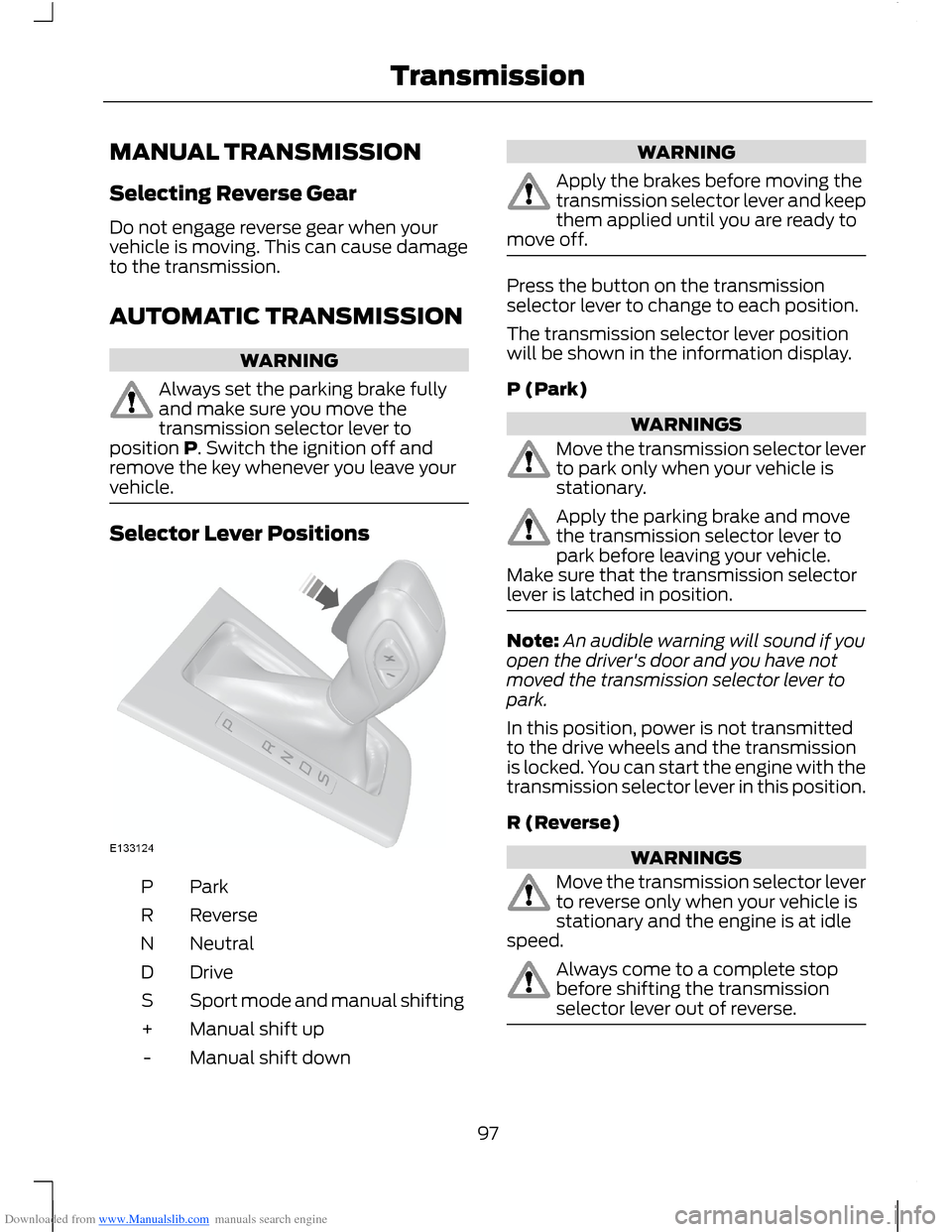
Selector Lever Positions
ParkP
ReverseR
NeutralN
DriveD
Sport mode and manual shiftingS
Manual shift up+
Manual shift down-
WARNING
Apply the brakes before moving thetransmission selector lever and keepthem applied until you are ready tomove off.
Press the button on the transmissionselector lever to change to each position.
The transmission selector lever positionwill be shown in the information display.
P (Park)
WARNINGS
Move the transmission selector leverto park only when your vehicle isstationary.
Apply the parking brake and movethe transmission selector lever topark before leaving your vehicle.Make sure that the transmission selectorlever is latched in position.
Note:An audible warning will sound if youopen the driver's door and you have notmoved the transmission selector lever topark.
In this position, power is not transmittedto the drive wheels and the transmissionis locked. You can start the engine with thetransmission selector lever in this position.
R (Reverse)
WARNINGS
Move the transmission selector leverto reverse only when your vehicle isstationary and the engine is at idlespeed.
Always come to a complete stopbefore shifting the transmissionselector lever out of reverse.
97Transmission
Page 119 of 256
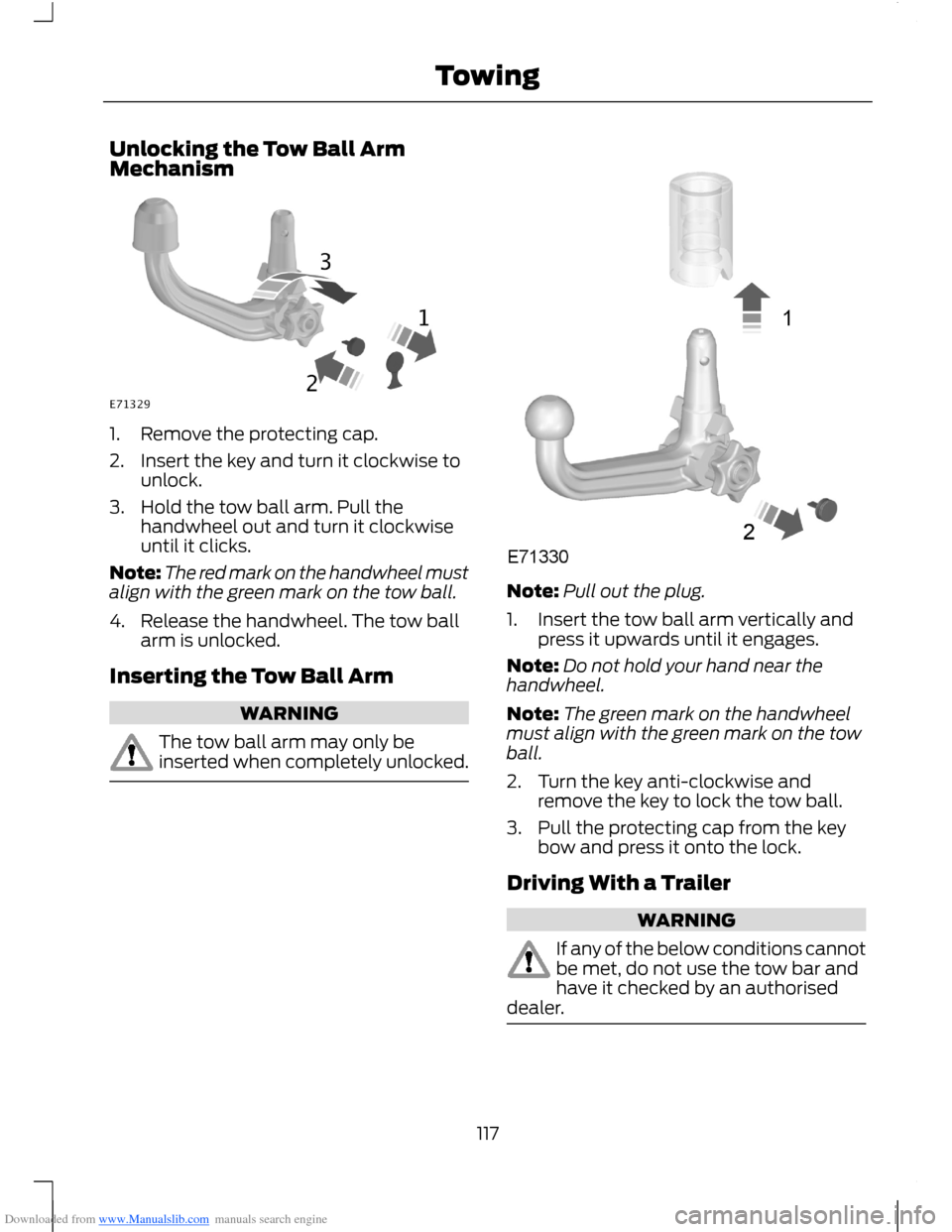
Downloaded from www.Manualslib.com manuals search engine Unlocking the Tow Ball ArmMechanism
1.Remove the protecting cap.
2.Insert the key and turn it clockwise tounlock.
3.Hold the tow ball arm. Pull thehandwheel out and turn it clockwiseuntil it clicks.
Note:The red mark on the handwheel mustalign with the green mark on the tow ball.
4.Release the handwheel. The tow ballarm is unlocked.
Inserting the Tow Ball Arm
WARNING
The tow ball arm may only beinserted when completely unlocked.
Note:Pull out the plug.
1.Insert the tow ball arm vertically andpress it upwards until it engages.
Note:Do not hold your hand near thehandwheel.
Note:The green mark on the handwheelmust align with the green mark on the towball.
2.Turn the key anti-clockwise andremove the key to lock the tow ball.
3.Pull the protecting cap from the keybow and press it onto the lock.
Driving With a Trailer
WARNING
If any of the below conditions cannotbe met, do not use the tow bar andhave it checked by an authoriseddealer.
117Towing
Page 120 of 256
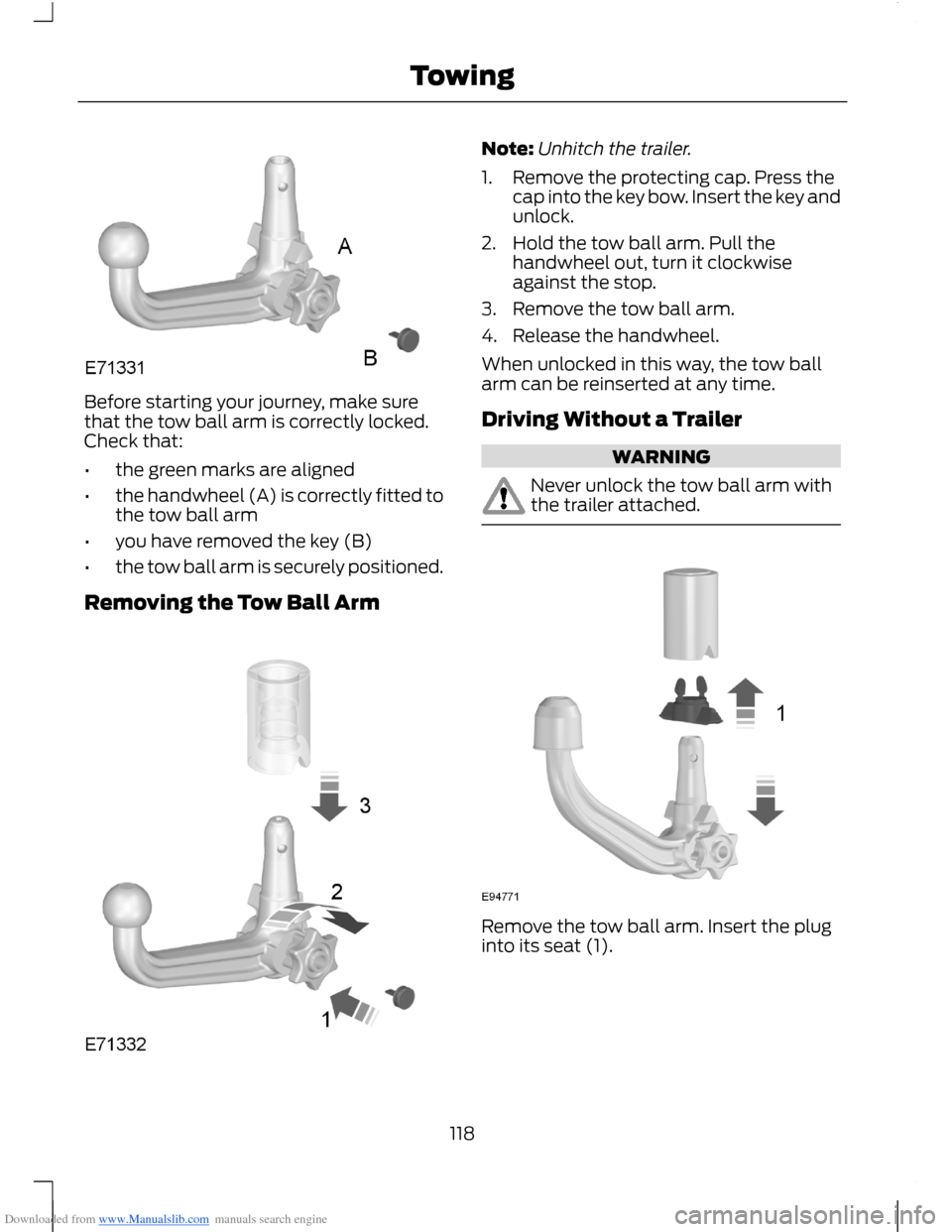
Downloaded from www.Manualslib.com manuals search engine Before starting your journey, make surethat the tow ball arm is correctly locked.Check that:
•the green marks are aligned
•the handwheel (A) is correctly fitted tothe tow ball arm
•you have removed the key (B)
•the tow ball arm is securely positioned.
Removing the Tow Ball Arm
Note:Unhitch the trailer.
1.Remove the protecting cap. Press thecap into the key bow. Insert the key andunlock.
2.Hold the tow ball arm. Pull thehandwheel out, turn it clockwiseagainst the stop.
3.Remove the tow ball arm.
4.Release the handwheel.
When unlocked in this way, the tow ballarm can be reinserted at any time.
Driving Without a Trailer
WARNING
Never unlock the tow ball arm withthe trailer attached.
Remove the tow ball arm. Insert the pluginto its seat (1).
118Towing