fuel pressure FORD B MAX 2012 1.G Owners Manual
[x] Cancel search | Manufacturer: FORD, Model Year: 2012, Model line: B MAX, Model: FORD B MAX 2012 1.GPages: 256, PDF Size: 19.67 MB
Page 8 of 256
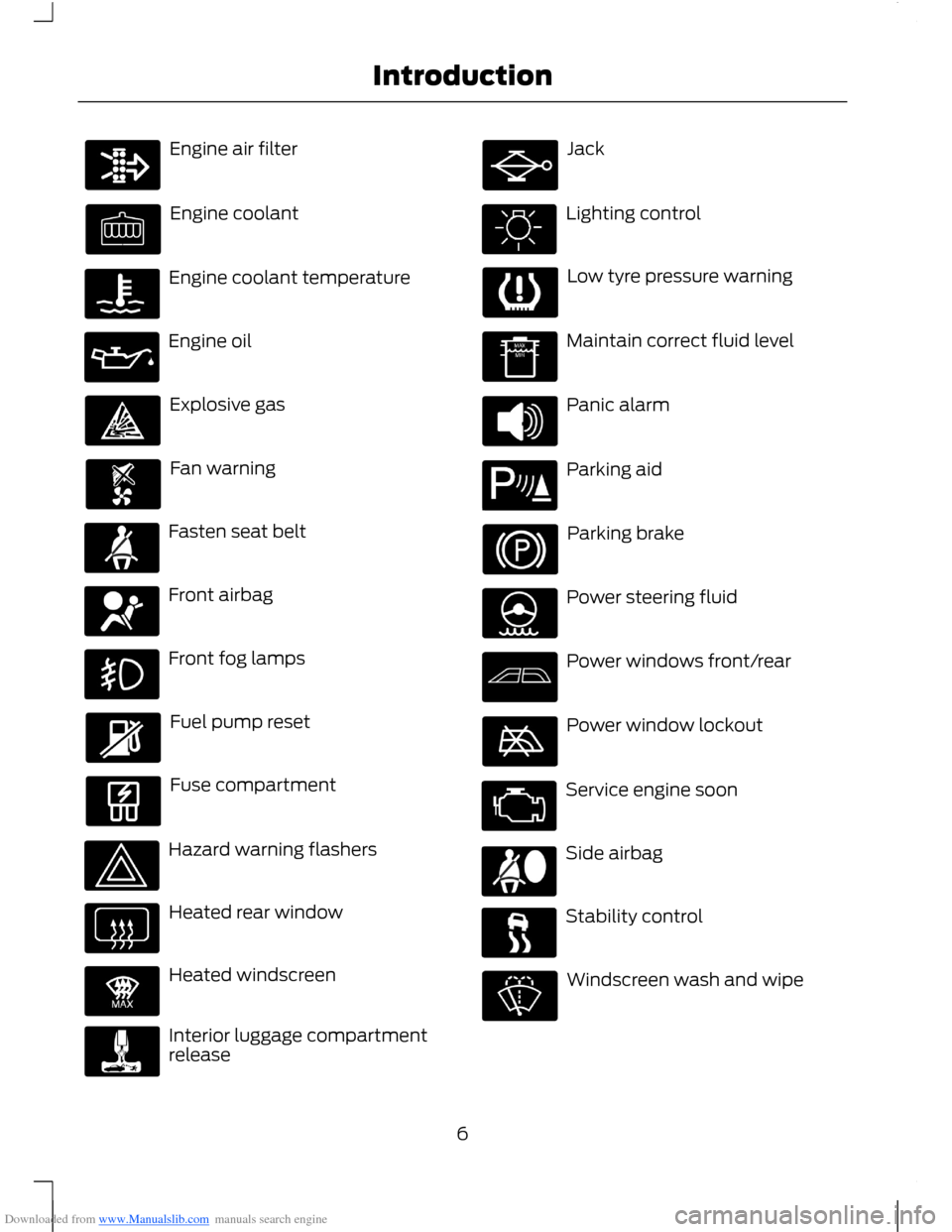
Downloaded from www.Manualslib.com manuals search engine Engine air filter
Engine coolant
Engine coolant temperature
Engine oil
Explosive gas
Fan warning
Fasten seat belt
Front airbag
Front fog lamps
Fuel pump reset
Fuse compartment
Hazard warning flashers
Heated rear window
Heated windscreen
Interior luggage compartmentrelease
Jack
Lighting control
Low tyre pressure warning
Maintain correct fluid level
Panic alarm
Parking aid
Parking brake
Power steering fluid
Power windows front/rear
Power window lockout
Service engine soon
Side airbag
Stability control
Windscreen wash and wipe
6Introduction
Page 15 of 256
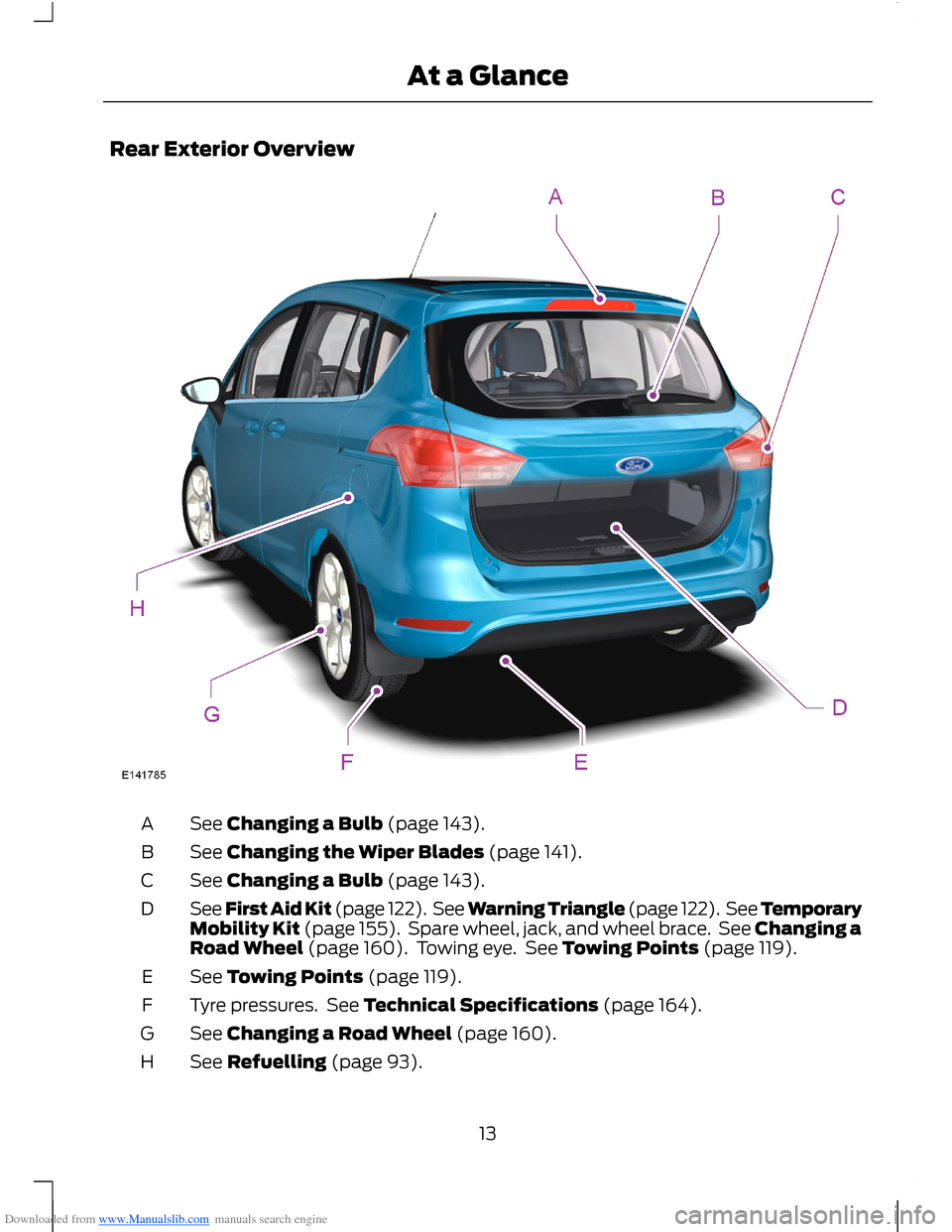
Downloaded from www.Manualslib.com manuals search engine Rear Exterior Overview
See Changing a Bulb (page 143).A
See Changing the Wiper Blades (page 141).B
See Changing a Bulb (page 143).C
See First Aid Kit (page 122). See Warning Triangle (page 122). See TemporaryMobility Kit (page 155). Spare wheel, jack, and wheel brace. See Changing aRoad Wheel (page 160). Towing eye. See Towing Points (page 119).
D
See Towing Points (page 119).E
Tyre pressures. See Technical Specifications (page 164).F
See Changing a Road Wheel (page 160).G
See Refuelling (page 93).H
13At a Glance
Page 55 of 256
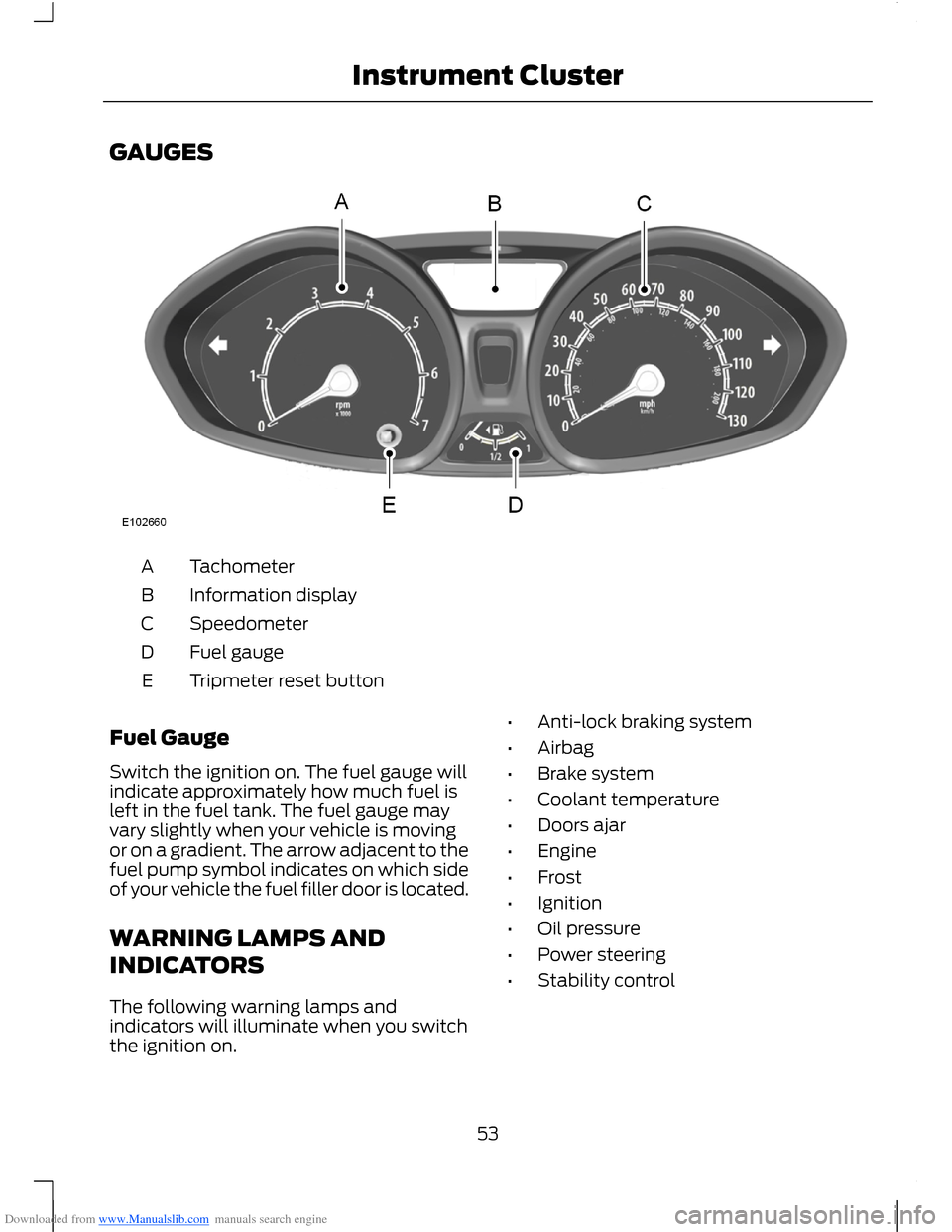
Downloaded from www.Manualslib.com manuals search engine GAUGES
TachometerA
Information displayB
SpeedometerC
Fuel gaugeD
Tripmeter reset buttonE
Fuel Gauge
Switch the ignition on. The fuel gauge willindicate approximately how much fuel isleft in the fuel tank. The fuel gauge mayvary slightly when your vehicle is movingor on a gradient. The arrow adjacent to thefuel pump symbol indicates on which sideof your vehicle the fuel filler door is located.
WARNING LAMPS AND
INDICATORS
The following warning lamps andindicators will illuminate when you switchthe ignition on.
•Anti-lock braking system
•Airbag
•Brake system
•Coolant temperature
•Doors ajar
•Engine
•Frost
•Ignition
•Oil pressure
•Power steering
•Stability control
53Instrument Cluster
Page 57 of 256
Downloaded from www.Manualslib.com manuals search engine All Vehicles
If either lamp illuminates when the engineis running, this indicates a malfunction. Theengine will continue to run but it may havelimited power. If it flashes when you aredriving, reduce the speed of your vehicleimmediately. If it continues to flash, avoidheavy acceleration or deceleration. Havethe system checked by an authoriseddealer immediately.
WARNING
Have this checked immediately.
If both lamps illuminate together, stop yourvehicle as soon as it is safe to do so(continued use may cause reduced powerand cause the engine to stop). Switch theignition off and attempt to restart theengine. If the engine restarts have thesystem checked by an authorised dealerimmediately. When the engine does notrestart have your vehicle checked beforecontinuing your journey.
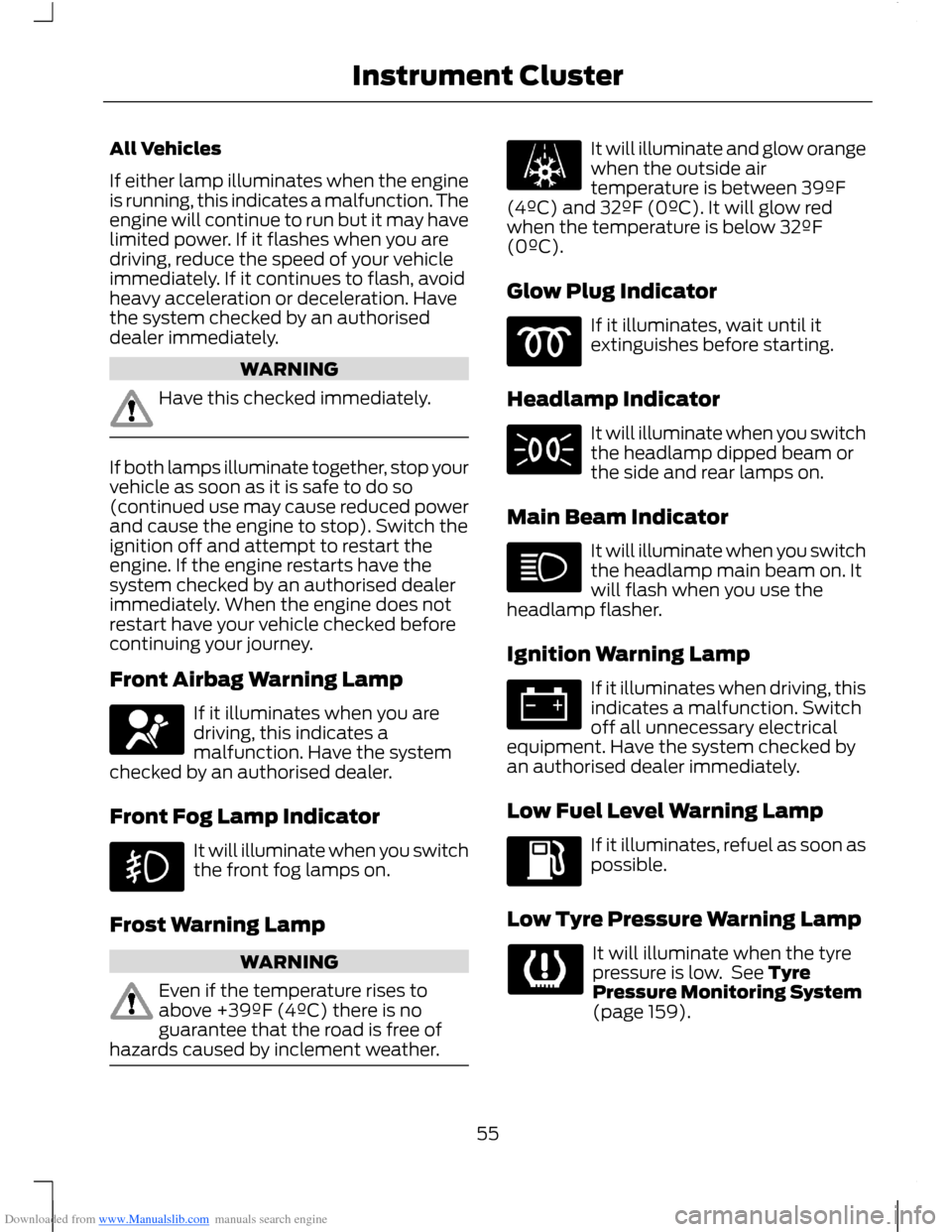
Front Airbag Warning Lamp
If it illuminates when you aredriving, this indicates amalfunction. Have the systemchecked by an authorised dealer.
Front Fog Lamp Indicator
It will illuminate when you switchthe front fog lamps on.
Frost Warning Lamp
WARNING
Even if the temperature rises toabove +39ºF (4ºC) there is noguarantee that the road is free ofhazards caused by inclement weather.
It will illuminate and glow orangewhen the outside airtemperature is between 39ºF(4ºC) and 32ºF (0ºC). It will glow redwhen the temperature is below 32ºF(0ºC).
Glow Plug Indicator
If it illuminates, wait until itextinguishes before starting.
Headlamp Indicator
It will illuminate when you switchthe headlamp dipped beam orthe side and rear lamps on.
Main Beam Indicator
It will illuminate when you switchthe headlamp main beam on. Itwill flash when you use theheadlamp flasher.
Ignition Warning Lamp
If it illuminates when driving, thisindicates a malfunction. Switchoff all unnecessary electricalequipment. Have the system checked byan authorised dealer immediately.
Low Fuel Level Warning Lamp
If it illuminates, refuel as soon aspossible.
Low Tyre Pressure Warning Lamp
It will illuminate when the tyrepressure is low. See TyrePressure Monitoring System(page 159).
55Instrument Cluster
Page 58 of 256
Downloaded from www.Manualslib.com manuals search engine Message Centre Indicator
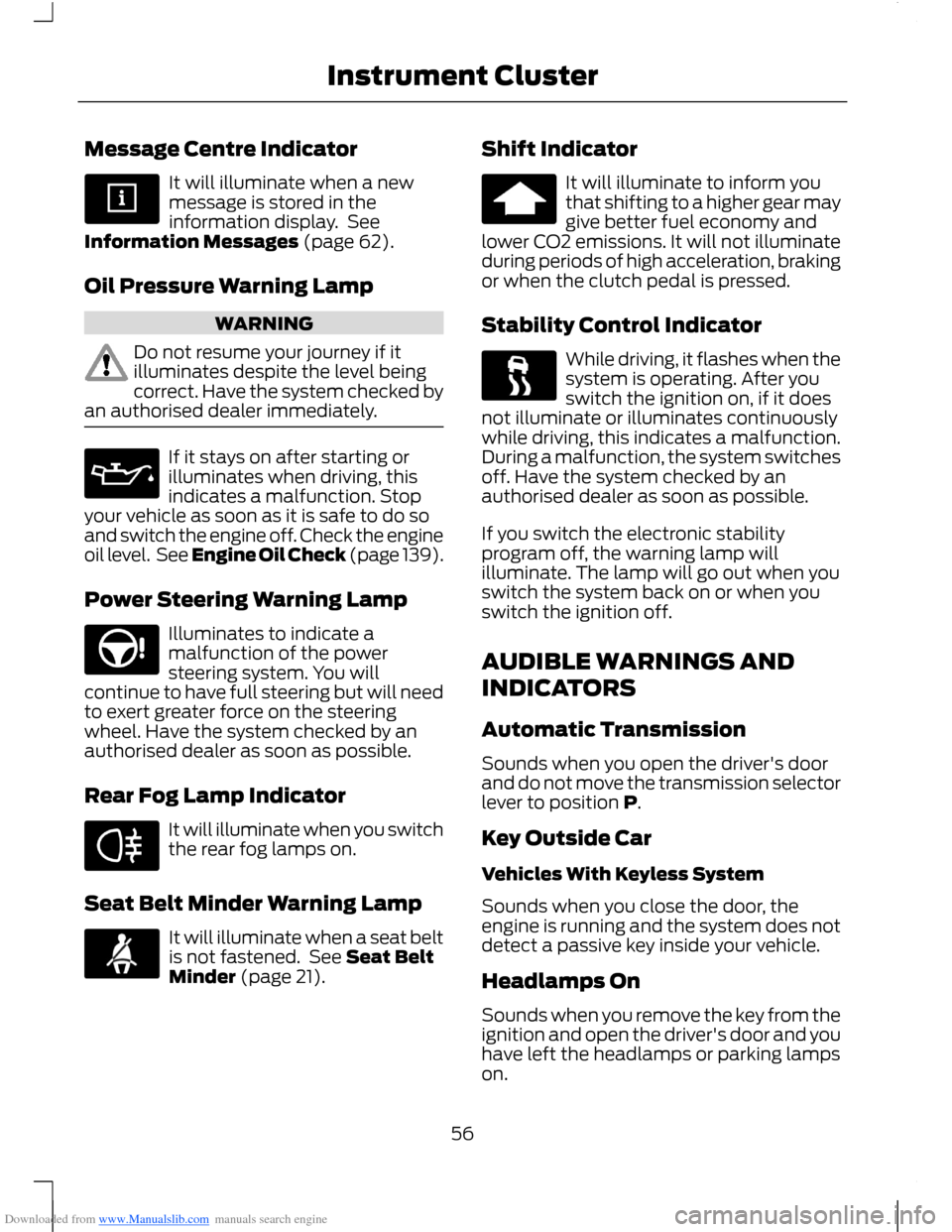
It will illuminate when a newmessage is stored in theinformation display. SeeInformation Messages (page 62).
Oil Pressure Warning Lamp
WARNING
Do not resume your journey if itilluminates despite the level beingcorrect. Have the system checked byan authorised dealer immediately.
If it stays on after starting orilluminates when driving, thisindicates a malfunction. Stopyour vehicle as soon as it is safe to do soand switch the engine off. Check the engineoil level. See Engine Oil Check (page 139).
Power Steering Warning Lamp
Illuminates to indicate amalfunction of the powersteering system. You willcontinue to have full steering but will needto exert greater force on the steeringwheel. Have the system checked by anauthorised dealer as soon as possible.
Rear Fog Lamp Indicator
It will illuminate when you switchthe rear fog lamps on.
Seat Belt Minder Warning Lamp
It will illuminate when a seat beltis not fastened. See Seat BeltMinder (page 21).
Shift Indicator
It will illuminate to inform youthat shifting to a higher gear maygive better fuel economy andlower CO2 emissions. It will not illuminateduring periods of high acceleration, brakingor when the clutch pedal is pressed.
Stability Control Indicator
While driving, it flashes when thesystem is operating. After youswitch the ignition on, if it doesnot illuminate or illuminates continuouslywhile driving, this indicates a malfunction.During a malfunction, the system switchesoff. Have the system checked by anauthorised dealer as soon as possible.
If you switch the electronic stabilityprogram off, the warning lamp willilluminate. The lamp will go out when youswitch the system back on or when youswitch the ignition off.
AUDIBLE WARNINGS AND
INDICATORS
Automatic Transmission
Sounds when you open the driver's doorand do not move the transmission selectorlever to position P.
Key Outside Car
Vehicles With Keyless System
Sounds when you close the door, theengine is running and the system does notdetect a passive key inside your vehicle.
Headlamps On
Sounds when you remove the key from theignition and open the driver's door and youhave left the headlamps or parking lampson.
56Instrument Cluster
Page 93 of 256
Downloaded from www.Manualslib.com manuals search engine SAFETY PRECAUTIONS
WARNINGS
Do not overfill the fuel tank. Thepressure in an overfilled tank maycause leakage and lead to fuel sprayand fire.
The fuel system may be underpressure. If you hear a hissing soundnear the fuel filler door (Easy Fuelcapless fuel system), do not refuel untilthe sound stops. Otherwise, fuel may sprayout, which could cause serious personalinjury.
Automotive fuels can cause seriousinjury or death if misused ormishandled.
The flow of fuel through a fuel pumpnozzle can produce static electricity,which can cause a fire if fuel ispumped into an ungrounded fuel container.
Fuel ethanol and petrol may containbenzene, which is a cancer-causingagent.
When refuelling always shut theengine off and never allow sparks oropen flames near the filler neck.Never smoke while refuelling. Fuel vapouris extremely hazardous under certainconditions. Care should be taken to avoidinhaling excess fumes.
Observe the following guidelines whenhandling automotive fuel:
•Extinguish all smoking materials andany open flames before refuelling yourvehicle.
•Always turn off the vehicle beforerefuelling.
•Automotive fuels can be harmful orfatal if swallowed. Fuel such as petrolis highly toxic and if swallowed cancause death or permanent injury. If fuelis swallowed, call a doctorimmediately, even if no symptoms areimmediately apparent. The toxiceffects of fuel may not be visible forhours.
•Avoid inhaling fuel vapours. Inhalingtoo much fuel vapour of any kind canlead to eye and respiratory tractirritation. In severe cases, excessive orprolonged breathing of fuel vapour cancause serious illness and permanentinjury.
•Avoid getting fuel liquid in your eyes. Iffuel is splashed in the eyes, removecontact lenses (if worn), flush withwater for 15 minutes and seek medicalattention. Failure to seek propermedical attention could lead topermanent injury.
•Fuels can also be harmful if absorbedthrough the skin. If fuel is splashed onthe skin, clothing or both, promptlyremove contaminated clothing andwash skin thoroughly with soap andwater. Repeated or prolonged skincontact with fuel liquid or vapourcauses skin irritation.
•Be particularly careful if you are taking“Antabuse” or other forms of disulfiramfor the treatment of alcoholism.Breathing petrol vapours, or skincontact could cause an adversereaction. In sensitive individuals, seriouspersonal injury or sickness may result.If fuel is splashed on the skin, promptlywash skin thoroughly with soap andwater. Consult a doctor immediately ifyou experience an adverse reaction.
91Fuel and Refuelling
Page 96 of 256
Downloaded from www.Manualslib.com manuals search engine WARNINGS
Do not use any kind of flames or heatnear the fuel system. The fuel systemis under pressure. There is a risk ofinjury if the fuel system is leaking.
If you use a high pressure spray towash your vehicle, only spray the fuelfiller flap briefly from a distance notless than 8 inches (200 millimetres).
We recommend that you wait atleast 10 seconds before removing thefuel pipe nozzle to allow any residualfuel to drain into the fuel tank.
Stop refuelling after the fuel nozzlestops the second time. Additionalfuel will fill the expansion space inthe fuel tank which could lead to fueloverflowing. Fuel spillage could behazardous to other road users.
Do not remove the nozzle from itsfully inserted position during theentire refuelling process.
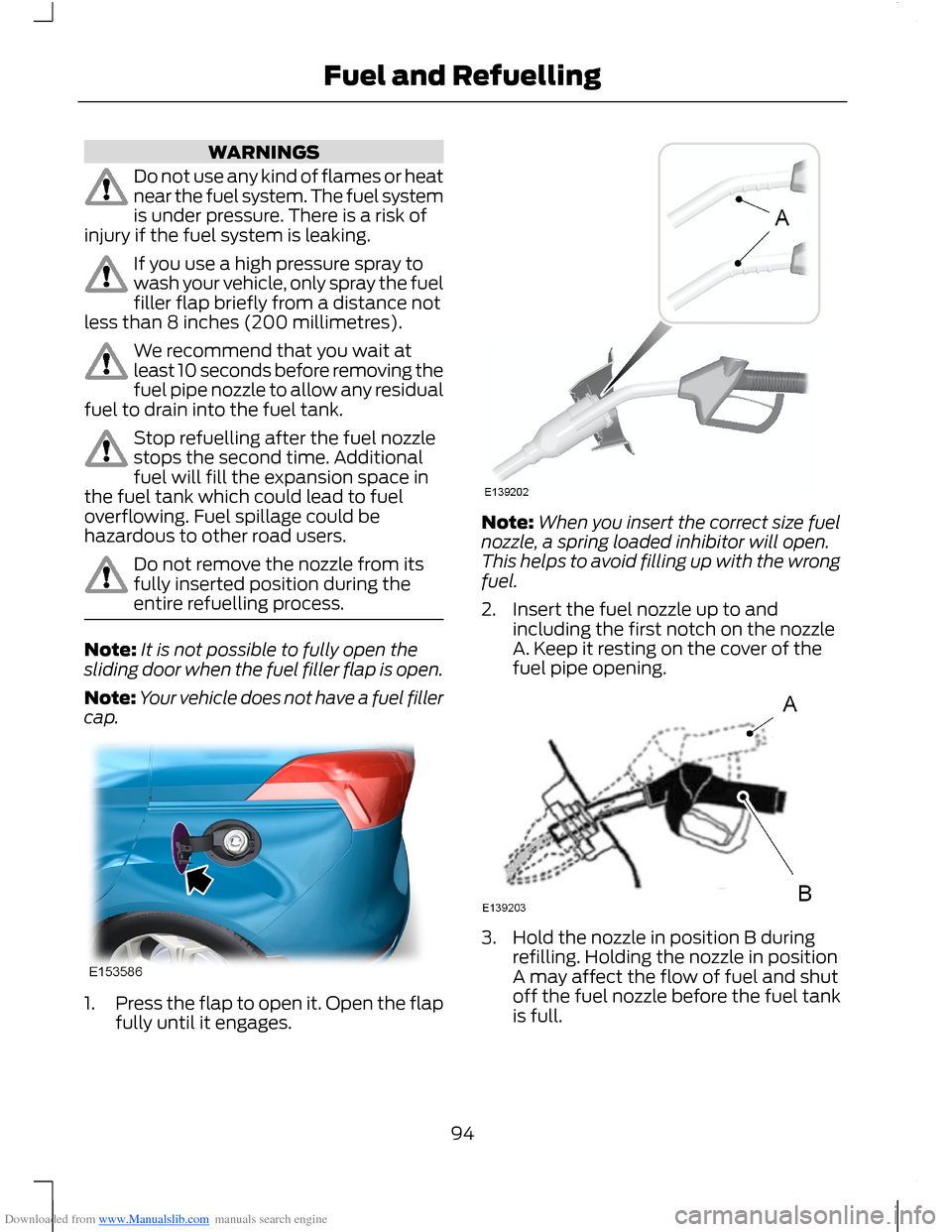
Note:It is not possible to fully open thesliding door when the fuel filler flap is open.
Note:Your vehicle does not have a fuel fillercap.
1.Press the flap to open it. Open the flapfully until it engages.
Note:When you insert the correct size fuelnozzle, a spring loaded inhibitor will open.This helps to avoid filling up with the wrongfuel.
2.Insert the fuel nozzle up to andincluding the first notch on the nozzleA. Keep it resting on the cover of thefuel pipe opening.
3.Hold the nozzle in position B duringrefilling. Holding the nozzle in positionA may affect the flow of fuel and shutoff the fuel nozzle before the fuel tankis full.
94Fuel and Refuelling
Page 136 of 256
Downloaded from www.Manualslib.com manuals search engine GENERAL INFORMATION
Have your vehicle serviced regularly to helpmaintain its roadworthiness and resalevalue. There is a large network of Fordauthorised repairers that are there to helpyou with their professional servicingexpertise. Authorised repairers are bestqualified to service your vehicle properlyand expertly, with a wide range of highlyspecialised tools.
In addition to regular servicing, werecommend that you carry out thefollowing checks.
WARNINGS
Switch the ignition off beforetouching or attempting adjustmentof any kind.
Do not touch the electronic ignitionsystem parts after you have switchedthe ignition on or when the engine isrunning. The system operates at highvoltage.
Keep your hands and clothing clearof the engine cooling fan. Undercertain conditions, the fan maycontinue to run for several minutes afteryou have switched the engine off.
Make sure that you fit filler capssecurely after carrying outmaintenance checks.
Daily Checks
•Exterior lamps.
•Interior lamps.
•Warning lamps and indicators.
Check When Refuelling
•Engine oil level. See Engine Oil Check(page 139).
•Brake fluid level. See Brake andClutch Fluid Check (page 141).
•Washer fluid level. See Washer FluidCheck (page 141).
•Tyre pressures (when cold). SeeTechnical Specifications (page 164).
•Tyre condition. See Wheels and Tyres(page 155).
Monthly Checks
•Engine coolant level (engine cold). SeeEngine Coolant Check (page 140).
•Pipes, hoses and reservoirs for leaks.
•Air conditioning operation.
•Parking brake operation.
•Horn operation.
•Tightness of wheel nuts. SeeTechnical Specifications (page 164).
OPENING AND CLOSING THE
BONNET
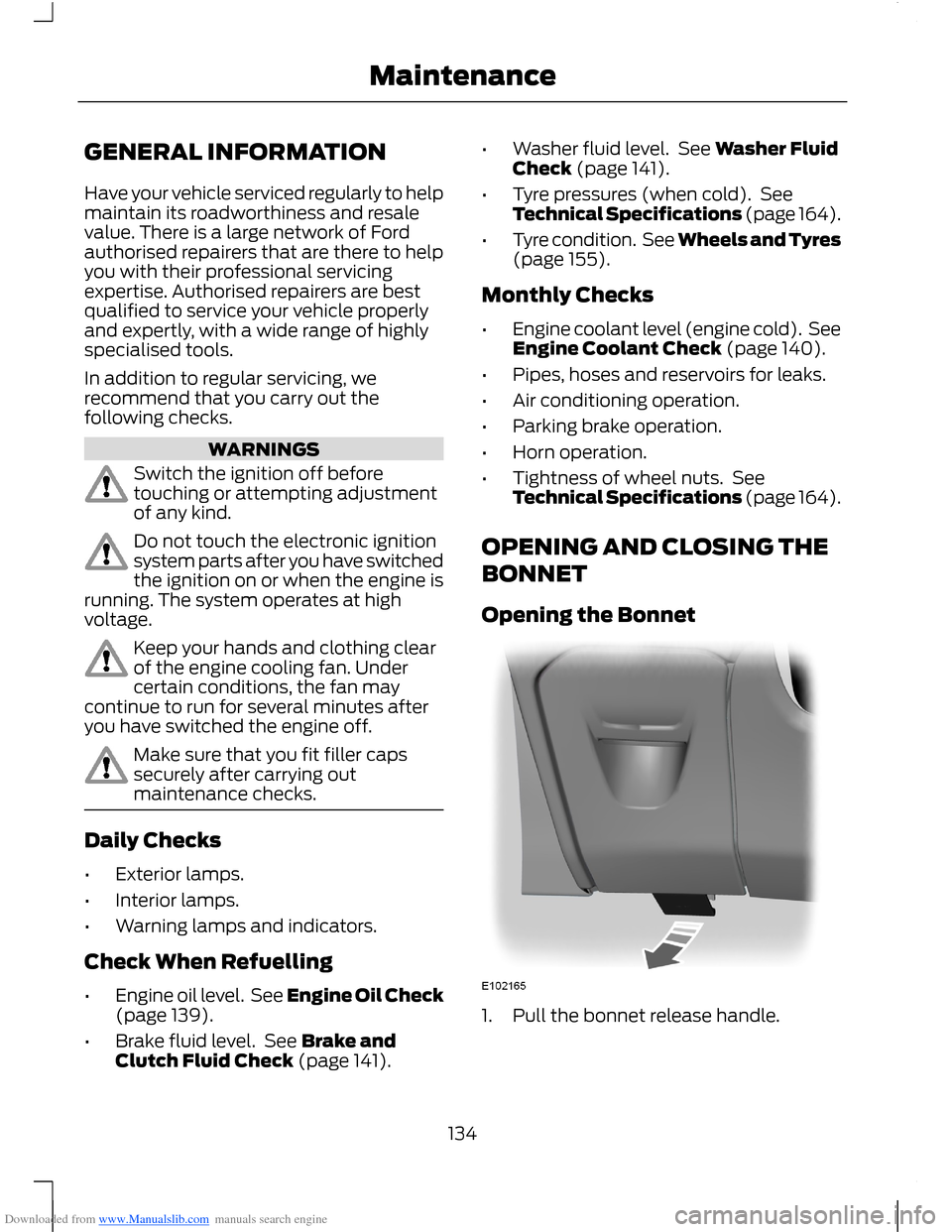
Opening the Bonnet
1.Pull the bonnet release handle.
134Maintenance
Page 157 of 256
Downloaded from www.Manualslib.com manuals search engine GENERAL INFORMATION
A decal with tyre pressure data is locatedin the driver’s door opening.
Check and set the tyre pressure at theambient temperature in which you areintending to drive your vehicle and whenthe tyres are cold.
Note:Check your tyre pressures regularlyto optimise fuel economy.
Note:Use only approved wheel and tyresizes. Using other sizes could damage yourvehicle and will make the National TypeApproval invalid.
Note:If you change the diameter of thetyres from that fitted at the factory, thespeedometer may not display the correctspeed. Take your vehicle to an authoriseddealer to have the engine managementsystem reprogrammed.
Note:If you intend to change the size of thewheels from that fitted at the factory, checkthe suitability with an authorised dealer.
TEMPORARY MOBILITY KIT
Your vehicle may not have a spare tyre.Therefore you will have an emergency kitwhich will only repair one flat tyre.
The kit is located in the spare wheel well.
General Information
WARNINGS
Depending on the type and extent oftyre damage, some tyres can only bepartially sealed or not sealed at all.Loss of tyre pressure can affect vehiclehandling, leading to loss of vehicle control.
Do not use the kit on a previouslydamaged tyre, for example when ithas been driven under inflated.
WARNINGS
Do not use the kit on run flat tyre.
Do not try to seal damage other thanthat located within the visible treadof the tyre.
Do not try to seal damage to thetyre’s sidewall.
The kit seals most tyre punctures [with adiameter of up to 1/4 inch (sixmillimetres)] to temporarily restoremobility.
Observe the following rules when using thekit:
•Drive with caution and avoid makingsudden steering or driving manoeuvres,especially if your vehicle is heavilyloaded or you are towing a trailer.
•The kit will provide you with anemergency temporary repair, enablingyou to continue your journey to the nextvehicle or tyre dealer, or to drive amaximum distance of 125 miles(200 kilometres).
•Do not exceed a maximum speed of50 mph (80 km/h).
•Keep the kit out of the reach ofchildren.
•Only use the kit when the ambienttemperature is between -22°F (–30°C)and +158°F (+70°C).
Using the Kit
WARNINGS
Compressed air can act as anexplosive or propellant.
Never leave the kit unattended whilein use.
Do not keep the compressoroperating for more than 10 minutes.
155Wheels and Tyres
Page 161 of 256
Downloaded from www.Manualslib.com manuals search engine USING WINTER TYRES
WARNING
When using winter tyres on yourvehicle, you must make sure that youfit the correct type of wheel nuts.
If winter tyres are used, make sure that thetyre pressures are correct. See TechnicalSpecifications (page 164).
USING SNOW CHAINS
WARNINGS
Do not exceed 30 mph (50 km/h).
Do not use snow chains on snow-freeroads.
Only fit snow chains to specifiedtyres. See TechnicalSpecifications (page 164).
If your vehicle has wheel trims,remove them before fitting snowchains.
Note:The anti-lock braking system willcontinue to operate normally.
Only use small link snow chains.
Only use snow chains on the front wheels.
Vehicles With Stability Control
When stability control is on, your vehiclemay exhibit some unusual drivingcharacteristics. To reduce this, switchtraction control off. See Using StabilityControl (page 103).
TYRE PRESSURE
MONITORING SYSTEM
WARNINGS
The system does not relieve you ofyour responsibility to regularly checkthe tyre pressures.
The system will only provide a lowtyre pressure warning. It will notinflate the tyres.
Do not drive on significantlyunder-inflated tyres. This may causethe tyres to overheat and fail.Under-inflation reduces fuel efficiency, tyretread life and may also affect your abilityto drive your vehicle safely.
Do not bend or damage the valveswhen you are inflating the tyres.
Have tyres installed by an authoriseddealer.
The deflation detection system will alertyou if there is a change of air pressure inany tyre. It does this by using the anti-lockbraking sensors to detect the rollingcircumference of the wheels. When thecircumference changes, this indicates lowtyre pressure. A warning message isdisplayed in the information display andthe message indicator will illuminate. SeeInformation Messages (page 62).
If a low pressure warning message isdisplayed in the information display, checkthe tyre pressures as soon as possible andinflate them to the recommendedpressure. See Technical Specifications(page 164).
If this happens frequently, have the causedetermined and rectified as soon aspossible.
159Wheels and Tyres