Eco FORD B MAX 2013 1.G Manual Online
[x] Cancel search | Manufacturer: FORD, Model Year: 2013, Model line: B MAX, Model: FORD B MAX 2013 1.GPages: 298, PDF Size: 20.63 MB
Page 173 of 298
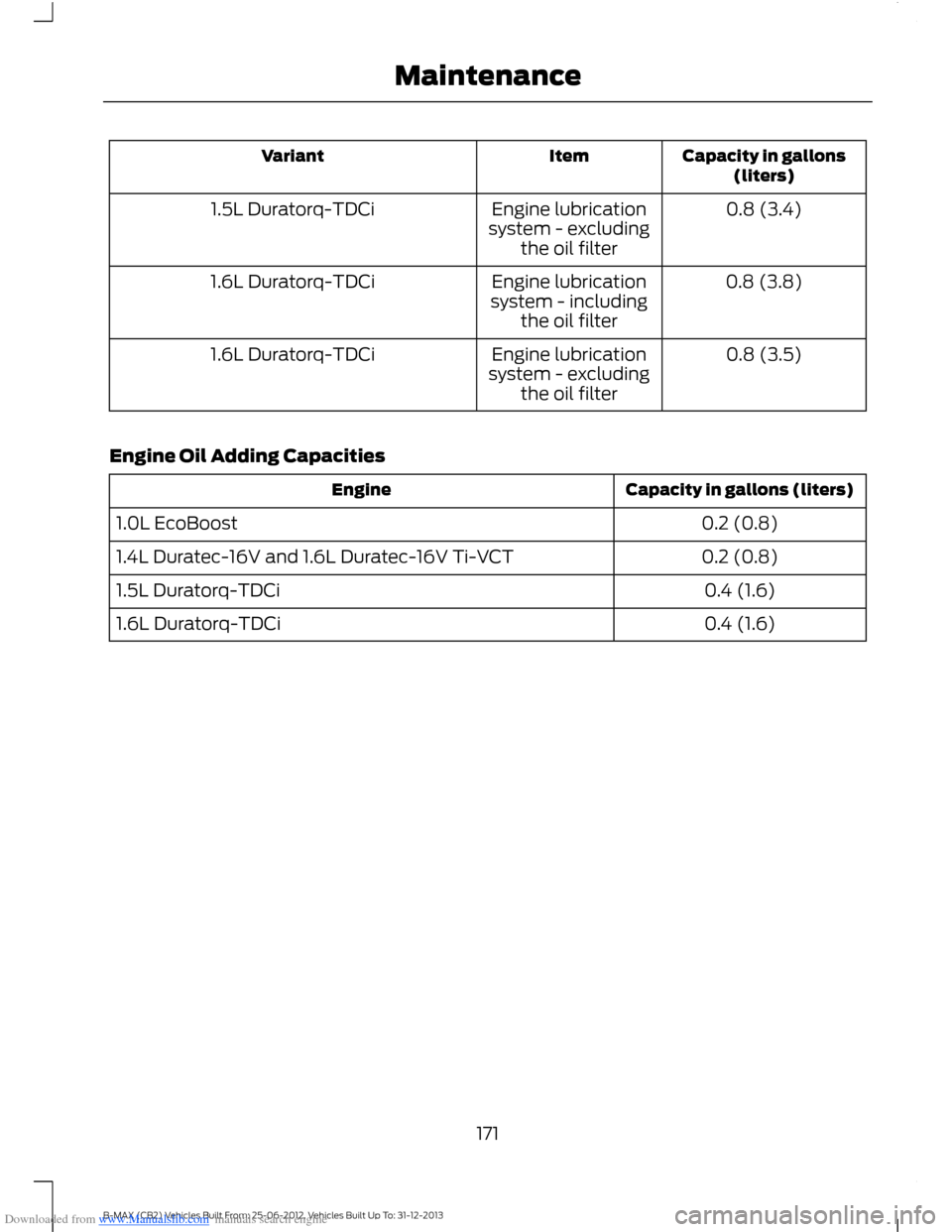
Downloaded from www.Manualslib.com manuals search engine Capacity in gallons(liters)ItemVariant
0.8 (3.4)Engine lubricationsystem - excludingthe oil filter
1.5L Duratorq-TDCi
0.8 (3.8)Engine lubricationsystem - includingthe oil filter
1.6L Duratorq-TDCi
0.8 (3.5)Engine lubricationsystem - excludingthe oil filter
1.6L Duratorq-TDCi
Engine Oil Adding Capacities
Capacity in gallons (liters)Engine
0.2 (0.8)1.0L EcoBoost
0.2 (0.8)1.4L Duratec-16V and 1.6L Duratec-16V Ti-VCT
0.4 (1.6)1.5L Duratorq-TDCi
0.4 (1.6)1.6L Duratorq-TDCi
171B-MAX (CB2) Vehicles Built From: 25-06-2012, Vehicles Built Up To: 31-12-2013Maintenance
Page 174 of 298
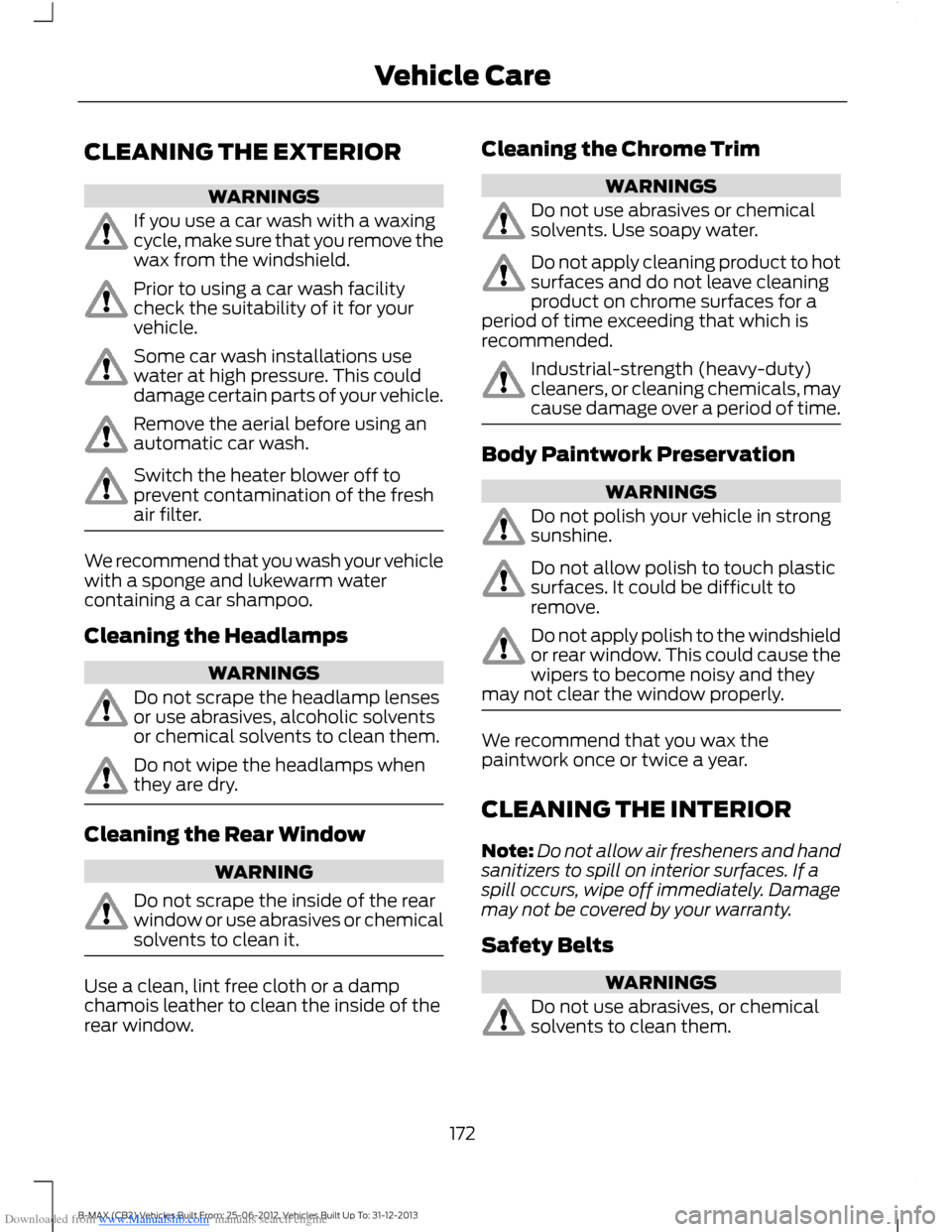
Downloaded from www.Manualslib.com manuals search engine CLEANING THE EXTERIOR
WARNINGS
If you use a car wash with a waxingcycle, make sure that you remove thewax from the windshield.
Prior to using a car wash facilitycheck the suitability of it for yourvehicle.
Some car wash installations usewater at high pressure. This coulddamage certain parts of your vehicle.
Remove the aerial before using anautomatic car wash.
Switch the heater blower off toprevent contamination of the freshair filter.
We recommend that you wash your vehiclewith a sponge and lukewarm watercontaining a car shampoo.
Cleaning the Headlamps
WARNINGS
Do not scrape the headlamp lensesor use abrasives, alcoholic solventsor chemical solvents to clean them.
Do not wipe the headlamps whenthey are dry.
Cleaning the Rear Window
WARNING
Do not scrape the inside of the rearwindow or use abrasives or chemicalsolvents to clean it.
Use a clean, lint free cloth or a dampchamois leather to clean the inside of therear window.
Cleaning the Chrome Trim
WARNINGS
Do not use abrasives or chemicalsolvents. Use soapy water.
Do not apply cleaning product to hotsurfaces and do not leave cleaningproduct on chrome surfaces for aperiod of time exceeding that which isrecommended.
Industrial-strength (heavy-duty)cleaners, or cleaning chemicals, maycause damage over a period of time.
Body Paintwork Preservation
WARNINGS
Do not polish your vehicle in strongsunshine.
Do not allow polish to touch plasticsurfaces. It could be difficult toremove.
Do not apply polish to the windshieldor rear window. This could cause thewipers to become noisy and theymay not clear the window properly.
We recommend that you wax thepaintwork once or twice a year.
CLEANING THE INTERIOR
Note:Do not allow air fresheners and handsanitizers to spill on interior surfaces. If aspill occurs, wipe off immediately. Damagemay not be covered by your warranty.
Safety Belts
WARNINGS
Do not use abrasives, or chemicalsolvents to clean them.
172B-MAX (CB2) Vehicles Built From: 25-06-2012, Vehicles Built Up To: 31-12-2013Vehicle Care
Page 175 of 298
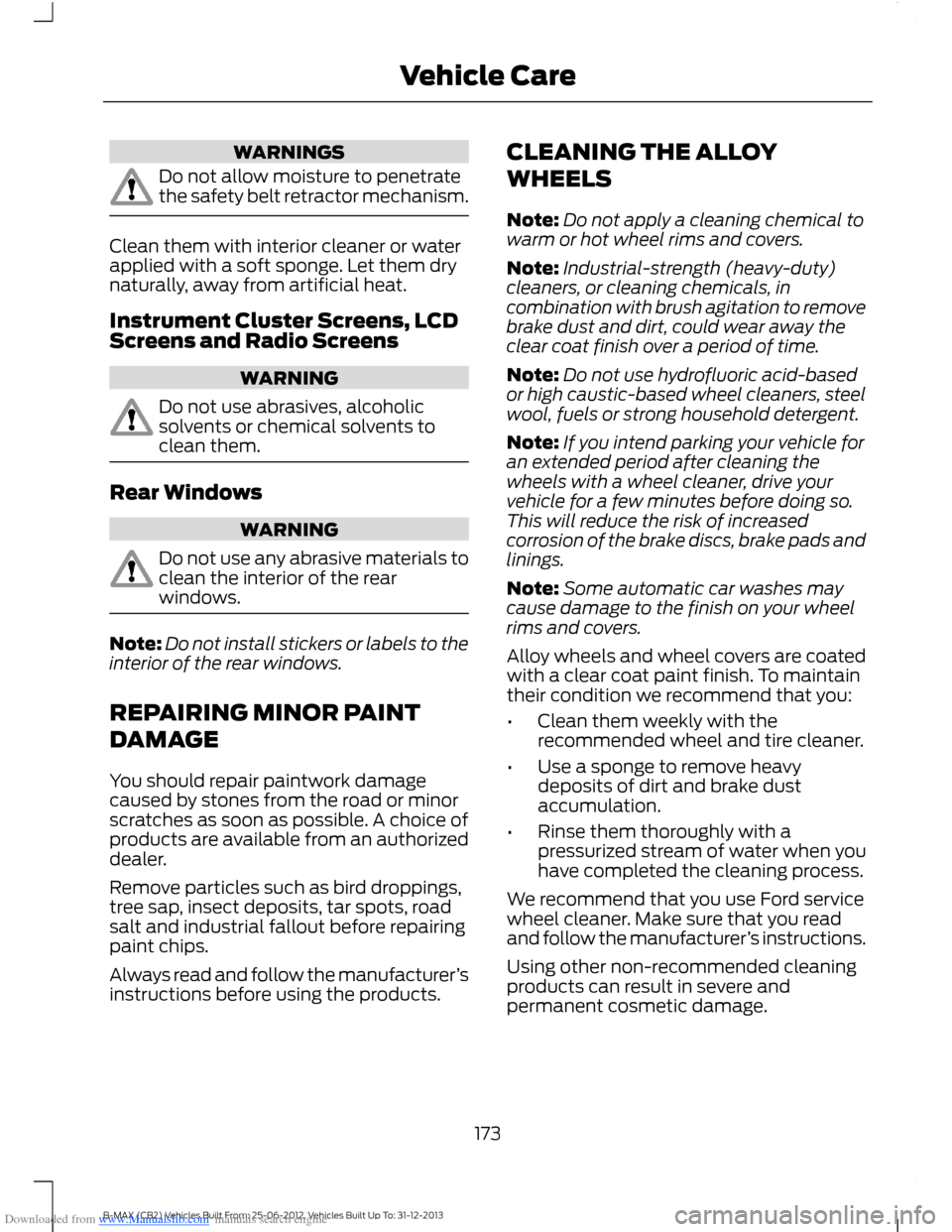
Downloaded from www.Manualslib.com manuals search engine WARNINGS
Do not allow moisture to penetratethe safety belt retractor mechanism.
Clean them with interior cleaner or waterapplied with a soft sponge. Let them drynaturally, away from artificial heat.
Instrument Cluster Screens, LCDScreens and Radio Screens
WARNING
Do not use abrasives, alcoholicsolvents or chemical solvents toclean them.
Rear Windows
WARNING
Do not use any abrasive materials toclean the interior of the rearwindows.
Note:Do not install stickers or labels to theinterior of the rear windows.
REPAIRING MINOR PAINT
DAMAGE
You should repair paintwork damagecaused by stones from the road or minorscratches as soon as possible. A choice ofproducts are available from an authorizeddealer.
Remove particles such as bird droppings,tree sap, insect deposits, tar spots, roadsalt and industrial fallout before repairingpaint chips.
Always read and follow the manufacturer’sinstructions before using the products.
CLEANING THE ALLOY
WHEELS
Note:Do not apply a cleaning chemical towarm or hot wheel rims and covers.
Note:Industrial-strength (heavy-duty)cleaners, or cleaning chemicals, incombination with brush agitation to removebrake dust and dirt, could wear away theclear coat finish over a period of time.
Note:Do not use hydrofluoric acid-basedor high caustic-based wheel cleaners, steelwool, fuels or strong household detergent.
Note:If you intend parking your vehicle foran extended period after cleaning thewheels with a wheel cleaner, drive yourvehicle for a few minutes before doing so.This will reduce the risk of increasedcorrosion of the brake discs, brake pads andlinings.
Note:Some automatic car washes maycause damage to the finish on your wheelrims and covers.
Alloy wheels and wheel covers are coatedwith a clear coat paint finish. To maintaintheir condition we recommend that you:
•Clean them weekly with therecommended wheel and tire cleaner.
•Use a sponge to remove heavydeposits of dirt and brake dustaccumulation.
•Rinse them thoroughly with apressurized stream of water when youhave completed the cleaning process.
We recommend that you use Ford servicewheel cleaner. Make sure that you readand follow the manufacturer’s instructions.
Using other non-recommended cleaningproducts can result in severe andpermanent cosmetic damage.
173B-MAX (CB2) Vehicles Built From: 25-06-2012, Vehicles Built Up To: 31-12-2013Vehicle Care
Page 176 of 298
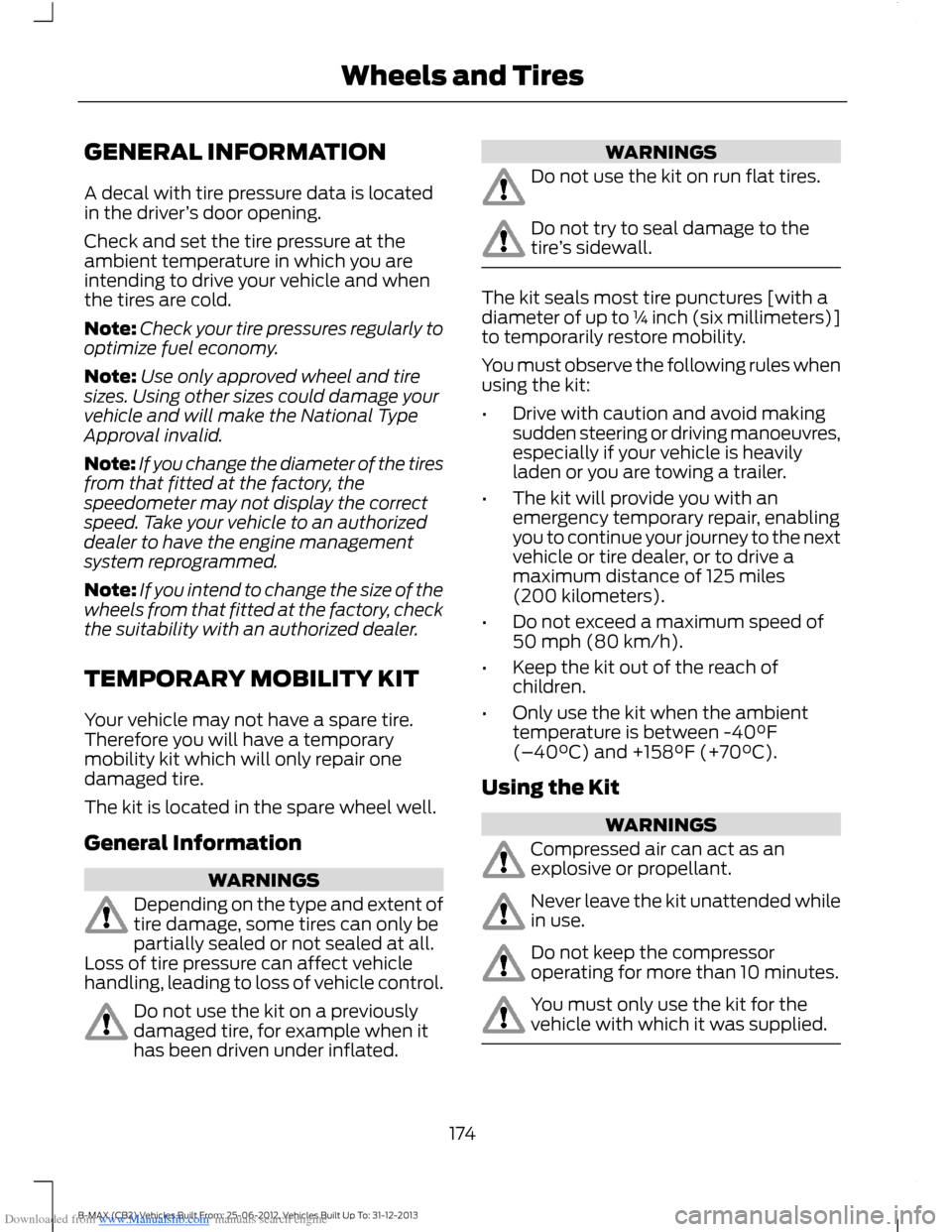
Downloaded from www.Manualslib.com manuals search engine GENERAL INFORMATION
A decal with tire pressure data is locatedin the driver’s door opening.
Check and set the tire pressure at theambient temperature in which you areintending to drive your vehicle and whenthe tires are cold.
Note:Check your tire pressures regularly tooptimize fuel economy.
Note:Use only approved wheel and tiresizes. Using other sizes could damage yourvehicle and will make the National TypeApproval invalid.
Note:If you change the diameter of the tiresfrom that fitted at the factory, thespeedometer may not display the correctspeed. Take your vehicle to an authorizeddealer to have the engine managementsystem reprogrammed.
Note:If you intend to change the size of thewheels from that fitted at the factory, checkthe suitability with an authorized dealer.
TEMPORARY MOBILITY KIT
Your vehicle may not have a spare tire.Therefore you will have a temporarymobility kit which will only repair onedamaged tire.
The kit is located in the spare wheel well.
General Information
WARNINGS
Depending on the type and extent oftire damage, some tires can only bepartially sealed or not sealed at all.Loss of tire pressure can affect vehiclehandling, leading to loss of vehicle control.
Do not use the kit on a previouslydamaged tire, for example when ithas been driven under inflated.
WARNINGS
Do not use the kit on run flat tires.
Do not try to seal damage to thetire’s sidewall.
The kit seals most tire punctures [with adiameter of up to ¼ inch (six millimeters)]to temporarily restore mobility.
You must observe the following rules whenusing the kit:
•Drive with caution and avoid makingsudden steering or driving manoeuvres,especially if your vehicle is heavilyladen or you are towing a trailer.
•The kit will provide you with anemergency temporary repair, enablingyou to continue your journey to the nextvehicle or tire dealer, or to drive amaximum distance of 125 miles(200 kilometers).
•Do not exceed a maximum speed of50 mph (80 km/h).
•Keep the kit out of the reach ofchildren.
•Only use the kit when the ambienttemperature is between -40°F(–40°C) and +158°F (+70°C).
Using the Kit
WARNINGS
Compressed air can act as anexplosive or propellant.
Never leave the kit unattended whilein use.
Do not keep the compressoroperating for more than 10 minutes.
You must only use the kit for thevehicle with which it was supplied.
174B-MAX (CB2) Vehicles Built From: 25-06-2012, Vehicles Built Up To: 31-12-2013Wheels and Tires
Page 178 of 298
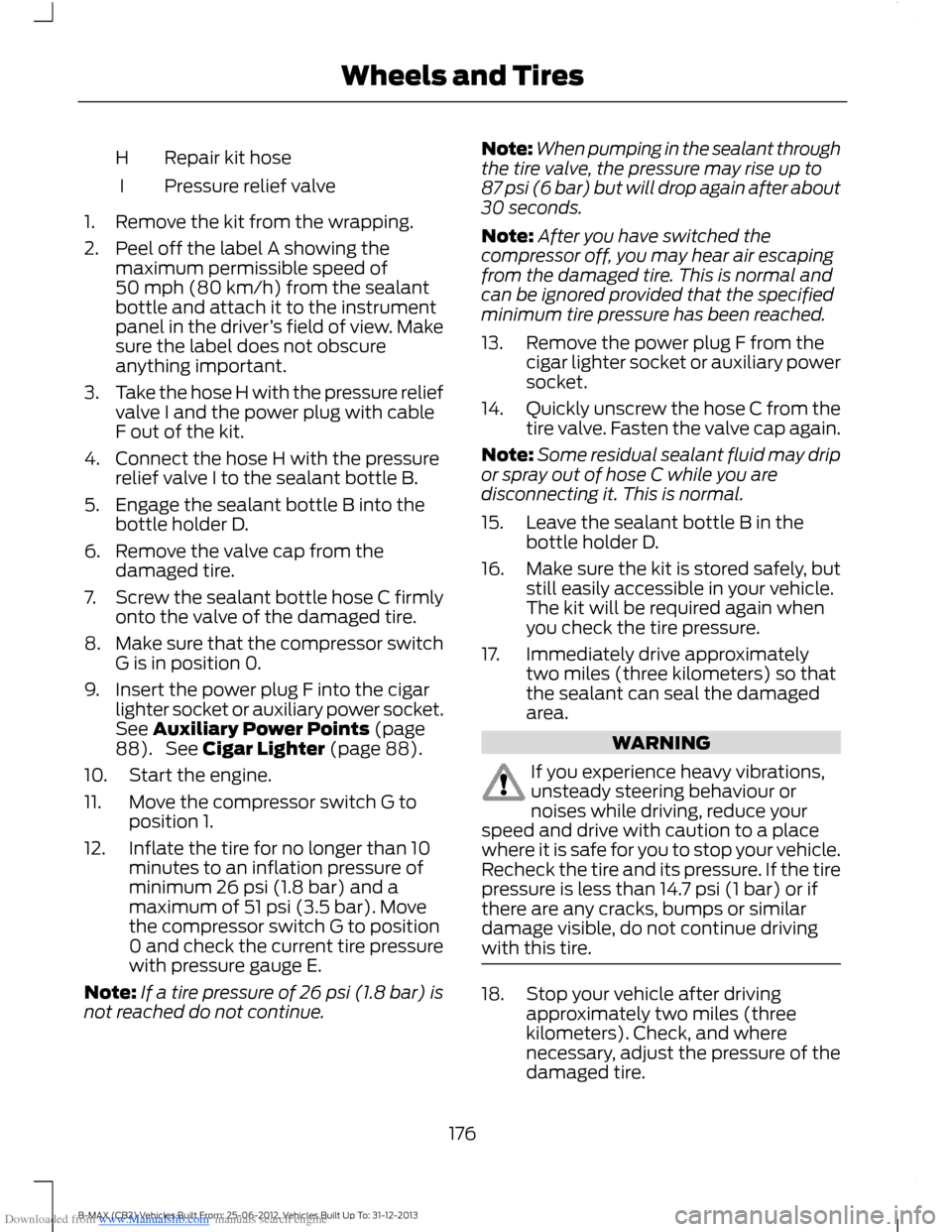
Downloaded from www.Manualslib.com manuals search engine Repair kit hoseH
Pressure relief valveI
1.Remove the kit from the wrapping.
2.Peel off the label A showing themaximum permissible speed of50 mph (80 km/h) from the sealantbottle and attach it to the instrumentpanel in the driver’s field of view. Makesure the label does not obscureanything important.
3.Take the hose H with the pressure reliefvalve I and the power plug with cableF out of the kit.
4.Connect the hose H with the pressurerelief valve I to the sealant bottle B.
5.Engage the sealant bottle B into thebottle holder D.
6.Remove the valve cap from thedamaged tire.
7.Screw the sealant bottle hose C firmlyonto the valve of the damaged tire.
8.Make sure that the compressor switchG is in position 0.
9.Insert the power plug F into the cigarlighter socket or auxiliary power socket.See Auxiliary Power Points (page88). See Cigar Lighter (page 88).
10.Start the engine.
11.Move the compressor switch G toposition 1.
12.Inflate the tire for no longer than 10minutes to an inflation pressure ofminimum 26 psi (1.8 bar) and amaximum of 51 psi (3.5 bar). Movethe compressor switch G to position0 and check the current tire pressurewith pressure gauge E.
Note:If a tire pressure of 26 psi (1.8 bar) isnot reached do not continue.
Note:When pumping in the sealant throughthe tire valve, the pressure may rise up to87 psi (6 bar) but will drop again after about30 seconds.
Note:After you have switched thecompressor off, you may hear air escapingfrom the damaged tire. This is normal andcan be ignored provided that the specifiedminimum tire pressure has been reached.
13.Remove the power plug F from thecigar lighter socket or auxiliary powersocket.
14.Quickly unscrew the hose C from thetire valve. Fasten the valve cap again.
Note:Some residual sealant fluid may dripor spray out of hose C while you aredisconnecting it. This is normal.
15.Leave the sealant bottle B in thebottle holder D.
16.Make sure the kit is stored safely, butstill easily accessible in your vehicle.The kit will be required again whenyou check the tire pressure.
17.Immediately drive approximatelytwo miles (three kilometers) so thatthe sealant can seal the damagedarea.
WARNING
If you experience heavy vibrations,unsteady steering behaviour ornoises while driving, reduce yourspeed and drive with caution to a placewhere it is safe for you to stop your vehicle.Recheck the tire and its pressure. If the tirepressure is less than 14.7 psi (1 bar) or ifthere are any cracks, bumps or similardamage visible, do not continue drivingwith this tire.
18.Stop your vehicle after drivingapproximately two miles (threekilometers). Check, and wherenecessary, adjust the pressure of thedamaged tire.
176B-MAX (CB2) Vehicles Built From: 25-06-2012, Vehicles Built Up To: 31-12-2013Wheels and Tires
Page 179 of 298
Downloaded from www.Manualslib.com manuals search engine 19.Attach the kit and read the tirepressure from the pressure gauge E.
20.Adjust it to the specified pressure.See Technical Specifications(page 183).
21.Once you have inflated the tire to itscorrect tire pressure, move thecompressor switch G to position 0,remove the power plug F from thesocket, unscrew the hose C andfasten the valve cap.
22.Leave hose C and H connected to thesealant bottle B and store the kitaway safely.
23.Go to the nearest tire specialist to getthe damaged tire replaced. Beforethe tire is removed from the rim,inform your tire dealer that the tirecontains sealant. You must renew thesealant bottle B and hose C as soonas possible once used.
Note:Remember that the kit only providestemporary mobility. Regulations concerningtire repair after using the kit may differ fromcountry to country. You should consult a tirespecialist for advice.
WARNING
Before driving, make sure the tire isadjusted to the recommendedinflation pressure. See TechnicalSpecifications (page 183). You must,monitor the tire pressure until the sealedtire is replaced.
Empty sealant bottles can be disposed oftogether with normal household waste.Return remains of sealant to an authorizeddealer or dispose of it in compliance withlocal waste disposal regulations.
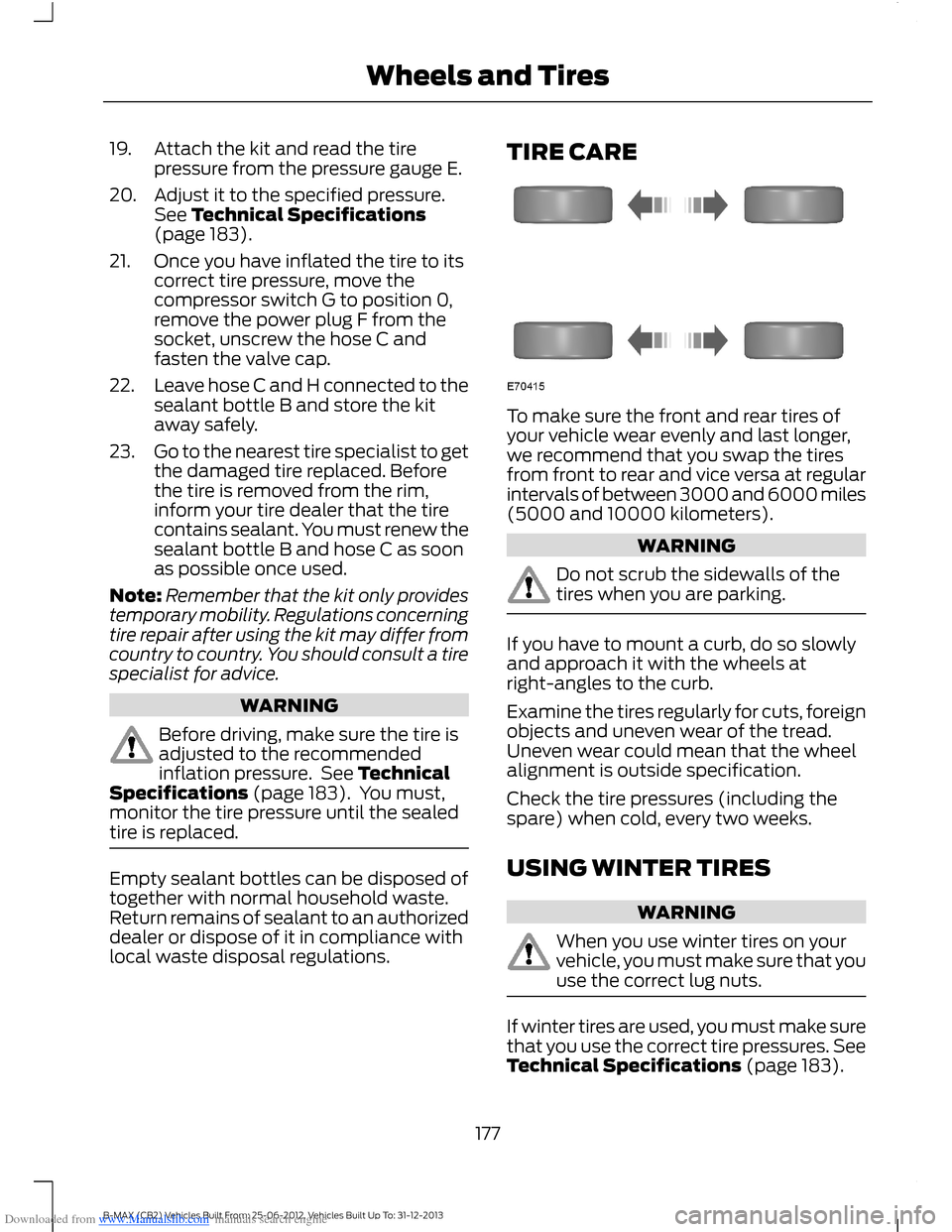
TIRE CARE
To make sure the front and rear tires ofyour vehicle wear evenly and last longer,we recommend that you swap the tiresfrom front to rear and vice versa at regularintervals of between 3000 and 6000 miles(5000 and 10000 kilometers).
WARNING
Do not scrub the sidewalls of thetires when you are parking.
If you have to mount a curb, do so slowlyand approach it with the wheels atright-angles to the curb.
Examine the tires regularly for cuts, foreignobjects and uneven wear of the tread.Uneven wear could mean that the wheelalignment is outside specification.
Check the tire pressures (including thespare) when cold, every two weeks.
USING WINTER TIRES
WARNING
When you use winter tires on yourvehicle, you must make sure that youuse the correct lug nuts.
If winter tires are used, you must make surethat you use the correct tire pressures. SeeTechnical Specifications (page 183).
177B-MAX (CB2) Vehicles Built From: 25-06-2012, Vehicles Built Up To: 31-12-2013Wheels and Tires
Page 180 of 298
Downloaded from www.Manualslib.com manuals search engine USING SNOW CHAINS
WARNINGS
Do not exceed 30 mph (50 km/h).
Do not use snow chains on snow-freeroads.
Only fit snow chains to specifiedtires. See Technical Specifications(page 183).
If your vehicle has wheel trims,remove them before fitting snowchains.
Note:The anti-lock braking system willcontinue to operate normally.
Only use small link snow chains.
Only use snow chains on the front wheels.
Vehicles with Stability Control
When stability control is on, your vehiclemay exhibit some unusual drivingcharacteristics. To reduce this, switchtraction control off. See Using StabilityControl (page 111).
TIRE PRESSURE MONITORING
SYSTEM
WARNINGS
The system does not relieve you ofyour responsibility to regularly checkthe tire pressures.
The system will only provide a lowtire pressure warning. It will notinflate the tires.
WARNINGS
Do not drive on significantlyunder-inflated tires. This may causethe tires to overheat and fail.Under-inflation reduces fuel efficiency, tiretread life and may also affect your abilityto drive your vehicle safely.
Do not bend or damage the valveswhen you are inflating the tires.
Have tires installed by an authorizeddealer.
The deflation detection system will alertyou if there is a change of air pressure inany tire. It does this by using the anti-lockbraking sensors to detect the rollingcircumference of the wheels. When thecircumference changes, this indicates lowtire pressure. A warning message isdisplayed in the information display andthe message indicator will illuminate. SeeInformation Messages (page 67).
If a low pressure warning message isdisplayed in the information display, checkthe tire pressures as soon as possible andinflate them to the recommendedpressure. See Technical Specifications(page 183).
If this happens frequently, have the causedetermined and rectified as soon aspossible.
Apart from a too low tire pressure or adamaged tire, the following situations canaffect the rolling circumference:
•Vehicle load is uneven.
•When using a trailer or traveling up anddown an incline.
•Using snow chains.
•Driving on soft surfaces such as snowor mud.
Note:The system will still functioncorrectly, but there may be an increaseddetection time.
178B-MAX (CB2) Vehicles Built From: 25-06-2012, Vehicles Built Up To: 31-12-2013Wheels and Tires
Page 181 of 298
Downloaded from www.Manualslib.com manuals search engine System Reset
Note:Do not reset the system when yourvehicle is moving.
Note:You should reset the systemfollowing any adjustment to the tirepressures or any changing of tires.
1.Switch the ignition on.
2.Using the information display control,navigate to Menu > Vehicle settings> Deflation detection.
3.Press and hold the OK button untilconfirmation appears.
CHANGING A ROAD WHEEL
Lug Nuts
You can obtain a replacement locking lugnut key and replacement locking lug nutsfrom your dealer using the referencenumber certificate.
Vehicles With a Spare Wheel
If the spare wheel is exactly the same typeand size as the other fitted road wheels,you can replace the existing road wheelwith the spare wheel and continue to drivein the normal manner.
If the spare wheel is different to the otherroad wheels, it will carry a yellow label withthe appropriate speed limit.
Refer to the following information beforechanging the road wheel.
WARNINGS
Drive the shortest possible distances.
Do not fit more than one spare wheelon your vehicle at any one time.
Do not carry out any tire repairs on aspare wheel.
WARNINGS
Do not drive through an automaticcar wash.
If you are unsure what type of sparewheel you have do not exceed 80km/h (50 mph).
Only fit snow chains to specifiedtires. See Technical Specifications(page 183).
The ground clearance of your vehiclemay be reduced. Take care whenparking next to a curb.
Note:Your vehicle may exhibit someunusual driving characteristics.
Vehicle Jack
WARNINGS
The vehicle jack supplied with yourvehicle should only be used whenchanging a wheel in emergencysituations.
Before using the vehicle jack, checkthat it is not damaged or deformedand that the thread is lubricated andfree from foreign matter.
Never place anything between thejack and the ground, or the jack andyour vehicle.
Note:Vehicles with a temporary mobilitykit do not have a vehicle jack or a wheelbrace.
It is recommended to use a workshop typehydraulic jack for changing betweensummer and winter tires.
Note:Use a jack with a minimum liftingcapacity of 1.5 tonnes and a lifting plate witha minimum diameter of 3.1 inches (80millimeters).
179B-MAX (CB2) Vehicles Built From: 25-06-2012, Vehicles Built Up To: 31-12-2013Wheels and Tires
Page 192 of 298
Downloaded from www.Manualslib.com manuals search engine GENERAL INFORMATION
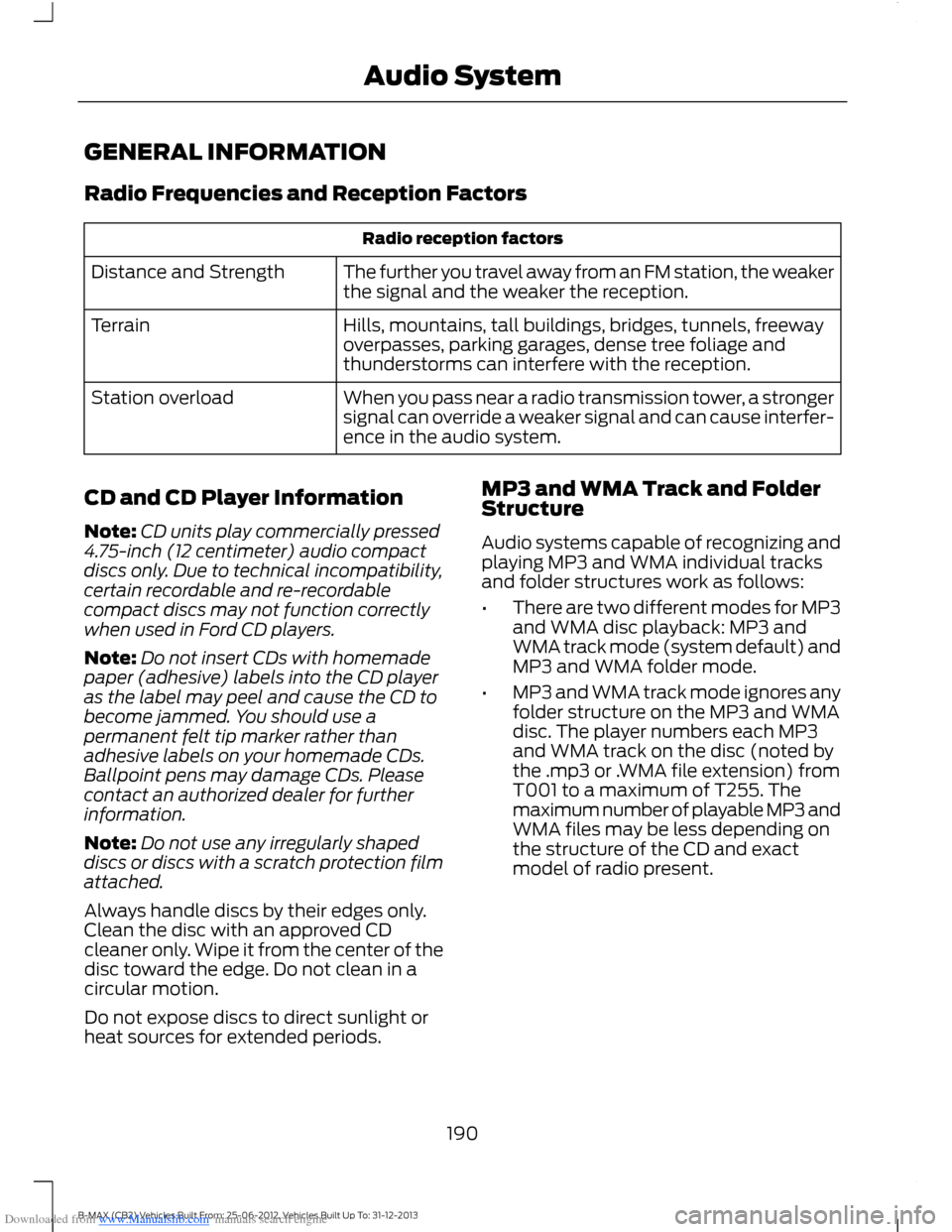
Radio Frequencies and Reception Factors
Radio reception factors
The further you travel away from an FM station, the weakerthe signal and the weaker the reception.Distance and Strength
Hills, mountains, tall buildings, bridges, tunnels, freewayoverpasses, parking garages, dense tree foliage andthunderstorms can interfere with the reception.
Terrain
When you pass near a radio transmission tower, a strongersignal can override a weaker signal and can cause interfer-ence in the audio system.
Station overload
CD and CD Player Information
Note:CD units play commercially pressed4.75-inch (12 centimeter) audio compactdiscs only. Due to technical incompatibility,certain recordable and re-recordablecompact discs may not function correctlywhen used in Ford CD players.
Note:Do not insert CDs with homemadepaper (adhesive) labels into the CD playeras the label may peel and cause the CD tobecome jammed. You should use apermanent felt tip marker rather thanadhesive labels on your homemade CDs.Ballpoint pens may damage CDs. Pleasecontact an authorized dealer for furtherinformation.
Note:Do not use any irregularly shapeddiscs or discs with a scratch protection filmattached.
Always handle discs by their edges only.Clean the disc with an approved CDcleaner only. Wipe it from the center of thedisc toward the edge. Do not clean in acircular motion.
Do not expose discs to direct sunlight orheat sources for extended periods.
MP3 and WMA Track and FolderStructure
Audio systems capable of recognizing andplaying MP3 and WMA individual tracksand folder structures work as follows:
•There are two different modes for MP3and WMA disc playback: MP3 andWMA track mode (system default) andMP3 and WMA folder mode.
•MP3 and WMA track mode ignores anyfolder structure on the MP3 and WMAdisc. The player numbers each MP3and WMA track on the disc (noted bythe .mp3 or .WMA file extension) fromT001 to a maximum of T255. Themaximum number of playable MP3 andWMA files may be less depending onthe structure of the CD and exactmodel of radio present.
190B-MAX (CB2) Vehicles Built From: 25-06-2012, Vehicles Built Up To: 31-12-2013Audio System
Page 193 of 298
Downloaded from www.Manualslib.com manuals search engine •MP3 and WMA folder mode representsa folder structure consisting of onelevel of folders. The CD player numbersall MP3 and WMA tracks on the disc(noted by the .mp3 or .WMA fileextension) and all folders containingMP3 and WMA files, from F001 (folder)T001 (track) to F253 T255.
•Creating discs with only one level offolders helps with navigation throughthe disc files.
If you are burning your own MP3 and WMAdiscs, it is important to understand howthe system reads the structures you create.While various files may be present, (fileswith extensions other than mp3 andWMA), only files with the .mp3 and WMAextension are played; other files areignored by the system. This enables you touse the same MP3 and WMA disc for avariety of tasks on your work computer,home computer and your in-vehiclesystem.
In track mode, the system displays andplays the structure as if it were only onelevel deep (all .mp3 files play, regardlessof being in a specific folder). In foldermode, the system only plays the .mp3 filesin the current folder.
AUDIO UNIT - VEHICLES WITH:
AM/FM/CD
WARNING
Driving while distracted can result inloss of vehicle control, crash andinjury. We strongly recommend thatyou use extreme caution when using anydevice that may take your focus off theroad. Your primary responsibility is the safeoperation of your vehicle. We recommendagainst the use of any hand-held devicewhile driving and encourage the use ofvoice-operated systems when possible.Make sure you are aware of all applicablelocal laws that may affect the use ofelectronic devices while driving.
191B-MAX (CB2) Vehicles Built From: 25-06-2012, Vehicles Built Up To: 31-12-2013Audio System