warning FORD B MAX 2013 1.G Manual Online
[x] Cancel search | Manufacturer: FORD, Model Year: 2013, Model line: B MAX, Model: FORD B MAX 2013 1.GPages: 298, PDF Size: 20.63 MB
Page 135 of 298
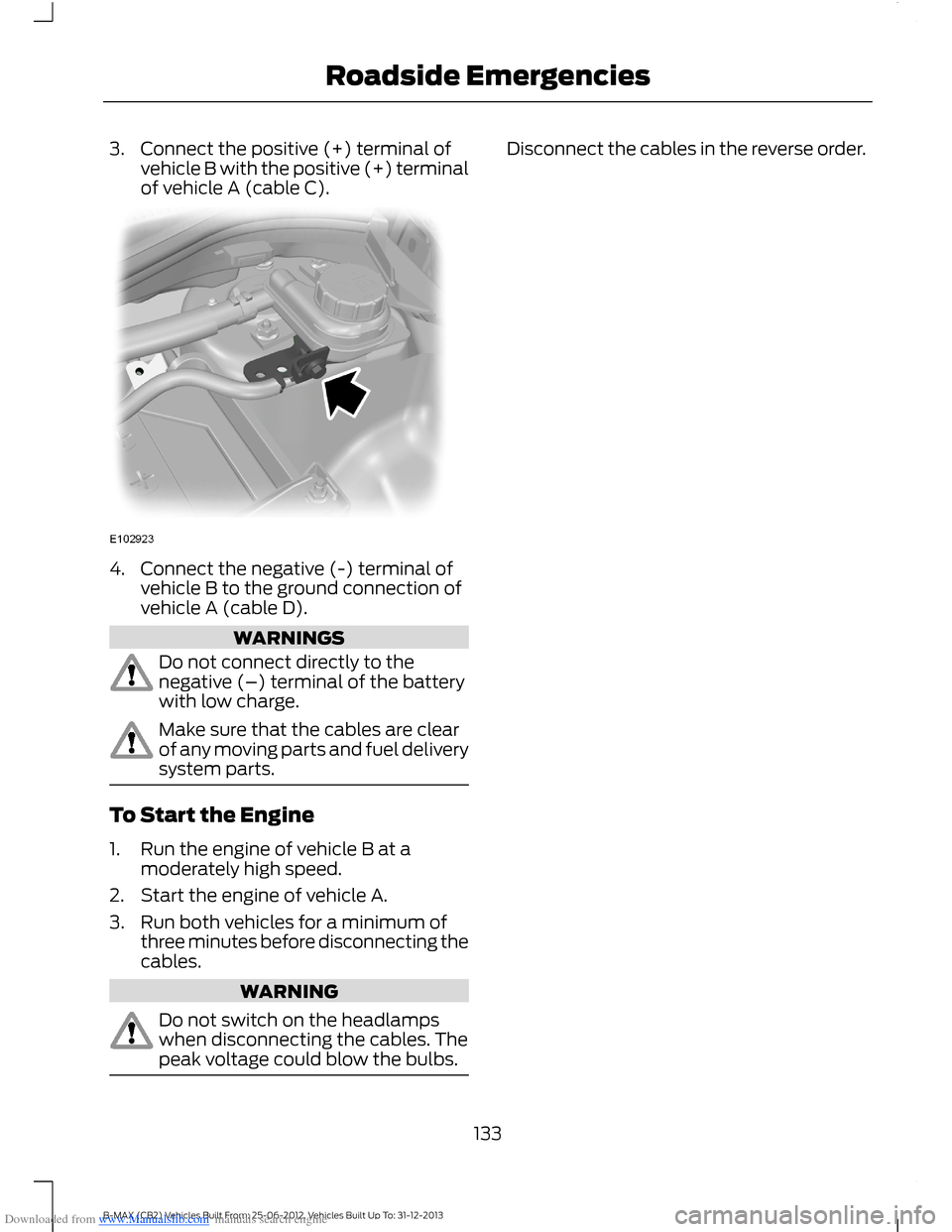
Downloaded from www.Manualslib.com manuals search engine 3.Connect the positive (+) terminal ofvehicle B with the positive (+) terminalof vehicle A (cable C).
4.Connect the negative (-) terminal ofvehicle B to the ground connection ofvehicle A (cable D).
WARNINGS
Do not connect directly to thenegative (–) terminal of the batterywith low charge.
Make sure that the cables are clearof any moving parts and fuel deliverysystem parts.
To Start the Engine
1.Run the engine of vehicle B at amoderately high speed.
2.Start the engine of vehicle A.
3.Run both vehicles for a minimum ofthree minutes before disconnecting thecables.
WARNING
Do not switch on the headlampswhen disconnecting the cables. Thepeak voltage could blow the bulbs.
Disconnect the cables in the reverse order.
133B-MAX (CB2) Vehicles Built From: 25-06-2012, Vehicles Built Up To: 31-12-2013Roadside Emergencies
Page 152 of 298
Downloaded from www.Manualslib.com manuals search engine Circuits protectedFuse ratingFuse
Passenger airbag deactiva-tion indicator7.5 A44
Not used-45
Not used-46
Not used-47
Not used-48
Not used-49
Circuits switchedRelay
IgnitionR1
Cigar lighterR2
Not usedR3
Active city stop relayR4
Not usedR5
Keyless entry (accessory)R6
Keyless entry (ignition)R7
Battery saver relayR8
Heated windshield left-hand sideR9
Heated windshield right-hand sideR10
Not usedR11
Not usedR12
CHANGING A FUSE
WARNINGS
Do not modify the electrical systemof your vehicle in any way. Haverepairs to the electrical system andthe replacement of relays and high currentfuses carried out by an authorized dealer.
WARNINGS
Switch the ignition and all electricalequipment off before attempting tochange a fuse.
Always replace a fuse with one thathas the specified amperage rating.Using a fuse with a higher amperagerating can cause severe wire damage andcould start a fire.
150B-MAX (CB2) Vehicles Built From: 25-06-2012, Vehicles Built Up To: 31-12-2013Fuses
Page 154 of 298
Downloaded from www.Manualslib.com manuals search engine GENERAL INFORMATION
Have your vehicle serviced regularly to helpmaintain its roadworthiness and resalevalue. There is a large network of Fordauthorized repairers that are there to helpyou with their professional servicingexpertise. Authorized repairers are bestqualified to service your vehicle properlyand expertly, with a wide range of highlyspecialized tools.
In addition to regular servicing, werecommend that you carry out thefollowing checks.
WARNINGS
Switch the ignition off beforetouching or attempting adjustmentof any kind.
Do not touch the electronic ignitionsystem parts after you have switchedthe ignition on or when the engine isrunning. The system operates at highvoltage.
Keep your hands and clothing clearof the engine cooling fan. Undercertain conditions, the fan maycontinue to run for several minutes afteryou have switched the engine off.
Make sure that you fit filler capssecurely after carrying outmaintenance checks.
Daily Checks
•Exterior lamps.
•Interior lamps.
•Warning lamps and indicators.
Check When Refueling
•Engine oil level. See Engine Oil Check(page 157).
•Brake fluid level. See Brake andClutch Fluid Check (page 159).
•Washer fluid level. See Washer FluidCheck (page 159).
•Tire pressures (when cold). SeeTechnical Specifications (page 183).
•Tire condition. See Wheels and Tires(page 174).
Monthly Checks
•Engine coolant level (engine cold). SeeEngine Coolant Check (page 158).
•Pipes, hoses and reservoirs for leaks.
•Air conditioning operation.
•Parking brake operation.
•Horn operation.
•Tightness of lug nuts. See TechnicalSpecifications (page 183).
OPENING AND CLOSING THE
HOOD
Opening the Hood
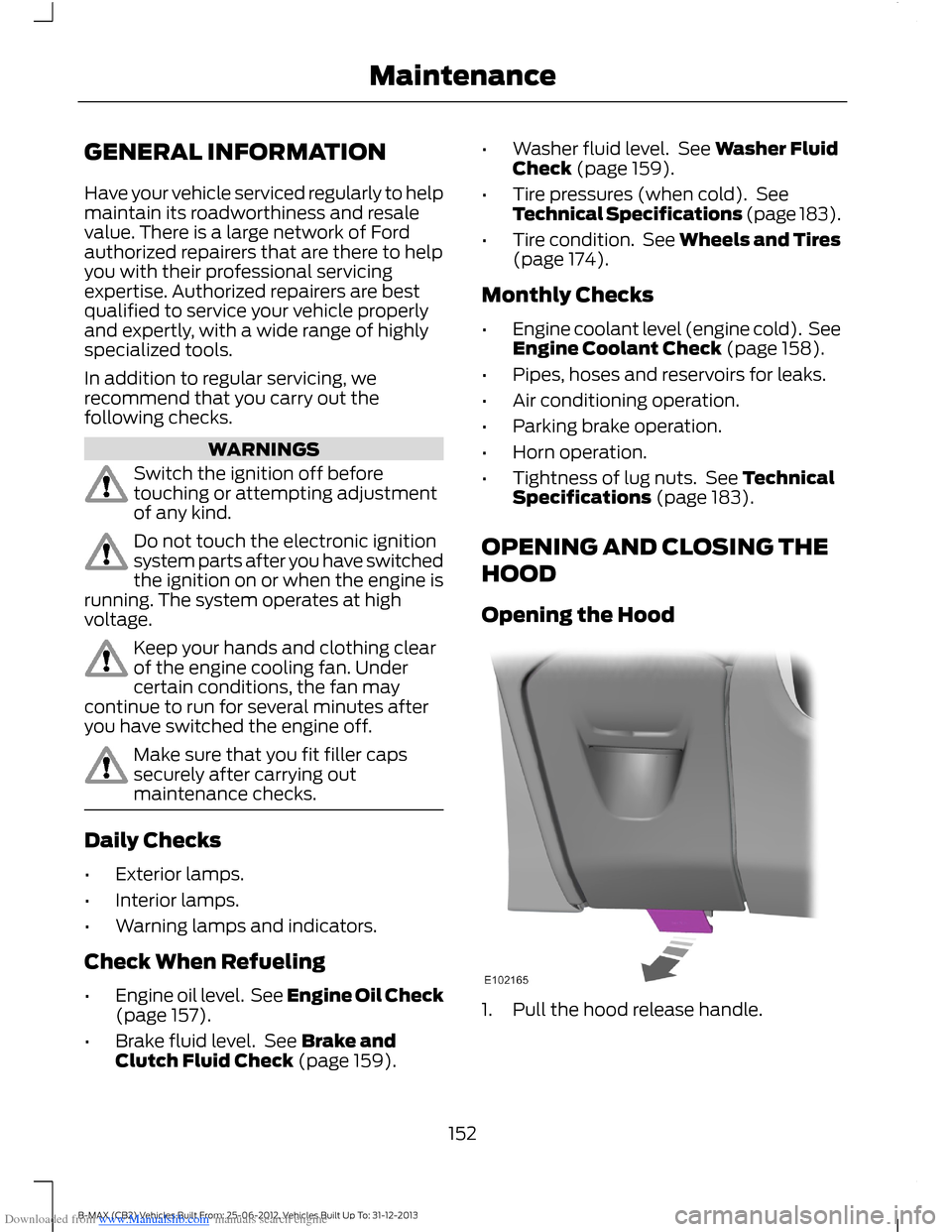
1.Pull the hood release handle.
152B-MAX (CB2) Vehicles Built From: 25-06-2012, Vehicles Built Up To: 31-12-2013Maintenance
Page 160 of 298
Downloaded from www.Manualslib.com manuals search engine Adding Oil
WARNINGS
Only add oil when the engine is cold.If the engine is hot, wait 10 minutesfor the engine to cool down. Failureto take care may result in personal injury.
Do not remove the filler cap whenthe engine is running. Failure to takecare may result in personal injury.
1.Remove the filler cap.
2.Add oil that meets Ford specifications.See Technical Specifications (page169).
3.Replace the filler cap. Turn it until youfeel a strong resistance.
Note:Do not add oil further than themaximum mark. Oil levels above themaximum mark may cause engine damage.
Note:Soak up any spillage with anabsorbent cloth immediately.
ENGINE COOLANT CHECK
WARNING
Do not allow the fluid to touch yourskin or eyes. If this happens, rinse theaffected areas immediately withplenty of water and contact your physician.
Note:Make sure that the level is betweenthe MIN and the MAX marks.
Note:Coolant expands when it is hot. Thelevel may therefore extend beyond the MAXmark.
If the level is at the MIN mark, add coolantimmediately.
Adding Engine Coolant
WARNINGS
Only add coolant when the engine iscold. If the engine is hot, wait 10minutes for the engine to cool down.
Do not remove the filler cap whenthe engine is running.
Do not remove the filler cap whenthe engine is hot. Wait for the engineto cool down.
Undiluted coolant is flammable andmay ignite if spilt on a hot exhaust.
Note:In an emergency, you can add justwater to the cooling system to reach avehicle service station. Have the systemchecked by an authorized dealer as soon aspossible.
Note:Prolonged use of incorrect dilutionof the coolant can cause engine damagefrom corrosion, overheating or freezing.
Note:Do not add coolant further than theMAX mark.
1.Remove the filler cap. Any pressure willescape slowly as you unscrew the cap.
2.Add a 50/50 mixture of coolant andwater using fluid that meets the Fordspecifications. See TechnicalSpecifications (page 169).
3.Replace the filler cap. Turn it until youfeel a strong resistance.
158B-MAX (CB2) Vehicles Built From: 25-06-2012, Vehicles Built Up To: 31-12-2013Maintenance
Page 161 of 298
Downloaded from www.Manualslib.com manuals search engine BRAKE AND CLUTCH FLUID
CHECK
WARNINGS
Do not use any fluid other than therecommended brake fluid as this willreduce brake efficiency. Use ofincorrect fluid could result in the loss ofvehicle control, serious personal injury ordeath.
Only use brake fluid from a sealedcontainer. Contamination with dirt,water, petroleum products or othermaterials may result in brake systemdamage or failure. Failure to adhere to thiswarning could result in the loss of vehiclecontrol, serious personal injury or death.
Do not allow the fluid to touch yourskin or eyes. This could cause seriouspersonal injury. Rinse the affectedareas immediately with plenty of waterand consult a physician.
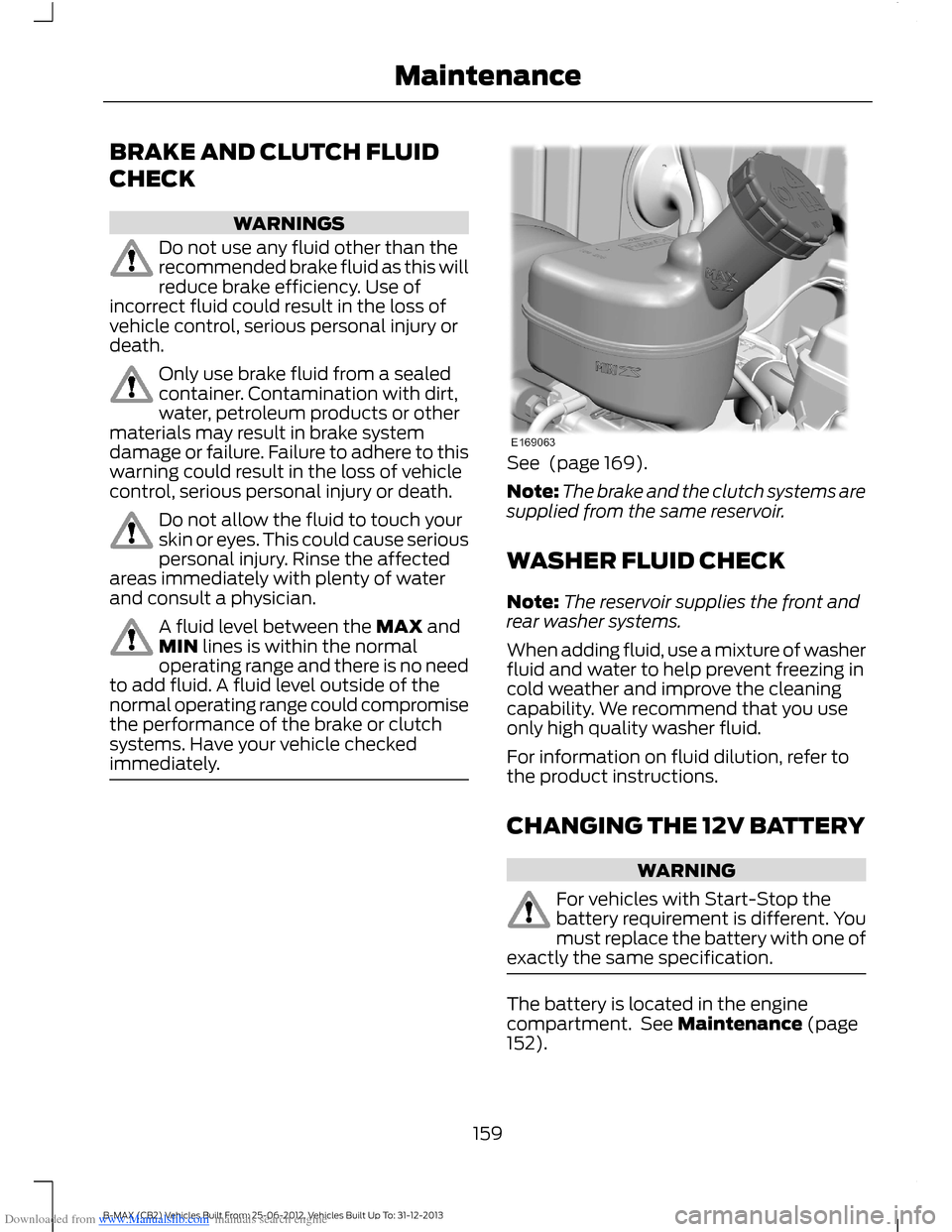
A fluid level between the MAX andMIN lines is within the normaloperating range and there is no needto add fluid. A fluid level outside of thenormal operating range could compromisethe performance of the brake or clutchsystems. Have your vehicle checkedimmediately.
See (page 169).
Note:The brake and the clutch systems aresupplied from the same reservoir.
WASHER FLUID CHECK
Note:The reservoir supplies the front andrear washer systems.
When adding fluid, use a mixture of washerfluid and water to help prevent freezing incold weather and improve the cleaningcapability. We recommend that you useonly high quality washer fluid.
For information on fluid dilution, refer tothe product instructions.
CHANGING THE 12V BATTERY
WARNING
For vehicles with Start-Stop thebattery requirement is different. Youmust replace the battery with one ofexactly the same specification.
The battery is located in the enginecompartment. See Maintenance (page152).
159B-MAX (CB2) Vehicles Built From: 25-06-2012, Vehicles Built Up To: 31-12-2013Maintenance
Page 164 of 298
Downloaded from www.Manualslib.com manuals search engine Note:When fitting the headlamp, makesure that you fully engage the headlamp inthe lower fixing point.
CHANGING A BULB
WARNINGS
Switch the lamps and the ignition off.
Let the bulb cool down beforeremoving it.
Do not touch the glass of the bulb.
Note:Only fit bulbs of the correctspecification.
Note:The following instructions describehow to remove the bulbs. Fit replacementsin the reverse order unless otherwise stated.
Headlamp
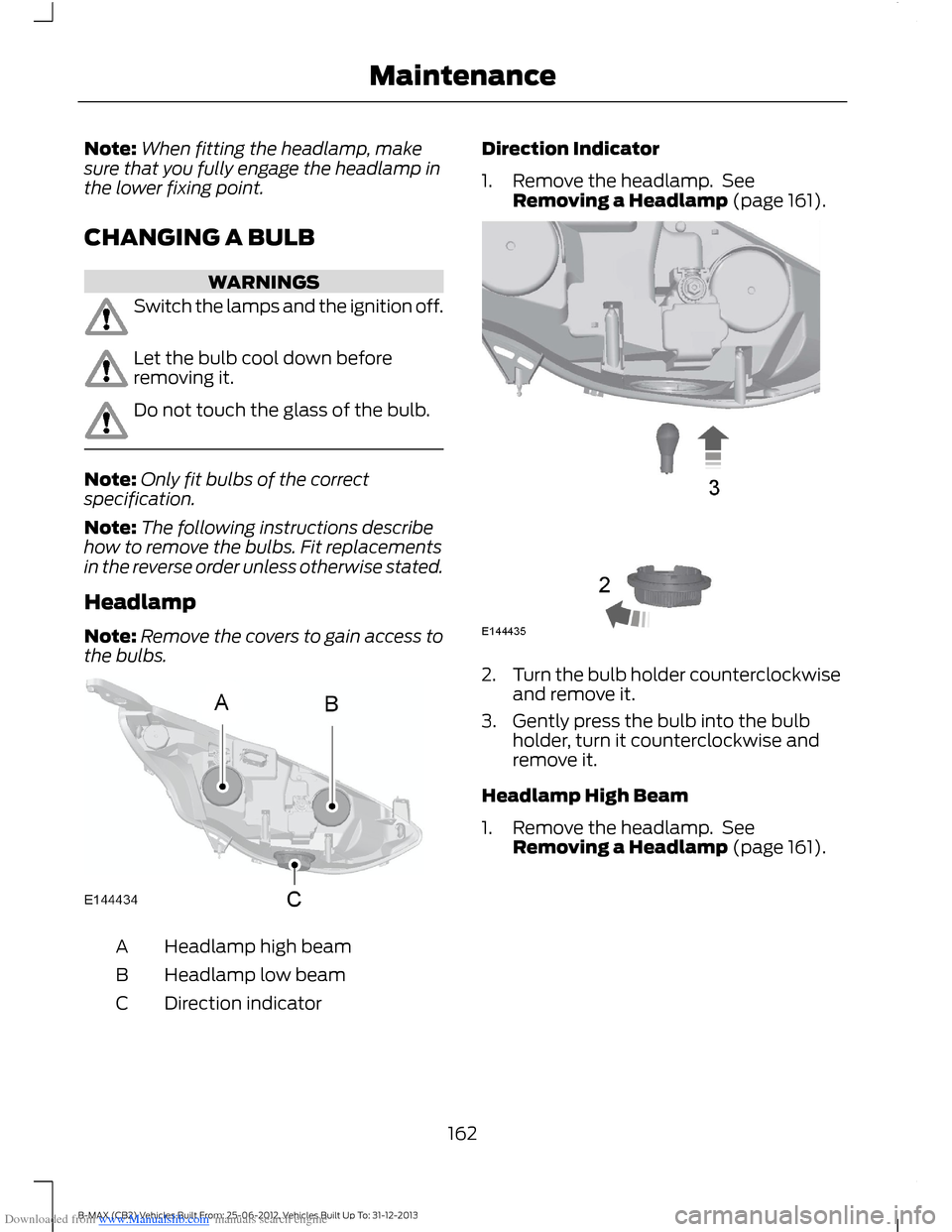
Note:Remove the covers to gain access tothe bulbs.
Headlamp high beamA
Headlamp low beamB
Direction indicatorC
Direction Indicator
1.Remove the headlamp. SeeRemoving a Headlamp (page 161).
2.Turn the bulb holder counterclockwiseand remove it.
3.Gently press the bulb into the bulbholder, turn it counterclockwise andremove it.
Headlamp High Beam
1.Remove the headlamp. SeeRemoving a Headlamp (page 161).
162B-MAX (CB2) Vehicles Built From: 25-06-2012, Vehicles Built Up To: 31-12-2013Maintenance
Page 174 of 298
Downloaded from www.Manualslib.com manuals search engine CLEANING THE EXTERIOR
WARNINGS
If you use a car wash with a waxingcycle, make sure that you remove thewax from the windshield.
Prior to using a car wash facilitycheck the suitability of it for yourvehicle.
Some car wash installations usewater at high pressure. This coulddamage certain parts of your vehicle.
Remove the aerial before using anautomatic car wash.
Switch the heater blower off toprevent contamination of the freshair filter.
We recommend that you wash your vehiclewith a sponge and lukewarm watercontaining a car shampoo.
Cleaning the Headlamps
WARNINGS
Do not scrape the headlamp lensesor use abrasives, alcoholic solventsor chemical solvents to clean them.
Do not wipe the headlamps whenthey are dry.
Cleaning the Rear Window
WARNING
Do not scrape the inside of the rearwindow or use abrasives or chemicalsolvents to clean it.
Use a clean, lint free cloth or a dampchamois leather to clean the inside of therear window.
Cleaning the Chrome Trim
WARNINGS
Do not use abrasives or chemicalsolvents. Use soapy water.
Do not apply cleaning product to hotsurfaces and do not leave cleaningproduct on chrome surfaces for aperiod of time exceeding that which isrecommended.
Industrial-strength (heavy-duty)cleaners, or cleaning chemicals, maycause damage over a period of time.
Body Paintwork Preservation
WARNINGS
Do not polish your vehicle in strongsunshine.
Do not allow polish to touch plasticsurfaces. It could be difficult toremove.
Do not apply polish to the windshieldor rear window. This could cause thewipers to become noisy and theymay not clear the window properly.
We recommend that you wax thepaintwork once or twice a year.
CLEANING THE INTERIOR
Note:Do not allow air fresheners and handsanitizers to spill on interior surfaces. If aspill occurs, wipe off immediately. Damagemay not be covered by your warranty.
Safety Belts
WARNINGS
Do not use abrasives, or chemicalsolvents to clean them.
172B-MAX (CB2) Vehicles Built From: 25-06-2012, Vehicles Built Up To: 31-12-2013Vehicle Care
Page 175 of 298
Downloaded from www.Manualslib.com manuals search engine WARNINGS
Do not allow moisture to penetratethe safety belt retractor mechanism.
Clean them with interior cleaner or waterapplied with a soft sponge. Let them drynaturally, away from artificial heat.
Instrument Cluster Screens, LCDScreens and Radio Screens
WARNING
Do not use abrasives, alcoholicsolvents or chemical solvents toclean them.
Rear Windows
WARNING
Do not use any abrasive materials toclean the interior of the rearwindows.
Note:Do not install stickers or labels to theinterior of the rear windows.
REPAIRING MINOR PAINT
DAMAGE
You should repair paintwork damagecaused by stones from the road or minorscratches as soon as possible. A choice ofproducts are available from an authorizeddealer.
Remove particles such as bird droppings,tree sap, insect deposits, tar spots, roadsalt and industrial fallout before repairingpaint chips.
Always read and follow the manufacturer’sinstructions before using the products.
CLEANING THE ALLOY
WHEELS
Note:Do not apply a cleaning chemical towarm or hot wheel rims and covers.
Note:Industrial-strength (heavy-duty)cleaners, or cleaning chemicals, incombination with brush agitation to removebrake dust and dirt, could wear away theclear coat finish over a period of time.
Note:Do not use hydrofluoric acid-basedor high caustic-based wheel cleaners, steelwool, fuels or strong household detergent.
Note:If you intend parking your vehicle foran extended period after cleaning thewheels with a wheel cleaner, drive yourvehicle for a few minutes before doing so.This will reduce the risk of increasedcorrosion of the brake discs, brake pads andlinings.
Note:Some automatic car washes maycause damage to the finish on your wheelrims and covers.
Alloy wheels and wheel covers are coatedwith a clear coat paint finish. To maintaintheir condition we recommend that you:
•Clean them weekly with therecommended wheel and tire cleaner.
•Use a sponge to remove heavydeposits of dirt and brake dustaccumulation.
•Rinse them thoroughly with apressurized stream of water when youhave completed the cleaning process.
We recommend that you use Ford servicewheel cleaner. Make sure that you readand follow the manufacturer’s instructions.
Using other non-recommended cleaningproducts can result in severe andpermanent cosmetic damage.
173B-MAX (CB2) Vehicles Built From: 25-06-2012, Vehicles Built Up To: 31-12-2013Vehicle Care
Page 176 of 298
Downloaded from www.Manualslib.com manuals search engine GENERAL INFORMATION
A decal with tire pressure data is locatedin the driver’s door opening.
Check and set the tire pressure at theambient temperature in which you areintending to drive your vehicle and whenthe tires are cold.
Note:Check your tire pressures regularly tooptimize fuel economy.
Note:Use only approved wheel and tiresizes. Using other sizes could damage yourvehicle and will make the National TypeApproval invalid.
Note:If you change the diameter of the tiresfrom that fitted at the factory, thespeedometer may not display the correctspeed. Take your vehicle to an authorizeddealer to have the engine managementsystem reprogrammed.
Note:If you intend to change the size of thewheels from that fitted at the factory, checkthe suitability with an authorized dealer.
TEMPORARY MOBILITY KIT
Your vehicle may not have a spare tire.Therefore you will have a temporarymobility kit which will only repair onedamaged tire.
The kit is located in the spare wheel well.
General Information
WARNINGS
Depending on the type and extent oftire damage, some tires can only bepartially sealed or not sealed at all.Loss of tire pressure can affect vehiclehandling, leading to loss of vehicle control.
Do not use the kit on a previouslydamaged tire, for example when ithas been driven under inflated.
WARNINGS
Do not use the kit on run flat tires.
Do not try to seal damage to thetire’s sidewall.
The kit seals most tire punctures [with adiameter of up to ¼ inch (six millimeters)]to temporarily restore mobility.
You must observe the following rules whenusing the kit:
•Drive with caution and avoid makingsudden steering or driving manoeuvres,especially if your vehicle is heavilyladen or you are towing a trailer.
•The kit will provide you with anemergency temporary repair, enablingyou to continue your journey to the nextvehicle or tire dealer, or to drive amaximum distance of 125 miles(200 kilometers).
•Do not exceed a maximum speed of50 mph (80 km/h).
•Keep the kit out of the reach ofchildren.
•Only use the kit when the ambienttemperature is between -40°F(–40°C) and +158°F (+70°C).
Using the Kit
WARNINGS
Compressed air can act as anexplosive or propellant.
Never leave the kit unattended whilein use.
Do not keep the compressoroperating for more than 10 minutes.
You must only use the kit for thevehicle with which it was supplied.
174B-MAX (CB2) Vehicles Built From: 25-06-2012, Vehicles Built Up To: 31-12-2013Wheels and Tires
Page 177 of 298
Downloaded from www.Manualslib.com manuals search engine •Park your vehicle at the roadside sothat you do not obstruct the flow oftraffic and so that you are able to usethe kit without being in danger.
•Apply the parking brake, even if youhave parked on a level road, to makesure that your vehicle will not move.
•Do not attempt to remove foreignobjects like nails or screws penetratingthe tire.
•Leave the engine running while the kitis in use, but not if your vehicle is in anenclosed or poorly ventilated area (e.g,inside a building). In thesecircumstances, switch the compressoron with the engine switched off.
•You must replace the sealant bottlewith a new one before the expiry date(see top of bottle).
•Inform all other users of your vehiclethat the tire has been temporarilysealed with the kit. Make them awareof the special driving conditions thatmust be observed.
Inflating the Tire
WARNINGS
Check the sidewall of the tire prior toinflation. If there are any cracks,bumps or similar damage, do notattempt to inflate the tire.
Do not stand directly beside the tirewhile the compressor is operating.
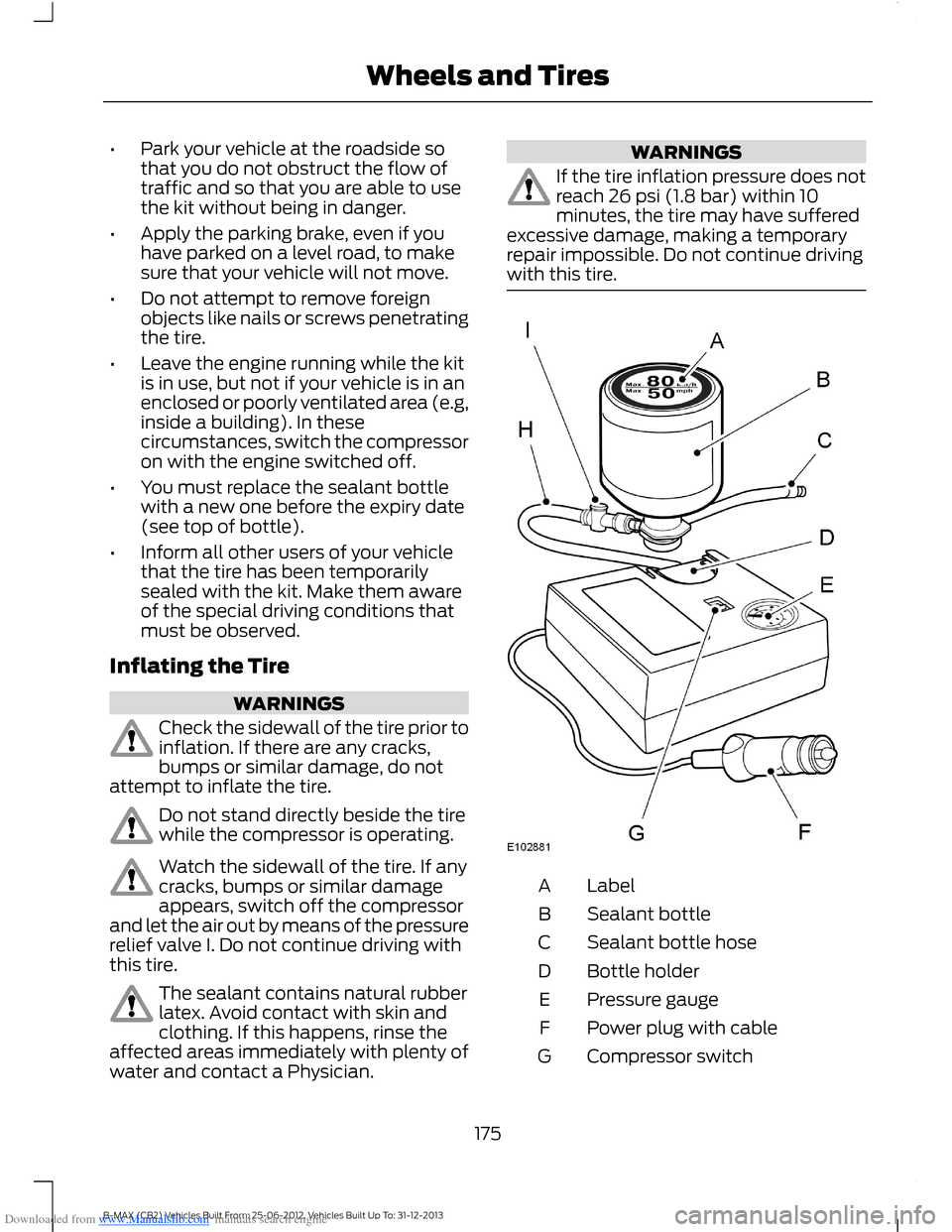
Watch the sidewall of the tire. If anycracks, bumps or similar damageappears, switch off the compressorand let the air out by means of the pressurerelief valve I. Do not continue driving withthis tire.
The sealant contains natural rubberlatex. Avoid contact with skin andclothing. If this happens, rinse theaffected areas immediately with plenty ofwater and contact a Physician.
WARNINGS
If the tire inflation pressure does notreach 26 psi (1.8 bar) within 10minutes, the tire may have sufferedexcessive damage, making a temporaryrepair impossible. Do not continue drivingwith this tire.
LabelA
Sealant bottleB
Sealant bottle hoseC
Bottle holderD
Pressure gaugeE
Power plug with cableF
Compressor switchG
175B-MAX (CB2) Vehicles Built From: 25-06-2012, Vehicles Built Up To: 31-12-2013Wheels and Tires