spare wheel FORD BRONCO 2023 Owners Manual
[x] Cancel search | Manufacturer: FORD, Model Year: 2023, Model line: BRONCO, Model: FORD BRONCO 2023Pages: 642, PDF Size: 14.71 MB
Page 52 of 642
Spare Tire Carrier Reinforcement
Your vehicle comes with a spare tire carrierreinforcement that has an accessory-readyspot to add your own gear to the rear swinggate. This is intended for light accessoriessuch as a flagpole, a camera or a light.
One attachment point is intended for upto 3 lb (1.4 kg) loads.
The attachment hole is an M6x1mm with1.38 in (35 mm) thread depth. Select afastener that equals the thickness of yourmounting bracket plus 0.79–1.18 in(20–30 mm) into the accessory mountinghole.
We recommend at least a Grade 10.9fastener when selecting a mountingfastener. Please use at least 7.4 lb.ft(10 Nm) of torque when installing.
Guidance for Door Swing
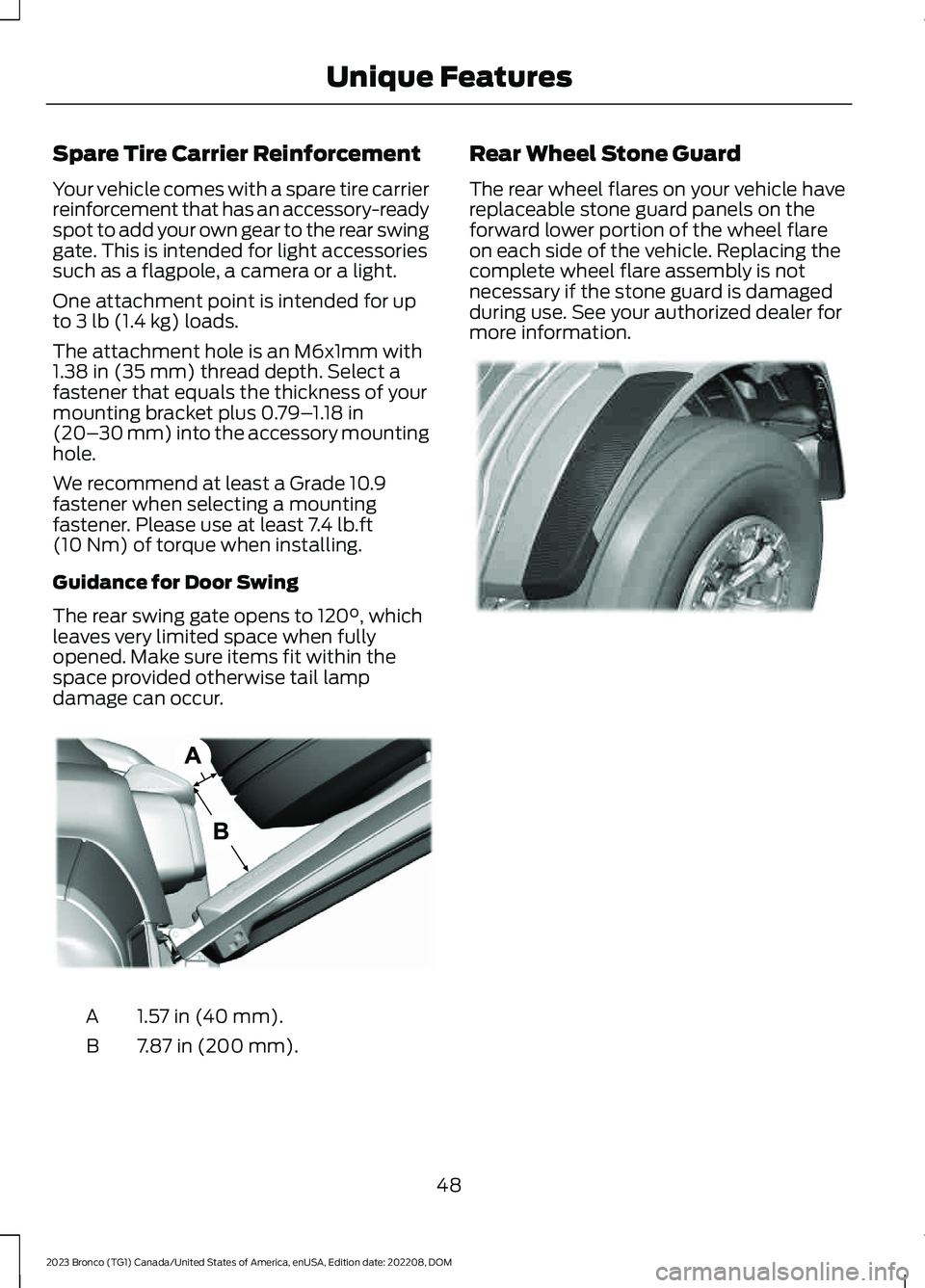
The rear swing gate opens to 120°, whichleaves very limited space when fullyopened. Make sure items fit within thespace provided otherwise tail lampdamage can occur.
1.57 in (40 mm).A
7.87 in (200 mm).B
Rear Wheel Stone Guard
The rear wheel flares on your vehicle havereplaceable stone guard panels on theforward lower portion of the wheel flareon each side of the vehicle. Replacing thecomplete wheel flare assembly is notnecessary if the stone guard is damagedduring use. See your authorized dealer formore information.
48
2023 Bronco (TG1) Canada/United States of America, enUSA, Edition date: 202208, DOMUnique FeaturesE384784 E367143
Page 200 of 642
FOUR-WHEEL DRIVE
LIMITATIONS
Do not use four-wheel drive high orfour-wheel drive low mode on dry, hardsurfaced roads. Doing so can produceexcessive noise, increase tire wear and candamage driveline components. Four-wheeldrive high or four-wheel drive low mode isonly for use on consistently slippery orloose surfaces. Use of four-wheel drive lowmode on these surfaces could producesome noise, such as occasional clunks, butshould not damage driveline components.
For vehicles with an electronicshift-on-the-fly transfer case, the drivelinecould become mechanically blocked whenattempting to shift out of a four-wheeldrive mode on dry, hard surfaced roads.
Note:When your vehicle comes with the4x4 part-time selectable engagementtransfer case and you are transitioning fromconsistently loose or slippery surfaces, besure the four-wheel drive system is notmechanically blocked once you are on dry,hard surfaced roads in two-wheel drive high.
Note: In certain scenarios, where thefour-wheel drive system has difficultyengaging, a To Engage 4x4 Slow to 3 MPHor To Engage 4x4 Slow to 5 km/hmessage could appear in the instrumentcluster. You can also see this messagewhen engaging the four-wheel drive systemin extreme cold climates at the beginningof the drive cycle. Once the driveline warmsup, shifting to four-wheel drive can resumeas normal.
Operating Four-Wheel Drive witha Spare or Mismatched Tires
On four-wheel drive vehicles, the size ofthe spare tire can affect the four-wheeldrive system.
If there is a significant difference betweenthe size of the spare tire and the remainingtires, you could have limited four-wheeldrive functionality, added noise, discomfortand driveline damage.
Due to normal tire wear, your spare tire isnot necessarily the same size as youron-road tires, which makes your spare tirea dissimilar size. Use the spare tire on alimited basis only.
When driving with a dissimilar wheel andtire assembly do not:
•Exceed 50 mph (80 km/h) whenoperating in a four-wheel drive mode.
•Select a four-wheel drive mode unlessthe vehicle is stationary.
•Use a four-wheel drive mode on drypavement.
You could have limited four-wheel drivefunctionality when driving with a dissimilarwheel and tire assembly, especially whendriving in a mechanically locked four-wheeldrive mode. You can experience thefollowing:
•Additional noise from the transfer caseor other drive components.
•Difficulty shifting in and out of amechanically locked four-wheel drivemode.
•Driveline component damage.
Mechanical Shift Blocking
On vehicles with an electronicshift-on-the-fly transfer case, the transfercase distributes torque to the front wheelsby mechanically interlocking the front andrear driveshafts together. Various externalfactors can affect shifting performance ofthis type of system including, but notlimited to:
•Vehicle acceleration.
•Dissimilar tire sizes.
•High steering input.
196
2023 Bronco (TG1) Canada/United States of America, enUSA, Edition date: 202208, DOMFour-Wheel Drive
Page 211 of 642
ELECTRONIC LOCKING DIFFERENTIAL – TROUBLESHOOTING
ELECTRONIC LOCKING DIFFERENTIAL – INFORMATION MESSAGES
DetailsMessage
The selected electronic locking differential is not available incurrent G.O.A.T mode. See G.O.A.T. Mode Control (page 260).Selected Locking Differ-ential Not Available inCurrent Drive Mode
The selected electronic locking differential is not available in yourcurrent four-wheel drive mode. See Four-Wheel Drive (page 195).Selected Locking Differ-ential Not Available inCurrent 4x4 Mode
The selected electronic locking differential requires that yourelease the accelerator pedal in order to engage.To Engage LockingDifferential ReleaseAccelerator Pedal
An electronic locking differential system fault is present. See yourauthorized dealer as soon as possible.Check Locking Differen-tial
The following conditions affect theelectronic locking differential:
•Based on G.O.A.T mode selection, therear electronic locking differential doesnot engage if your vehicle speed isabove 20 mph (32 km/h).
•The front electronic locking differentialdoes not engage if your vehicle speedis above 20 mph (32 km/h) infour-wheel drive low (4L).
•Based on G.O.A.T mode selection, theelectronic locking differentialautomatically disengages at speedsabove 25 mph (41 km/h) andautomatically re-engages at speedsbelow 20 mph (32 km/h).
•The electronic locking differential maynot engage if you press youraccelerator pedal during anengagement attempt. A message maydisplay in the instrument displayguiding you to release the acceleratorpedal.
•In four-wheel drive low (4L), the frontelectronic locking differentialautomatically disengages at speedsabove 25 mph (41 km/h) andautomatically re-engages at speedsbelow 20 mph (32 km/h).
•The AdvanceTrac system has theability to take over control of theelectronic locking differential anddisable it during driving maneuverswhen necessary.
Operating Electronic LockingDifferential With a Spare orMismatched Tires
On vehicles with an electronic lockingdifferential, the size of the spare tire canaffect performance of the system. If thereis a significant difference between the tworear tires or two front tires, you may havelimited electronic locking differentialfunctionality. If the electronic lockingdifferential has difficulty disengaging,
207
2023 Bronco (TG1) Canada/United States of America, enUSA, Edition date: 202208, DOMElectronic Locking Differential (If Equipped)
Page 212 of 642
release the accelerator pedal and turn thesteering wheel in the opposite directionwhen rolling. We recommend engagingand disengaging the electronic lockingdifferential at a stop when you mount aspare or mismatched tire on either axle.
208
2023 Bronco (TG1) Canada/United States of America, enUSA, Edition date: 202208, DOMElectronic Locking Differential (If Equipped)
Page 313 of 642
When towing a trailer:
•Obey country specific regulations fortowing a trailer.
•Do not drive faster than 70 mph(113 km/h) during the first 500 mi(800 km).
•Do not make full-throttle starts.
•Check your hitch, electrical connectionsand trailer wheel lug nuts thoroughlyafter you have traveled 50 mi (80 km).
•Place the transmission in neutral (N)when stopped in congested or heavytraffic during hot weather. This will aidin engine and transmission cooling andto help A/C performance.
•Turn off the speed control with heavyloads or in hilly terrain. The speedcontrol may turn off when you aretowing on long, steep slopes.
•Shift to a lower gear when driving downa long or steep hill. Do not continuouslyapply the brakes, as they may overheatand become less effective.
•If your transmission has Grade Assistor Tow/Haul, use this feature whentowing. This provides engine brakingand helps eliminate excessivetransmission shifting for optimum fueleconomy and transmission cooling.
•Your vehicle has AdvanceTrac with rollstability control. When towing a trailer,additional loads could cause theAdvanceTrac system to engage duringcornering maneuvers. Reduce corneringspeeds to make sure that you canmaintain control of the vehicle andtrailer if the AdvanceTrac systemengages.
•Allow more distance for stopping witha trailer attached. Anticipate stops andgradually brake.
•Avoid parking on a slope. However, ifyou must park on a slope. Turn thesteering wheel to point your vehicletires away from traffic flow. Set yourvehicle parking brake. Place thetransmission in a low gear. Place wheelchocks in front and back of the trailerwheels.
Note:Chocks are not included with yourvehicle.
TRAILER TOWING HINTS -
AUTOMATIC TRANSMISSION
Towing a trailer places an extra load onyour vehicle's engine, transmission, axle,brakes, tires and suspension. Periodicallyinspect these components during and afterany towing operation.
When driving with a trailer or payload, aslight takeoff vibration or shudder may bepresent due to the increased payloadweight.
Your vehicle may have a temporary orconventional spare tire. A temporary sparetire is different in diameter or width,tread-type, or is from a differentmanufacturer than the road tires on yourvehicle. Consult information on the tirelabel or Safety Compliance label forlimitations when using.
When towing a trailer:
•Obey country specific regulations fortowing a trailer.
•Do not drive faster than 70 mph(113 km/h) during the first 500 mi(800 km).
•Do not make full-throttle starts.
•Check your hitch, electrical connectionsand trailer wheel lug nuts thoroughlyafter you have traveled 50 mi (80 km).
309
2023 Bronco (TG1) Canada/United States of America, enUSA, Edition date: 202208, DOMTowing a Trailer
Page 348 of 642
Protected ComponentRatingItem
Driveline control module.40 A54
Trailer tow park lamp relay.30 A55
Trailer tow backup lamps.20 A58
Upfitter switch #1 (Base).30 A60Upfitter switch #3 (Raptor).
Upfitter switch #2.15 A61
Upfitter switch #3 (Base).10 A62Upfitter switch #1 - off-roaddriving lights (Raptor).
Upfitter switch #4.10 A63
Upfitter switch #5.10 A64
Upfitter switch #6.10 A65
Stability bar disconnectmodule.10 A66
Front windshield wiper.30 A69
Rear windshield wiper.30 A71
Integrated wheel end(Raptor).10 A80
Trailer tow light module.40 A91
Left-hand headlamps.20 A100
Right-hand headlamps.20 A101
Trailer tow battery charge.30 A107
Fuel injectors (2.7L, Raptor).10 A120
Not used (spare).5 A124
USB smart charger 1.10 A125
USB smart charger 2.5 A139
Not used (spare).5 A140
Not used (spare).5 A141
Amplifier.20 A146
344
2023 Bronco (TG1) Canada/United States of America, enUSA, Edition date: 202208, DOMFuses
Page 352 of 642
Protected ComponentRatingItem
Audio control module.20 A32
Not used.—33
Not used.—34
Not used (spare).5 A35
Automatic high beam.15 A36Image processing module A.
Auto-dimming interiormirror.20 A37
Parking assist controlmodule.Heated steering wheel.
Not used.30 A Circuit Breaker38
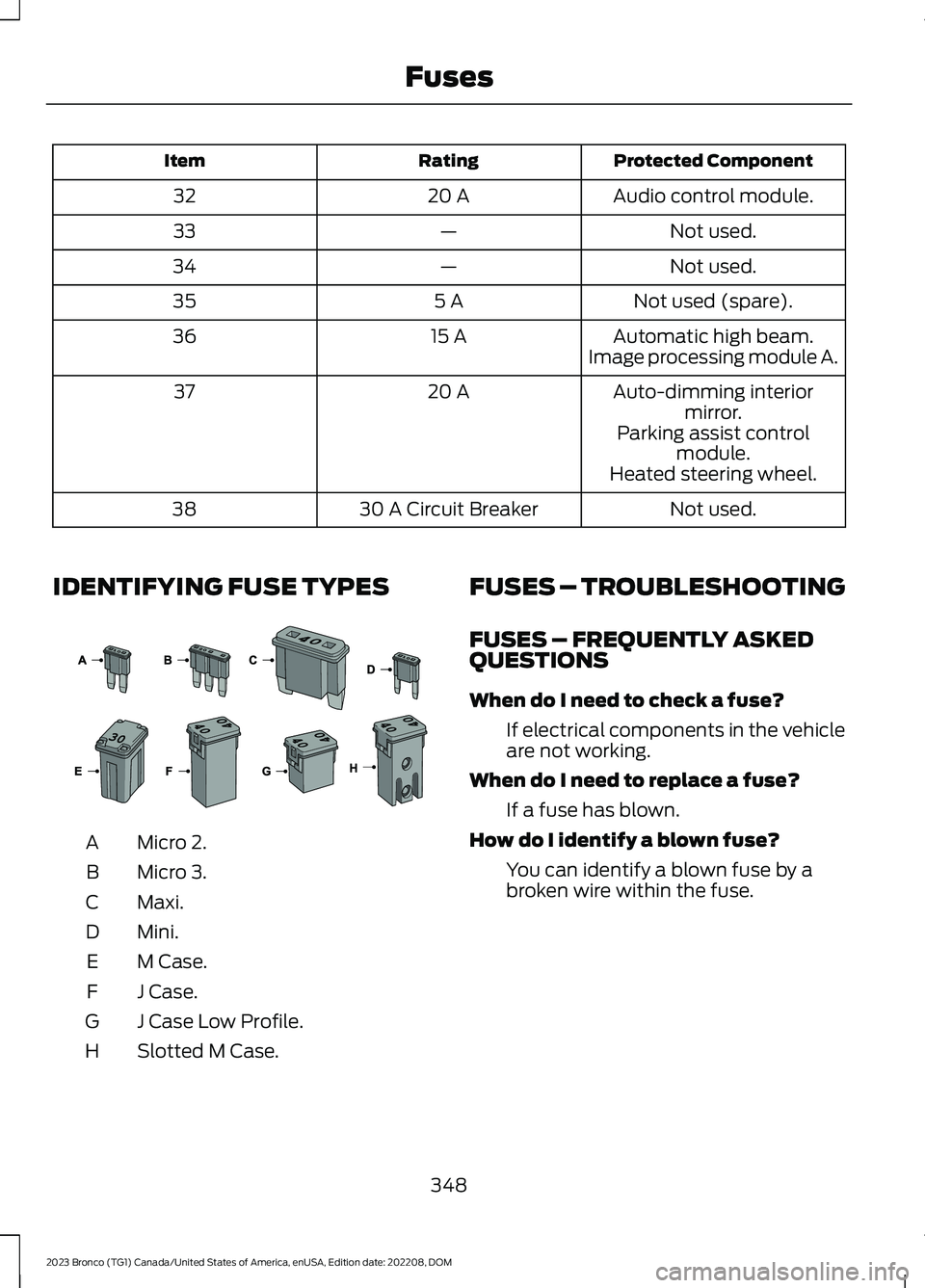
IDENTIFYING FUSE TYPES
Micro 2.A
Micro 3.B
Maxi.C
Mini.D
M Case.E
J Case.F
J Case Low Profile.G
Slotted M Case.H
FUSES – TROUBLESHOOTING
FUSES – FREQUENTLY ASKEDQUESTIONS
When do I need to check a fuse?
If electrical components in the vehicleare not working.
When do I need to replace a fuse?
If a fuse has blown.
How do I identify a blown fuse?
You can identify a blown fuse by abroken wire within the fuse.
348
2023 Bronco (TG1) Canada/United States of America, enUSA, Edition date: 202208, DOMFuses E267379
Page 434 of 642
LOCATING THE TIRE LABEL
You will find a Tire Labelcontaining tire inflation pressureby tire size and other importantinformation located on the B-Pillaror the edge of the driver's door.See Locating the SafetyCompliance CertificationLabels (page 296).
DEPARTMENT OF
TRANSPORTATION UNIFORM
TIRE QUALITY GRADES
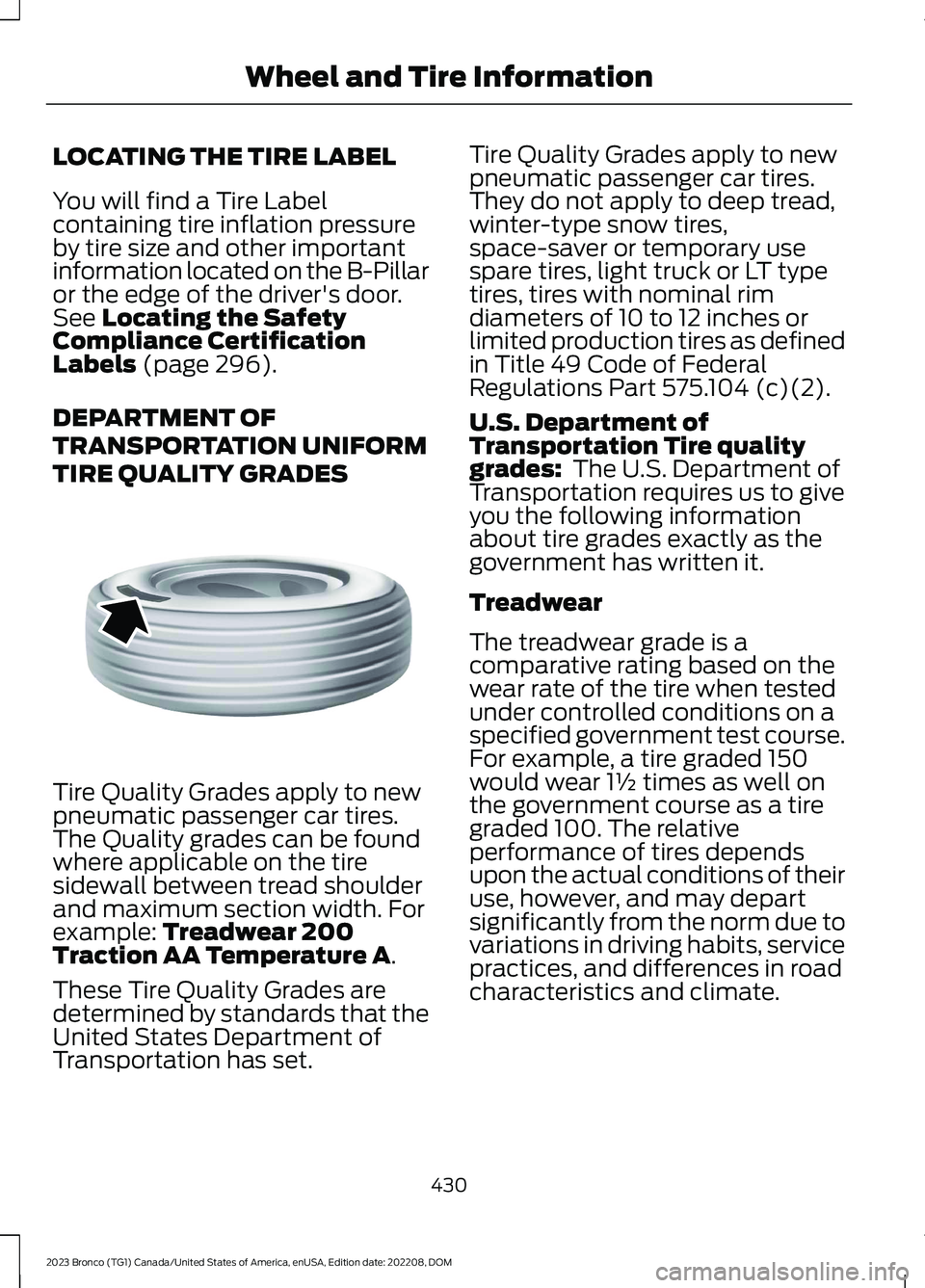
Tire Quality Grades apply to newpneumatic passenger car tires.The Quality grades can be foundwhere applicable on the tiresidewall between tread shoulderand maximum section width. Forexample: Treadwear 200Traction AA Temperature A.
These Tire Quality Grades aredetermined by standards that theUnited States Department ofTransportation has set.
Tire Quality Grades apply to newpneumatic passenger car tires.They do not apply to deep tread,winter-type snow tires,space-saver or temporary usespare tires, light truck or LT typetires, tires with nominal rimdiameters of 10 to 12 inches orlimited production tires as definedin Title 49 Code of FederalRegulations Part 575.104 (c)(2).
U.S. Department ofTransportation Tire qualitygrades: The U.S. Department ofTransportation requires us to giveyou the following informationabout tire grades exactly as thegovernment has written it.
Treadwear
The treadwear grade is acomparative rating based on thewear rate of the tire when testedunder controlled conditions on aspecified government test course.For example, a tire graded 150would wear 1½ times as well onthe government course as a tiregraded 100. The relativeperformance of tires dependsupon the actual conditions of theiruse, however, and may departsignificantly from the norm due tovariations in driving habits, servicepractices, and differences in roadcharacteristics and climate.
430
2023 Bronco (TG1) Canada/United States of America, enUSA, Edition date: 202208, DOMWheel and Tire InformationE142542
Page 441 of 642
*Tread area of the tire: Area ofthe perimeter of the tire thatcontacts the road when mountedon the vehicle.
*Rim: The metal support (wheel)for a tire or a tire and tubeassembly upon which the tirebeads are seated.
TIRE REPLACEMENT
REQUIREMENTS
AGE
WARNING: Tires degradeover time depending on manyfactors such as weather, storageconditions, and conditions of use(load, speed, inflation pressure)the tires experience throughouttheir lives.In general, tires should bereplaced after six yearsregardless of tread wear.However, heat caused by hotclimates or frequent high loadingconditions can accelerate theaging process and may requiretires to be replaced morefrequently.You should replace your sparetire when you replace the roadtires or after six years due toaging even if it has not beenused.
U.S. DOT Tire IdentificationNumber
Both United States and CanadaFederal regulations require tiremanufacturers to placestandardized information on thesidewall of all tires. Thisinformation identifies anddescribes the fundamentalcharacteristics of the tire and alsoprovides a U.S. DOT TireIdentification Number for safetystandard certification and in caseof a recall.
This begins with the letters DOTand indicates that the tire meetsall federal standards. The nexttwo numbers or letters are theplant code designating where itwas manufactured, the next twoare the tire size code and the lastfour numbers represent the weekand year the tire was built. Forexample, the numbers 317 meanthe 31st week of 1997. After 2000,the numbers go to four digits. Forexample, 2501 means the 25thweek of 2001. The numbers inbetween are identification codesused for traceability. Thisinformation is used to contactcustomers if a tire defect requiresa recall.
Tire ReplacementRequirements
Your vehicle is equipped with tiresdesigned to provide a safe rideand handling capability.
437
2023 Bronco (TG1) Canada/United States of America, enUSA, Edition date: 202208, DOMWheel and Tire Information
Page 443 of 642
•Stand at a minimum of 12 ft(3.66 m) away from the wheeland tire assembly.
•Use both eye and earprotection.
Important: Remember to replacethe wheel valve stems when theroad tires are replaced on yourvehicle.
If a four tire rotation is beingfollowed, it is recommended thatboth front tires or both rear tiresgenerally be replaced as a pair ifthe two remaining worn tires stillhave usable tread depth. If a fivetire rotation is being followed andthe fifth tire is used to replace asingle unrepairable tire, a four tirerotation should be followed withthe undamaged tires. Any
replacement for the damaged tireshould be used as a dedicatedspare until the remaining tires arereplaced as a set.
To avoid potential Four-WheelDrive (4WD) malfunction or(4WD) system damage, it isrecommended to replace all tiresused in the tire rotation ratherthan mixing significantly worn tireswith new tires.
The tire pressure sensors mountedin the wheels (originally installedon your vehicle) are not designedto be used in aftermarket wheels.
The use of wheels or tires notrecommended may affect theoperation of your tire pressuremonitoring system.
If the tire pressure monitoringsystem indicator is flashing, yoursystem is malfunctioning. Yourreplacement tire might beincompatible with your tirepressure monitoring system, orsome component of the systemmay be damaged.
USING SNOW CHAINS
WARNING: Do not exceed 30 mph(50 km/h). Failure to follow thisinstruction could result in the loss ofcontrol of your vehicle, personal injury ordeath.
WARNING: Do not use snow chainson snow-free roads.
WARNING: Only fit snow chains tospecified tires.
WARNING: If your vehicle is fittedwith wheel trims, remove them beforefitting snow chains.
WARNING: If you choose to installsnow tires on your vehicle, they must bethe same size, construction, and loadrange as the original tires listed on thetire placard, and they must be installedon all four wheels. Mixing tires ofdifferent size or construction on yourvehicle can adversely affect yourvehicle's handling and braking, and maylead to loss of vehicle control.
Only use snow chains on rear wheels.Install snow chains in pairs. Do not useself-tensioning snow chains.
Only use snow chains on the followingspecified tire sizes:
439
2023 Bronco (TG1) Canada/United States of America, enUSA, Edition date: 202208, DOMWheel and Tire Information