brake FORD C MAX 2008 1.G Owner's Manual
[x] Cancel search | Manufacturer: FORD, Model Year: 2008, Model line: C MAX, Model: FORD C MAX 2008 1.GPages: 278, PDF Size: 17.5 MB
Page 161 of 278
Downloaded from www.Manualslib.com manuals search engine The ABS will not eliminate thedangers inherent when:
•you drive too close to the vehiclein front of you.
•the vehicle is aquaplaning.
•you take corners too fast.
•the road surface is poor.
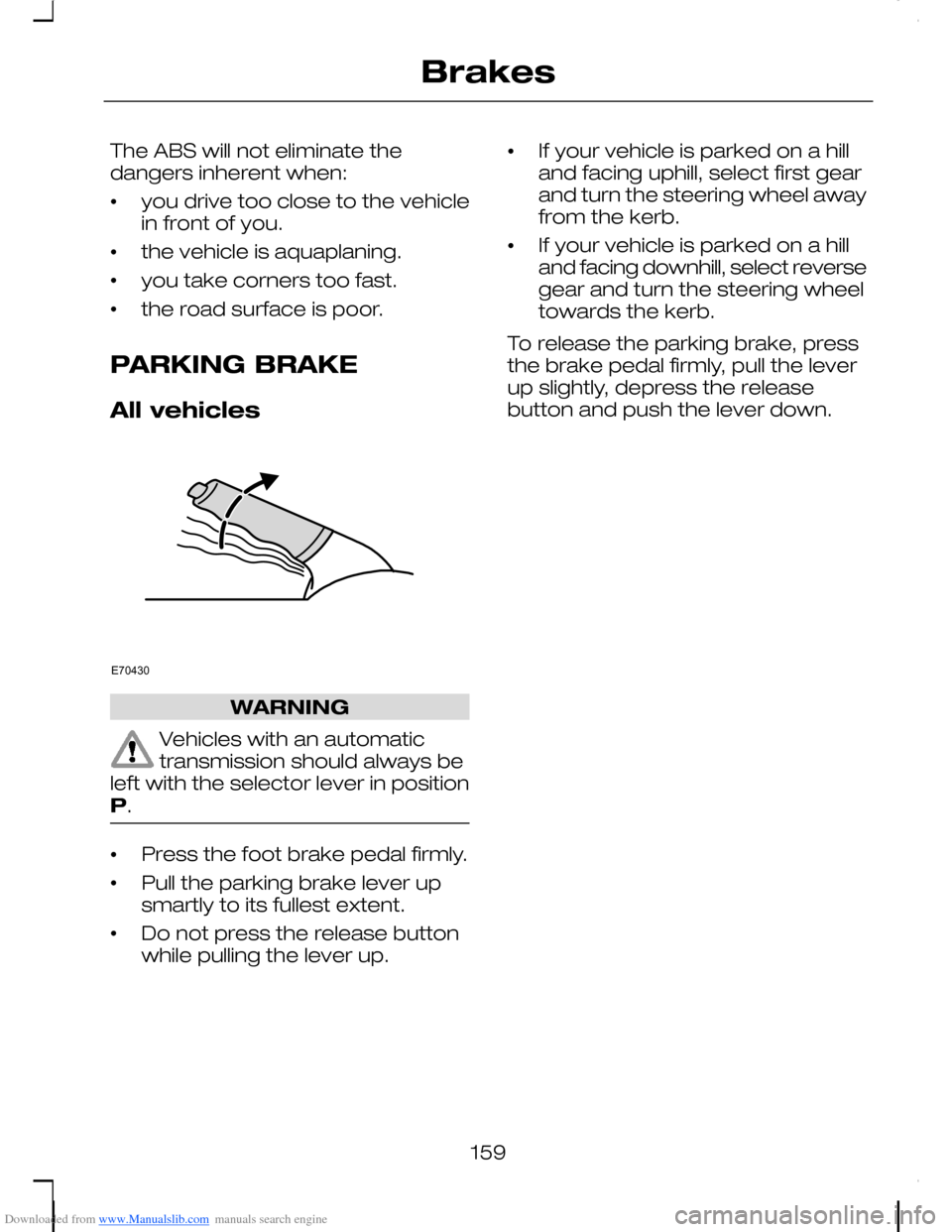
PARKING BRAKE
All vehicles
WARNING
Vehicles with an automatictransmission should always beleft with the selector lever in positionP.
•Press the foot brake pedal firmly.
•Pull the parking brake lever upsmartly to its fullest extent.
•Do not press the release buttonwhile pulling the lever up.
•If your vehicle is parked on a hilland facing uphill, select first gearand turn the steering wheel awayfrom the kerb.
•If your vehicle is parked on a hilland facing downhill, select reversegear and turn the steering wheeltowards the kerb.
To release the parking brake, pressthe brake pedal firmly, pull the leverup slightly, depress the releasebutton and push the lever down.
159
BrakesE70430
Page 162 of 278
Downloaded from www.Manualslib.com manuals search engine PRINCIPLE OF
OPERATION
Electronic stabilityprogramme (ESP)
WARNING
ESP does not relieve you of yourresponsibility to drive with duecare and attention.
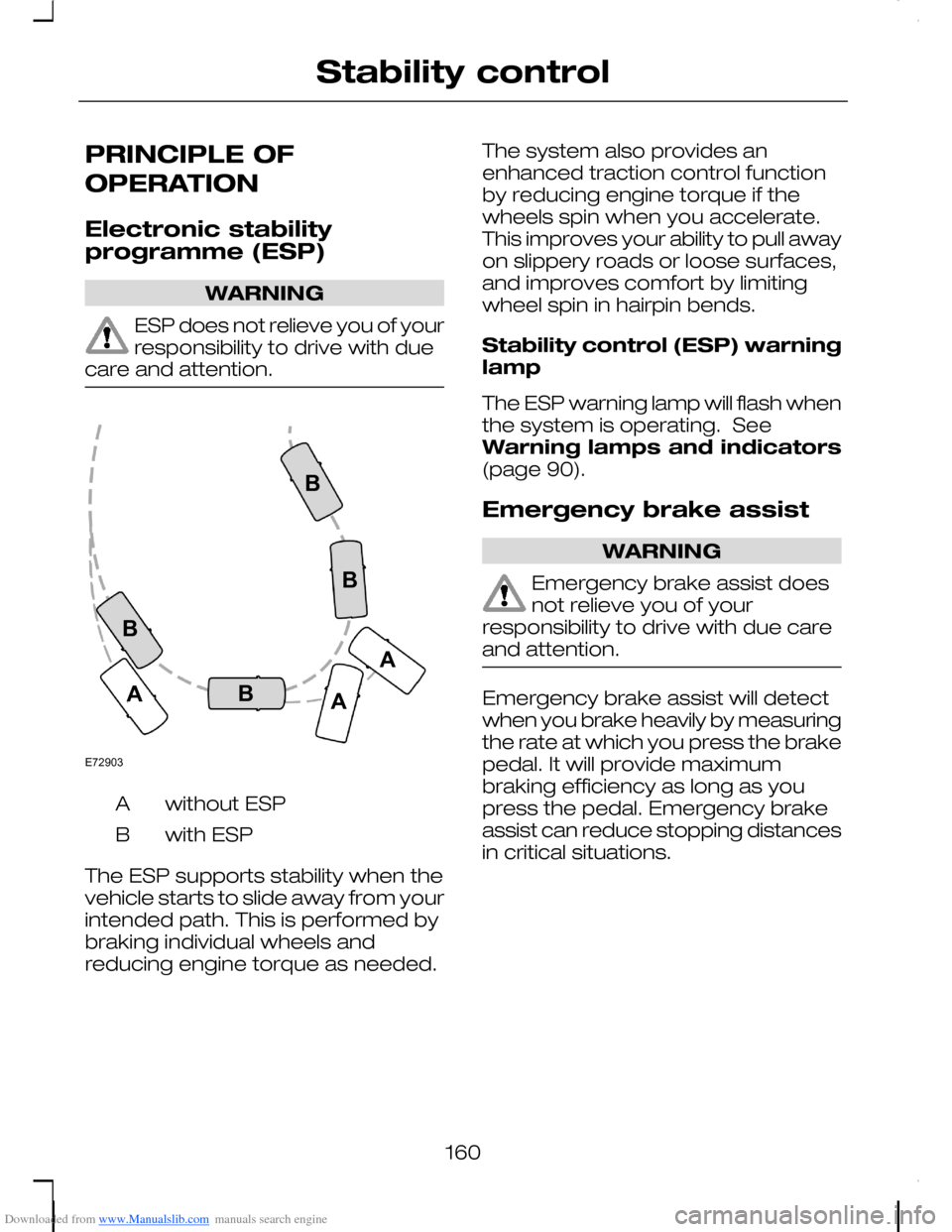
without ESPA
with ESPB
The ESP supports stability when thevehicle starts to slide away from yourintended path. This is performed bybraking individual wheels andreducing engine torque as needed.
The system also provides anenhanced traction control functionby reducing engine torque if thewheels spin when you accelerate.This improves your ability to pull awayon slippery roads or loose surfaces,and improves comfort by limitingwheel spin in hairpin bends.
Stability control (ESP) warninglamp
The ESP warning lamp will flash whenthe system is operating. SeeWarning lamps and indicators(page 90).
Emergency brake assist
WARNING
Emergency brake assist doesnot relieve you of yourresponsibility to drive with due careand attention.
Emergency brake assist will detectwhen you brake heavily by measuringthe rate at which you press the brakepedal. It will provide maximumbraking efficiency as long as youpress the pedal. Emergency brakeassist can reduce stopping distancesin critical situations.
160
Stability controlE72903AAABBBB
Page 166 of 278
Downloaded from www.Manualslib.com manuals search engine PRINCIPLE OF
OPERATION
Cruise control allows you to controlyour speed using the switches on thesteering wheel. You can use cruisecontrol when you exceed 40 km/h(25 mph).
USING CRUISE CONTROL
WARNING
Do not use cruise control inheavy traffic, on twisty roads orwhen the road surface is slippery.
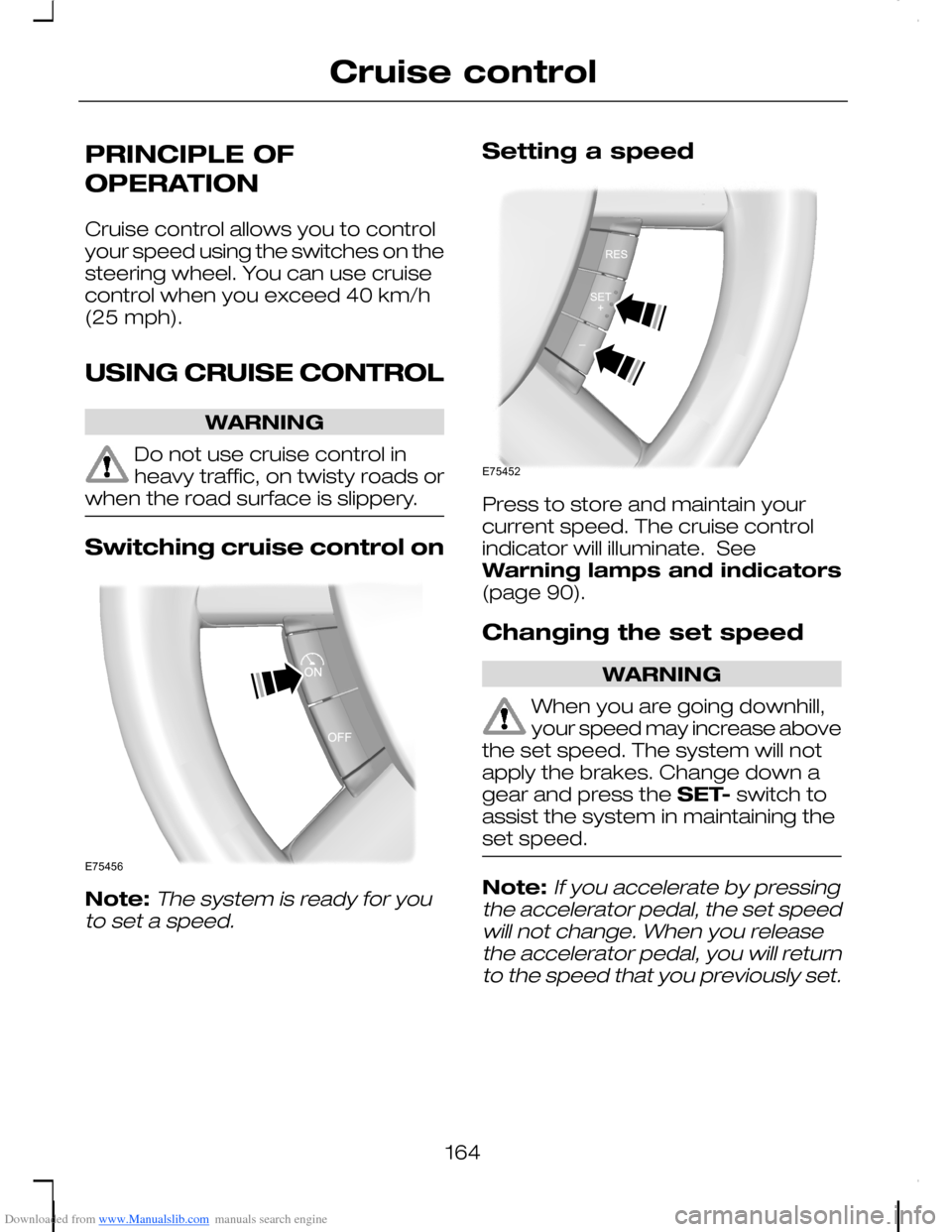
Switching cruise control on
Note:The system is ready for youto set a speed.
Setting a speed
Press to store and maintain yourcurrent speed. The cruise controlindicator will illuminate. SeeWarning lamps and indicators(page 90).
Changing the set speed
WARNING
When you are going downhill,your speed may increase abovethe set speed. The system will notapply the brakes. Change down agear and press the SET- switch toassist the system in maintaining theset speed.
Note:If you accelerate by pressingthe accelerator pedal, the set speedwill not change. When you releasethe accelerator pedal, you will returnto the speed that you previously set.
164
Cruise controlE75456 E75452
Page 167 of 278
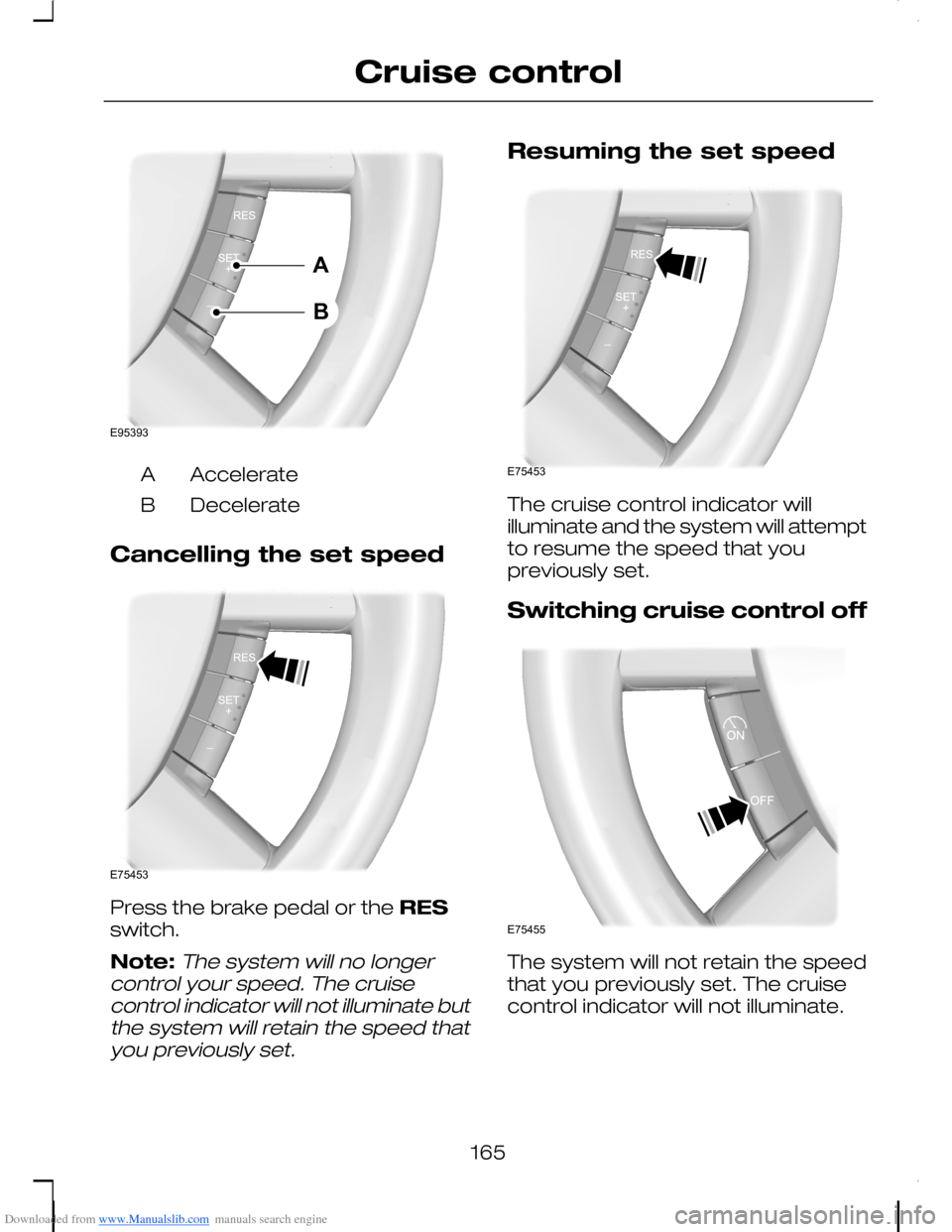
Downloaded from www.Manualslib.com manuals search engine AccelerateA
DecelerateB
Cancelling the set speed
Press the brake pedal or the RESswitch.
Note:The system will no longercontrol your speed. The cruisecontrol indicator will not illuminate butthe system will retain the speed thatyou previously set.
Resuming the set speed
The cruise control indicator willilluminate and the system will attemptto resume the speed that youpreviously set.
Switching cruise control off
The system will not retain the speedthat you previously set. The cruisecontrol indicator will not illuminate.
165
Cruise controlE95393AB E75453 E75453 E75455
Page 171 of 278
Downloaded from www.Manualslib.com manuals search engine TOWING A TRAILER
WARNINGS
Do not exceed the maximumvehicle and trailer weight statedon the vehicle identification plate. SeeVehicle identification (page 226).
ST vehicles are not approvedfor trailer towing.
Note:Not all vehicles are suitable orapproved to have tow bars fitted.Check with your dealer first.
Place loads as low and central to theaxle(s) of the trailer as possible. If youare towing with an unladen vehicle,the load in the trailer should beplaced toward the nose, within themaximum nose load, as this gives thebest stability.
Note:The maximum trailer noseweight can be found on themanufacturers data plate on the towbar.
The stability of the vehicle to trailercombination is very much dependanton the quality of the trailer.
In high altitude regions, the stipulatedmaximum permitted gross trainweight must be reduced by 10% forevery 1 000 metres (3 281 feet).
Steep gradients
WARNING
The overrun brake on a trailer isnot controlled by ABS.
Change down a gear before youreach a steep downhill gradient.
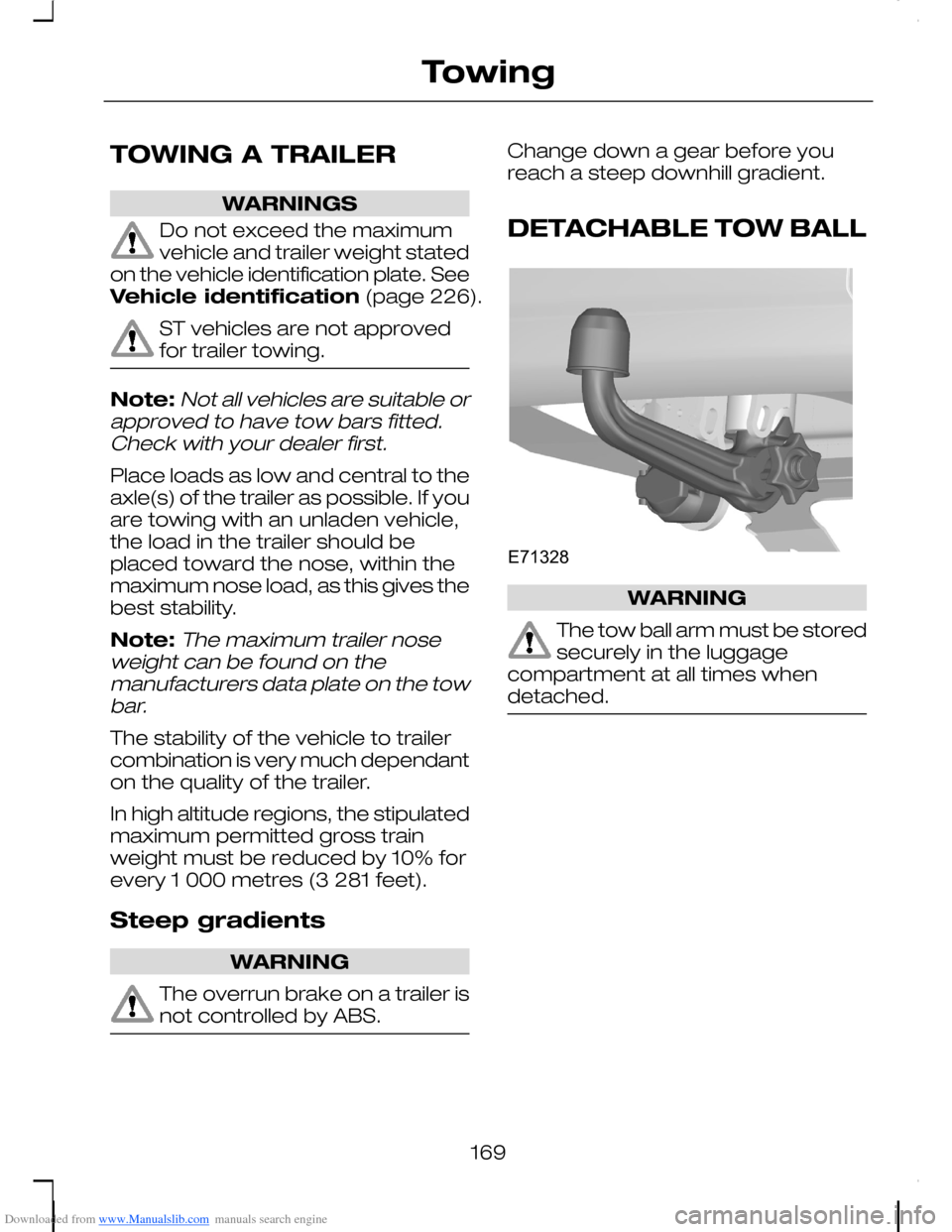
DETACHABLE TOW BALL
WARNING
The tow ball arm must be storedsecurely in the luggagecompartment at all times whendetached.
169
TowingE71328
Page 175 of 278
Downloaded from www.Manualslib.com manuals search engine RUNNING-IN
Tyres
WARNING
New tyres need to be run-in forapproximately 500 kilometres(300 miles). During this time, you mayexperience different drivingcharacteristics.
Brakes and clutch
WARNING
Avoid heavy use of the brakesand clutch if possible for the first150 kilometres (100 miles) in townand for the first 1 500 kilometres (1000 miles) on motorways.
Engine
CAUTION
Avoid driving too fast during thefirst 1 500 kilometres (1 000miles). Vary your speed frequentlyand change up through the gearsearly. Do not labour the engine.
173
Driving hints
Page 180 of 278
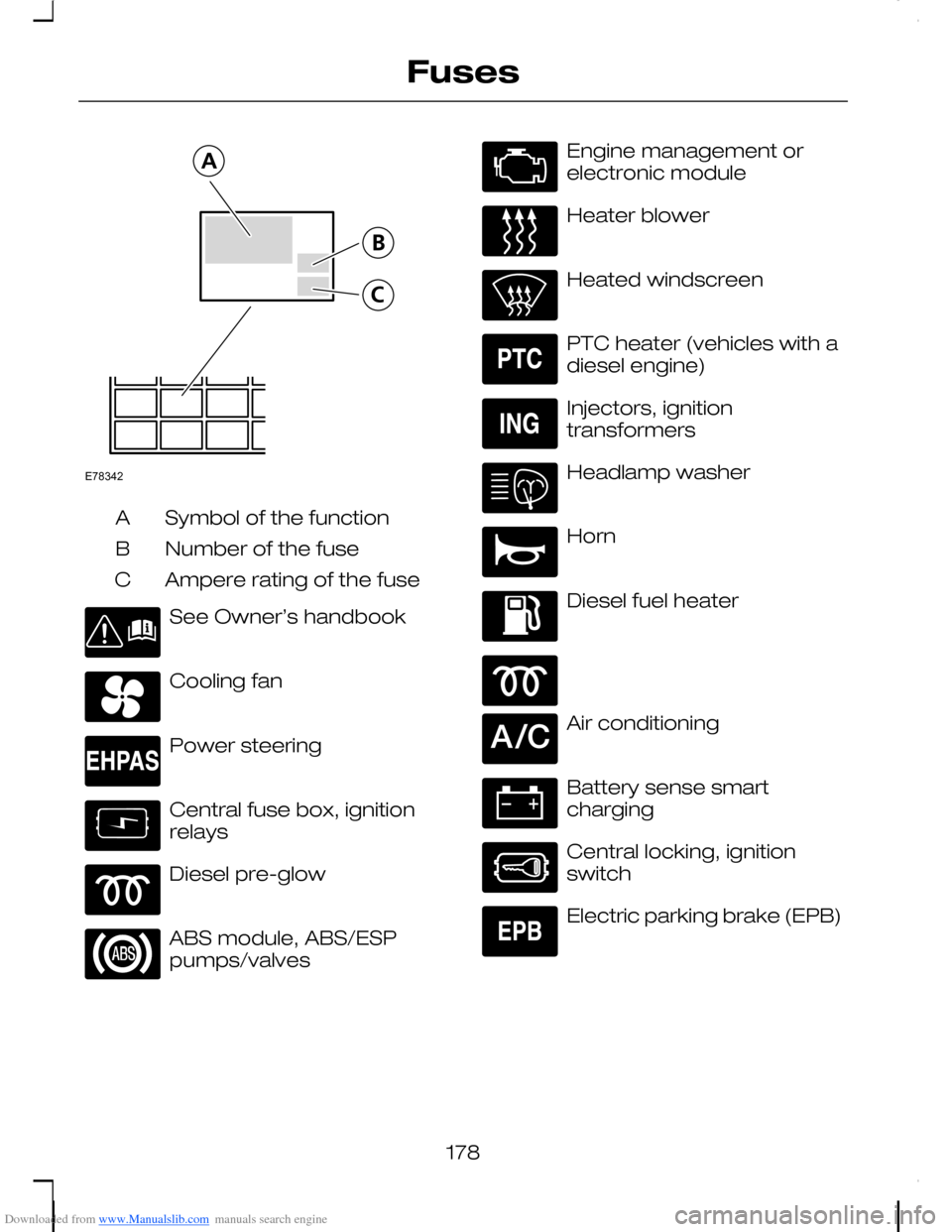
Downloaded from www.Manualslib.com manuals search engine Symbol of the functionA
Number of the fuseB
Ampere rating of the fuseC
See Owner’s handbook
Cooling fan
Power steering
Central fuse box, ignitionrelays
Diesel pre-glow
ABS module, ABS/ESPpumps/valves
Engine management orelectronic module
Heater blower
Heated windscreen
PTC heater (vehicles with adiesel engine)
Injectors, ignitiontransformers
Headlamp washer
Horn
Diesel fuel heater
Air conditioning
Battery sense smartcharging
Central locking, ignitionswitch
Electric parking brake (EPB)
178
FusesE78342
Page 185 of 278
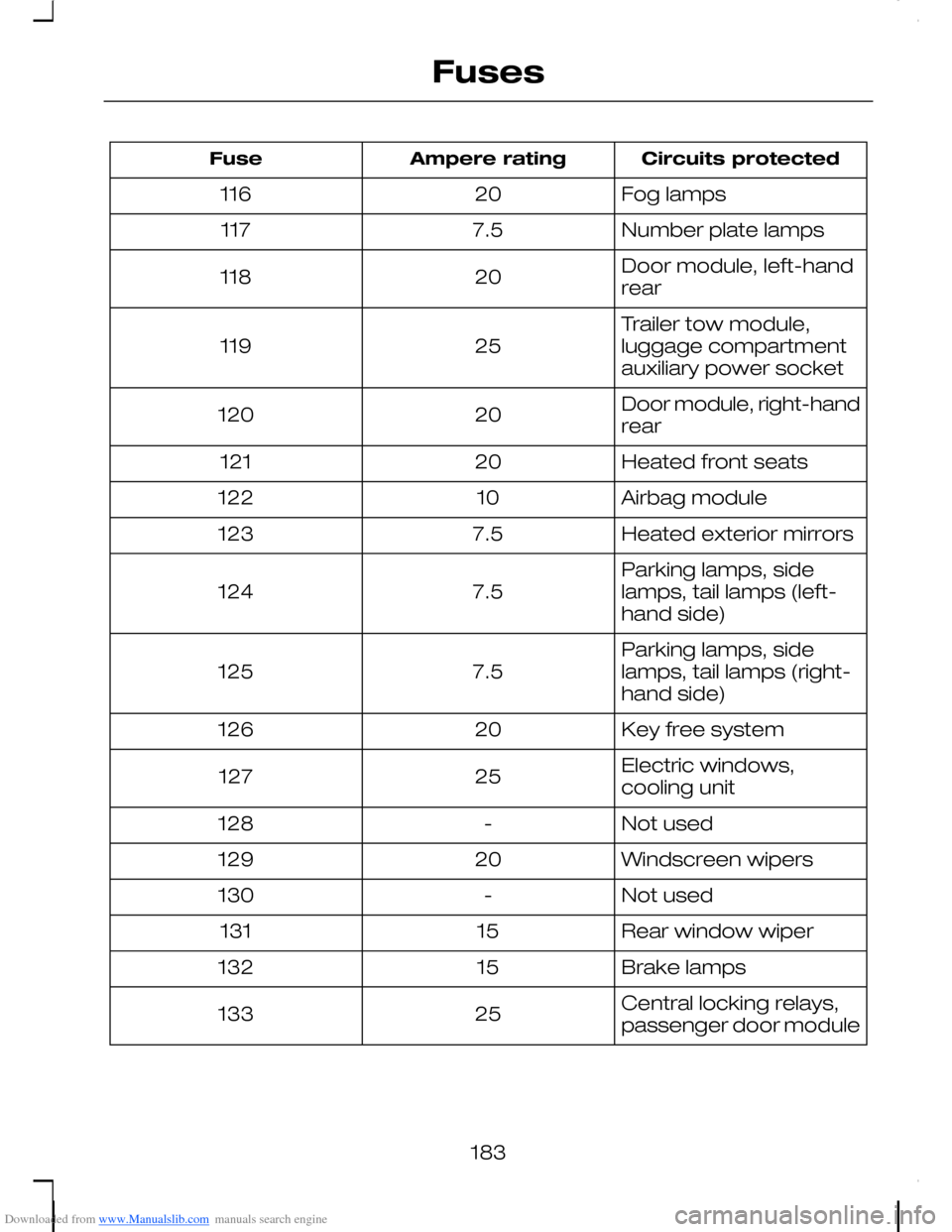
Downloaded from www.Manualslib.com manuals search engine Circuits protectedAmpere ratingFuse
Fog lamps20116
Number plate lamps7.5117
Door module, left-handrear20118
Trailer tow module,luggage compartmentauxiliary power socket25119
Door module, right-handrear20120
Heated front seats20121
Airbag module10122
Heated exterior mirrors7.5123
Parking lamps, sidelamps, tail lamps (left-hand side)7.5124
Parking lamps, sidelamps, tail lamps (right-hand side)7.5125
Key free system20126
Electric windows,cooling unit25127
Not used-128
Windscreen wipers20129
Not used-130
Rear window wiper15131
Brake lamps15132
Central locking relays,passenger door module25133
183
Fuses
Page 188 of 278
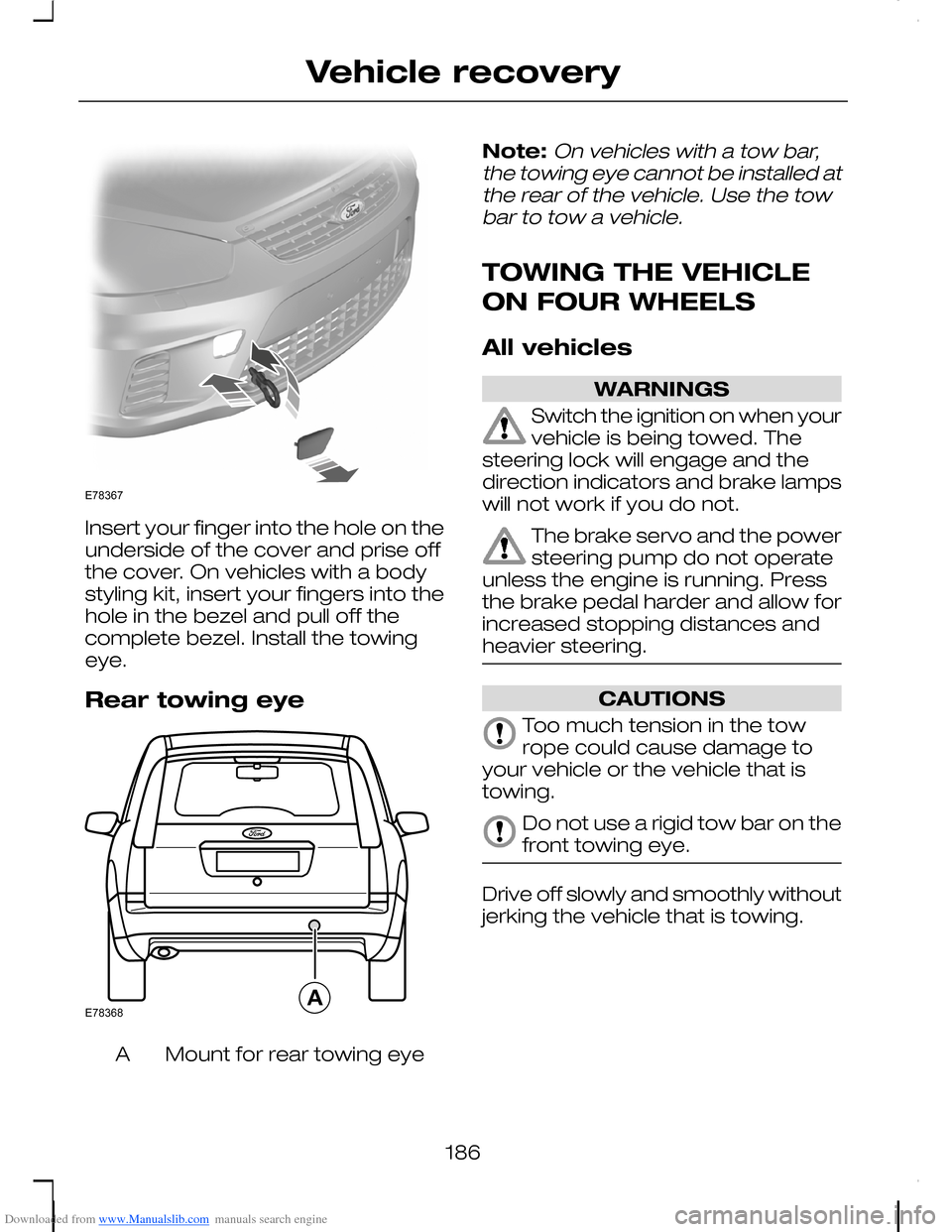
Downloaded from www.Manualslib.com manuals search engine Insert your finger into the hole on theunderside of the cover and prise offthe cover. On vehicles with a bodystyling kit, insert your fingers into thehole in the bezel and pull off thecomplete bezel. Install the towingeye.
Rear towing eye
Mount for rear towing eyeA
Note:On vehicles with a tow bar,the towing eye cannot be installed atthe rear of the vehicle. Use the towbar to tow a vehicle.
TOWING THE VEHICLE
ON FOUR WHEELS
All vehicles
WARNINGS
Switch the ignition on when yourvehicle is being towed. Thesteering lock will engage and thedirection indicators and brake lampswill not work if you do not.
The brake servo and the powersteering pump do not operateunless the engine is running. Pressthe brake pedal harder and allow forincreased stopping distances andheavier steering.
CAUTIONS
Too much tension in the towrope could cause damage toyour vehicle or the vehicle that istowing.
Do not use a rigid tow bar on thefront towing eye.
Drive off slowly and smoothly withoutjerking the vehicle that is towing.
186
Vehicle recoveryE78367 E78368
Page 190 of 278
Downloaded from www.Manualslib.com manuals search engine GENERAL INFORMATION
Have your vehicle serviced regularlyto help maintain its roadworthinessand resale value. There is a largenetwork of Ford Authorised Repairersthat are there to help you with theirprofessional servicing expertise. Webelieve that their specially trainedtechnicians are best qualified toservice your vehicle properly andexpertly. They are supported by awide range of highly specialised toolsdeveloped specifically for servicingyour vehicle.
In addition to regular servicing, werecommend that you carry out thefollowing additional checks.
WARNINGS
Switch the ignition off beforetouching or attemptingadjustment of any kind.
Do not touch the electronicignition system parts after youhave switched the ignition on orwhen the engine is running. Thesystem operates at high voltage.
Keep your hands and clothingclear of the engine cooling fan.Under certain conditions, the fan maycontinue to run for several minutesafter you have switched the engineoff.
Daily checks
•Exterior lamps.
•Interior lamps.
•Warning lamps and indicators.
Check when refuelling
•Engine oil level. See Engine oilcheck (page 200).
•Brake fluid level. See Brake andclutch fluid check (page 202).
•Washer fluid level. See Washerfluid check (page 203).
•Tyre pressures (when cold). SeeWheels and tyres (page 211).
•Tyre condition. See Wheels andtyres (page 211).
Monthly checks
•Engine coolant level (engine cold).See Engine coolant check(page 201).
•Pipes, hoses and reservoirs forleaks.
•Power steering fluid level. SeePower steering fluid check(page 202).
•Air conditioning operation.
•Parking brake operation.
•Horn operation.
•Tightness of wheel nuts. SeeWheels and tyres (page 211).
188
Maintenance