lock FORD C MAX 2011 2.G Workshop Manual
[x] Cancel search | Manufacturer: FORD, Model Year: 2011, Model line: C MAX, Model: FORD C MAX 2011 2.GPages: 296, PDF Size: 7.87 MB
Page 131 of 296
Downloaded from www.Manualslib.com manuals search engine Note:
Continue cranking the engine until it
starts.
Note: You can only operate the starter for
a maximum of 30 seconds at a time. Switch the ignition on and wait
until the glow plug indicator goes
off.
Vehicles with manual transmission
Note: Do not touch the accelerator pedal.
1. Fully depress the clutch pedal.
2. Start the engine.
Vehicles with automatic transmission
1. Select park or neutral.
2. Fully depress the brake pedal.
3. Start the engine.
KEYLESS STARTING WARNINGS
The keyless starting system may not
function if the key is close to metal
objects or electronic devices such as
mobile phones. Always check that the steering wheel
lock is deactivated before
attempting to move your vehicle.
See Steering Wheel Lock (page 127). Note:
The ignition may automatically
switch off after a period of time if your
vehicle has been left unattended with the
ignition on. This is to prevent the vehicle
battery from discharging.
Note: A valid passive key must be located
inside the vehicle to switch the ignition on
and start the engine.
Note: To start your engine you must also
fully depress the brake or clutch pedal,
depending on the transmission fitted. Ignition on
Press the start button once. All electrical
circuits are operational, warning lamps and
indicators illuminate.
Starting with automatic
transmission
Note:
Releasing the brake pedal during
engine start may stop the engine cranking
and return to ignition on.
1. Make sure the transmission is in P or N.
2. Fully depress the brake pedal.
3. Press the start button.
Starting with manual transmission
Note: Releasing the clutch pedal during
engine start will stop the engine cranking
and return to ignition on.
1. Fully depress the clutch pedal.
2. Press the start button.
Starting a diesel engine
Note: Engine cranking may not commence
until the engine glow plug cycle has been
completed. This may take several seconds
in extremely cold conditions.
Note: Continue to press the clutch or brake
pedal until engine cranking begins.
129
Starting and Stopping the Engine E85766
Page 132 of 296
Downloaded from www.Manualslib.com manuals search engine Failure to start
The passive starting system will not
function if:
•
The passive key frequencies are
jammed.
• The passive key battery is flat.
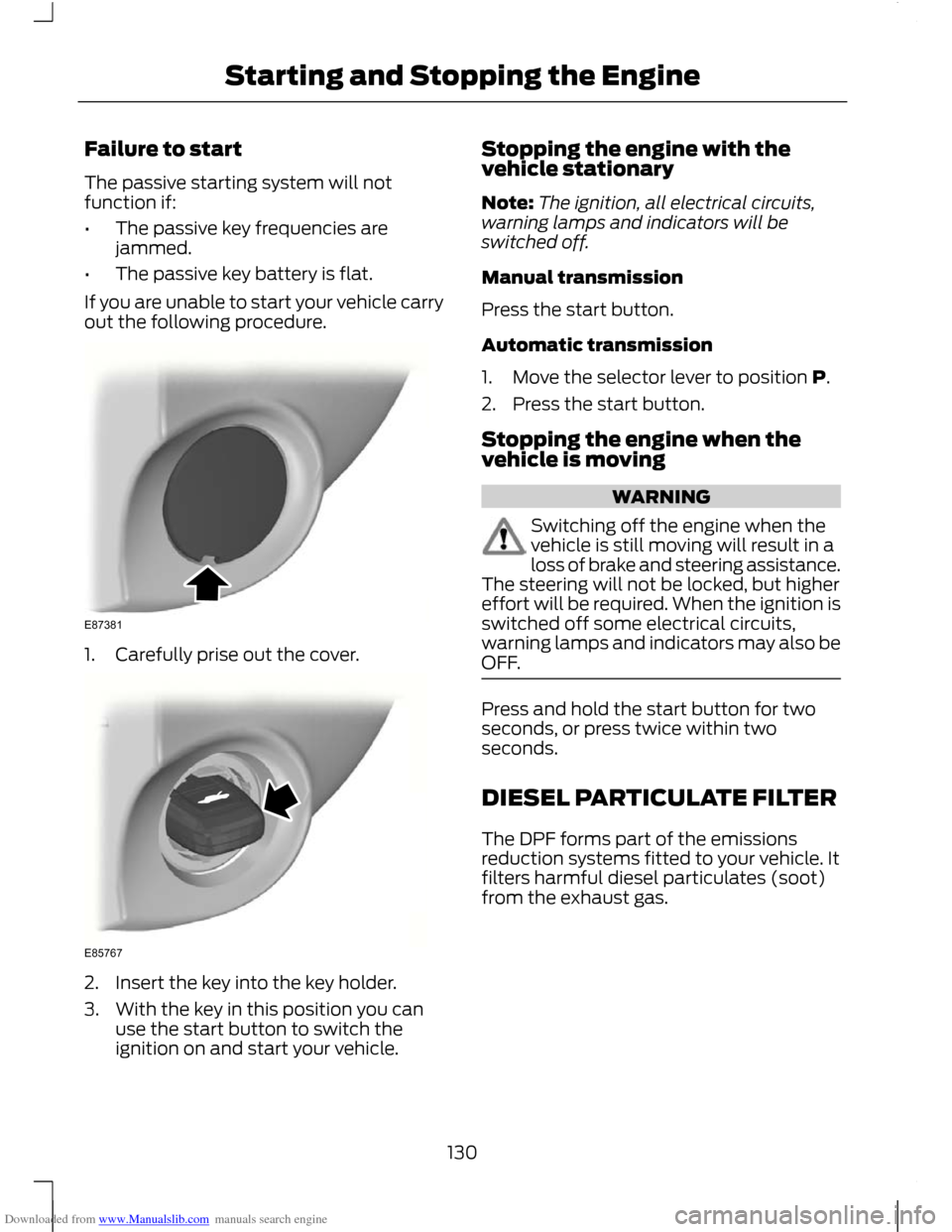
If you are unable to start your vehicle carry
out the following procedure. 1. Carefully prise out the cover.
2. Insert the key into the key holder.
3. With the key in this position you can
use the start button to switch the
ignition on and start your vehicle. Stopping the engine with the
vehicle stationary
Note:
The ignition, all electrical circuits,
warning lamps and indicators will be
switched off.
Manual transmission
Press the start button.
Automatic transmission
1. Move the selector lever to position P.
2. Press the start button.
Stopping the engine when the
vehicle is moving WARNING
Switching off the engine when the
vehicle is still moving will result in a
loss of brake and steering assistance.
The steering will not be locked, but higher
effort will be required. When the ignition is
switched off some electrical circuits,
warning lamps and indicators may also be
OFF. Press and hold the start button for two
seconds, or press twice within two
seconds.
DIESEL PARTICULATE FILTER
The DPF forms part of the emissions
reduction systems fitted to your vehicle. It
filters harmful diesel particulates (soot)
from the exhaust gas.
130
Starting and Stopping the EngineE87381 E85767
Page 133 of 296
Downloaded from www.Manualslib.com manuals search engine Regeneration
WARNING
Do not park or idle your vehicle over
dry leaves, dry grass or other
combustible materials. The DPF
regeneration process creates very high
exhaust gas temperatures and the exhaust
will radiate a considerable amount of heat
during and after DPF regeneration, and
after you have switched the engine off.
This is a potential fire hazard. CAUTION
Avoid running out of fuel.
Note:
During regeneration at low speed or
engine idle, you may smell a hot metallic
odour and could notice a clicking metallic
sound. This is due to the high temperatures
reached during regeneration and is normal.
Note: After you have switched your engine
off the fans may continue to run for a short
period of time.
Unlike a normal filter which requires
periodic replacement, the DPF has been
designed to regenerate, or clean itself to
maintain operating efficiency. The
regeneration process takes place
automatically. However, some driving
conditions mean that you may need to
support the regeneration process.
If you drive only short distances or your
journeys contain frequent stopping and
starting, where there is increased
acceleration and deceleration, occasional
trips with the following conditions will
assist the regeneration process: •
Drive your vehicle at a constant speed,
preferably on a main road or motorway,
for up to 20 minutes.
• Avoid prolonged idling and always
observe speed limits and road
conditions.
• Do not switch off the ignition.
• Use a lower gear than normal to
maintain a higher engine speed during
this journey, where appropriate.
SWITCHING OFF THE ENGINE
Vehicles with a turbocharger CAUTION
Do not switch the engine off when it
is running at high speed. If you do, the
turbocharger will continue running
after the engine oil pressure has dropped
to zero. This will lead to premature
turbocharger bearing wear. Release the accelerator pedal. Wait until
the engine has reached idle speed and then
switch it off.
ENGINE BLOCK HEATER
CAUTION
Make sure you disconnect the power
cable from the engine heater
connector before driving away.
Note:
The engine heater connector is
located in the front bumper.
131
Starting and Stopping the Engine
Page 143 of 296
Downloaded from www.Manualslib.com manuals search engine MANUAL TRANSMISSION
CAUTION
Do not engage reverse gear when the
vehicle is moving. This can cause
damage to the transmission.
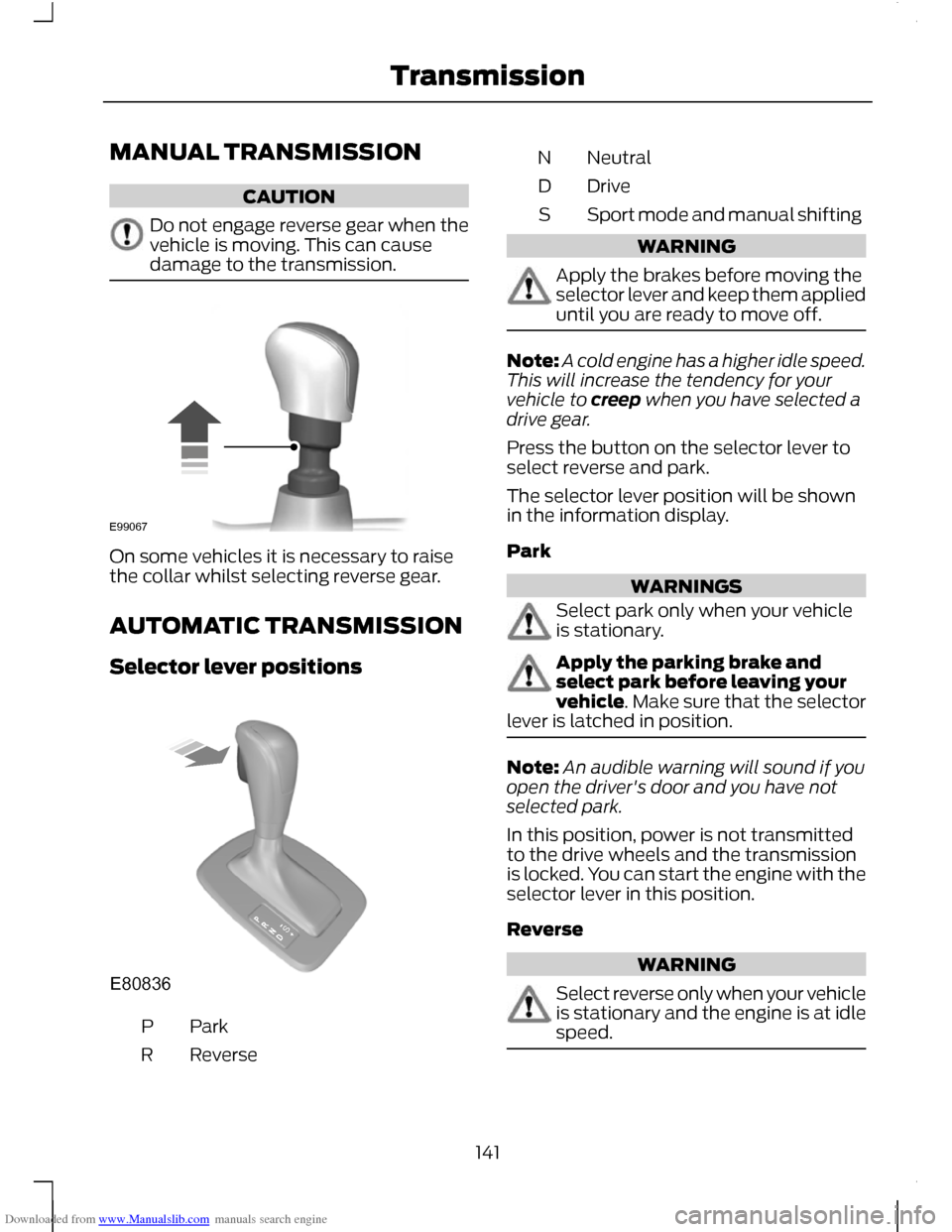
On some vehicles it is necessary to raise
the collar whilst selecting reverse gear.
AUTOMATIC TRANSMISSION
Selector lever positions
ParkP
Reverse
R Neutral
N
Drive
D
Sport mode and manual shifting
S WARNING
Apply the brakes before moving the
selector lever and keep them applied
until you are ready to move off.
Note:
A cold engine has a higher idle speed.
This will increase the tendency for your
vehicle to creep when you have selected a
drive gear.
Press the button on the selector lever to
select reverse and park.
The selector lever position will be shown
in the information display.
Park WARNINGS
Select park only when your vehicle
is stationary.
Apply the parking brake and
select park before leaving your
vehicle. Make sure that the selector
lever is latched in position. Note:
An audible warning will sound if you
open the driver's door and you have not
selected park.
In this position, power is not transmitted
to the drive wheels and the transmission
is locked. You can start the engine with the
selector lever in this position.
Reverse WARNING
Select reverse only when your vehicle
is stationary and the engine is at idle
speed.
141
TransmissionE99067 E80836S
Page 144 of 296
Downloaded from www.Manualslib.com manuals search engine Neutral
In this position, power is not transmitted
to the drive wheels but the transmission is
not locked. You can start the engine with
the selector lever in this position.
Drive
Select drive to shift automatically through
the forward gears.
The transmission will select the
appropriate gear for optimum performance
based on ambient temperature, road
gradient, vehicle load and driver input.
Manual shifting - Vehicles with a
5 speed transmission
WARNING
Do not hold the selector lever
permanently in – or +.
CAUTION
The transmission will automatically
downshift when the engine speed is
too low and upshift when too high.
Note:
A shift will occur only when the
vehicle speed and the engine speed are
appropriate.
Note: In Select mode the current gear (1,
2, 3, 4 or 5) will be displayed on the
instrument panel.
Move the selector lever to position S.
Push the selector lever forwards to shift
down and pull it backwards to shift up.
Gears may be skipped by moving the
selector lever repeatedly at short intervals.
Manual mode also provides a kickdown
function. See Kickdown. Sport mode and manual shifting -
Vehicles with a 6 speed
transmission
Note:
A shift will occur only when the
vehicle speed and the engine speed are
appropriate.
Sport Mode
Note: In Sport mode the transmission
operates as normal but gears are selected
more quickly and at higher engine speeds.
Note: In Sport mode S will be displayed on
the instrument panel.
Activate Sport mode by moving the
selector lever to position S. Sport mode
will remain active until either you shift
manually up or down the gears or return
the selector lever to position D.
Manual shifting WARNING
Do not hold the selector lever
permanently in – or +.
CAUTION
The transmission will automatically
downshift when the engine speed is
too low.
Push the selector lever forwards to shift
down and pull it backwards to shift up.
Gears may be skipped by moving the
selector lever repeatedly at short intervals.
Manual mode also provides a kickdown
function. See Kickdown.
142
Transmission
Page 146 of 296
Downloaded from www.Manualslib.com manuals search engine PRINCIPLE OF OPERATION
Note:
Depending on applicable laws and
regulations in the country for which your
vehicle was originally built, the brake lamps
may flash if you brake heavily.
Note: Occasional brake noise is normal and
often does not indicate a concern. In normal
operation, the system may emit occasional
or intermittent squeal or groan noises when
the brakes are applied. Such noises are
usually caused by environmental conditions
such as cold, heat, moisture, road dust, salt
or mud.
Disc brakes
Wet brake discs result in reduced braking
efficiency. Dab the brake pedal when
driving from a car wash to remove the film
of water.
ABS WARNING
The ABS does not relieve you of your
responsibility to drive with due care
and attention.
The ABS helps you to maintain full steering
and directional stability when you brake
heavily in an emergency, by preventing the
road wheels from locking.
HINTS ON DRIVING WITH
ANTI-LOCK BRAKES
When the ABS is operating, the brake pedal
will pulse. This is normal. Maintain pressure
on the brake pedal.
The ABS will not eliminate the dangers
inherent when:
•
you drive too close to the vehicle in
front of you.
• the vehicle is aquaplaning. •
you take corners too fast.
• the road surface is poor.
PARKING BRAKE WARNING
Vehicles with an automatic
transmission should always be left
with the selector lever in position P
(Park). •
Press the foot brake pedal firmly.
• Pull the parking brake lever up smartly
to its fullest extent.
• Do not press the release button while
pulling the lever up.
• If your vehicle is parked on a hill and
facing uphill, select first gear or P
(Park) and turn the steering wheel
away from the kerb.
• If your vehicle is parked on a hill and
facing downhill, select reverse gear or
P (Park) and turn the steering wheel
towards the kerb.
To release the parking brake, press the
brake pedal firmly, pull the lever up slightly,
depress the release button and push the
lever down.
144
Brakes
Page 168 of 296
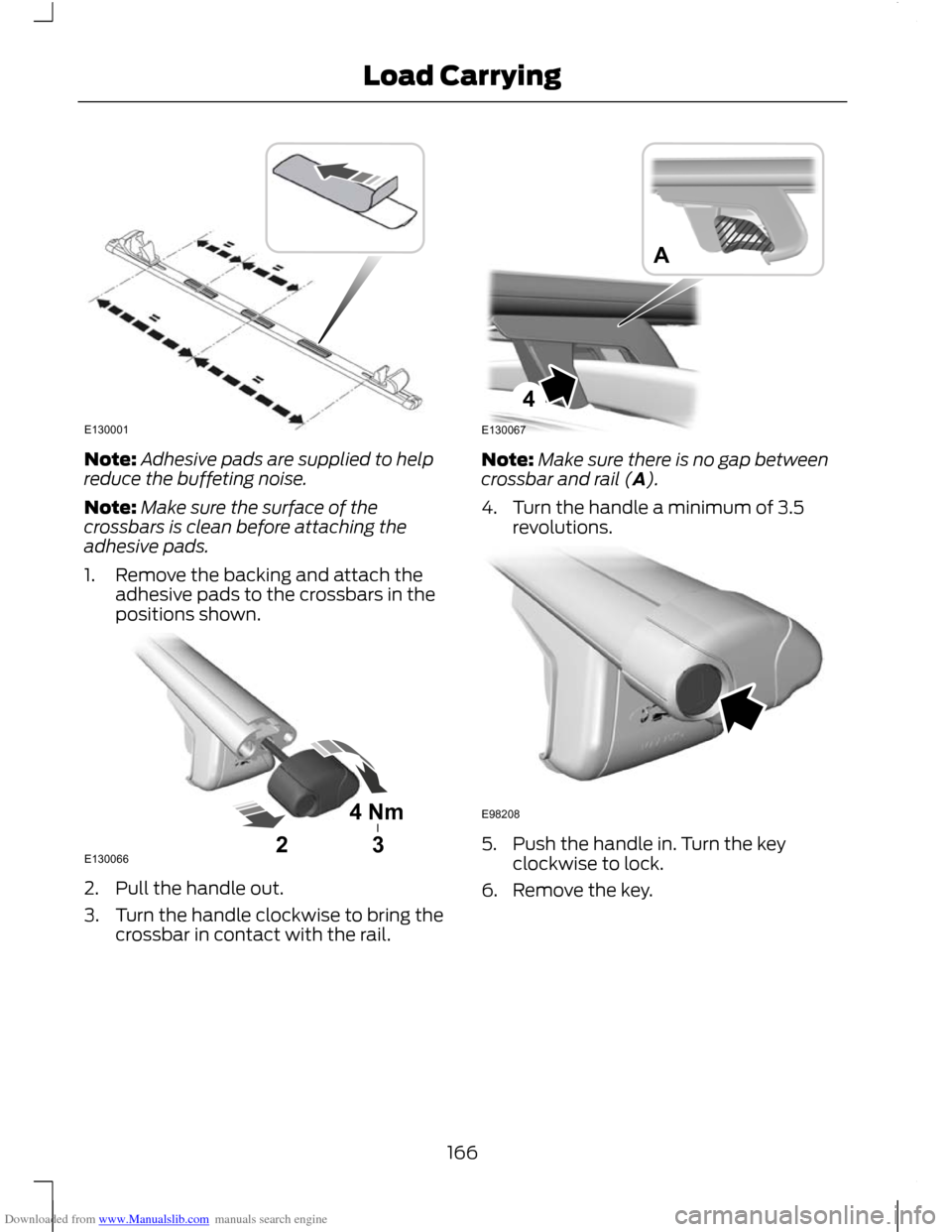
Downloaded from www.Manualslib.com manuals search engine Note:
Adhesive pads are supplied to help
reduce the buffeting noise.
Note: Make sure the surface of the
crossbars is clean before attaching the
adhesive pads.
1. Remove the backing and attach the adhesive pads to the crossbars in the
positions shown. 2. Pull the handle out.
3. Turn the handle clockwise to bring the
crossbar in contact with the rail. Note:
Make sure there is no gap between
crossbar and rail (A).
4. Turn the handle a minimum of 3.5 revolutions. 5. Push the handle in. Turn the key
clockwise to lock.
6. Remove the key.
166
Load CarryingE130001 4Nm32E130066 4E130067A E98208
Page 171 of 296
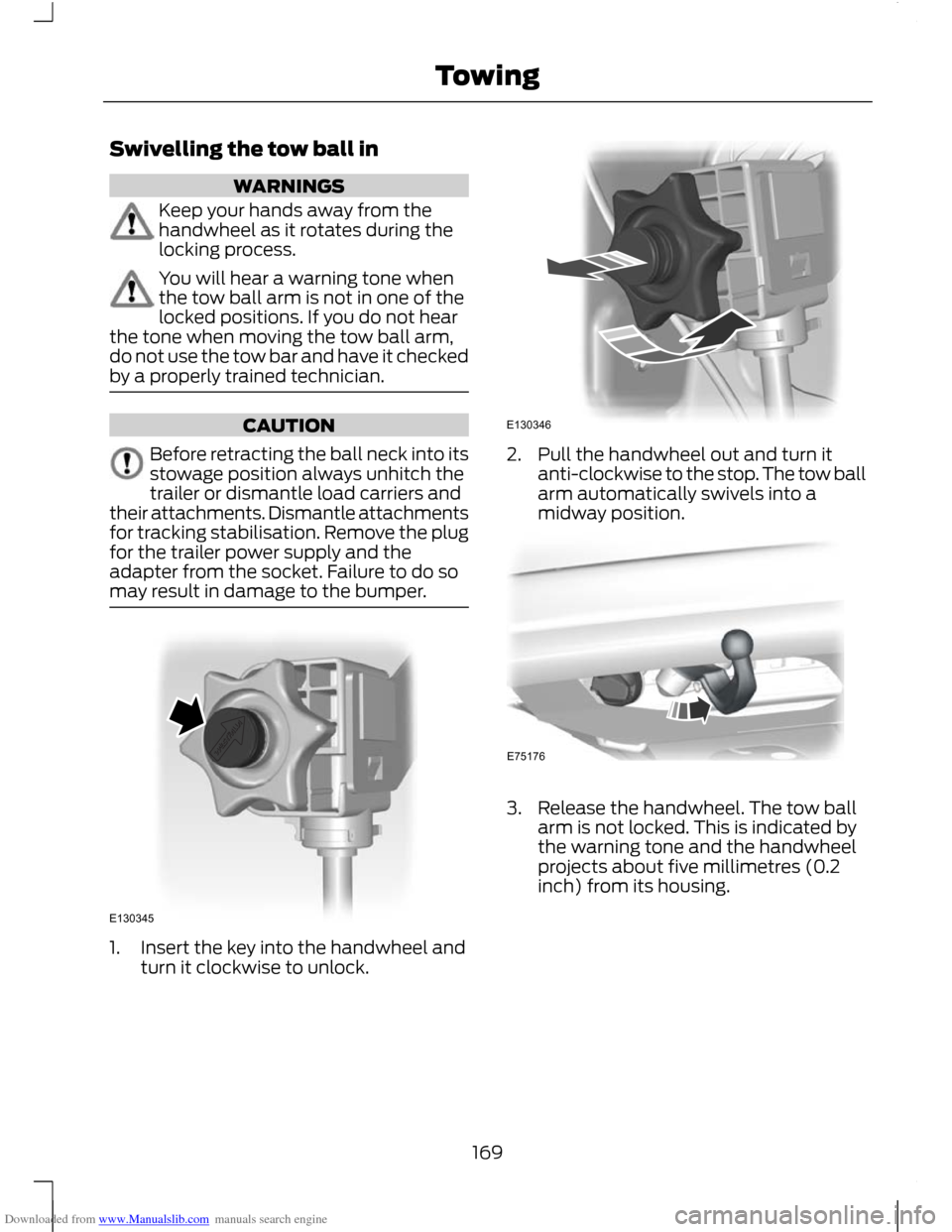
Downloaded from www.Manualslib.com manuals search engine Swivelling the tow ball in
WARNINGS
Keep your hands away from the
handwheel as it rotates during the
locking process.
You will hear a warning tone when
the tow ball arm is not in one of the
locked positions. If you do not hear
the tone when moving the tow ball arm,
do not use the tow bar and have it checked
by a properly trained technician. CAUTION
Before retracting the ball neck into its
stowage position always unhitch the
trailer or dismantle load carriers and
their attachments. Dismantle attachments
for tracking stabilisation. Remove the plug
for the trailer power supply and the
adapter from the socket. Failure to do so
may result in damage to the bumper. 1. Insert the key into the handwheel and
turn it clockwise to unlock. 2. Pull the handwheel out and turn it
anti-clockwise to the stop. The tow ball
arm automatically swivels into a
midway position. 3. Release the handwheel. The tow ball
arm is not locked. This is indicated by
the warning tone and the handwheel
projects about five millimetres (0.2
inch) from its housing.
169
TowingE130345 E130346 E75176
Page 172 of 296
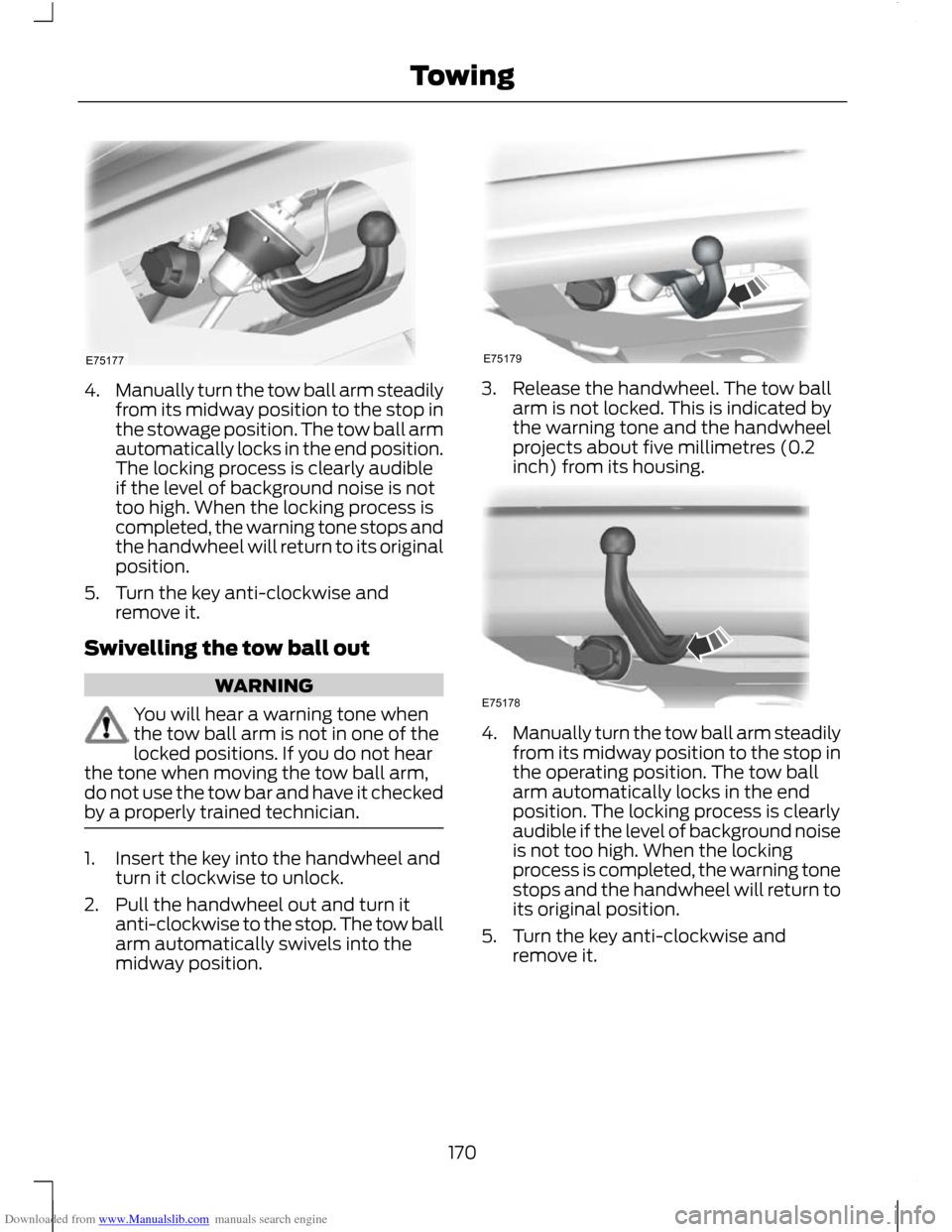
Downloaded from www.Manualslib.com manuals search engine 4.
Manually turn the tow ball arm steadily
from its midway position to the stop in
the stowage position. The tow ball arm
automatically locks in the end position.
The locking process is clearly audible
if the level of background noise is not
too high. When the locking process is
completed, the warning tone stops and
the handwheel will return to its original
position.
5. Turn the key anti-clockwise and remove it.
Swivelling the tow ball out WARNING
You will hear a warning tone when
the tow ball arm is not in one of the
locked positions. If you do not hear
the tone when moving the tow ball arm,
do not use the tow bar and have it checked
by a properly trained technician. 1. Insert the key into the handwheel and
turn it clockwise to unlock.
2. Pull the handwheel out and turn it anti-clockwise to the stop. The tow ball
arm automatically swivels into the
midway position. 3. Release the handwheel. The tow ball
arm is not locked. This is indicated by
the warning tone and the handwheel
projects about five millimetres (0.2
inch) from its housing. 4.
Manually turn the tow ball arm steadily
from its midway position to the stop in
the operating position. The tow ball
arm automatically locks in the end
position. The locking process is clearly
audible if the level of background noise
is not too high. When the locking
process is completed, the warning tone
stops and the handwheel will return to
its original position.
5. Turn the key anti-clockwise and remove it.
170
TowingE75177 E75179 E75178
Page 173 of 296
Downloaded from www.Manualslib.com manuals search engine Driving with a trailer
WARNING
If any of the conditions below cannot
be met, do not use the tow bar and
have it checked by a properly trained
technician. Before starting your journey, make sure
that the tow ball arm is properly locked.
Check that:
•
there is no warning tone when the
locking procedure has been completed
• the handwheel is in its housing and that
there is no gap
• you have locked the handwheel
(anti-clockwise) and removed the key
• the tow ball arm is locked. It must not
move when jerked.
Maintenance CAUTIONS
The towing hitch and control unit are
maintenance-free. Do not grease or
oil them.
Only the manufacturer should carry
out repairs or dismantle the towing
hitch.
If you use a high pressure spray to
wash your vehicle, do not direct the
spray onto the swivel joint of the tow
ball arm. 171
Towing