automatic transmission FORD C MAX 2015 Owners Manual
[x] Cancel search | Manufacturer: FORD, Model Year: 2015, Model line: C MAX, Model: FORD C MAX 2015Pages: 469, PDF Size: 6.16 MB
Page 6 of 469
Emission Control System..........................146
High Voltage Battery
General Information....................................149
Charging the High Voltage Battery.........151
High Voltage Battery Cut-Off Switch...........................................................156
Transmission
Automatic Transmission
............................157
Brakes
General Information
....................................160
Hints on Driving With Anti-Lock Brakes............................................................161
Parking Brake
..................................................161
Hill Start Assist
...............................................161
Traction Control
Principle of Operation.................................163
Using Traction Control
................................163
Stability Control
Principle of Operation................................164
Using Stability Control...............................165
Parking Aids
Parking Aid......................................................166
Active Park Assist.........................................168
Rear View Camera........................................172
Cruise Control
Principle of Operation
.................................175
Using Cruise Control....................................175
Driving Aids
Steering
.............................................................177
Load Carrying
Rear Under Floor Storage..........................178 Luggage Covers.............................................178
Load Limit
........................................................179
Towing
Towing a Trailer.............................................186
Transporting the Vehicle...........................186
Towing the Vehicle on Four Wheels......186
Driving Hints
Breaking-In.....................................................188
Economical Driving......................................188
Driving Through Water...............................189
Floor Mats
.......................................................190
Roadside Emergencies
Roadside Assistance....................................191
Hazard Warning Flashers
..........................192
Fuel Shutoff....................................................192
Jump Starting the Vehicle
.........................193
Collision, Damage or Fire Event..............195
Post-Crash Alert System...........................197
Customer Assistance
Getting the Services You Need...............198
In California (U.S. Only).............................199
The Better Business Bureau (BBB) Auto Line Program (U.S. Only).....................200
Utilizing the Mediation/Arbitration Program (Canada Only)......................200
Getting Assistance Outside the U.S. and Canada.........................................................201
Ordering Additional Owner's Literature....................................................202
Reporting Safety Defects (U.S. Only)............................................................202
Reporting Safety Defects (Canada Only)............................................................203
Fuses
Fuse Specification Chart..........................204
Changing a Fuse
............................................212
3
C-MAX (CCG) Canada/United States of America, enUSA, Second Printing Table of Contents
Page 7 of 469
Maintenance
General Information....................................213
Opening and Closing the Hood...............213
Under Hood Overview -
Hybrid Electric
Vehicle (HEV)............................................214
Under Hood Overview -
Plug-In Hybrid
Electric Vehicle (PHEV).........................216
Engine Oil Dipstick........................................217
Engine Oil Check............................................217
Engine Coolant Check
................................218
Automatic Transmission Fluid Check............................................................222
Brake Fluid Check........................................222
Power Steering Fluid Check.....................222
Washer Fluid Check.....................................222
Fuel Filter
.........................................................222
Changing the 12V Battery.........................223
Checking the Wiper Blades......................224
Changing the Wiper Blades
.....................224
Adjusting the Headlamps.........................226
Removing a Headlamp
..............................227
Changing a Bulb...........................................227
Bulb Specification Chart............................231
Changing the Engine Air Filter.................233
Vehicle Care
General Information
...................................236
Cleaning Products
.......................................236
Cleaning the Exterior..................................236
Waxing..............................................................237
Cleaning the Engine
....................................237
Cleaning the Windows and Wiper Blades..........................................................238
Cleaning the Interior...................................238
Cleaning the Instrument Panel and Instrument Cluster Lens.......................239
Cleaning Leather Seats.............................239
Repairing Minor Paint Damage..............240
Cleaning the Alloy Wheels.......................240
Vehicle Storage
............................................240 Wheels and Tires
Temporary Mobility Kit..............................243
Tire Care
..........................................................255
Using Snow Chains.....................................269
Tire Pressure Monitoring System...........270
Technical Specifications
...........................273
Capacities and Specific- ations
Engine Specifications.................................275
Motorcraft Parts...........................................276
Vehicle Identification Number.................277
Vehicle Certification Label........................277
Transmission Code Designation............278
Capacities and Specifications................279
Audio System
General Information...................................282
Audio Unit - Vehicles With: AM/FM/CD/ SYNC
............................................................283
Audio Unit - Vehicles With: Premium AM/ FM/CD.........................................................285
Audio Unit - Vehicles With: Sony AM/FM/ CD..................................................................287
Digital Radio
..................................................290
Satellite Radio..............................................292
Audio Input Jack...........................................295
USB Port
.........................................................295
Media Hub
......................................................296
SYNC™
General Information
...................................297
Using Voice Recognition...........................299
Using SYNC™ With Your Phone.............301
SYNC™ Applications and Services.......312
Using SYNC™ With Your Media Player............................................................319
SYNC™ Troubleshooting..........................327
4
C-MAX (CCG) Canada/United States of America, enUSA, Second Printing Table of Contents
Page 51 of 469
3. Remove the old battery.
4. Insert a new battery with the + facing
downward. Press the battery down to
make sure it is fully in the housing.
5. Snap the battery cover back onto the transmitter and install the backup key.
Car Finder
Press the lock button on the key twice
within three seconds. The horn sounds and
the turn signals flash. We recommend you
use this method to locate your vehicle,
rather than using the panic alarm.
Note: If locking was not successful or if any
door or the liftgate is open, or if the hood is
open on vehicles with a perimeter alarm or
remote start, the horn does sound twice and
the lamp does not flash.
Sounding a Panic Alarm
(If Equipped)
Note: The panic alarm only operates when
the ignition is off. Press the button to activate the
alarm. Press the button again or
switch the ignition on to
deactivate it.
Remote Start (If Equipped) WARNING
To avoid exhaust fumes, do not use
remote start if your vehicle is parked
indoors or areas that are not well
ventilated. Note:
Do not use remote start if your vehicle
is low on fuel. The remote start button is on the
transmitter. This feature allows you to start your
vehicle from outside the vehicle. The
transmitter has an extended operating
range.
Vehicles with automatic climate control
can be configured to operate when the
vehicle is remote started. See Automatic
Climate Control
(page 107).
Many states and provinces have
restrictions for the use of remote start.
Check your local and state or provincial
laws for specific requirements regarding
remote start systems.
The remote start system does not work if
any of the following occur:
• The ignition is on.
• The alarm system triggers.
• You disable the feature.
• The hood is open.
• The transmission is not in
P.
• The vehicle battery voltage is too low.
• The powertrain fault indicator was on
the last time your vehicle was driven.
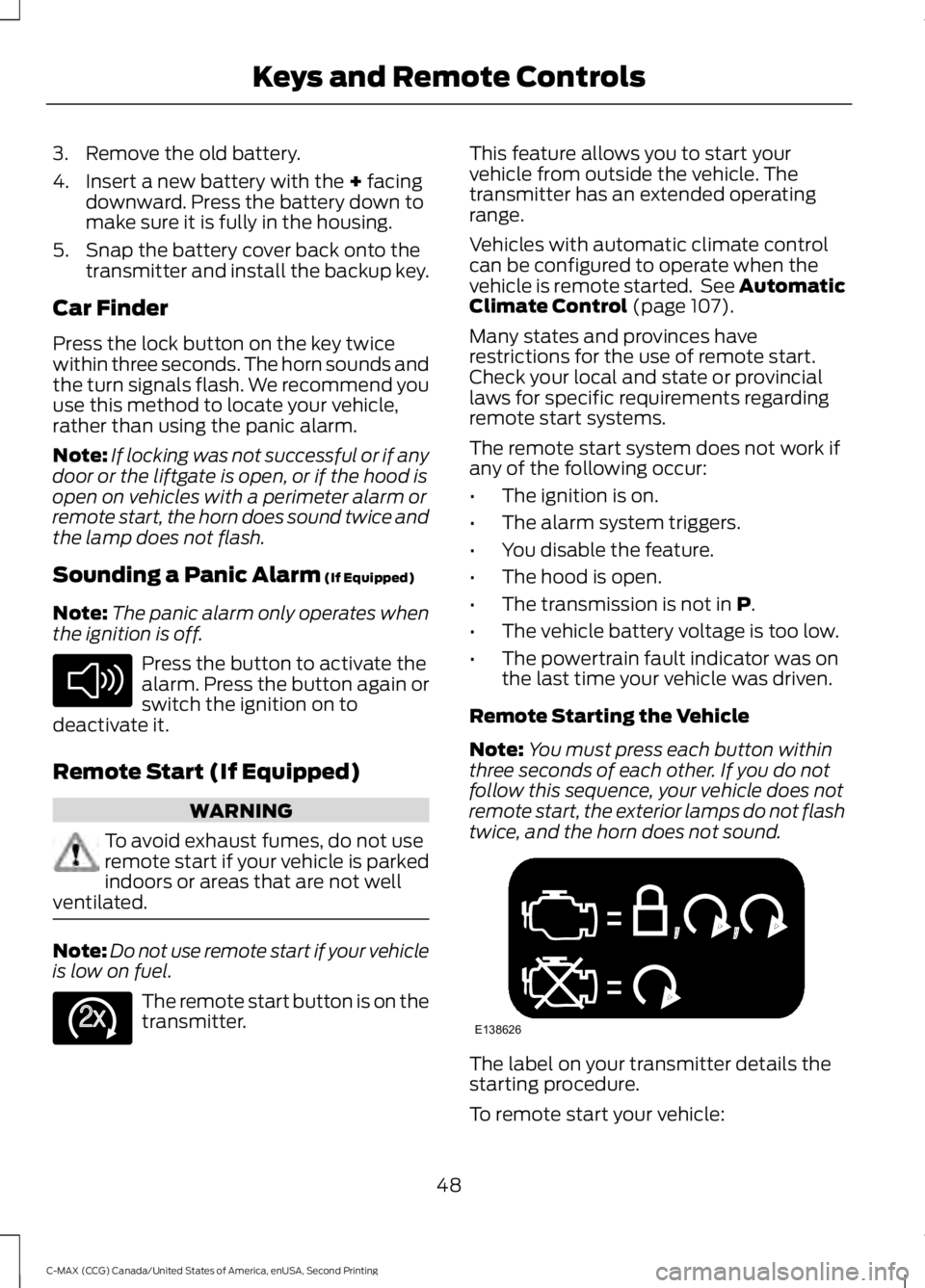
Remote Starting the Vehicle
Note: You must press each button within
three seconds of each other. If you do not
follow this sequence, your vehicle does not
remote start, the exterior lamps do not flash
twice, and the horn does not sound. The label on your transmitter details the
starting procedure.
To remote start your vehicle:
48
C-MAX (CCG) Canada/United States of America, enUSA, Second Printing Keys and Remote ControlsE138624 E138625 E138626
Page 78 of 469
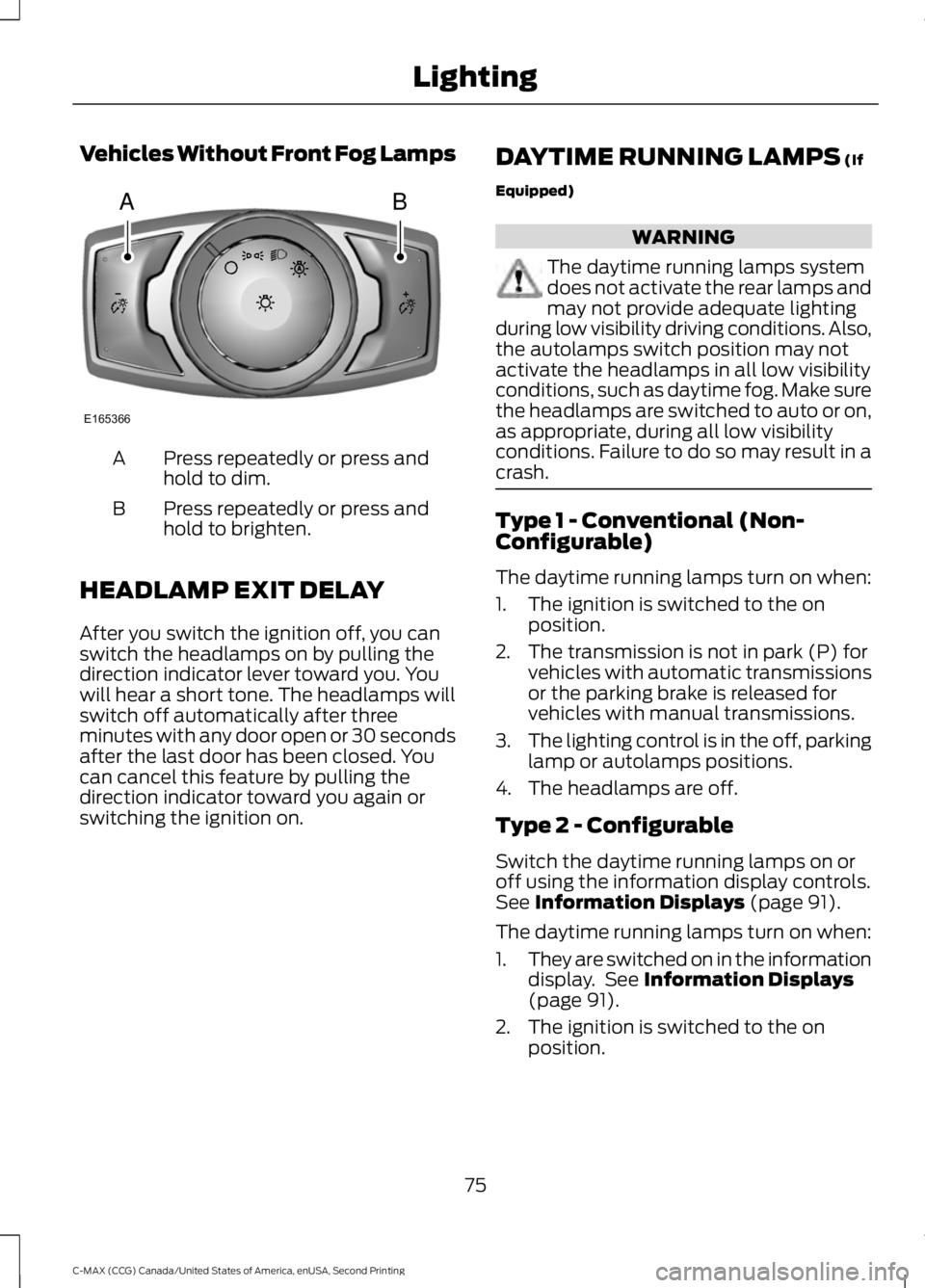
Vehicles Without Front Fog Lamps
Press repeatedly or press and
hold to dim.
A
Press repeatedly or press and
hold to brighten.
B
HEADLAMP EXIT DELAY
After you switch the ignition off, you can
switch the headlamps on by pulling the
direction indicator lever toward you. You
will hear a short tone. The headlamps will
switch off automatically after three
minutes with any door open or 30 seconds
after the last door has been closed. You
can cancel this feature by pulling the
direction indicator toward you again or
switching the ignition on. DAYTIME RUNNING LAMPS (If
Equipped) WARNING
The daytime running lamps system
does not activate the rear lamps and
may not provide adequate lighting
during low visibility driving conditions. Also,
the autolamps switch position may not
activate the headlamps in all low visibility
conditions, such as daytime fog. Make sure
the headlamps are switched to auto or on,
as appropriate, during all low visibility
conditions. Failure to do so may result in a
crash. Type 1 - Conventional (Non-
Configurable)
The daytime running lamps turn on when:
1. The ignition is switched to the on
position.
2. The transmission is not in park (P) for vehicles with automatic transmissions
or the parking brake is released for
vehicles with manual transmissions.
3. The lighting control is in the off, parking
lamp or autolamps positions.
4. The headlamps are off.
Type 2 - Configurable
Switch the daytime running lamps on or
off using the information display controls.
See
Information Displays (page 91).
The daytime running lamps turn on when:
1. They are switched on in the information
display. See
Information Displays
(page 91).
2. The ignition is switched to the on position.
75
C-MAX (CCG) Canada/United States of America, enUSA, Second Printing LightingAB
E165366
Page 79 of 469
3. The transmission is not in park (P) for
vehicles with automatic transmissions
or the parking brake is released for
vehicles with manual transmissions.
4. The lighting control is in the autolamps
position.
5. The headlamps are off.
The other lighting control switch positions
do not activate the daytime running lamps,
and you can use them to temporarily
override autolamp control.
When switched off in the information
display, the daytime running lamps are off
in all lighting control switch positions.
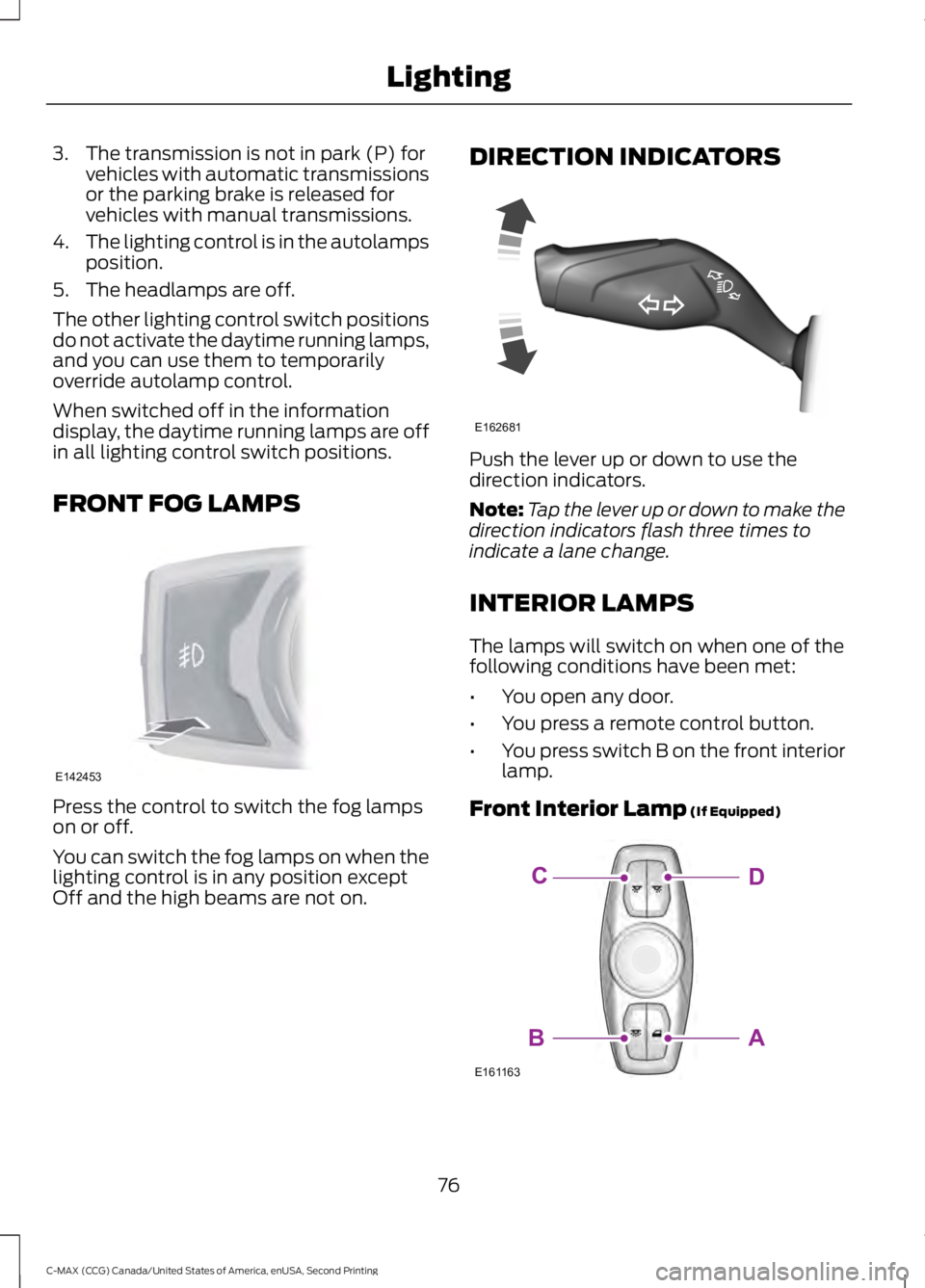
FRONT FOG LAMPS Press the control to switch the fog lamps
on or off.
You can switch the fog lamps on when the
lighting control is in any position except
Off and the high beams are not on. DIRECTION INDICATORS Push the lever up or down to use the
direction indicators.
Note:
Tap the lever up or down to make the
direction indicators flash three times to
indicate a lane change.
INTERIOR LAMPS
The lamps will switch on when one of the
following conditions have been met:
• You open any door.
• You press a remote control button.
• You press switch B on the front interior
lamp.
Front Interior Lamp (If Equipped) 76
C-MAX (CCG) Canada/United States of America, enUSA, Second Printing LightingE142453 E162681 E161163
DC
AB
Page 93 of 469
AUDIBLE WARNINGS AND
INDICATORS
Key in Ignition Warning Chime
Sounds when you open the driver's door
and you have left the key in the ignition.
Engine On Warning Chime
A warning chime will sound when any door
is opened if the vehicle exceeds a relatively
low speed.
Keyless Warning Alert (If Equipped)
Sounds the horn twice when you exit the
vehicle and the keyless vehicle is in RUN,
indicating the vehicle is still on.
Headlamps On Warning Chime
Sounds when you remove the key from the
ignition and open the driver's door and you
have left the headlamps or parking lamps
on.
Parking Brake On Warning Chime
Sounds when you have left the parking
brake on and drive your vehicle. If the
warning chime remains on after you have
released the parking brake, have the
system checked by your authorized dealer
immediately.
Automatic Transmission Warning
Chime
Sounds when you have not moved the
transmission selector lever to position
P.
A message will be shown in the display.
90
C-MAX (CCG) Canada/United States of America, enUSA, Second Printing Instrument Cluster
Page 131 of 469
Ignition Modes
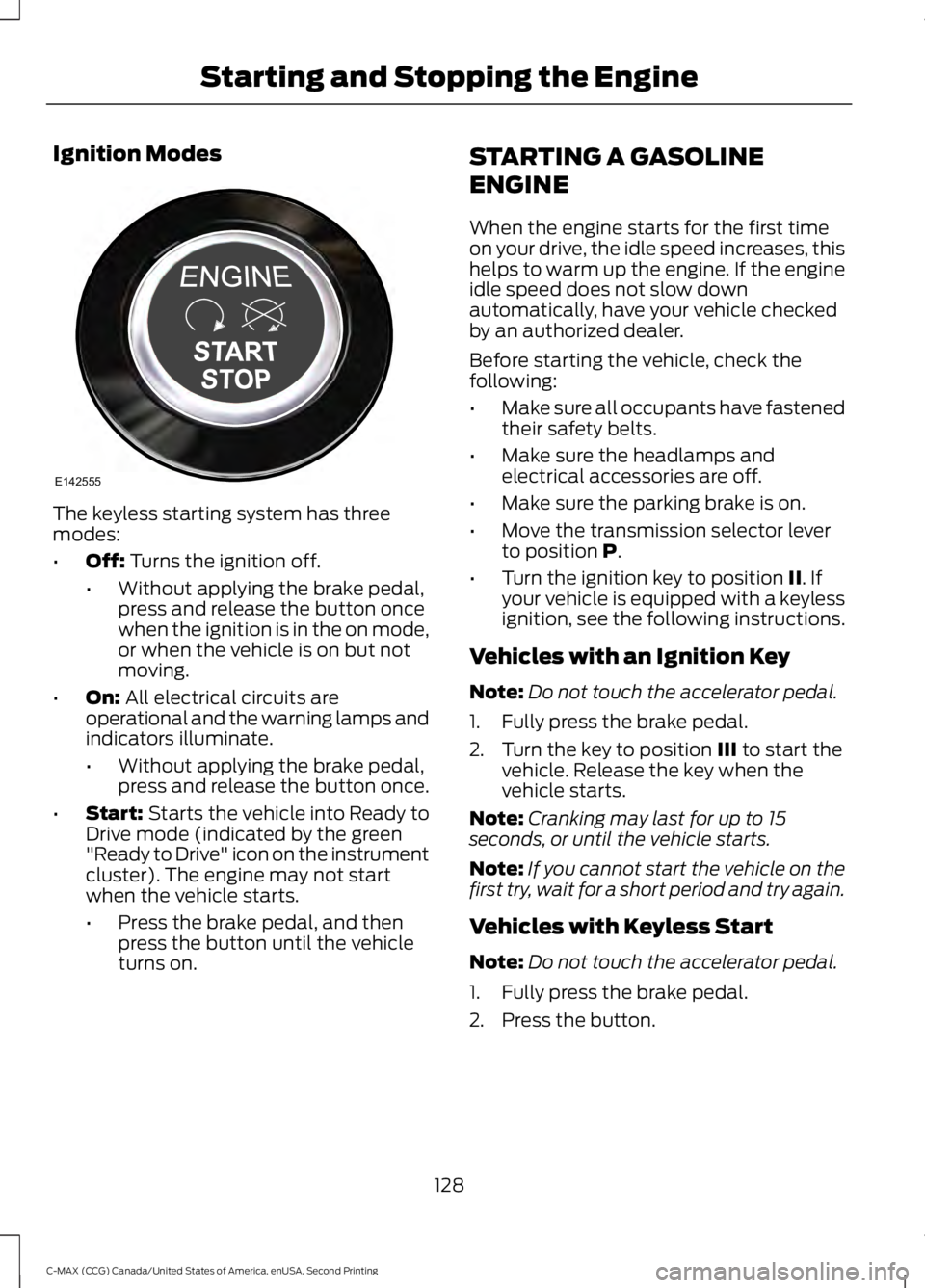
The keyless starting system has three
modes:
•
Off: Turns the ignition off.
• Without applying the brake pedal,
press and release the button once
when the ignition is in the on mode,
or when the vehicle is on but not
moving.
• On:
All electrical circuits are
operational and the warning lamps and
indicators illuminate.
• Without applying the brake pedal,
press and release the button once.
• Start:
Starts the vehicle into Ready to
Drive mode (indicated by the green
"Ready to Drive" icon on the instrument
cluster). The engine may not start
when the vehicle starts.
• Press the brake pedal, and then
press the button until the vehicle
turns on. STARTING A GASOLINE
ENGINE
When the engine starts for the first time
on your drive, the idle speed increases, this
helps to warm up the engine. If the engine
idle speed does not slow down
automatically, have your vehicle checked
by an authorized dealer.
Before starting the vehicle, check the
following:
•
Make sure all occupants have fastened
their safety belts.
• Make sure the headlamps and
electrical accessories are off.
• Make sure the parking brake is on.
• Move the transmission selector lever
to position
P.
• Turn the ignition key to position
II. If
your vehicle is equipped with a keyless
ignition, see the following instructions.
Vehicles with an Ignition Key
Note: Do not touch the accelerator pedal.
1. Fully press the brake pedal.
2. Turn the key to position
III to start the
vehicle. Release the key when the
vehicle starts.
Note: Cranking may last for up to 15
seconds, or until the vehicle starts.
Note: If you cannot start the vehicle on the
first try, wait for a short period and try again.
Vehicles with Keyless Start
Note: Do not touch the accelerator pedal.
1. Fully press the brake pedal.
2. Press the button.
128
C-MAX (CCG) Canada/United States of America, enUSA, Second Printing Starting and Stopping the EngineE142555
Page 138 of 469
During certain events (such as vehicle
servicing) your low voltage 12-volt battery
may become disconnected or disabled.
Once the battery is reconnected and after
driving the vehicle, the engine may
continue to operate for three to five
seconds after the key is turned to off. This
is a normal condition.
Braking: Your hybrid is equipped with
standard hydraulic braking and
regenerative braking. Regenerative braking
is performed by your transmission and it
captures brake energy and stores it in your
high voltage battery.
Driving to Optimize Fuel Economy
Note: Having your engine running is not
always an indication of inefficiency. In some
cases, it is actually more efficient than
driving in electric mode.
Your fuel economy should improve
throughout your hybrid's break-in period.
As with any vehicle, your driving habits and
accessory usage can significantly impact
your fuel economy. For best results, keep
in mind these tips:
• Keep the tires properly inflated and
only use the recommended size.
• Aggressive driving increases the
amount of energy required to move
your vehicle. In general, you can
achieve better fuel economy with mild
to moderate acceleration and
deceleration. Moderate braking is
particularly important since it allows
you to maximize the energy captured
by the regenerative braking system.
Additional Tips:
• Do not carry extra loads.
• Be mindful of adding external
accessories that may increase
aerodynamic drag.
• Observe posted speed limits. •
Perform all scheduled maintenance.
• There is no need to wait for your engine
to warm up. The vehicle is ready to
drive immediately after starting.
EV+ Mode (C-MAX Energi Only)
Your vehicle will recognize your frequent
destinations and allow for more EV driving
as you approach them. For example, when
nearing your home it should be easier to
stay in electric mode. The EV indicator will
display EV+ when this mode is active. You
should see this approximately 1/8 mile
(200 meters) from a frequent destination.
See
Information Displays (page 91).
Note: Frequent destinations are learned by
your vehicle after two to four weeks of use.
You can clear these destinations with a
Driving History reset through the Settings
menu.
Note: You can switch the EV+ feature on
or off through the Driver Assist section of
the Settings menu.
Low Engine Use (If Equipped)
The low engine use mode is equipped on
Energi models only. The low engine use
mode will activate automatically when you
drive your vehicle with limited engine use.
The mode will maintain proper engine
lubrication at sufficient temperature. If your
vehicle is in low engine use mode when you
start the vehicle, a message will appear in
the information display. When your vehicle
is in low engine use mode, your vehicle will
automatically run the engine as necessary.
If you select the EV Now mode while the
vehicle is in the low engine use mode, EV
Now mode will be suspended for as long
as you are in low engine use mode The low
engine use mode will resume the next time
you start your vehicle and will
automatically stop when no longer needed.
135
C-MAX (CCG) Canada/United States of America, enUSA, Second Printing Unique Driving Characteristics
Page 160 of 469
AUTOMATIC TRANSMISSION
WARNINGS
Always set the parking brake fully
and make sure the gearshift is
latched in park (P). Turn the ignition
to the off position and remove the key
whenever you leave your vehicle. Do not apply the brake pedal and
accelerator pedal simultaneously.
Applying both pedals simultaneously
for more than three seconds will limit
engine rpm, which may result in difficulty
maintaining speed in traffic and could lead
to serious injury. Note:
Do not leave your vehicle with the
transmission in neutral (N). Leaving your
vehicle with the transmission in neutral (N)
will drain the battery and you may not be
able to start your vehicle.
Automatic Transmission
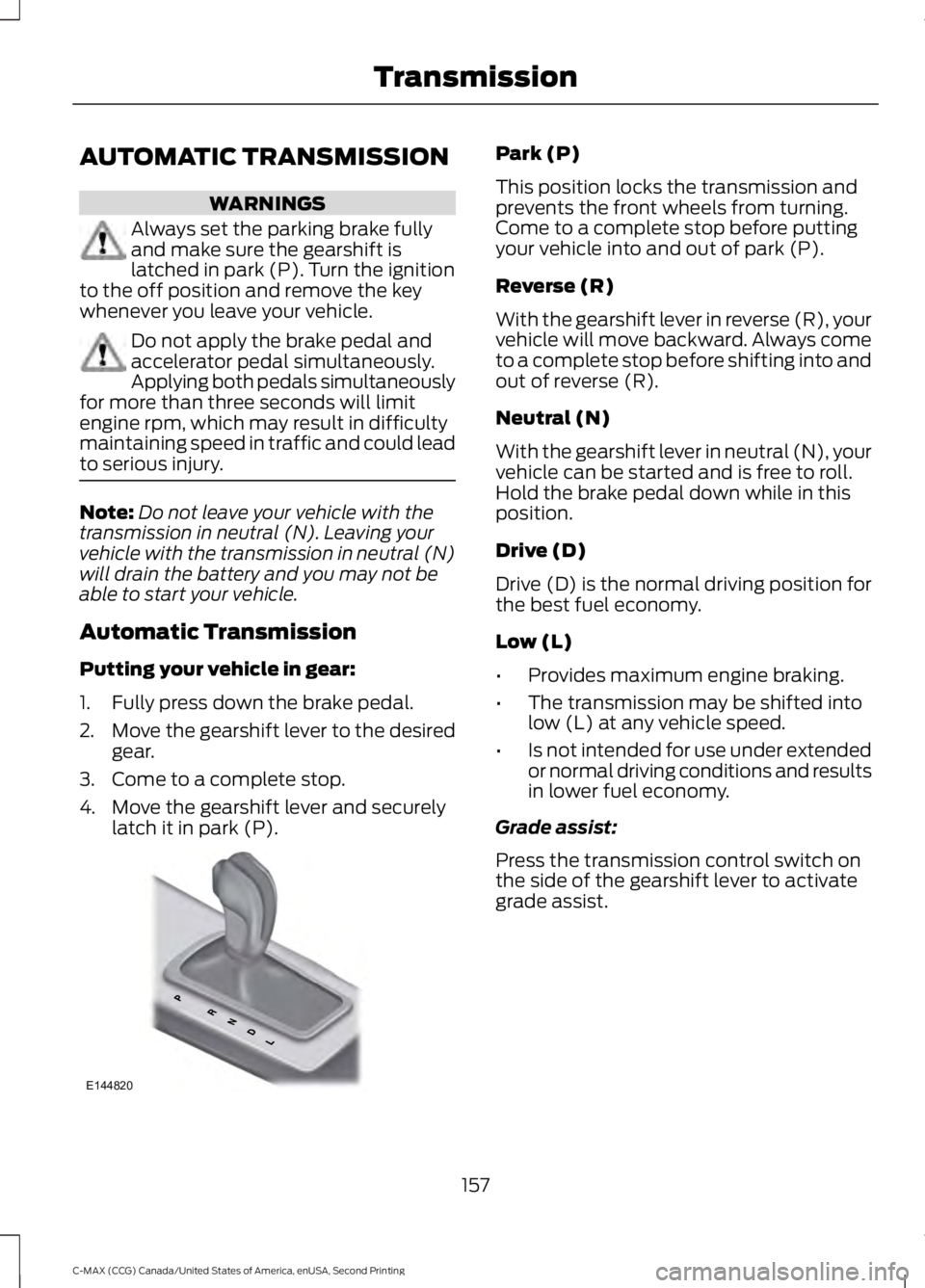
Putting your vehicle in gear:
1. Fully press down the brake pedal.
2. Move the gearshift lever to the desired
gear.
3. Come to a complete stop.
4. Move the gearshift lever and securely latch it in park (P). Park (P)
This position locks the transmission and
prevents the front wheels from turning.
Come to a complete stop before putting
your vehicle into and out of park (P).
Reverse (R)
With the gearshift lever in reverse (R), your
vehicle will move backward. Always come
to a complete stop before shifting into and
out of reverse (R).
Neutral (N)
With the gearshift lever in neutral (N), your
vehicle can be started and is free to roll.
Hold the brake pedal down while in this
position.
Drive (D)
Drive (D) is the normal driving position for
the best fuel economy.
Low (L)
•
Provides maximum engine braking.
• The transmission may be shifted into
low (L) at any vehicle speed.
• Is not intended for use under extended
or normal driving conditions and results
in lower fuel economy.
Grade assist:
Press the transmission control switch on
the side of the gearshift lever to activate
grade assist.
157
C-MAX (CCG) Canada/United States of America, enUSA, Second Printing TransmissionE144820
Page 163 of 469
GENERAL INFORMATION
Note:
Occasional brake noise is normal. If
a metal-to-metal, continuous grinding or
continuous squeal sound is present, the
brake linings may be worn-out. Have the
system checked by an authorized dealer. If
the vehicle has continuous vibration or
shudder in the steering wheel while braking,
have it checked by an authorized dealer.
Note: Brake dust may accumulate on the
wheels, even under normal driving
conditions. Some dust is inevitable as the
brakes wear and does not contribute to
brake noise. See Cleaning the Alloy
Wheels (page 240). See
Warning Lamps and
Indicators (page 86).
Wet brakes result in reduced braking
efficiency. Gently press the brake pedal a
few times when driving from a car wash or
standing water to dry the brakes.
Brake Over Accelerator
In the event the accelerator pedal
becomes stuck or entrapped, apply steady
and firm pressure to the brake pedal to
slow the vehicle and reduce engine power.
If you experience this condition, apply the
brakes and bring your vehicle to a safe
stop. Move the transmission to park (P),
switch the engine off and apply the parking
brake. Inspect the accelerator pedal for
any interference. If none are found and the
condition persists, have your vehicle towed
to the nearest authorized dealer.
Brake Assist
Brake assist detects when you brake
heavily by measuring the rate at which you
press the brake pedal. It provides
maximum braking efficiency as long as you
press the pedal. Brake assist can reduce
stopping distances in critical situations. Anti-lock Brake System
This system helps you maintain steering
control during emergency stops by keeping
the brakes from locking. This lamp momentarily
illuminates when you turn the
ignition on. If the light does not
illuminate during start up, remains on or
flashes, the system may be disabled. Have
the system checked by an authorized
dealer. If the anti-lock brake system is
disabled, normal braking is still effective. If the brake warning lamp
illuminates when you release the
parking brake, have the system
checked by an authorized dealer.
Regenerative Braking System
This feature is used to simulate the engine
braking of an internal combustion engine
and assist the standard brake system while
recovering some of the energy of motion
and storing it in the battery to improve the
range of your vehicle. The standard brake
system is designed to fully stop the car if
regenerative braking is not available.
During regenerative braking, the motor is
spun as a generator to create electrical
current. This recharges the battery and
slows the vehicle. In effect, once the
accelerator pedal is released, the motor
changes from an energy user to an energy
producer.
When the accelerator pedal is released or
the brake pedal is applied, the brake
controller automatically detects the
amount of deceleration requested and
optimizes how much of the deceleration
will be produced by regenerative braking.
The remaining portion is generated by
160
C-MAX (CCG) Canada/United States of America, enUSA, Second Printing BrakesE144522 E144522