belt FORD CONTOUR 1998 2.G Owners Manual
[x] Cancel search | Manufacturer: FORD, Model Year: 1998, Model line: CONTOUR, Model: FORD CONTOUR 1998 2.GPages: 200, PDF Size: 2.7 MB
Page 7 of 200
Instrumentation
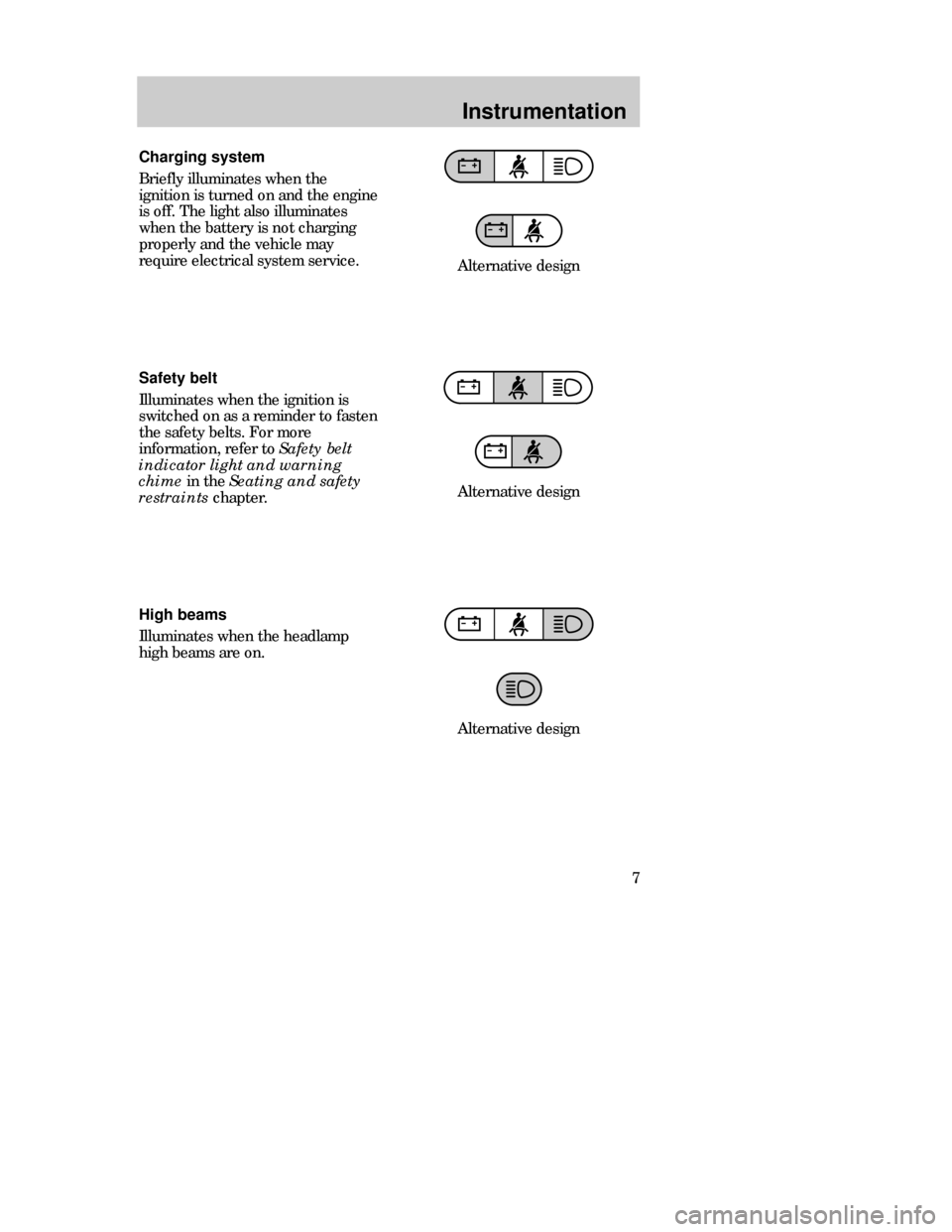
7 High beams
Illuminates when the headlamp
high beams are on. Charging system
Briefly illuminates when the
ignition is turned on and the engine
is off. The light also illuminates
when the battery is not charging
properly and the vehicle may
require electrical system service.
Safety belt
Illuminates when the ignition is
switched on as a reminder to fasten
the safety belts. For more
information, refer to
Safety belt
indicator light and warning
chime in the Seating and safety
restraints chapter.
Alternative design
Alternative design
Alternative design
CDW IIA2Instrum_en C 5/15/97 8:42 PM Page 7
Page 12 of 200
Instrumentation
12
EF 1
/
2
UNLEADED FUEL ONLY
NORMAL
BRAKE
TRACTION
CONTROLO/D
OFF
000123
000010 20 3040506070
80
90
110
120
130
MPH
20 4060
55
80120 100
140
160
180
200100
CHECK
ENGINE
000123
000010 20 3040506070
80
90
110
120
130
MPH
20 4060
55
80120 100
140
160
180
200100
EF 1
/
2
UNLEADED FUEL ONLY
12
03
x 1000
4
5
6
7
8
NORMAL
BRAKE
TRACTION
CONTROLO/D
OFFCHECK
ENGINE
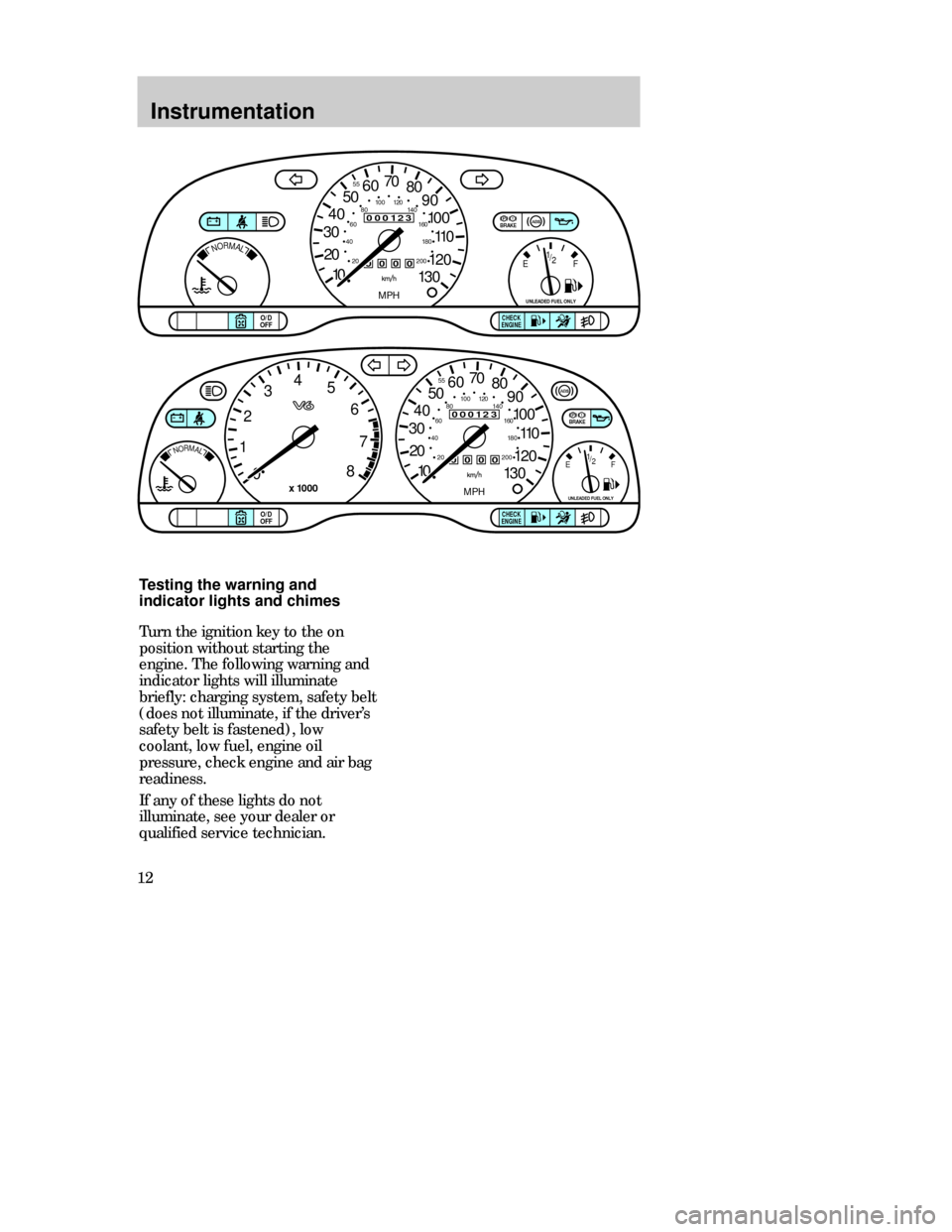
Testing the warning and
indicator lights and chimes
Turn the ignition key to the on
position without starting the
engine. The following warning and
indicator lights will illuminate
briefly: charging system, safety belt
(does not illuminate, if the driver’s
safety belt is fastened), low
coolant, low fuel, engine oil
pressure, check engine and air bag
readiness.
If any of these lights do not
illuminate, see your dealer or
qualified service technician.
CDW IIA2Instrum_en C 5/15/97 8:42 PM Page 12
Page 13 of 200

Instrumentation
13
Headlamps on warning chime
Sounds when the headlamps are
on, the ignition is off (and the key
is not in the ignition) and the
driver’s door is open.
Key-in-ignition warning chime
Sounds when the key is left in the
off/lock or accessory position and
the driver’s door is open.
Air bag supplemental restraint
system (SRS) warning chime
For information on the SRS
warning chime, refer to the
Seating and safety restraints
chapter.
Safety belt warning chime
For information on the safety belt
warning chime, refer to the
Seating and safety restraints
chapter.
CDW IIA2Instrum_en C 5/15/97 8:42 PM Page 13
Page 49 of 200
Seating and safety restraints
49
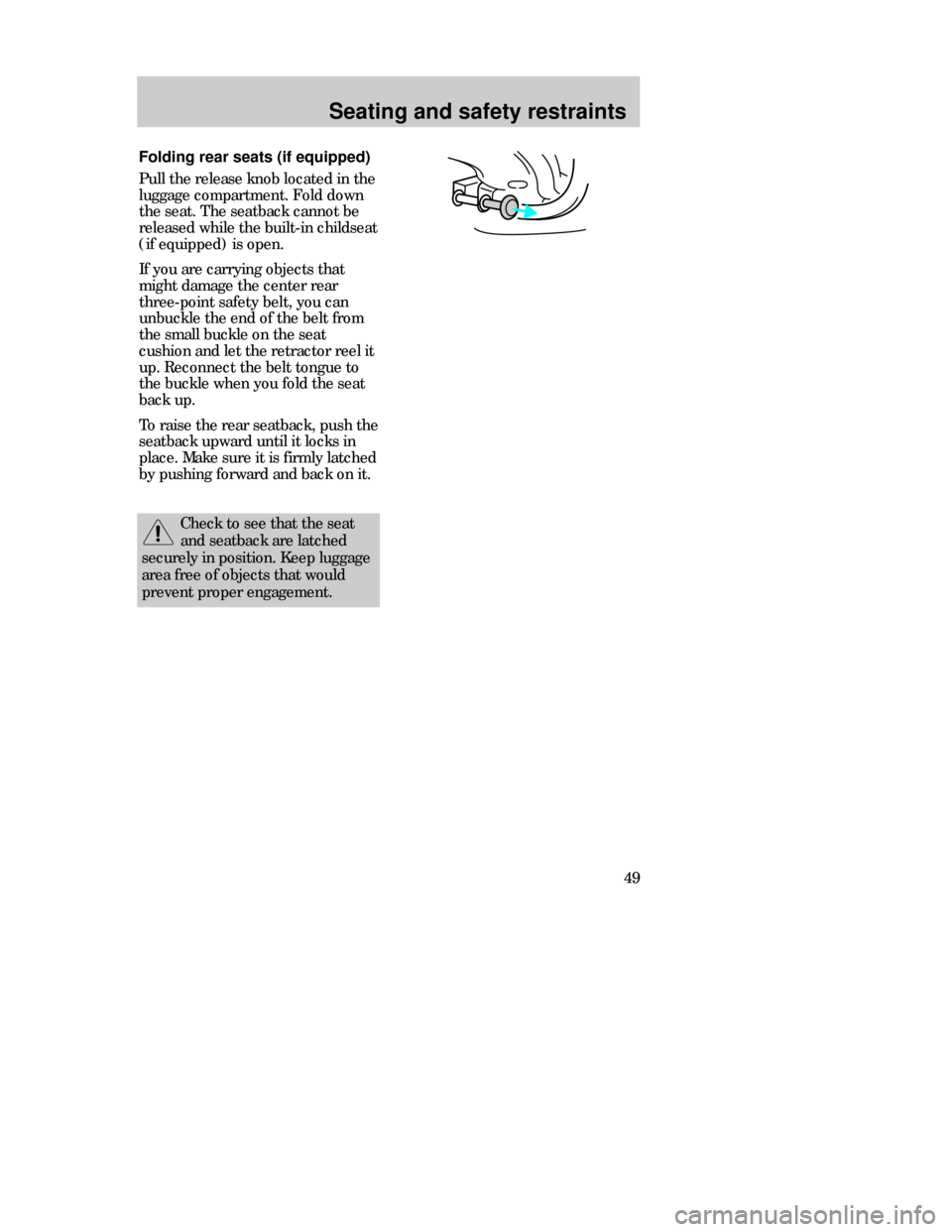
Folding rear seats (if equipped)
Pull the release knob located in the
luggage compartment. Fold down
the seat. The seatback cannot be
released while the built-in childseat
(if equipped) is open.
If you are carrying objects that
might damage the center rear
three-point safety belt, you can
unbuckle the end of the belt from
the small buckle on the seat
cushion and let the retractor reel it
up. Reconnect the belt tongue to
the buckle when you fold the seat
back up.
To raise the rear seatback, push the
seatback upward until it locks in
place. Make sure it is firmly latched
by pushing forward and back on it.
Check to see that the seat
and seatback are latched
securely in position. Keep luggage
area free of objects that would
prevent proper engagement.
CDW IIID Seat en C 5/15/97 8:47 PM Page 49
Page 50 of 200
Seating and safety restraints
50
Important safety restraints
precautions
The use of safety belts helps to
restrain both driver and passenger
in case of a collision. In most states
and Canada, the law requires the
use of safety belts.
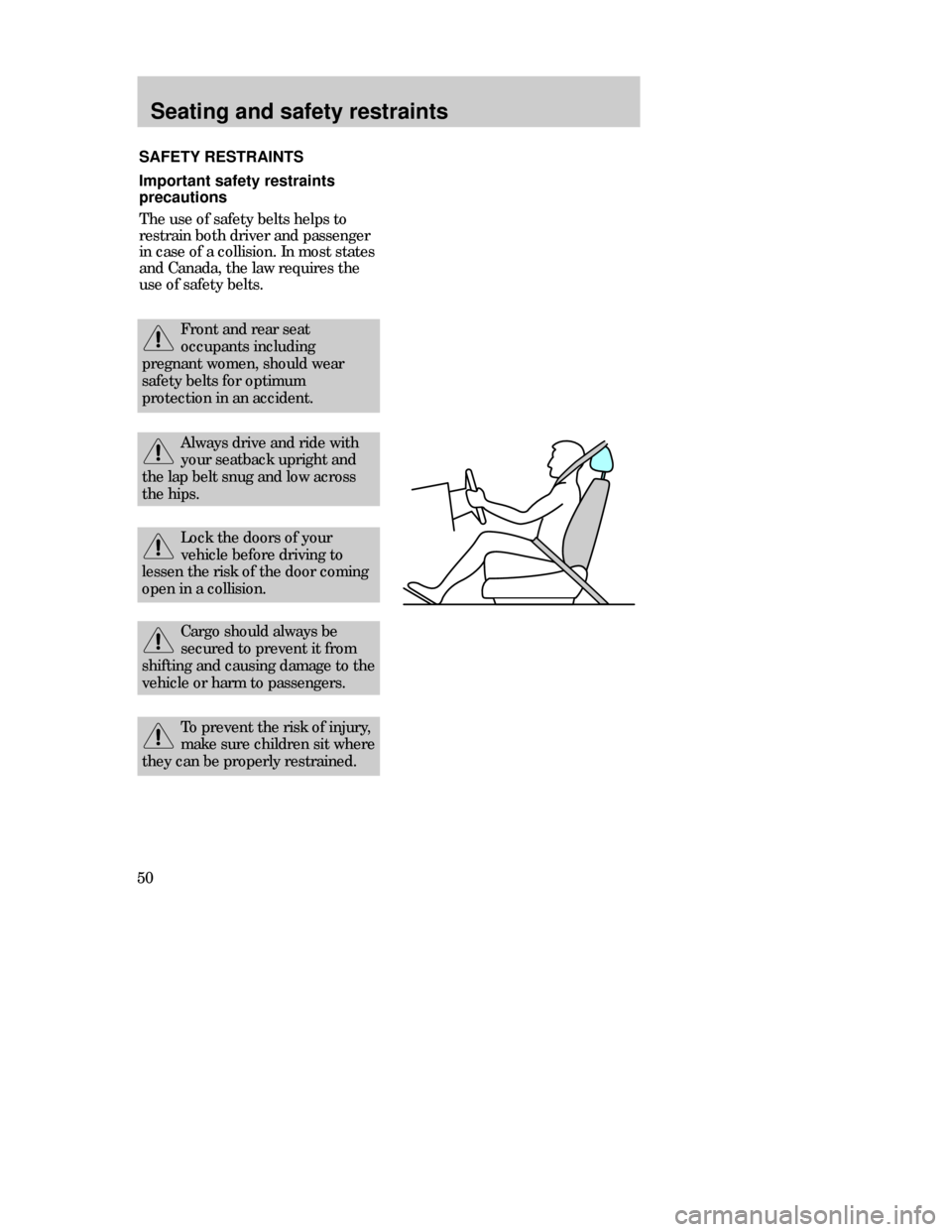
Always drive and ride with
your seatback upright and
the lap belt snug and low across
the hips.
Lock the doors of your
vehicle before driving to
lessen the risk of the door coming
open in a collision.
Cargo should always be
secured to prevent it from
shifting and causing damage to the
vehicle or harm to passengers.
To prevent the risk of injury,
make sure children sit where
they can be properly restrained.
SAFETYRESTRAINTS
Front and rear seat
occupants including
pregnant women, should wear
safety belts for optimum
protection in an accident.
CDW IIID Seat en C 5/15/97 8:48 PM Page 50
Page 51 of 200
Seating and safety restraints
51
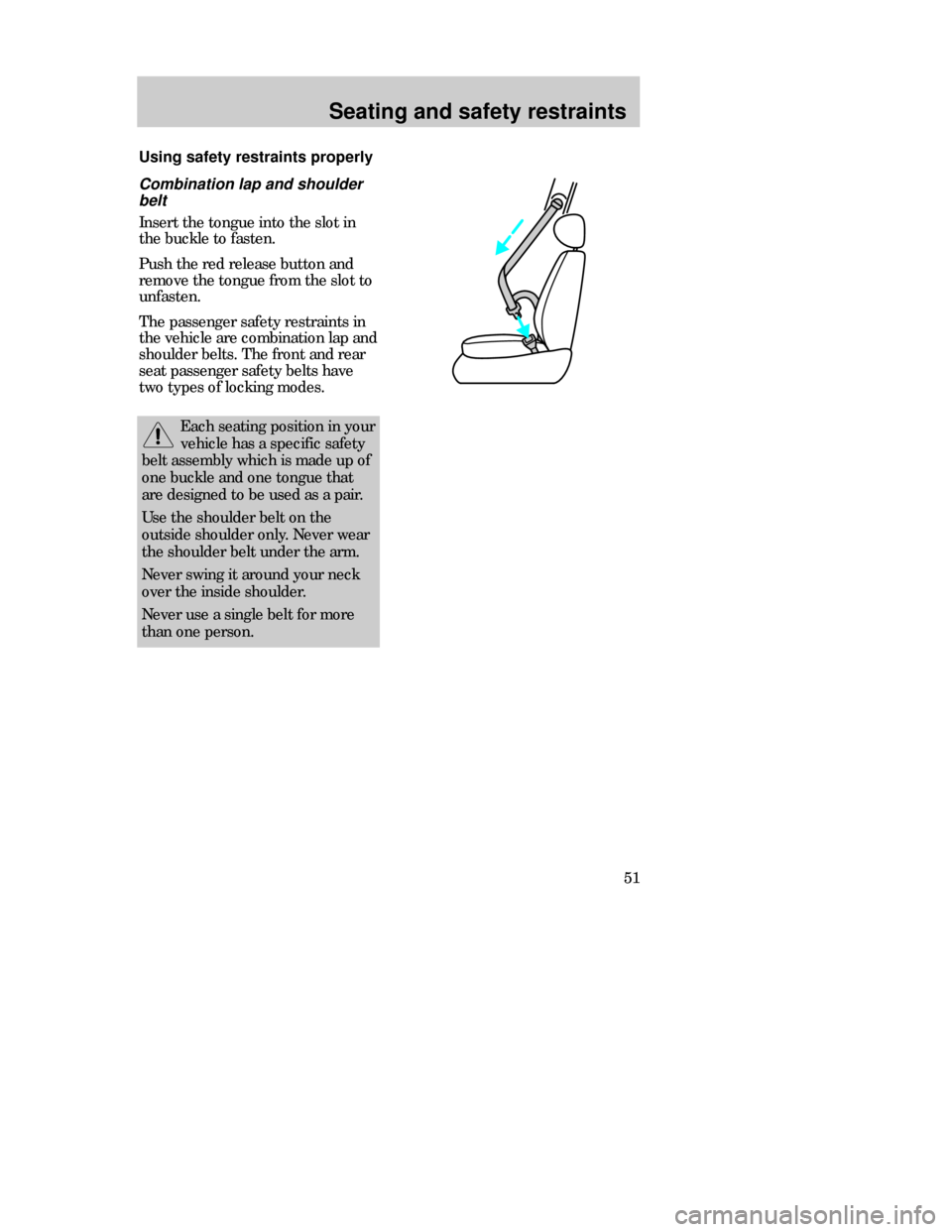
Combination lap and shoulder
belt
Insert the tongue into the slot in
the buckle to fasten.
Push the red release button and
remove the tongue from the slot to
unfasten.
The passenger safety restraints in
the vehicle are combination lap and
shoulder belts. The front and rear
seat passenger safety belts have
two types of locking modes.
Using safety restraints properly
Each seating position in your
vehicle has a specific safety
belt assembly which is made up of
one buckle and one tongue that
are designed to be used as a pair.
Use the shoulder belt on the
outside shoulder only. Never wear
the shoulder belt under the arm.
Never swing it around your neck
over the inside shoulder.
Never use a single belt for more
than one person.
CDW IIID Seat en C 5/15/97 8:48 PM Page 51
Page 52 of 200
Seating and safety restraints
52
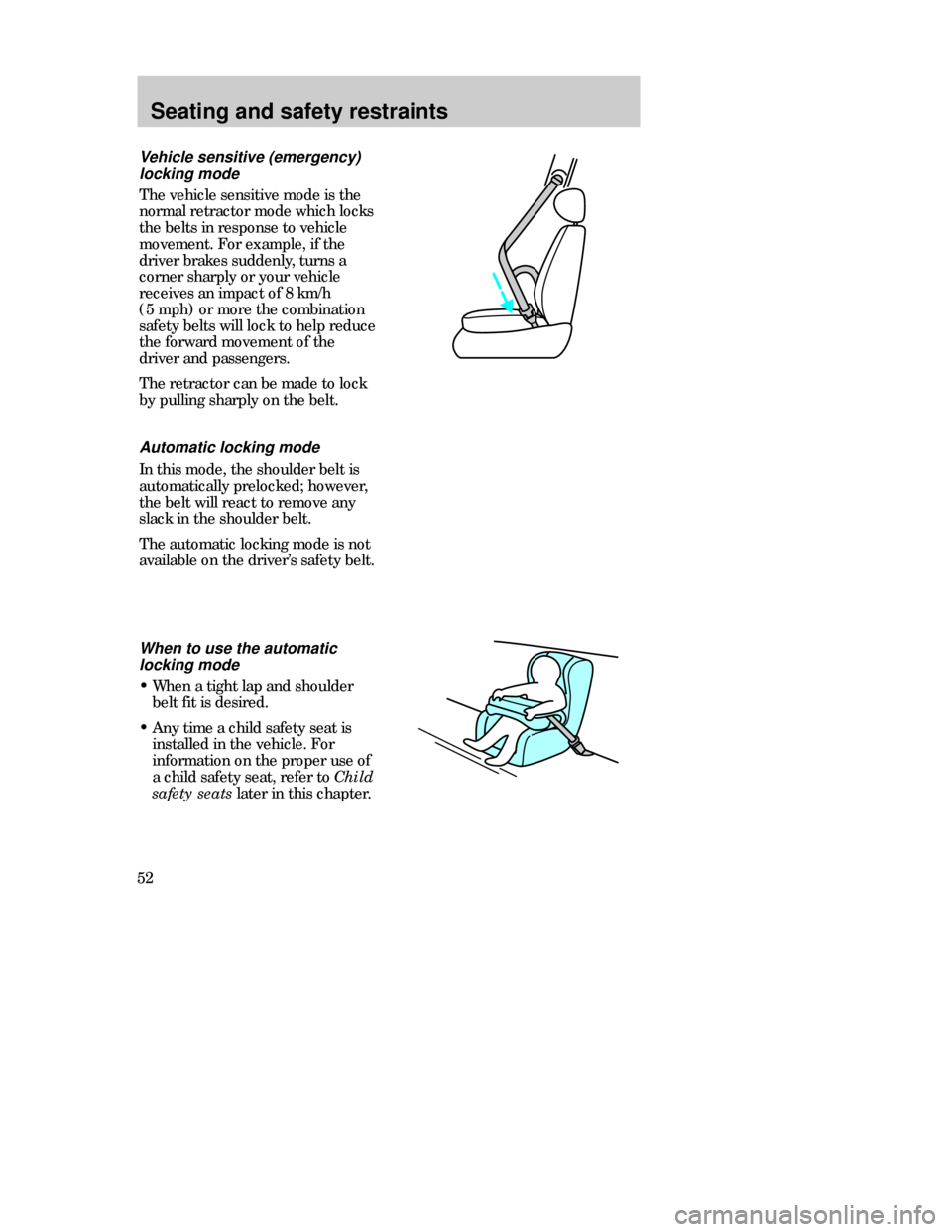
Automatic locking mode
In this mode, the shoulder belt is
automatically prelocked; however,
the belt will react to remove any
slack in the shoulder belt.
The automatic locking mode is not
available on the driver’s safety belt.
When to use the automatic
locking mode
•When a tight lap and shoulder
belt fit is desired.
•Any time a child safety seat is
installed in the vehicle. For
information on the proper use of
a child safety seat, refer to
Child
safety seatslater in this chapter.
Vehicle sensitive (emergency)
locking mode
The vehicle sensitive mode is the
normal retractor mode which locks
the belts in response to vehicle
movement. For example, if the
driver brakes suddenly, turns a
corner sharply or your vehicle
receives an impact of 8 km/h
(5mph) or more the combination
safety belts will lock to help reduce
the forward movement of the
driver and passengers.
The retractor can be made to lock
by pulling sharply on the belt.
CDW IIID Seat en C 5/15/97 8:48 PM Page 52
Page 53 of 200
Seating and safety restraints
53
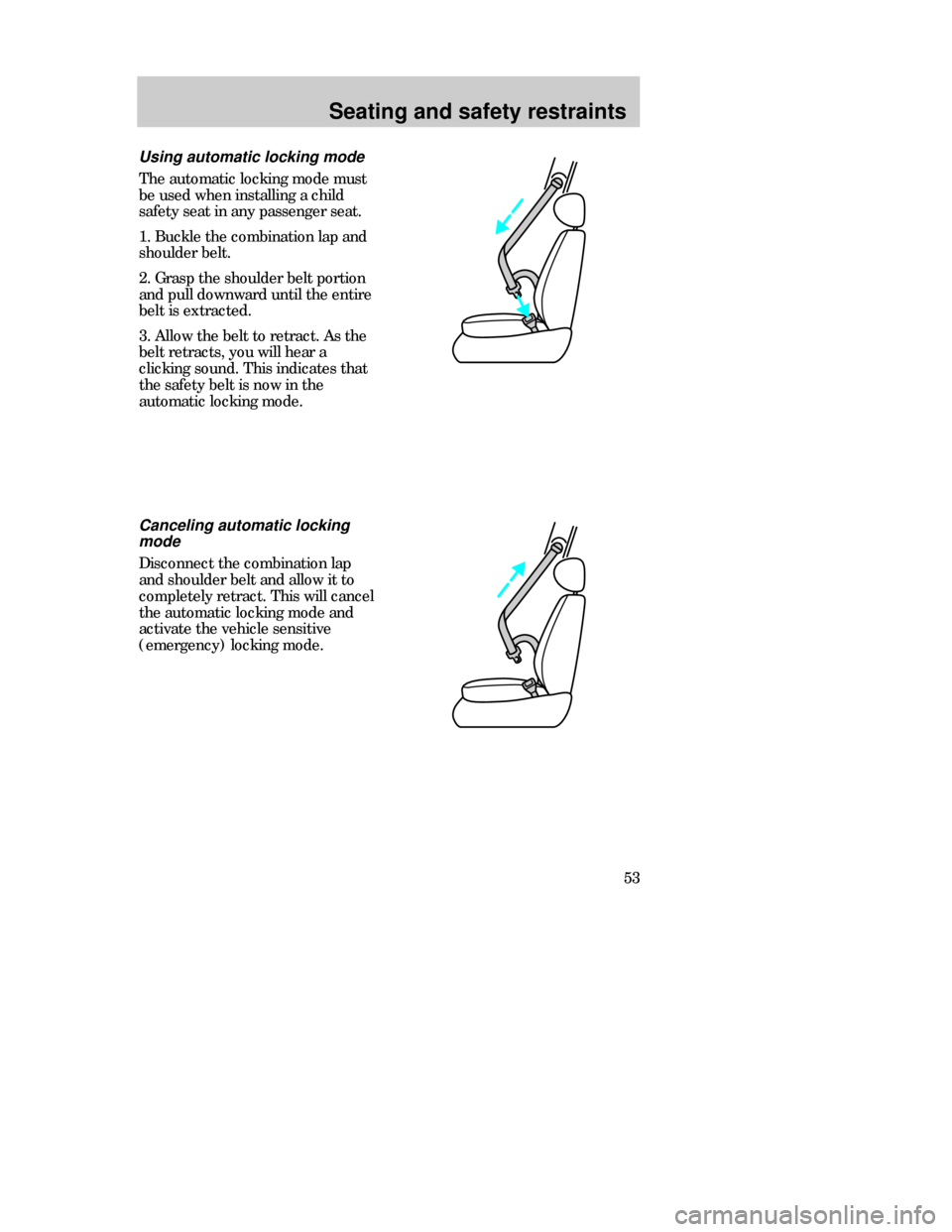
Using automatic locking mode
The automatic locking mode must
be used when installing a child
safety seat in any passenger seat.
1. Buckle the combination lap and
shoulder belt.
2. Grasp the shoulder belt portion
and pull downward until the entire
belt is extracted.
3. Allow the belt to retract. As the
belt retracts, you will hear a
clicking sound. This indicates that
the safety belt is now in the
automatic locking mode.
Canceling automatic locking
mode
Disconnect the combination lap
and shoulder belt and allow it to
completely retract. This will cancel
the automatic locking mode and
activate the vehicle sensitive
(emergency) locking mode.
CDW IIID Seat en C 5/15/97 8:48 PM Page 53
Page 54 of 200
Seating and safety restraints
54
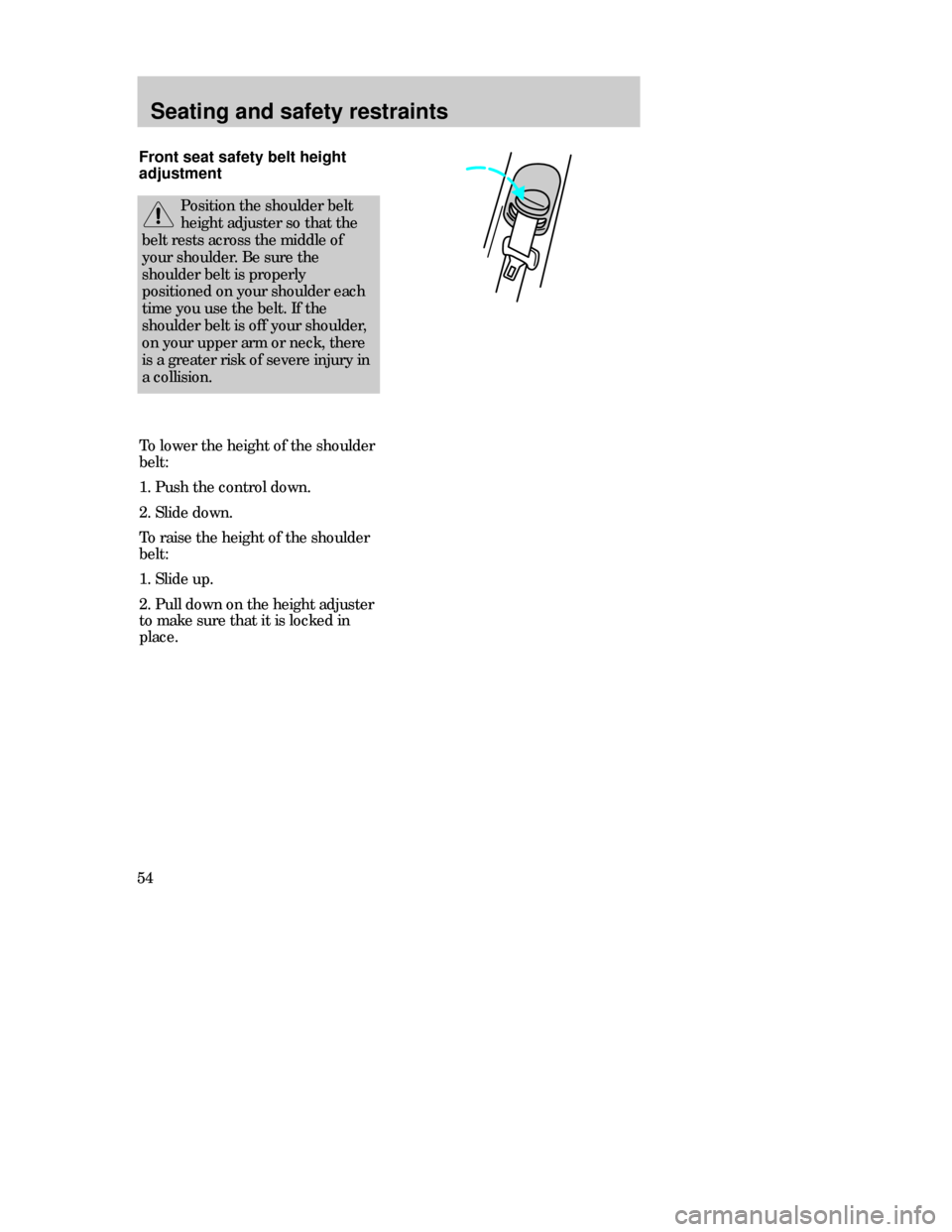
Front seat safety belt height
adjustment
To lower the height of the shoulder
belt:
1. Push the control down.
2. Slide down.
To raise the height of the shoulder
belt:
1. Slide up.
2. Pull down on the height adjuster
to make sure that it is locked in
place.
Position the shoulder belt
height adjuster so that the
belt rests across the middle of
your shoulder. Be sure the
shoulder belt is properly
positioned on your shoulder each
time you use the belt. If the
shoulder belt is off your shoulder,
on your upper arm or neck, there
is a greater risk of severe injury in
a collision.
CDW IIID Seat en C 5/15/97 8:48 PM Page 54
Page 55 of 200
Seating and safety restraints
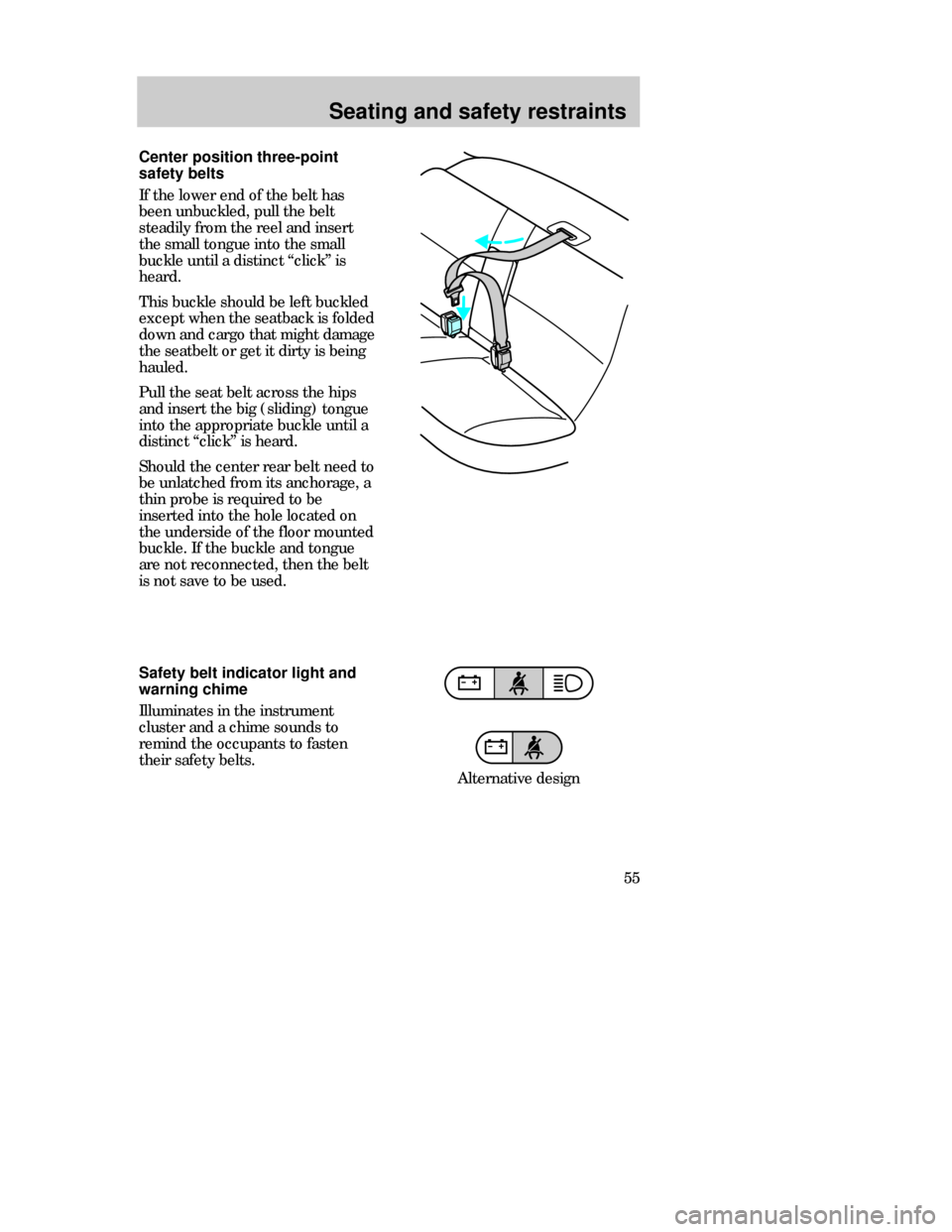
55 Safety belt indicator light and
warning chime
Illuminates in the instrument
cluster and a chime sounds to
remind the occupants to fasten
their safety belts.
Center position three-point
safety belts
If the lower end of the belt has
been unbuckled, pull the belt
steadily from the reel and insert
the small tongue into the small
buckle until a distinct “click” is
heard.
This buckle should be left buckled
except when the seatback is folded
down and cargo that might damage
the seatbelt or get it dirty is being
hauled.
Pull the seat belt across the hips
and insert the big (sliding) tongue
into the appropriate buckle until a
distinct “click” is heard.
Should the center rear belt need to
be unlatched from its anchorage, a
thin probe is required to be
inserted into the hole located on
the underside of the floor mounted
buckle. If the buckle and tongue
are not reconnected, then the belt
is not save to be used.
Alternative design
CDW IIID Seat en C 5/15/97 8:48 PM Page 55