fuel FORD CONTOUR 2000 2.G User Guide
[x] Cancel search | Manufacturer: FORD, Model Year: 2000, Model line: CONTOUR, Model: FORD CONTOUR 2000 2.GPages: 248, PDF Size: 2.23 MB
Page 141 of 248
Roadside emergencies
141
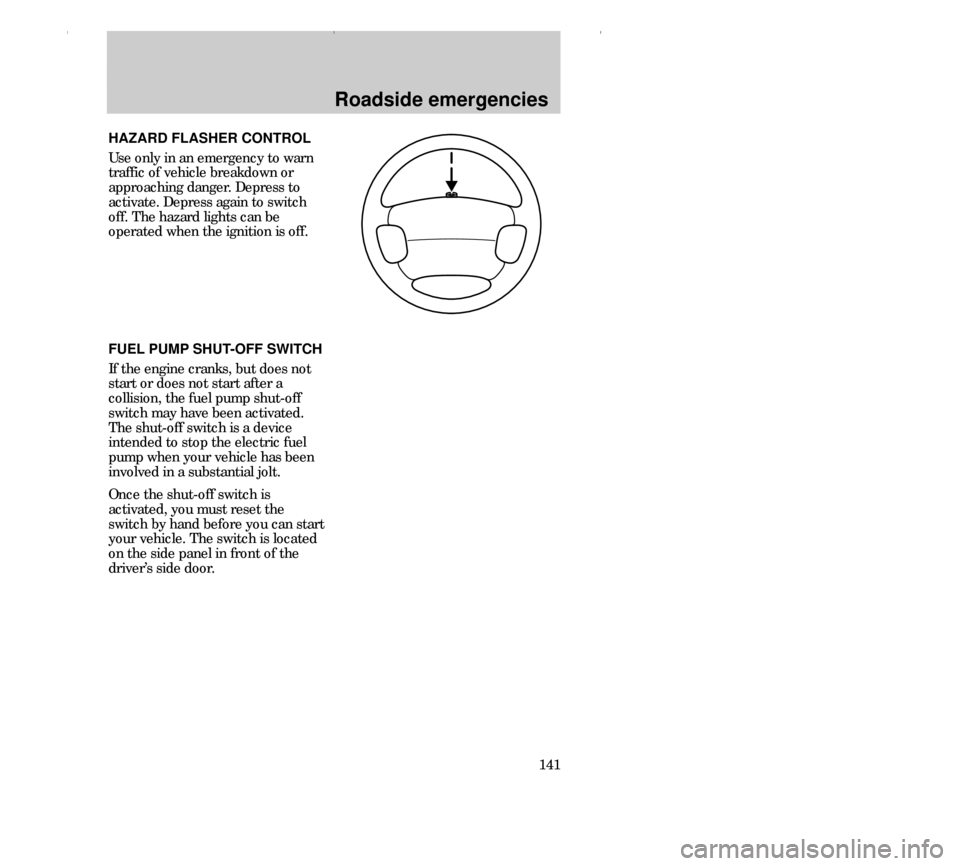
HAZARD FLASHER CONTROL
Use only in an emergency to warn
traffic of vehicle breakdown or
approaching danger. Depress to
activate. Depress again to switch
off. The hazard lights can be
operated when the ignition is off.
FUEL PUMP SHUT-OFF SWITCH
If the engine cranks, but does not
start or does not start after a
collision, the fuel pump shut-off
switch may have been activated.
The shut-off switch is a device
intended to stop the electric fuel
pump when your vehicle has been
involved in a substantial jolt.
Once the shut-off switch is
activated, you must reset the
switch by hand before you can start
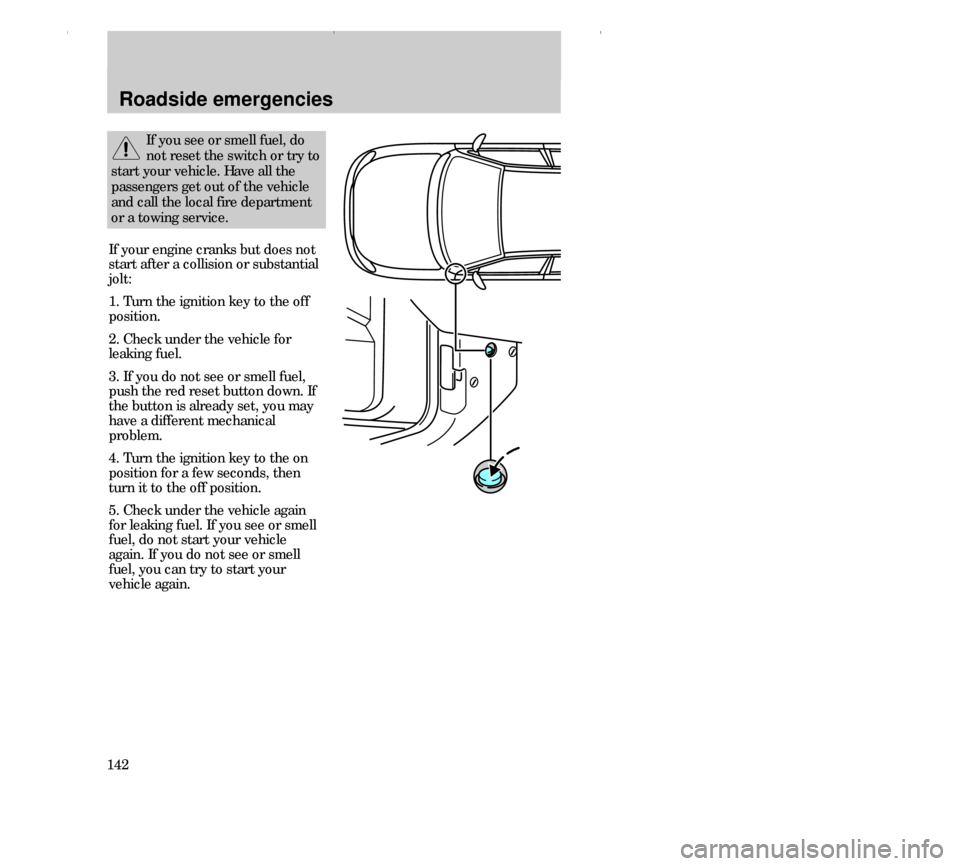
your vehicle. The switch is located
on the side panel in front of the
driver’s side door.
22CDren 17.6.99 11:09 Uhr Seite 141
Page 142 of 248
142
Roadside emergencies
If your engine cranks but does not
start after a collision or substantial
jolt:
1. Turn the ignition key to the off
position.
2. Check under the vehicle for
leaking fuel.
3. If you do not see or smell fuel,
push the red reset button down. If
the button is already set, you may
have a different mechanical
problem.
4. Turn the ignition key to the on
position for a few seconds, then
turn it to the off position.
5. Check under the vehicle again
for leaking fuel. If you see or smell
fuel, do not start your vehicle
again. If you do not see or smell
fuel, you can try to start your
vehicle again.
If you see or smell fuel, do
not reset the switch or try to
start your vehicle. Have all the
passengers get out of the vehicle
and call the local fire department
or a towing service.
23CREen 17.6.99 11:11 Uhr Seite 142
Page 145 of 248
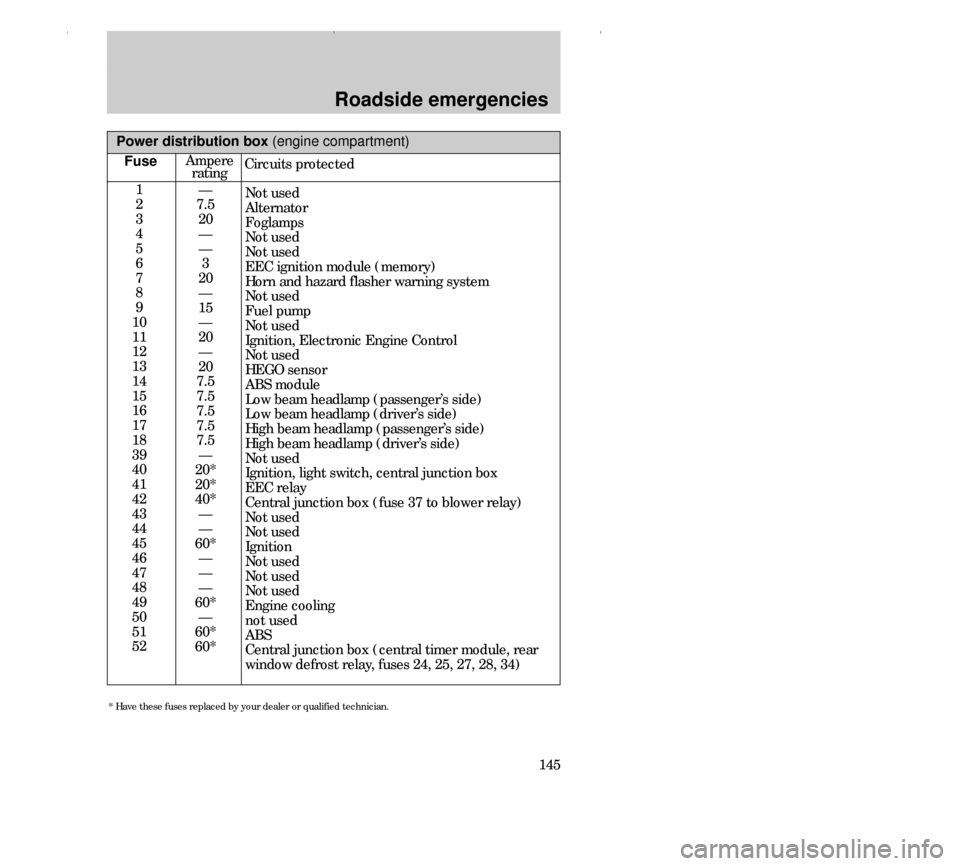
Roadside emergencies
145 Ampere
ratingCircuits protected
1
2
3
4
5
6
7
8
9
10
11
12
13
14
15
16
17
18
39
40
41
42
43
44
45
46
47
48
49
50
51
52—
7.5
20
—
—
3
20
—
15
—
20
—
20
7.5
7.5
7.5
7.5
7.5
—
20*
20*
40*
—
—
60*
—
—
—
60*
—
60*
60*Not used
Alternator
Foglamps
Not used
Not used
EEC ignition module (memory)
Horn and hazard flasher warning system
Not used
Fuel pump
Not used
Ignition, Electronic Engine Control
Not used
HEGO sensor
ABS module
Low beam headlamp (passenger’s side)
Low beam headlamp (driver’s side)
High beam headlamp (passenger’s side)
High beam headlamp (driver’s side)
Not used
Ignition, light switch, central junction box
EEC relay
Central junction box (fuse 37 to blower relay)
Not used
Not used
Ignition
Not used
Not used
Not used
Engine cooling
not used
ABS
Central junction box (central timer module, rear
window defrost relay, fuses 24, 25, 27, 28, 34) Fuse
Power distribution box (engine compartment)
* Have these fuses replaced by your dealer or qualified technician.
23CREen 17.6.99 11:11 Uhr Seite 145
Page 146 of 248
Roadside emergencies
146
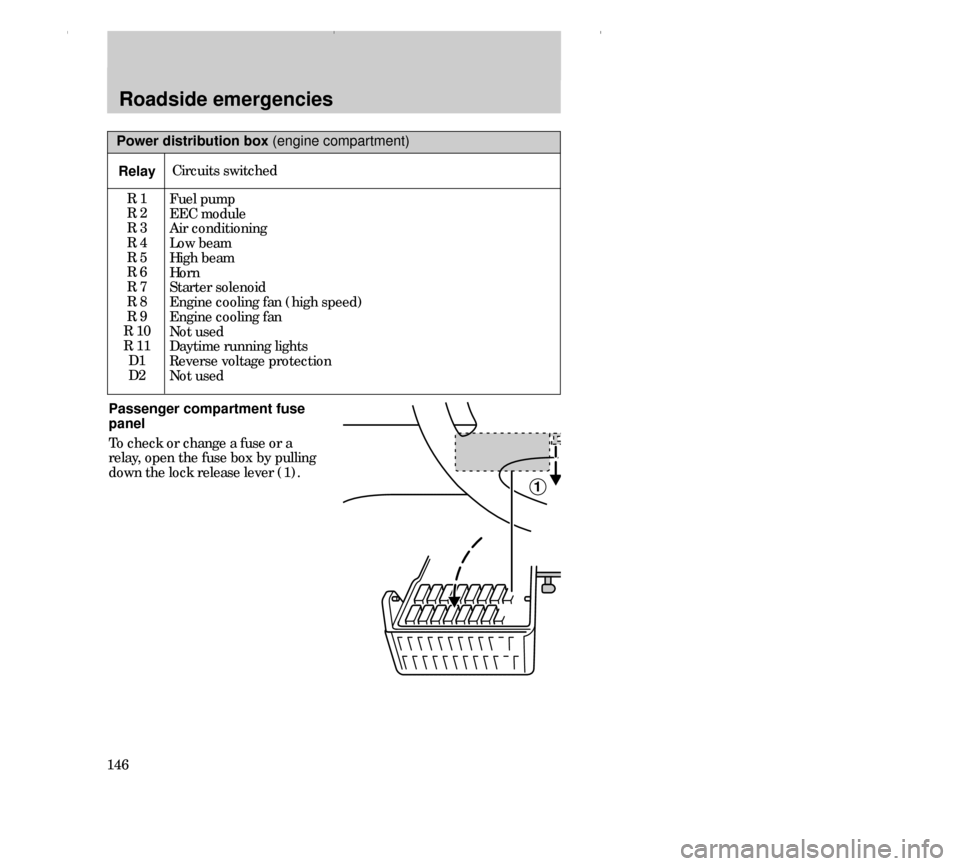
Power distribution box (engine compartment)
RelayCircuits switched
R 1
R 2
R 3
R 4
R 5
R 6
R 7
R 8
R 9
R 10
R 11
D1
D2
Passenger compartment fuse
panel
To check or change a fuse or a
relay, open the fuse box by pulling
down the lock release lever (1).
1
Fuel pump
EEC module
Air conditioning
Low beam
High beam
Horn
Starter solenoid
Engine cooling fan (high speed)
Engine cooling fan
Not used
Daytime running lights
Reverse voltage protection
Not used
23CREen 17.6.99 11:11 Uhr Seite 146
Page 156 of 248
Roadside emergencies
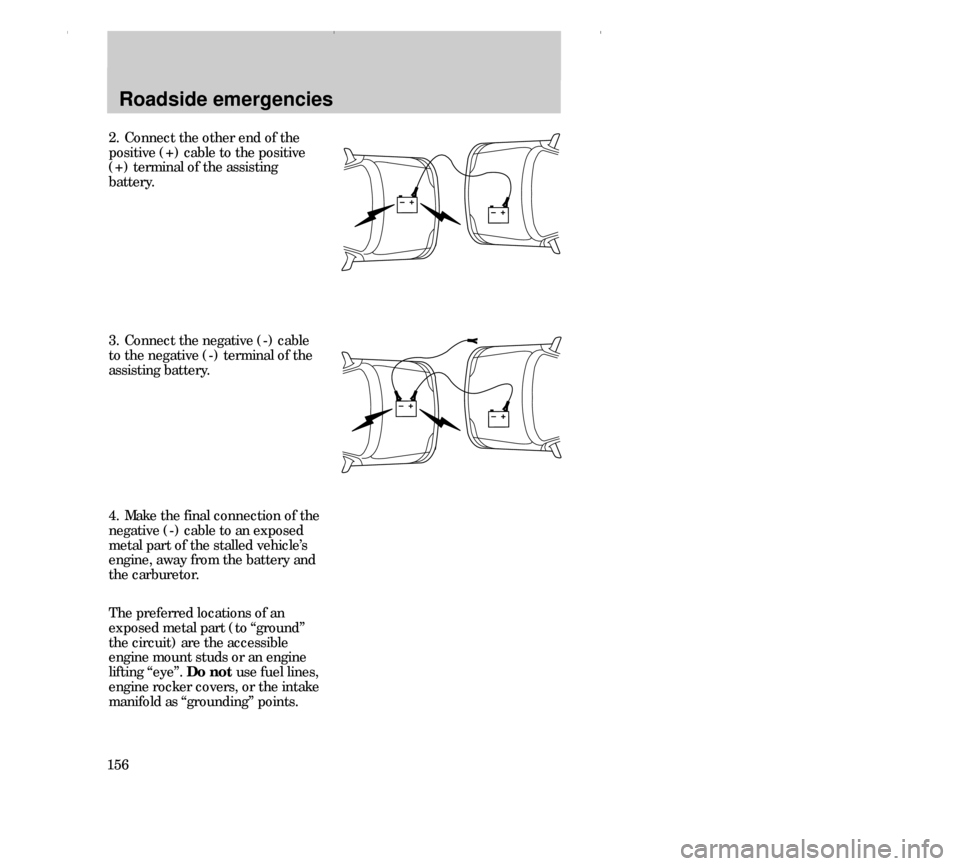
1562. Connect the other end of the
positive (+) cable to the positive
(+) terminal of the assisting
battery.
3. Connect the negative (-) cable
to the negative (-) terminal of the
assisting battery.
4. Make the final connection of the
negative (-) cable to an exposed
metal part of the stalled vehicle’s
engine, away from the battery and
the carburetor.
The preferred locations of an
exposed metal part (to “ground”
the circuit) are the accessible
engine mount studs or an engine
lifting “eye”. Do notuse fuel lines,
engine rocker covers, or the intake
manifold as “grounding” points.
23CREen 17.6.99 11:11 Uhr Seite 156
Page 162 of 248
Maintenance and care
162SERVICE RECOMMENDATIONS
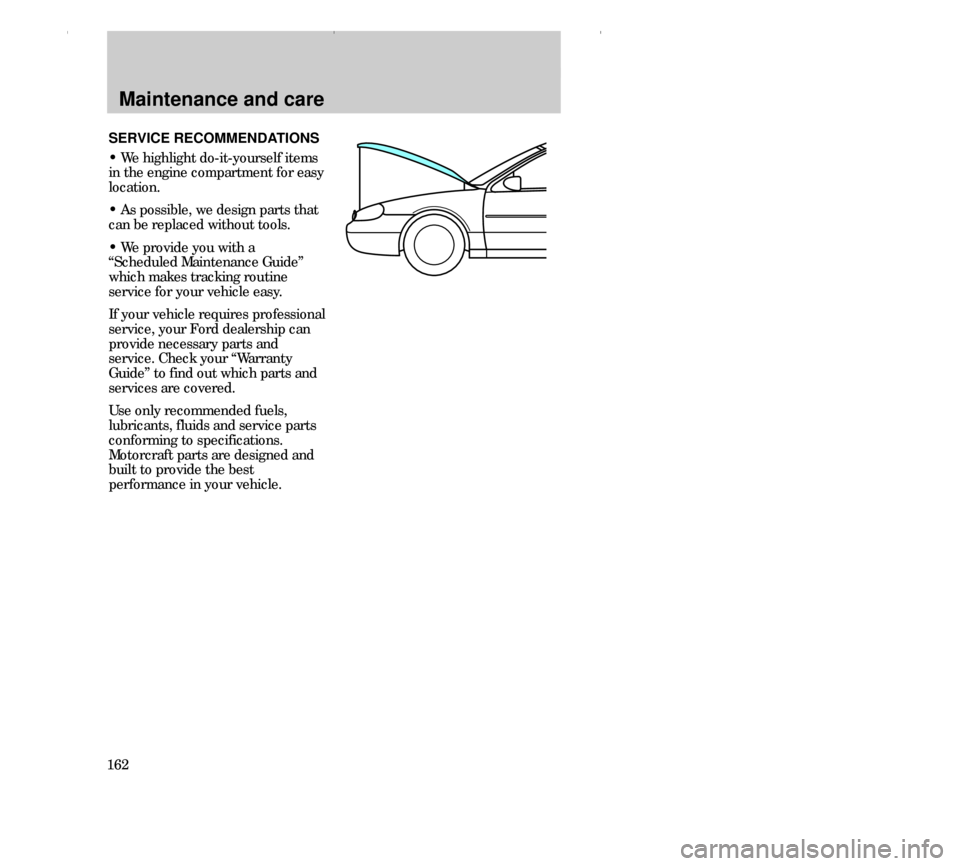
• We highlight do-it-yourself items
in the engine compartment for easy
location.
• As possible, we design parts that
can be replaced without tools.
• We provide you with a
“Scheduled Maintenance Guide”
which makes tracking routine
service for your vehicle easy.
If your vehicle requires professional
service, your Ford dealership can
provide necessary parts and
service. Check your “Warranty
Guide” to find out which parts and
services are covered.
Use only recommended fuels,
lubricants, fluids and service parts
conforming to specifications.
Motorcraft parts are designed and
built to provide the best
performance in your vehicle.
31CMCen 17.6.99 11:15 Uhr Seite 162
Page 163 of 248
Maintenance and care
163 Precautions when servicing
your vehicle
Be especially careful when
inspecting or servicing your
vehicle. Here are some general
precautions for your safety:
• Do not work on a hot engine.
The cooling fan is automatic
and may come on at any
time. Always disconnect the
negative terminal of the battery
before working near the fan.
• If you must work with the engine
running, avoid wearing loose
clothing or jewelry that could get
caught in moving parts. Take
precautions with long hair.
• Do not work on a vehicle with the
engine running in an enclosed
space, unless you are sure you have
enough ventilation.
• Keep all lit cigarettes, open
flames and other lit material away
from the battery and all fuel related
parts.
If you disconnect the battery, the
engine must “relearn” its idle
conditions before your vehicle will
drive properly, as explained under
Battery in this chapter.
31CMCen 17.6.99 11:15 Uhr Seite 163
Page 169 of 248
Maintenance and care
169
ADDFULL
Engine oil
Use SAE 5W-30 motor oil
CERTIFIED FOR GASOLINE
ENGINES by the American
Petroleum Institute.
Do not use supplemental engine oil
additives, oil treatments or engine
treatments. They are unnecessary
and could, under certain
conditions, lead to engine damage
which is not covered by Ford
Warranty.
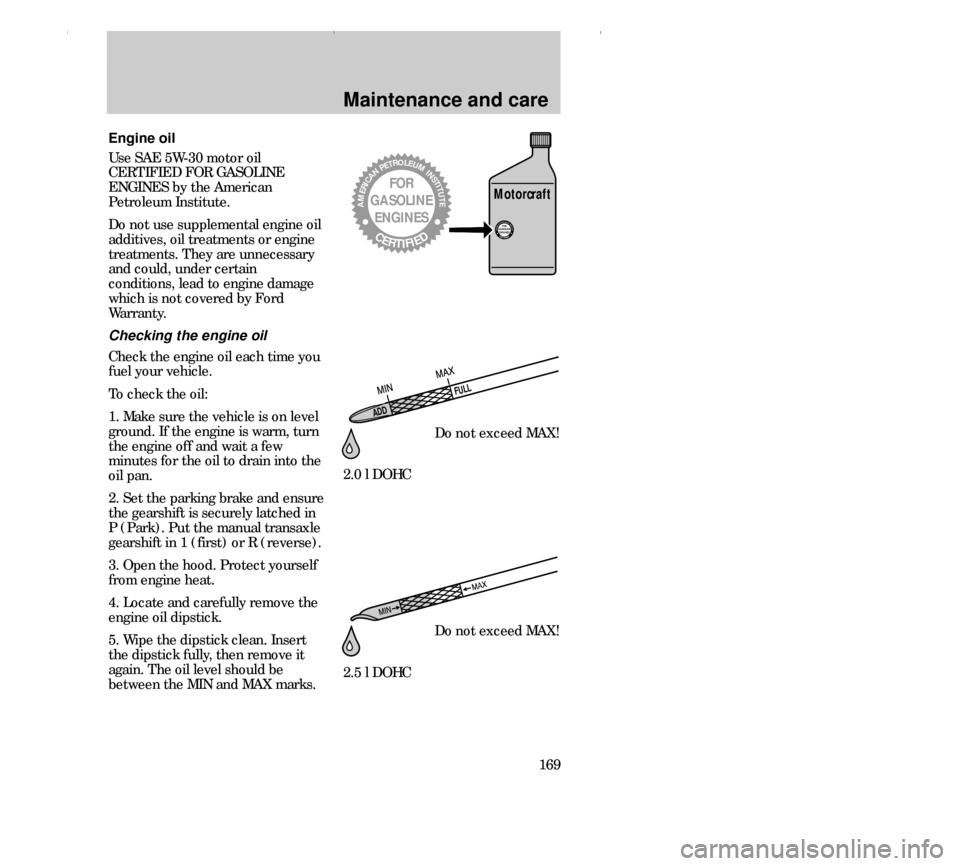
Checking the engine oil
Check the engine oil each time you
fuel your vehicle.
To check the oil:
1. Make sure the vehicle is on level
ground. If the engine is warm, turn
the engine off and wait a few
minutes for the oil to drain into the
oil pan.
2. Set the parking brake and ensure
the gearshift is securely latched in
P (Park). Put the manual transaxle
gearshift in 1 (first) or R (reverse).
3. Open the hood. Protect yourself
from engine heat.
4. Locate and carefully remove the
engine oil dipstick.
5. Wipe the dipstick clean. Insert
the dipstick fully, then remove it
again. The oil level should be
between the MIN and MAX marks. 2.0 l DOHC
2.5 l DOHC
AMERICANPETROLEUMINSTITUTE
CERTIFIED
FOR
GASOLINE
ENGINES
AMERICANPETROLEUMINSTITUTECERTIFIEDFOR
GASOLINE
ENGINES
Motorcraft
Do not exceed MAX!
Do not exceed MAX!
31CMCen 17.6.99 11:15 Uhr Seite 169
Page 186 of 248
Maintenance and care
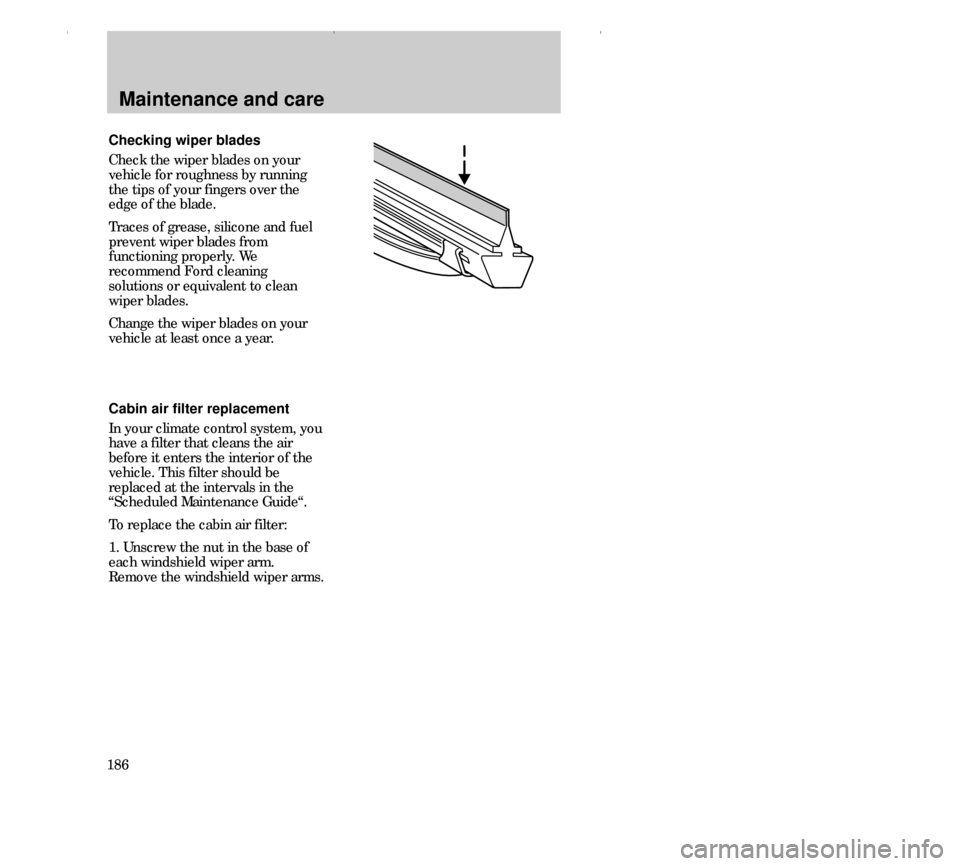
186Checking wiper blades
Check the wiper blades on your
vehicle for roughness by running
the tips of your fingers over the
edge of the blade.
Traces of grease, silicone and fuel
prevent wiper blades from
functioning properly. We
recommend Ford cleaning
solutions or equivalent to clean
wiper blades.
Change the wiper blades on your
vehicle at least once a year.
Cabin air filter replacement
In your climate control system, you
have a filter that cleans the air
before it enters the interior of the
vehicle. This filter should be
replaced at the intervals in the
“Scheduled Maintenance Guide“.
To replace the cabin air filter:
1. Unscrew the nut in the base of
each windshield wiper arm.
Remove the windshield wiper arms.
31CMCen 17.6.99 11:15 Uhr Seite 186
Page 194 of 248
Maintenance and care
194The tires on your vehicle have all-
weather treads to provide traction
in rain and snow. However, in some
climates, using snow tires and
chains may be necessary. Ford
offers snow chains as a Ford
approved accessory and
recommends use of these or their
equivalents on approved tires. See
your dealer or a qualified service
technician for more information on
tire chains for your vehicle. Follow
these guidelines when using snow
tires and chains:
• Install chains securely, verifying
that the chains do not touch any
wiring, brake lines or fuel lines.
• Install the chains on the front
tires only.
• Do not use tire chains on 205/60
tires and 205/55R16 Z rated tires.
Steering, suspension and body
components may be damaged by
use of chains.
Snow tires must be the same
size and grade as the tires
you currently have on your
vehicle.
Using snow tires and chains
31CMCen 17.6.99 11:15 Uhr Seite 194