fuel FORD CONTOUR 2000 2.G Owner's Manual
[x] Cancel search | Manufacturer: FORD, Model Year: 2000, Model line: CONTOUR, Model: FORD CONTOUR 2000 2.GPages: 248, PDF Size: 2.23 MB
Page 195 of 248
Maintenance and care
195 Change over from winter to
summer tires as soon as road
conditions allow, this will reduce
fuel consumption and noise in the
vehicle’s interior.
• Drive cautiously. If you hear the
chains rub or bang against the
vehicle, stop and retighten them. If
this does not work, remove the
chains to prevent vehicle damage.
• Local regulations may prohibit or
restrict the use of tire chains.
Investigate the laws and
regulations in your area before
installing chains.
• Avoid overloading your vehicle.
• Do not use tire chains on
temporary spare tires.
• Remove the tire chains when
they are no longer needed. Do not
use chains on dry roads.
• The suspension insulation and
bumpers will help prevent vehicle
damage. Do not remove these
components from the vehicle when
using snow tires and chains.
31CMCen 17.6.99 11:15 Uhr Seite 195
Page 196 of 248
Maintenance and care
196
Automotive fuels can cause
serious injury or death if
misused or mishandled.
IMPORTANT FUEL
INFORMATON
Important safety precautions
Do not overfill the fuel tank.
The pressure in an overfilled
tank may cause leakage and lead
to fuel spray and fire.
If you do not use the proper
fuel cap, the pressure in the
fuel tank can damage the fuel
system or cause it to work
improperly in a collision.
The fuel system may be
under pressure. If the fuel
cap is venting vapor or if you hear
a hissing sound, wait until it stops
before completely removing the
cap.
31CMCen 17.6.99 11:15 Uhr Seite 196
Page 197 of 248
Maintenance and care
197 Observe the following guidelines
when handling automotive fuel:
• Extinguish all smoking materials
and any open flames before fueling
your vehicle.
• Always turn off the vehicle before
fueling.
• Make sure the fuel cap is
correctly fitted after fueling. Failure
to do so may cause the on board
diagnostic system to illuminate the
check enginelight.
• Automotive fuels can be harmful
or fatal if swallowed. If fuel is
swallowed, call a physician
immediately, even if no symptoms
are immediately apparent. The
toxic effects of fuel may not be
visible for hours.
• Fuels can also be harmful if
absorbed through the skin. If fuel is
splashed on the skin, promptly
remove contaminated clothing and
wash skin thoroughly with soap and
water.
• If fuel is splashed in the eyes,
remove contact lenses (if worn),
flush with water for 15 minutes and
seek medical attention.
• Be particularly careful if you are
taking “Antabuse” or other forms of
disulfiram for the treatment of
alcoholism. Breathing gasoline
vapors or skin contact could cause
an adverse reaction. Consult a
physician immediately.
31CMCen 17.6.99 11:15 Uhr Seite 197
Page 198 of 248
Maintenance and care
198Choosing the right fuel
Use only UNLEADED FUEL. The
use of leaded fuel is prohibited by
law and could damage your vehicle.
The damage may not be covered by
your warranty.
Your vehicle was not designed to
use fuel containing manganese-
based additives such as MMT.
Additionally, vehicles certified to
California emission standards
(indicated on the underhood
Vehicle Emission Control
Information label) are designed to
operate on California reformulated
gasolines. If California reformulated
gasoline is not available when you
refuel, your vehicle can be
operated on non-California fuels.
However, even though your engine
will perform adequately on other
gasolines, the performance of the
emission control devices and
systems may be adversely affected.
Repair of damage caused by a fuel
that your vehicle was not designed
for may not be covered by your
warranty.
31CMCen 17.6.99 11:15 Uhr Seite 198
Page 199 of 248
Maintenance and care
199 Octane recommendations
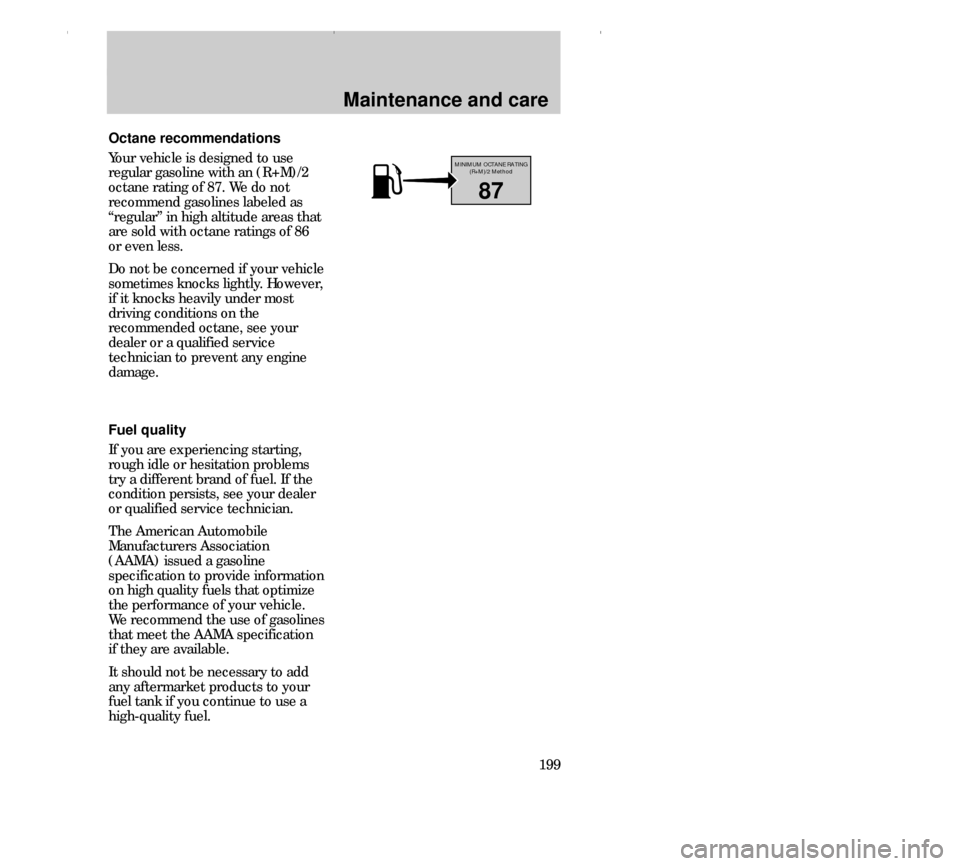
Your vehicle is designed to use
regular gasoline with an (R+M)/2
octane rating of 87. We do not
recommend gasolines labeled as
“regular” in high altitude areas that
are sold with octane ratings of 86
or even less.
Do not be concerned if your vehicle
sometimes knocks lightly. However,
if it knocks heavily under most
driving conditions on the
recommended octane, see your
dealer or a qualified service
technician to prevent any engine
damage.
87
MINIMUM OCTANE RATING
(R+M)/2 Method
Fuel quality
If you are experiencing starting,
rough idle or hesitation problems
try a different brand of fuel. If the
condition persists, see your dealer
or qualified service technician.
The American Automobile
Manufacturers Association
(AAMA) issued a gasoline
specification to provide information
on high quality fuels that optimize
the performance of your vehicle.
We recommend the use of gasolines
that meet the AAMA specification
if they are available.
It should not be necessary to add
any aftermarket products to your
fuel tank if you continue to use a
high-quality fuel.
31CMCen 17.6.99 11:15 Uhr Seite 199
Page 200 of 248
Maintenance and care
200
The fuel system may be
under pressure. If the fuel
filler cap is venting vapor or if you
hear a hissing sound, wait until it
stops before completely removing
the fuel filler cap. Otherwise fuel
may spray out and injure you or
others.
Fuel filler cap
If the check engineindicator
comes on and stays on when you
start the engine, the fuel filler cap
may not be properly installed. Turn
off the engine, remove the fuel
filler cap and reinstall it being
careful to align the cap properly.
If you must replace the fuel
filler cap, replace it with an
authorized Motorcraft part.
The customer warranty may be
void for any damage to the fuel
tank or fuel system if an
authorized Motorcraft fuel
filler cap is not used. Cleaner air
Ford approves the use of gasolines
to improve air quality, including
reformulated gasolines that contain
oxygenates such as a maximum of
10% ethanol or 15% MTBE. There
should be no more than 5%
methanol with cosolvents and
additives to protect the fuel
system.
31CMCen 17.6.99 11:15 Uhr Seite 200
Page 201 of 248
Maintenance and care
201 Calculating fuel economy
To accurately calculate your
vehicle’s fuel economy:
1. Fill the tank completely and
record the initial odometer reading.
2. Each time you fill the tank,
record the amount of fuel added
(in litres or gallons).
3. After at least three to five fill-
ups, fill the fuel tank and record
the current mileage reading.
4. Use one of the following
equations to calculate fuel
economy.
Litres used x 100 / Total kilometres
traveled.
Total miles traveled / Total gallons
used.
Keep a record for at least one
month. This will provide an
accurate estimate of the vehicle’s
fuel economy.
31CMCen 17.6.99 11:15 Uhr Seite 201
Page 202 of 248
Maintenance and care
202EMISSION CONTROL SYSTEM
Your vehicle is equipped with
various emission control
components and a catalytic
converter which will enable your
vehicle to comply with applicable
exhaust emission standards. To
make sure that the catalytic
converter and other emission
control components continue to
work properly:
• Use unleaded fuel only.
• Avoid running out of fuel.
• Do not turn off the ignition while
your vehicle is moving, especially
at high speeds.
• Have the items listed in your
“Scheduled Maintenance Guide”
performed according to the
specified schedule.
The scheduled maintenance
services listed in the “Scheduled
Maintenance Guide“ are required
because they are considered
essential to the life and
performance of your vehicle and to
its emissions system.
If other than Ford, Motorcraft, or
Ford authorized parts are used for
maintenance replacements or for
service of components affecting
emissions control, such non-Ford
parts should be equivalent to
genuine Ford Motor Company parts
in performance and durability.
31CMCen 17.6.99 11:15 Uhr Seite 202
Page 218 of 248
Maintenance and care
218Repairing paint chips
Minor scratches or paint damage
from road debris may be repaired
with the Ultra Touch Prep and
Finishing Kit (# F7AZ-19K507-BA).
Lacquer Touch-up Paint (# ALBZ-
19500-XXXXA) or Exterior Acrylic
Spray Lacquer (# ALAZ-19500-
XXXXA) from the Ford Car Care
Chemicals line. Please not that the
part numbers (shown as XXXX
above) will vary with your vehicle’s
specific coloring. Observe the
application instructions on the
products.
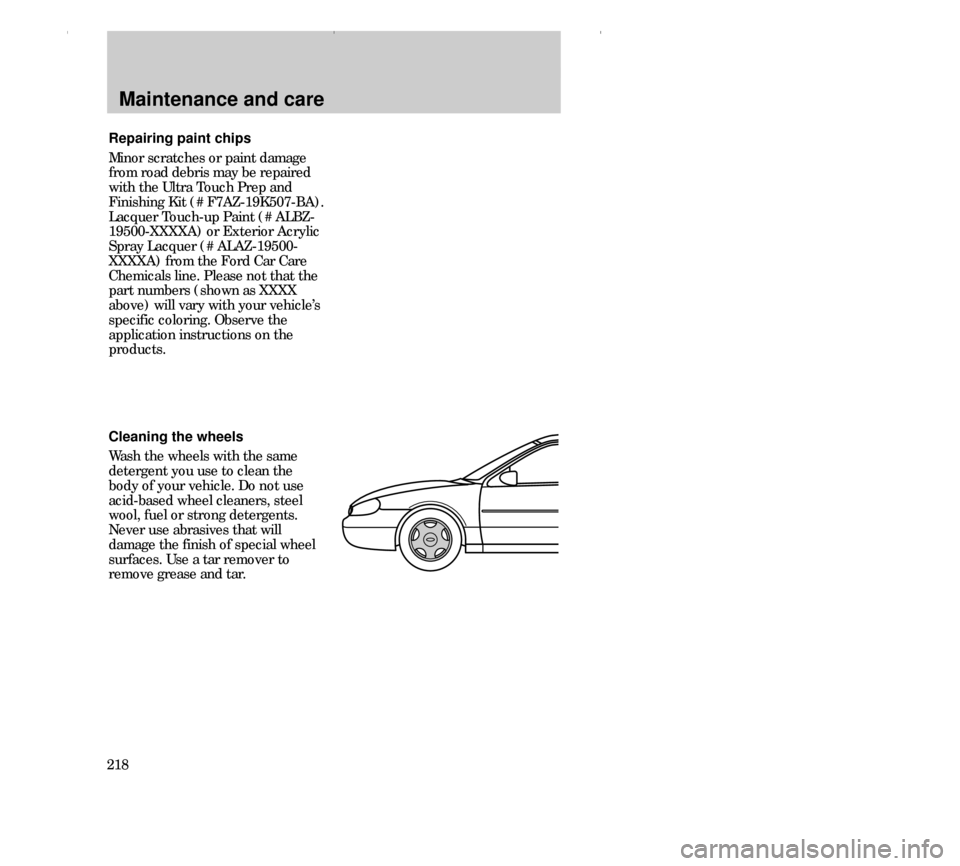
Cleaning the wheels
Wash the wheels with the same
detergent you use to clean the
body of your vehicle. Do not use
acid-based wheel cleaners, steel
wool, fuel or strong detergents.
Never use abrasives that will
damage the finish of special wheel
surfaces. Use a tar remover to
remove grease and tar.
31CMCen 17.6.99 11:16 Uhr Seite 218
Page 220 of 248
Maintenance and care
220Cleaning plastic exterior parts
Use a vinyl cleaner for routine
cleaning of plastic. Clean with a tar
remover if necessary. Do not clean
plastic parts with thinners, solvents
or petroleum-based cleaners.
Cleaning the exterior lamps
Wash the exterior lamps with the
same detergent you use to wash
the exterior of your vehicle. Use
glass cleaner or tar remover if
necessary.
To avoid scratching the lamps, do
not use a dry paper towel, chemical
solvents or abrasive cleaners to
clean the lamps.
Cleaning the wiper blades
If the wiper blades do not wipe
properly, clean both the windshield
and wiper blades using undiluted
windshield wiper solution or a mild
detergent. Rinse thoroughly with
clean water. To avoid damaging the
blades, do not use fuel, kerosene,
paint thinner or other solvents.
31CMCen 17.6.99 11:16 Uhr Seite 220