brake FORD CONTOUR 2000 2.G Owner's Manual
[x] Cancel search | Manufacturer: FORD, Model Year: 2000, Model line: CONTOUR, Model: FORD CONTOUR 2000 2.GPages: 248, PDF Size: 2.23 MB
Page 87 of 248
Seating and safety restraints
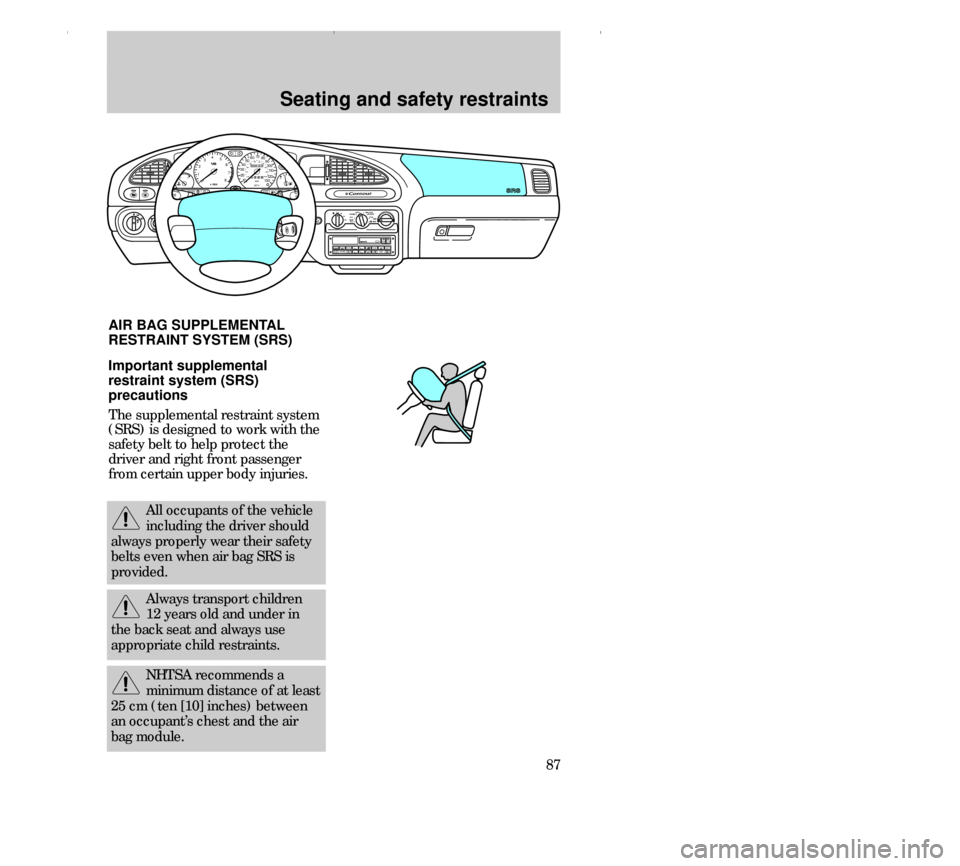
87 Important supplemental
restraint system (SRS)
precautions
The supplemental restraint system
(SRS) is designed to work with the
safety belt to help protect the
driver and right front passenger
from certain upper body injuries.
AIR BAG SUPPLEMENTAL
RESTRAINT SYSTEM (SRS)
MIRRORS
OFF LO PNL/FLR
PANEL
A/CFLOOR
DEF FLR
DEF
MAX
A/C HI/
POWER AUDIO AM/FM
SCAN
SEEK 31245ANSSIDE 1-2EJECTVOLUME
000123000010 20 3040506070
80
90
10 0
110
120
13 0MPH20 406055
80120 10 0
14 0
160
18 0
200EF12
03x 1000
4
5
6
7
8BRAKE
CHECK
ENGINEO/D
OFF
CLOCK
TRACTION
TROLCH
Always transport children
12 years old and under in
the back seat and always use
appropriate child restraints.
All occupants of the vehicle
including the driver should
always properly wear their safety
belts even when air bag SRS is
provided.
NHTSA recommends a
minimum distance of at least
25 cm (ten [10] inches) between
an occupant’s chest and the air
bag module.
14CSSen 17.6.99 11:00 Uhr Seite 87
Page 112 of 248
Starting
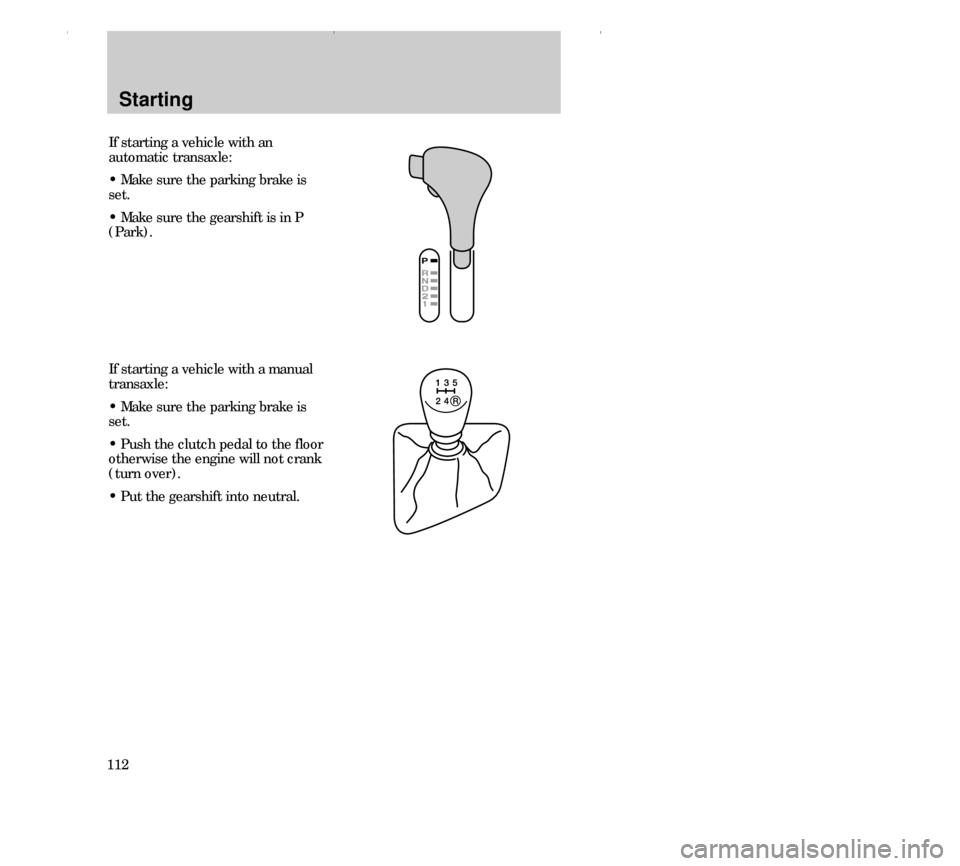
112If starting a vehicle with an
automatic transaxle:
• Make sure the parking brake is
set.
• Make sure the gearshift is in P
(Park).
If starting a vehicle with a manual
transaxle:
• Make sure the parking brake is
set.
• Push the clutch pedal to the floor
otherwise the engine will not crank
(turn over).
• Put the gearshift into neutral.
21CSten 17.6.99 11:06 Uhr Seite 112
Page 113 of 248
Starting
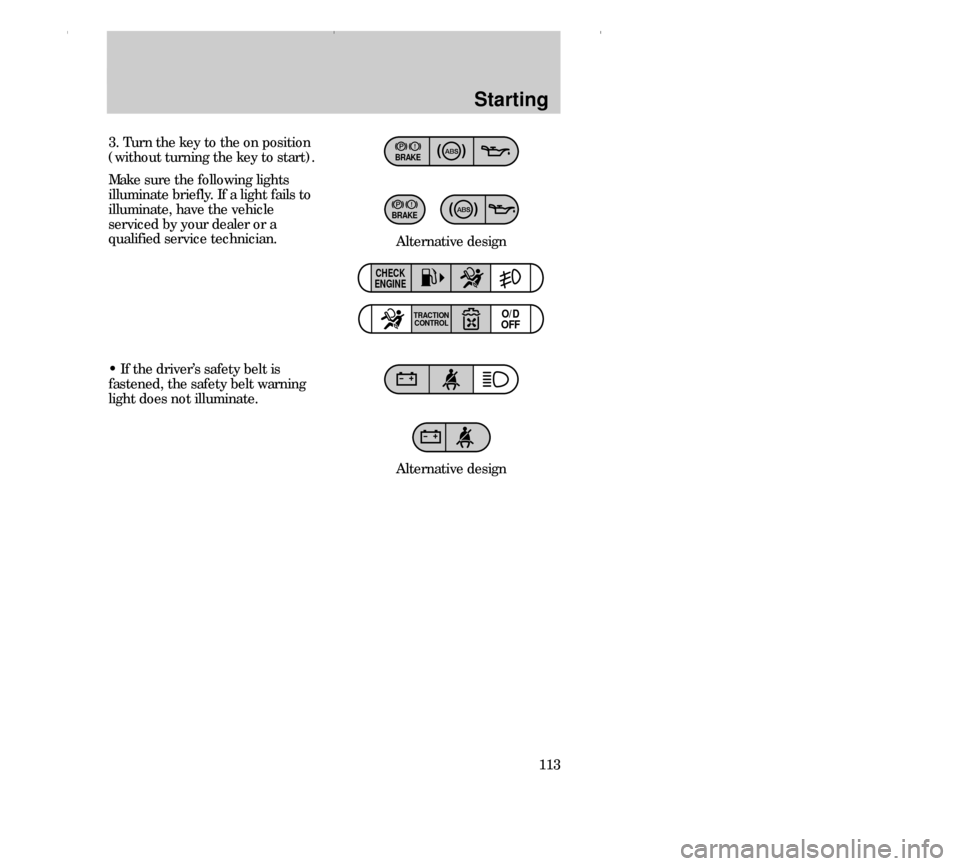
113 3. Turn the key to the on position
(without turning the key to start).
Make sure the following lights
illuminate briefly. If a light fails to
illuminate, have the vehicle
serviced by your dealer or a
qualified service technician.
BRAKE
BRAKE
CHECK
ENGINE
• If the driver’s safety belt is
fastened, the safety belt warning
light does not illuminate.Alternative design
Alternative design
O/D
OFFTRACTION
CONTROL
21CSten 17.6.99 11:06 Uhr Seite 113
Page 114 of 248
Starting
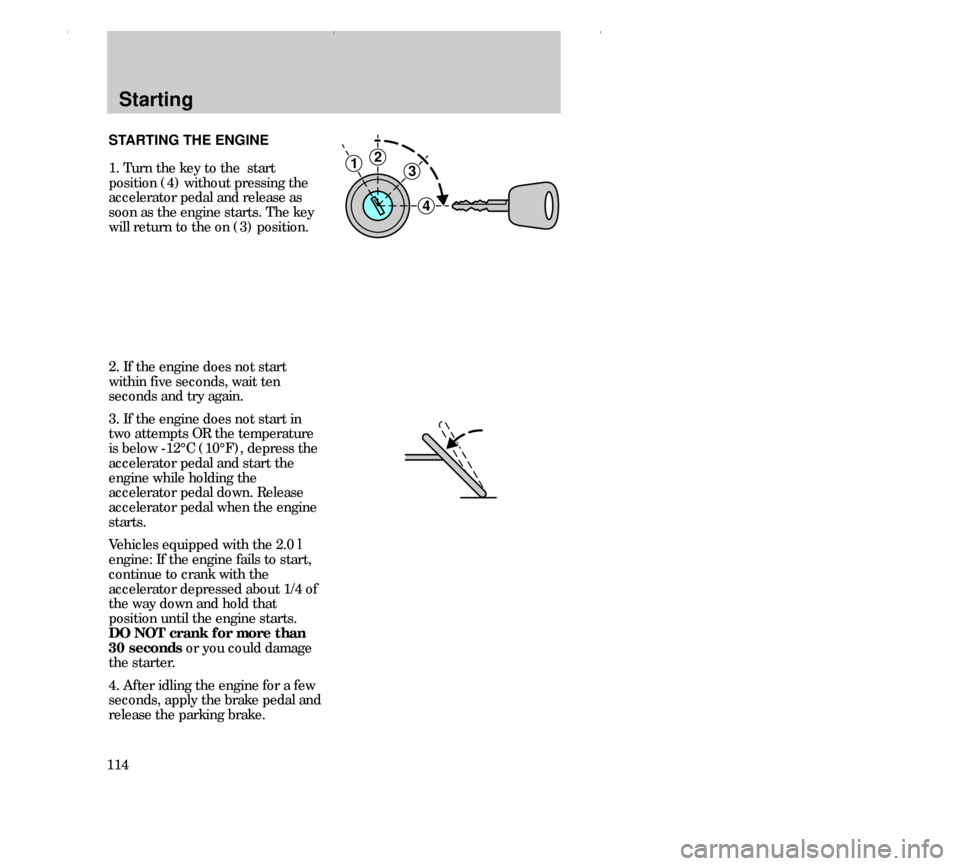
114STARTING THE ENGINE
1. Turn the key to the start
position (4) without pressing the
accelerator pedal and release as
soon as the engine starts. The key
will return to the on (3) position.
3
4
21
2. If the engine does not start
within five seconds, wait ten
seconds and try again.
3. If the engine does not start in
two attempts OR the temperature
is below -12°C (10°F), depress the
accelerator pedal and start the
engine while holding the
accelerator pedal down. Release
accelerator pedal when the engine
starts.
Vehicles equipped with the 2.0 l
engine: If the engine fails to start,
continue to crank with the
accelerator depressed about 1/4 of
the way down and hold that
position until the engine starts.
DO NOT crank for more than
30 secondsor you could damage
the starter.
4. After idling the engine for a few
seconds, apply the brake pedal and
release the parking brake.
21CSten 17.6.99 11:06 Uhr Seite 114
Page 116 of 248
116
Driving
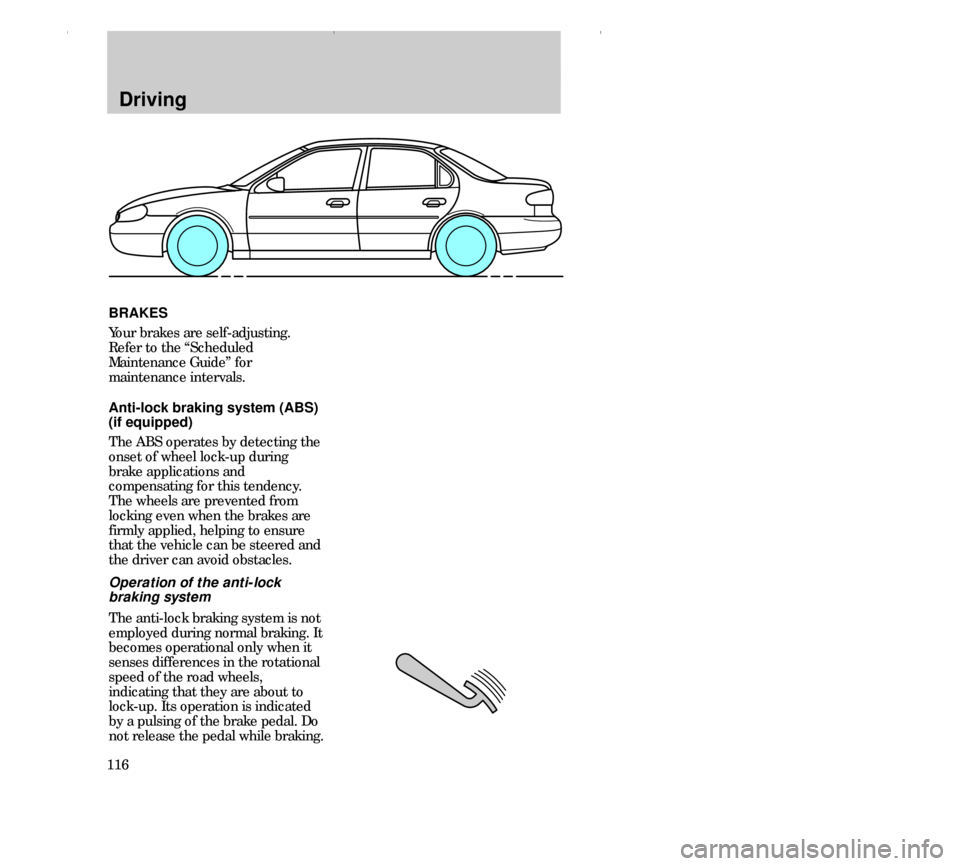
BRAKES
Your brakes are self-adjusting.
Refer to the “Scheduled
Maintenance Guide” for
maintenance intervals.
Anti-lock braking system (ABS)
(if equipped)
The ABS operates by detecting the
onset of wheel lock-up during
brake applications and
compensating for this tendency.
The wheels are prevented from
locking even when the brakes are
firmly applied, helping to ensure
that the vehicle can be steered and
the driver can avoid obstacles.
Operation of the anti-lock
braking system
The anti-lock braking system is not
employed during normal braking. It
becomes operational only when it
senses differences in the rotational
speed of the road wheels,
indicating that they are about to
lock-up. Its operation is indicated
by a pulsing of the brake pedal. Do
not release the pedal while braking.
22CDren 17.6.99 11:08 Uhr Seite 116
Page 117 of 248
Driving
117
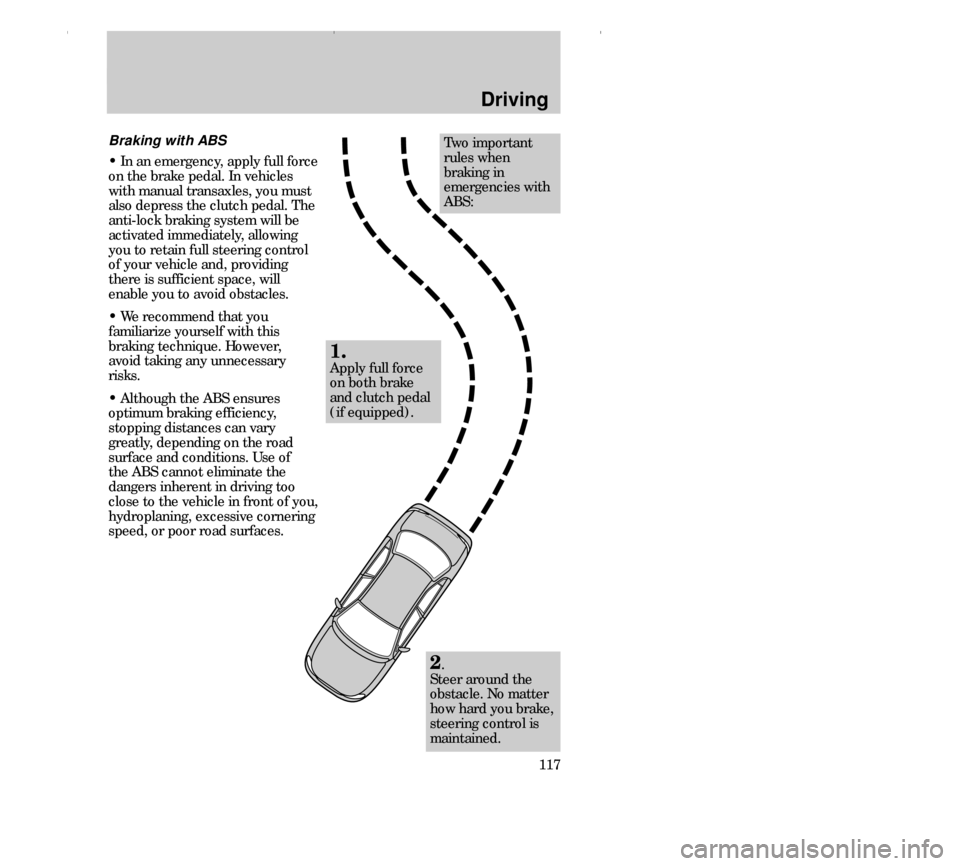
Two important
rules when
braking in
emergencies with
ABS:
1.
Apply full force
on both brake
and clutch pedal
(if equipped). Braking with ABS
• In an emergency, apply full force
on the brake pedal. In vehicles
with manual transaxles, you must
also depress the clutch pedal. The
anti-lock braking system will be
activated immediately, allowing
you to retain full steering control
of your vehicle and, providing
there is sufficient space, will
enable you to avoid obstacles.
• We recommend that you
familiarize yourself with this
braking technique. However,
avoid taking any unnecessary
risks.
• Although the ABS ensures
optimum braking efficiency,
stopping distances can vary
greatly, depending on the road
surface and conditions. Use of
the ABS cannot eliminate the
dangers inherent in driving too
close to the vehicle in front of you,
hydroplaning, excessive cornering
speed, or poor road surfaces.
2.
Steer around the
obstacle. No matter
how hard you brake,
steering control is
maintained.
22CDren 17.6.99 11:08 Uhr Seite 117
Page 118 of 248
Driving
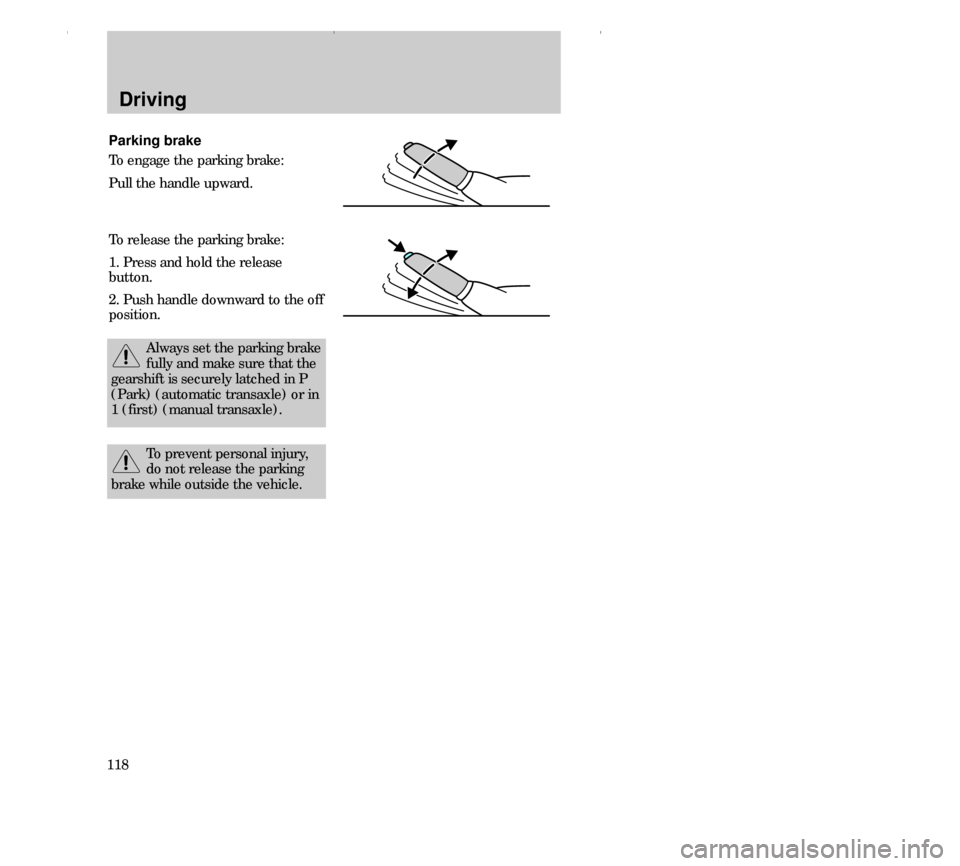
118Parking brake
To engage the parking brake:
Pull the handle upward.
To release the parking brake:
1. Press and hold the release
button.
2. Push handle downward to the off
position.
Always set the parking brake
fully and make sure that the
gearshift is securely latched in P
(Park) (automatic transaxle) or in
1 (first) (manual transaxle).
To prevent personal injury,
do not release the parking
brake while outside the vehicle.
22CDren 17.6.99 11:08 Uhr Seite 118
Page 119 of 248
Driving
119 TRACTION CONTROL
(if equipped)
This system prevents wheel spin at
all speeds. The control will toggle
this function on and off, but the
feature defaults to on after each
cycle of the ignition key.
The traction control system
controls excessive wheel spin by
automatically applying and
releasing the brakes in conjunction
with engine torque reductions.
This can occur when accelerating
on a slippery road, a loose surface
or when pulling away on a hill. The
traction control lamp flashes on the
instrument panel when the system
is functioning to regulate tire
traction.
When the ignition is turned to the
on position, the traction control
system light comes on for
approximately three (3) seconds. If
the light does not come on when
the ignition is turned to the on
position or if it remains on
continuously when the traction
control system is turned on, have
the system serviced by your dealer
or a qualified service technician.
You can continue to drive and do
not need to have the vehicle towed
in.
You should not take unnecessary
driving risks because of the
system’s safety potential.
22CDren 17.6.99 11:08 Uhr Seite 119
Page 121 of 248
Driving
121 TRANSAXLE OPERATION
Automatic transaxle
(if equipped)
Your 2.5 l V6 automatic transaxle
electronically controls the shift feel
by using an adaptive learning
strategy. This feature is designed to
optimize shift smoothness. It is
normal for your transaxle to adjust
during the first few hundred
kilometers (miles) of operation
until the adaptive strategy has
been learned. The adaptive
learning strategy is maintained by
power from the battery. When the
battery is disconnected or a new
battery is installed, the transaxle
must relearn its adaptive strategy.
Optimal shifting will resume within
a few hundred kilometers (miles)
of operation.
Vehicles equipped with an
automatic transaxle are equipped
with a brake-shift interlock feature
that prevents the gearshift lever
from being moved from the P
(Park) position unless the brake
pedal is depressed.
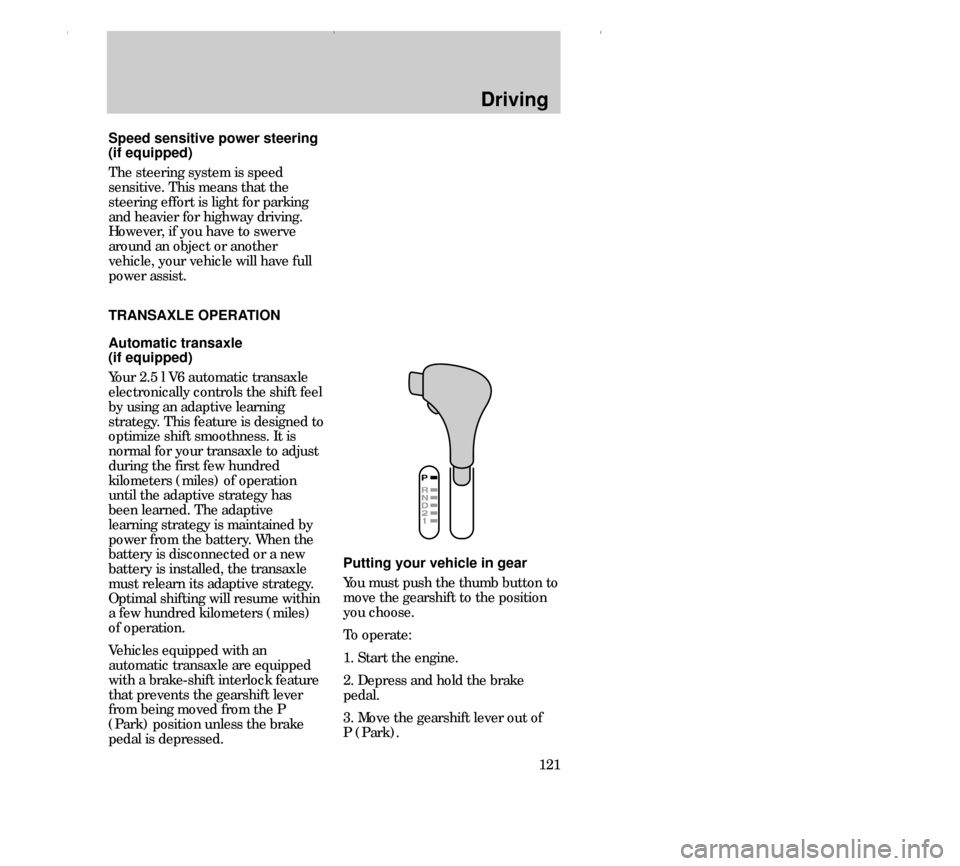
Putting your vehicle in gear
You must push the thumb button to
move the gearshift to the position
you choose.
To operate:
1. Start the engine.
2. Depress and hold the brake
pedal.
3. Move the gearshift lever out of
P (Park). Speed sensitive power steering
(if equipped)
The steering system is speed
sensitive. This means that the
steering effort is light for parking
and heavier for highway driving.
However, if you have to swerve
around an object or another
vehicle, your vehicle will have full
power assist.
22CDren 17.6.99 11:08 Uhr Seite 121
Page 122 of 248
Driving
122
Overriding the brake-shift
interlock feature
If it is necessary to use this
procedure to move the gearshift
lever, it is possible that a fuse has
blown and the vehicle’s brakelamps
may not be working. Refer to
Fuses
and relaysin the Roadside
emergencieschapter.
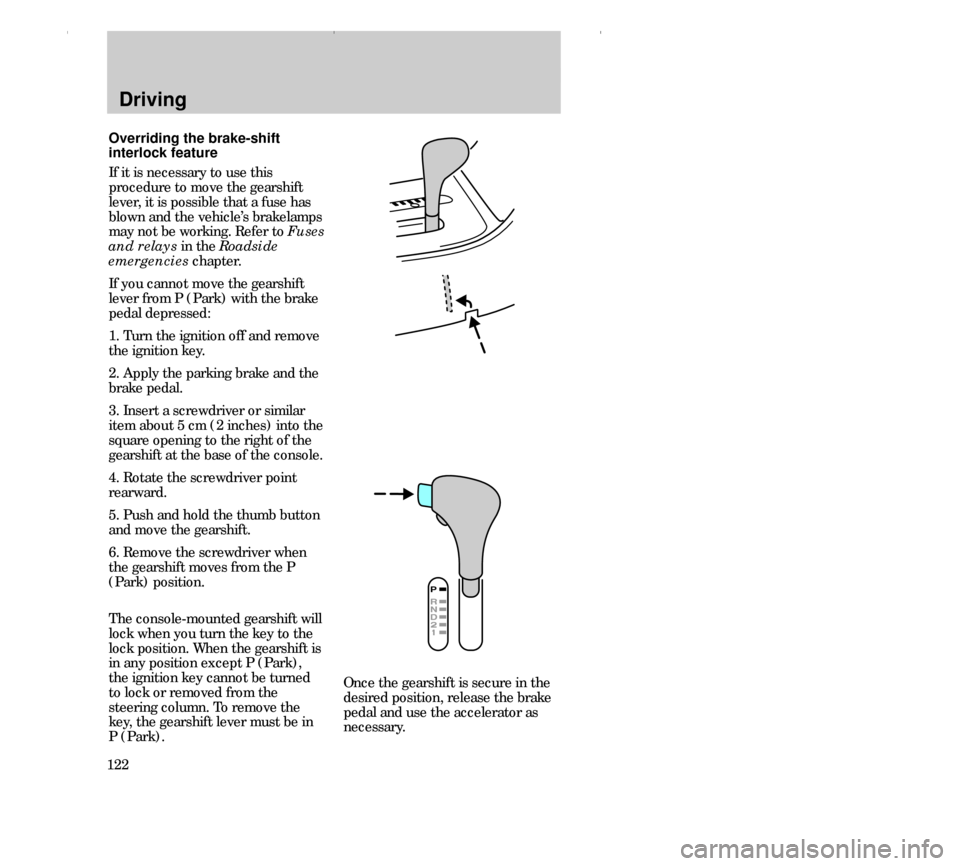
If you cannot move the gearshift
lever from P (Park) with the brake
pedal depressed:
1. Turn the ignition off and remove
the ignition key.
2. Apply the parking brake and the
brake pedal.
3. Insert a screwdriver or similar
item about 5 cm (2 inches) into the
square opening to the right of the
gearshift at the base of the console.
4. Rotate the screwdriver point
rearward.
5. Push and hold the thumb button
and move the gearshift.
6. Remove the screwdriver when
the gearshift moves from the P
(Park) position.
The console-mounted gearshift will
lock when you turn the key to the
lock position. When the gearshift is
in any position except P (Park),
the ignition key cannot be turned
to lock or removed from the
steering column. To remove the
key, the gearshift lever must be in
P (Park).Once the gearshift is secure in the
desired position, release the brake
pedal and use the accelerator as
necessary.
22CDren 17.6.99 11:09 Uhr Seite 122