brake FORD CONTOUR 2000 2.G Service Manual
[x] Cancel search | Manufacturer: FORD, Model Year: 2000, Model line: CONTOUR, Model: FORD CONTOUR 2000 2.GPages: 248, PDF Size: 2.23 MB
Page 155 of 248
Roadside emergencies
155
3. Park the booster vehicle close to
the hood of the disabled vehicle,
making sure the two vehicles do
nottouch. Set the parking brake
on both vehicles and stay clear of
the engine cooling fan and other
moving parts.
4. Check all battery terminals and
remove any excessive corrosion
before you attach the battery
cables. Ensure that vent caps are
tight and level.
5. Turn the heater fan on in both
vehicles to protect from any
electrical surges. Turn all other
accessories off.
Connecting the jumper cables
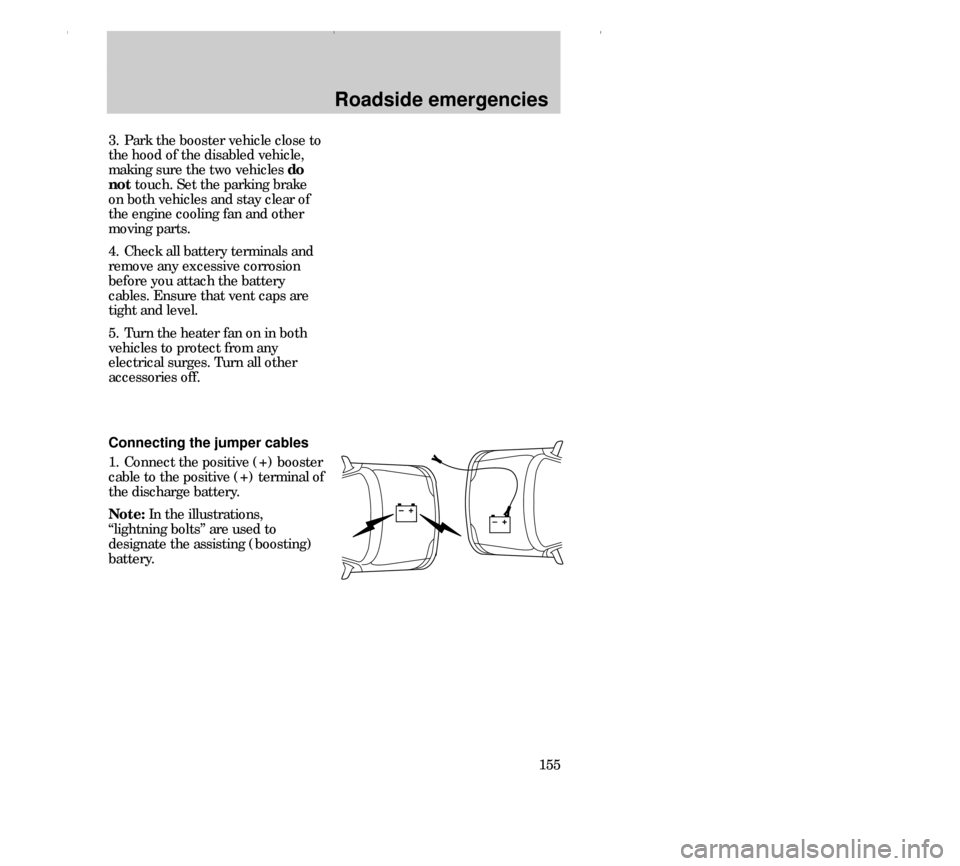
1. Connect the positive (+) booster
cable to the positive (+) terminal of
the discharge battery.
Note:In the illustrations,
“lightning bolts” are used to
designate the assisting (boosting)
battery.
23CREen 17.6.99 11:11 Uhr Seite 155
Page 161 of 248
Roadside emergencies
161
Never use a tow bar that
attaches to the bumper
when you tow your vehicle. This
could damage the bumper and
cause an accident.
TOWING YOUR VEHICLE
BEHIND ANOTHER VEHICLE
Before you have your vehicle
towed:
• release the parking brake,
• move the gearshift to N
(Neutral),
• turn the ignition to the off
position and
• unlock the steering wheel.
Recreational towing or having
your vehicle towed
An example of recreational towing
would be towing your vehicle
behind a Motorhome. Follow these
guidelines if you have the need for
recreational towing.
These guidelines are designed to
ensure that your transaxle is not
damgaged.
It is not recommended to tow front
wheel drive vehicles with the front
drive wheels on the ground.
It is recommended to tow your
vehicle with the drive wheels on a
dolly or two wheel car hauling
trailer.Automatic transaxle
In case of a roadside emergency
with a disabled vehicle (without
access to wheel dollies, car hauling
trailer or flatbed transport vehicle)
your vehicle can be flat towed (all
wheels on the ground) under the
following conditions.
• Place the transaxle in N
(Neutral)
• Do not exceed a distance of 80
km (50 miles).
• Do not exceed 56 km/h (35 mph)
vehicle speed.
Manual transaxle
Do not tow your vehicle at a speed
faster than 90 km/h (55 mph). Your
maximum towing distance is
unlimited.
23CREen 17.6.99 11:11 Uhr Seite 161
Page 164 of 248
Maintenance and care
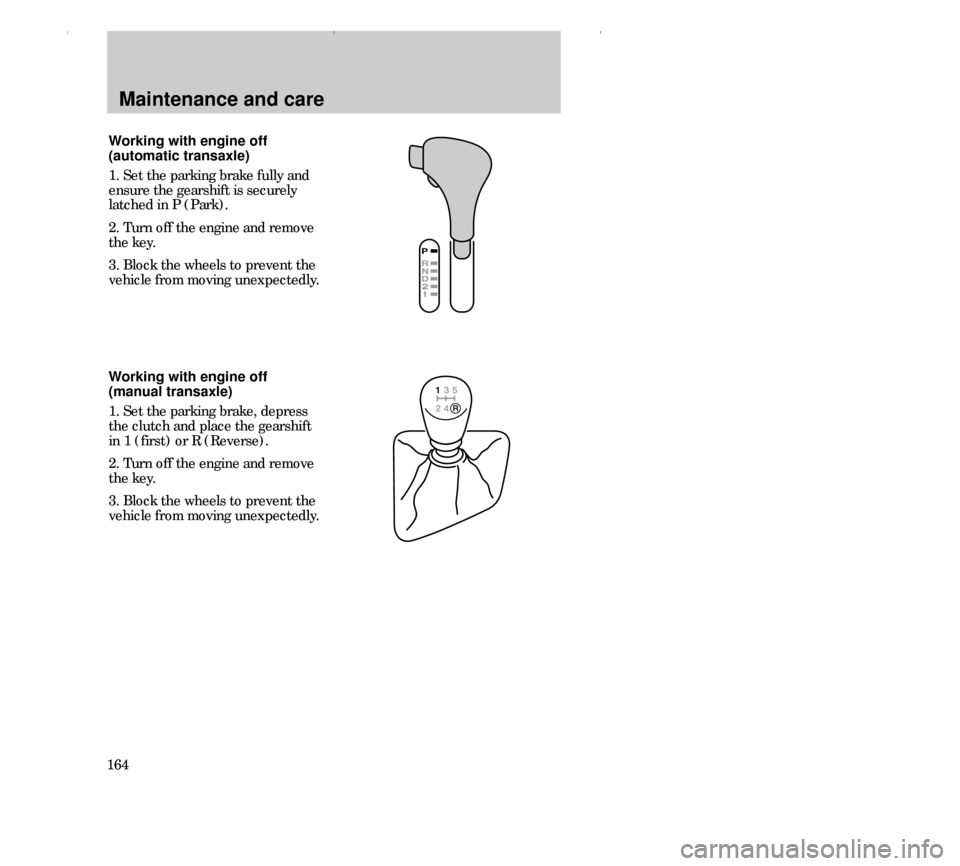
164Working with engine off
(automatic transaxle)
1. Set the parking brake fully and
ensure the gearshift is securely
latched in P (Park).
2. Turn off the engine and remove
the key.
3. Block the wheels to prevent the
vehicle from moving unexpectedly.
Working with engine off
(manual transaxle)
1. Set the parking brake, depress
the clutch and place the gearshift
in 1 (first) or R (Reverse).
2. Turn off the engine and remove
the key.
3. Block the wheels to prevent the
vehicle from moving unexpectedly.
31CMCen 17.6.99 11:15 Uhr Seite 164
Page 165 of 248
Maintenance and care
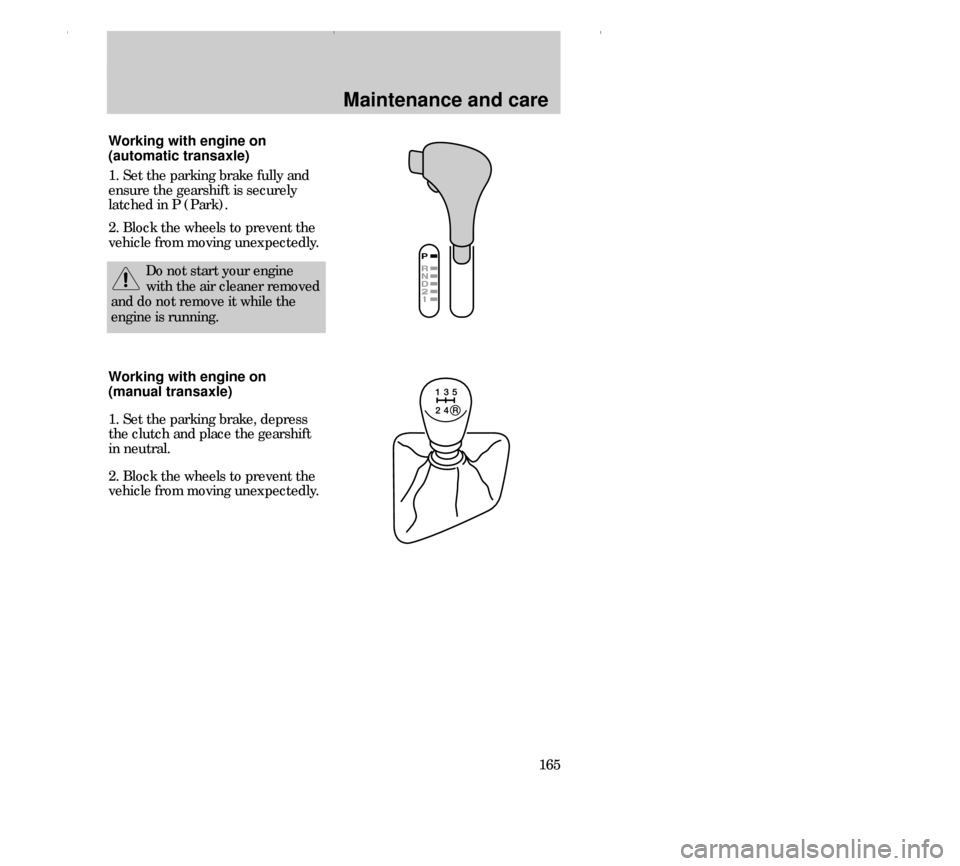
165 Working with engine on
(automatic transaxle)
1. Set the parking brake fully and
ensure the gearshift is securely
latched in P (Park).
2. Block the wheels to prevent the
vehicle from moving unexpectedly.
Do not start your engine
with the air cleaner removed
and do not remove it while the
engine is running.
Working with engine on
(manual transaxle)
1. Set the parking brake, depress
the clutch and place the gearshift
in neutral.
2. Block the wheels to prevent the
vehicle from moving unexpectedly.
31CMCen 17.6.99 11:15 Uhr Seite 165
Page 167 of 248
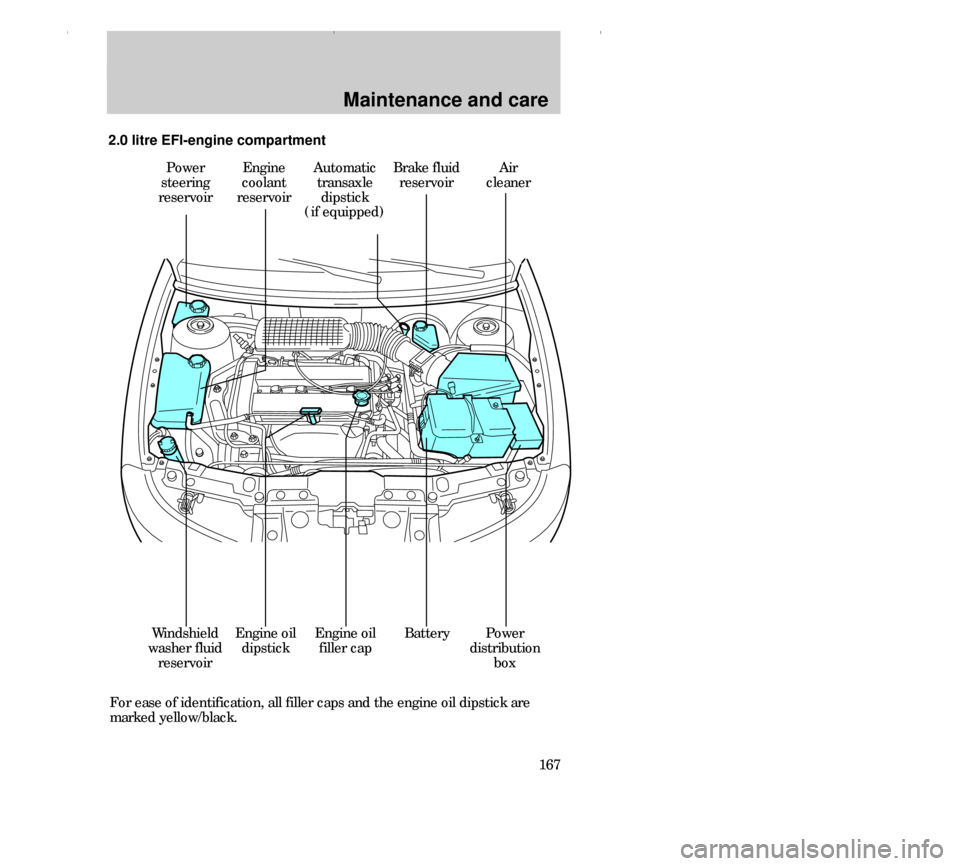
Maintenance and care
167 For ease of identification, all filler caps and the engine oil dipstick are
marked yellow/black. 2.0 litre EFI-engine compartment
Power
steering
reservoirEngine
coolant
reservoirAutomatic
transaxle
dipstick
(if equipped)Brake fluid
reservoir
BatteryWindshield
washer fluid
reservoirEngine oil
dipstickPower
distribution
box
Air
cleaner
Engine oil
filler cap
31CMCen 17.6.99 11:15 Uhr Seite 167
Page 168 of 248
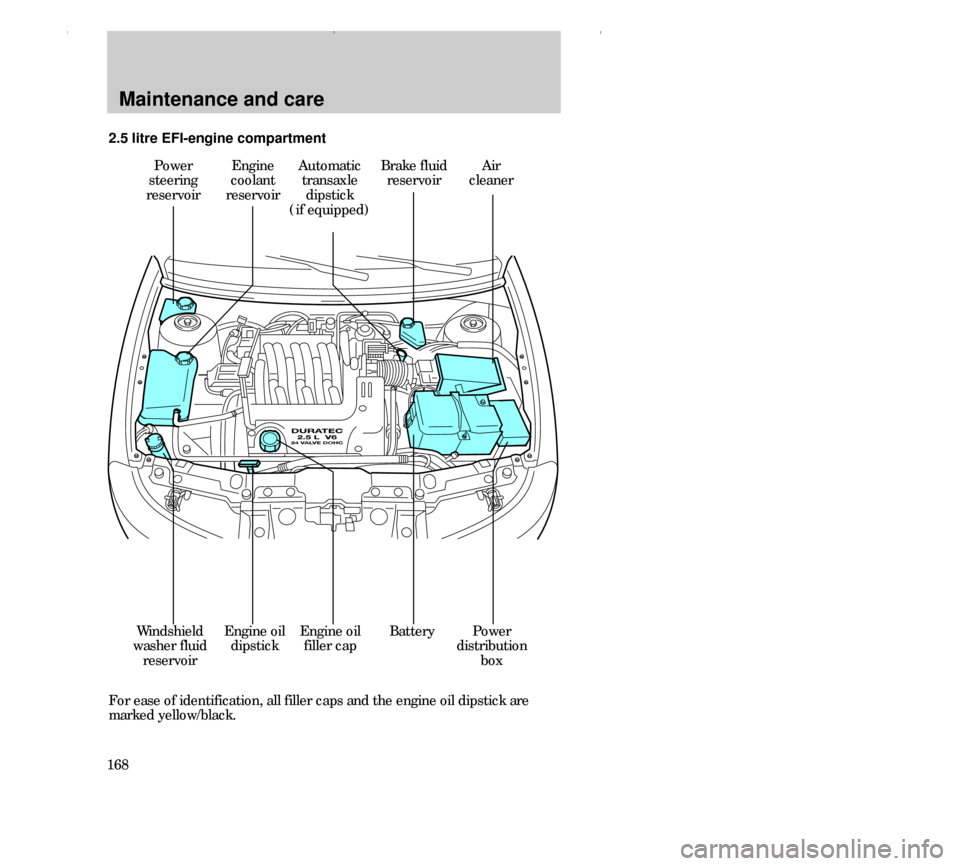
Maintenance and care
168
Power
steering
reservoirEngine
coolant
reservoir 2.5 litre EFI-engine compartment
For ease of identification, all filler caps and the engine oil dipstick are
marked yellow/black.Air
cleanerBrake fluid
reservoirAutomatic
transaxle
dipstick
(if equipped)
BatteryWindshield
washer fluid
reservoirEngine oil
dipstickPower
distribution
boxEngine oil
filler cap
31CMCen 17.6.99 11:15 Uhr Seite 168
Page 169 of 248
Maintenance and care
169
ADDFULL
Engine oil
Use SAE 5W-30 motor oil
CERTIFIED FOR GASOLINE
ENGINES by the American
Petroleum Institute.
Do not use supplemental engine oil
additives, oil treatments or engine
treatments. They are unnecessary
and could, under certain
conditions, lead to engine damage
which is not covered by Ford
Warranty.
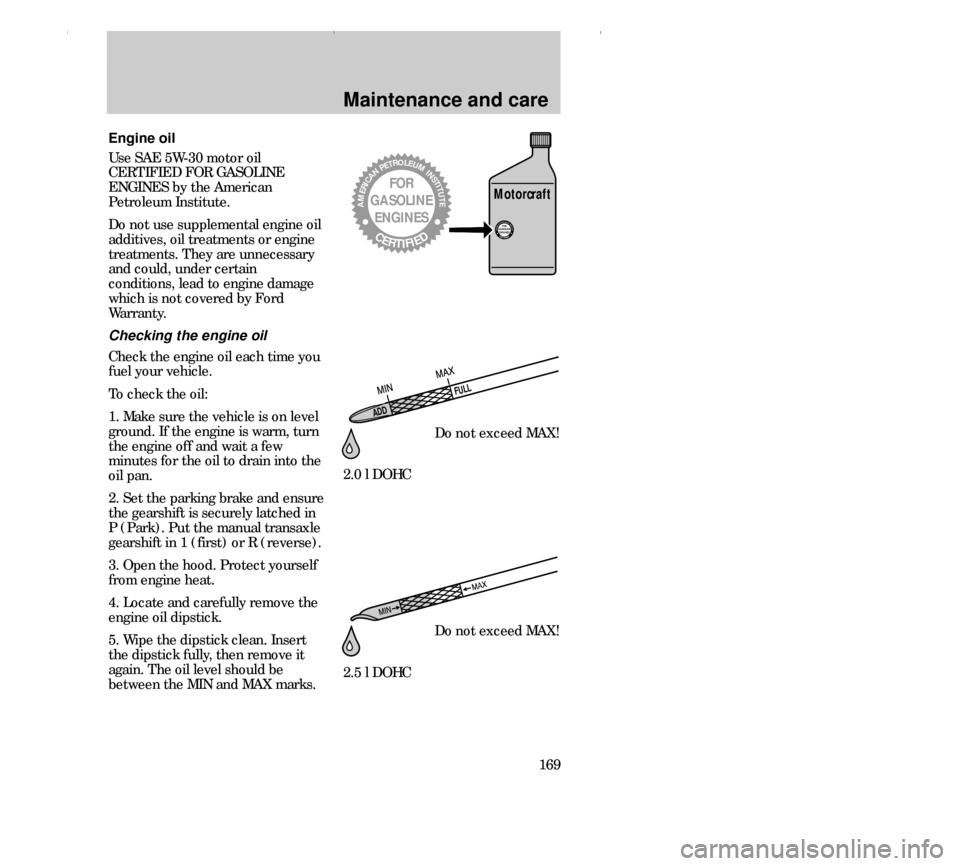
Checking the engine oil
Check the engine oil each time you
fuel your vehicle.
To check the oil:
1. Make sure the vehicle is on level
ground. If the engine is warm, turn
the engine off and wait a few
minutes for the oil to drain into the
oil pan.
2. Set the parking brake and ensure
the gearshift is securely latched in
P (Park). Put the manual transaxle
gearshift in 1 (first) or R (reverse).
3. Open the hood. Protect yourself
from engine heat.
4. Locate and carefully remove the
engine oil dipstick.
5. Wipe the dipstick clean. Insert
the dipstick fully, then remove it
again. The oil level should be
between the MIN and MAX marks. 2.0 l DOHC
2.5 l DOHC
AMERICANPETROLEUMINSTITUTE
CERTIFIED
FOR
GASOLINE
ENGINES
AMERICANPETROLEUMINSTITUTECERTIFIEDFOR
GASOLINE
ENGINES
Motorcraft
Do not exceed MAX!
Do not exceed MAX!
31CMCen 17.6.99 11:15 Uhr Seite 169
Page 172 of 248
Maintenance and care
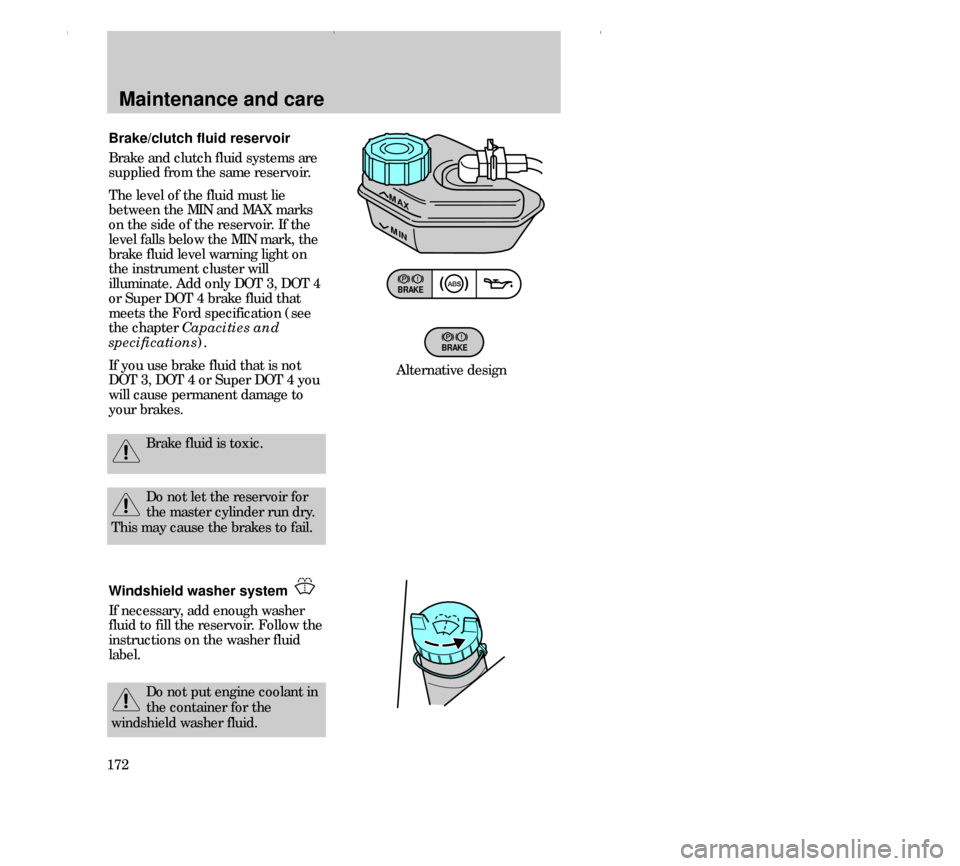
172Brake/clutch fluid reservoir
Brake and clutch fluid systems are
supplied from the same reservoir.
The level of the fluid must lie
between the MIN and MAX marks
on the side of the reservoir. If the
level falls below the MIN mark, the
brake fluid level warning light on
the instrument cluster will
illuminate. Add only DOT 3, DOT 4
or Super DOT 4 brake fluid that
meets the Ford specification (see
the chapter Capacities and
specifications).
If you use brake fluid that is not
DOT 3, DOT 4 or Super DOT 4 you
will cause permanent damage to
your brakes.
MAX
MIN
Brake fluid is toxic.
BRAKE
BRAKE
Do not let the reservoir for
the master cylinder run dry.
This may cause the brakes to fail.
Windshield washer system
If necessary, add enough washer
fluid to fill the reservoir. Follow the
instructions on the washer fluid
label.
Alternative design
Do not put engine coolant in
the container for the
windshield washer fluid.
31CMCen 17.6.99 11:15 Uhr Seite 172
Page 179 of 248
Maintenance and care
179 Checking and adding automatic
transaxle fluid
Follow the scheduled service
intervals outlined in the
“Scheduled Maintenance Guide“.
Your transaxle does not consume
fluid. However, it is recommended
that you refer to your “Scheduled
Maintenance Guide“ for scheduled
intervals for fluid checks and
changes. The fluid level should be
checked or changed by a qualified
technician at the appropriate
intervals or if the transaxle is not
working properly, i.e., if the
transaxle slips or shifts slowly or if
you notice some sign of fluid
leakage.
Note: Automatic transaxle fluid
expands when warmed. To obtain
an accurate fluid level check drive
the vehicle until warmed,
approximately 30 km (20 miles). If
your vehicle has been operated for
an extended period at high speeds,
in city traffic during hot weather or
pulling a trailer, the vehicle should
be turned off for about 30 minutes
to allow fluid to cool before
checking.
1. Drive the vehicle 30 km (20
miles) or until the vehicle reaches
normal operating temperatures.
2. Park the vehicle on a level
surface and engage the parking
brake.
31CMCen 17.6.99 11:15 Uhr Seite 179
Page 180 of 248
Maintenance and care
180
3. With the parking brake engaged
and your foot on the brake pedal,
start the engine and move the
gearshift lever through all of the
gear ranges. Allow sufficient time
for each gear to engage.
4. Latch the gearshift lever in P
(Park) and leave the engine
running.
5. Remove the dipstick, wiping it
with a clean, dry lint free rag.
6. Install the dipstick making sure
it is fully seated in the filler tube.
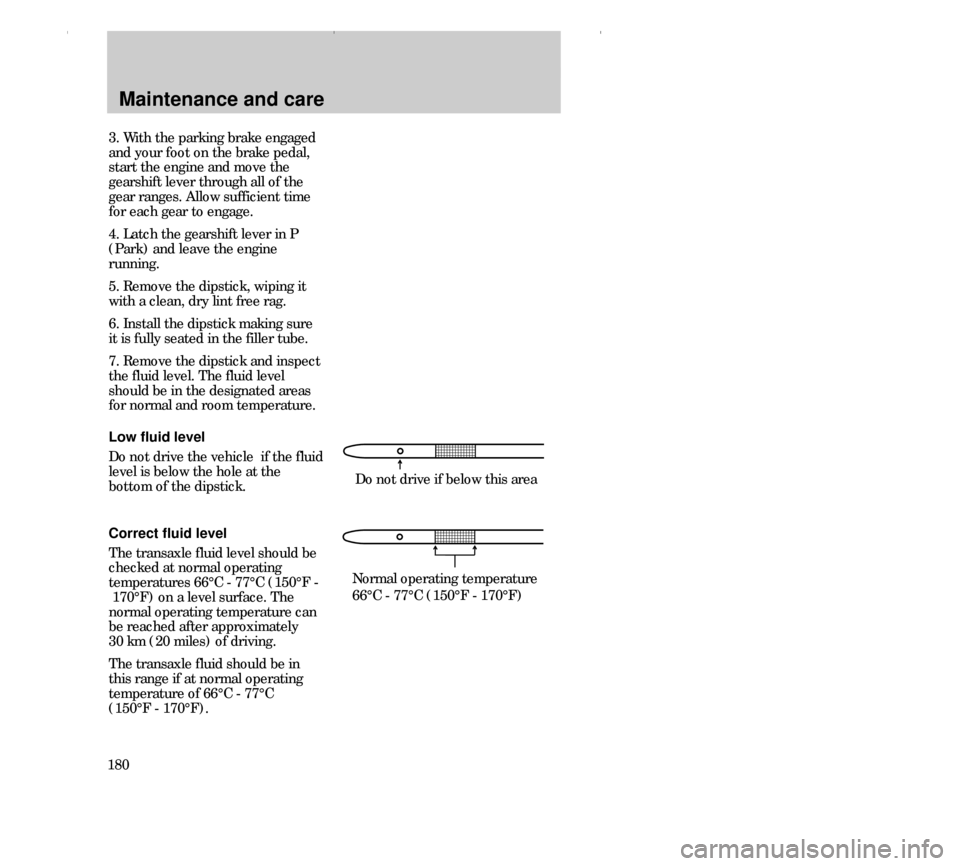
7. Remove the dipstick and inspect
the fluid level. The fluid level
should be in the designated areas
for normal and room temperature.
Low fluid level
Do not drive the vehicle if the fluid
level is below the hole at the
bottom of the dipstick.
Correct fluid level
The transaxle fluid level should be
checked at normal operating
temperatures 66°C - 77°C (150°F -
170°F) on a level surface. The
normal operating temperature can
be reached after approximately
30 km (20 miles) of driving.
The transaxle fluid should be in
this range if at normal operating
temperature of 66°C - 77°C
(150°F - 170°F).Normal operating temperature
66°C - 77°C (150°F - 170°F)Do not drive if below this area
31CMCen 17.6.99 11:15 Uhr Seite 180