lock FORD CONTOUR 2000 2.G Workshop Manual
[x] Cancel search | Manufacturer: FORD, Model Year: 2000, Model line: CONTOUR, Model: FORD CONTOUR 2000 2.GPages: 248, PDF Size: 2.23 MB
Page 148 of 248
Roadside emergencies
148
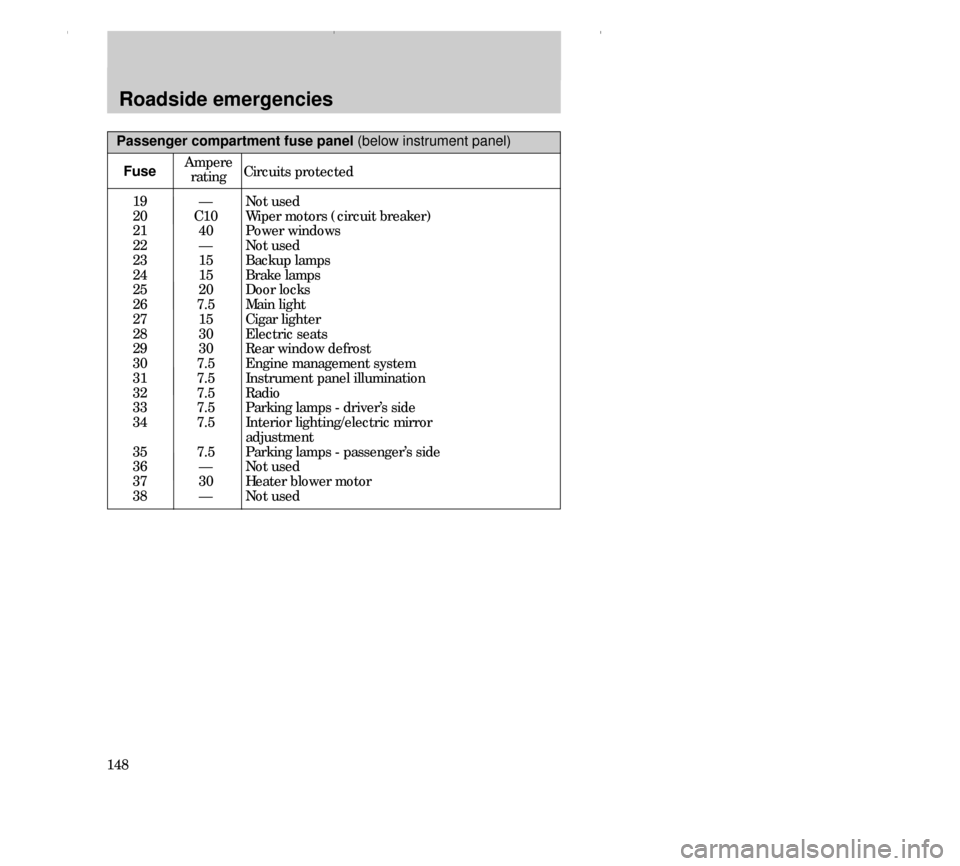
19
20
21
22
23
24
25
26
27
28
29
30
31
32
33
34
35
36
37
38—
C10
40
—
15
15
20
7.5
15
30
30
7.5
7.5
7.5
7.5
7.5
7.5
—
30
—Not used
Wiper motors (circuit breaker)
Power windows
Not used
Backup lamps
Brake lamps
Door locks
Main light
Cigar lighter
Electric seats
Rear window defrost
Engine management system
Instrument panel illumination
Radio
Parking lamps - driver’s side
Interior lighting/electric mirror
adjustment
Parking lamps - passenger’s side
Not used
Heater blower motor
Not used
Passenger compartment fuse panel (below instrument panel)
FuseAmpere
ratingCircuits protected
23CREen 17.6.99 11:11 Uhr Seite 148
Page 149 of 248
Roadside emergencies
149
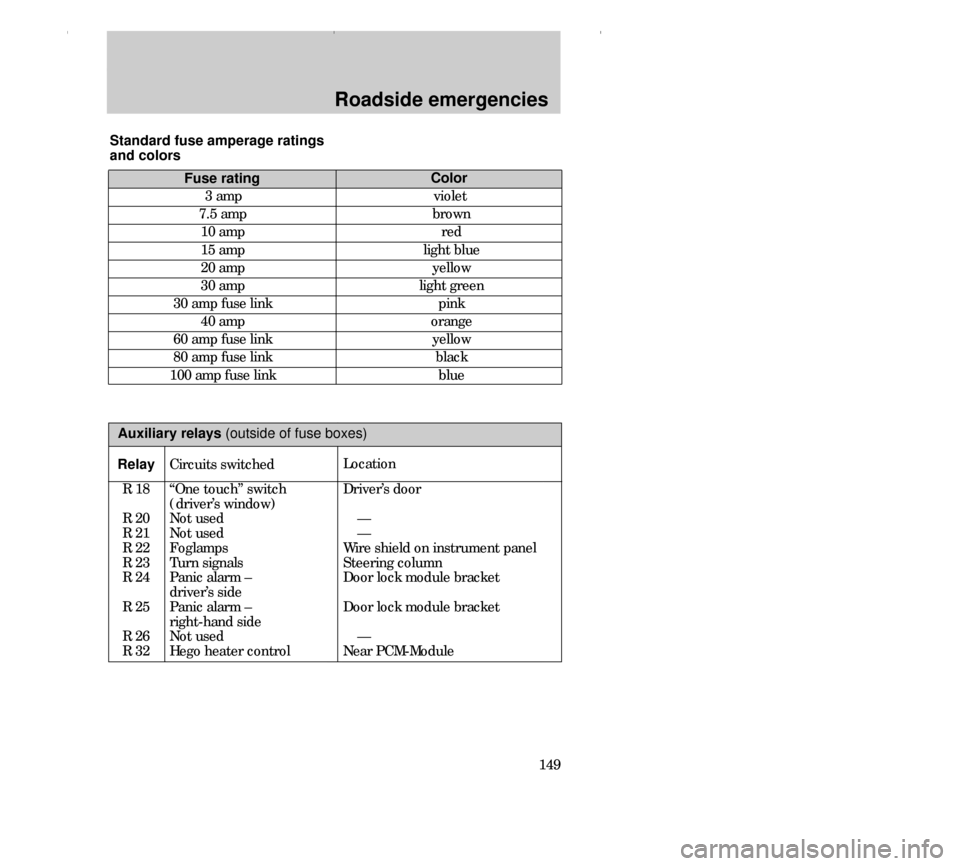
Fuse rating
7.5 amp
10 amp
15 amp
20 amp
30 amp
30 amp fuse link
40 amp
60 amp fuse link
80 amp fuse link
100 amp fuse linkColor
brown
red
light blue
yellow
light green
pink
orange
yellow
black
blue
Relay
R 18
R 20
R 21
R 22
R 23
R 24
R 25
R 26
R 32
“One touch” switch
(driver’s window)
Not used
Not used
Foglamps
Turn signals
Panic alarm –
driver’s side
Panic alarm –
right-hand side
Not used
Hego heater controlDriver’s door
—
—
Wire shield on instrument panel
Steering column
Door lock module bracket
Door lock module bracket
—
Near PCM-Module
Circuits switchedLocation Standard fuse amperage ratings
and colors
3 amp violet
Auxiliary relays (outside of fuse boxes)
23CREen 17.6.99 11:11 Uhr Seite 149
Page 150 of 248
Roadside emergencies
150
CHANGING TIRES
Park your vehicle in such a position
that neither the traffic nor you are
hindered or endangered when
changing the tire. Ensure that the
vehicle is on firm, level ground.
Secure your vehicle further by
blocking the wheels.
Activate the hazard lights.
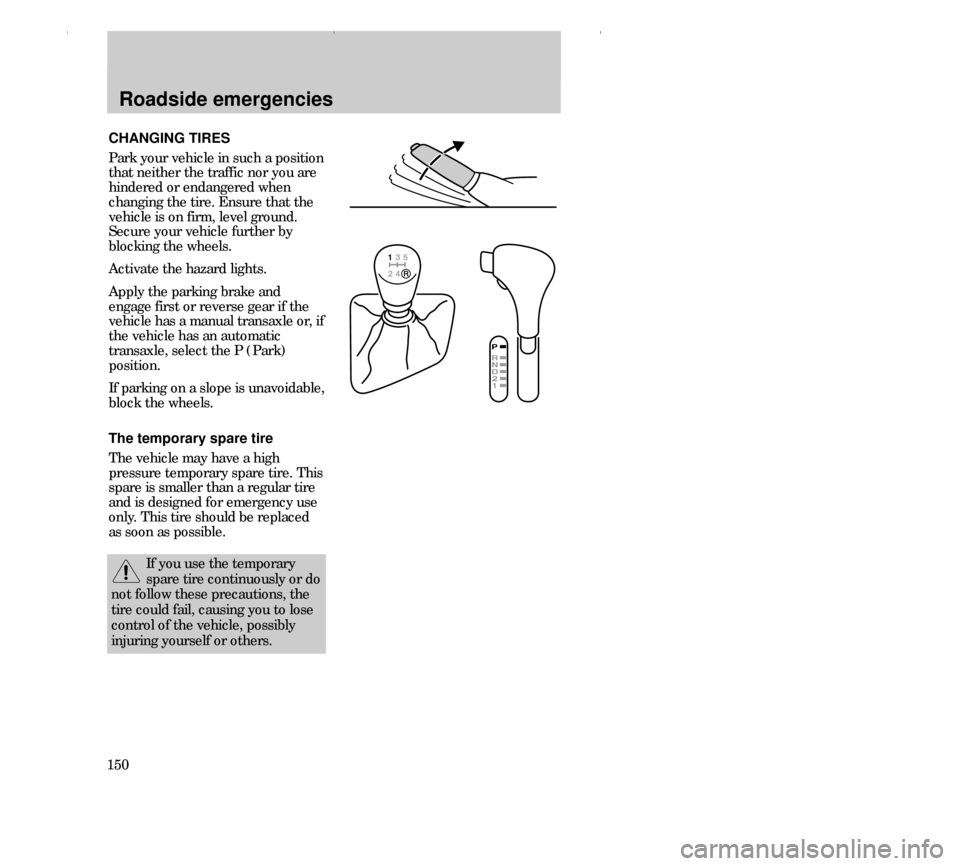
Apply the parking brake and
engage first or reverse gear if the
vehicle has a manual transaxle or, if
the vehicle has an automatic
transaxle, select the P (Park)
position.
If parking on a slope is unavoidable,
block the wheels.
The temporary spare tire
The vehicle may have a high
pressure temporary spare tire. This
spare is smaller than a regular tire
and is designed for emergency use
only. This tire should be replaced
as soon as possible.
If you use the temporary
spare tire continuously or do
not follow these precautions, the
tire could fail, causing you to lose
control of the vehicle, possibly
injuring yourself or others.
23CREen 17.6.99 11:11 Uhr Seite 150
Page 153 of 248
Roadside emergencies
153
Replacing a tire
1. Push the spare tire onto the
wheel studs.
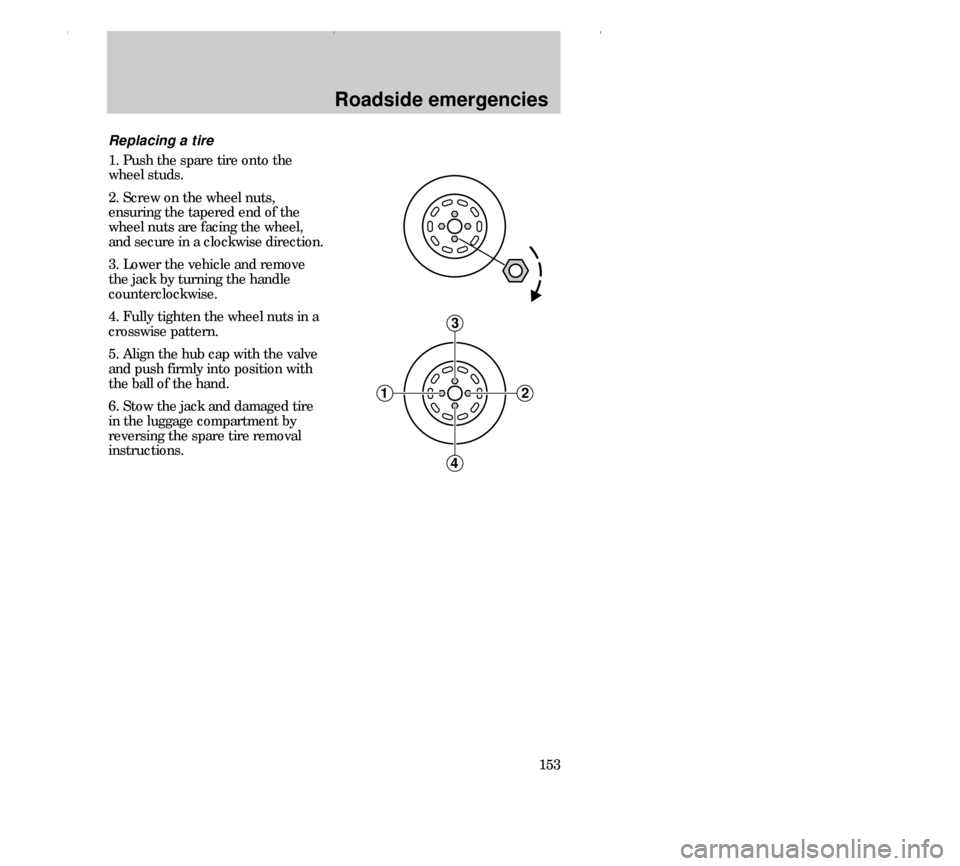
2. Screw on the wheel nuts,
ensuring the tapered end of the
wheel nuts are facing the wheel,
and secure in a clockwise direction.
3. Lower the vehicle and remove
the jack by turning the handle
counterclockwise.
4. Fully tighten the wheel nuts in a
crosswise pattern.
5. Align the hub cap with the valve
and push firmly into position with
the ball of the hand.
6. Stow the jack and damaged tire
in the luggage compartment by
reversing the spare tire removal
instructions.
3
42 1
23CREen 17.6.99 11:11 Uhr Seite 153
Page 161 of 248
Roadside emergencies
161
Never use a tow bar that
attaches to the bumper
when you tow your vehicle. This
could damage the bumper and
cause an accident.
TOWING YOUR VEHICLE
BEHIND ANOTHER VEHICLE
Before you have your vehicle
towed:
• release the parking brake,
• move the gearshift to N
(Neutral),
• turn the ignition to the off
position and
• unlock the steering wheel.
Recreational towing or having
your vehicle towed
An example of recreational towing
would be towing your vehicle
behind a Motorhome. Follow these
guidelines if you have the need for
recreational towing.
These guidelines are designed to
ensure that your transaxle is not
damgaged.
It is not recommended to tow front
wheel drive vehicles with the front
drive wheels on the ground.
It is recommended to tow your
vehicle with the drive wheels on a
dolly or two wheel car hauling
trailer.Automatic transaxle
In case of a roadside emergency
with a disabled vehicle (without
access to wheel dollies, car hauling
trailer or flatbed transport vehicle)
your vehicle can be flat towed (all
wheels on the ground) under the
following conditions.
• Place the transaxle in N
(Neutral)
• Do not exceed a distance of 80
km (50 miles).
• Do not exceed 56 km/h (35 mph)
vehicle speed.
Manual transaxle
Do not tow your vehicle at a speed
faster than 90 km/h (55 mph). Your
maximum towing distance is
unlimited.
23CREen 17.6.99 11:11 Uhr Seite 161
Page 164 of 248
Maintenance and care
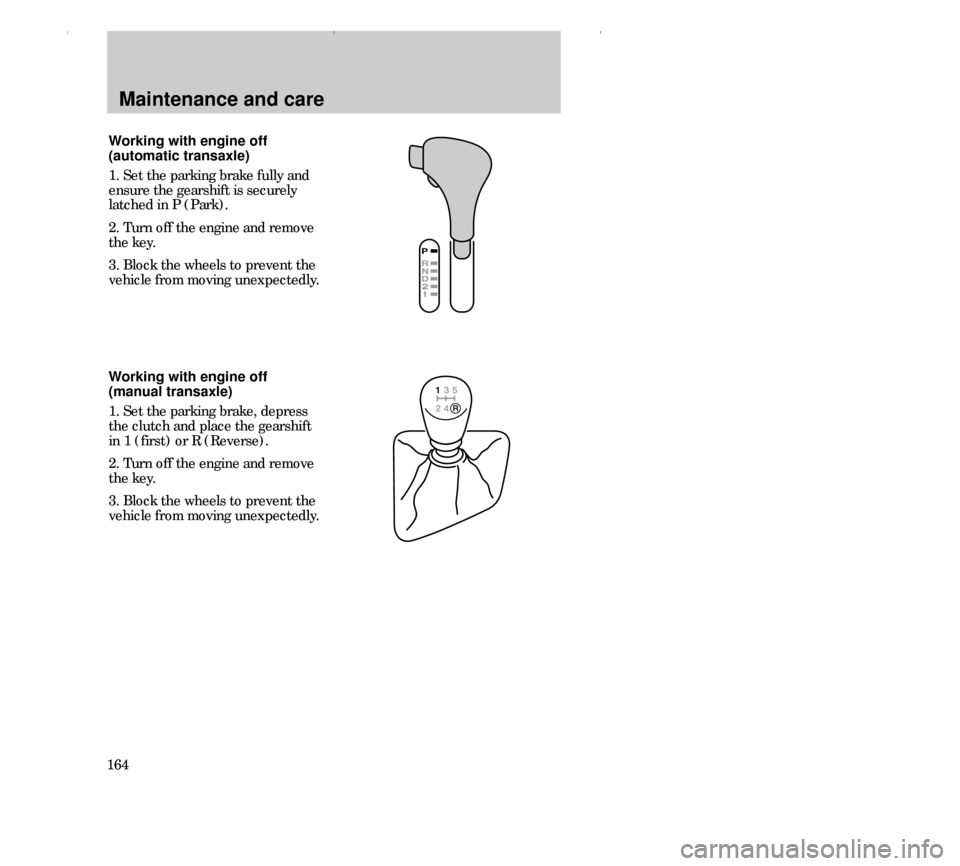
164Working with engine off
(automatic transaxle)
1. Set the parking brake fully and
ensure the gearshift is securely
latched in P (Park).
2. Turn off the engine and remove
the key.
3. Block the wheels to prevent the
vehicle from moving unexpectedly.
Working with engine off
(manual transaxle)
1. Set the parking brake, depress
the clutch and place the gearshift
in 1 (first) or R (Reverse).
2. Turn off the engine and remove
the key.
3. Block the wheels to prevent the
vehicle from moving unexpectedly.
31CMCen 17.6.99 11:15 Uhr Seite 164
Page 165 of 248
Maintenance and care
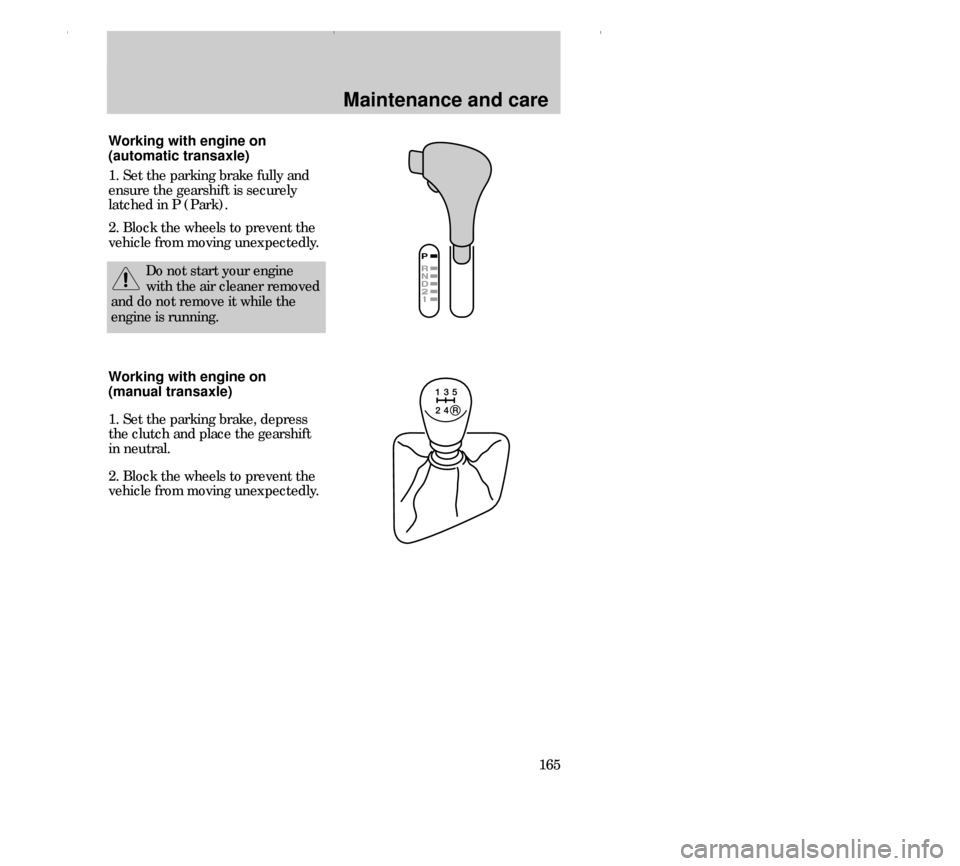
165 Working with engine on
(automatic transaxle)
1. Set the parking brake fully and
ensure the gearshift is securely
latched in P (Park).
2. Block the wheels to prevent the
vehicle from moving unexpectedly.
Do not start your engine
with the air cleaner removed
and do not remove it while the
engine is running.
Working with engine on
(manual transaxle)
1. Set the parking brake, depress
the clutch and place the gearshift
in neutral.
2. Block the wheels to prevent the
vehicle from moving unexpectedly.
31CMCen 17.6.99 11:15 Uhr Seite 165
Page 166 of 248
Maintenance and care
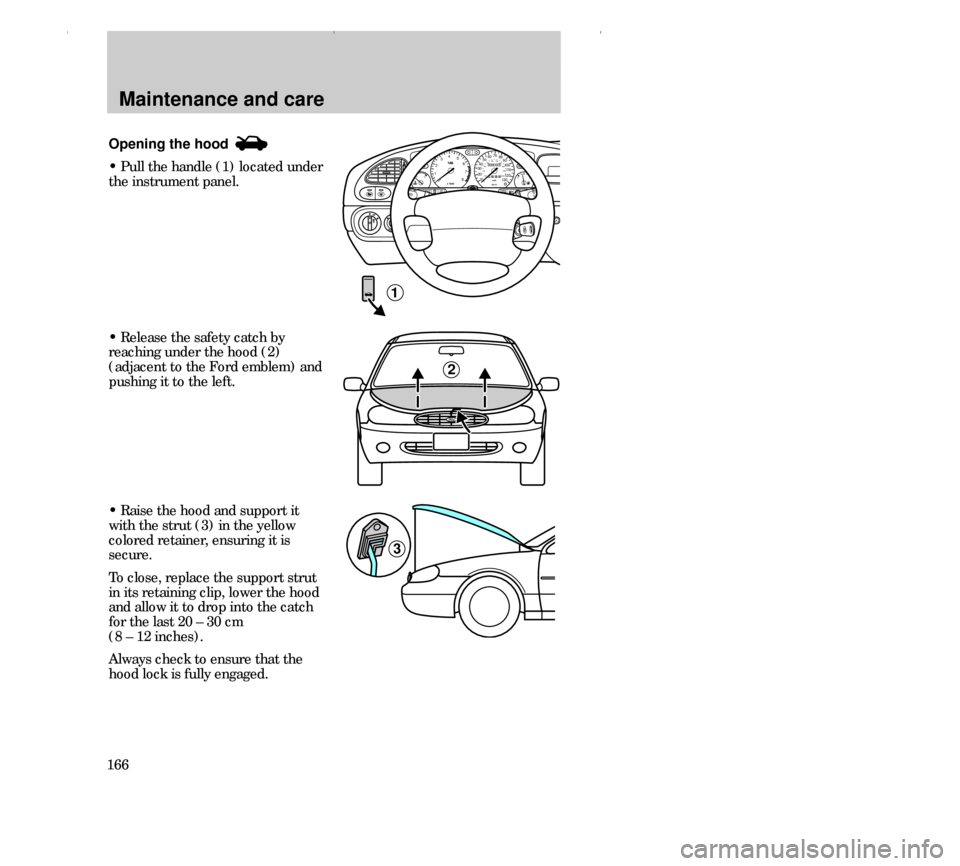
166Opening the hood
• Pull the handle (1) located under
the instrument panel.
000123000010 20 3040506070
80
90
10 0
110
120
13 0MPH20 406055
80120 10 0
14 0
160
18 0
200EF12
03x 1000
4
5
6
7
8
CHECK
ENGINE TRACTION
CONTROLO/D
OFF
MIRRORS
1
TRACTION
TROLCH
• Release the safety catch by
reaching under the hood (2)
(adjacent to the Ford emblem) and
pushing it to the left.
2
3
• Raise the hood and support it
with the strut (3) in the yellow
colored retainer, ensuring it is
secure.
To close, replace the support strut
in its retaining clip, lower the hood
and allow it to drop into the catch
for the last 20 – 30 cm
(8 – 12 inches).
Always check to ensure that the
hood lock is fully engaged.
31CMCen 17.6.99 11:15 Uhr Seite 166
Page 176 of 248
Maintenance and care
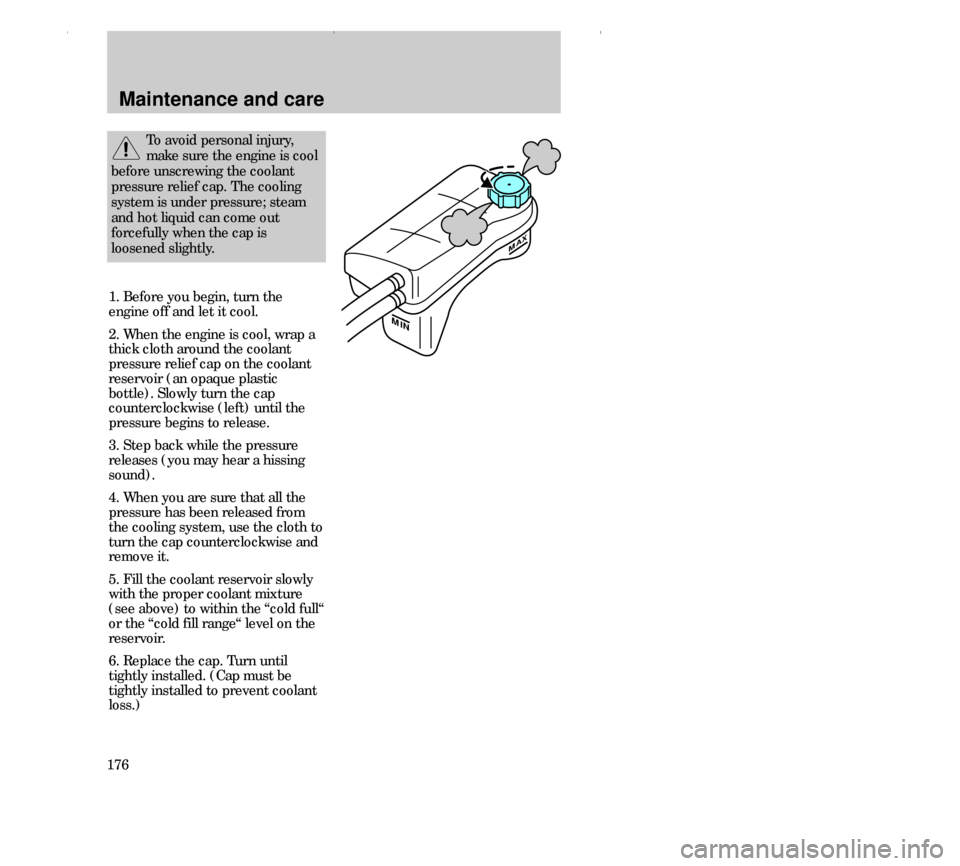
1761. Before you begin, turn the
engine off and let it cool.
2. When the engine is cool, wrap a
thick cloth around the coolant
pressure relief cap on the coolant
reservoir (an opaque plastic
bottle). Slowly turn the cap
counterclockwise (left) until the
pressure begins to release.
3. Step back while the pressure
releases (you may hear a hissing
sound).
4. When you are sure that all the
pressure has been released from
the cooling system, use the cloth to
turn the cap counterclockwise and
remove it.
5. Fill the coolant reservoir slowly
with the proper coolant mixture
(see above) to within the “cold full“
or the “cold fill range“ level on the
reservoir.
6. Replace the cap. Turn until
tightly installed. (Cap must be
tightly installed to prevent coolant
loss.)
To avoid personal injury,
make sure the engine is cool
before unscrewing the coolant
pressure relief cap. The cooling
system is under pressure; steam
and hot liquid can come out
forcefully when the cap is
loosened slightly.
MAX
MIN
31CMCen 17.6.99 11:15 Uhr Seite 176
Page 185 of 248

Maintenance and care
185 Relearning the idle function
Because your vehicle’s engine is
electronically controlled, some
control conditions are maintained
by power from the battery. When
the battery is disconnected or a
new battery is installed, the
computer must “relearn” its idle
conditions before your vehicle can
drive properly. To begin this
process:
1. Put the automatic transaxle
gearshift in P (Park). Put the
manual transaxle gearshift in
neutral.
2. Turn off all accessories and start
the vehicle.
3. Let the engine idle for at least
one minute.
4. The “relearning” process will
automatically complete as you
drive the vehicle.
• If you do not allow the engine to
“relearn” its idle, the idle quality of
your vehicle may be adversely
affected until the idle is eventually
“relearned”.
• If the battery has been
disconnected or if a new battery
has been installed, the clock and
preset radio stations must be reset
once the battery is reconnected.
31CMCen 17.6.99 11:15 Uhr Seite 185