transmission FORD E SERIES 1997 4.G User Guide
[x] Cancel search | Manufacturer: FORD, Model Year: 1997, Model line: E SERIES, Model: FORD E SERIES 1997 4.GPages: 192, PDF Size: 3.44 MB
Page 97 of 192

hilly country or on hot days.
Speed control may shut off if you
are towing on very long, steep
grades.
When towing a trailer
If towing a trailer and your vehicle
is not equipped with the Ford
trailer tow package, an auxiliary
transmission fluid cooler is
recommended.
²Use D (Drive) rather than
D(Overdrive) while towing up
or down steep hills. This will
eliminate excessive downshifting
and upshifting for optimum fuel
economy and transmission
cooling.
²Anticipate stops and brake
gradually.
²Allow more room for stopping
with a trailer attached.
²Practice turning, stopping and
backing in an area before
starting on a trip to get the feel
of the vehicle/trailer
combination.
²When turning, drive slightly
beyond the normal turning point
so the trailer wheels will clear
curbs and other obstacles.
²When stopped in traffic for long
periods of time in hot weather,
place the gearshift in P (Park)
to increase idle speed. This aids
engine cooling and air
conditioner efficiency.
²Vehicles with trailers should not
be parked on a grade. If you
eco_when_towing
Driving
97
Page 106 of 192

Number Fuse amperage
ratingCircuits protected
8 30 amp Noise supression
capacitor, ignition coil
positive feed, PCM
relay diode/PCM
power relay, fuel
heater (diesel), glow
plug relay (diesel)
9 30 amp Wiper control module,
wiper motor
10 20 amp Headlamp switch
(exterior lamps),
Multi-function switch
(flash-to-pass)
11 15 amp Stoplight switch, brake
pressure switch,
multi-function switch
12 15 amp Digital transmission
range sensor (backup
lamps), auxiliary
battery relay
13 15 amp A/C mode switch,
blend door actuator
14 5 amp Instrument cluster (air
bag and charge
indicator lamps)
15 5 amp Trailer tow battery
charge relay (coil)
16 30 amp Power seats
17 - Not used
18 - Not used
19 10 amp Air bag module
20 5 amp Overdrive cancel
switch
Roadside emergencies
106
Page 107 of 192
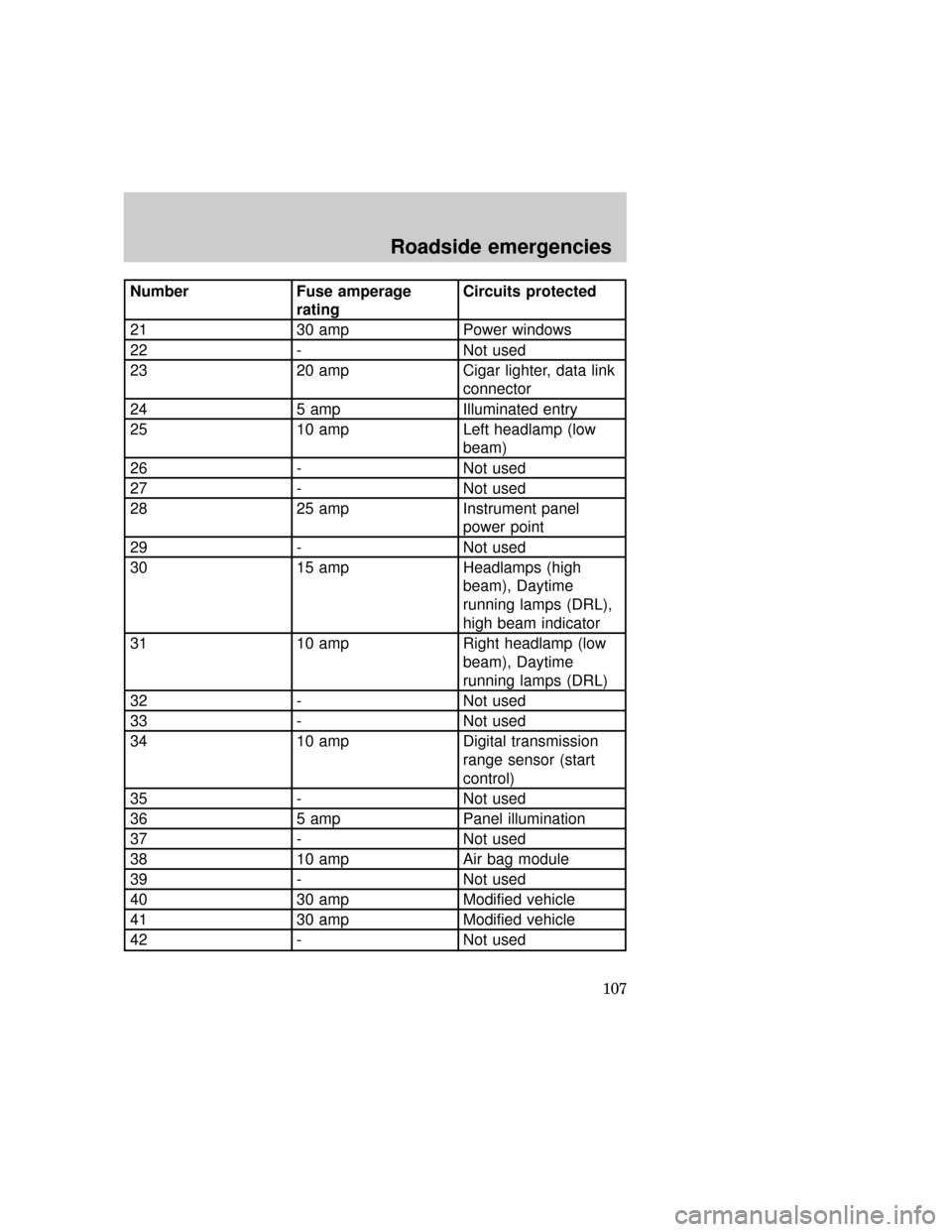
Number Fuse amperage
ratingCircuits protected
21 30 amp Power windows
22 - Not used
23 20 amp Cigar lighter, data link
connector
24 5 amp Illuminated entry
25 10 amp Left headlamp (low
beam)
26 - Not used
27 - Not used
28 25 amp Instrument panel
power point
29 - Not used
30 15 amp Headlamps (high
beam), Daytime
running lamps (DRL),
high beam indicator
31 10 amp Right headlamp (low
beam), Daytime
running lamps (DRL)
32 - Not used
33 - Not used
34 10 amp Digital transmission
range sensor (start
control)
35 - Not used
36 5 amp Panel illumination
37 - Not used
38 10 amp Air bag module
39 - Not used
40 30 amp Modified vehicle
41 30 amp Modified vehicle
42 - Not used
Roadside emergencies
107
Page 115 of 192
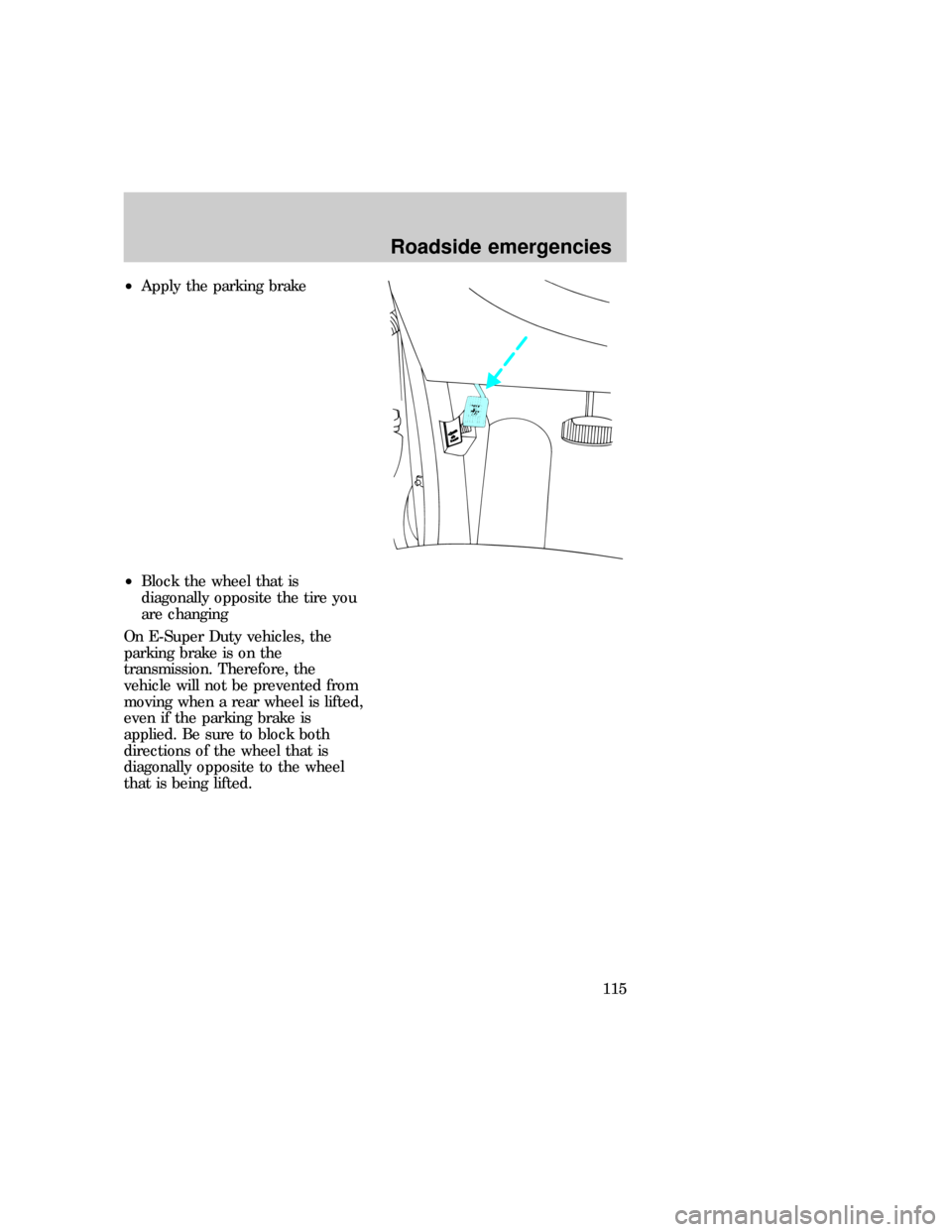
²Apply the parking brake
²Block the wheel that is
diagonally opposite the tire you
are changing
On E-Super Duty vehicles, the
parking brake is on the
transmission. Therefore, the
vehicle will not be prevented from
moving when a rear wheel is lifted,
even if the parking brake is
applied. Be sure to block both
directions of the wheel that is
diagonally opposite to the wheel
that is being lifted.
Roadside emergencies
115
Page 129 of 192
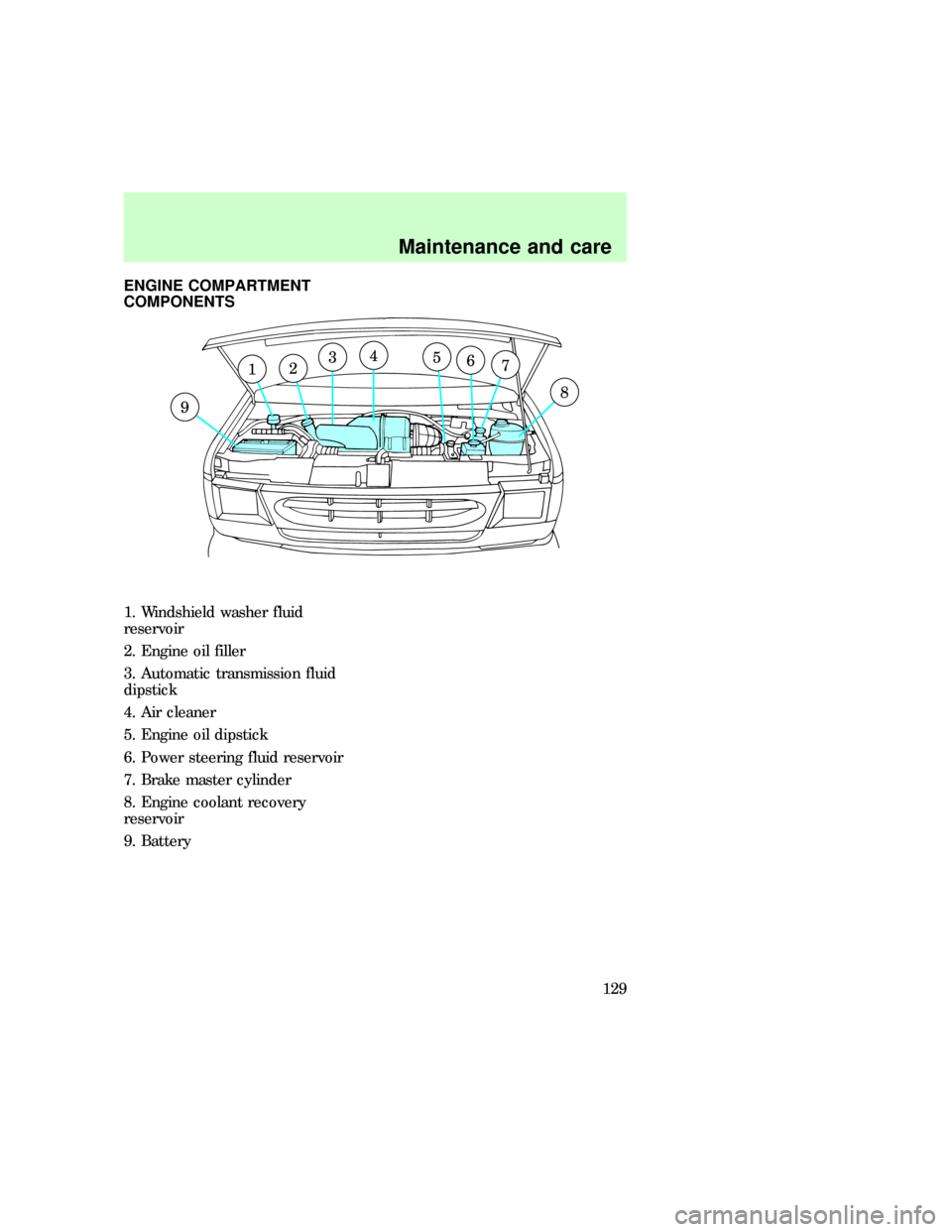
ENGINE COMPARTMENT
COMPONENTS
1. Windshield washer fluid
reservoir
2. Engine oil filler
3. Automatic transmission fluid
dipstick
4. Air cleaner
5. Engine oil dipstick
6. Power steering fluid reservoir
7. Brake master cylinder
8. Engine coolant recovery
reservoir
9. Battery
91234
5
6
7
8
com_check-add_oil.01
Maintenance and care
129
Page 141 of 192

CHECKING AND ADDING
AUTOMATIC TRANSMISSION
FLUID
Service the automatic transmission
according to the scheduled
intervals in the9Service Guide.9
Before adding any fluid, make sure
the correct type will be used. This
information is indicated on the
dipstick.
Do not drive the vehicle if the fluid
level is below the bottom hole on
the blade type dipstick (4R70W
transmission) or below the COLD
area on the bullet type dipstick
(E4OD transmission) and outside
temperatures are above 10ÉC
(50ÉF).
Your vehicle does not use up
transmission fluid. However, it is
recommended that you check the
transmission fluid at least twice a
year. The fluid level should be
checked if the transmission is not
working properly, i.e., if the
transmission slips or shifts slowly
or if you notice some sign of fluid
leakage.
It is preferable to check the
transmission fluid level at normal
operating temperature, after
approximately 32 km (20 miles) of
driving. However, you can check
the fluid level without driving to
obtain a normal operating
temperature if the outside
temperature is above 10ÉC (50ÉF).
If your vehicle has been operated
for an extended period at high
Maintenance and care
141
Page 142 of 192
speeds, in city traffic during hot
weather or pulling a trailer, the
vehicle should be turned off for
about 30 minutes to allow the fluid
to cool before checking.
1. Park the vehicle on a level
surface.
2. Start the engine and move the
gearshift lever through all of the
gear ranges. Allow sufficient time
for each gear to engage.
3. Latch the gearshift lever in P
(Park), set the parking brake and
leave the engine running.
4. Remove the dipstick, wiping it
clean with a clean, dry rag.
5. Install the dipstick.
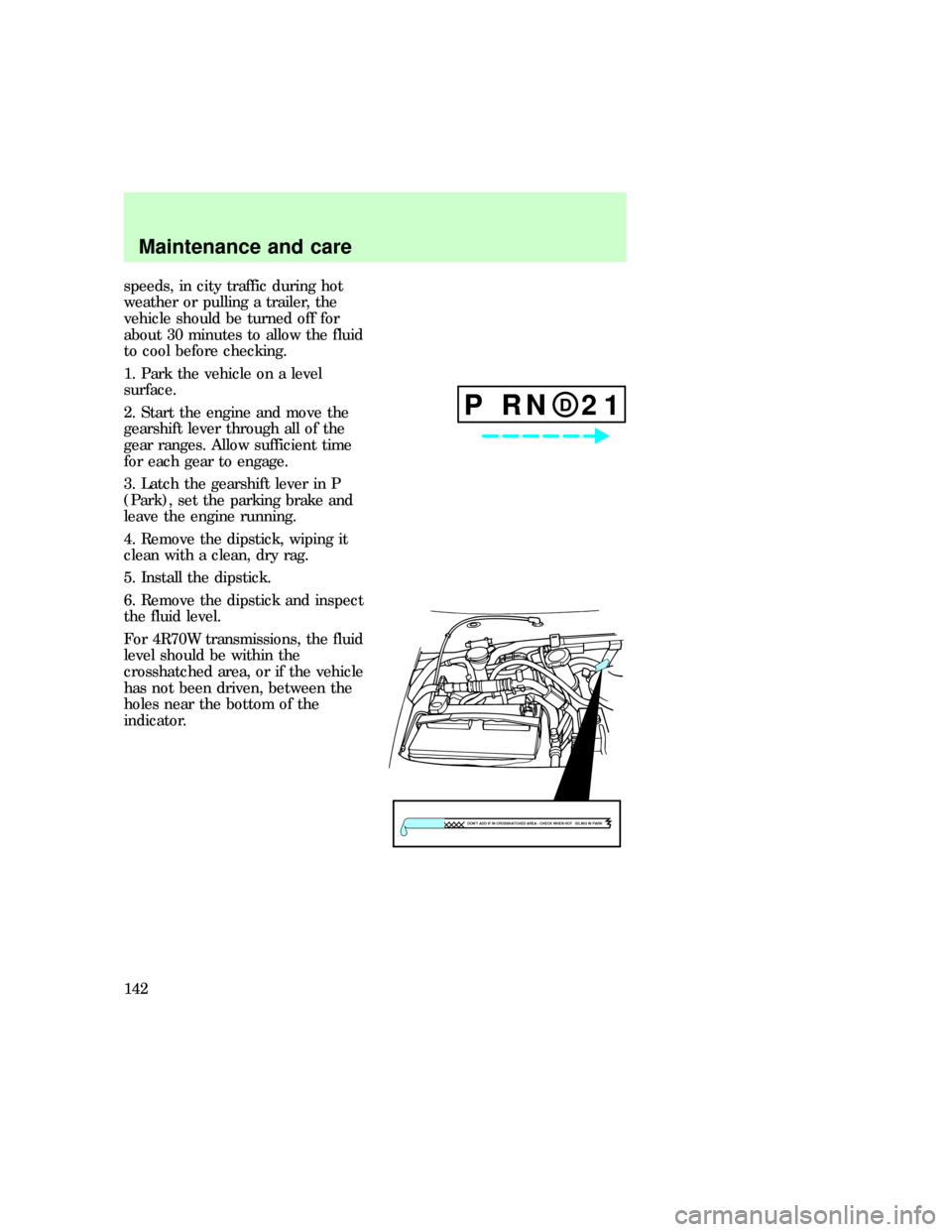
6. Remove the dipstick and inspect
the fluid level.
For 4R70W transmissions, the fluid
level should be within the
crosshatched area, or if the vehicle
has not been driven, between the
holes near the bottom of the
indicator.
P RN 21D
DON'T ADD IF IN CROSSHATCHED AREA - CHECK WHEN HOT IDLING IN PARK
Maintenance and care
142
Page 143 of 192
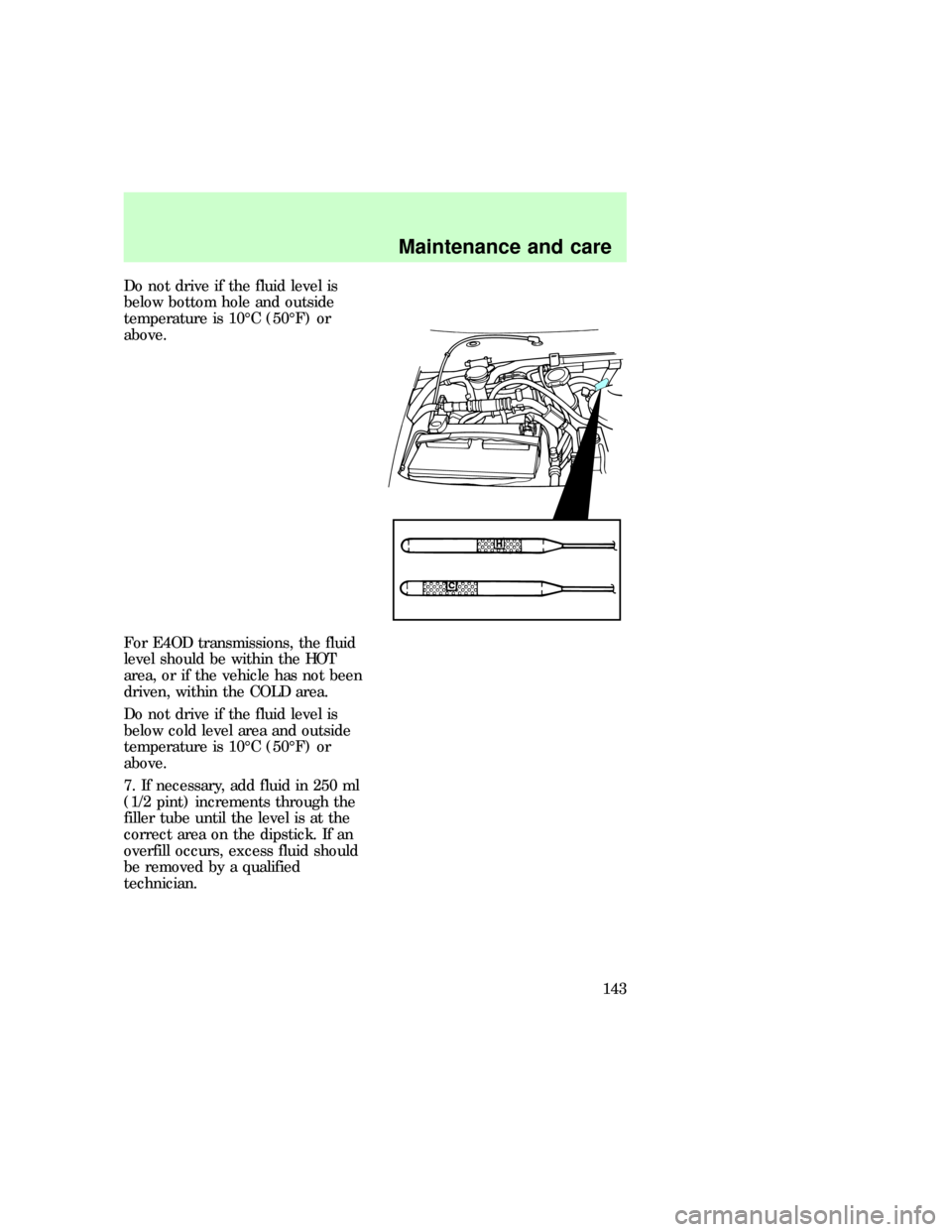
Do not drive if the fluid level is
below bottom hole and outside
temperature is 10ÉC (50ÉF) or
above.
For E4OD transmissions, the fluid
level should be within the HOT
area, or if the vehicle has not been
driven, within the COLD area.
Do not drive if the fluid level is
below cold level area and outside
temperature is 10ÉC (50ÉF) or
above.
7. If necessary, add fluid in 250 ml
(1/2 pint) increments through the
filler tube until the level is at the
correct area on the dipstick. If an
overfill occurs, excess fluid should
be removed by a qualified
technician.
com_universal_joint.01
Maintenance and care
143
Page 167 of 192

DescriptionNumber of
BulbsTrade Number
Interior Courtesy Lamps
Cargo lamp 1 211-2
Dome lamp (standard) 1 912
Instrument panel
illumination2 194
Map/reading lamp 2 211-2
Radio Illumination
1
Instrument Panel
Automatic transmission
gear selector1 194
Instrument Panel Controls
A/C control 1 161
Heater control 1 161
Instrument Cluster
Seat belt light 1 194
High beam indicator 1 194
Brake Warning 1 194
Turn signal indicator 1 194
Anti-lock brake system 1 194
Service engine soon 1 194
Air bag readniness 1 194
Door ajar 1 194
Oil pressure/engine
coolant1 194
1Replaceable at Ford authorized
radio service centers.
NA Ð Natural amber
K Ð Krypton filled bulb
com_cleaning_caring.01
Maintenance and care
167
Page 174 of 192

Fluid Application Capacity
Transmission3Automatic (4R70W) 13.1L (13.9 qts.)
Automatic (E4OD) 15.0L (15.9 qts.)
Fuel 138º wheelbase
(except E-Super Duty)132.5L (35.0 gal.)
158º wheelbase
(except E-Super Duty)140L (37.0 gal.)
4
176º wheelbase
(except E-Super Duty)140L (37.0 gal.)4
158º wheelbase
(E-Super Duty)208L (55 .0 gal.)
176º wheelbase
(E-Super Duty)208L (55 .0 gal.)
1Fill 6.4 mm to 14.2 mm (1/4º to
9/16º) below bottom of fill hole.
2Fill Dana rear axles to 1/4º to 3/4º
below bottom of fill hole.
3Always use dipstick to determine
exact fluid requirement.
4Optional tank, 208L (55 gal.).
LUBRICANT SPECIFICATIONS
Item Ford part name Ford part
numberFord
specification
Brake master
cylinderHigh
Performance
DOT 3 Motor
Vehicle Brake
FluidC6AZ-19542-AB ESA-M6C25-A,
DOT 3
Door
weatherstripsSilicone
LubricantC0AZ-19553-AA
and
D7AZ-19553-AAESR-M13P4-A
eco_lubricant_specifications
Capacities and specifications
174