transmission FORD E SERIES 1997 4.G Owners Manual
[x] Cancel search | Manufacturer: FORD, Model Year: 1997, Model line: E SERIES, Model: FORD E SERIES 1997 4.GPages: 192, PDF Size: 3.44 MB
Page 6 of 192
OVERDRIVE
ON
OFFRES
SET
ACCEL
COAST
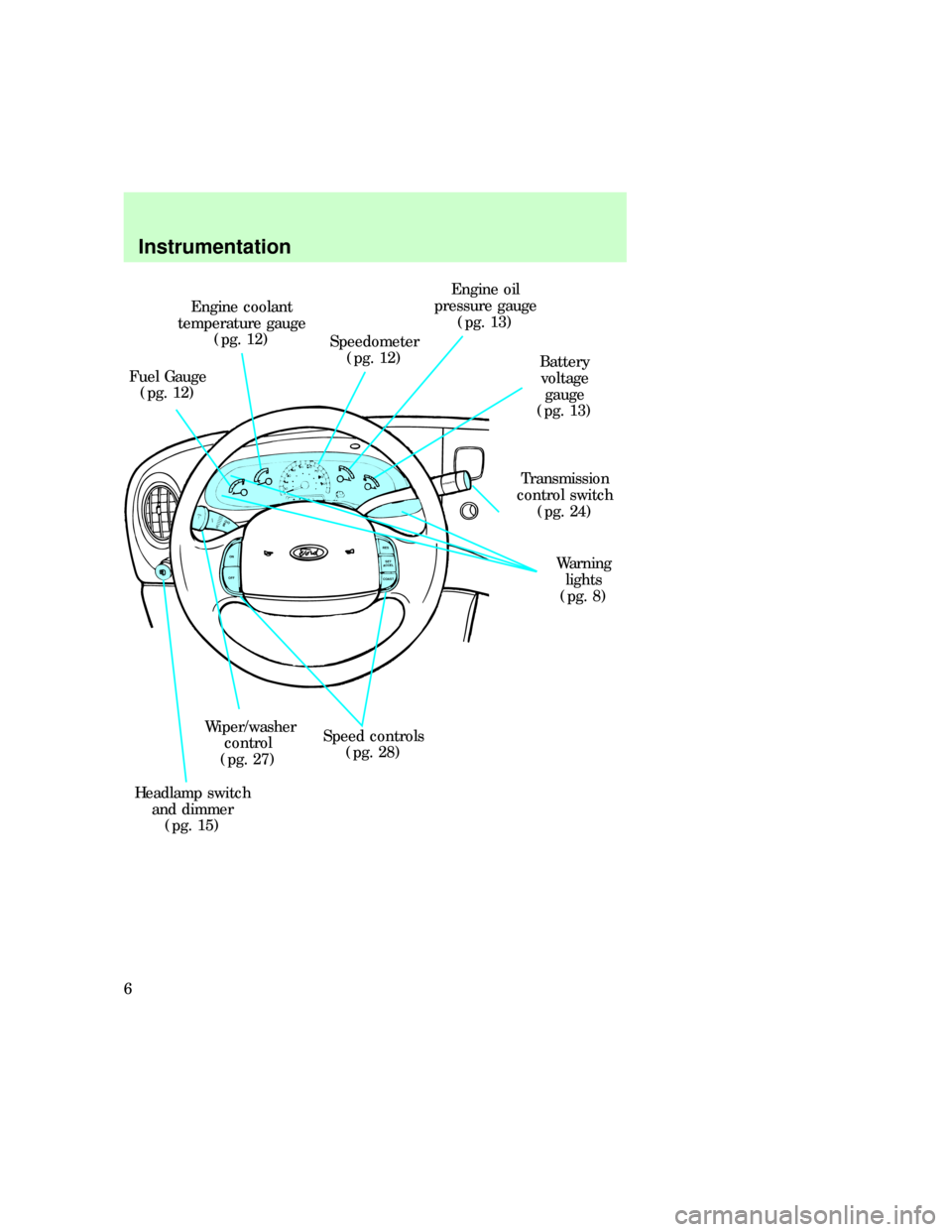
Engine coolant
temperature gauge
(pg. 12)
Fuel Gauge
(pg. 12)Speedometer
(pg. 12)Engine oil
pressure gauge
(pg. 13)
Battery
voltage
gauge
(pg. 13)
Warning
lights
(pg. 8)
Speed controls
(pg. 28)
Headlamp switch
and dimmer
(pg. 15)Transmission
control switch
(pg. 24)
Wiper/washer
control
(pg. 27)
Instrumentation
6
Page 9 of 192
in the ON position and the engine
is off.
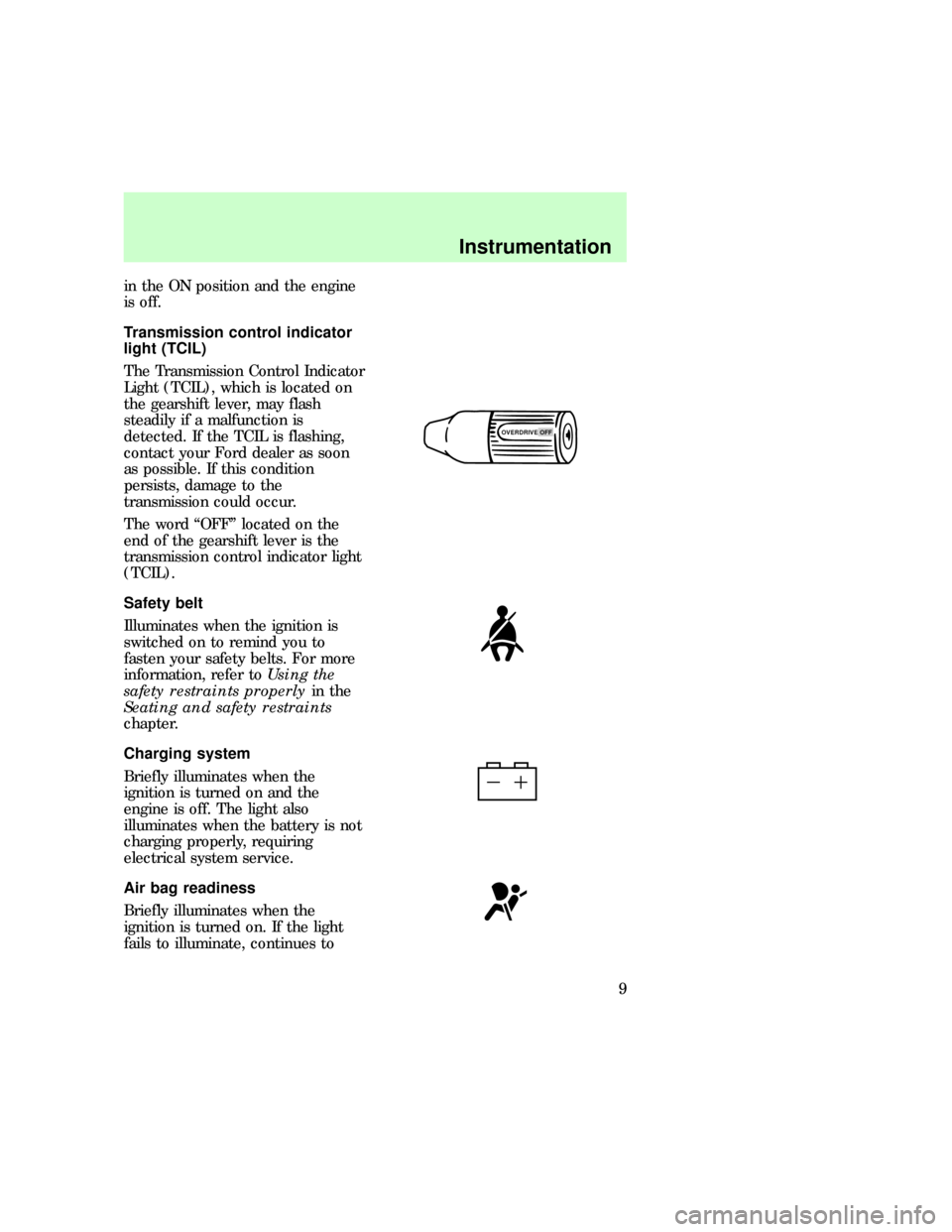
Transmission control indicator
light (TCIL)
The Transmission Control Indicator
Light (TCIL), which is located on
the gearshift lever, may flash
steadily if a malfunction is
detected. If the TCIL is flashing,
contact your Ford dealer as soon
as possible. If this condition
persists, damage to the
transmission could occur.
The word ªOFFº located on the
end of the gearshift lever is the
transmission control indicator light
(TCIL).
Safety belt
Illuminates when the ignition is
switched on to remind you to
fasten your safety belts. For more
information, refer toUsing the
safety restraints properlyin the
Seating and safety restraints
chapter.
Charging system
Briefly illuminates when the
ignition is turned on and the
engine is off. The light also
illuminates when the battery is not
charging properly, requiring
electrical system service.
Air bag readiness
Briefly illuminates when the
ignition is turned on. If the light
fails to illuminate, continues to
OVERDRIVE OFF
eco_trans_control_light
com_safety_belt.01
com_charging_system.01
com_air_bag.01
Instrumentation
9
Page 24 of 192
the vehiclein theStarting
chapter.
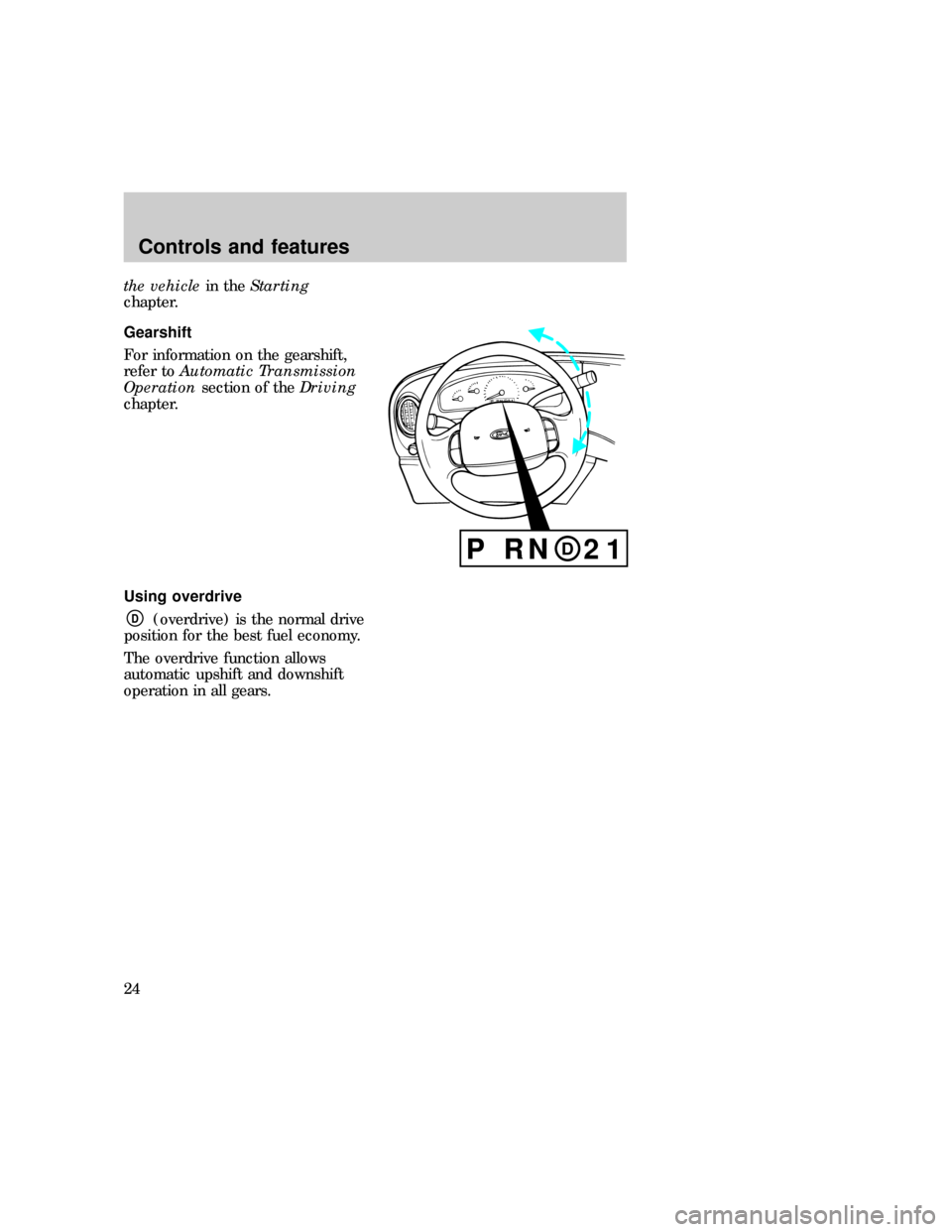
Gearshift
For information on the gearshift,
refer toAutomatic Transmission
Operationsection of theDriving
chapter.
Using overdrive
D(overdrive) is the normal drive
position for the best fuel economy.
The overdrive function allows
automatic upshift and downshift
operation in all gears.
P RN 21D
P RN 21D
eco_gearshift eco_overdrive_operation
eco_overdrive-off
Controls and features
24
Page 25 of 192
Deactivating overdrive
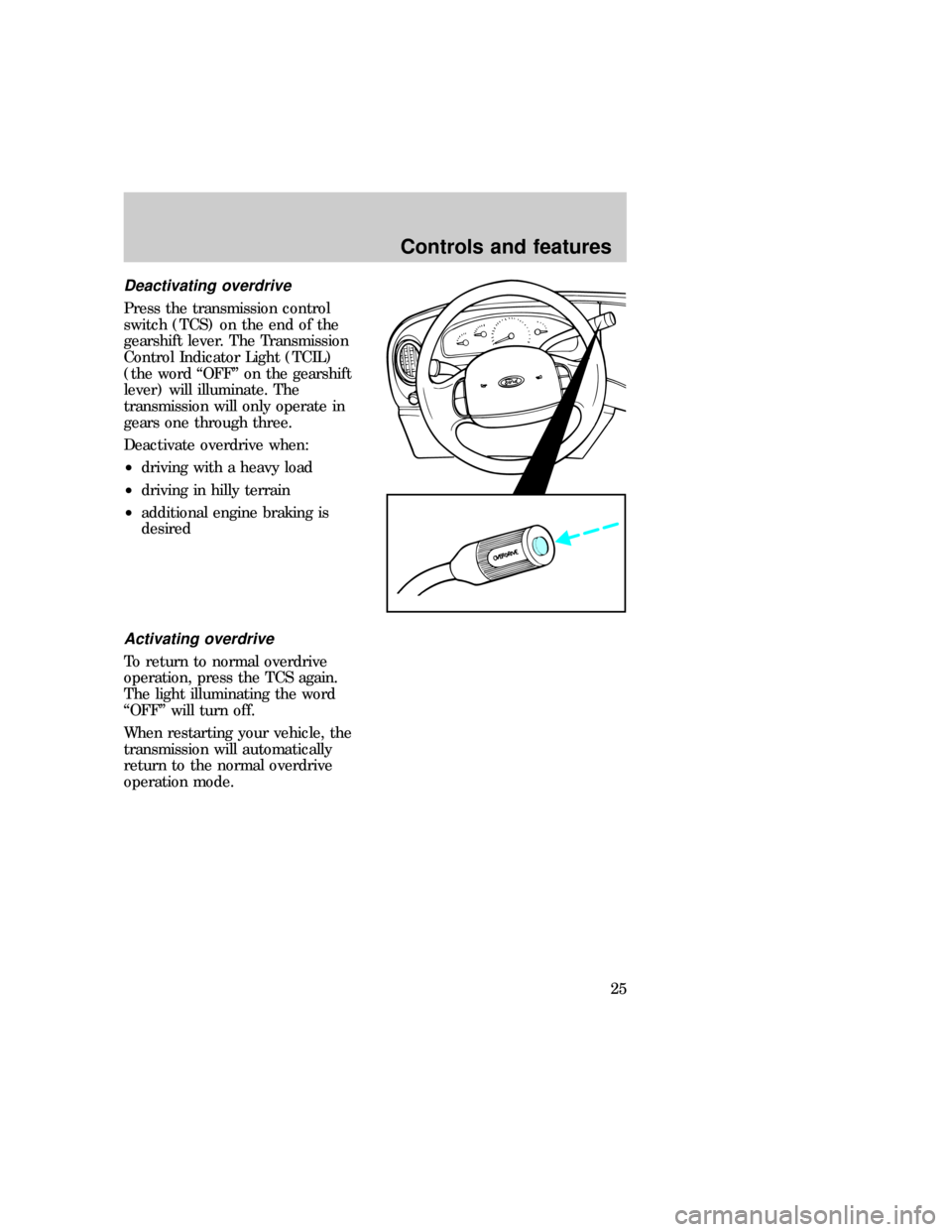
Press the transmission control
switch (TCS) on the end of the
gearshift lever. The Transmission
Control Indicator Light (TCIL)
(the word ªOFFº on the gearshift
lever) will illuminate. The
transmission will only operate in
gears one through three.
Deactivate overdrive when:
²driving with a heavy load
²driving in hilly terrain
²additional engine braking is
desired
Activating overdrive
To return to normal overdrive
operation, press the TCS again.
The light illuminating the word
ªOFFº will turn off.
When restarting your vehicle, the
transmission will automatically
return to the normal overdrive
operation mode.
eco_overdrive_activating
eco_trans_control_light
Controls and features
25
Page 26 of 192
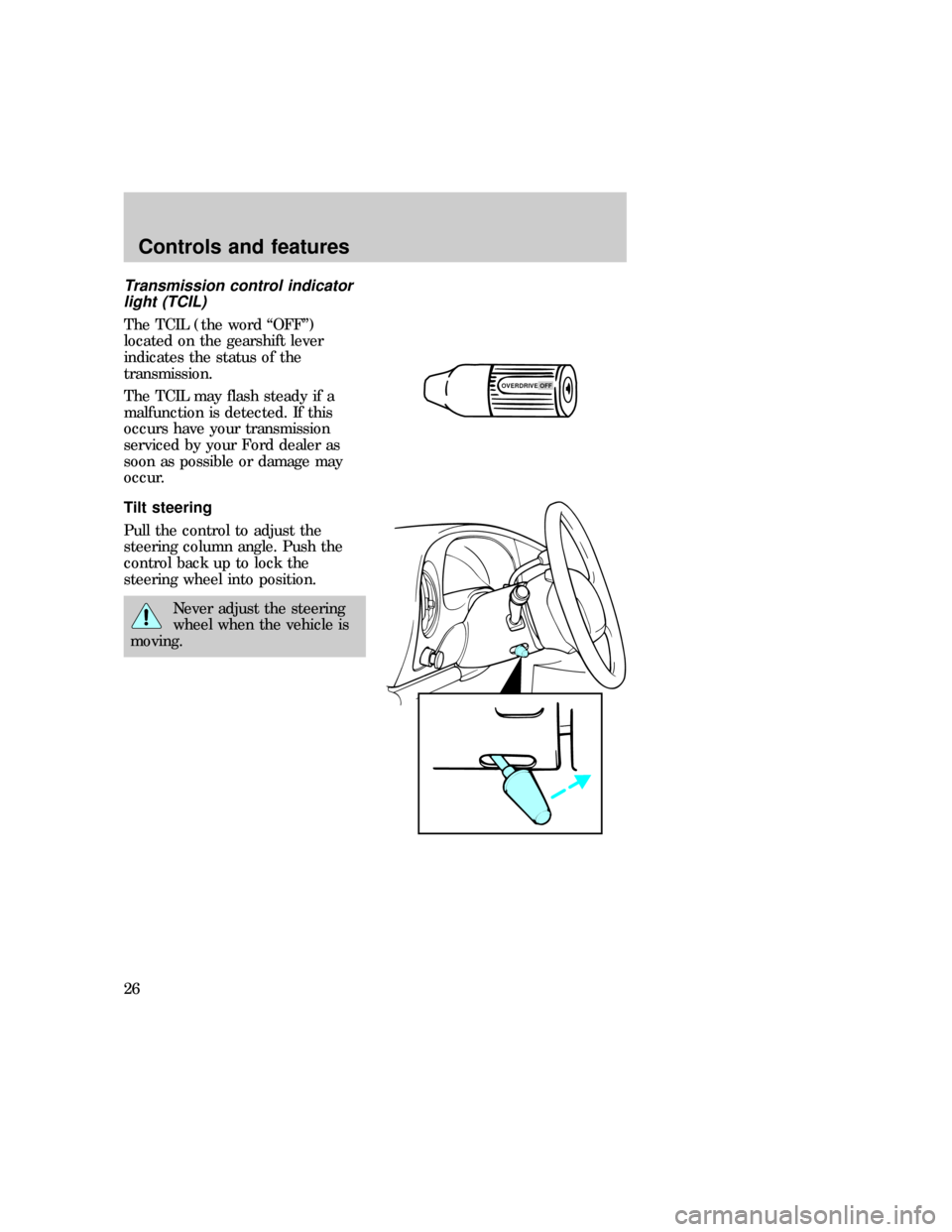
Transmission control indicator
light (TCIL)
The TCIL (the word ªOFFº)
located on the gearshift lever
indicates the status of the
transmission.
The TCIL may flash steady if a
malfunction is detected. If this
occurs have your transmission
serviced by your Ford dealer as
soon as possible or damage may
occur.
Tilt steering
Pull the control to adjust the
steering column angle. Push the
control back up to lock the
steering wheel into position.
Never adjust the steering
wheel when the vehicle is
moving.
OVERDRIVE OFF
eco_tilt-steering
eco_hazard_flasher
Controls and features
26
Page 83 of 192
steering wheel seem to be in a
different position while going
straight down the road, have the
suspension and steering checked
for possible damage.
AUTOMATIC TRANSMISSION
OPERATION
Hold the brake pedal down
while you move the
gearshift lever from position to
position. If you do not hold the
brake pedal down, your vehicle
may move unexpectedly and
injure someone.
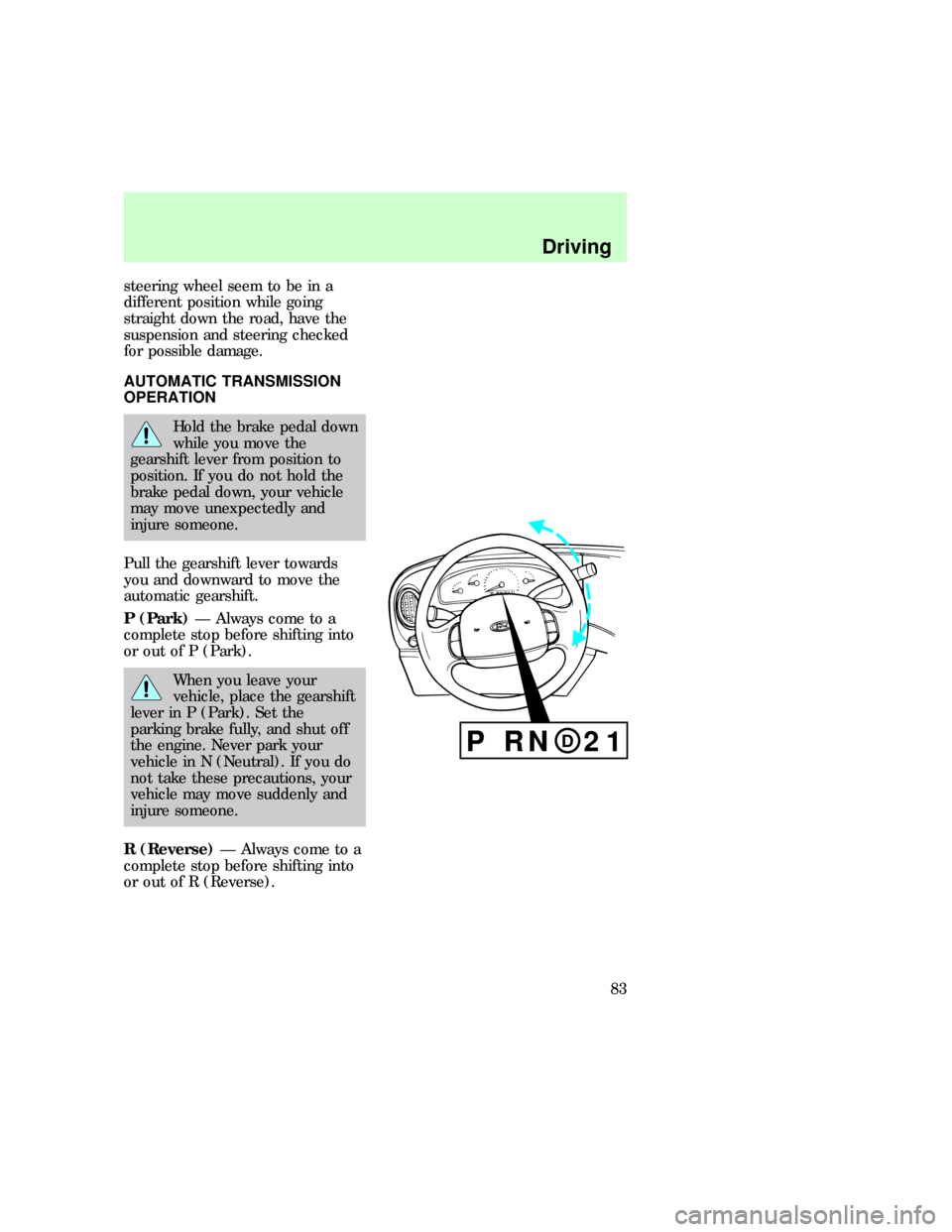
Pull the gearshift lever towards
you and downward to move the
automatic gearshift.
P (Park)Ð Always come to a
complete stop before shifting into
or out of P (Park).
When you leave your
vehicle, place the gearshift
lever in P (Park). Set the
parking brake fully, and shut off
the engine. Never park your
vehicle in N (Neutral). If you do
not take these precautions, your
vehicle may move suddenly and
injure someone.
R (Reverse)Ð Always come to a
complete stop before shifting into
or out of R (Reverse).
P RN 21D
P RN 21D
eco_automatic_trans
Driving
83
Page 84 of 192
N (Neutral)Ð Vehicle is free to
roll.
D(Overdrive)Ð The normal
driving position for the best fuel
economy. Transmission operates
automatically in gears one through
four.
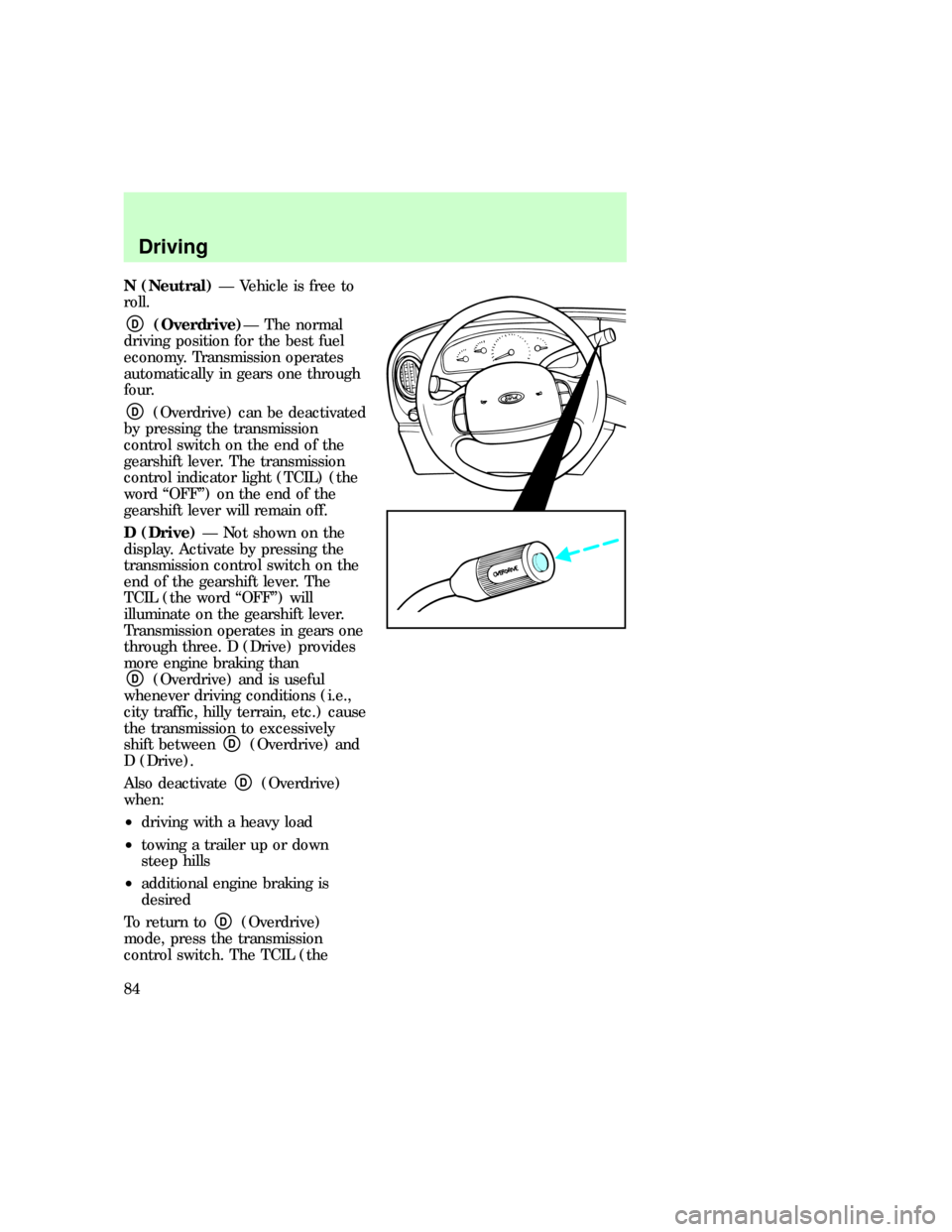
D(Overdrive) can be deactivated
by pressing the transmission
control switch on the end of the
gearshift lever. The transmission
control indicator light (TCIL) (the
word ªOFFº) on the end of the
gearshift lever will remain off.
D (Drive)Ð Not shown on the
display. Activate by pressing the
transmission control switch on the
end of the gearshift lever. The
TCIL (the word ªOFFº) will
illuminate on the gearshift lever.
Transmission operates in gears one
through three. D (Drive) provides
more engine braking than
D(Overdrive) and is useful
whenever driving conditions (i.e.,
city traffic, hilly terrain, etc.) cause
the transmission to excessively
shift between
D(Overdrive) and
D (Drive).
Also deactivate
D(Overdrive)
when:
²driving with a heavy load
²towing a trailer up or down
steep hills
²additional engine braking is
desired
To return to
D(Overdrive)
mode, press the transmission
control switch. The TCIL (the
Driving
84
Page 85 of 192

word ªOFFº) will no longer be
illuminated.
Each time the vehicle is started,
the transmission will automatically
return to normal overdrive mode
and you must press the TCS to
deactivate overdrive again if you
do not want overdrive operation.
2 (Second)Ð Use 2 (Second) to
start-up on slippery roads or to
provide additional engine braking
on downgrades. Transmission
operates in first and second gears.
1 (Low)Ð Use 1 (Low) to
provide maximum engine braking
on steep downgrades. Upshifts can
be made by shifting to 2 (Second)
or to
D(Overdrive). Selecting 1
(Low) at higher speeds causes a
shift to 2 (Second), and will shift
to 1 (Low) after vehicle
decelerates to the proper speed.
Brake-shift interlock
The brake-shift interlock feature
prevents you from shifting from P
(Park) unless the brake pedal is
depressed (with the ignition in the
ON position). If you cannot move
the gearshift out of P (Park) with
the brake pedal depressed:
1. Turn ignition key to Off.
2. Apply the parking brake.
3. Turn ignition key to Lock and
remove the key.
4. Re-insert the ignition key and
turn it to Off.
eco_brake_shift_inter-lock
Driving
85
Page 86 of 192
5. Shift the transmission to N
(Neutral).
6. Start the vehicle.
If you need to use the above
procedure, it is possible that a fuse
has blown and your brakelamps
may not be functioning. Refer to
theRoadside emergencies
chapter for instructions on
replacing fuses.
Do not drive your vehicle
until you verify that the
brakelamps are working.
VEHICLE LOADING
It is extremely dangerous
to ride in a cargo area,
inside or outside of a vehicle. In
a collision, people riding in these
areas are more likely to be
seriously injured or killed. Do not
allow people to ride in any area
of your vehicle that is not
equipped with seats and safety
belts. Be sure everyone in your
vehicle is in a seat and using a
safety belt properly.
Before loading a vehicle, familiarize
yourself with the following terms:
²Base Curb Weight:Weight of
the vehicle including any
standard equipment, fluids,
lubricants, etc. It does not
include passengers or
aftermarket equipment.
eco_heavy-load
Driving
86
Page 95 of 192
it does not shift and change the
weight on the hitch.
Towing a trailer places an
additional load on your vehicle's
engine, transmission, axle, brakes,
tires and suspension. Inspect these
components carefully after any
towing operation.
Do not exceed the GVWR
or the GAWR specified on
the Safety Compliance
Certification Label.
Towing trailers beyond the
maximum recommended
gross trailer weight could result
in engine damage,
transmission/axle damage,
structural damage, loss of
control, and personal injury.
Preparing to tow
Use the proper equipment for
towing a trailer, and make sure it
is properly attached to your
vehicle. See your dealer or a
reliable trailer dealer if you require
assistance.
Hitches
Do not use or install hitches that
clamp onto the bumper or to the
axle. Underbody hitches are
acceptable if installed properly.
Step bumper (if equipped)
Step bumpers have a built-in hitch
and only require a ball with a 2.5
cm (1 in.) shank diameter. Step
eco_preparing_tow
eco_hitch
eco_step-bumper
Driving
95