wheel FORD E SERIES 1998 4.G Owners Manual
[x] Cancel search | Manufacturer: FORD, Model Year: 1998, Model line: E SERIES, Model: FORD E SERIES 1998 4.GPages: 144, PDF Size: 2.14 MB
Page 21 of 144
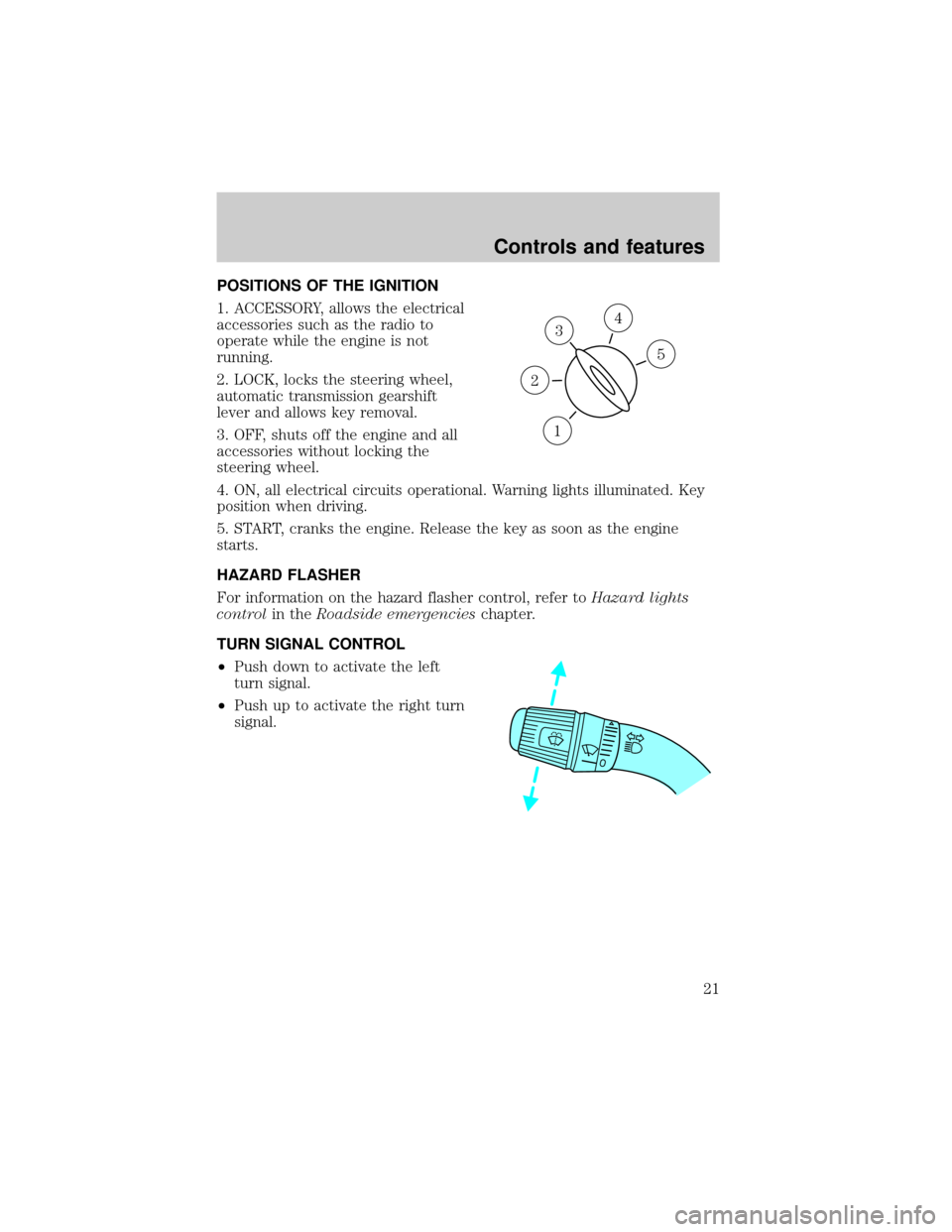
POSITIONS OF THE IGNITION
1. ACCESSORY, allows the electrical
accessories such as the radio to
operate while the engine is not
running.
2. LOCK, locks the steering wheel,
automatic transmission gearshift
lever and allows key removal.
3. OFF, shuts off the engine and all
accessories without locking the
steering wheel.
4. ON, all electrical circuits operational. Warning lights illuminated. Key
position when driving.
5. START, cranks the engine. Release the key as soon as the engine
starts.
HAZARD FLASHER
For information on the hazard flasher control, refer toHazard lights
controlin theRoadside emergencieschapter.
TURN SIGNAL CONTROL
²Push down to activate the left
turn signal.
²Push up to activate the right turn
signal.
3
1
2
5
4
Controls and features
21
Page 26 of 144
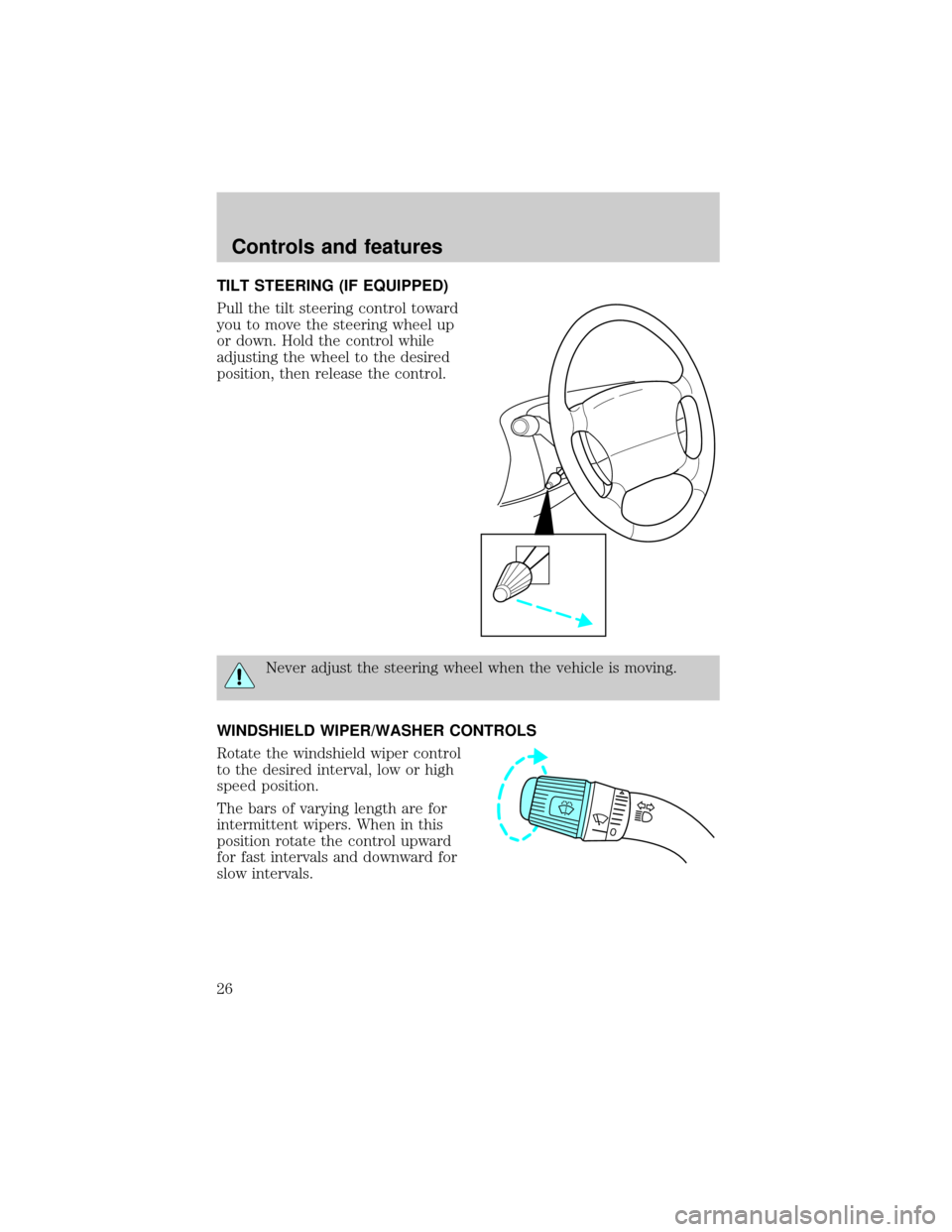
TILT STEERING (IF EQUIPPED)
Pull the tilt steering control toward
you to move the steering wheel up
or down. Hold the control while
adjusting the wheel to the desired
position, then release the control.
Never adjust the steering wheel when the vehicle is moving.
WINDSHIELD WIPER/WASHER CONTROLS
Rotate the windshield wiper control
to the desired interval, low or high
speed position.
The bars of varying length are for
intermittent wipers. When in this
position rotate the control upward
for fast intervals and downward for
slow intervals.
Controls and features
26
Page 47 of 144
Do not place objects or mount equipment on or near the air bag
cover on the steering wheel or in front seat areas that may come
into contact with a deploying air bag. Failure to follow this instruction
may increase the risk of personal injury in the event of a collision.
Do not attempt to service, repair, or modify the Air Bag
Supplemental Restraint System or its fuses. See your Ford or
Lincoln-Mercury dealer.
Children and air bags
For additional important safety
information, read all information on
safety restraints in this guide.
Children should always wear their
safety belts. Failure to follow these
instructions may increase the risk of
injury in a collision.
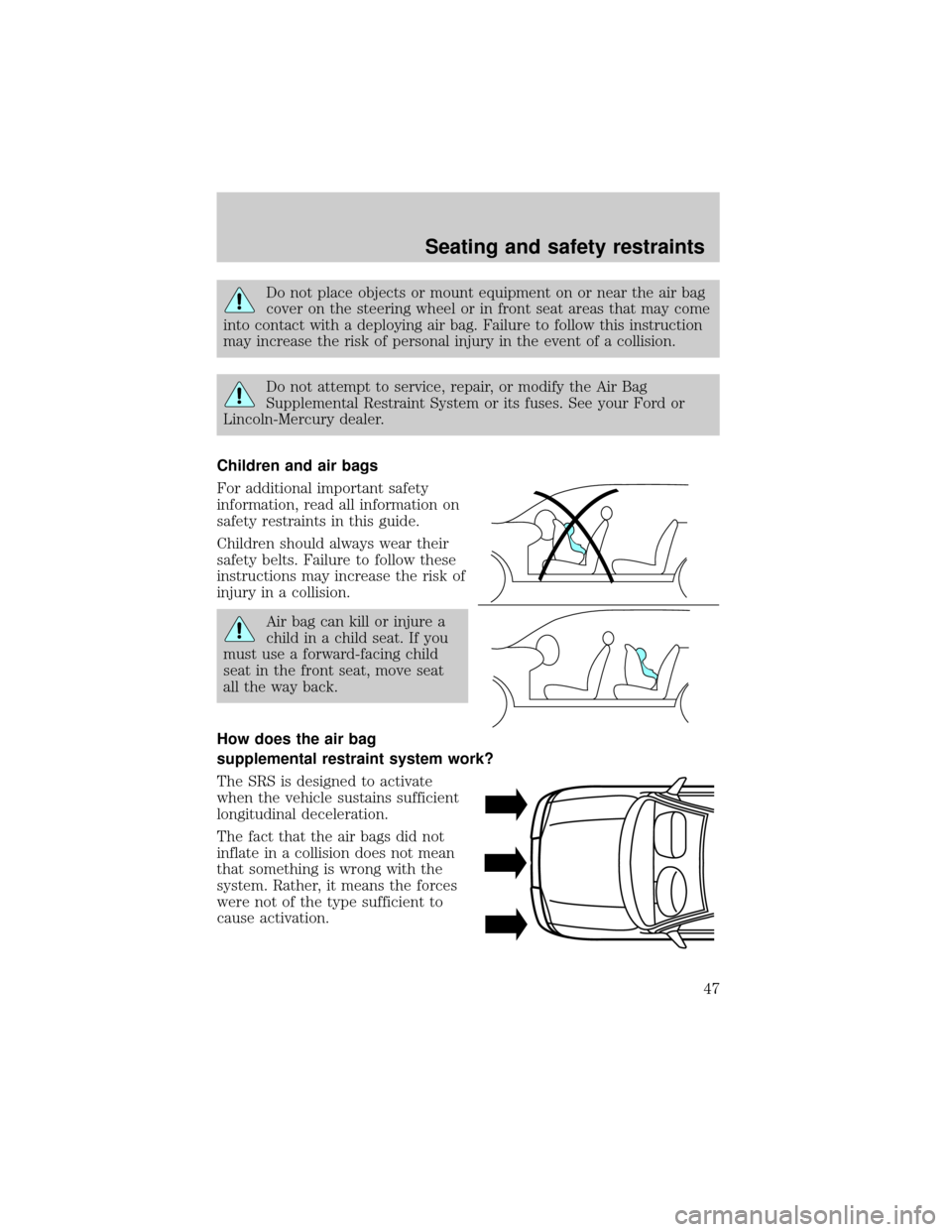
Air bag can kill or injure a
child in a child seat. If you
must use a forward-facing child
seat in the front seat, move seat
all the way back.
How does the air bag
supplemental restraint system work?
The SRS is designed to activate
when the vehicle sustains sufficient
longitudinal deceleration.
The fact that the air bags did not
inflate in a collision does not mean
that something is wrong with the
system. Rather, it means the forces
were not of the type sufficient to
cause activation.
Seating and safety restraints
47
Page 63 of 144
BRAKES
Your brakes are self-adjusting. Refer to the ªService Guideº for scheduled
maintenance.
Occasional brake noise is normal and often does not indicate a
performance concern with the vehicle's brake system. In normal
operation, automotive brake systems may emit occasional or intermittent
squeal or groan noises when the brakes are applied. Such noises are
usually heard during the first few brake applications in the morning;
however, they may be heard at any time while braking and can be
aggravated by environmental conditions such as cold, heat, moisture,
road dust, salt or mud. If a ªmetal-to-metal,º ªcontinuous grindingº or
ªcontinuous squealº sound is present while braking, the brake linings
may be worn-out and should be inspected by a qualified service
technician.
Anti-lock brake system (ABS) (if equipped)
On vehicles equipped with an anti-lock braking system (ABS), a noise
from the hydraulic pump motor and pulsation in the pedal may be
observed during ABS braking events. Pedal pulsation coupled with noise
while braking under panic conditions or on loose gravel, bumps, wet or
snowy roads is normal and indicates proper functioning of the vehicle's
anti-lock brake system. If the vehicle has continuous vibration or shudder
while braking, felt mainly in the steering wheel, the vehicle most likely
needs service.
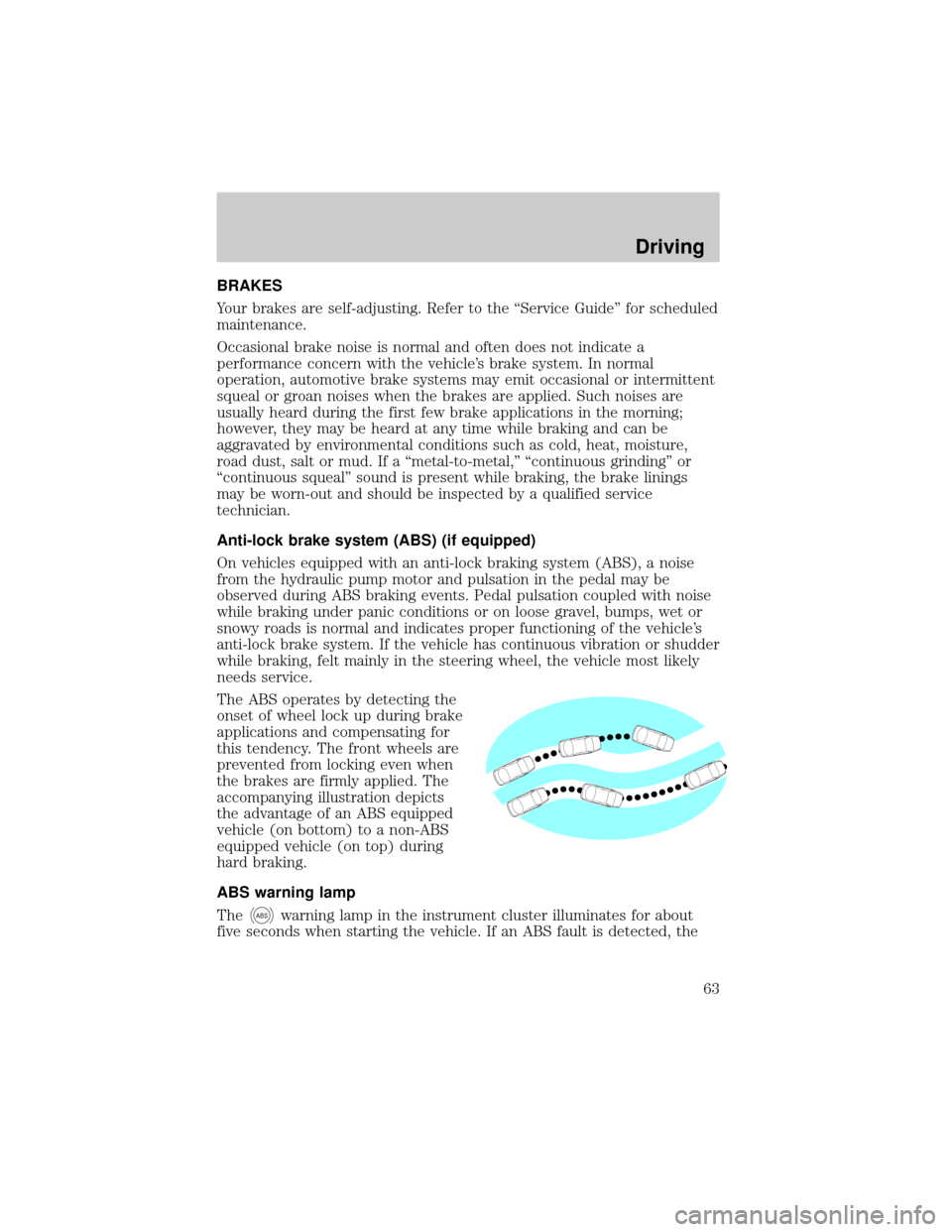
The ABS operates by detecting the
onset of wheel lock up during brake
applications and compensating for
this tendency. The front wheels are
prevented from locking even when
the brakes are firmly applied. The
accompanying illustration depicts
the advantage of an ABS equipped
vehicle (on bottom) to a non-ABS
equipped vehicle (on top) during
hard braking.
ABS warning lamp
The
ABSwarning lamp in the instrument cluster illuminates for about
five seconds when starting the vehicle. If an ABS fault is detected, the
Driving
63
Page 70 of 144

DRIVING THROUGH WATER
Do not drive quickly through standing water, especially if the depth is
unknown. Traction or brake capability may be limited and if the ignition
system gets wet, your engine may stall. Water may also enter your
engine's air intake and severely damage your engine.
If driving through deep or standing water is unavoidable, proceed very
slowly. Never drive through water that is higher than the bottom of the
hubs (truck)/wheel rims (car).
Once through the water, always try the brakes. Wet brakes do not stop
the vehicle as effectively as dry brakes. Drying can be improved by
moving your vehicle slowly while applying light pressure on the brake
pedal.
TRAILER TOWING
Your vehicle may tow a class I, II or III trailer provided the maximum
trailer weight is less than or equal to the maximum trailer weight listed
for your engine and rear axle ratio on the following charts.
Trailer Towing Table
GCWR (Gross Combined Weight Rating)/Trailer Weights
EngineRear
axle
ratioMaximum
GCWR-kg
(lbs.)Trailer weight
range-kg (lbs.)
(0-Maximum)Maximum
Frontal Area
Of Trailer-m
2
(ft2)
Regular Van E-150
4.2L 3.31 4 082 (9 000) 1 860 (4 100) 5.52 (60)
4.2L 3.55 4 536 (10 000) 2 313 (5 100) 5.52 (60)
4.6L 3.31 4 990 (11 000) 2 766 (6 100) 5.52 (60)
4.6L 3.55 5 216 (11 500) 2 993 (6 600) 5.52 (60)
5.4L 3.55 5 443 (12 000) 3 130 (6 900) 5.52 (60)
Regular Van E-250
4.2L 3.73 4 763 (10 500) 2 359 (5 200) 5.52 (60)
5.4L 3.73 5 897 (13 000) 3 402 (7 500) 5.52 (60)
Regular Van E-250 HD
4.2L 4.09 4 990 (11 000) 2 586 (5 700) 5.52 (60)
5.4L 3.73 5 897 (13 000) 3 402 (7 500) 5.52 (60)
Driving
70
Page 72 of 144

Trailer Towing Table
GCWR (Gross Combined Weight Rating)/Trailer Weights
EngineRear
axle
ratioMaximum
GCWR-kg
(lbs.)Trailer weight
range-kg (lbs.)
(0-Maximum)Maximum
Frontal Area
Of Trailer-m
2
(ft2)
4.6L 3.55 5 216 (11 500) 2 767 (6 100) 5.52 (60)
5.4L 3.55 5 443 (12 000) 2 948 (6 500) 5.52 (60)
Club Wagon Regular E-350 (12 passenger)
5.4L 3.55 5 443 (12 000) 2 722 (6 000) 5.52 (60)
5.4L 4.10 5 897 (13 000) 3 175 (7 000) 5.52 (60)
6.8L 3.73 6 804 (15 000) 4 037 (8 900) 5.52 (60)
6.8L 4.10 8 392 (18 500) 4 536 (10 000) 5.52 (60)
7.3L
(Diesel)3.55 7 258 (16 000) 4 309 (9 500) 5.52 (60)
7.3L
(Diesel)4.10 9 072 (20 000) 4 536 (10 000) 5.52 (60)
Club Wagon Super E-350 (15 passenger)
5.4L 3.55 5 443 (12 000) 2 586 (5 700) 5.52 (60)
5.4L 4.10 5 897 (13 000) 3 039 (6 700) 5.52 (60)
6.8L 3.73 6 804 (15 000) 3 901 (8 600) 5.52 (60)
6.8L 4.10 8 392 (18 500) 4 536 (10 000) 5.52 (60)
7.3L
(Diesel)3.55 7 258 (16 000) 4 173 (9 200) 5.52 (60)
7.3L
(Diesel)4.10 9 072 (20 000) 4 536 (10 000) 5.52 (60)
E-350 RV Cutaway (single rear wheel)
7.3L
(Diesel)4.10 9 072 (20 000) 4 717 (10 400)* 5.52 (60)
E-350 RV Cutaway (dual rear wheel)
5.4L 4.10 5 897 (13 000) 1 134 (2 500) 5.52 (60)
6.8L 4.10 8 392 (18 500) 3 629 (8 000) 5.52 (60)
7.3L
(Diesel)4.10 9 072 (20 000) 4 309 (9 500) 5.52 (60)
Driving
72
Page 73 of 144

Trailer Towing Table
GCWR (Gross Combined Weight Rating)/Trailer Weights
EngineRear
axle
ratioMaximum
GCWR-kg
(lbs.)Trailer weight
range-kg (lbs.)
(0-Maximum)Maximum
Frontal Area
Of Trailer-m
2
(ft2)
E-350 Commercial Cutaway (single rear wheel)
7.3L
(Diesel)4.10 9 072 (20 000) 4 717 (10 400)* 5.52 (60)
E-350 Commercial Cutaway (dual rear wheel)
5.4L 4.10 5 897 (13 000) 1 225 (2 700) 5.52 (60)
6.8L 4.10 8 392 (18 500) 3 720 (8 200) 5.52 (60)
7.3L
(Diesel)4.10 9 072 (20 000) 4 400 (9 700) 5.52 (60)
E-Super Duty
6.8L 4.63 9 072 (20 000) 4 536 (10 000) 5.52 (60)
7.3L
(Diesel)4.63 9 072 (20 000) 4 536 (10 000) 5.52 (60)
E-250/350 Stripped Chassis (single rear wheel)
4.2L 4.09 4 990 (11 000) 1 090 (2 400) 5.52 (60)
5.4L 4.10 5 897 (13 000) 1 542 (3 400) 5.52 (60)
6.8L 3.73 6 804 (15 000) 2 540 (5 600) 5.52 (60)
E-250/350 Stripped Chassis (dual rear wheel)
5.4L 4.10 5 897 (13 000) 1 361 (3 000) 5.52 (60)
6.8L 4.10 8 392 (18 500) 3 856 (8 500) 5.52 (60)
Maximum loaded trailer weight of 4 717 kg (10 400 lbs.) on 7.3L E350
RV and commercial cutaways (single rear wheel) applicable to fifth
wheel trailer usage only. Otherwise, maximum trailer weight is 4 536 kg
(10 000 lbs.).
For high altitude operation reduce GCWR by 2% per 300 meters
(1 000 ft) elevation.
To determine the maximum trailer weight designed for you particular
vehicle as equipped, follow the sectionCalculating the load your
vehicle can tow/carryearlier in this chapter.
Driving
73
Page 76 of 144

Trailer towing tips
²Practice turning, stopping and backing up in an area before starting on
a trip to get the feel of the vehicle trailer combination. When turning,
make wider turns so the trailer wheels will clear curbs and other
obstacles.
²Allow more distance for stopping with a trailer attached.
²The trailer tongue weight should be 10±15% of the loaded trailer
weight.
²After you have traveled 80 km (50 miles), thoroughly check your
hitch, electrical connections and trailer wheel lug nuts.
²When stopped in traffic for long periods of time in hot weather, place
the gearshift in P (Park) and increase idle speed. This aids engine
cooling and air conditioner efficiency.
²Vehicles with trailers should not be parked on a grade. If you must
park on a grade, place wheel chocks under the trailer's wheels.
Launching or retrieving a boat
When backing down a ramp during boat launching or retrieval,
²Do not allow the static water level to rise above the bottom edge of
the rear bumper and
²Do not allow waves to break higher than 15 cm (six inches) above the
bottom edge of the rear bumper.
Exceeding these limits may allow water to enter critical vehicle
components, adversely affecting driveability, emissions and reliability.
If the rear axle is submerged in water, the rear axle lubricant should be
changed. Axle lubricant quantities are not to be checked unless a leak is
suspected.
FUEL CONSUMPTION
Fuel economy can be improved by avoiding:
²lack of regular, scheduled maintenance.
²excessive speed.
²rapid acceleration.
²extended idle.
Driving
76
Page 79 of 144
FUSES AND RELAYS
Fuses
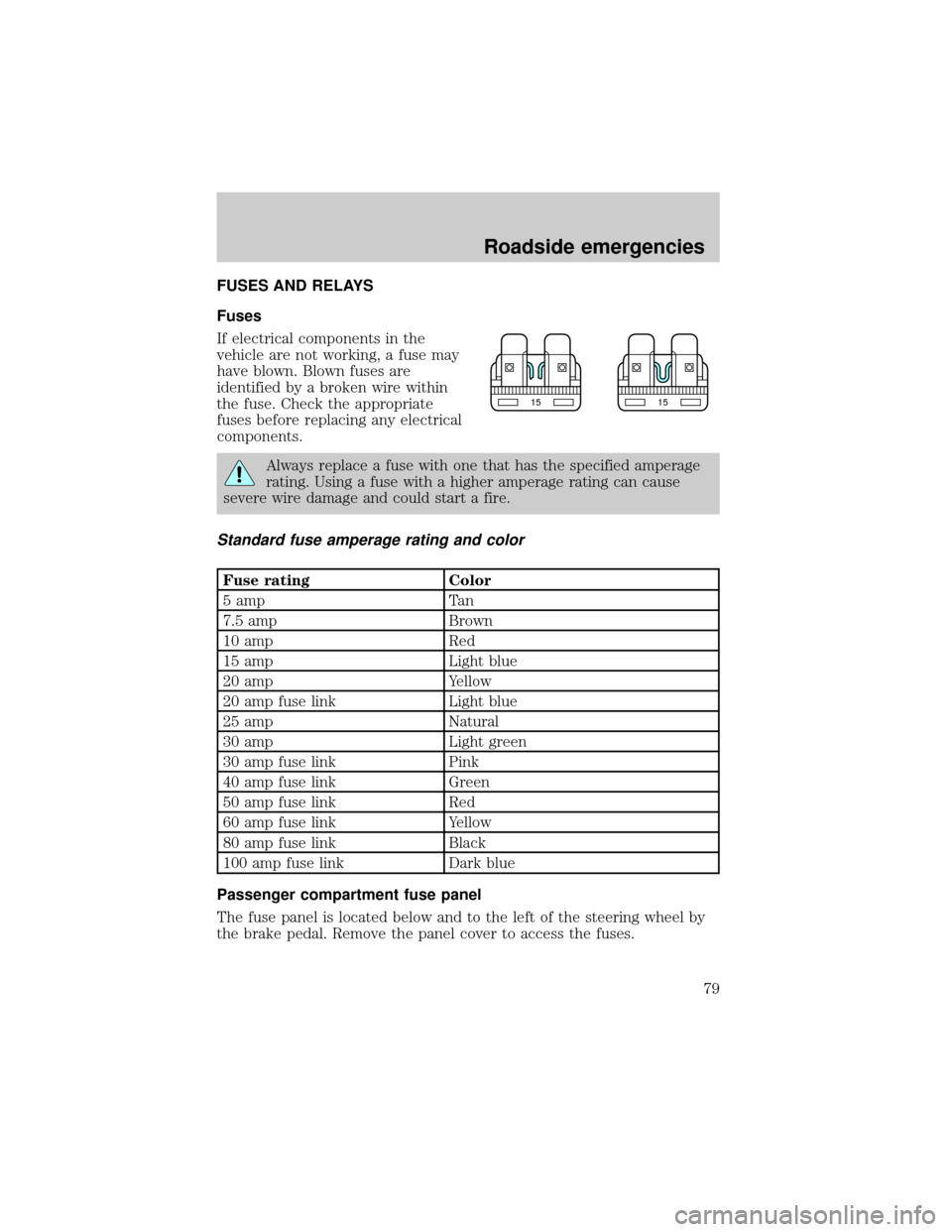
If electrical components in the
vehicle are not working, a fuse may
have blown. Blown fuses are
identified by a broken wire within
the fuse. Check the appropriate
fuses before replacing any electrical
components.
Always replace a fuse with one that has the specified amperage
rating. Using a fuse with a higher amperage rating can cause
severe wire damage and could start a fire.
Standard fuse amperage rating and color
Fuse rating Color
5 amp Tan
7.5 amp Brown
10 amp Red
15 amp Light blue
20 amp Yellow
20 amp fuse link Light blue
25 amp Natural
30 amp Light green
30 amp fuse link Pink
40 amp fuse link Green
50 amp fuse link Red
60 amp fuse link Yellow
80 amp fuse link Black
100 amp fuse link Dark blue
Passenger compartment fuse panel
The fuse panel is located below and to the left of the steering wheel by
the brake pedal. Remove the panel cover to access the fuses.
1515
Roadside emergencies
79
Page 85 of 144
CHANGING THE TIRES
If you get a flat tire while driving, do not apply the brake heavily.
Instead, gradually decrease your speed. Hold the steering wheel firmly
and slowly move to a safe place on the side of the road.
Spare tire information
The spare tire for your vehicle is stowed under the rear of your vehicle
(except cutaway and stripped chassis models).
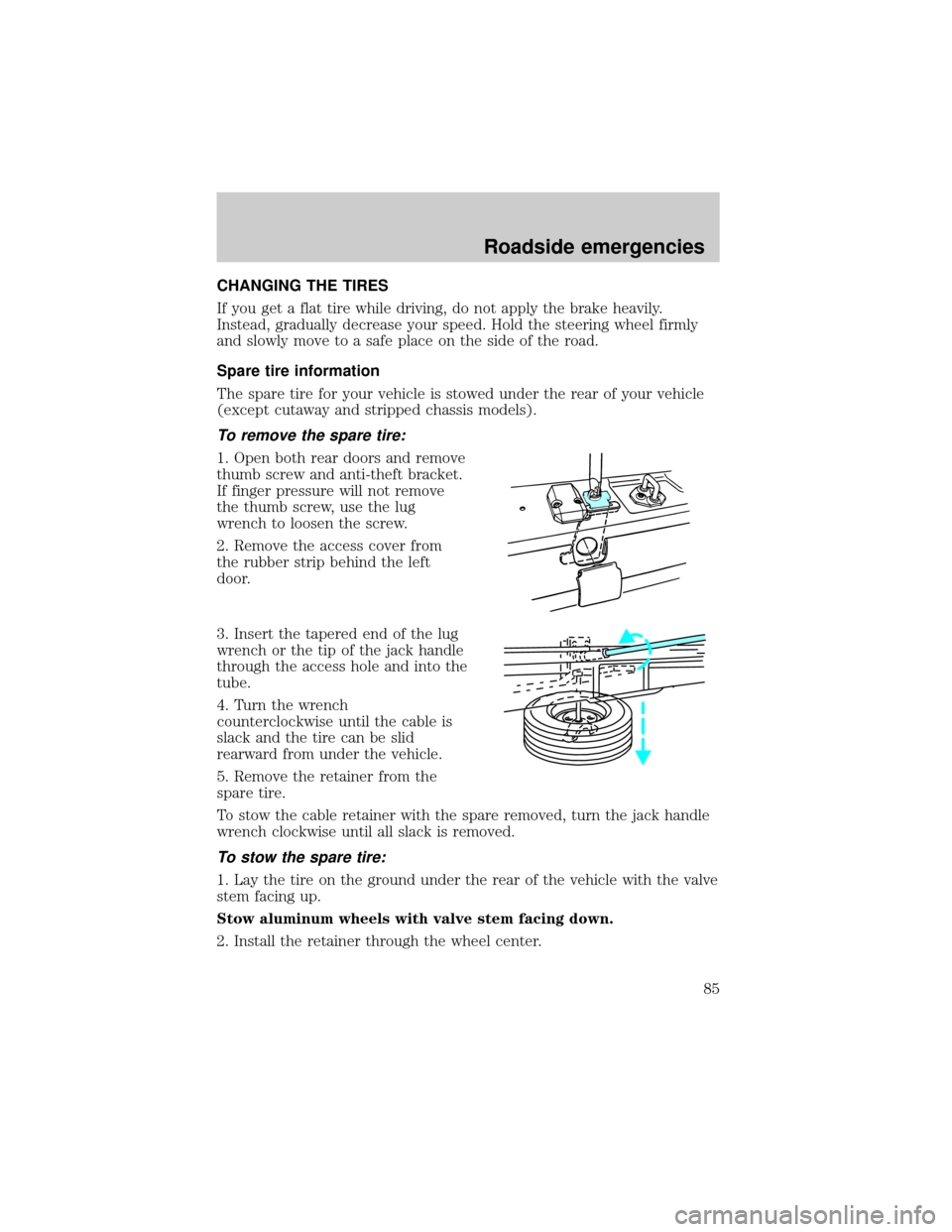
To remove the spare tire:
1. Open both rear doors and remove
thumb screw and anti-theft bracket.
If finger pressure will not remove
the thumb screw, use the lug
wrench to loosen the screw.
2. Remove the access cover from
the rubber strip behind the left
door.
3. Insert the tapered end of the lug
wrench or the tip of the jack handle
through the access hole and into the
tube.
4. Turn the wrench
counterclockwise until the cable is
slack and the tire can be slid
rearward from under the vehicle.
5. Remove the retainer from the
spare tire.
To stow the cable retainer with the spare removed, turn the jack handle
wrench clockwise until all slack is removed.
To stow the spare tire:
1. Lay the tire on the ground under the rear of the vehicle with the valve
stem facing up.
Stow aluminum wheels with valve stem facing down.
2. Install the retainer through the wheel center.
Roadside emergencies
85