battery FORD E SERIES 2002 4.G User Guide
[x] Cancel search | Manufacturer: FORD, Model Year: 2002, Model line: E SERIES, Model: FORD E SERIES 2002 4.GPages: 272, PDF Size: 2.6 MB
Page 179 of 272
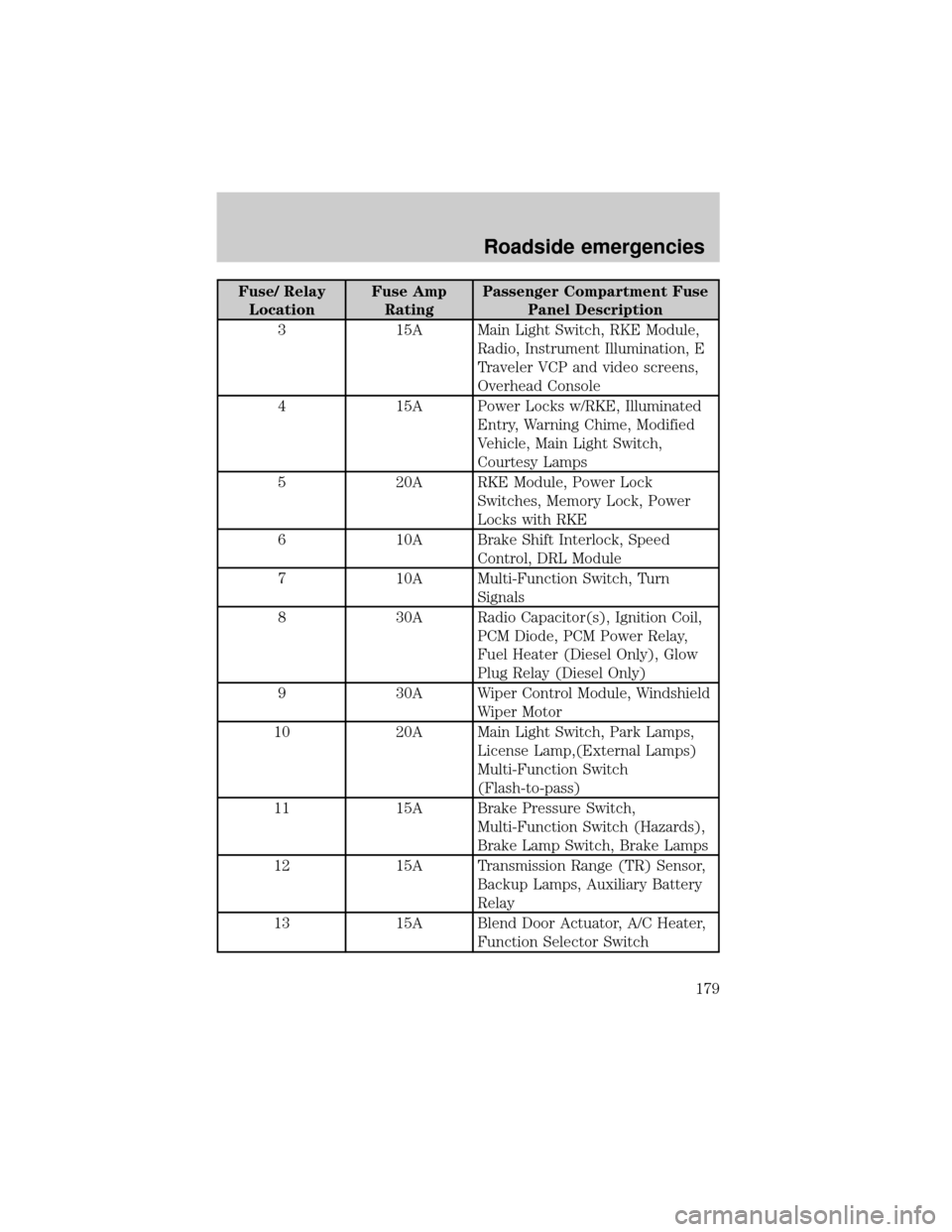
Fuse/ Relay
LocationFuse Amp
RatingPassenger Compartment Fuse
Panel Description
3 15A Main Light Switch, RKE Module,
Radio, Instrument Illumination, E
Traveler VCP and video screens,
Overhead Console
4 15A Power Locks w/RKE, Illuminated
Entry, Warning Chime, Modified
Vehicle, Main Light Switch,
Courtesy Lamps
5 20A RKE Module, Power Lock
Switches, Memory Lock, Power
Locks with RKE
6 10A Brake Shift Interlock, Speed
Control, DRL Module
7 10A Multi-Function Switch, Turn
Signals
8 30A Radio Capacitor(s), Ignition Coil,
PCM Diode, PCM Power Relay,
Fuel Heater (Diesel Only), Glow
Plug Relay (Diesel Only)
9 30A Wiper Control Module, Windshield
Wiper Motor
10 20A Main Light Switch, Park Lamps,
License Lamp,(External Lamps)
Multi-Function Switch
(Flash-to-pass)
11 15A Brake Pressure Switch,
Multi-Function Switch (Hazards),
Brake Lamp Switch, Brake Lamps
12 15A Transmission Range (TR) Sensor,
Backup Lamps, Auxiliary Battery
Relay
13 15A Blend Door Actuator, A/C Heater,
Function Selector Switch
Roadside emergencies
179
Page 180 of 272
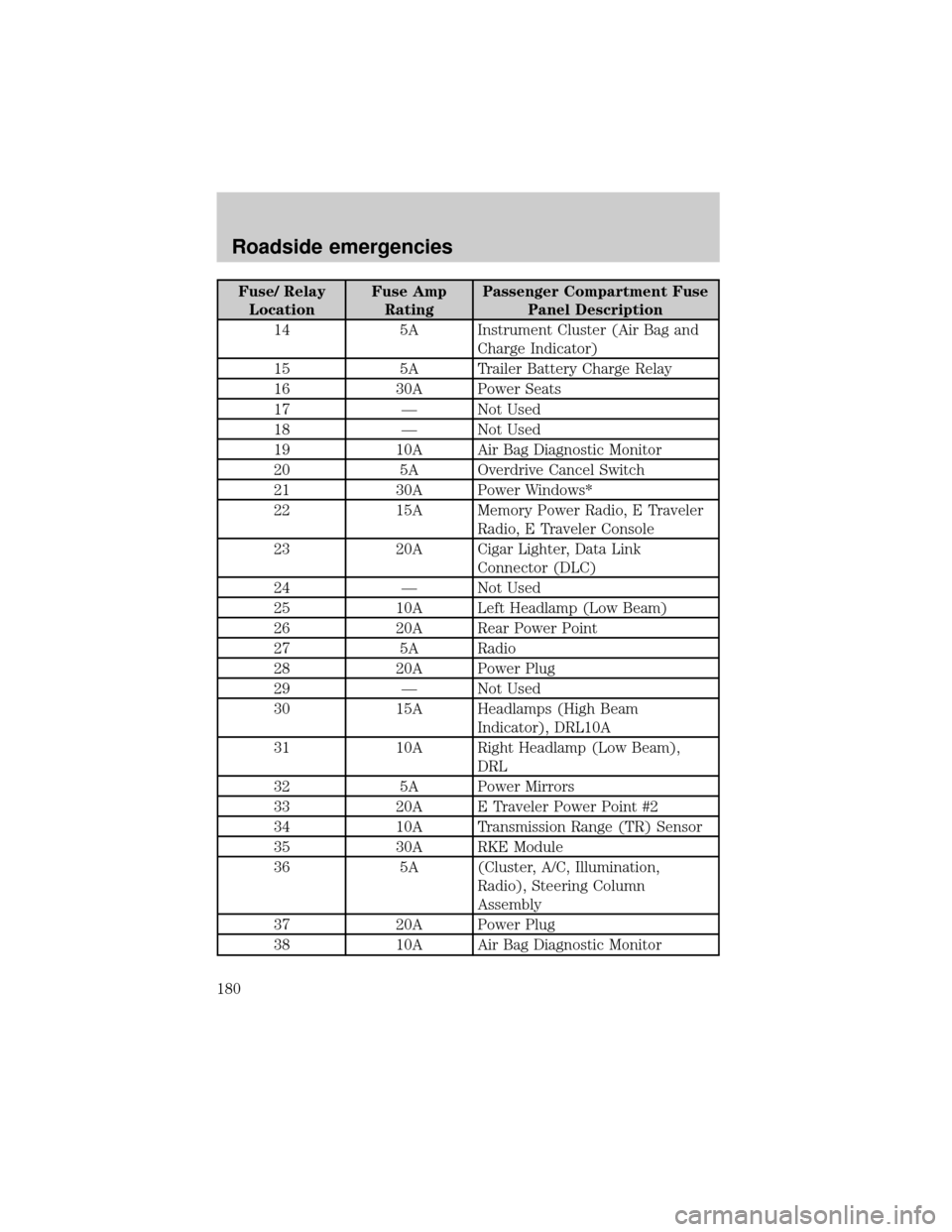
Fuse/ Relay
LocationFuse Amp
RatingPassenger Compartment Fuse
Panel Description
14 5A Instrument Cluster (Air Bag and
Charge Indicator)
15 5A Trailer Battery Charge Relay
16 30A Power Seats
17 Ð Not Used
18 Ð Not Used
19 10A Air Bag Diagnostic Monitor
20 5A Overdrive Cancel Switch
21 30A Power Windows*
22 15A Memory Power Radio, E Traveler
Radio, E Traveler Console
23 20A Cigar Lighter, Data Link
Connector (DLC)
24 Ð Not Used
25 10A Left Headlamp (Low Beam)
26 20A Rear Power Point
27 5A Radio
28 20A Power Plug
29 Ð Not Used
30 15A Headlamps (High Beam
Indicator), DRL10A
31 10A Right Headlamp (Low Beam),
DRL
32 5A Power Mirrors
33 20A E Traveler Power Point #2
34 10A Transmission Range (TR) Sensor
35 30A RKE Module
36 5A (Cluster, A/C, Illumination,
Radio), Steering Column
Assembly
37 20A Power Plug
38 10A Air Bag Diagnostic Monitor
Roadside emergencies
180
Page 181 of 272
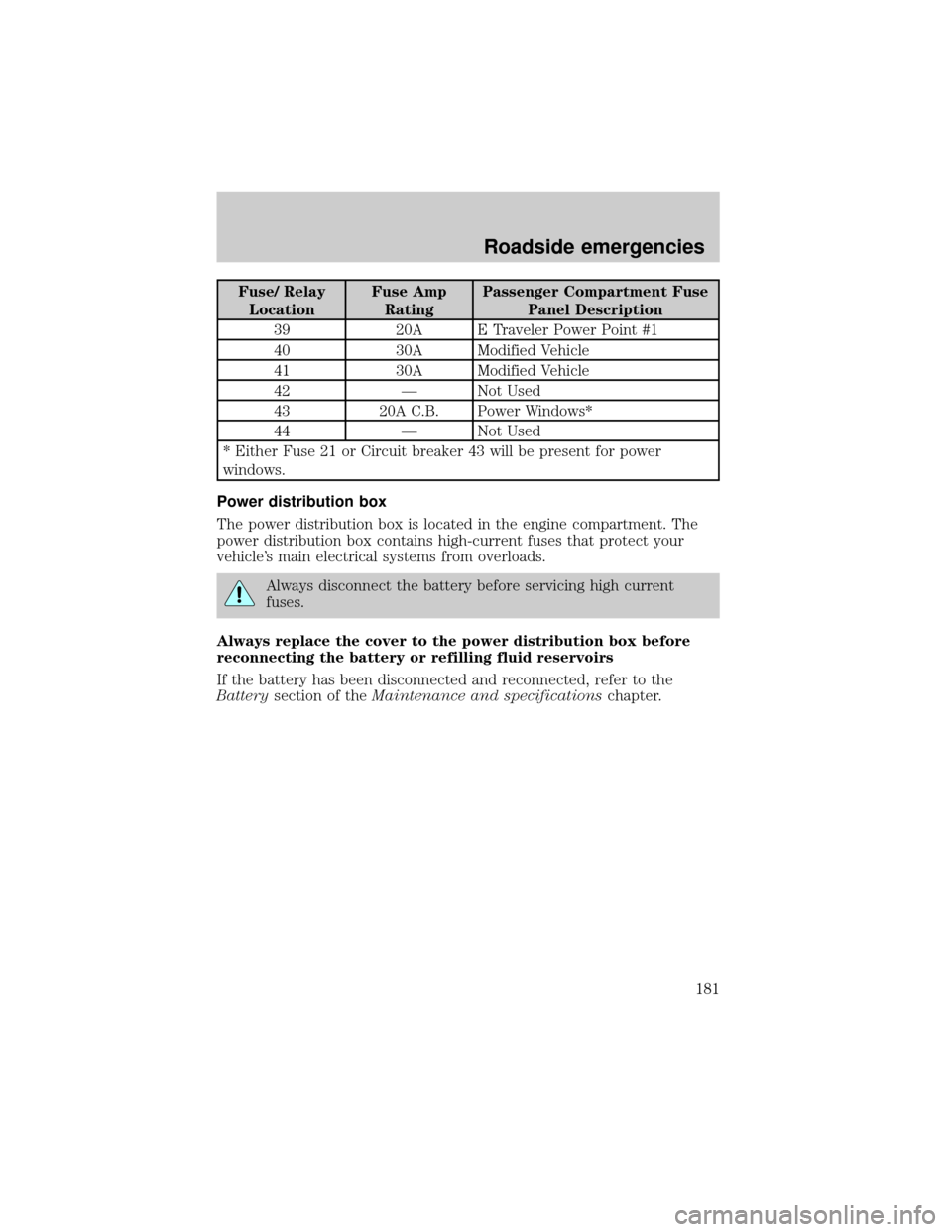
Fuse/ Relay
LocationFuse Amp
RatingPassenger Compartment Fuse
Panel Description
39 20A E Traveler Power Point #1
40 30A Modified Vehicle
41 30A Modified Vehicle
42 Ð Not Used
43 20A C.B. Power Windows*
44 Ð Not Used
* Either Fuse 21 or Circuit breaker 43 will be present for power
windows.
Power distribution box
The power distribution box is located in the engine compartment. The
power distribution box contains high-current fuses that protect your
vehicle's main electrical systems from overloads.
Always disconnect the battery before servicing high current
fuses.
Always replace the cover to the power distribution box before
reconnecting the battery or refilling fluid reservoirs
If the battery has been disconnected and reconnected, refer to the
Batterysection of theMaintenance and specificationschapter.
Roadside emergencies
181
Page 182 of 272
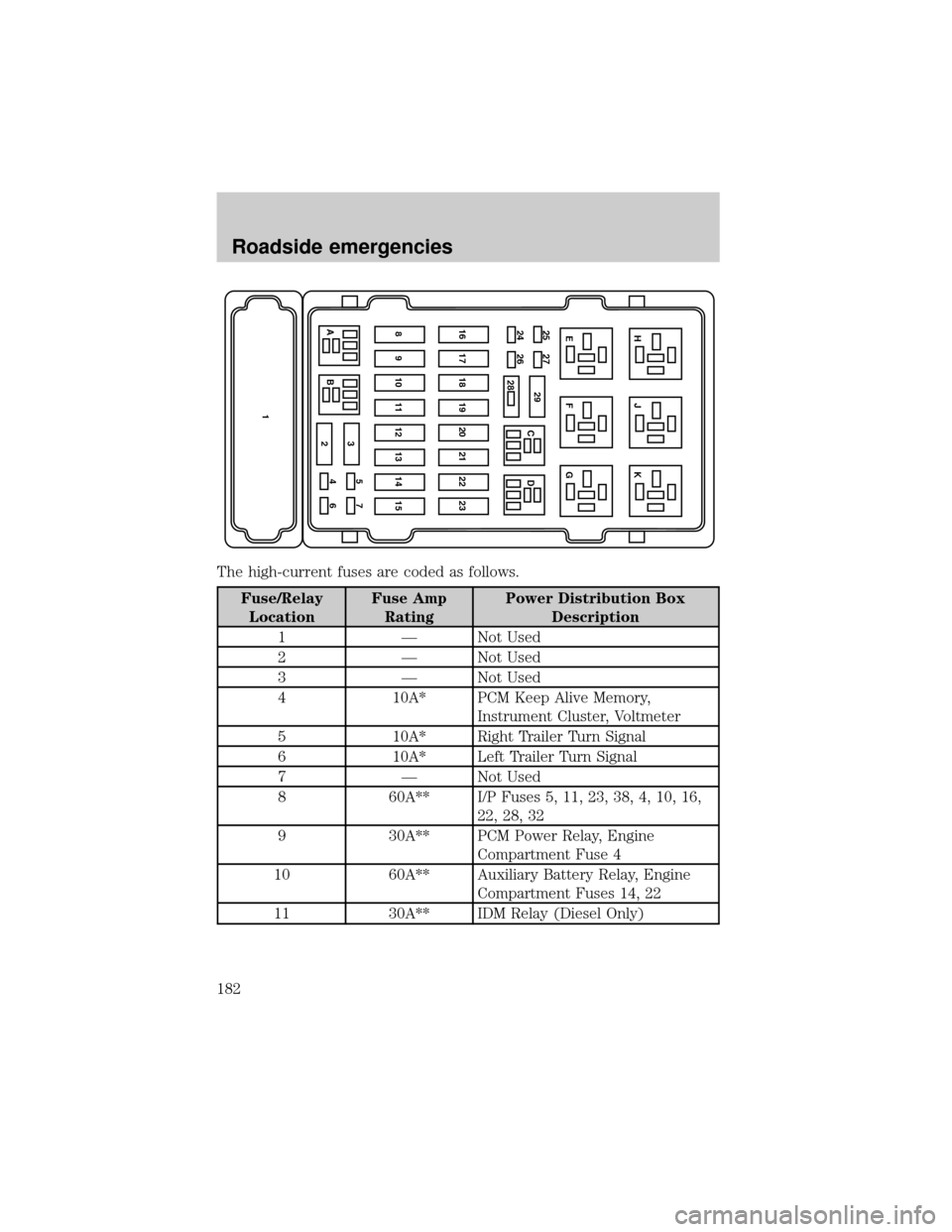
The high-current fuses are coded as follows.
Fuse/Relay
LocationFuse Amp
RatingPower Distribution Box
Description
1 Ð Not Used
2 Ð Not Used
3 Ð Not Used
4 10A* PCM Keep Alive Memory,
Instrument Cluster, Voltmeter
5 10A* Right Trailer Turn Signal
6 10A* Left Trailer Turn Signal
7 Ð Not Used
8 60A** I/P Fuses 5, 11, 23, 38, 4, 10, 16,
22, 28, 32
9 30A** PCM Power Relay, Engine
Compartment Fuse 4
10 60A** Auxiliary Battery Relay, Engine
Compartment Fuses 14, 22
11 30A** IDM Relay (Diesel Only)
AB3
2
146 5715 14 13 12 11 10 9 823 22 21 20 19 18 17 1624 26 25 27
29
CDG F EK J H
28
Roadside emergencies
182
Page 183 of 272
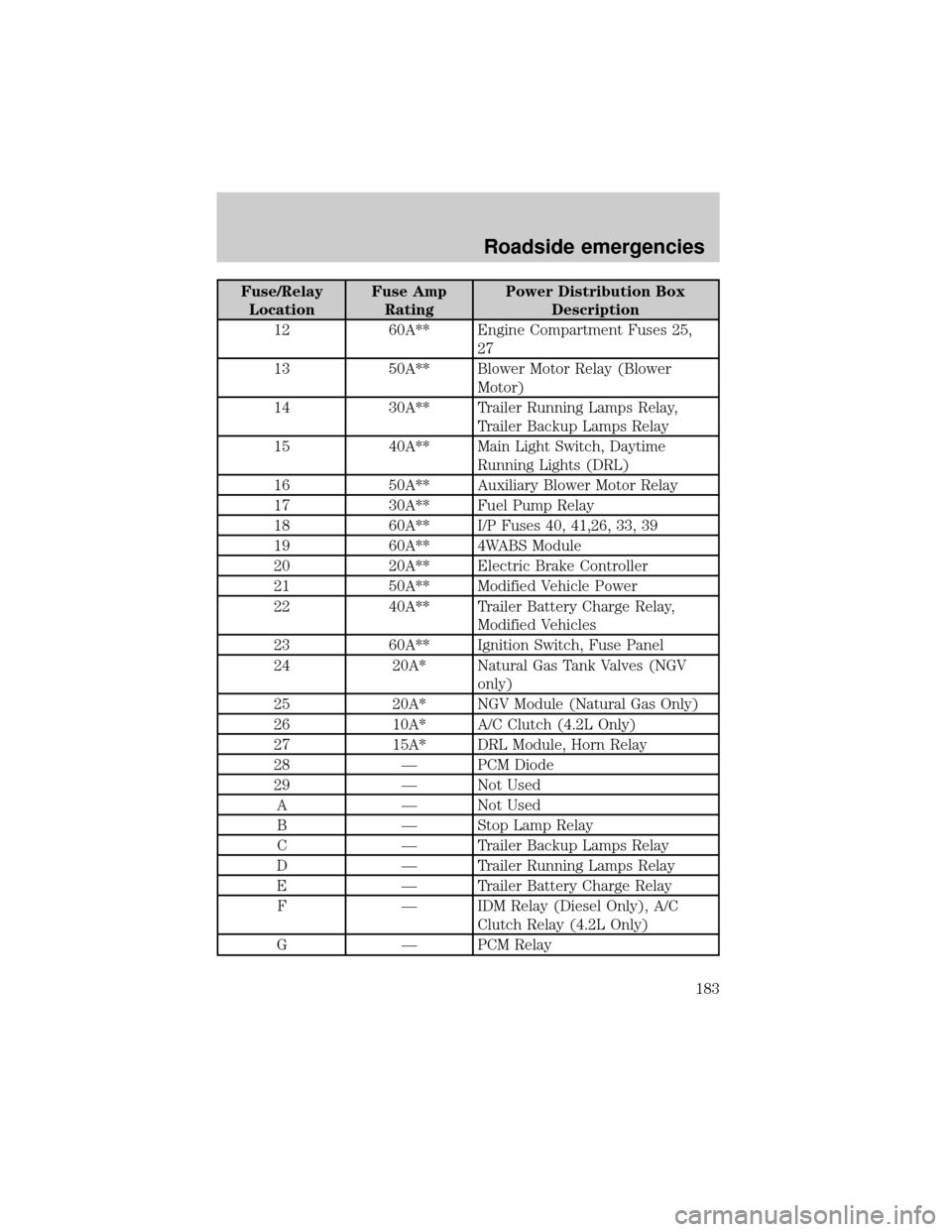
Fuse/Relay
LocationFuse Amp
RatingPower Distribution Box
Description
12 60A** Engine Compartment Fuses 25,
27
13 50A** Blower Motor Relay (Blower
Motor)
14 30A** Trailer Running Lamps Relay,
Trailer Backup Lamps Relay
15 40A** Main Light Switch, Daytime
Running Lights (DRL)
16 50A** Auxiliary Blower Motor Relay
17 30A** Fuel Pump Relay
18 60A** I/P Fuses 40, 41,26, 33, 39
19 60A** 4WABS Module
20 20A** Electric Brake Controller
21 50A** Modified Vehicle Power
22 40A** Trailer Battery Charge Relay,
Modified Vehicles
23 60A** Ignition Switch, Fuse Panel
24 20A* Natural Gas Tank Valves (NGV
only)
25 20A* NGV Module (Natural Gas Only)
26 10A* A/C Clutch (4.2L Only)
27 15A* DRL Module, Horn Relay
28 Ð PCM Diode
29 Ð Not Used
A Ð Not Used
B Ð Stop Lamp Relay
C Ð Trailer Backup Lamps Relay
D Ð Trailer Running Lamps Relay
E Ð Trailer Battery Charge Relay
F Ð IDM Relay (Diesel Only), A/C
Clutch Relay (4.2L Only)
G Ð PCM Relay
Roadside emergencies
183
Page 191 of 272
JUMP STARTING YOUR VEHICLE
The gases around the battery can explode if exposed to flames,
sparks, or lit cigarettes. An explosion could result in injury or
vehicle damage.
Batteries contain sulfuric acid which can burn skin, eyes, and
clothing, if contacted.
Do not attempt to push-start your vehicle. Automatic
transmissions do not have push-start capability; also, the
catalytic conveter may become damaged.
Preparing your vehicle
When the battery is disconnected or a new battery is installed, the
transmission must relearn its adaptive strategy. As a result of this, the
transmission may shift firmly. This operation is considered normal and
will not affect function or durability of the transmission. Over time, the
adaptive learning process will fully update transmission operation to its
optimum shift feel.
1.Use only a 12±volt supply to start your vehicle.
2. Do not disconnect the battery of the disabled vehicle as this could
damage the vehicle's electrical system.
3. Park the booster vehicle close to the hood of the disabled vehicle
making sure the two vehiclesdo nottouch. Set the parking brake on
both vehicles and stay clear of the engine cooling fan and other moving
parts.
4. Check all battery terminals and remove any excessive corrosion before
you attach the battery cables. Ensure that vent caps are tight and level.
5. Turn the heater fan on in both vehicles to protect any electrical
surges. Turn all other accessories off.
Roadside emergencies
191
Page 192 of 272
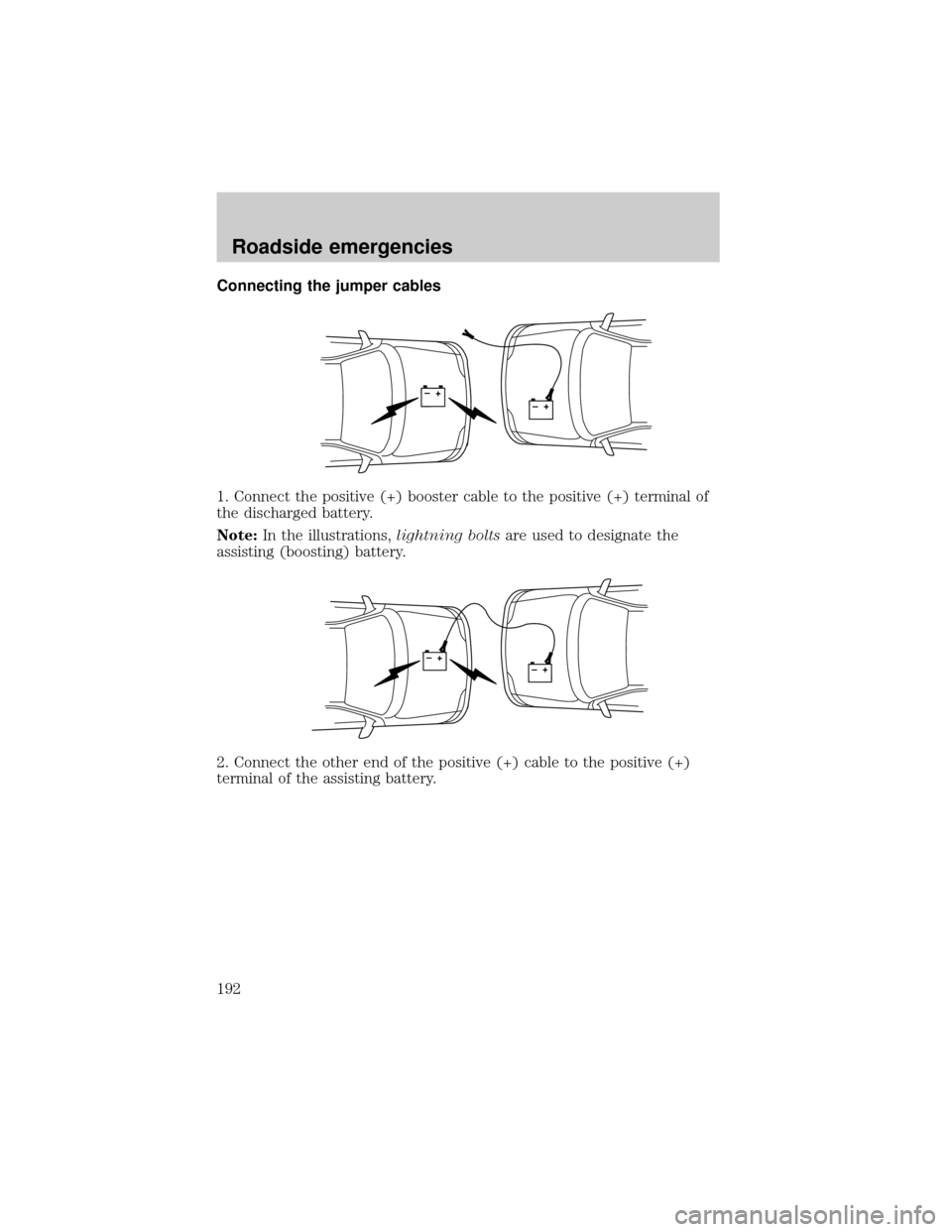
Connecting the jumper cables
1. Connect the positive (+) booster cable to the positive (+) terminal of
the discharged battery.
Note:In the illustrations,lightning boltsare used to designate the
assisting (boosting) battery.
2. Connect the other end of the positive (+) cable to the positive (+)
terminal of the assisting battery.
+–+–
+–+–
Roadside emergencies
192
Page 193 of 272
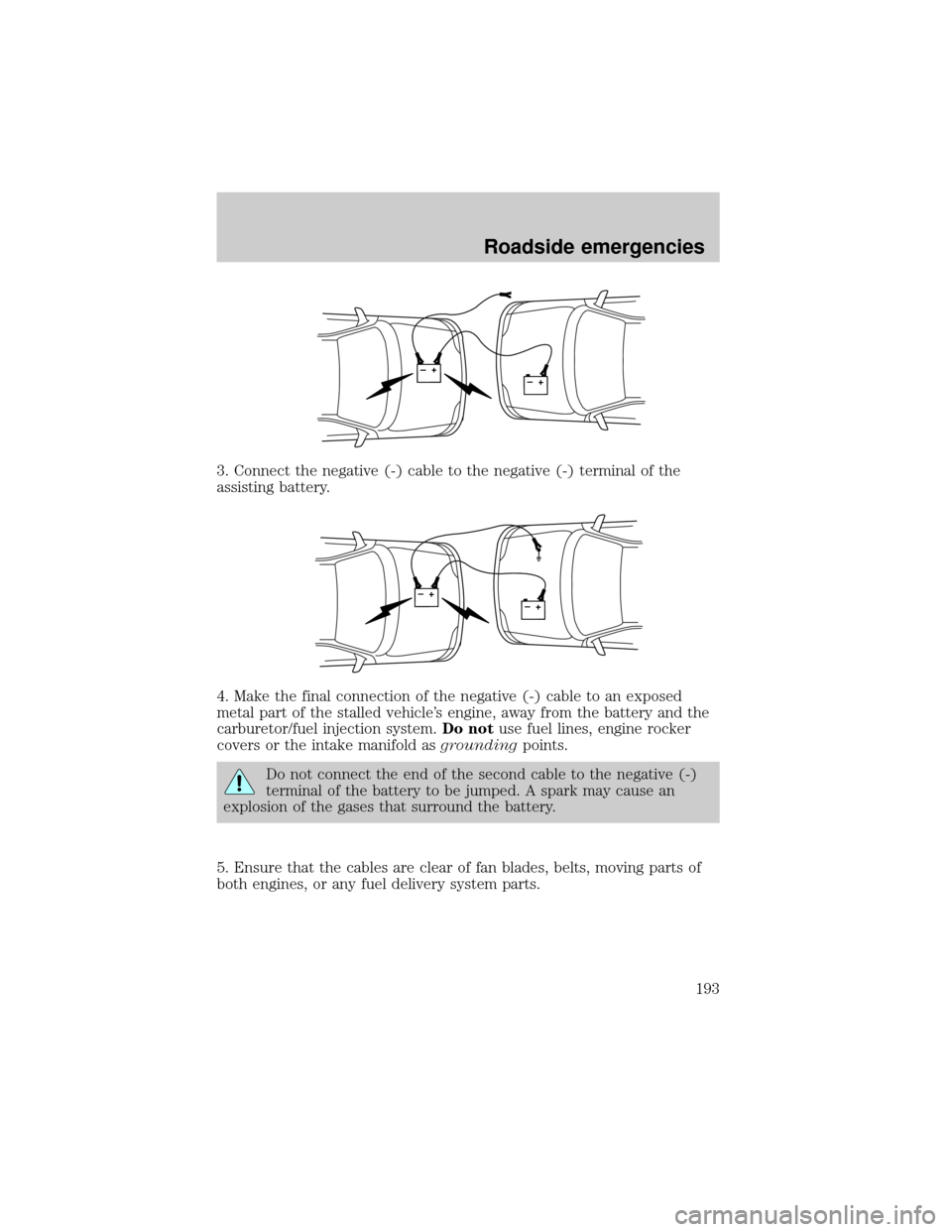
3. Connect the negative (-) cable to the negative (-) terminal of the
assisting battery.
4. Make the final connection of the negative (-) cable to an exposed
metal part of the stalled vehicle's engine, away from the battery and the
carburetor/fuel injection system.Do notuse fuel lines, engine rocker
covers or the intake manifold asgroundingpoints.
Do not connect the end of the second cable to the negative (-)
terminal of the battery to be jumped. A spark may cause an
explosion of the gases that surround the battery.
5. Ensure that the cables are clear of fan blades, belts, moving parts of
both engines, or any fuel delivery system parts.
+–+–
+–+–
Roadside emergencies
193
Page 194 of 272
Jump starting
1. Start the engine of the booster vehicle and run the engine at
moderately increased speed.
2. Start the engine of the disabled vehicle.
3. Once the disabled vehicle has been started, run both engines for an
additional three minutes before disconnecting the jumper cables.
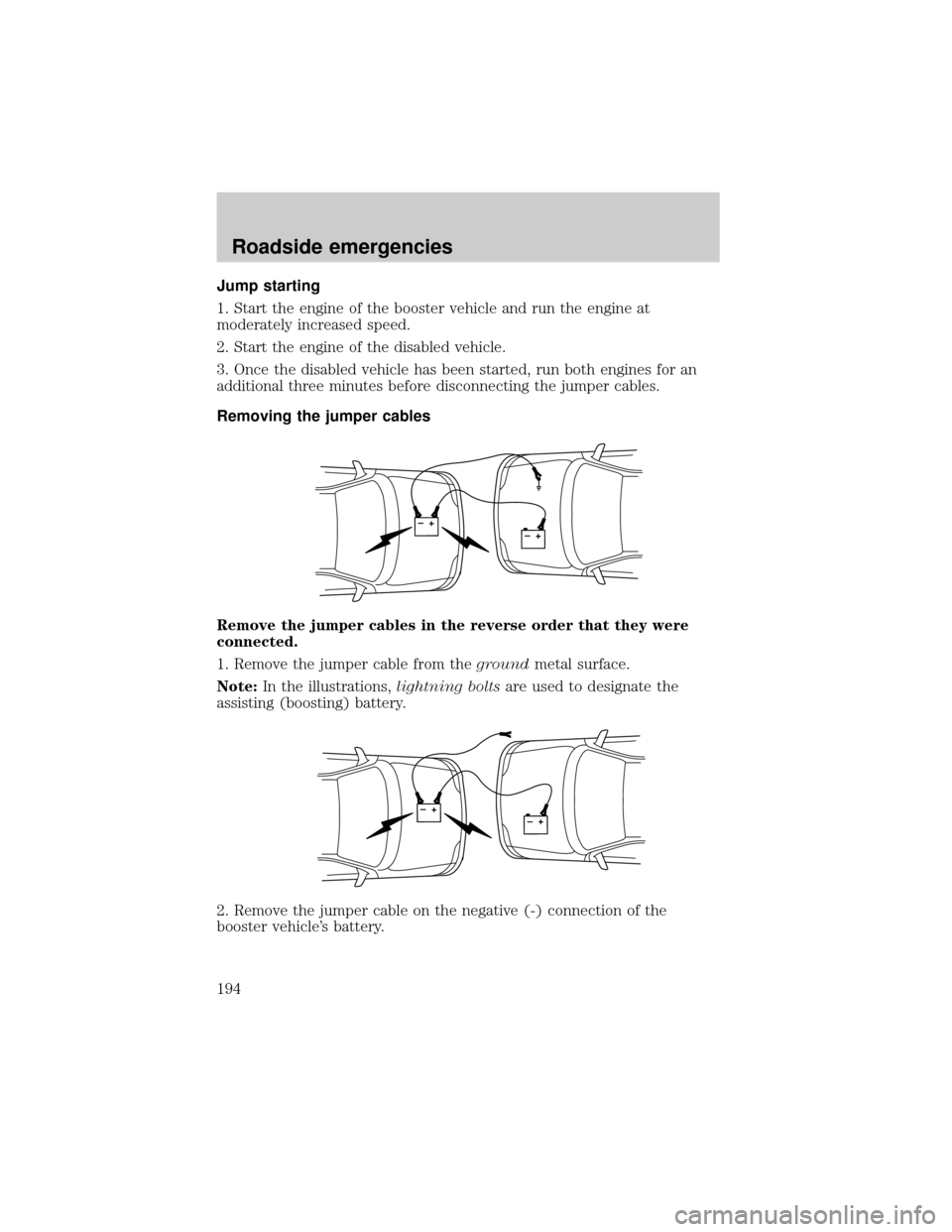
Removing the jumper cables
Remove the jumper cables in the reverse order that they were
connected.
1. Remove the jumper cable from thegroundmetal surface.
Note:In the illustrations,lightning boltsare used to designate the
assisting (boosting) battery.
2. Remove the jumper cable on the negative (-) connection of the
booster vehicle's battery.
+–+–
+–+–
Roadside emergencies
194
Page 195 of 272
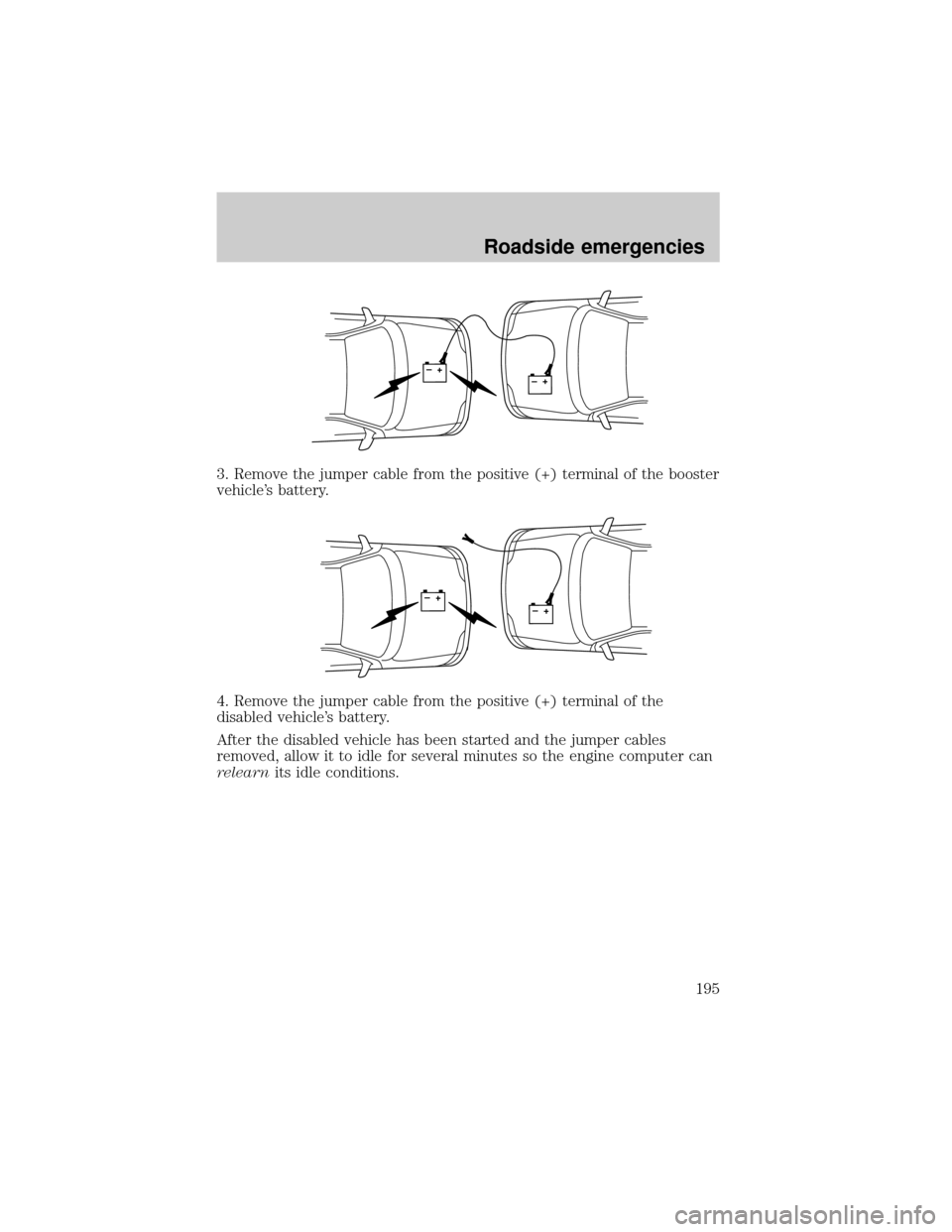
3. Remove the jumper cable from the positive (+) terminal of the booster
vehicle's battery.
4. Remove the jumper cable from the positive (+) terminal of the
disabled vehicle's battery.
After the disabled vehicle has been started and the jumper cables
removed, allow it to idle for several minutes so the engine computer can
relearnits idle conditions.
+–+–
+–+–
Roadside emergencies
195