battery FORD E SERIES 2015 4.G Owner's Manual
[x] Cancel search | Manufacturer: FORD, Model Year: 2015, Model line: E SERIES, Model: FORD E SERIES 2015 4.GPages: 360, PDF Size: 3.28 MB
Page 151 of 360
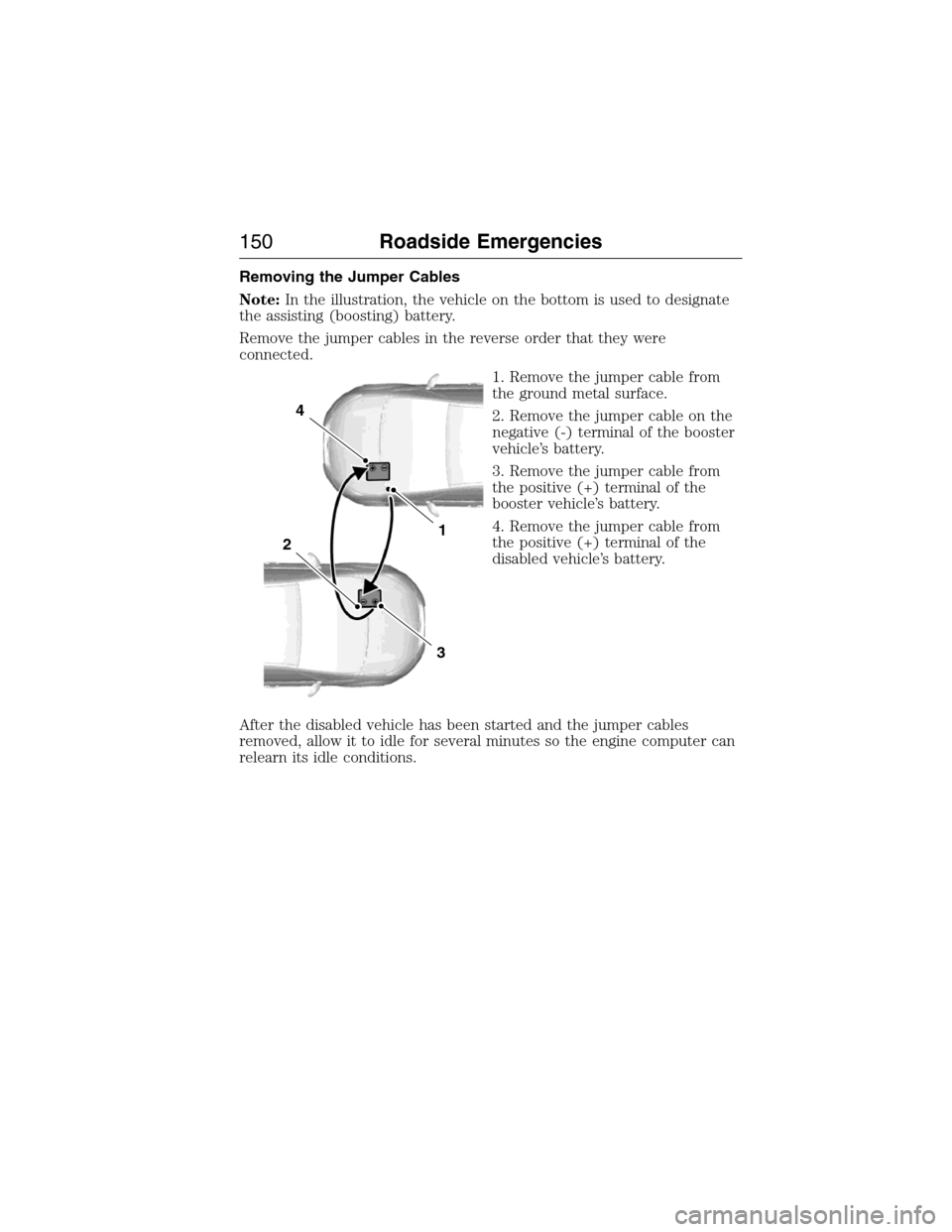
Removing the Jumper Cables
Note:In the illustration, the vehicle on the bottom is used to designate
the assisting (boosting) battery.
Remove the jumper cables in the reverse order that they were
connected.
1. Remove the jumper cable from
the ground metal surface.
2. Remove the jumper cable on the
negative (-) terminal of the booster
vehicle’s battery.
3. Remove the jumper cable from
the positive (+) terminal of the
booster vehicle’s battery.
4. Remove the jumper cable from
the positive (+) terminal of the
disabled vehicle’s battery.
After the disabled vehicle has been started and the jumper cables
removed, allow it to idle for several minutes so the engine computer can
relearn its idle conditions.
4
1
3
2
150Roadside Emergencies
2015 Econoline(eco)
Owners Guide gf, 1st Printing, June 2014
USA(fus)
Page 161 of 360
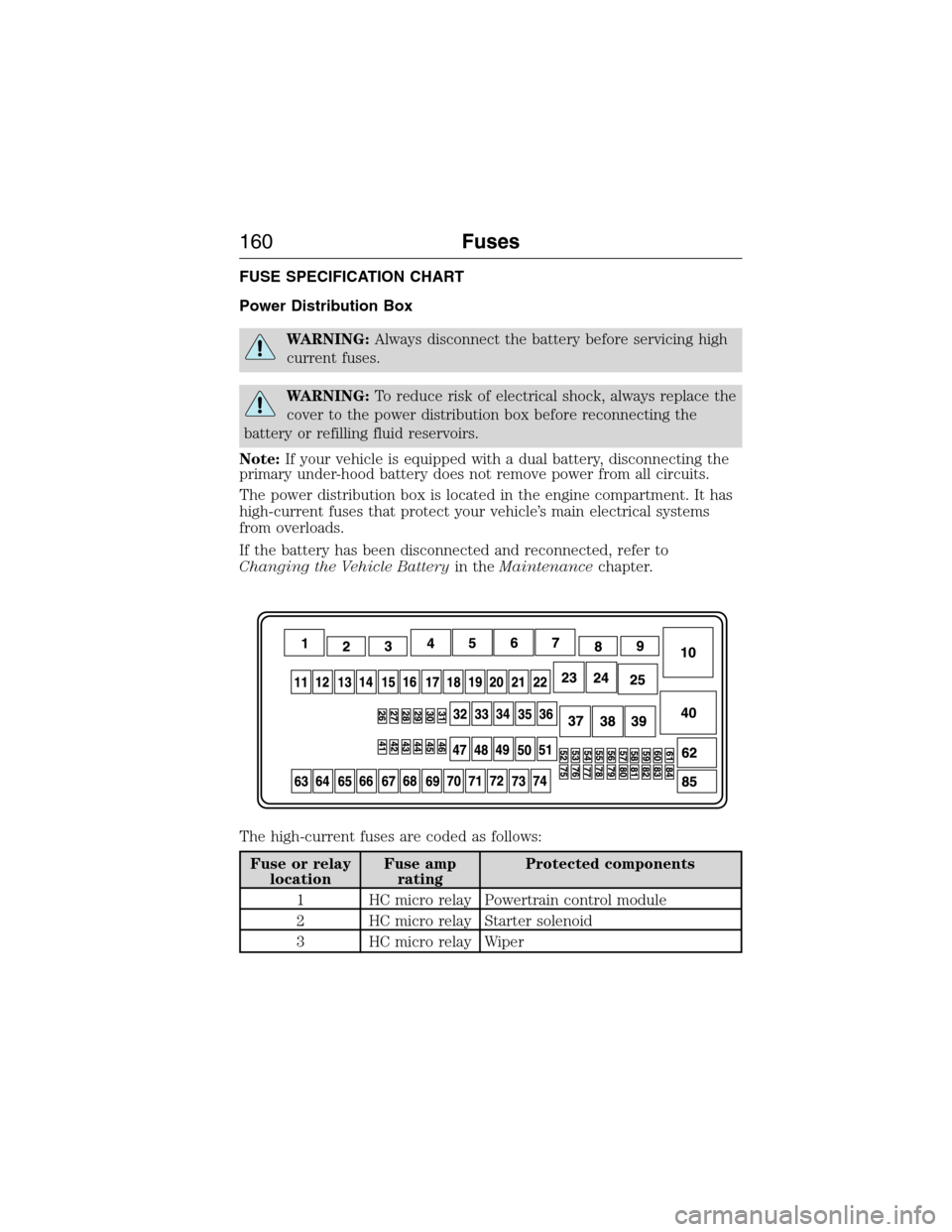
FUSE SPECIFICATION CHART
Power Distribution Box
WARNING:Always disconnect the battery before servicing high
current fuses.
WARNING:To reduce risk of electrical shock, always replace the
cover to the power distribution box before reconnecting the
battery or refilling fluid reservoirs.
Note:If your vehicle is equipped with a dual battery, disconnecting the
primary under-hood battery does not remove power from all circuits.
The power distribution box is located in the engine compartment. It has
high-current fuses that protect your vehicle’s main electrical systems
from overloads.
If the battery has been disconnected and reconnected, refer to
Changing the Vehicle Batteryin theMaintenancechapter.
The high-current fuses are coded as follows:
Fuse or relay
locationFuse amp
ratingProtected components
1 HC micro relay Powertrain control module
2 HC micro relay Starter solenoid
3 HC micro relay Wiper
160Fuses
2015 Econoline(eco)
Owners Guide gf, 1st Printing, June 2014
USA(fus)
Page 162 of 360
Fuse or relay
locationFuse amp
ratingProtected components
4 HC micro relay Trailer tow battery charge
5 HC micro relay Fuel pump
6 HC micro relay Trailer tow park lamp
7 HC micro relay Auxiliary switch #4
8 HC micro relay Auxiliary switch #3
9 HC micro relay Modified vehicle and stripped
chassis run/start
10 — Not used
11 — Not used
12 40A** Modified vehicle and stripped
chassis run/start
13 30A** Starter solenoid relay
14 40A** Run start relay
15 40A** Modified vehicle and stripped
chassis battery
16 50A** Auxiliary air conditioning blower
17 50A** Trailer tow battery charge, Trailer
tow park feed
18 30A** Electric trailer brake, Trailer brake
controller
19 30A** Auxiliary switch #1
20 30A** Auxiliary switch #2
21 — Not used
22 — Not used
23 G8VA relay Air conditioning clutch
24 G8VA relay Horn relay (stripped chassis)
25 HC micro relay Run/start
26 — Not used
27 — Not used
28 20A* Back-up lamp
29 10A* Air conditioning clutch
30 10A* Brake on/off switch
Fuses161
2015 Econoline(eco)
Owners Guide gf, 1st Printing, June 2014
USA(fus)
Page 163 of 360
Fuse or relay
locationFuse amp
ratingProtected components
31 10A* Cluster battery (stripped chassis)
32 50A** Blower motor
33 40A** Anti-lock brake system pump
34 20A** Stripped chassis horn
35 40A** Powertrain control module relay
36 20A** Ignition switch (stripped chassis)
37 G8VA relay Trailer tow stop — left turn signal
38 G8VA relay Trailer tow stop — right turn signal
39 G8VA relay Back up lamp
40 ISO relay Blower motor
41 — Not used
42 15A* Diagnostic connector (stripped
chassis)
43 20A* Fuel pump
44 10A* Auxiliary switch #3
45 15A* Auxiliary switch #4
46 10A* Powertrain control module keep
alive power, Canister vent,
Powertrain control module relay coil
47 40A** Anti-lock brake system coil
48 20A** Trailer tow stop lamp/turn signal
49 30A** Wiper motor
50 — Not used
51 20A** Cutaway
52 10A* Stripped chassis and modified
vehicle run/start relay coil
53 10A* Anti-lock brake system run/start
feed
54 10A* Fuel pump relay coil
55 — Not used
56 — Not used
57 20A* Trailer tow park lamp
162Fuses
2015 Econoline(eco)
Owners Guide gf, 1st Printing, June 2014
USA(fus)
Page 164 of 360
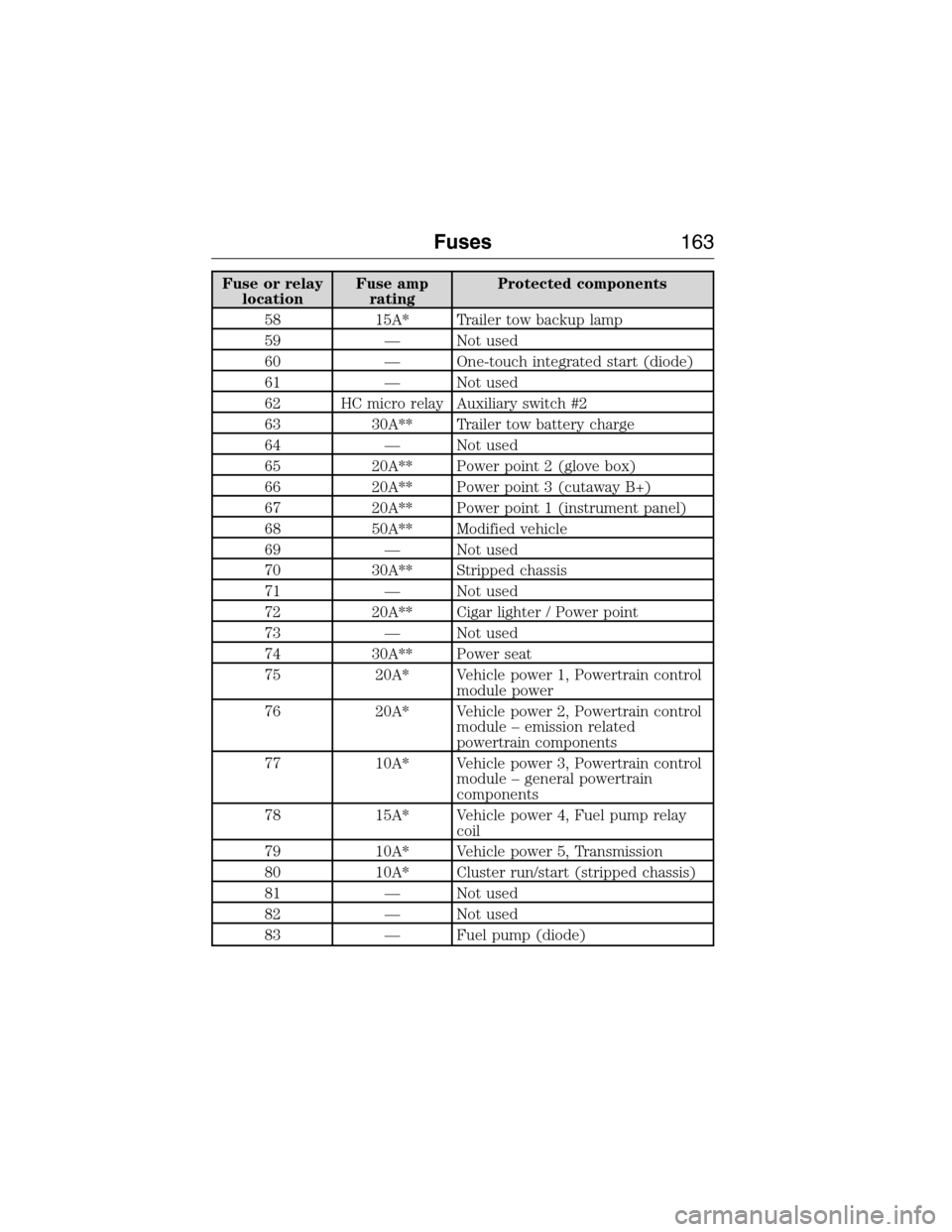
Fuse or relay
locationFuse amp
ratingProtected components
58 15A* Trailer tow backup lamp
59 — Not used
60 — One-touch integrated start (diode)
61 — Not used
62 HC micro relay Auxiliary switch #2
63 30A** Trailer tow battery charge
64 — Not used
65 20A** Power point 2 (glove box)
66 20A** Power point 3 (cutaway B+)
67 20A** Power point 1 (instrument panel)
68 50A** Modified vehicle
69 — Not used
70 30A** Stripped chassis
71 — Not used
72 20A** Cigar lighter / Power point
73 — Not used
74 30A** Power seat
75 20A* Vehicle power 1, Powertrain control
module power
76 20A* Vehicle power 2, Powertrain control
module – emission related
powertrain components
77 10A* Vehicle power 3, Powertrain control
module – general powertrain
components
78 15A* Vehicle power 4, Fuel pump relay
coil
79 10A* Vehicle power 5, Transmission
80 10A* Cluster run/start (stripped chassis)
81 — Not used
82 — Not used
83 — Fuel pump (diode)
Fuses163
2015 Econoline(eco)
Owners Guide gf, 1st Printing, June 2014
USA(fus)
Page 165 of 360
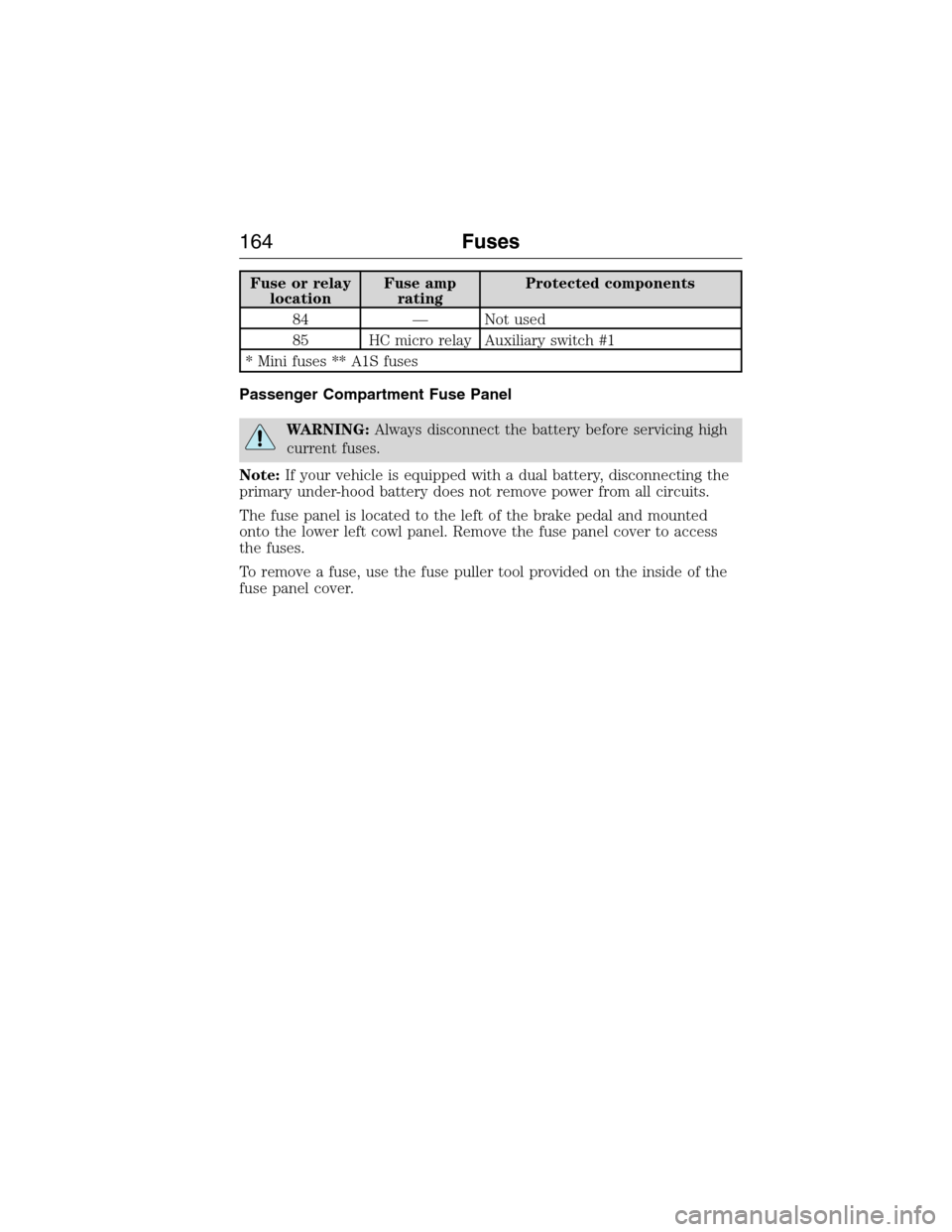
Fuse or relay
locationFuse amp
ratingProtected components
84 — Not used
85 HC micro relay Auxiliary switch #1
* Mini fuses ** A1S fuses
Passenger Compartment Fuse Panel
WARNING:Always disconnect the battery before servicing high
current fuses.
Note:If your vehicle is equipped with a dual battery, disconnecting the
primary under-hood battery does not remove power from all circuits.
The fuse panel is located to the left of the brake pedal and mounted
onto the lower left cowl panel. Remove the fuse panel cover to access
the fuses.
To remove a fuse, use the fuse puller tool provided on the inside of the
fuse panel cover.
164Fuses
2015 Econoline(eco)
Owners Guide gf, 1st Printing, June 2014
USA(fus)
Page 168 of 360
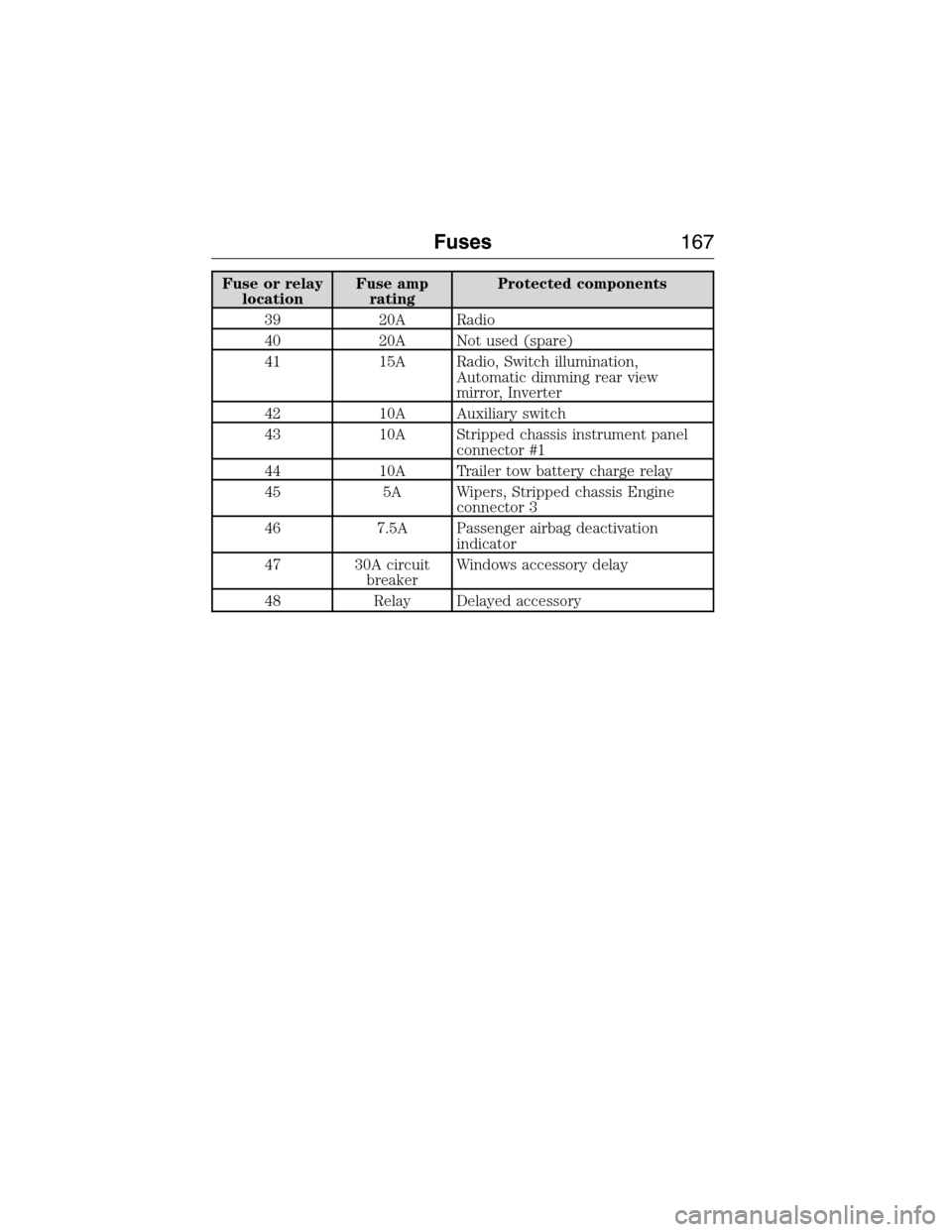
Fuse or relay
locationFuse amp
ratingProtected components
39 20A Radio
40 20A Not used (spare)
41 15A Radio, Switch illumination,
Automatic dimming rear view
mirror, Inverter
42 10A Auxiliary switch
43 10A Stripped chassis instrument panel
connector #1
44 10A Trailer tow battery charge relay
45 5A Wipers, Stripped chassis Engine
connector 3
46 7.5A Passenger airbag deactivation
indicator
47 30A circuit
breakerWindows accessory delay
48 Relay Delayed accessory
Fuses167
2015 Econoline(eco)
Owners Guide gf, 1st Printing, June 2014
USA(fus)
Page 169 of 360
GENERAL INFORMATION
Have your vehicle serviced regularly to help maintain its roadworthiness
and resale value. There is a large network of Ford authorized dealers
who are there to help you with their professional servicing expertise. We
believe that their specially trained technicians are best qualified to
service your vehicle properly and expertly. They are supported by a wide
range of highly specialized tools developed specifically for servicing your
vehicle.
To help you service your vehicle, we provideScheduled Maintenance
Informationwhich makes tracking routine service easy.
If your vehicle requires professional service, your authorized dealer can
provide the necessary parts and service. Check your warranty
information to find out which parts and services are covered.
Use only recommended fuels, lubricants, fluids and service parts
conforming to specifications. Motorcraft® parts are designed and built to
provide the best performance in your vehicle.
Precautions
•Do not work on a hot engine.
•Make sure that nothing gets caught in moving parts.
•Do not work on a vehicle with the engine running in an enclosed
space, unless you are sure you have enough ventilation.
•Keep all open flames and other burning material (such as cigarettes)
away from the battery and all fuel related parts.
Working with the Engine Off
1. Set the parking brake and shift toP(Park).
2. Turn off the engine and remove the key (if equipped).
3. Block the wheels.
Working with the Engine On
WARNING:To reduce the risk of vehicle damage or personal
burn injuries, do not start your engine with the air cleaner
removed and do not remove it while the engine is running.
1. Set the parking brake and shift to positionP(Park) .
2. Block the wheels.
168Maintenance
2015 Econoline(eco)
Owners Guide gf, 1st Printing, June 2014
USA(fus)
Page 171 of 360
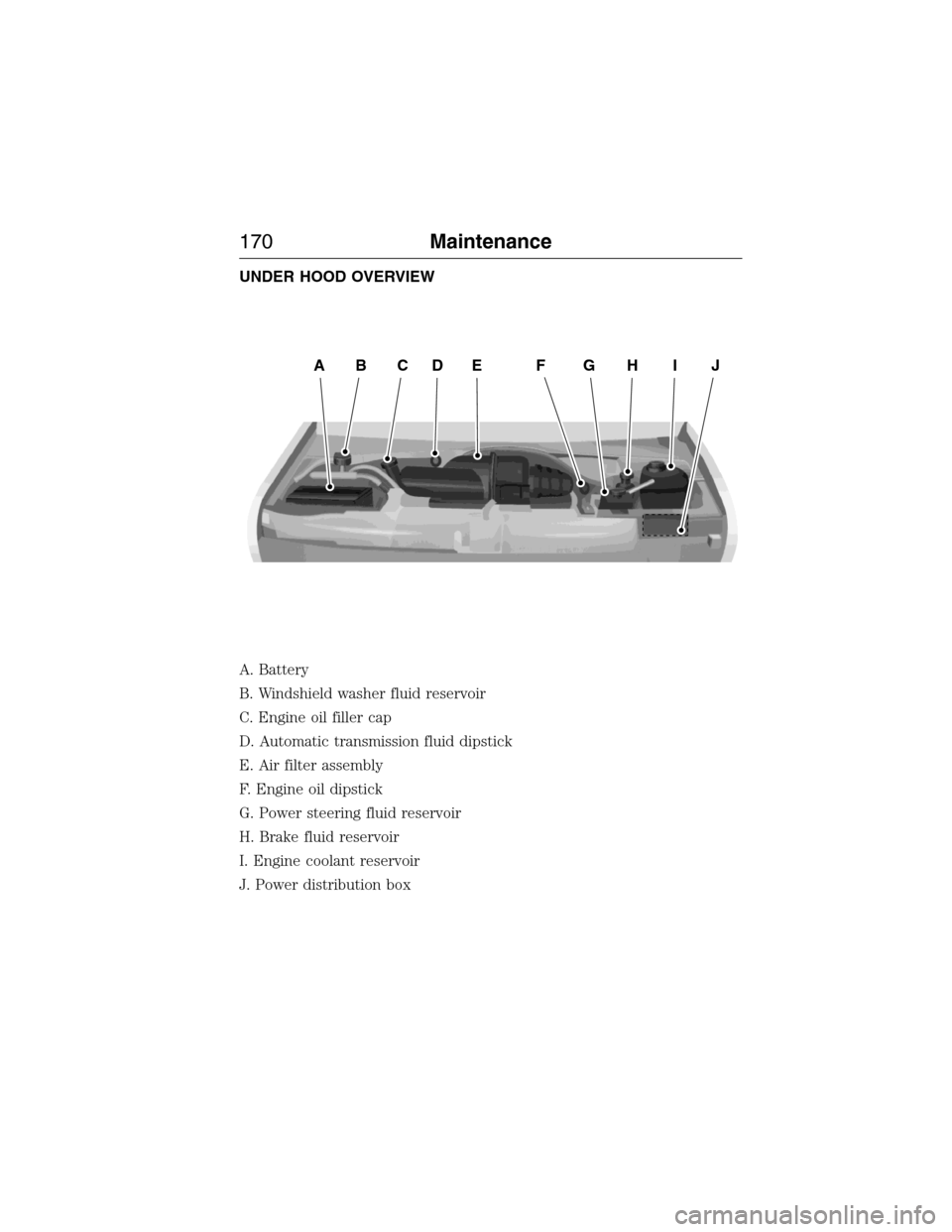
UNDER HOOD OVERVIEW
A. Battery
B. Windshield washer fluid reservoir
C. Engine oil filler cap
D. Automatic transmission fluid dipstick
E. Air filter assembly
F. Engine oil dipstick
G. Power steering fluid reservoir
H. Brake fluid reservoir
I. Engine coolant reservoir
J. Power distribution box
ABCDEFGHIJ
170Maintenance
2015 Econoline(eco)
Owners Guide gf, 1st Printing, June 2014
USA(fus)
Page 174 of 360
The coolant concentration should be maintained within 48% to 50%,
which equates to a freeze point between -30°F (-34°C) and -34°F
(-37°C).
Note:For best results, coolant concentration should be tested with a
refractometer such as Robinair Coolant and Battery Refractometer
75240. We do not recommend the use of hydrometers or coolant test
strips for measuring coolant concentrations.
Note:Automotive fluids are not interchangeable; do not use engine
coolant/antifreeze or windshield washer fluid outside of its specified
function and vehicle location.
Adding Engine Coolant
WARNING:Do not add engine coolant when the engine is hot.
Steam and scalding liquids released from a hot cooling system
can burn you badly. Also, you can be burned if you spill coolant on hot
engine parts.
WARNING:Do not put engine coolant in the windshield washer
fluid container. If sprayed on the windshield, engine coolant
could make it difficult to see through the windshield.
WARNING:To reduce the risk of personal injury, make sure the
engine is cool before unscrewing the coolant pressure relief cap.
The cooling system is under pressure; steam and hot liquid can come
out forcefully when the cap is loosened slightly.
WARNING:Do not add coolant further than the FULL COLD
mark.
Note:Do not use stop leak pellets, cooling system sealants or additives
as they can cause damage to the engine cooling or heating systems. This
damage would not be covered under your vehicle’s warranty.
•DO NOT MIX different colors or types of coolant in your vehicle. Make
sure the correct coolant is used. Mixing of engine coolants may harm
your engine’s cooling system. The use of an improper coolant may
harm engine and cooling system components and may void the
warranty.
Maintenance173
2015 Econoline(eco)
Owners Guide gf, 1st Printing, June 2014
USA(fus)