belt FORD E SERIES 2015 4.G Owner's Guide
[x] Cancel search | Manufacturer: FORD, Model Year: 2015, Model line: E SERIES, Model: FORD E SERIES 2015 4.GPages: 360, PDF Size: 3.28 MB
Page 47 of 360
2.Child age 12 or under:A child age 12 or under must ride in the
front seat because:
•my vehicle has no rear seat;
•although children age 12 and under ride in the rear seat whenever
possible, children age 12 and under have no option but to sometimes
ride in the front seat because rear seat space is insufficient; or
•the child has a medical condition that, according to the child’s
physician, makes it necessary for the child to ride in the front seat so
that the driver can monitor the child’s condition.
3.Medical condition:A passenger has a medical condition that,
according to his or her physician:
•poses a special risk for the passenger if the airbag deploys; and
•makes the potential harm from the passenger airbag deployment
greater than the potential harm from turning off the airbag and
experiencing a crash without the protection offered by the airbag
CRASH SENSORS AND AIRBAG INDICATOR
WARNING:Modifying or adding equipment to the front end of
your vehicle (including frame, bumper, front end body structure
and tow hooks) may affect the performance of the airbag system,
increasing the risk of injury. Do not modify the front end of your
vehicle.
Your vehicle has a collection of crash and occupant sensors which
provide information to the restraints control module. The restraints
control module deploys (activates) the front safety belt pretensioners,
driver airbag and passenger airbag. Based on the type of accident, the
restraints control module will deploy the appropriate safety devices.
The restraints control module also monitors the readiness of the above
safety devices plus the crash sensors. The readiness of the safety system
is indicated by a warning indicator light in the instrument cluster or by a
backup tone if the warning light is not working. See theInstrument
Clusterchapter. Routine maintenance of the airbag is not required.
46Supplementary Restraints System
2015 Econoline(eco)
Owners Guide gf, 1st Printing, June 2014
USA(fus)
Page 48 of 360
A difficulty with the system is indicated by one or more of the following:
•The readiness light will either flash or stay lit.
•The readiness light will not illuminate immediately after the
ignition is turned on.
•A series of five beeps will be heard. The tone pattern will repeat
periodically until the problem or light are repaired.
If any of these things happen, even intermittently, have the supplemental
restraint system serviced at an authorized dealer immediately. Unless
serviced, the system may not function properly in the event of a crash.
The safety belt pretensioners and the airbag supplemental restraint
system are designed to activate when the vehicle sustains frontal
deceleration sufficient to cause the restraints control module to deploy a
safety device.
The fact that the safety belt pretensioners or airbags did not activate in a
crash does not mean that something is wrong with the system. Rather, it
means the restraints control module determined the accident conditions
(such as crash severity, belt usage) were not appropriate to activate
these safety devices.
•The design of the front airbags is to activate only in frontal and
near-frontal crashes (not rollovers, side impacts or rear impacts)
unless the crash causes sufficient frontal deceleration.
•The design of the safety belt pretensioners is to activate in frontal or
near-frontal crashes and may deploy in rollovers if the vehicle is
equipped with roll stability control.
AIRBAG DISPOSAL
Contact your authorized dealer as soon as possible. Airbags must be
disposed of by qualified personnel.
Supplementary Restraints System47
2015 Econoline(eco)
Owners Guide gf, 1st Printing, June 2014
USA(fus)
Page 73 of 360
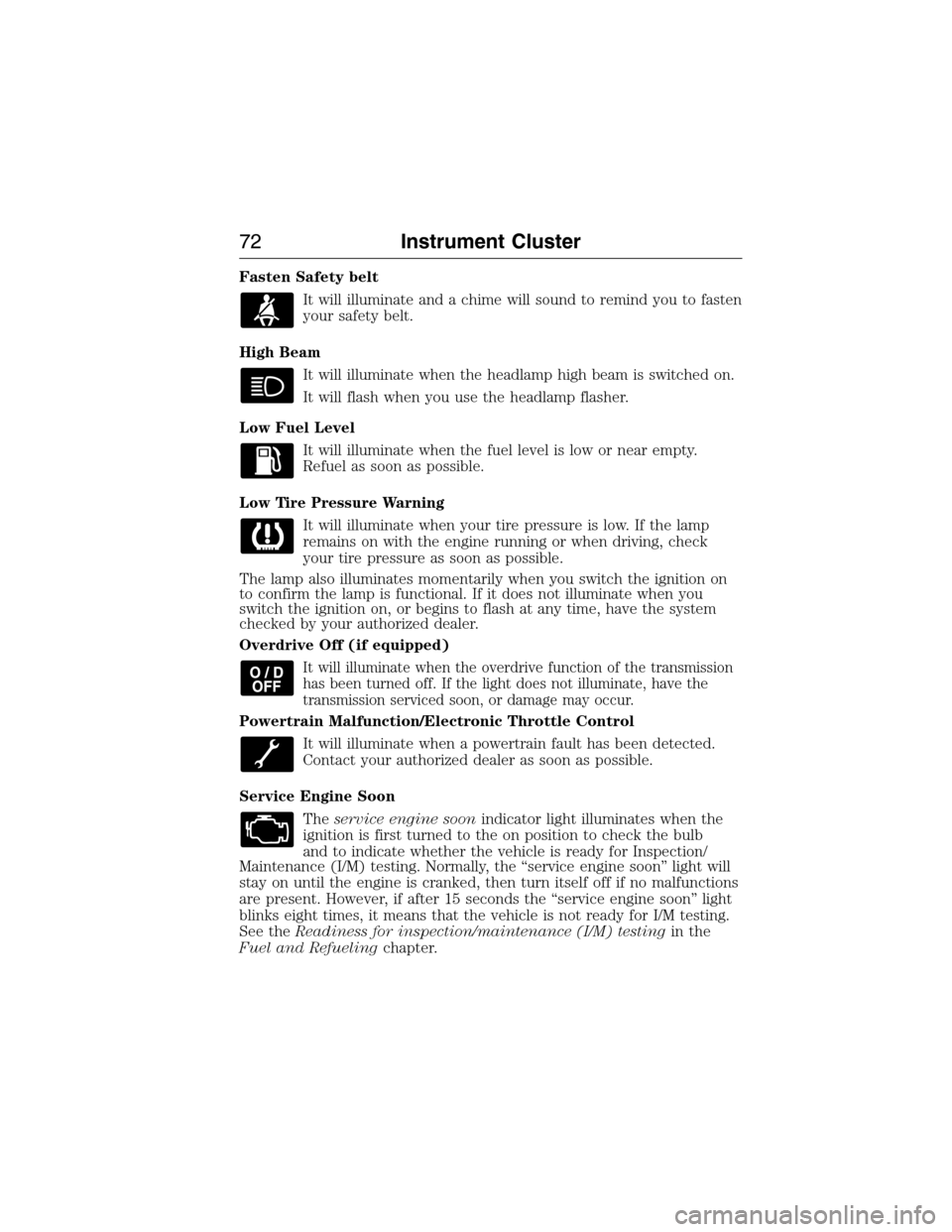
Fasten Safety belt
It will illuminate and a chime will sound to remind you to fasten
your safety belt.
High Beam
It will illuminate when the headlamp high beam is switched on.
It will flash when you use the headlamp flasher.
Low Fuel Level
It will illuminate when the fuel level is low or near empty.
Refuel as soon as possible.
Low Tire Pressure Warning
It will illuminate when your tire pressure is low. If the lamp
remains on with the engine running or when driving, check
your tire pressure as soon as possible.
The lamp also illuminates momentarily when you switch the ignition on
to confirm the lamp is functional. If it does not illuminate when you
switch the ignition on, or begins to flash at any time, have the system
checked by your authorized dealer.
Overdrive Off (if equipped)
It will illuminate when the overdrive function of the transmission
has been turned off. If the light does not illuminate, have the
transmission serviced soon, or damage may occur.
Powertrain Malfunction/Electronic Throttle Control
It will illuminate when a powertrain fault has been detected.
Contact your authorized dealer as soon as possible.
Service Engine Soon
Theservice engine soonindicator light illuminates when the
ignition is first turned to the on position to check the bulb
and to indicate whether the vehicle is ready for Inspection/
Maintenance (I/M) testing. Normally, the “service engine soon” light will
stay on until the engine is cranked, then turn itself off if no malfunctions
are present. However, if after 15 seconds the “service engine soon” light
blinks eight times, it means that the vehicle is not ready for I/M testing.
See theReadiness for inspection/maintenance (I/M) testingin the
Fuel and Refuelingchapter.
72Instrument Cluster
2015 Econoline(eco)
Owners Guide gf, 1st Printing, June 2014
USA(fus)
Page 87 of 360
SITTING IN THE CORRECT POSITION
WARNING:Sitting improperly out of position or with the
seatback reclined too far can take off weight from the seat
cushion and affect the passenger sensing system, resulting in serious
injury or death in a crash. Always sit upright against your seatback,
with your feet on the floor.
WARNING:Do not recline the seatback as this can cause the
occupant to slide under the seat’s safety belt, resulting in severe
personal injury in the event of a crash.
WARNING:Do not place objects higher than the seatbacks to
reduce the risk of injury in a crash or during heavy braking or
when stopping suddenly.
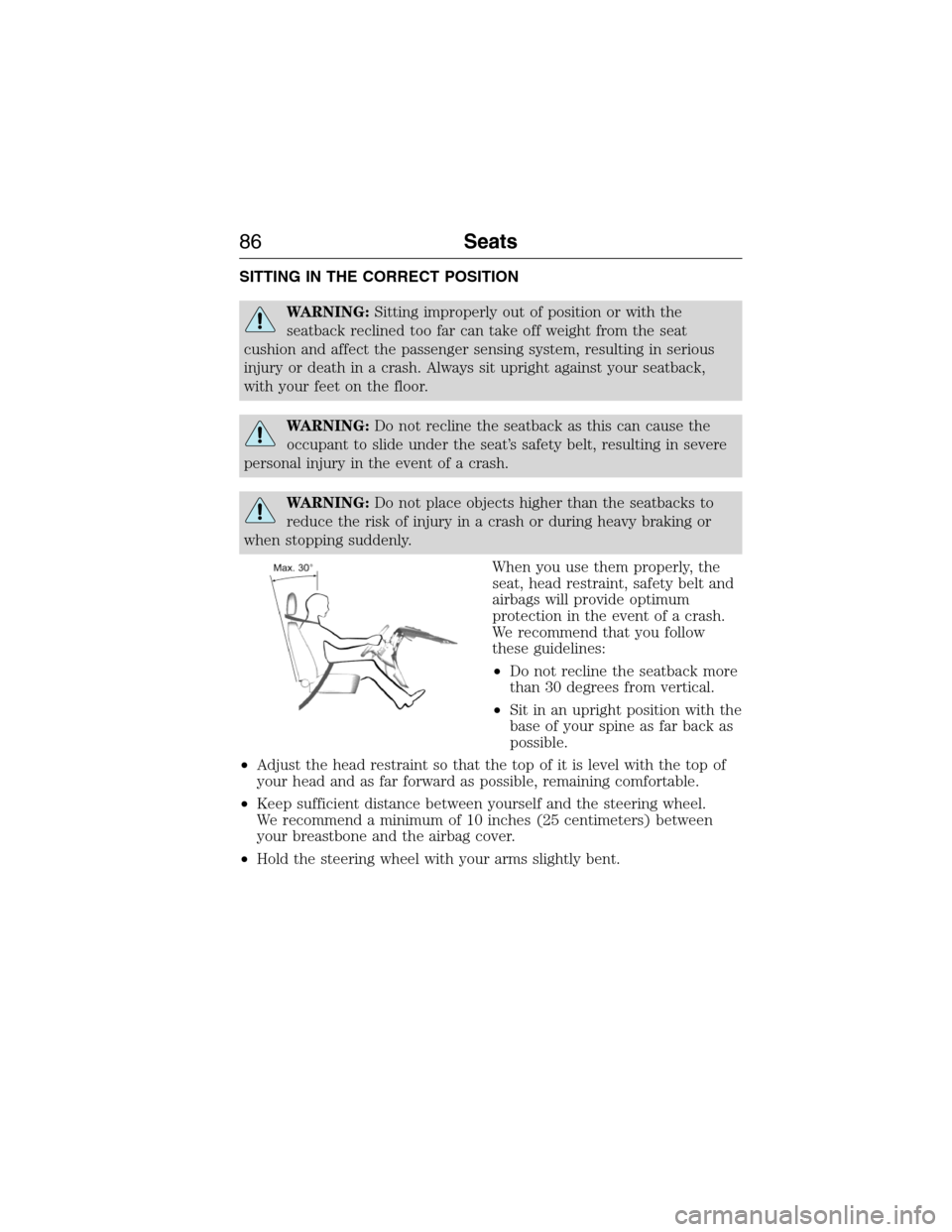
When you use them properly, the
seat, head restraint, safety belt and
airbags will provide optimum
protection in the event of a crash.
We recommend that you follow
these guidelines:
•Do not recline the seatback more
than 30 degrees from vertical.
•Sit in an upright position with the
base of your spine as far back as
possible.
•Adjust the head restraint so that the top of it is level with the top of
your head and as far forward as possible, remaining comfortable.
•Keep sufficient distance between yourself and the steering wheel.
We recommend a minimum of 10 inches (25 centimeters) between
your breastbone and the airbag cover.
•Hold the steering wheel with your arms slightly bent.
86Seats
2015 Econoline(eco)
Owners Guide gf, 1st Printing, June 2014
USA(fus)
Page 88 of 360
•Bend your legs slightly so that you can press the pedals fully.
•Position the shoulder strap of the safety belt over the center of your
shoulder and position the lap strap tightly across your hips.
Make sure that your driving position is comfortable and that you can
maintain full control of your vehicle.
HEAD RESTRAINTS
WARNING:To minimize the risk of neck injury in the event of a
crash, the driver and passenger occupants should not sit in and
operate the vehicle until the seatback is placed in its proper position.
The driver should never adjust the head restraint while the vehicle is
in motion.
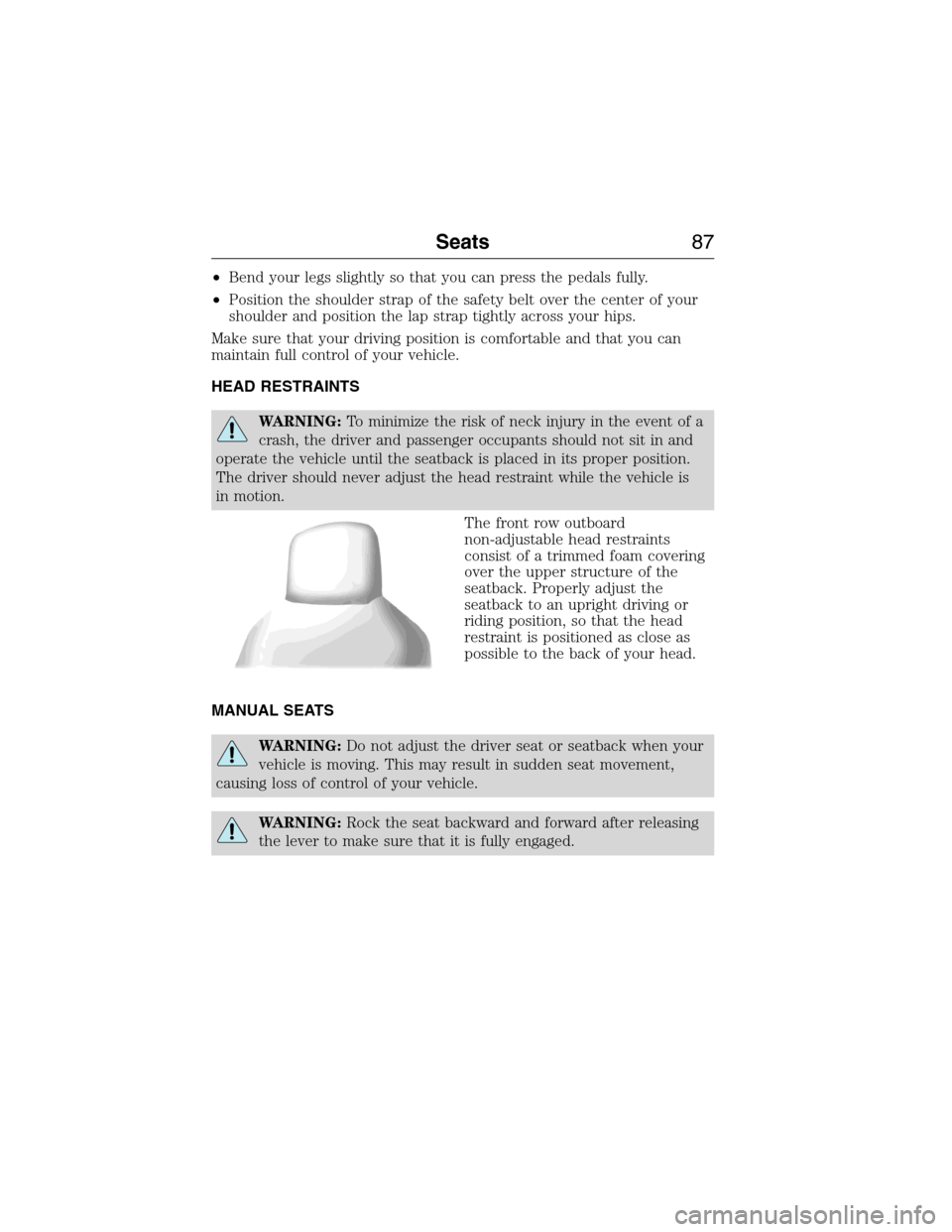
The front row outboard
non-adjustable head restraints
consist of a trimmed foam covering
over the upper structure of the
seatback. Properly adjust the
seatback to an upright driving or
riding position, so that the head
restraint is positioned as close as
possible to the back of your head.
MANUAL SEATS
WARNING:Do not adjust the driver seat or seatback when your
vehicle is moving. This may result in sudden seat movement,
causing loss of control of your vehicle.
WARNING:Rock the seat backward and forward after releasing
the lever to make sure that it is fully engaged.
Seats87
2015 Econoline(eco)
Owners Guide gf, 1st Printing, June 2014
USA(fus)
Page 95 of 360
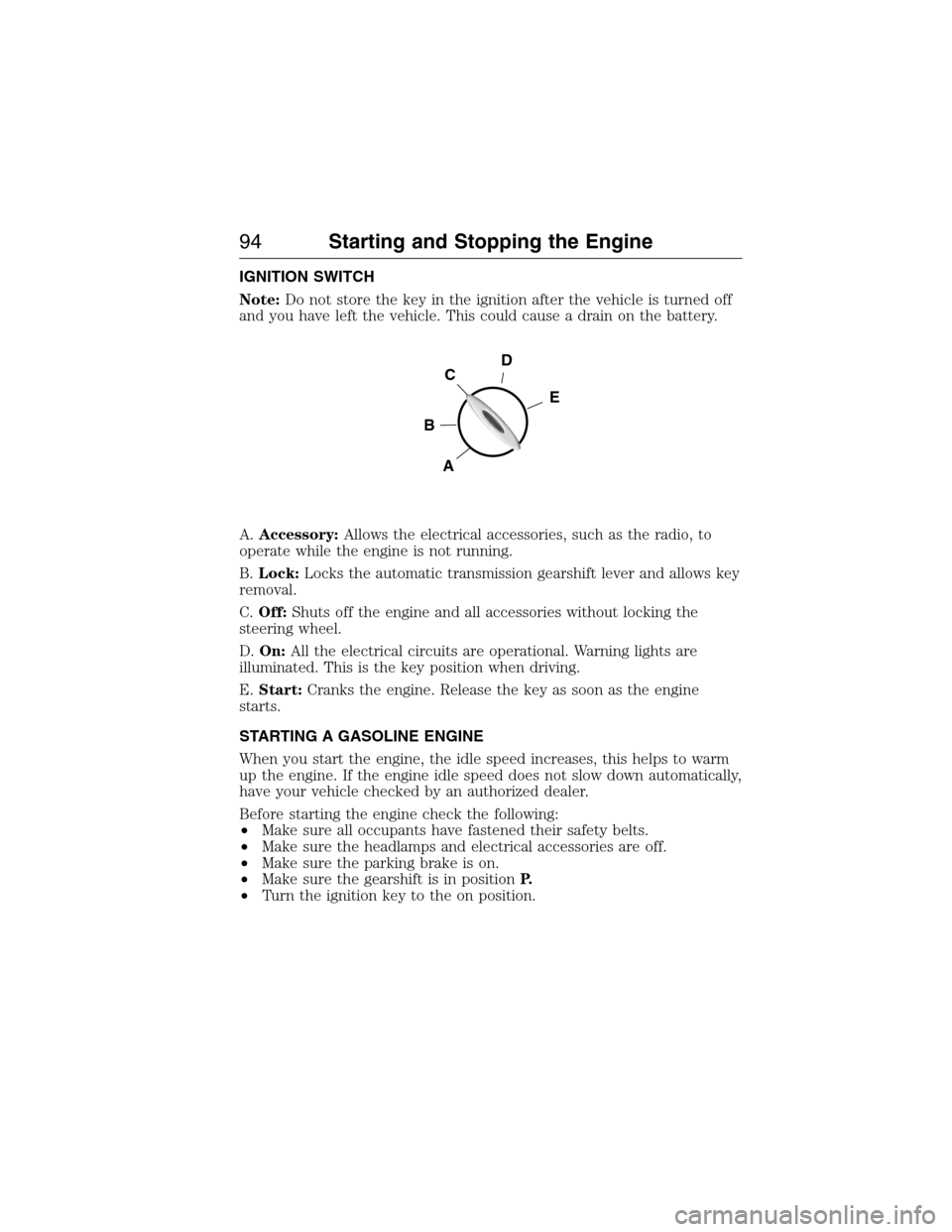
IGNITION SWITCH
Note:Do not store the key in the ignition after the vehicle is turned off
and you have left the vehicle. This could cause a drain on the battery.
A.Accessory:Allows the electrical accessories, such as the radio, to
operate while the engine is not running.
B.Lock:Locks the automatic transmission gearshift lever and allows key
removal.
C.Off:Shuts off the engine and all accessories without locking the
steering wheel.
D.On:All the electrical circuits are operational. Warning lights are
illuminated. This is the key position when driving.
E.Start:Cranks the engine. Release the key as soon as the engine
starts.
STARTING A GASOLINE ENGINE
When you start the engine, the idle speed increases, this helps to warm
up the engine. If the engine idle speed does not slow down automatically,
have your vehicle checked by an authorized dealer.
Before starting the engine check the following:
•Make sure all occupants have fastened their safety belts.
•Make sure the headlamps and electrical accessories are off.
•Make sure the parking brake is on.
•Make sure the gearshift is in positionP.
•Turn the ignition key to the on position.
D
E
C
B
A
94Starting and Stopping the Engine
2015 Econoline(eco)
Owners Guide gf, 1st Printing, June 2014
USA(fus)
Page 138 of 360
TRANSPORTING THE VEHICLE
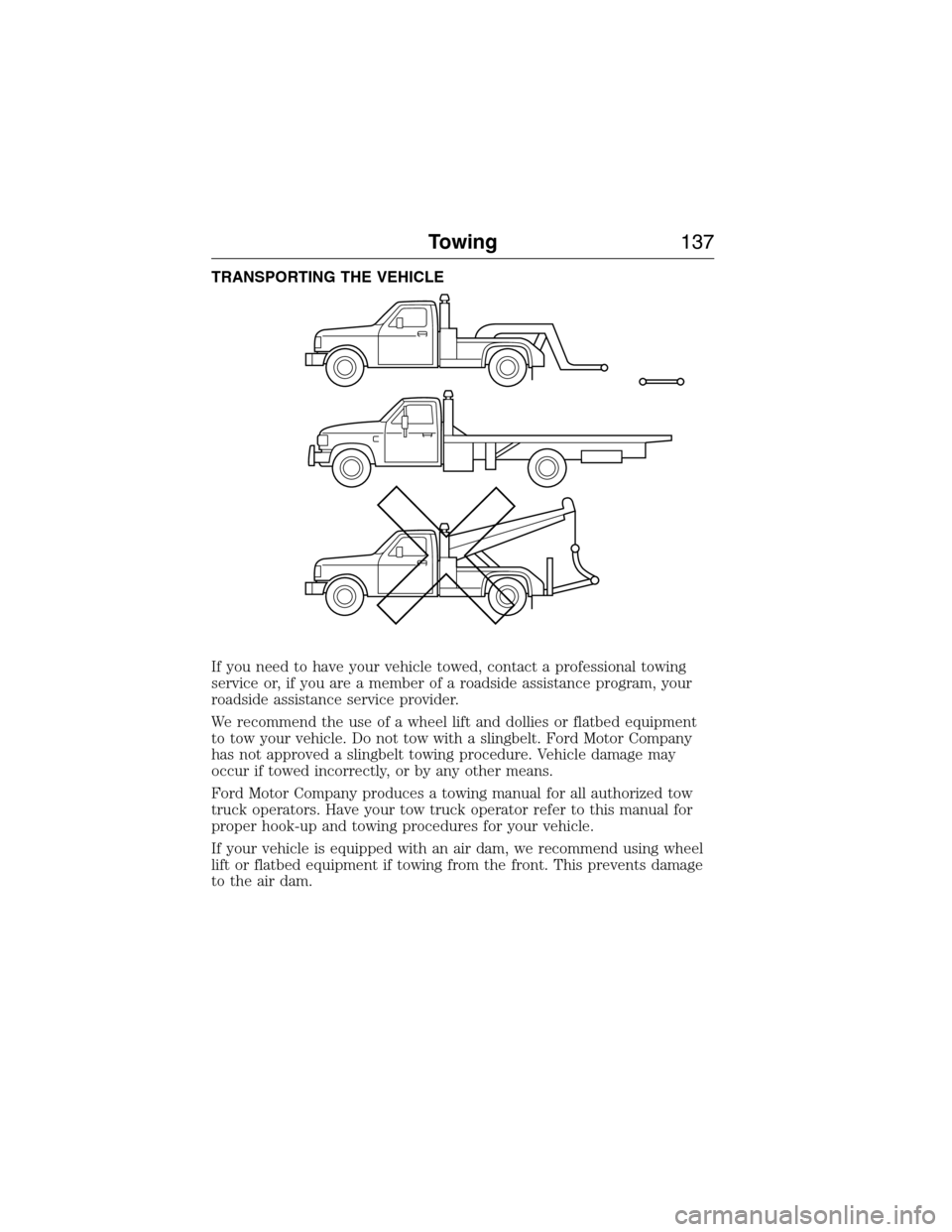
If you need to have your vehicle towed, contact a professional towing
service or, if you are a member of a roadside assistance program, your
roadside assistance service provider.
We recommend the use of a wheel lift and dollies or flatbed equipment
to tow your vehicle. Do not tow with a slingbelt. Ford Motor Company
has not approved a slingbelt towing procedure. Vehicle damage may
occur if towed incorrectly, or by any other means.
Ford Motor Company produces a towing manual for all authorized tow
truck operators. Have your tow truck operator refer to this manual for
proper hook-up and towing procedures for your vehicle.
If your vehicle is equipped with an air dam, we recommend using wheel
lift or flatbed equipment if towing from the front. This prevents damage
to the air dam.
Towing137
2015 Econoline(eco)
Owners Guide gf, 1st Printing, June 2014
USA(fus)
Page 140 of 360
PREPARING TO DRIVE
WARNING:Utility vehicles have a significantly higher rollover
rate than other types of vehicles.
WARNING:In a rollover crash, an unbelted person is
significantly more likely to die than a person wearing a seat belt.
WARNING:Vehicles with a higher center of gravity such as
utility vehicles and trucks handle differently than vehicles with a
lower center of gravity. Utility vehicles and trucks arenotdesigned for
cornering at speeds as high as passenger cars any more than low-slung
sports cars are designed to perform satisfactorily under off-road
conditions. Avoid sharp turns, excessive speed or abrupt maneuvers in
these vehicles. Failure to drive cautiously could result in an increased
risk of loss of vehicle control, vehicle rollover, personal injury and
death.
WARNING:Loaded vehicles, with a higher center of gravity, may
handle differently than unloaded vehicles. Do not overload your
vehicle and use extra precautions, such as driving at slower speeds,
avoiding abrupt steering changes and allowing for increased stopping
distance, when driving a heavily loaded vehicle. Over-loading or loading
the vehicle improperly can deteriorate handling capability and
contribute to loss of vehicle control and vehicle rollover.
Utility vehicles and trucks have larger tires and increased ground
clearance, giving the vehicle a higher center of gravity than a passenger
car.
Vehicle stability and handling
This van or wagon, like any vehicle designed to carry very heavy loads,
must be driven differently from a passenger car. The extra weight can
affect stopping distance and maneuverability. The higher center of
gravity and other features may reduce the ability to make abrupt
maneuvers and may increase the risk of rollover compared to a
passenger car. Do not place any loads on the roof of passenger wagons.
This raises the center of gravity, which increases the risk of rollover.
When loading your wagon, passengers should fill the front rows of seats
Driving Hints139
2015 Econoline(eco)
Owners Guide gf, 1st Printing, June 2014
USA(fus)
Page 141 of 360
first. Do not exceed the weight limits specified on the certification label.
Exceeding any vehicle weight rating limitation could result in serious
damage to the vehicle, loss of vehicle control, vehicle rollover or personal
injury.
The van should be operated by an experienced driver. An organization
that owns a 15–passenger van should select one or two experienced
drivers to drive the van on a regular basis. These drivers will gain
valuable experience handling the van. This experience will help make
each trip safer.
The van should be operated at a safe speed which, in some conditions,
may be less than the posted speed limit.
Further, all occupants should be properly restrained. Most people killed
in rollover crashes were unbelted. Occupants can dramatically reduce
their risk of being killed or seriously injured in a rollover crash by simply
using their seat belts. Organizations that own 15–passenger vans should
have a written seat belt use policy. Drivers should be responsible for
enforcing the policy.
Emergency Maneuvers
WARNING:Vehicles with a higher center of gravity such as
utility and four-wheel drive vehicles handle differently than
vehicles with a lower center of gravity. Utility and four-wheel drive
vehicles arenotdesigned for cornering at speeds as high as passenger
cars any more than low-slung sports cars are designed to perform
satisfactorily under off-road conditions. Avoid sharp turns, excessive
speed and abrupt maneuvers in these vehicles. Failure to drive
cautiously could result in an increased risk of loss of vehicle control,
vehicle rollover, personal injury and death.
•In an unavoidable emergency situation where a sudden sharp turn
must be made, remember to avoid “over-driving” your vehicle, i.e.,
turn the steering wheel only as rapidly and as far as required to avoid
the emergency. Excessive steering will result in less vehicle control,
not more. Additionally, smooth variations of the accelerator and/or
brake pedal pressure should be utilized if changes in vehicle speed are
called for. Avoid abrupt steering, acceleration or braking which could
result in an increased risk of loss of vehicle control, vehicle rollover
and/or personal injury. Use all available road surface to return the
vehicle to a safe direction of travel.
•In the event of an emergency stop, avoid skidding the tires and do not
attempt any sharp steering wheel movements.
140Driving Hints
2015 Econoline(eco)
Owners Guide gf, 1st Printing, June 2014
USA(fus)
Page 150 of 360
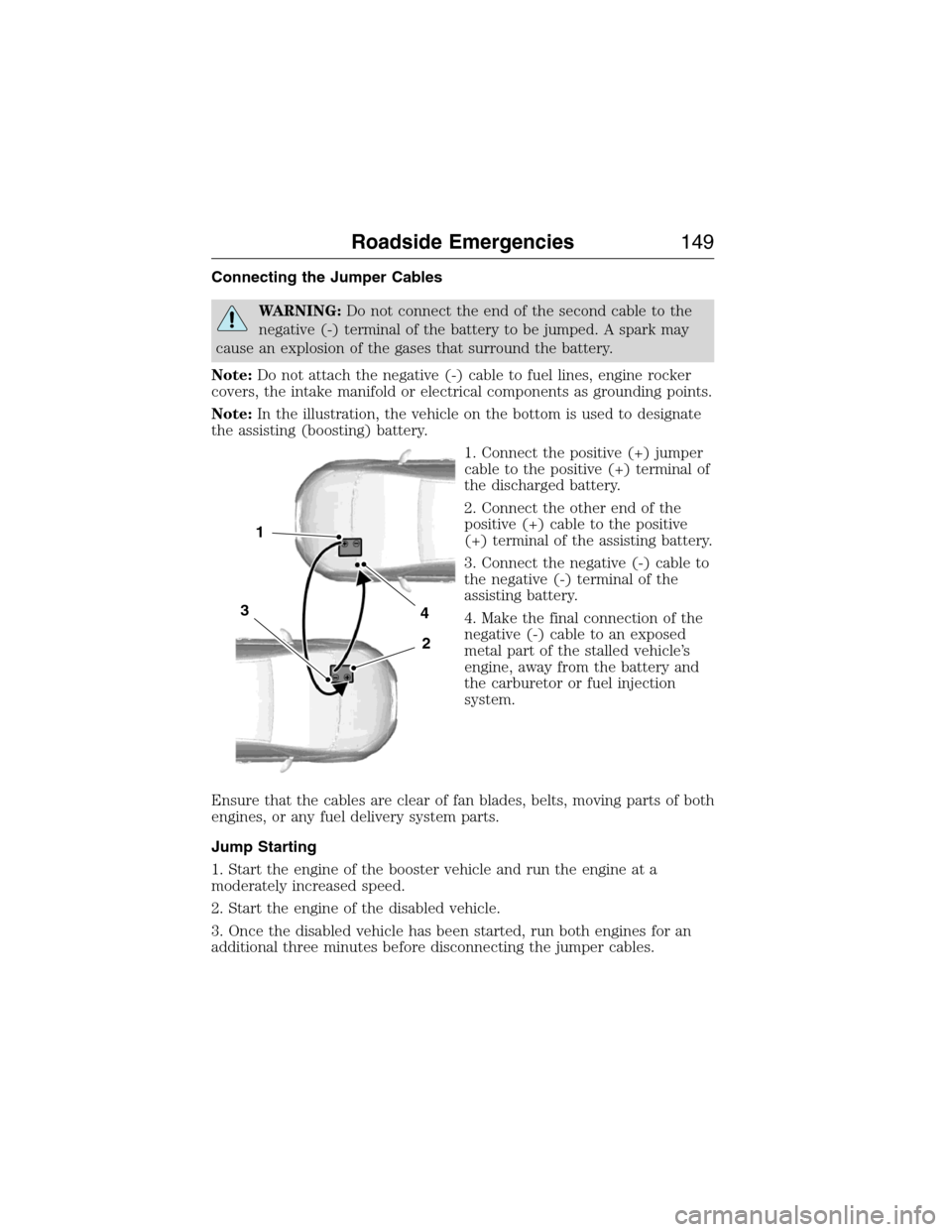
Connecting the Jumper Cables
WARNING:Do not connect the end of the second cable to the
negative (-) terminal of the battery to be jumped. A spark may
cause an explosion of the gases that surround the battery.
Note:Do not attach the negative (-) cable to fuel lines, engine rocker
covers, the intake manifold or electrical components as grounding points.
Note:In the illustration, the vehicle on the bottom is used to designate
the assisting (boosting) battery.
1. Connect the positive (+) jumper
cable to the positive (+) terminal of
the discharged battery.
2. Connect the other end of the
positive (+) cable to the positive
(+) terminal of the assisting battery.
3. Connect the negative (-) cable to
the negative (-) terminal of the
assisting battery.
4. Make the final connection of the
negative (-) cable to an exposed
metal part of the stalled vehicle’s
engine, away from the battery and
the carburetor or fuel injection
system.
Ensure that the cables are clear of fan blades, belts, moving parts of both
engines, or any fuel delivery system parts.
Jump Starting
1. Start the engine of the booster vehicle and run the engine at a
moderately increased speed.
2. Start the engine of the disabled vehicle.
3. Once the disabled vehicle has been started, run both engines for an
additional three minutes before disconnecting the jumper cables.
4
2
1
3
Roadside Emergencies149
2015 Econoline(eco)
Owners Guide gf, 1st Printing, June 2014
USA(fus)