air sensor FORD ECOSPORT 2018 User Guide
[x] Cancel search | Manufacturer: FORD, Model Year: 2018, Model line: ECOSPORT, Model: FORD ECOSPORT 2018Pages: 452, PDF Size: 17.04 MB
Page 163 of 452
Note:The system may not alert you if avehicle quickly passes through the detectionzone.
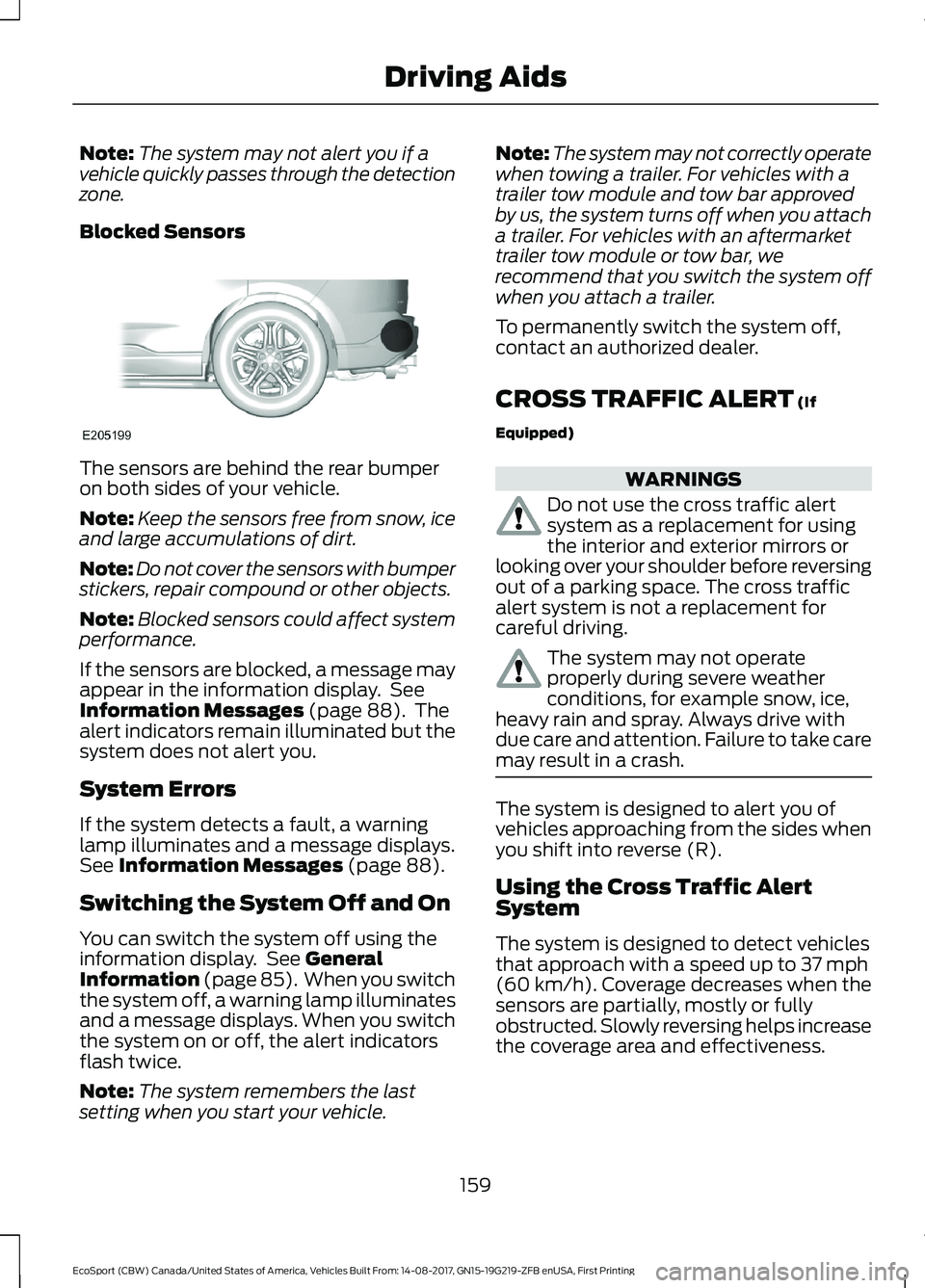
Blocked Sensors
The sensors are behind the rear bumperon both sides of your vehicle.
Note:Keep the sensors free from snow, iceand large accumulations of dirt.
Note:Do not cover the sensors with bumperstickers, repair compound or other objects.
Note:Blocked sensors could affect systemperformance.
If the sensors are blocked, a message mayappear in the information display. SeeInformation Messages (page 88). Thealert indicators remain illuminated but thesystem does not alert you.
System Errors
If the system detects a fault, a warninglamp illuminates and a message displays.See Information Messages (page 88).
Switching the System Off and On
You can switch the system off using theinformation display. See GeneralInformation (page 85). When you switchthe system off, a warning lamp illuminatesand a message displays. When you switchthe system on or off, the alert indicatorsflash twice.
Note:The system remembers the lastsetting when you start your vehicle.
Note:The system may not correctly operatewhen towing a trailer. For vehicles with atrailer tow module and tow bar approvedby us, the system turns off when you attacha trailer. For vehicles with an aftermarkettrailer tow module or tow bar, werecommend that you switch the system offwhen you attach a trailer.
To permanently switch the system off,contact an authorized dealer.
CROSS TRAFFIC ALERT (If
Equipped)
WARNINGS
Do not use the cross traffic alertsystem as a replacement for usingthe interior and exterior mirrors orlooking over your shoulder before reversingout of a parking space. The cross trafficalert system is not a replacement forcareful driving.
The system may not operateproperly during severe weatherconditions, for example snow, ice,heavy rain and spray. Always drive withdue care and attention. Failure to take caremay result in a crash.
The system is designed to alert you ofvehicles approaching from the sides whenyou shift into reverse (R).
Using the Cross Traffic AlertSystem
The system is designed to detect vehiclesthat approach with a speed up to 37 mph(60 km/h). Coverage decreases when thesensors are partially, mostly or fullyobstructed. Slowly reversing helps increasethe coverage area and effectiveness.
159EcoSport (CBW) Canada/United States of America, Vehicles Built From: 14-08-2017, GN15-19G219-ZFB enUSA, First PrintingDriving Aids
Page 165 of 452
Zone coverage also decreases whenparking at narrow angles. The sensor onthe left-hand side is mostly obstructed andzone coverage on that side is severelyreduced.
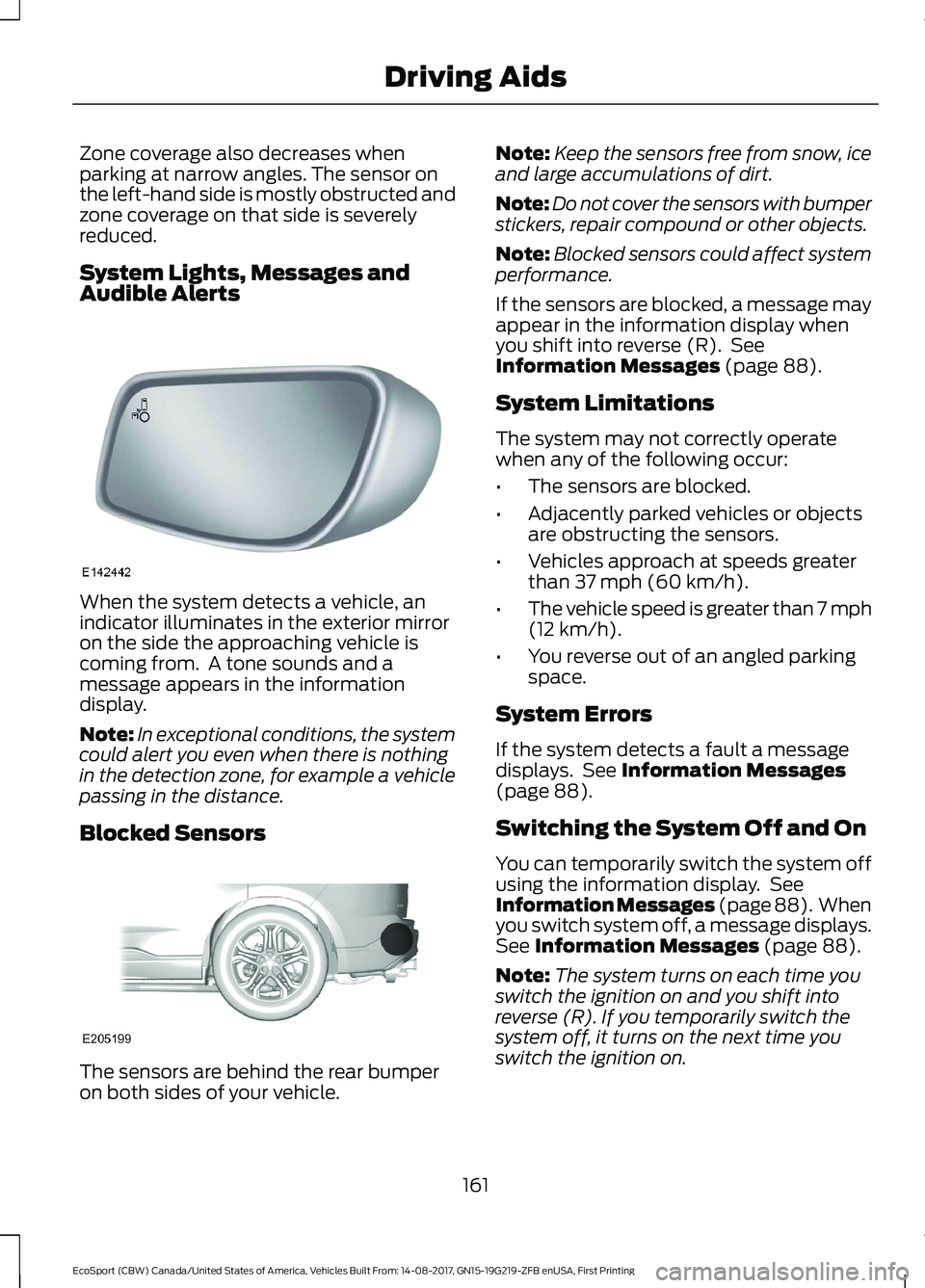
System Lights, Messages andAudible Alerts
When the system detects a vehicle, anindicator illuminates in the exterior mirroron the side the approaching vehicle iscoming from. A tone sounds and amessage appears in the informationdisplay.
Note:In exceptional conditions, the systemcould alert you even when there is nothingin the detection zone, for example a vehiclepassing in the distance.
Blocked Sensors
The sensors are behind the rear bumperon both sides of your vehicle.
Note:Keep the sensors free from snow, iceand large accumulations of dirt.
Note:Do not cover the sensors with bumperstickers, repair compound or other objects.
Note:Blocked sensors could affect systemperformance.
If the sensors are blocked, a message mayappear in the information display whenyou shift into reverse (R). SeeInformation Messages (page 88).
System Limitations
The system may not correctly operatewhen any of the following occur:
•The sensors are blocked.
•Adjacently parked vehicles or objectsare obstructing the sensors.
•Vehicles approach at speeds greaterthan 37 mph (60 km/h).
•The vehicle speed is greater than 7 mph(12 km/h).
•You reverse out of an angled parkingspace.
System Errors
If the system detects a fault a messagedisplays. See Information Messages(page 88).
Switching the System Off and On
You can temporarily switch the system offusing the information display. SeeInformation Messages (page 88). Whenyou switch system off, a message displays.See Information Messages (page 88).
Note:The system turns on each time youswitch the ignition on and you shift intoreverse (R). If you temporarily switch thesystem off, it turns on the next time youswitch the ignition on.
161EcoSport (CBW) Canada/United States of America, Vehicles Built From: 14-08-2017, GN15-19G219-ZFB enUSA, First PrintingDriving Aids
Page 200 of 452
Protected componentsFuse amp ratingFuse
Provision for trailer tow wiring.20A26
Not used.-27
Left horn.10A28
Right horn.10A29
Heated Steering wheel.15A30
Temperature mass air flow sensor (2.0L).5A31
Body control module (battery voltage).30A32
ABS/eletronic stability program pump.60A33
Trailer tow module.50A34
Heated backlite.40A35
Starter.30A36
Positive temperature coefficient heater.40A37
Not used.-38
Not used.-39
Heated seats (climate control module).25A40
Subwoofer amplifier.15A41
Intercooler puller fan (1.0 L).7.5A42
Power window switch power switch times.30A46
Fuel pump.20A47
Not used.-48
Assisted direct start transmission fluidpump (stop/start) - power.20A49
Not used.-55
Electrical power assisted system module.5A56Powertrain control module.
Start / Stop - transmission fluid pump.10A57
Left hand blind spot monitor module.10A58Right hand blind spot monitor module.
196EcoSport (CBW) Canada/United States of America, Vehicles Built From: 14-08-2017, GN15-19G219-ZFB enUSA, First PrintingFuses
Page 244 of 452
Note:Do note use the kit if you haveseverely damaged a tire. Only sealpunctures located within the tire tread withthe kit.
Loss of air pressure may adversely affecttire performance. For this reason:
•Drive carefully and avoid abruptsteering maneuvers.
•Periodically monitor tire inflationpressure in the affected tire; if the tireis losing pressure, have the vehicletowed.
•Read the information in the Tips forUse of the Kit section to make sure safeoperation of the kit and your vehicle.
Note:Do not drive the vehicle above50 mph (80 km/h).
Note:Do not drive further than 124 mi(200 km). Drive only to the closestauthorized Ford dealer or tire repair shop tohave your tire inspected.
Tips for use of the kit
To ensure safe operation of the kit:
•Read all instructions and cautions fully.
•Before operating the kit, make sureyour vehicle is safely off the road andaway from moving traffic. Switch onthe hazard lights.
•Always set the parking brake to ensurethe vehicle doesn't move unexpectedly.
•Do not remove any foreign objects,such as nails or screws, from the tire.
•When using the kit, if the vehicle isoutdoors or in a well-ventilated area,leave the engine running so thecompressor does not drain thevehicle's battery.
•Do not allow the compressor tooperate continuously for more than 15minutes. This will help prevent thecompressor from overheating.
•Never leave the kit unattended whenit is operating.
•Keep the kit away from children.
•Only use the kit when the ambienttemperature is between -22.0°F(-30°C) and 157.9°F (70°C).
•Only use the sealing compound beforethe use-by date which is printed on thetop of sealant bottle.
•After sealant use, an authorized Forddealer must replace the tire pressuremonitoring system sensor and valvestem on the wheel.
•Operating the kit could cause anelectrical disturbance in radio, CD, andDVD player operation.
What to do when a tire is punctured
A tire puncture within the tire's tread areacan be sealed in two stages with the kit.
•In the first stage, the tire will bereinflated with a sealing compoundand air. After the tire has been inflated,you will need to drive the vehicleapproximately 4 mi (6 km) to distributethe sealant in the tire.
•In the second stage, you will need tocheck the tire pressure and adjust, ifnecessary, to the vehicle's specifiedtire inflation pressure.
First stage: reinflating the tire withsealing compound and air
WARNINGS
Do not stand directly over the kitwhile inflating the tire. If you noticeany unusual bulges or deformationsin the tire's sidewall during inflation, stopand call roadside assistance.
If the tire does not inflate to therecommended tire pressure within15 minutes, stop and call roadsideassistance.
240EcoSport (CBW) Canada/United States of America, Vehicles Built From: 14-08-2017, GN15-19G219-ZFB enUSA, First PrintingWheels and Tires
Page 261 of 452
WARNINGS
may be found on either the SafetyCompliance Certification Label(affixed to either the door hingepillar, door-latch post, or the dooredge that meets the door-latchpost, next to the driver's seatingposition), or the Tire Label whichis located on the B-Pillar or edgeof the driver's door. If thisinformation is not found on theselabels, then you should contactyour authorized dealer as soon aspossible. Use of any tire or wheelnot recommended by Ford canaffect the safety and performanceof your vehicle, which could resultin an increased risk of loss ofvehicle control, vehicle rollover,personal injury and death.
To reduce the risk of seriousinjury, when mountingreplacement tires and wheels, youshould not exceed the maximumpressure indicated on the sidewallof the tire to set the beads withoutadditional precautions listedbelow. If the beads do not seat atthe maximum pressure indicated,re-lubricate and try again.
When inflating the tire formounting pressures up to20 psi (1.38 bar) greater than themaximum pressure on the tiresidewall, the followingprecautions must be taken toprotect the person mounting thetire:
•Make sure that you have thecorrect tire and wheel size.
•Lubricate the tire bead andwheel bead seat area again.
•Stand at a minimum of 12 ft(3.66 m) away from the wheeland tire assembly.
•Use both eye and earprotection.
WARNINGS
For a mounting pressuremore than 20 psi (1.38 bar)greater than the maximumpressure, a Ford dealer or othertire service professional should dothe mounting.
Always inflate steel carcasstires with a remote air fill withthe person inflating standing at aminimum of 12 ft (3.66 m) awayfrom the wheel and tire assembly.
Important: Remember to replacethe wheel valve stems when theroad tires are replaced on yourvehicle.
It is recommended that the twofront tires or two rear tiresgenerally be replaced as a pair.
The tire pressure sensors mountedin the wheels (originally installedon your vehicle) are not designedto be used in aftermarket wheels.
257EcoSport (CBW) Canada/United States of America, Vehicles Built From: 14-08-2017, GN15-19G219-ZFB enUSA, First PrintingWheels and Tires
Page 265 of 452
The tires on your vehicle may haveall-weather treads to provide traction inrain and snow. However, in some climatesyou may need to use snow chains. If youneed to use chains, it is recommended thatsteel wheels (of the same size andspecification) be used, as chains may chipaluminum wheels. Follow these guidelineswhen using traction devices:
•Use 0.3937 in (10 mm) or less indimension as measured on the sidewallof your tire with 205/60 R16 92H or205/50 R17 93H XL. Not all S-classsnow chains meet these restrictions.Chains of this size restriction willinclude a tensioning device. (AnyLincoln or Ford passenger vehicle).
•The snow chains or cables must bemounted in pairs on only on the frontaxle.
•Purchase chains or cables from amanufacturer that clearly labels bodyto tire dimension restrictions.
•When installing tire chains or cables,make sure they are the proper size forthe tires on your vehicle and areinstalled according to the chainmanufacturer’s suggestions.
•Install cables securely, verifying thatthe cables do not extend beyond thewheel or touch the wheel, any wiring,brake lining.
•If possible, avoid fully loading yourvehicle.
•When driving with snow chains orcables, do not exceed 30 mph(48 km/h) or the maximum speedrecommended by the chainmanufacturer; whichever is less.
•Drive cautiously. If you hear the chainsor cables rub or bang against thevehicle, stop and retighten them. If thisdoes not work, remove the chains orcables and prevent vehicle damage.
•Remove the chains or cables when theyare no longer needed. Do not use thechains or cables on dry roads.
•If a temporary spare tire is mounted onyour vehicle, do not use snow chainson the axle with the temporary sparetire.
If you have any questions regarding snowtires or snow chains, please contact yourauthorized dealer.
TIRE PRESSURE MONITORING
SYSTEM
WARNING
The tire pressure monitoring systemis not a substitute for manuallychecking tire pressures. You shouldperiodically check tire pressures using apressure gauge. Failure to correctlymaintain tire pressures could increase therisk of tire failure, loss of control, vehiclerollover and personal injury.
Note: You should only use tire sealants inroadside emergencies as they may causedamage to the tire pressure monitoringsystem sensor.
Note: If the tire pressure monitoring systemsensor becomes damaged, it may notfunction.
Each tire, including the spare (ifprovided), should be checkedmonthly when cold and inflatedto the inflation pressure recommended bythe vehicle manufacturer on the vehicleplacard or tire inflation pressure label. (Ifyour vehicle has tires of a different sizethan the size indicated on the vehicleplacard or tire inflation pressure label, youshould determine the proper tire inflationpressure for those tires).
261EcoSport (CBW) Canada/United States of America, Vehicles Built From: 14-08-2017, GN15-19G219-ZFB enUSA, First PrintingWheels and Tires
Page 270 of 452
When driving with a type 3 dissimilarspare tire listed above, do not:
•Exceed 70 mph (113 km/h).
•Use more than one dissimilar sparewheel and tire assembly at a time.
•Use commercial car washingequipment.
Use of one of the dissimilar spare tireslisted above at any one wheel location canlead to impairment of the following:
•Handling, stability and brakingperformance.
•Comfort and noise.
•Ground clearance and parking at curbs.
•Winter weather driving capability.
•Wet weather driving capability.
•All-wheel driving capability (ifapplicable).
The usage of a full-size dissimilar sparewheel and tire assembly can lead toimpairment of the following:
•Handling, stability and brakingperformance.
•Comfort and noise.
•Ground clearance and parking at curbs.
•Winter weather driving capability.
•Wet weather driving capability.
•All-wheel driving capability.
When driving with the full-size dissimilarspare wheel and tire assembly additionalcaution should be given to:
•Towing a trailer.
•Driving vehicles equipped with acamper body.
•Driving vehicles with a load on thecargo rack.
Drive cautiously when using a full-sizedissimilar spare wheel and tire assemblyand seek service as soon as possible.
Vehicles With a Spare Wheel
If the spare wheel is exactly the same typeand size as the other fitted wheels, you canreplace the existing road wheel with thespare wheel and continue to drive in thenormal manner.
If the spare wheel is different to the otherwheels, it will carry a yellow label with theappropriate speed limit.
See the following information for using thespare wheel.
WARNINGS
Drive the shortest possible distances.
Do not fit more than one spare wheelon your vehicle at any one time.
Do not carry out any tire repairs on aspare wheel.
If you are not sure what type of sparewheel your vehicle has, do notexceed 50 mph (80 km/h).
The ground clearance of your vehiclemay be reduced. Take care whenparking next to a curb.
Note:The use of tire sealant may damageyour tire pressure monitoring system andshould only be used in roadsideemergencies. If you must use a sealant, theFord Tire Mobility Kit sealant should beused. The tire pressure monitoring systemsensor and valve stem on the wheel mustbe replaced by an authorized dealer afteruse of the sealant.
Note:Your vehicle may exhibit somedifferent driving characteristics if you fit thespare wheel.
Note:If the spare wheel is fitted to yourvehicle, do not drive through an automaticcar wash.
266EcoSport (CBW) Canada/United States of America, Vehicles Built From: 14-08-2017, GN15-19G219-ZFB enUSA, First PrintingWheels and Tires
Page 441 of 452
Side Repeater......................................................222Vanity lamp..........................................................225Changing a Fuse..........................................200Fuses......................................................................200Changing a Road Wheel...........................265Dissimilar Spare Wheel and Tire AssemblyInformation.....................................................265Installing a Road Wheel..................................269Jacking and Lifting Points..............................268Removing a Road Wheel................................268Vehicle Jack..........................................................267Vehicles With a Spare Wheel.......................266Changing the 12V Battery..........................213Remove and Reinstall the Battery...............214Changing the Engine Air Filter.................227Changing the Air Filter Element....................227Changing the Wiper Blades......................215Rear Window Wiper Blade..............................215Windshield Wiper Blades.................................215Checking MyKey System Status...............52MyKey Distance.....................................................52Number of Admin Keys......................................53Number of MyKeys...............................................52Checking the Wiper Blades.......................215Child Restraint and SeatbeltMaintenance.................................................34Child Restraint Positioning.........................25Child Safety.......................................................16General Information.............................................16Child Safety Locks.........................................26Rear Left-Hand Door..........................................26Rear Right-Hand Door........................................27Cleaning Leather Seats.............................233Cleaning Products.......................................229Cleaning the Engine.....................................231Cleaning the Exterior..................................230Cleaning the Headlamps................................230Exterior Chrome Parts.....................................230Exterior Plastic Parts.........................................231Stripes or Graphics.............................................231Underbody.............................................................231Under Hood...........................................................231Cleaning the Instrument Panel andInstrument Cluster Lens.........................233Cleaning the Interior....................................232Cleaning the Wheels..................................234Cleaning the Windows and WiperBlades............................................................232
Clearing All MyKeys.......................................52Climate Control..............................................98Principle of Operation........................................98Cold Weather Precautions........................178Coolant CheckSee: Engine Coolant Check...........................208Cool Box.............................................................117Crash Sensors and Airbag Indicator........43Creating a MyKey.............................................51Vehicles With a Key..............................................51Vehicles With Push-Button Start....................51Cross Traffic Alert.........................................159Blocked Sensors..................................................161Switching the System Off and On................161System Errors........................................................161System Lights, Messages and AudibleAlerts...................................................................161System Limitations.............................................161Using the Cross Traffic Alert System..........159Cruise Control.................................................66Principle of Operation.......................................156Cruise controlSee: Using Cruise Control................................156Customer Assistance.................................186
D
Data Recording..................................................9Event Data Recording..........................................10Service Data Recording........................................9Daytime Running Lamps.............................73Type 1 - Conventional (Non-Configurable)....................................................73Type 2 - Configurable..........................................73Direction Indicators........................................74Doors and Locks.............................................54Drive Belt Routing - 1.0LEcoBoost™.................................................228Drive Belt Routing - 2.0L...........................228Driver and Passenger Airbags....................37Children and Airbags..........................................38Proper Driver and Front Passenger SeatingAdjustment........................................................37Driver and Passenger Knee Airbags.........41Driving Aids.....................................................158Driving Hints....................................................178Driving Through Water................................178
437EcoSport (CBW) Canada/United States of America, Vehicles Built From: 14-08-2017, GN15-19G219-ZFB enUSA, First PrintingIndex
Page 448 of 452
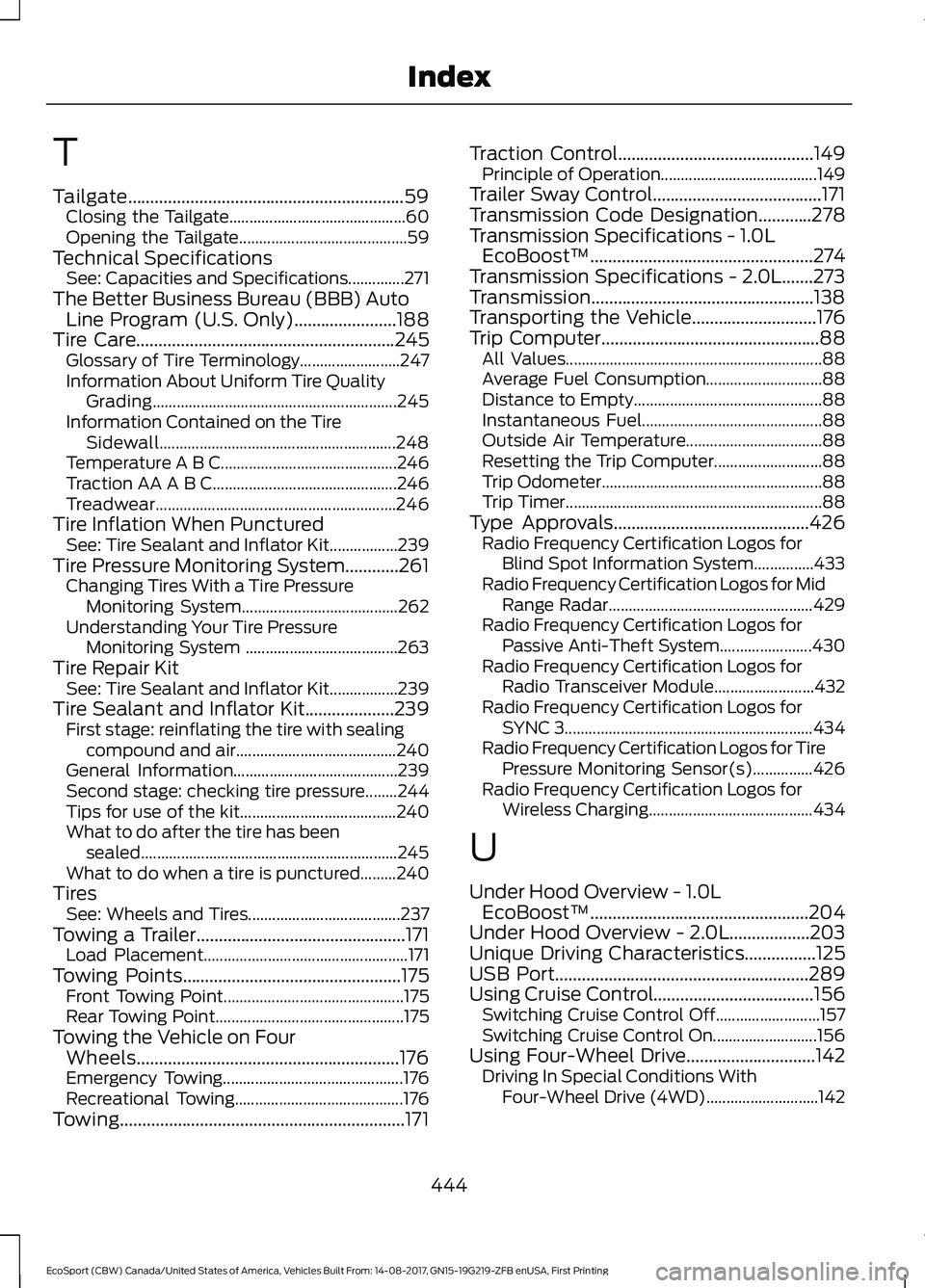
T
Tailgate..............................................................59Closing the Tailgate............................................60Opening the Tailgate..........................................59Technical SpecificationsSee: Capacities and Specifications..............271The Better Business Bureau (BBB) AutoLine Program (U.S. Only).......................188Tire Care..........................................................245Glossary of Tire Terminology.........................247Information About Uniform Tire QualityGrading.............................................................245Information Contained on the TireSidewall...........................................................248Temperature A B C............................................246Traction AA A B C..............................................246Treadwear............................................................246Tire Inflation When PuncturedSee: Tire Sealant and Inflator Kit.................239Tire Pressure Monitoring System............261Changing Tires With a Tire PressureMonitoring System.......................................262Understanding Your Tire PressureMonitoring System ......................................263Tire Repair KitSee: Tire Sealant and Inflator Kit.................239Tire Sealant and Inflator Kit....................239First stage: reinflating the tire with sealingcompound and air........................................240General Information.........................................239Second stage: checking tire pressure........244Tips for use of the kit.......................................240What to do after the tire has beensealed................................................................245What to do when a tire is punctured.........240TiresSee: Wheels and Tires......................................237Towing a Trailer...............................................171Load Placement...................................................171Towing Points.................................................175Front Towing Point.............................................175Rear Towing Point...............................................175Towing the Vehicle on FourWheels...........................................................176Emergency Towing.............................................176Recreational Towing..........................................176Towing................................................................171
Traction Control............................................149Principle of Operation.......................................149Trailer Sway Control......................................171Transmission Code Designation............278Transmission Specifications - 1.0LEcoBoost™..................................................274Transmission Specifications - 2.0L.......273Transmission..................................................138Transporting the Vehicle............................176Trip Computer.................................................88All Values................................................................88Average Fuel Consumption.............................88Distance to Empty...............................................88Instantaneous Fuel.............................................88Outside Air Temperature..................................88Resetting the Trip Computer...........................88Trip Odometer.......................................................88Trip Timer................................................................88Type Approvals............................................426Radio Frequency Certification Logos forBlind Spot Information System...............433Radio Frequency Certification Logos for MidRange Radar...................................................429Radio Frequency Certification Logos forPassive Anti-Theft System.......................430Radio Frequency Certification Logos forRadio Transceiver Module.........................432Radio Frequency Certification Logos forSYNC 3..............................................................434Radio Frequency Certification Logos for TirePressure Monitoring Sensor(s)...............426Radio Frequency Certification Logos forWireless Charging.........................................434
U
Under Hood Overview - 1.0LEcoBoost™.................................................204Under Hood Overview - 2.0L..................203Unique Driving Characteristics................125USB Port.........................................................289Using Cruise Control....................................156Switching Cruise Control Off..........................157Switching Cruise Control On..........................156Using Four-Wheel Drive.............................142Driving In Special Conditions WithFour-Wheel Drive (4WD)............................142
444EcoSport (CBW) Canada/United States of America, Vehicles Built From: 14-08-2017, GN15-19G219-ZFB enUSA, First PrintingIndex