spare wheel FORD ECOSPORT 2018 User Guide
[x] Cancel search | Manufacturer: FORD, Model Year: 2018, Model line: ECOSPORT, Model: FORD ECOSPORT 2018Pages: 452, PDF Size: 17.04 MB
Page 262 of 452
The use of wheels or tires notrecommended by Ford MotorCompany may affect theoperation of your tire pressuremonitoring system.
If the tire pressure monitoringsystem indicator is flashing, yourtire pressure monitoring system ismalfunctioning. Your replacementtire might be incompatible withyour TPMS, or some componentof the TPMS may be damaged.
Safety Practices
WARNINGS
If your vehicle is stuck insnow, mud or sand, do notrapidly spin the tires; spinning thetires can tear the tire and causean explosion. A tire can explode inas little as three to five seconds.
Do not spin the wheels atover 34 mph (55 km/h). Thetires may fail and injure apassenger or bystander.
Driving habits have a great dealto do with your tire mileage andsafety.
Observe posted speed limits.
Avoid fast starts, stops and turns.
Avoid potholes and objects on theroad.
Do not run over curbs or hit the tireagainst a curb when parking.
Highway Hazards
No matter how carefully you drivethere is always the possibility thatyou may eventually have a flat tireon the highway. Drive slowly to theclosest safe area out of traffic.This may further damage the flattire, but your safety is moreimportant.
If you feel a sudden vibration orride disturbance while driving, oryou suspect your tire or vehiclehas been damaged, immediatelyreduce your speed. Drive withcaution until you can safely pulloff the road. Stop and inspect thetires for damage.
If a tire is under-inflated, check thetire for damage. If the tire is notdamaged inflate it to therecommended tire pressure.
If a tire is damaged, have itreplaced immediately. If yourvehicle has a spare wheel, fit thespare wheel immediately andhave the damaged tire replacedas soon as possible. If your vehicledoes not have a spare wheel, ithas a temporary mobility kit.
258EcoSport (CBW) Canada/United States of America, Vehicles Built From: 14-08-2017, GN15-19G219-ZFB enUSA, First PrintingWheels and Tires
Page 263 of 452
Tire and Wheel Alignment
A bad jolt from hitting a curb orpothole can cause the front endof your vehicle to becomemisaligned or cause damage toyour tires. If your vehicle seems topull to one side when you aredriving, the wheels may be out ofalignment. Have an authorizeddealer check the wheel alignmentperiodically.
Wheel misalignment in the frontor the rear can cause uneven andrapid treadwear of your tires andshould be corrected by anauthorized dealer. Front-wheeldrive vehicles and those with anindependent rear suspension (ifequipped) may require alignmentof all four wheels.
The tires should also be balancedperiodically. An unbalanced tireand wheel assembly may result inirregular tire wear.
Tire Rotation
WARNING
If the tire label showsdifferent tire pressures for thefront and rear tires and the vehiclehas a tire pressure monitoringsystem, then you need to updatethe settings for the systemsensors. Always perform thesystem reset procedure after tirerotation. If you do not reset thesystem, it may not provide a low
tire pressure warning whennecessary.
Note:If your tires show unevenwear ask an authorized dealer tocheck for and correct any wheelmisalignment, tire imbalance ormechanical problem involvedbefore tire rotation.
Note:Your vehicle may beequipped with a dissimilar sparewheel and tire assembly. Adissimilar spare wheel and tireassembly is defined as a sparewheel and tire assembly that isdifferent in brand, size orappearance from the road tires andwheels. If you have a dissimilarspare wheel and tire assembly it isintended for temporary use onlyand should not be used in a tirerotation.
Note:After having your tiresrotated, inflation pressure must bechecked and adjusted to thevehicle requirements.
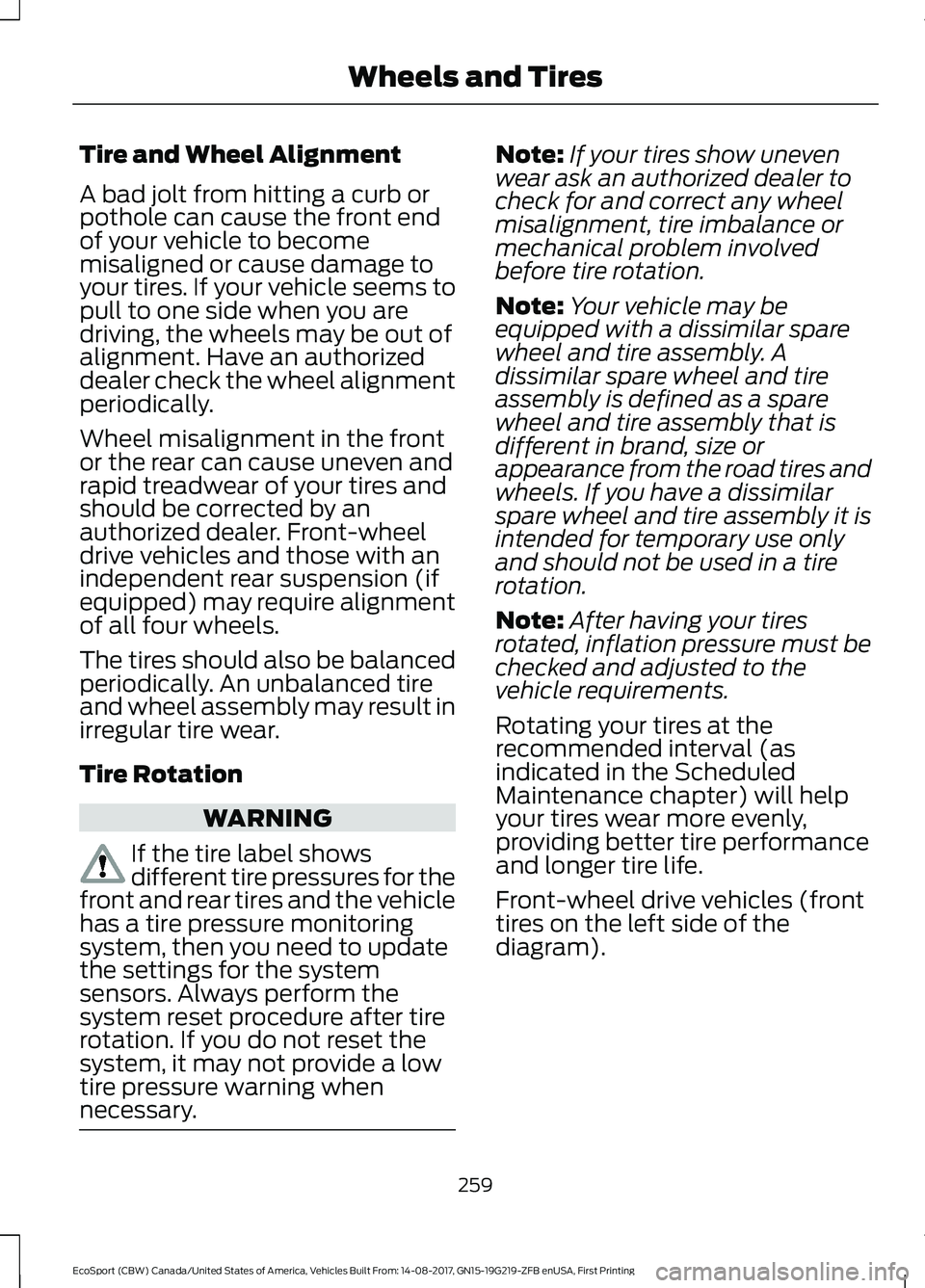
Rotating your tires at therecommended interval (asindicated in the ScheduledMaintenance chapter) will helpyour tires wear more evenly,providing better tire performanceand longer tire life.
Front-wheel drive vehicles (fronttires on the left side of thediagram).
259EcoSport (CBW) Canada/United States of America, Vehicles Built From: 14-08-2017, GN15-19G219-ZFB enUSA, First PrintingWheels and Tires
Page 265 of 452
The tires on your vehicle may haveall-weather treads to provide traction inrain and snow. However, in some climatesyou may need to use snow chains. If youneed to use chains, it is recommended thatsteel wheels (of the same size andspecification) be used, as chains may chipaluminum wheels. Follow these guidelineswhen using traction devices:
•Use 0.3937 in (10 mm) or less indimension as measured on the sidewallof your tire with 205/60 R16 92H or205/50 R17 93H XL. Not all S-classsnow chains meet these restrictions.Chains of this size restriction willinclude a tensioning device. (AnyLincoln or Ford passenger vehicle).
•The snow chains or cables must bemounted in pairs on only on the frontaxle.
•Purchase chains or cables from amanufacturer that clearly labels bodyto tire dimension restrictions.
•When installing tire chains or cables,make sure they are the proper size forthe tires on your vehicle and areinstalled according to the chainmanufacturer’s suggestions.
•Install cables securely, verifying thatthe cables do not extend beyond thewheel or touch the wheel, any wiring,brake lining.
•If possible, avoid fully loading yourvehicle.
•When driving with snow chains orcables, do not exceed 30 mph(48 km/h) or the maximum speedrecommended by the chainmanufacturer; whichever is less.
•Drive cautiously. If you hear the chainsor cables rub or bang against thevehicle, stop and retighten them. If thisdoes not work, remove the chains orcables and prevent vehicle damage.
•Remove the chains or cables when theyare no longer needed. Do not use thechains or cables on dry roads.
•If a temporary spare tire is mounted onyour vehicle, do not use snow chainson the axle with the temporary sparetire.
If you have any questions regarding snowtires or snow chains, please contact yourauthorized dealer.
TIRE PRESSURE MONITORING
SYSTEM
WARNING
The tire pressure monitoring systemis not a substitute for manuallychecking tire pressures. You shouldperiodically check tire pressures using apressure gauge. Failure to correctlymaintain tire pressures could increase therisk of tire failure, loss of control, vehiclerollover and personal injury.
Note: You should only use tire sealants inroadside emergencies as they may causedamage to the tire pressure monitoringsystem sensor.
Note: If the tire pressure monitoring systemsensor becomes damaged, it may notfunction.
Each tire, including the spare (ifprovided), should be checkedmonthly when cold and inflatedto the inflation pressure recommended bythe vehicle manufacturer on the vehicleplacard or tire inflation pressure label. (Ifyour vehicle has tires of a different sizethan the size indicated on the vehicleplacard or tire inflation pressure label, youshould determine the proper tire inflationpressure for those tires).
261EcoSport (CBW) Canada/United States of America, Vehicles Built From: 14-08-2017, GN15-19G219-ZFB enUSA, First PrintingWheels and Tires
Page 267 of 452
Check the tire pressure periodically (atleast monthly) using an accurate tiregauge. See When Inflating Your Tires inthis chapter.
Understanding Your Tire PressureMonitoring System
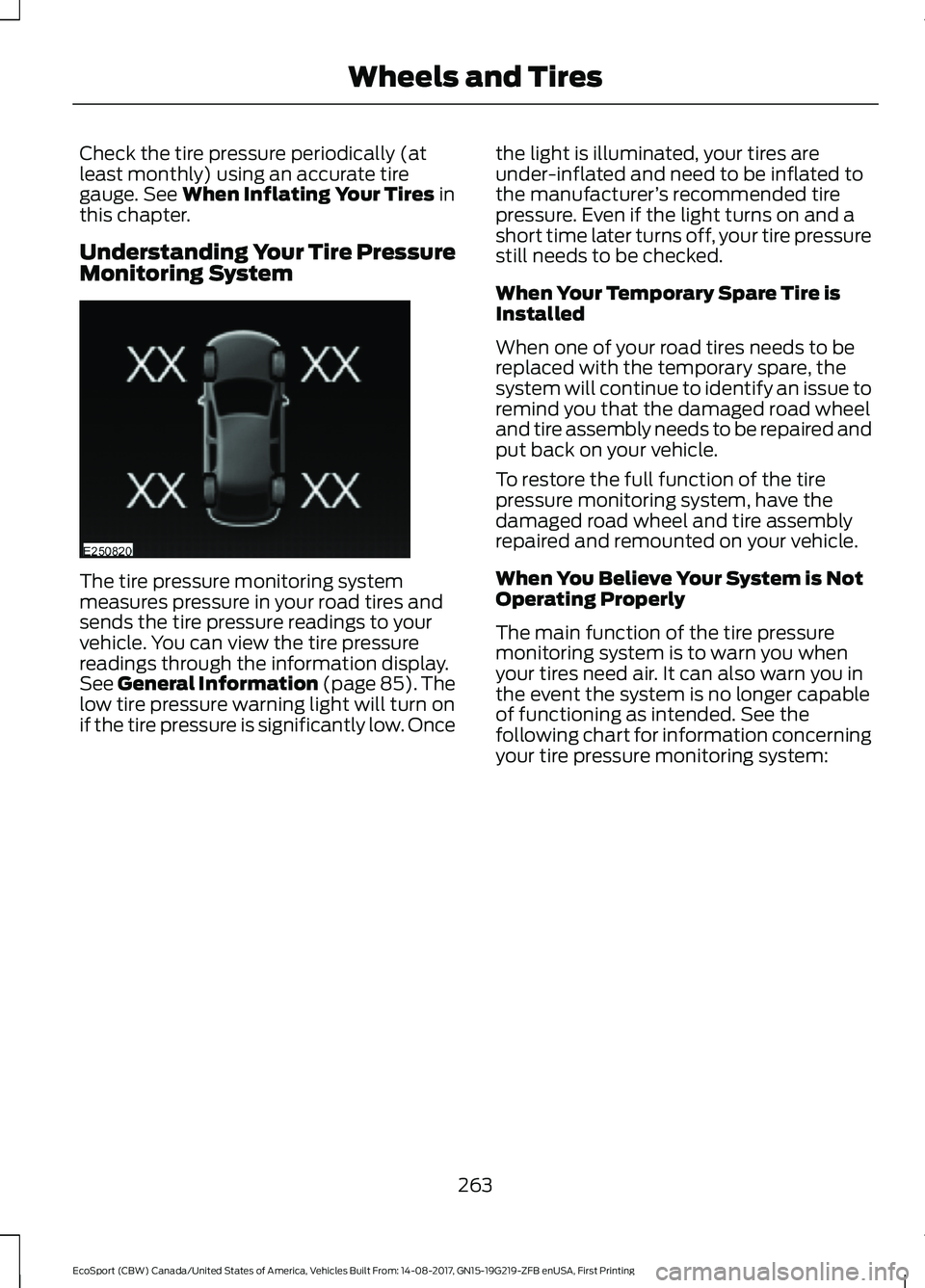
The tire pressure monitoring systemmeasures pressure in your road tires andsends the tire pressure readings to yourvehicle. You can view the tire pressurereadings through the information display.See General Information (page 85).Thelow tire pressure warning light will turn onif the tire pressure is significantly low. Once
the light is illuminated, your tires areunder-inflated and need to be inflated tothe manufacturer’s recommended tirepressure. Even if the light turns on and ashort time later turns off, your tire pressurestill needs to be checked.
When Your Temporary Spare Tire isInstalled
When one of your road tires needs to bereplaced with the temporary spare, thesystem will continue to identify an issue toremind you that the damaged road wheeland tire assembly needs to be repaired andput back on your vehicle.
To restore the full function of the tirepressure monitoring system, have thedamaged road wheel and tire assemblyrepaired and remounted on your vehicle.
When You Believe Your System is NotOperating Properly
The main function of the tire pressuremonitoring system is to warn you whenyour tires need air. It can also warn you inthe event the system is no longer capableof functioning as intended. See thefollowing chart for information concerningyour tire pressure monitoring system:
263EcoSport (CBW) Canada/United States of America, Vehicles Built From: 14-08-2017, GN15-19G219-ZFB enUSA, First PrintingWheels and Tires
Page 268 of 452
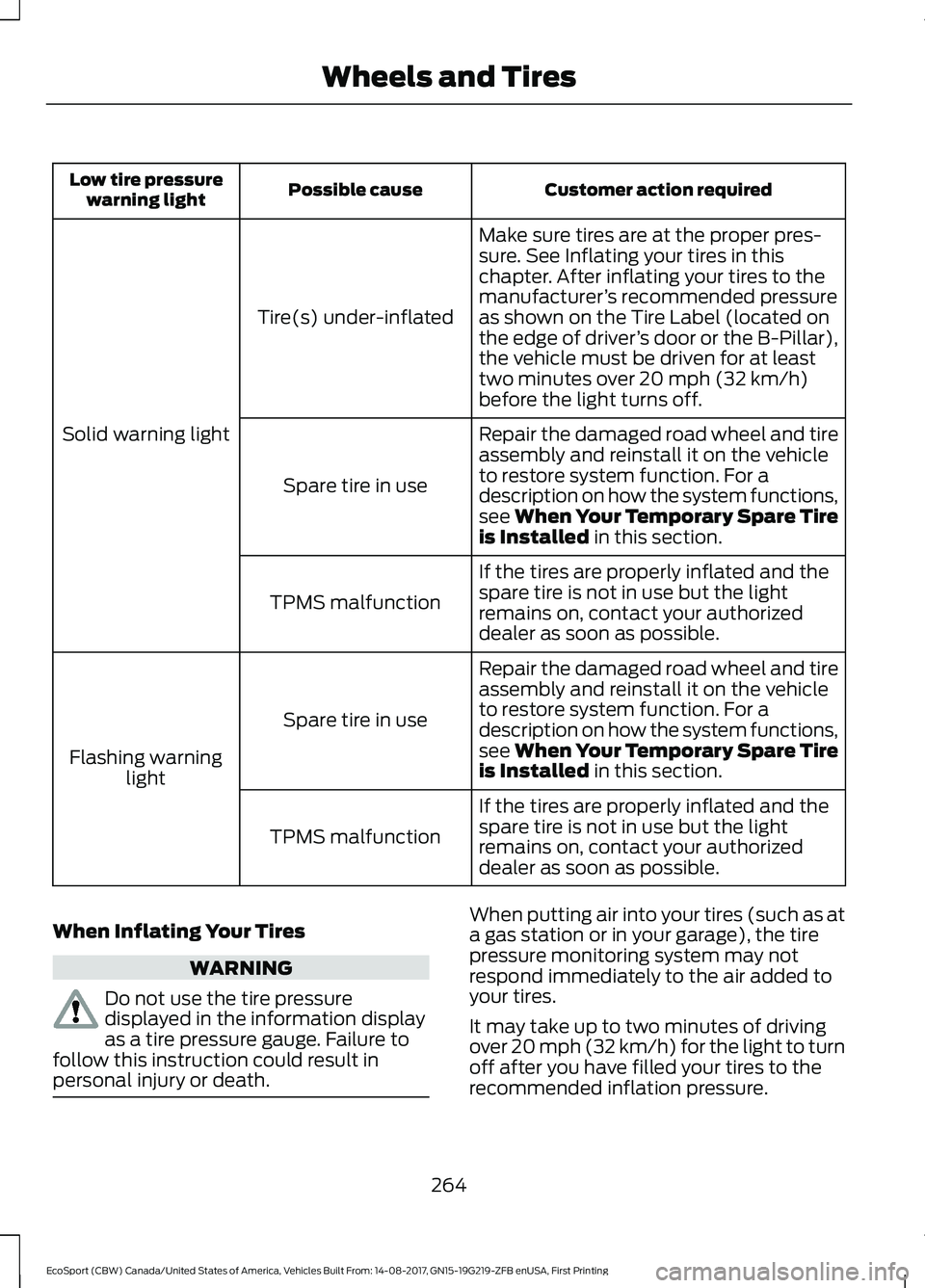
Customer action requiredPossible causeLow tire pressurewarning light
Make sure tires are at the proper pres-sure. See Inflating your tires in thischapter. After inflating your tires to themanufacturer’s recommended pressureas shown on the Tire Label (located onthe edge of driver’s door or the B-Pillar),the vehicle must be driven for at leasttwo minutes over 20 mph (32 km/h)before the light turns off.
Tire(s) under-inflated
Solid warning lightRepair the damaged road wheel and tireassembly and reinstall it on the vehicleto restore system function. For adescription on how the system functions,see When Your Temporary Spare Tireis Installed in this section.
Spare tire in use
If the tires are properly inflated and thespare tire is not in use but the lightremains on, contact your authorizeddealer as soon as possible.
TPMS malfunction
Repair the damaged road wheel and tireassembly and reinstall it on the vehicleto restore system function. For adescription on how the system functions,see When Your Temporary Spare Tireis Installed in this section.
Spare tire in use
Flashing warninglight
If the tires are properly inflated and thespare tire is not in use but the lightremains on, contact your authorizeddealer as soon as possible.
TPMS malfunction
When Inflating Your Tires
WARNING
Do not use the tire pressuredisplayed in the information displayas a tire pressure gauge. Failure tofollow this instruction could result inpersonal injury or death.
When putting air into your tires (such as ata gas station or in your garage), the tirepressure monitoring system may notrespond immediately to the air added toyour tires.
It may take up to two minutes of drivingover 20 mph (32 km/h) for the light to turnoff after you have filled your tires to therecommended inflation pressure.
264EcoSport (CBW) Canada/United States of America, Vehicles Built From: 14-08-2017, GN15-19G219-ZFB enUSA, First PrintingWheels and Tires
Page 269 of 452
How Temperature Affects Your TirePressure
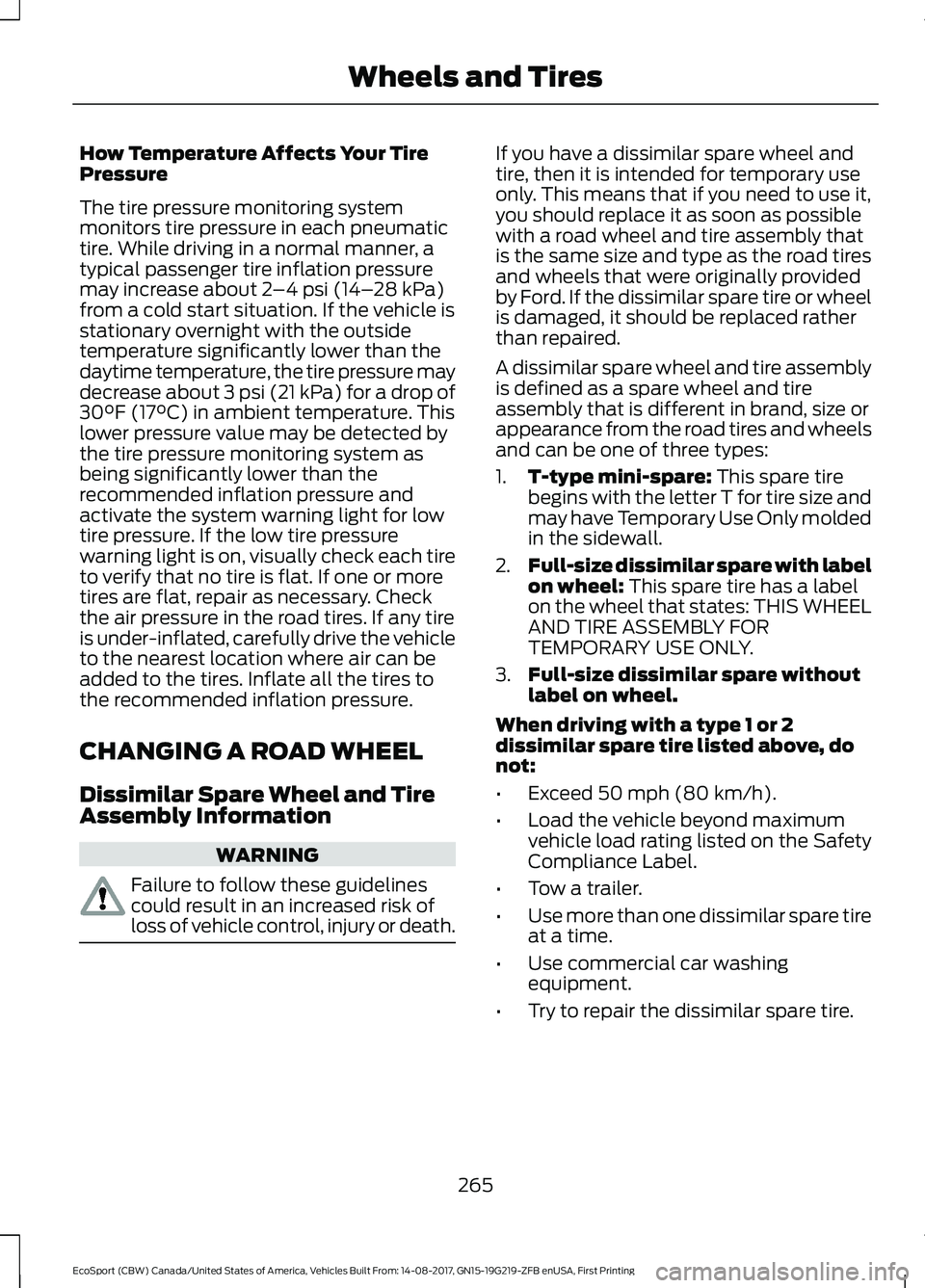
The tire pressure monitoring systemmonitors tire pressure in each pneumatictire. While driving in a normal manner, atypical passenger tire inflation pressuremay increase about 2–4 psi (14–28 kPa)from a cold start situation. If the vehicle isstationary overnight with the outsidetemperature significantly lower than thedaytime temperature, the tire pressure maydecrease about 3 psi (21 kPa) for a drop of30°F (17°C) in ambient temperature. Thislower pressure value may be detected bythe tire pressure monitoring system asbeing significantly lower than therecommended inflation pressure andactivate the system warning light for lowtire pressure. If the low tire pressurewarning light is on, visually check each tireto verify that no tire is flat. If one or moretires are flat, repair as necessary. Checkthe air pressure in the road tires. If any tireis under-inflated, carefully drive the vehicleto the nearest location where air can beadded to the tires. Inflate all the tires tothe recommended inflation pressure.
CHANGING A ROAD WHEEL
Dissimilar Spare Wheel and TireAssembly Information
WARNING
Failure to follow these guidelinescould result in an increased risk ofloss of vehicle control, injury or death.
If you have a dissimilar spare wheel andtire, then it is intended for temporary useonly. This means that if you need to use it,you should replace it as soon as possiblewith a road wheel and tire assembly thatis the same size and type as the road tiresand wheels that were originally providedby Ford. If the dissimilar spare tire or wheelis damaged, it should be replaced ratherthan repaired.
A dissimilar spare wheel and tire assemblyis defined as a spare wheel and tireassembly that is different in brand, size orappearance from the road tires and wheelsand can be one of three types:
1.T-type mini-spare: This spare tirebegins with the letter T for tire size andmay have Temporary Use Only moldedin the sidewall.
2.Full-size dissimilar spare with labelon wheel: This spare tire has a labelon the wheel that states: THIS WHEELAND TIRE ASSEMBLY FORTEMPORARY USE ONLY.
3.Full-size dissimilar spare withoutlabel on wheel.
When driving with a type 1 or 2dissimilar spare tire listed above, donot:
•Exceed 50 mph (80 km/h).
•Load the vehicle beyond maximumvehicle load rating listed on the SafetyCompliance Label.
•Tow a trailer.
•Use more than one dissimilar spare tireat a time.
•Use commercial car washingequipment.
•Try to repair the dissimilar spare tire.
265EcoSport (CBW) Canada/United States of America, Vehicles Built From: 14-08-2017, GN15-19G219-ZFB enUSA, First PrintingWheels and Tires
Page 270 of 452
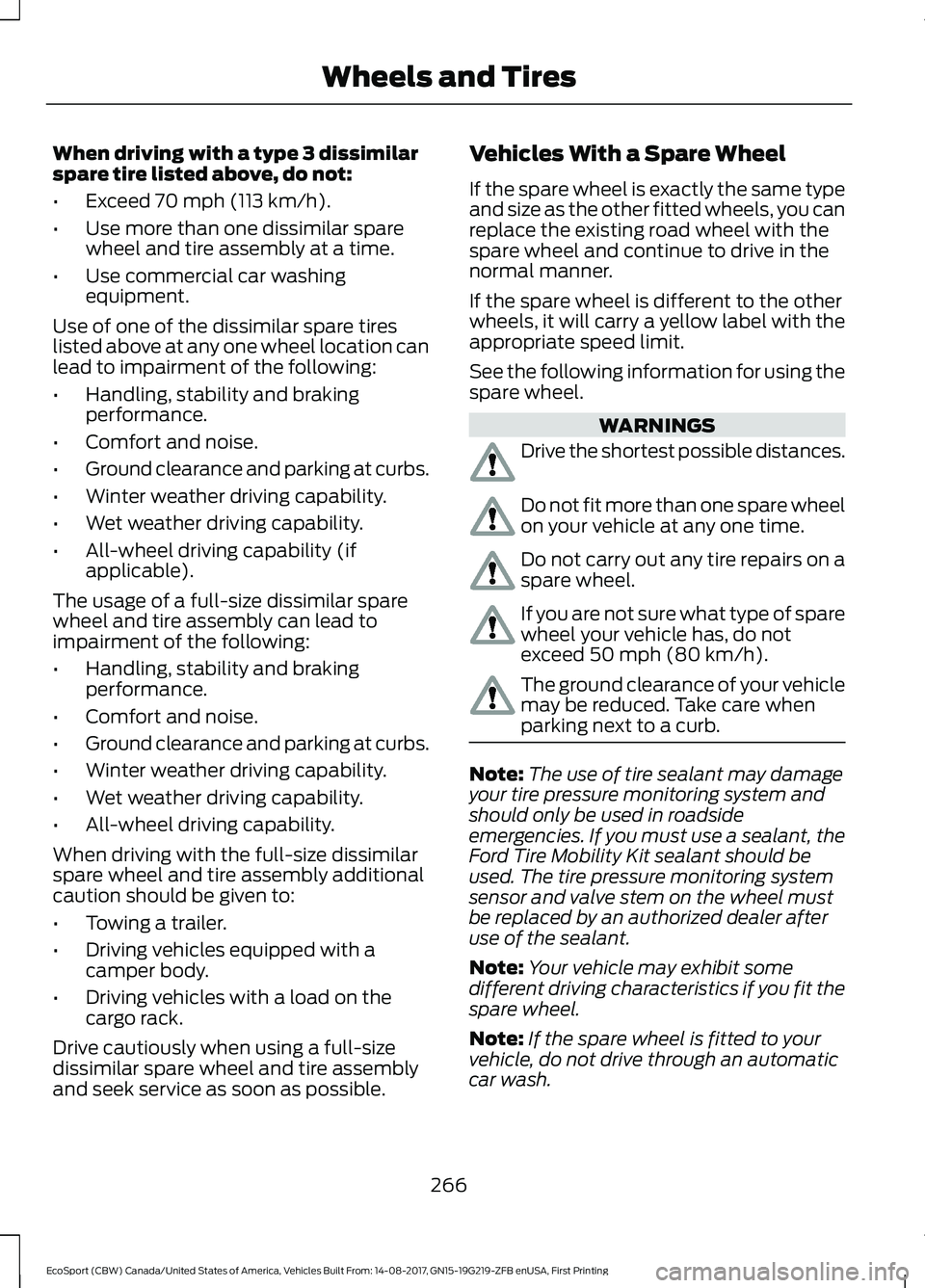
When driving with a type 3 dissimilarspare tire listed above, do not:
•Exceed 70 mph (113 km/h).
•Use more than one dissimilar sparewheel and tire assembly at a time.
•Use commercial car washingequipment.
Use of one of the dissimilar spare tireslisted above at any one wheel location canlead to impairment of the following:
•Handling, stability and brakingperformance.
•Comfort and noise.
•Ground clearance and parking at curbs.
•Winter weather driving capability.
•Wet weather driving capability.
•All-wheel driving capability (ifapplicable).
The usage of a full-size dissimilar sparewheel and tire assembly can lead toimpairment of the following:
•Handling, stability and brakingperformance.
•Comfort and noise.
•Ground clearance and parking at curbs.
•Winter weather driving capability.
•Wet weather driving capability.
•All-wheel driving capability.
When driving with the full-size dissimilarspare wheel and tire assembly additionalcaution should be given to:
•Towing a trailer.
•Driving vehicles equipped with acamper body.
•Driving vehicles with a load on thecargo rack.
Drive cautiously when using a full-sizedissimilar spare wheel and tire assemblyand seek service as soon as possible.
Vehicles With a Spare Wheel
If the spare wheel is exactly the same typeand size as the other fitted wheels, you canreplace the existing road wheel with thespare wheel and continue to drive in thenormal manner.
If the spare wheel is different to the otherwheels, it will carry a yellow label with theappropriate speed limit.
See the following information for using thespare wheel.
WARNINGS
Drive the shortest possible distances.
Do not fit more than one spare wheelon your vehicle at any one time.
Do not carry out any tire repairs on aspare wheel.
If you are not sure what type of sparewheel your vehicle has, do notexceed 50 mph (80 km/h).
The ground clearance of your vehiclemay be reduced. Take care whenparking next to a curb.
Note:The use of tire sealant may damageyour tire pressure monitoring system andshould only be used in roadsideemergencies. If you must use a sealant, theFord Tire Mobility Kit sealant should beused. The tire pressure monitoring systemsensor and valve stem on the wheel mustbe replaced by an authorized dealer afteruse of the sealant.
Note:Your vehicle may exhibit somedifferent driving characteristics if you fit thespare wheel.
Note:If the spare wheel is fitted to yourvehicle, do not drive through an automaticcar wash.
266EcoSport (CBW) Canada/United States of America, Vehicles Built From: 14-08-2017, GN15-19G219-ZFB enUSA, First PrintingWheels and Tires
Page 271 of 452
Vehicle Jack (If Equipped)
WARNINGS
The jack should be used on level firmground wherever possible.
Switch the ignition off and apply thepark brake fully before lifting vehicle.
It is recommended that the wheelsof the vehicle be chocked, and thatno person should remain in a vehiclethat is being jacked.
No person should place any portionof their body under a vehicle that issupported by a jack.
The jack supplied with this vehicle isonly intended for changing wheels.Do not use the vehicle jack otherthan when you are changing a wheel in anemergency.
Check that the vehicle jack is notdamaged or deformed and thethread is lubricated and clean.
Never place anything between thevehicle jack and the ground.
Never place anything between thevehicle jack and your vehicle.
Note:No maintenance or additionallubrication of your jack is required over theservice life of your vehicle.
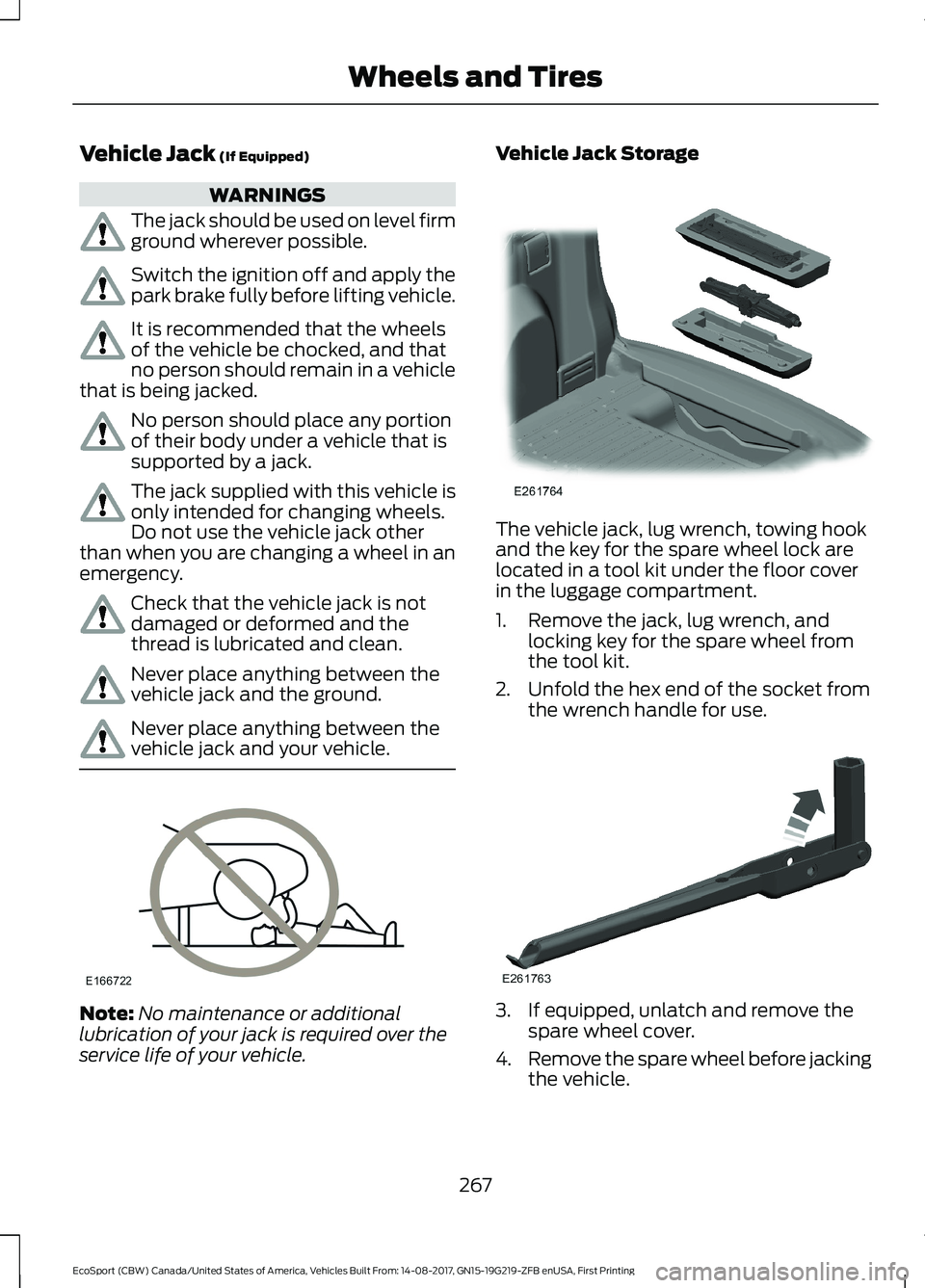
Vehicle Jack Storage
The vehicle jack, lug wrench, towing hookand the key for the spare wheel lock arelocated in a tool kit under the floor coverin the luggage compartment.
1.Remove the jack, lug wrench, andlocking key for the spare wheel fromthe tool kit.
2.Unfold the hex end of the socket fromthe wrench handle for use.
3.If equipped, unlatch and remove thespare wheel cover.
4.Remove the spare wheel before jackingthe vehicle.
267EcoSport (CBW) Canada/United States of America, Vehicles Built From: 14-08-2017, GN15-19G219-ZFB enUSA, First PrintingWheels and Tires
Page 272 of 452
Note:The spare wheel is located on thetailgate.
To remove the spare wheel, loosen andremove the locking nut using the lugwrench and the spare wheel lock key.Loosen and remove the remaining lug nutssecuring the spare wheel to the tailgate.
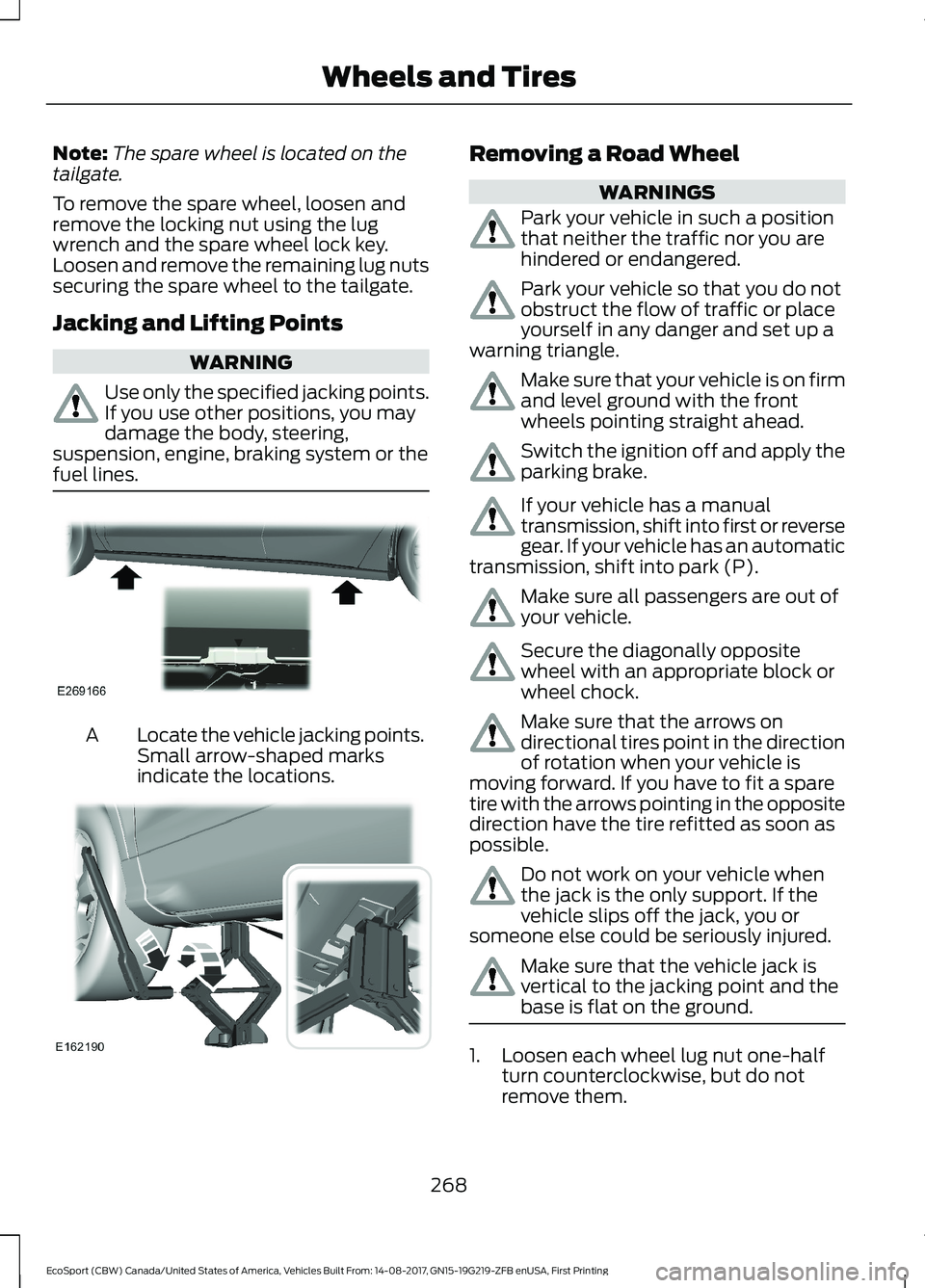
Jacking and Lifting Points
WARNING
Use only the specified jacking points.If you use other positions, you maydamage the body, steering,suspension, engine, braking system or thefuel lines.
Locate the vehicle jacking points.Small arrow-shaped marksindicate the locations.
A
Removing a Road Wheel
WARNINGS
Park your vehicle in such a positionthat neither the traffic nor you arehindered or endangered.
Park your vehicle so that you do notobstruct the flow of traffic or placeyourself in any danger and set up awarning triangle.
Make sure that your vehicle is on firmand level ground with the frontwheels pointing straight ahead.
Switch the ignition off and apply theparking brake.
If your vehicle has a manualtransmission, shift into first or reversegear. If your vehicle has an automatictransmission, shift into park (P).
Make sure all passengers are out ofyour vehicle.
Secure the diagonally oppositewheel with an appropriate block orwheel chock.
Make sure that the arrows ondirectional tires point in the directionof rotation when your vehicle ismoving forward. If you have to fit a sparetire with the arrows pointing in the oppositedirection have the tire refitted as soon aspossible.
Do not work on your vehicle whenthe jack is the only support. If thevehicle slips off the jack, you orsomeone else could be seriously injured.
Make sure that the vehicle jack isvertical to the jacking point and thebase is flat on the ground.
1.Loosen each wheel lug nut one-halfturn counterclockwise, but do notremove them.
268EcoSport (CBW) Canada/United States of America, Vehicles Built From: 14-08-2017, GN15-19G219-ZFB enUSA, First PrintingWheels and Tires
Page 273 of 452
2.Jack up your vehicle until the tire isclear of the ground.
3.Remove the lug nuts and the wheel.
Note:Do not lay alloy wheels face downon the ground, this may damage the paint.
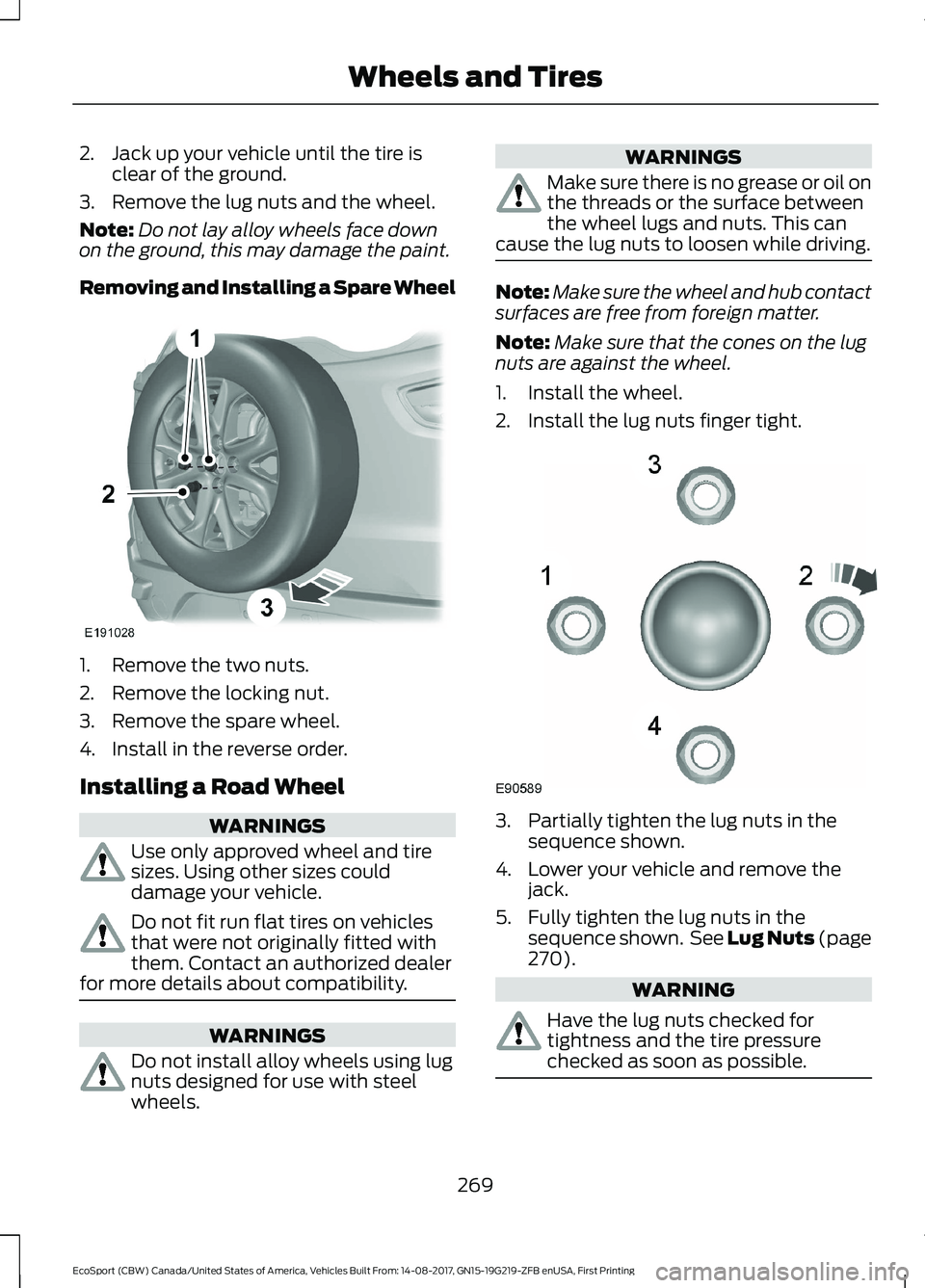
Removing and Installing a Spare Wheel
1.Remove the two nuts.
2.Remove the locking nut.
3.Remove the spare wheel.
4.Install in the reverse order.
Installing a Road Wheel
WARNINGS
Use only approved wheel and tiresizes. Using other sizes coulddamage your vehicle.
Do not fit run flat tires on vehiclesthat were not originally fitted withthem. Contact an authorized dealerfor more details about compatibility.
WARNINGS
Do not install alloy wheels using lugnuts designed for use with steelwheels.
WARNINGS
Make sure there is no grease or oil onthe threads or the surface betweenthe wheel lugs and nuts. This cancause the lug nuts to loosen while driving.
Note:Make sure the wheel and hub contactsurfaces are free from foreign matter.
Note:Make sure that the cones on the lugnuts are against the wheel.
1.Install the wheel.
2.Install the lug nuts finger tight.
3.Partially tighten the lug nuts in thesequence shown.
4.Lower your vehicle and remove thejack.
5.Fully tighten the lug nuts in thesequence shown. See Lug Nuts (page270).
WARNING
Have the lug nuts checked fortightness and the tire pressurechecked as soon as possible.
269EcoSport (CBW) Canada/United States of America, Vehicles Built From: 14-08-2017, GN15-19G219-ZFB enUSA, First PrintingWheels and Tires