air filter FORD ESCAPE 2013 3.G User Guide
[x] Cancel search | Manufacturer: FORD, Model Year: 2013, Model line: ESCAPE, Model: FORD ESCAPE 2013 3.GPages: 423, PDF Size: 4.59 MB
Page 238 of 423
•Never wash or rinse any ignition coil,
spark plug wire or spark plug well, or
the area in and around these locations.
• Cover the battery, power distribution
box, and air filter assembly to prevent
water damage when cleaning the
engine.
CLEANING THE WINDOWS AND
WIPER BLADES
The windows and wiper blades should be
cleaned regularly. If the wipers do not wipe
properly, substances on the vehicle ’s glass
or the wiper blades may cause squeaking
or chatter noise from the blades, and
streaking and smearing of the windshield.
To clean these items, follow these tips:
• The windows may be cleaned with a
non-abrasive cleaner such as
Motorcraft® Ultra-Clear Spray Glass
Cleaner.
• The wiper blades can be cleaned with
isopropyl (rubbing) alcohol or
Motorcraft® Premium Windshield
Washer Concentrate in the U.S., or
Premium Quality Windshield Washer
Fluid in Canada. Be sure to replace
wiper blades when they appear worn
or do not function properly.
• Do not use abrasives, as they may
cause scratches
• Do not use fuel, kerosene, or paint
thinner to clean any parts. If you cannot remove those streaks after
cleaning with the glass cleaner or if the
wipers chatter and move in a jerky motion,
clean the outer surface of the windshield
and the wiper blades using a sponge or
soft cloth with a neutral detergent or
mild-abrasive cleaning solution. After
cleaning, rinse the windshield and wiper
blades with clean water. The windshield
is clean if beads do not form when you
rinse the windshield with water.
Note:
Do not use sharp objects, such as a
razor blade, to clean the inside of the rear
window or to remove decals, as it may cause
damage to the rear window defroster ’s
heated grid lines.
CLEANING THE INTERIOR
WARNINGS
Do not use cleaning solvents, bleach
or dye on the vehicle ’s safety belts,
as these actions may weaken the
belt webbing.
On vehicles equipped with
seat-mounted airbags, do not use
chemical solvents or strong
detergents. Such products could
contaminate the side airbag system and
affect performance of the side airbag in a
collision.
For fabric, carpets, cloth seats, safety belts
and seats equipped with side airbags:
• Remove dust and loose dirt with a
vacuum cleaner.
• Remove light stains and soil with
Motorcraft® Professional Strength
Carpet & Upholstery Cleaner.
238
Vehicle Care
Page 241 of 423
Body
•Wash vehicle thoroughly to remove
dirt, grease, oil, tar or mud from exterior
surfaces, rear-wheel housing and
underside of front fenders.
• Periodically wash vehicles stored in
exposed locations.
• Touch-up raw or primed metal to
prevent rust
• Cover chrome and stainless steel parts
with a thick coat of auto wax to prevent
discoloration. Re-wax as necessary
when the vehicle is washed.
• Lubricate all hood, door and trunk lid
hinges, and latches with a light grade
oil.
• Cover interior trim to prevent fading.
• Keep all rubber parts free from oil and
solvents.
Engine
• The engine oil and filter should be
changed prior to storage, as used
engine oil contain contaminates that
may cause engine damage.
• Start the engine every 15 days. Run at
fast idle until it reaches normal
operating temperature
• With your foot on the brake, shift
through all the gears while the engine
is running.
Fuel system
• Fill the fuel tank with high-quality fuel
until the first automatic shutoff of the
fuel pump nozzle. Note:
During extended periods of vehicle
storage (30 days or more), fuel may
deteriorate due to oxidation. Add a quality
gas stabilizer product to the vehicle fuel
system whenever actual or expected
storage periods exceed 30 days. Follow the
instructions on the additive label. The
vehicle should then be operated at idle
speed to circulate the additive throughout
the fuel system.
Cooling system
• Protect against freezing temperatures.
• When removing vehicle from storage,
check coolant fluid level. Confirm there
are no cooling system leaks, and fluid
is at the recommended level.
Battery
• Check and recharge as necessary. Keep
connections clean.
• If storing your vehicle for more than 30
days without recharging the battery, it
may be advisable to disconnect the
battery cables to ensure battery charge
is maintained for quick starting.
Note: If battery cables are disconnected, it
will be necessary to reset memory features.
Brakes
• Make sure brakes and parking brake
are fully released.
Tires
• Maintain recommended air pressure.
Miscellaneous
• Make sure all linkages, cables, levers
and pins under vehicle are covered with
grease to prevent rust.
• Move vehicles at least 25 feet (8
meters) every 15 days to lubricate
working parts and prevent corrosion.
241
Vehicle Care
Page 267 of 423
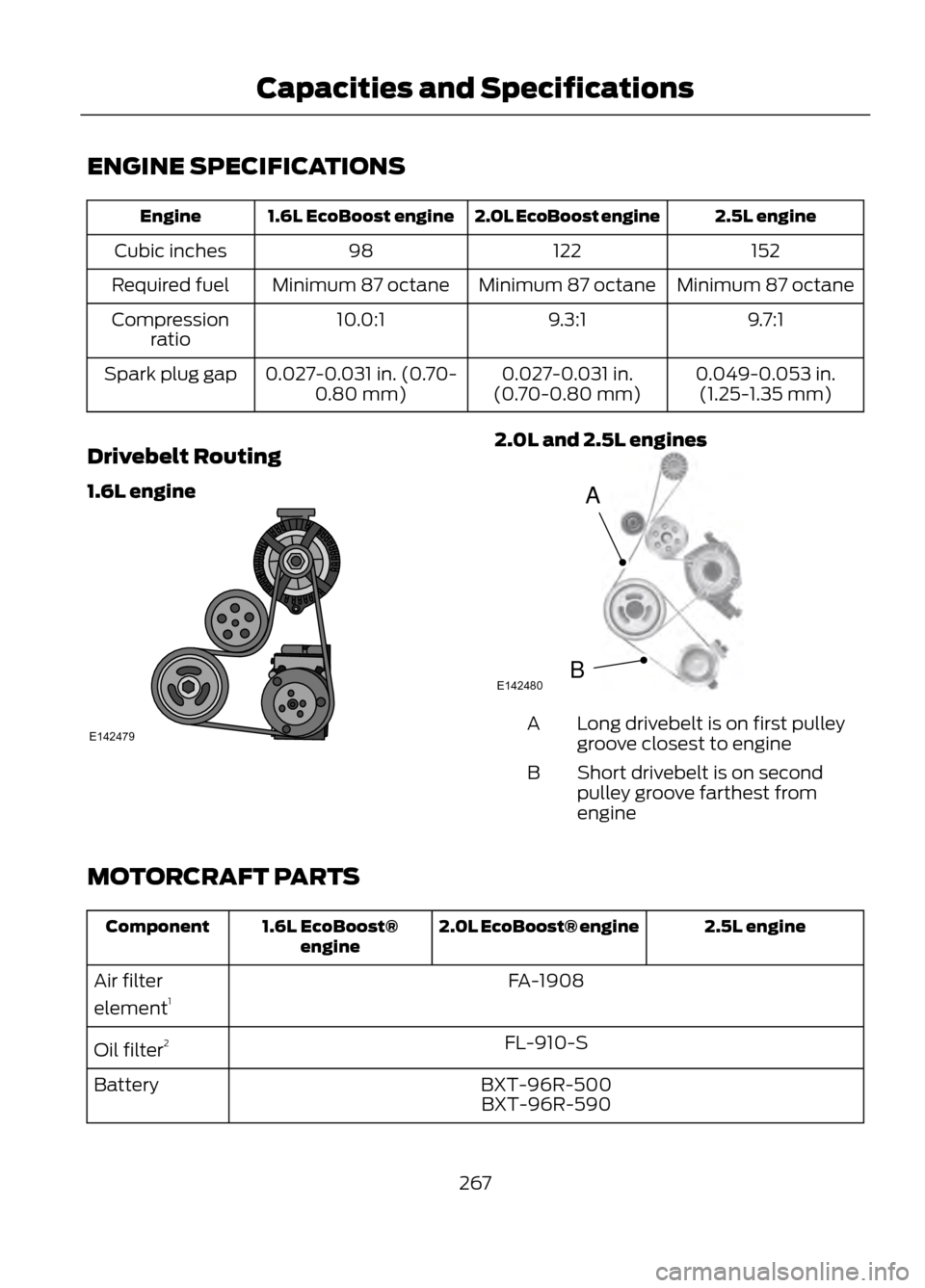
ENGINE SPECIFICATIONS
2.5L engine
2.0L EcoBoost engine
1.6L EcoBoost engine
Engine
152
122
98
Cubic inches
Minimum 87 octane
Minimum 87 octane
Minimum 87 octane
Required fuel
9.7:1
9.3:1
10.0:1
Compression
ratio
0.049-0.053 in.(1.25-1.35 mm)
0.027-0.031 in.
(0.70-0.80 mm)
0.027-0.031 in. (0.70-
0.80 mm)
Spark plug gap
Drivebelt Routing
1.6L engine
2.0L and 2.5L engines
Long drivebelt is on first pulley
groove closest to engine
A
Short drivebelt is on second
pulley groove farthest from
engine
B
MOTORCRAFT PARTS
2.5L engine
2.0L EcoBoost® engine
1.6L EcoBoost®
engine
Component
FA-1908
Air filter
element 1
FL-910-S
Oil filter 2
BXT-96R-500
Battery
BXT-96R-590
267
Capacities and Specifications
E142479
A
BE142480
Page 268 of 423
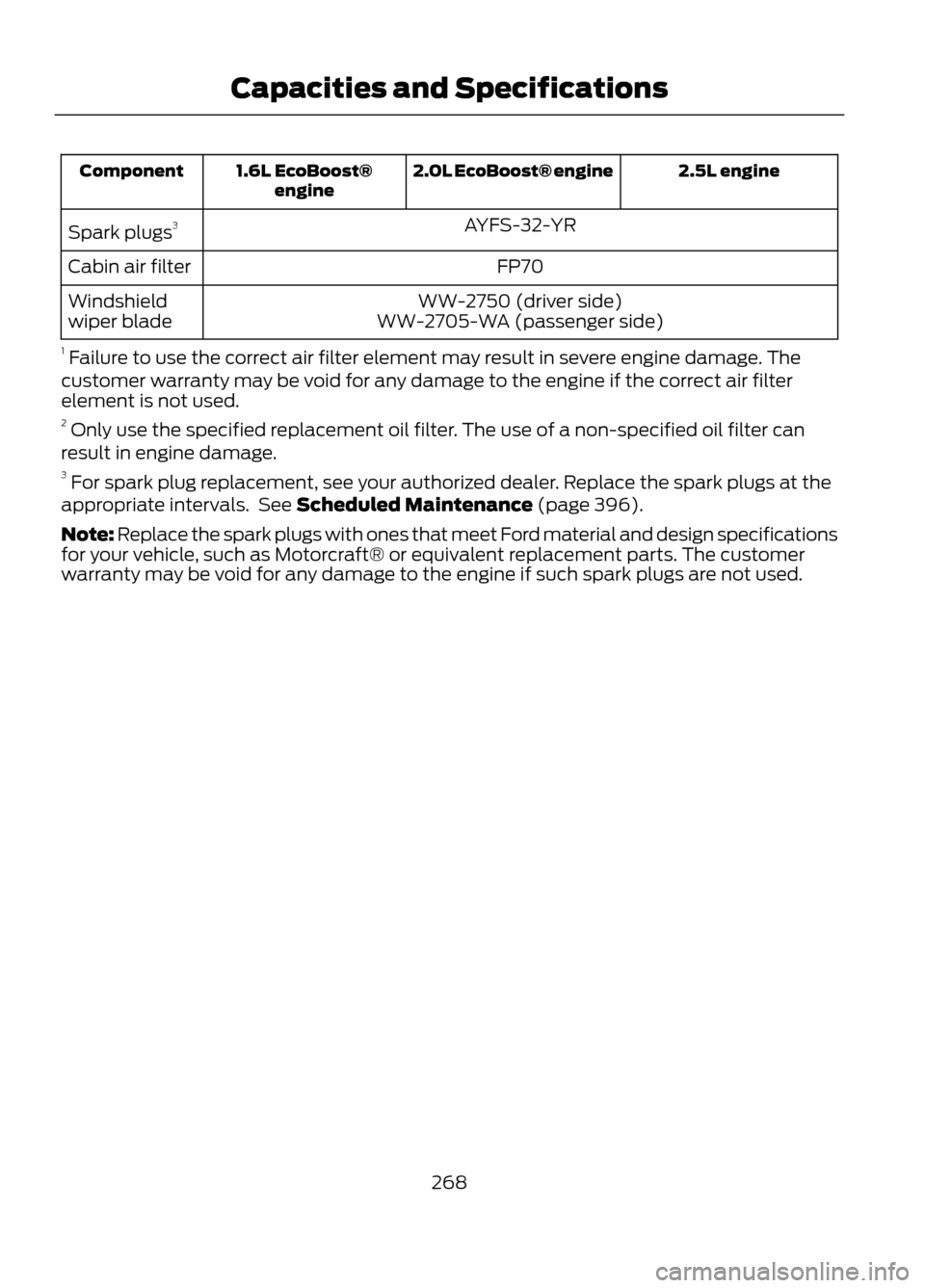
2.5L engine
2.0L EcoBoost® engine
1.6L EcoBoost®
engine
Component
AYFS-32-YR
Spark plugs 3
FP70
Cabin air filter
WW-2750 (driver side)
Windshield
wiper blade WW-2705-WA (passenger side)
1 Failure to use the correct air filter element may result in severe engine damage. The
customer warranty may be void for any damage to the engine if the correct air filter
element is not used.
2 Only use the specified replacement oil filter. The use of a non-specified oil filter can
result in engine damage.
3 For spark plug replacement, see your authorized dealer. Replace the spark plugs at the
appropriate intervals. See Scheduled Maintenance (page 396).
Note: Replace the spark plugs with ones that meet Ford material and design specifications
for your vehicle, such as Motorcraft® or equivalent replacement parts. The customer
warranty may be void for any damage to the engine if such spark plugs are not used.
268
Capacities and Specifications
Page 398 of 423
Check Every Six Months
•Battery connections. Clean if
necessary.
• Body and door drain holes for
obstructions. Clean if necessary.
• Cooling system fluid level and coolant
strength.
• Door weatherstrips for wear. Lubricate
if necessary.
• Hinges, latches and outside locks for
proper operation. Lubricate if
necessary.
• Parking brake for proper operation.
• Safety belts and seat latches for wear
and function. •
Safety warning lamps (brake, ABS,
airbag and safety belt) for operation.
• Washer spray and wiper operation.
Clean or replace blades as necessary.
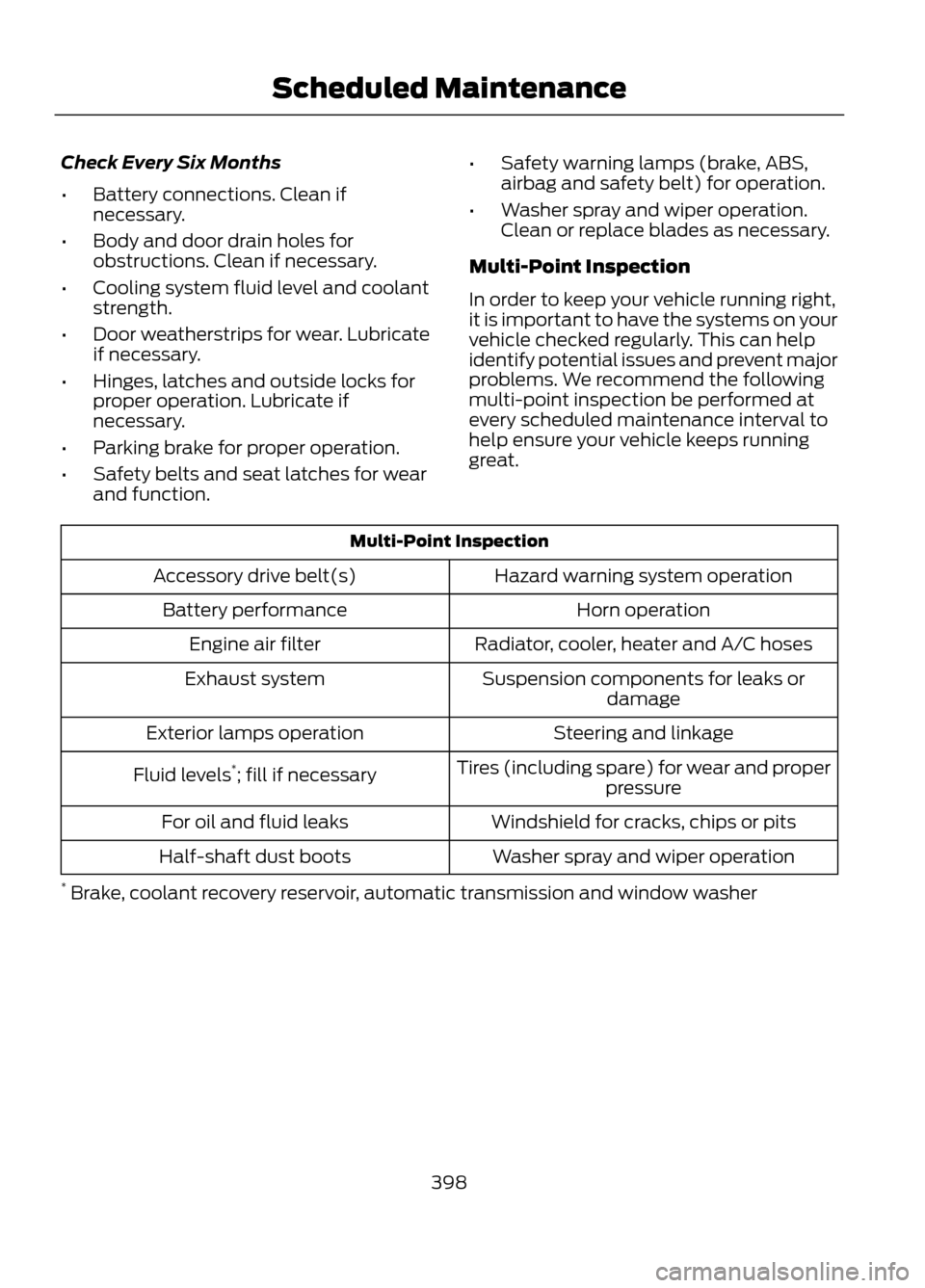
Multi-Point Inspection
In order to keep your vehicle running right,
it is important to have the systems on your
vehicle checked regularly. This can help
identify potential issues and prevent major
problems. We recommend the following
multi-point inspection be performed at
every scheduled maintenance interval to
help ensure your vehicle keeps running
great.
Multi-Point Inspection Hazard warning system operation
Accessory drive belt(s)
Horn operation
Battery performance
Radiator, cooler, heater and A/C hoses
Engine air filter
Suspension components for leaks ordamage
Exhaust system
Steering and linkage
Exterior lamps operation
Tires (including spare) for wear and properpressure
Fluid levels
*
; fill if necessary
Windshield for cracks, chips or pits
For oil and fluid leaks
Washer spray and wiper operation
Half-shaft dust boots
* Brake, coolant recovery reservoir, automatic transmission and window washer
398
Scheduled Maintenance
Page 400 of 423
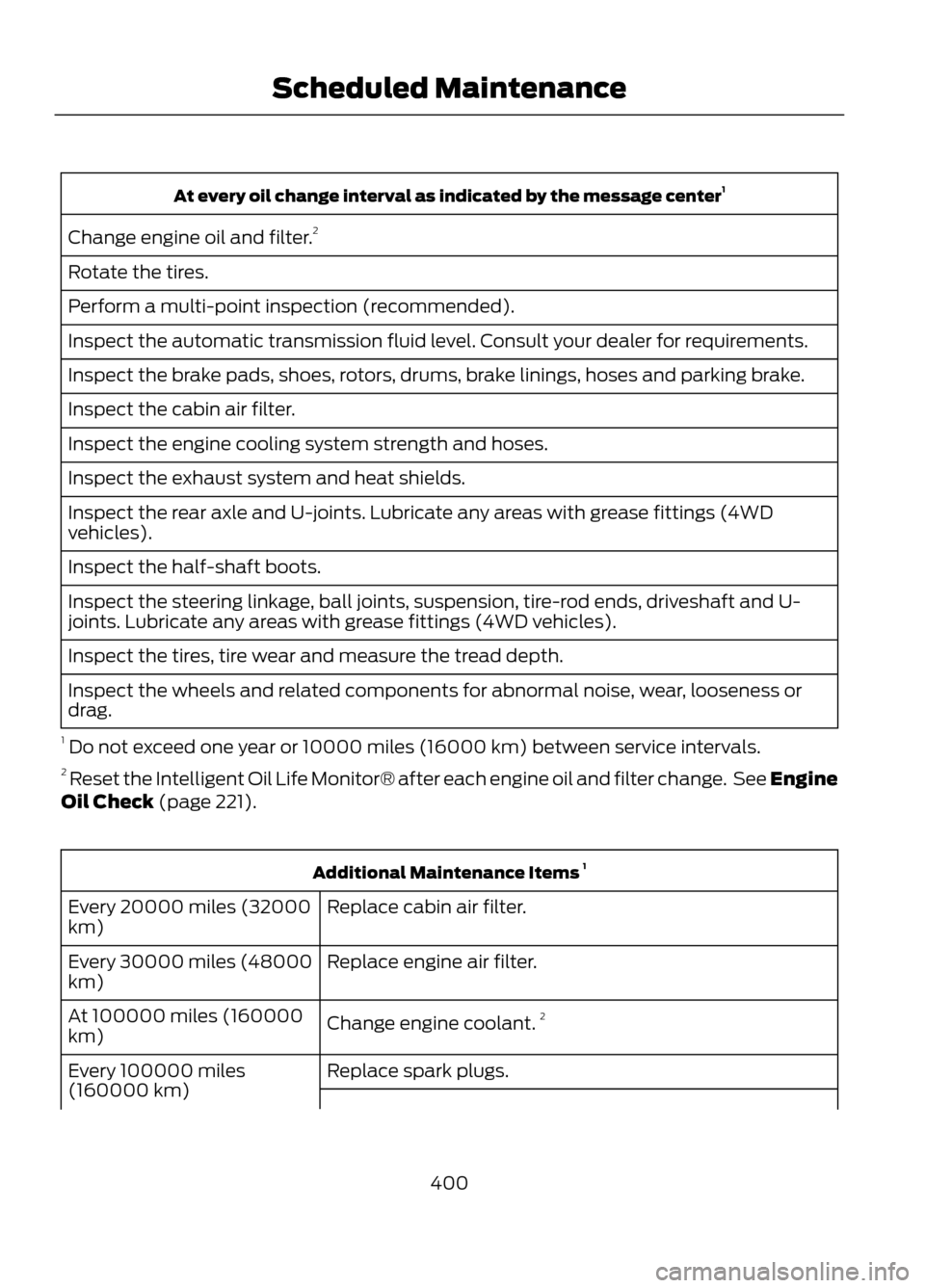
At every oil change interval as indicated by the message center1
Change engine oil and filter. 2
Rotate the tires.
Perform a multi-point inspection (recommended).
Inspect the automatic transmission fluid level. Consult your dealer for requirements.
Inspect the brake pads, shoes, rotors, drums, brake linings, hoses and parking brake.
Inspect the cabin air filter.
Inspect the engine cooling system strength and hoses.
Inspect the exhaust system and heat shields.
Inspect the rear axle and U-joints. Lubricate any areas with grease fittings (4WD
vehicles).
Inspect the half-shaft boots.
Inspect the steering linkage, ball joints, suspension, tire-rod ends, driveshaft and U-
joints. Lubricate any areas with grease fittings (4WD vehicles).
Inspect the tires, tire wear and measure the tread depth.
Inspect the wheels and related components for abnormal noise, wear, looseness or
drag.
1 Do not exceed one year or 10000 miles (16000 km) between service intervals.
2 Reset the Intelligent Oil Life Monitor® after each engine oil and filter change. See Engine
Oil Check (page 221).
Additional Maintenance Items 1
Replace cabin air filter.
Every 20000 miles (32000
km)
Replace engine air filter.
Every 30000 miles (48000
km)
Change engine coolant.2
At 100000 miles (160000
km)
Replace spark plugs.
Every 100000 miles
(160000 km)
400
Scheduled Maintenance
Page 401 of 423
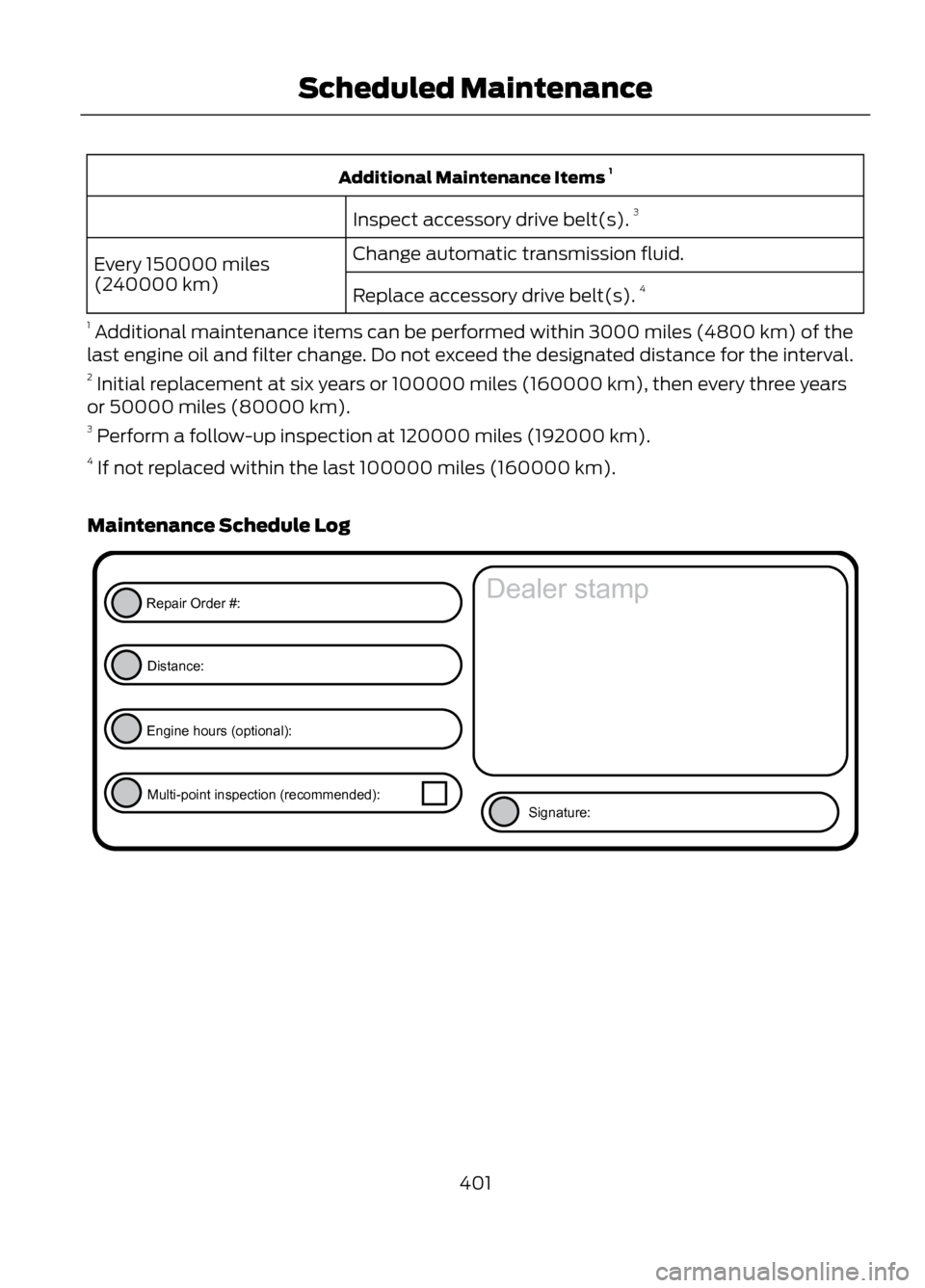
Additional Maintenance Items 1
Inspect accessory drive belt(s). 3
Change automatic transmission fluid.
Every 150000 miles
(240000 km)
Replace accessory drive belt(s). 4
1 Additional maintenance items can be performed within 3000 miles (4800 km) of the
last engine oil and filter change. Do not exceed the designated distance for the interval.
2 Initial replacement at six years or 100000 miles (160000 km), then every three years
or 50000 miles (80000 km).
3 Perform a follow-up inspection at 120000 miles (192000 km).
4 If not replaced within the last 100000 miles (160000 km).
Maintenance Schedule Log
401
Scheduled Maintenance
E146852
Repair Order #:Distance:
Engine
hours (optional):
Multi-point inspection (recommended): Signature:
Dealer stamp
Page 406 of 423
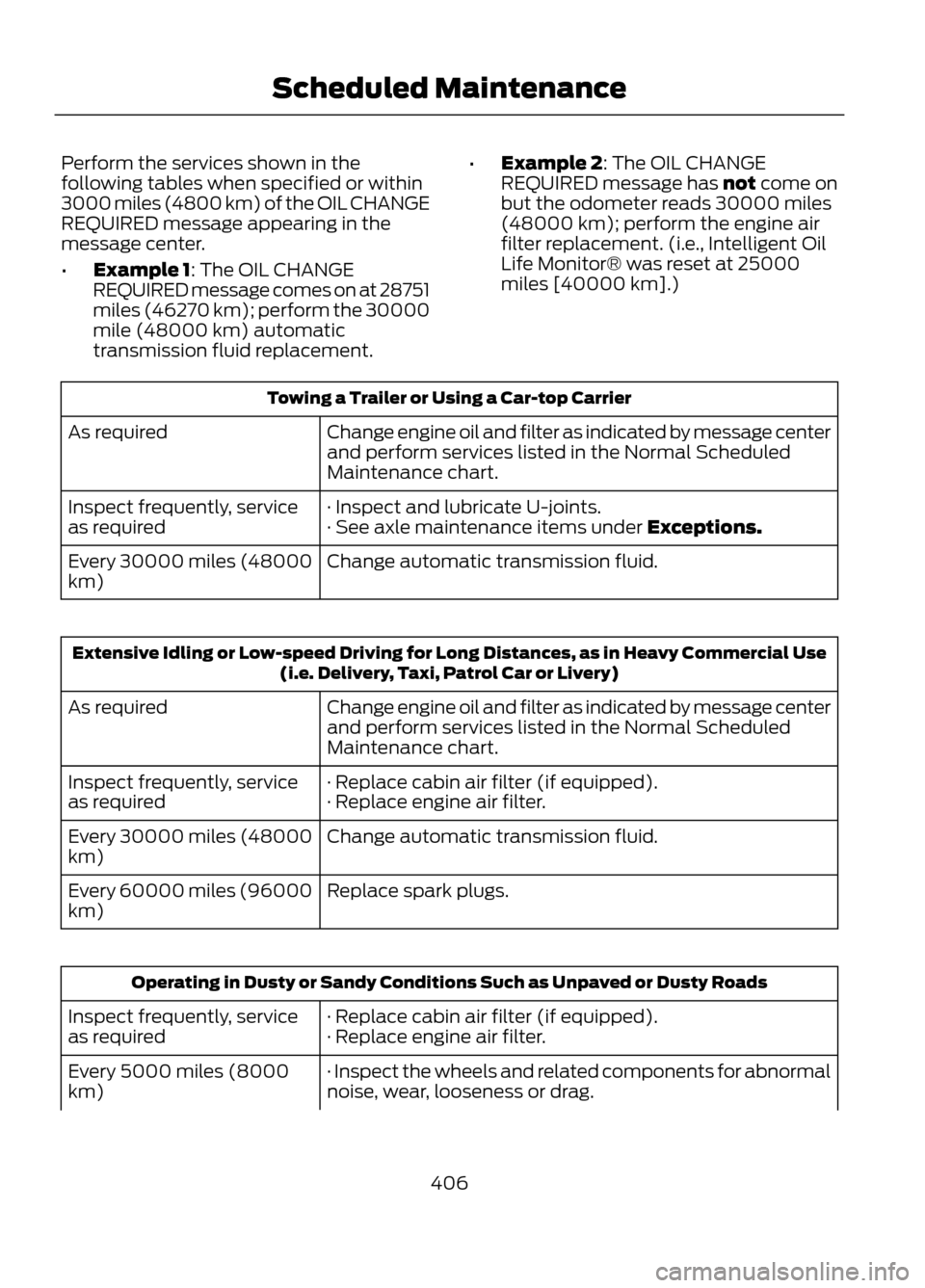
Perform the services shown in the
following tables when specified or within
3000 miles (4800 km) of the OIL CHANGE
REQUIRED message appearing in the
message center.
•Example 1: The OIL CHANGE
REQUIRED message comes on at 28751
miles (46270 km); perform the 30000
mile (48000 km) automatic
transmission fluid replacement. •
Example 2: The OIL CHANGE
REQUIRED message has not come on
but the odometer reads 30000 miles
(48000 km); perform the engine air
filter replacement. (i.e., Intelligent Oil
Life Monitor® was reset at 25000
miles [40000 km].)
Towing a Trailer or Using a Car-top Carrier
Change engine oil and filter as indicated by message center
and perform services listed in the Normal Scheduled
Maintenance chart.
As required
· Inspect and lubricate U-joints.
Inspect frequently, service
as required · See axle maintenance items under Exceptions.
Change automatic transmission fluid.
Every 30000 miles (48000
km)
Extensive Idling or Low-speed Driving for Long Distances, as in Heavy Commercial Use
(i.e. Delivery, Taxi, Patrol Car or Livery)
Change engine oil and filter as indicated by message center
and perform services listed in the Normal Scheduled
Maintenance chart.
As required
· Replace cabin air filter (if equipped).
Inspect frequently, service
as required · Replace engine air filter.
Change automatic transmission fluid.
Every 30000 miles (48000
km)
Replace spark plugs.
Every 60000 miles (96000
km)
Operating in Dusty or Sandy Conditions Such as Unpaved or Dusty Roads
· Replace cabin air filter (if equipped).
Inspect frequently, service
as required · Replace engine air filter.
· Inspect the wheels and related components for abnormal
noise, wear, looseness or drag.
Every 5000 miles (8000
km)
406
Scheduled Maintenance
Page 407 of 423
Operating in Dusty or Sandy Conditions Such as Unpaved or Dusty Roads· Rotate tires, inspect tires for wear and measure tread
depth.
· Change engine oil and filter.
Every 5000 miles (8000
km) or six months · Perform multi-point inspection.
Change automatic transmission fluid.
Every 30000 miles (48000
km)
Reset your Intelligent Oil Life Monitor® after each engine oil and filter change. See Engine
Oil Check (page 221).
Exclusive Use of E85 (Flex Fuel Vehicles only) If ran exclusively on E85, fill the fuel tank full with regular
unleaded fuel.
Every oil change
Special Operating Condition Log
407
Scheduled Maintenance
E146852
Repair Order #:Distance:
Engine
hours (optional):
Multi-point inspection (recommended): Signature:
Dealer stamp
Page 410 of 423
Normal vehicle axle maintenance: Rear
axles and power take-off (PTO) units with
synthetic fluid and light-duty trucks
equipped with Ford-design axles are
lubricated for life; do not check or change
fluid unless a leak is suspected, service is
required or the assembly has been
submerged in water. During long periods
of trailer towing with outside temperatures
above 70°F (21°C) and at wide-open
throttle for long periods above 45 mph (72
km/h), non-synthetic rear axle fluids
should be changed every 3000 miles
(4800 km) or three months, whichever
comes first. This interval can be waived if
the axle is filled with 75W140 synthetic
gear fluid meeting Ford specification
WSL-M2C192-A, part number
F1TZ-19580-B, or equivalent. Add friction
modifier XL-3 (EST-M2C118-A) or
equivalent for complete refill of
Traction-Lok rear axles. See Technical
Specifications (page 271).
Police/Taxi/Livery vehicle axle
maintenance: Change rear axle fluid every
100000 miles (160000 km). Rear axle
fluid change may be waived if the axle was
filled with 75W140 synthetic gear fluid
meeting Ford specification
WSL-M2C192-A, part number
F1TZ-19580-B, or equivalent. Add four
ounces (118 mL) of additive friction
modifier XL-3 (EST-M2C118-A) or
equivalent for complete refill of
Traction-Lok rear axles. The axle fluid
should be changed anytime the axle has
been submerged in water.California fuel filter replacement: If the
vehicle is registered in California, the
California Air Resources Board has
determined that the failure to perform this
maintenance item will not nullify the
emission warranty or limit recall liability
prior to the completion of the vehicle's
useful life. Ford Motor Company, however,
urges you to have all recommended
maintenance services performed at the
specified intervals and to record all vehicle
service.
Hot climate oil change intervals:
Vehicles operating in the Middle East,
North Africa, Sub-Saharan Africa or
locations with similar climates using an
American Petroleum Institute (API)
Certified for Gasoline Engines (Certification
mark) oil of SM or SN quality, the normal
oil change interval is 5000 miles (8000
km). If the available API "SM" or "SN" oils
are not available, then the oil change
service interval is 3000 mile (4800 km).
Engine air filter and cabin air filter
replacement: Engine air filter and cabin
air filter life is dependent on exposure to
dusty and dirty conditions. Vehicles
operated in these conditions will require
frequent inspection and replacement of
the engine air filter and cabin air filter.
Engine Coolant Change Record
Initial change: Six years or 100000 miles
(160000 km) (whichever comes first).
After initial change: Every three years or
50000 miles (80000 km).
410
Scheduled Maintenance