roof FORD ESCAPE 2014 3.G Owners Manual
[x] Cancel search | Manufacturer: FORD, Model Year: 2014, Model line: ESCAPE, Model: FORD ESCAPE 2014 3.GPages: 428, PDF Size: 16.6 MB
Page 5 of 428
Autowipers........................................................70
Windshield Washers.......................................71
Rear Window Wiper and Washers............71
Lighting
Lighting Control...............................................73
Autolamps.........................................................73
Instrument Lighting Dimmer......................74
Headlamp Exit Delay....................................74
Daytime Running Lamps.............................75
Front Fog Lamps.............................................75
Direction Indicators........................................75
Interior Lamps..................................................75
Ambient Lighting.............................................77
Windows and Mirrors
Power Windows..............................................78
Exterior Mirrors................................................79
Interior Mirror...................................................80
Sun Visors..........................................................81
Moonroof............................................................81
Instrument Cluster
Gauges...............................................................83
Warning Lamps and Indicators................84
Audible Warnings and Indicators.............87
Information Displays
General Information.....................................88
Trip Computer.................................................90
Information Messages..................................91
Climate Control
Manual Climate Control.............................101
Automatic Climate Control......................102
Hints on Controlling the Interior
Climate........................................................104
Heated Windows and Mirrors..................107
Cabin Air Filter................................................107Remote Start..................................................107
Seats
Sitting in the Correct Position.................109
Head Restraints............................................109
Manual Seats...................................................111
Power Seats.....................................................112
Memory Function...........................................113
Rear Seats........................................................114
Heated Seats...................................................115
Rear Seat Armrest.........................................115
Universal Garage Door
Opener
Universal Garage Door Opener................116
Auxiliary Power Points
Auxiliary Power Points................................120
Storage Compartments
Center Console..............................................122
Overhead Console........................................122
Starting and Stopping the
Engine
General Information....................................123
Ignition Switch...............................................123
Keyless Starting.............................................123
Starting a Gasoline Engine........................124
Engine Block Heater....................................126
Fuel and Refueling
Safety Precautions.......................................128
Fuel Quality.....................................................129
Running Out of Fuel.....................................129
Refueling..........................................................130
Emission Control System...........................132
Fuel Consumption........................................134
2
Table of Contents
Page 6 of 428
Transmission
Automatic Transmission............................136
Hill Start Assist..............................................138
Four-Wheel Drive
Principle of Operation................................140
Using Four-Wheel Drive............................140
Brakes
General Information....................................145
Hints on Driving With Anti-Lock
Brakes...........................................................145
Parking Brake.................................................146
Hill Start Assist..............................................146
Traction Control
Principle of Operation.................................147
Using Traction Control................................147
Stability Control
Principle of Operation................................148
Using Stability Control...............................149
Parking Aids
Parking Aid......................................................150
Active Park Assist.........................................152
Rear View Camera.......................................156
Cruise Control
Principle of Operation.................................159
Using Cruise Control....................................159
Driving Aids
Blind Spot Monitor......................................160
Eco Mode.........................................................164
Steering............................................................164
Load Carrying
Rear Under Floor Storage.........................166Luggage Covers.............................................166
Roof Racks and Load Carriers..................167
Load Limit.......................................................168
Towing
Towing a Trailer..............................................176
Trailer Sway Control.....................................177
Recommended Towing Weights.............177
Essential Towing Checks...........................179
Towing Points.................................................181
Transporting the Vehicle.............................181
Towing the Vehicle on Four Wheels......182
Driving Hints
Breaking-In......................................................183
Economical Driving......................................183
Driving Through Water...............................184
Floor Mats.......................................................184
Roadside Emergencies
Roadside Assistance..................................186
Hazard Warning Flashers...........................187
Fuel Shutoff....................................................187
Jump-Starting the Vehicle........................187
Customer Assistance
Getting the Services You Need...............190
In California (U.S. Only)..............................191
The Better Business Bureau (BBB) Auto
Line Program (U.S. Only)......................192
Utilizing the Mediation/Arbitration
Program (Canada Only)........................192
Getting Assistance Outside the U.S. and
Canada.........................................................193
Ordering Additional Owner's
Literature.....................................................194
Reporting Safety Defects (U.S.
Only).............................................................194
Reporting Safety Defects (Canada
Only).............................................................195
3
Table of Contents
Page 28 of 428
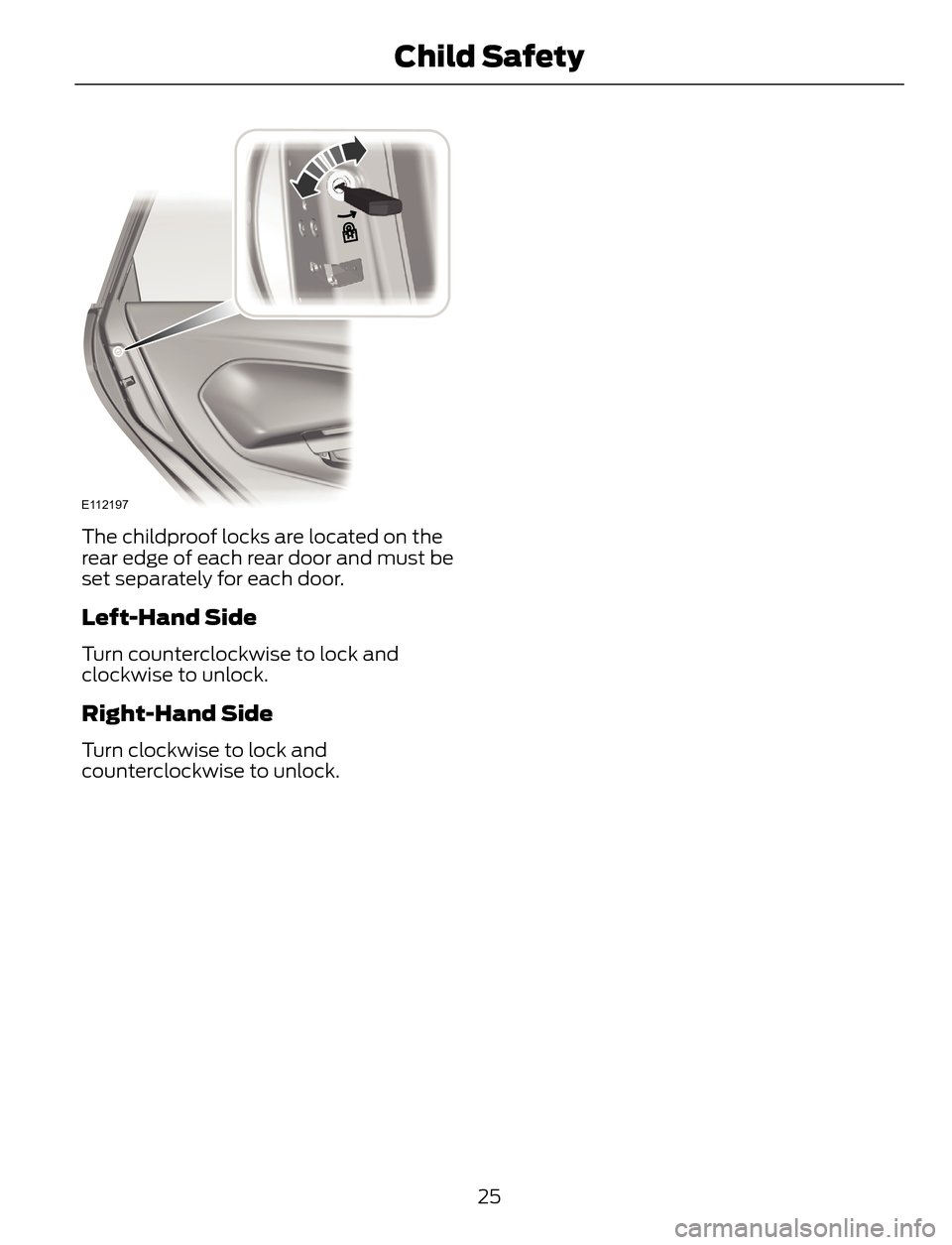
E112197
The childproof locks are located on the
rear edge of each rear door and must be
set separately for each door.
Left-Hand Side
Turn counterclockwise to lock and
clockwise to unlock.
Right-Hand Side
Turn clockwise to lock and
counterclockwise to unlock.
25
Child Safety
Page 44 of 428
The design and development of the side
airbag system included recommended
testing procedures that were developed
by a group of automotive safety experts
known as the Side Airbag Technical
Working Group. These recommended
testing procedures help reduce the risk of
injuries related to the deployment of side
airbags.
SAFETY CANOPY™
WARNINGS
Do not place objects or mount
equipment on or near the headliner
at the siderail that may come into
contact with a deploying curtain airbag.
Failure to follow these instructions may
increase the risk of personal injury in the
event of a crash.
Do not lean your head on the door.
The curtain airbag could injure you
as it deploys from the headliner.
Do not attempt to service, repair, or
modify the curtain airbags, its fuses,
the A, B, or C pillar trim, or the
headliner on a vehicle containing curtain
airbags as you could be seriously injured
or killed. Contact your authorized dealer
as soon as possible.
All occupants of your vehicle
including the driver should always
wear their safety belts even when an
airbag supplemental restraint system and
curtain airbag is provided. Failure to
properly wear your safety belt could
seriously increase the risk of injury or death.
To reduce risk of injury, do not
obstruct or place objects in the
deployment path of the curtain
airbag.
WARNINGS
If the curtain airbags have deployed,
the curtain airbags will not function
again. The curtain airbags (including
the A, B and C pillar trim and headliner)
must be inspected and serviced by an
authorized dealer. If the curtain airbag is
not replaced, the unrepaired area will
increase the risk of injury in a crash.
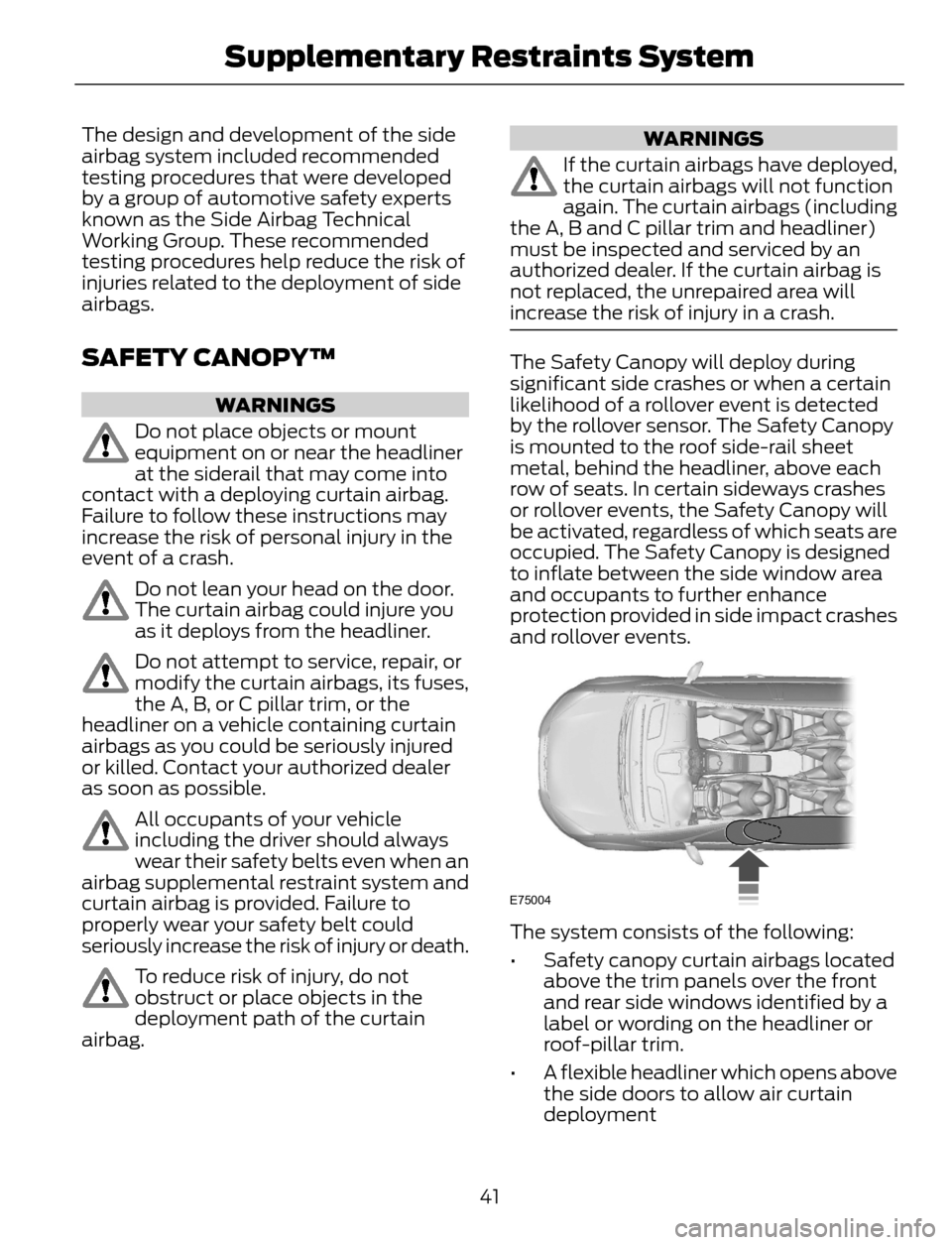
The Safety Canopy will deploy during
significant side crashes or when a certain
likelihood of a rollover event is detected
by the rollover sensor. The Safety Canopy
is mounted to the roof side-rail sheet
metal, behind the headliner, above each
row of seats. In certain sideways crashes
or rollover events, the Safety Canopy will
be activated, regardless of which seats are
occupied. The Safety Canopy is designed
to inflate between the side window area
and occupants to further enhance
protection provided in side impact crashes
and rollover events.
E75004
The system consists of the following:
• Safety canopy curtain airbags located
above the trim panels over the front
and rear side windows identified by a
label or wording on the headliner or
roof-pillar trim.
• A flexible headliner which opens above
the side doors to allow air curtain
deployment
41
Supplementary Restraints System
Page 79 of 428
• You open any door.
• You press a remote control button.
• You press switch B on the front interior
lamp.
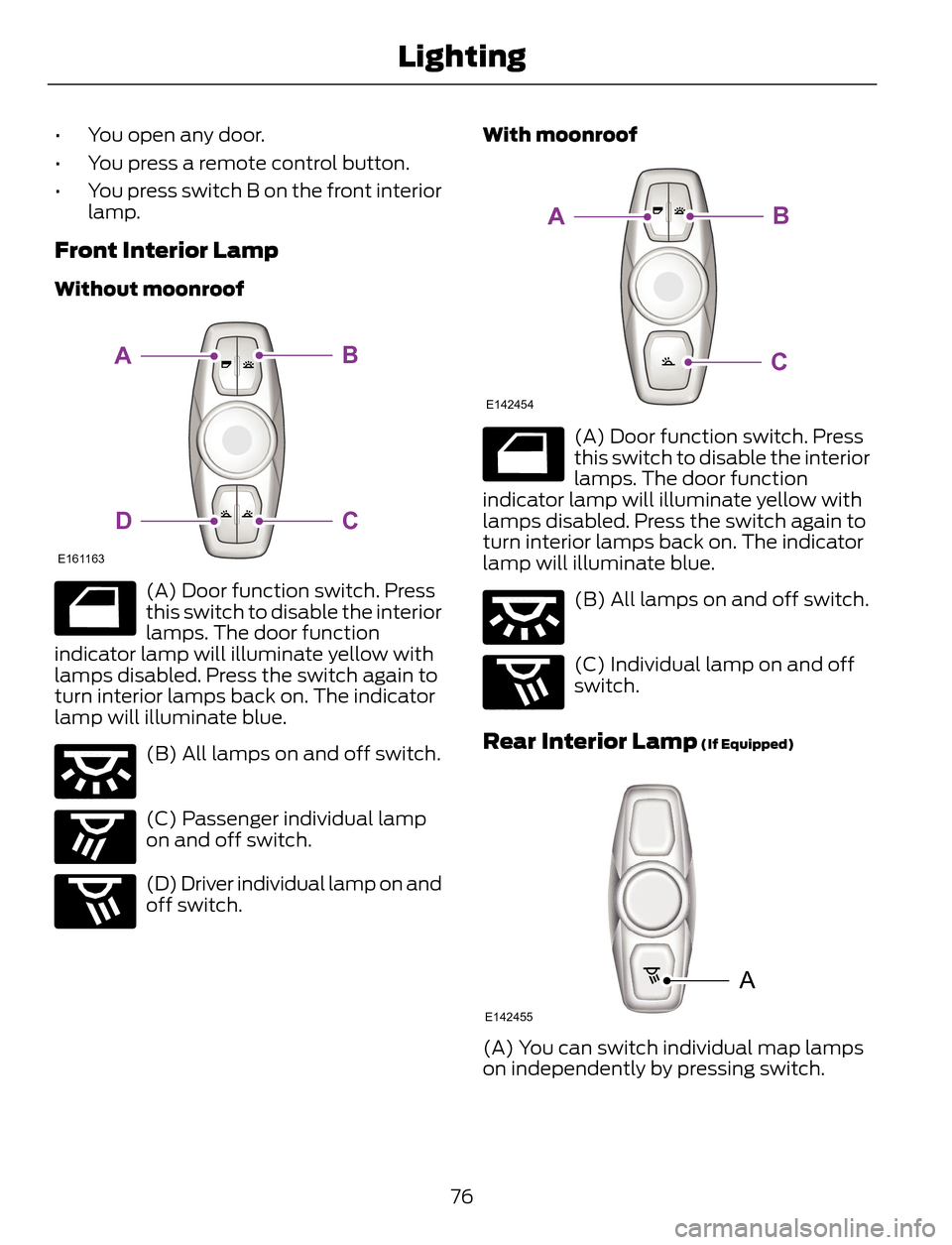
Front Interior Lamp
Without moonroof
E161163
BA
CD
E160819
(A) Door function switch. Press
this switch to disable the interior
lamps. The door function
indicator lamp will illuminate yellow with
lamps disabled. Press the switch again to
turn interior lamps back on. The indicator
lamp will illuminate blue.
E160816
(B) All lamps on and off switch.
E160817
(C) Passenger individual lamp
on and off switch.
E160818
(D) Driver individual lamp on and
off switch.With moonroof
E142454
BA
C
E160819
(A) Door function switch. Press
this switch to disable the interior
lamps. The door function
indicator lamp will illuminate yellow with
lamps disabled. Press the switch again to
turn interior lamps back on. The indicator
lamp will illuminate blue.
E160816
(B) All lamps on and off switch.
E160818
(C) Individual lamp on and off
switch.
Rear Interior Lamp (If Equipped)
A
E142455
(A) You can switch individual map lamps
on independently by pressing switch.
76
Lighting
Page 84 of 428
Note:Do not clean the housing or glass of
any mirror with harsh abrasives, fuel or other
petroleum or ammonia-based cleaning
products.
You can adjust the interior mirror to your
preference. Some mirrors also have a
second pivot point. This lets you move the
mirror head up or down and from side to
side.
Pull the tab below the mirror toward you
to reduce glare at night.
Auto-Dimming Mirror (If Equipped)
Note:Do not block the sensors on the front
and back of the mirror. Mirror performance
may be affected. A rear center passenger or
raised rear center head restraint may also
block light from reaching the sensor.
The mirror will dim automatically to reduce
glare when bright lights are detected from
behind your vehicle. It will automatically
return to normal reflection when you select
reverse gear to make sure you have a clear
view when backing up.
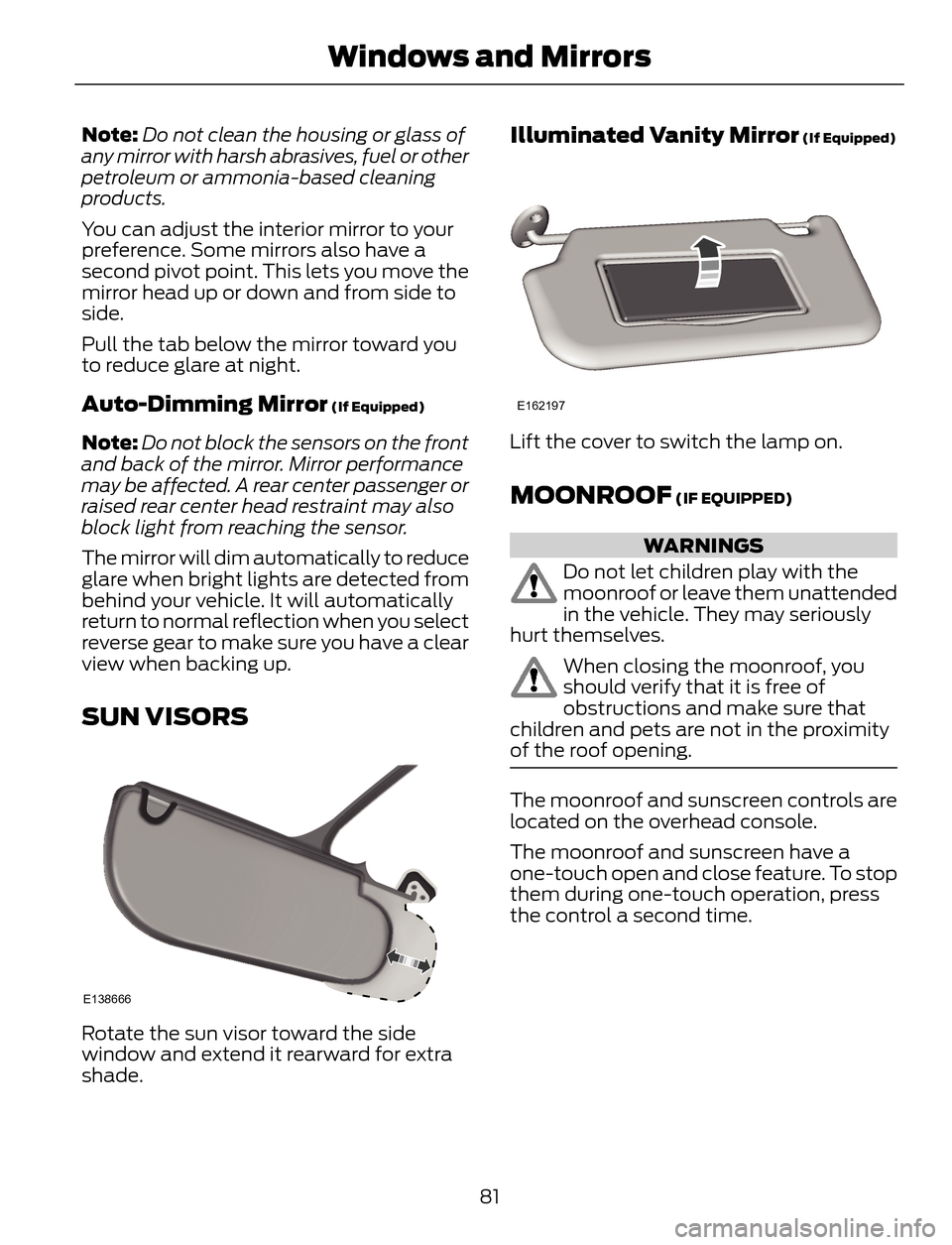
SUN VISORS
E138666
Rotate the sun visor toward the side
window and extend it rearward for extra
shade.
Illuminated Vanity Mirror (If Equipped)
E162197
Lift the cover to switch the lamp on.
MOONROOF (IF EQUIPPED)
WARNINGS
Do not let children play with the
moonroof or leave them unattended
in the vehicle. They may seriously
hurt themselves.
When closing the moonroof, you
should verify that it is free of
obstructions and make sure that
children and pets are not in the proximity
of the roof opening.
The moonroof and sunscreen controls are
located on the overhead console.
The moonroof and sunscreen have a
one-touch open and close feature. To stop
them during one-touch operation, press
the control a second time.
81
Windows and Mirrors
Page 85 of 428
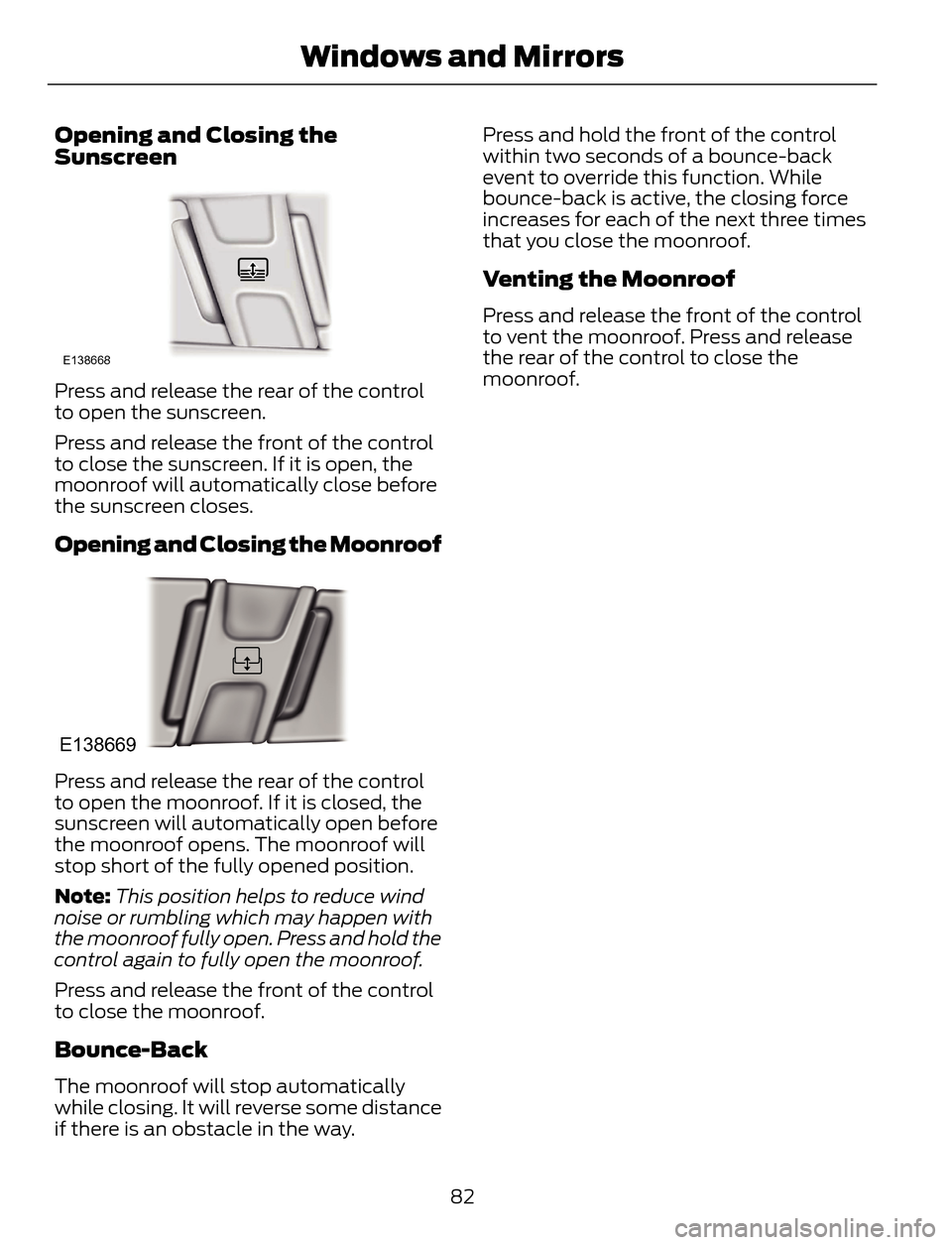
Opening and Closing the
Sunscreen
E138668
Press and release the rear of the control
to open the sunscreen.
Press and release the front of the control
to close the sunscreen. If it is open, the
moonroof will automatically close before
the sunscreen closes.
Opening and Closing the Moonroof
E138669
Press and release the rear of the control
to open the moonroof. If it is closed, the
sunscreen will automatically open before
the moonroof opens. The moonroof will
stop short of the fully opened position.
Note:This position helps to reduce wind
noise or rumbling which may happen with
the moonroof fully open. Press and hold the
control again to fully open the moonroof.
Press and release the front of the control
to close the moonroof.
Bounce-Back
The moonroof will stop automatically
while closing. It will reverse some distance
if there is an obstacle in the way.Press and hold the front of the control
within two seconds of a bounce-back
event to override this function. While
bounce-back is active, the closing force
increases for each of the next three times
that you close the moonroof.
Venting the Moonroof
Press and release the front of the control
to vent the moonroof. Press and release
the rear of the control to close the
moonroof.
82
Windows and Mirrors
Page 151 of 428
PRINCIPLE OF OPERATION
WARNINGS
Vehicle modifications involving
braking system, aftermarket roof
racks, suspension, steering system,
tire construction and wheel and tire size
may change the handling characteristics
of your vehicle and may adversely affect
the performance of the AdvanceTrac
system. In addition, installing any stereo
loudspeakers may interfere with and
adversely affect the AdvanceTrac system.
Install any aftermarket stereo loudspeaker
as far as possible from the front center
console, the tunnel, and the front seats in
order to minimize the risk of interfering with
the AdvanceTrac sensors. Reducing the
effectiveness of the AdvanceTrac system
could lead to an increased risk of loss of
vehicle control, vehicle rollover, personal
injury and death.
Remember that even advanced
technology cannot defy the laws of
physics. It’s always possible to lose
control of a vehicle due to inappropriate
driver input for the conditions. Aggressive
driving on any road condition can cause
you to lose control of your vehicle
increasing the risk of personal injury or
property damage. Activation of the
AdvanceTrac system is an indication that
at least some of the tires have exceeded
their ability to grip the road; this could
reduce the operator’s ability to control the
vehicle potentially resulting in a loss of
vehicle control, vehicle rollover, personal
injury and death. If your AdvanceTrac
system activates, SLOW DOWN.
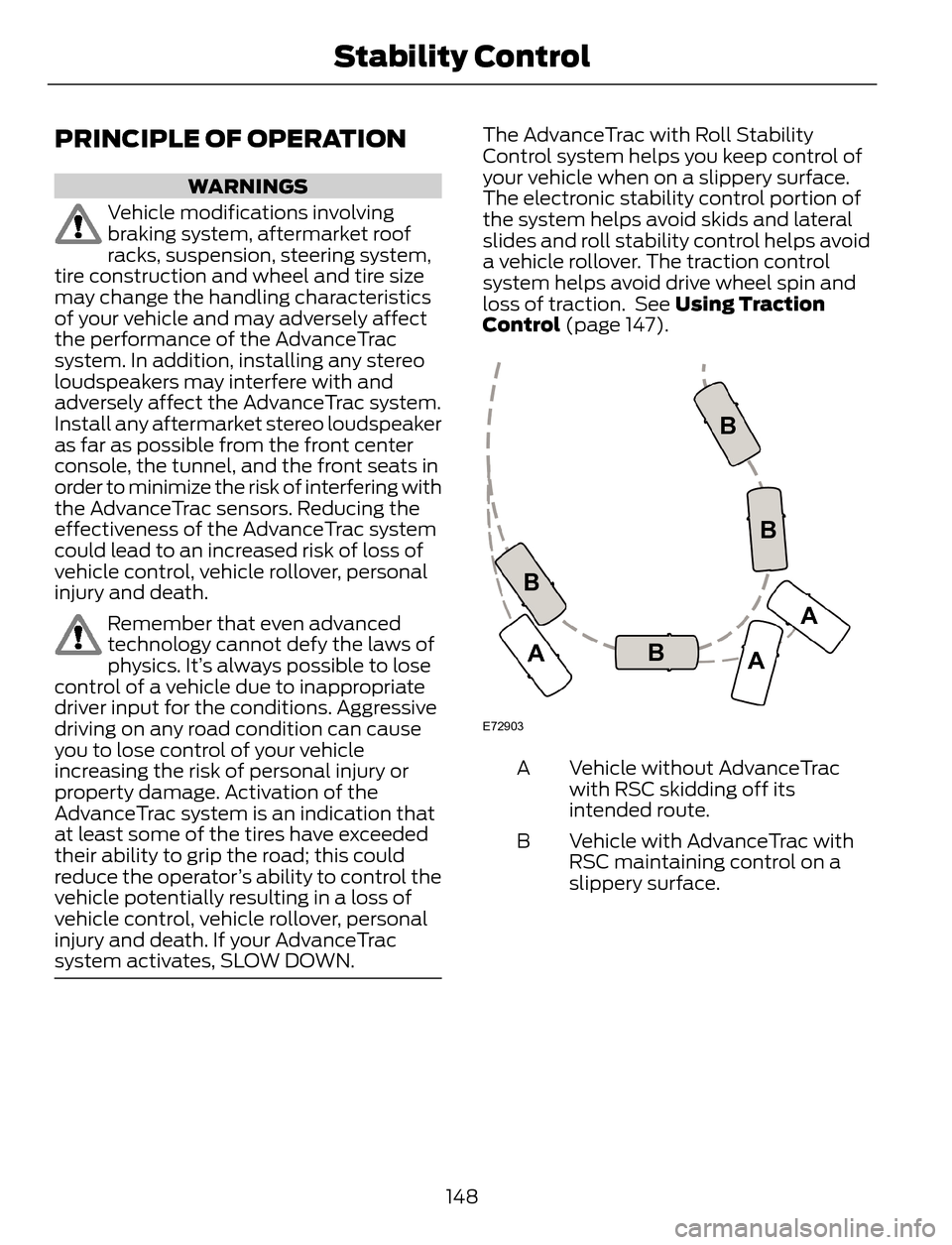
The AdvanceTrac with Roll Stability
Control system helps you keep control of
your vehicle when on a slippery surface.
The electronic stability control portion of
the system helps avoid skids and lateral
slides and roll stability control helps avoid
a vehicle rollover. The traction control
system helps avoid drive wheel spin and
loss of traction. See Using Traction
Control (page 147).
E72903
A
AA B
BB B
Vehicle without AdvanceTrac
with RSC skidding off its
intended route. A
Vehicle with AdvanceTrac with
RSC maintaining control on a
slippery surface. B
148
Stability Control
Page 155 of 428
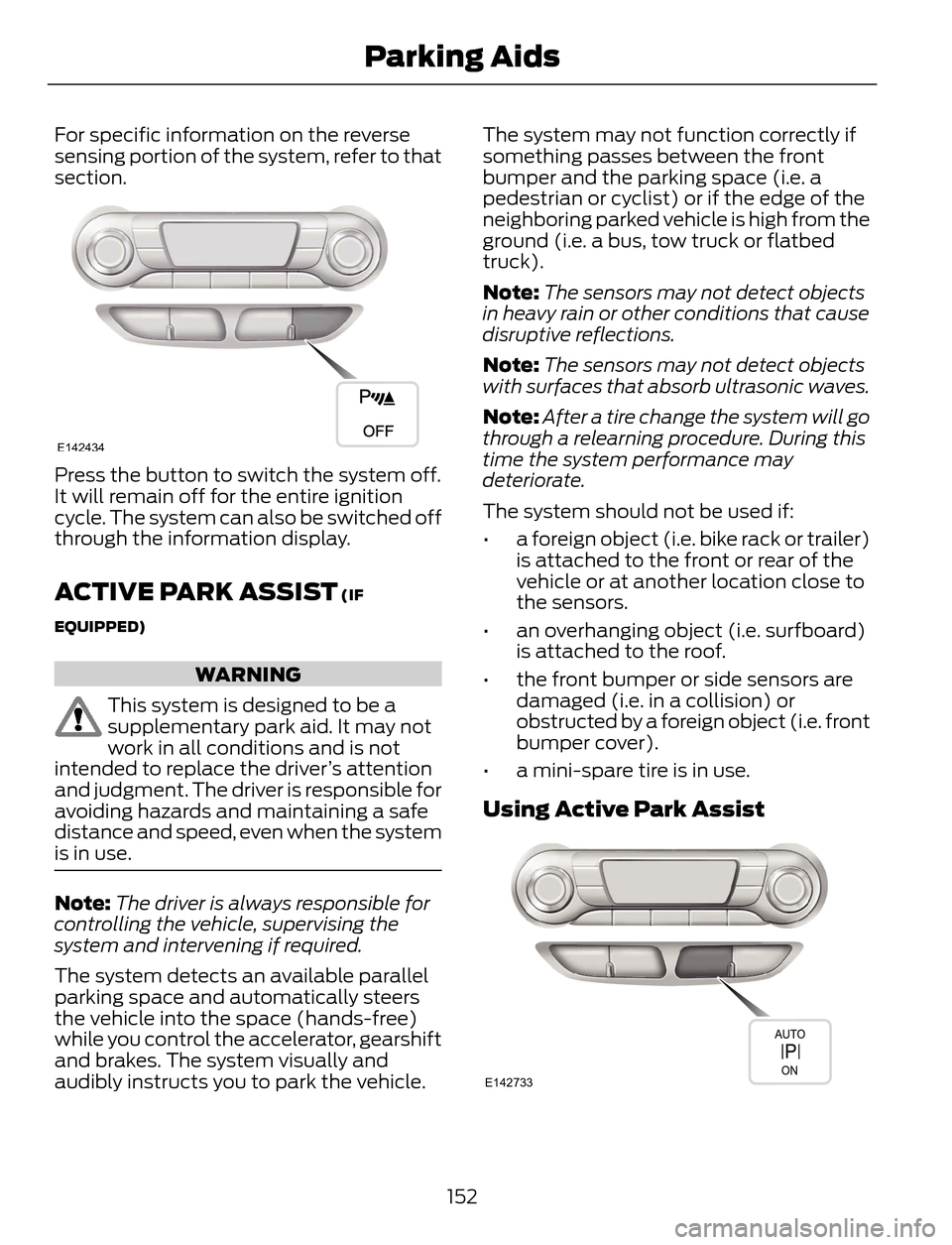
For specific information on the reverse
sensing portion of the system, refer to that
section.
E142434
Press the button to switch the system off.
It will remain off for the entire ignition
cycle. The system can also be switched off
through the information display.
ACTIVE PARK ASSIST (IF
EQUIPPED)
WARNING
This system is designed to be a
supplementary park aid. It may not
work in all conditions and is not
intended to replace the driver’s attention
and judgment. The driver is responsible for
avoiding hazards and maintaining a safe
distance and speed, even when the system
is in use.
Note:The driver is always responsible for
controlling the vehicle, supervising the
system and intervening if required.
The system detects an available parallel
parking space and automatically steers
the vehicle into the space (hands-free)
while you control the accelerator, gearshift
and brakes. The system visually and
audibly instructs you to park the vehicle.The system may not function correctly if
something passes between the front
bumper and the parking space (i.e. a
pedestrian or cyclist) or if the edge of the
neighboring parked vehicle is high from the
ground (i.e. a bus, tow truck or flatbed
truck).
Note:The sensors may not detect objects
in heavy rain or other conditions that cause
disruptive reflections.
Note:The sensors may not detect objects
with surfaces that absorb ultrasonic waves.
Note:After a tire change the system will go
through a relearning procedure. During this
time the system performance may
deteriorate.
The system should not be used if:
• a foreign object (i.e. bike rack or trailer)
is attached to the front or rear of the
vehicle or at another location close to
the sensors.
• an overhanging object (i.e. surfboard)
is attached to the roof.
• the front bumper or side sensors are
damaged (i.e. in a collision) or
obstructed by a foreign object (i.e. front
bumper cover).
• a mini-spare tire is in use.
Using Active Park Assist
E142733
152
Parking Aids
Page 170 of 428
E142447
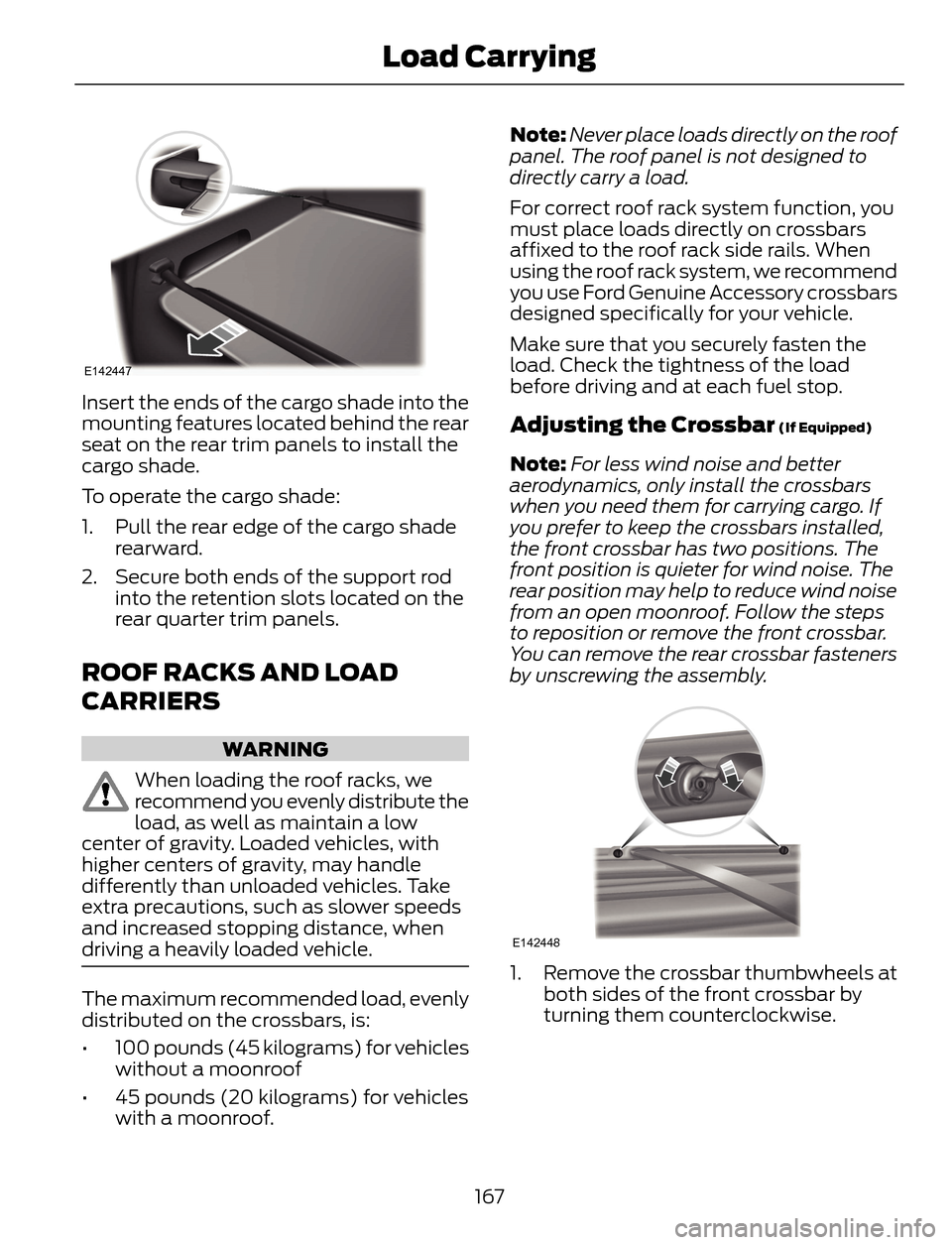
Insert the ends of the cargo shade into the
mounting features located behind the rear
seat on the rear trim panels to install the
cargo shade.
To operate the cargo shade:
1. Pull the rear edge of the cargo shade
rearward.
2. Secure both ends of the support rod
into the retention slots located on the
rear quarter trim panels.
ROOF RACKS AND LOAD
CARRIERS
WARNING
When loading the roof racks, we
recommend you evenly distribute the
load, as well as maintain a low
center of gravity. Loaded vehicles, with
higher centers of gravity, may handle
differently than unloaded vehicles. Take
extra precautions, such as slower speeds
and increased stopping distance, when
driving a heavily loaded vehicle.
The maximum recommended load, evenly
distributed on the crossbars, is:
• 100 pounds (45 kilograms) for vehicles
without a moonroof
• 45 pounds (20 kilograms) for vehicles
with a moonroof.Note:Never place loads directly on the roof
panel. The roof panel is not designed to
directly carry a load.
For correct roof rack system function, you
must place loads directly on crossbars
affixed to the roof rack side rails. When
using the roof rack system, we recommend
you use Ford Genuine Accessory crossbars
designed specifically for your vehicle.
Make sure that you securely fasten the
load. Check the tightness of the load
before driving and at each fuel stop.
Adjusting the Crossbar (If Equipped)
Note:For less wind noise and better
aerodynamics, only install the crossbars
when you need them for carrying cargo. If
you prefer to keep the crossbars installed,
the front crossbar has two positions. The
front position is quieter for wind noise. The
rear position may help to reduce wind noise
from an open moonroof. Follow the steps
to reposition or remove the front crossbar.
You can remove the rear crossbar fasteners
by unscrewing the assembly.
E142448
1. Remove the crossbar thumbwheels at
both sides of the front crossbar by
turning them counterclockwise.
167
Load Carrying