light FORD ESCAPE 2016 3.G Workshop Manual
[x] Cancel search | Manufacturer: FORD, Model Year: 2016, Model line: ESCAPE, Model: FORD ESCAPE 2016 3.GPages: 393, PDF Size: 5.85 MB
Page 169 of 393
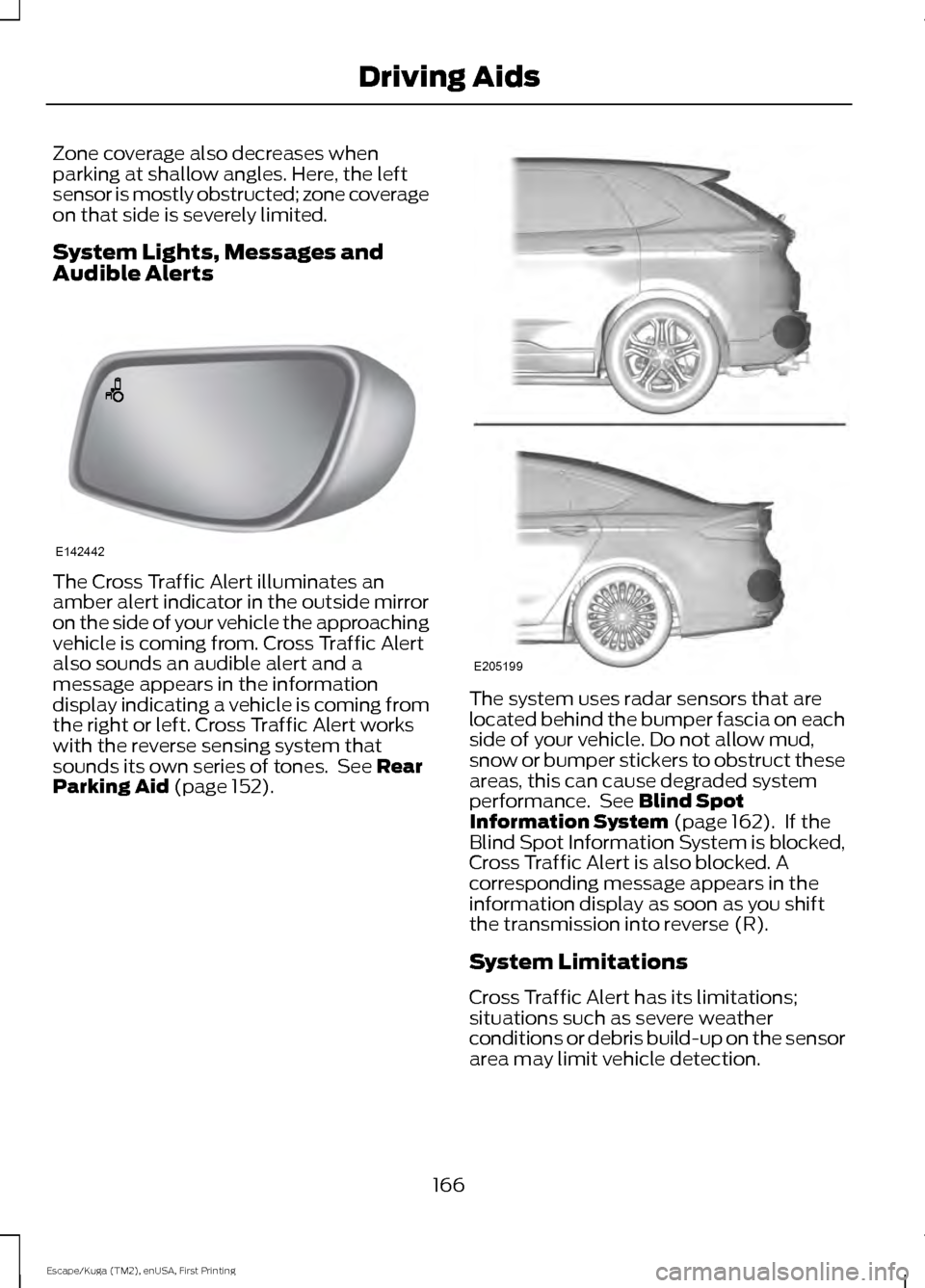
Zone coverage also decreases when
parking at shallow angles. Here, the left
sensor is mostly obstructed; zone coverage
on that side is severely limited.
System Lights, Messages and
Audible Alerts
The Cross Traffic Alert illuminates an
amber alert indicator in the outside mirror
on the side of your vehicle the approaching
vehicle is coming from. Cross Traffic Alert
also sounds an audible alert and a
message appears in the information
display indicating a vehicle is coming from
the right or left. Cross Traffic Alert works
with the reverse sensing system that
sounds its own series of tones. See Rear
Parking Aid (page 152). The system uses radar sensors that are
located behind the bumper fascia on each
side of your vehicle. Do not allow mud,
snow or bumper stickers to obstruct these
areas, this can cause degraded system
performance. See Blind Spot
Information System (page 162). If the
Blind Spot Information System is blocked,
Cross Traffic Alert is also blocked. A
corresponding message appears in the
information display as soon as you shift
the transmission into reverse (R).
System Limitations
Cross Traffic Alert has its limitations;
situations such as severe weather
conditions or debris build-up on the sensor
area may limit vehicle detection.
166
Escape/Kuga (TM2), enUSA, First Printing Driving AidsE142442 E205199
Page 182 of 393
TOWING A TRAILER
WARNINGS
Do not exceed the GVWR or
the GAWR specified on the
certification label. Towing trailers beyond the
maximum recommended
gross trailer weight exceeds the
limit of the vehicle and could
result in engine damage,
transmission damage, structural
damage, loss of vehicle control,
vehicle rollover and personal
injury. Your vehicle may have electrical
items, such as fuses or relays,
related to towing. See the Fuses
chapter.
Your vehicle's load capacity
designation is by weight, not by
volume, so you cannot necessarily
use all available space when
loading a vehicle or trailer.
Towing a trailer places an extra
load on your vehicle's engine,
transmission, axle, brakes, tires
and suspension. Inspect these
components periodically during,
and after, any towing operation. Load Placement
To help minimize how trailer
movement affects your vehicle
when driving:
•
Load the heaviest items closest
to the trailer floor.
• Load the heaviest items
centered between the left and
right side trailer tires.
• Load the heaviest items above
the trailer axles or just slightly
forward toward the trailer
tongue. Do not allow the final
trailer tongue weight to go
above or below 10-15% of the
loaded trailer weight.
• Select a tow bar with the
correct rise or drop. When both
the loaded vehicle and trailer
are connected, the trailer frame
should be level, or slightly
angled down toward your
vehicle, when viewed from the
side.
When driving with a trailer or
payload, a slight takeoff vibration
or shudder may be present due to
the increased payload weight.
Additional information regarding
proper trailer loading and setting
your vehicle up for towing is
located in another chapter of this
manual. See
Load Limit (page
172).
You can also find information in
the
RV & Trailer Towing Guide
available at your authorized
dealer, or online.
179
Escape/Kuga (TM2), enUSA, First Printing Towing
Page 186 of 393
6.
Check that the trailer is level or
slightly nose down toward your
vehicle. If not, adjust the ball
height accordingly and repeat
Steps 2-6.
When the trailer is level or slightly
nose down toward the vehicle:
• Lock the bar tension adjuster
in place.
• Check that the trailer tongue
securely attaches and locks
onto the hitch.
• Install safety chains, lighting,
and trailer brake controls as
required by law or the trailer
manufacturer.
Safety Chains
Note: Never attach safety chains
to the bumper.
Always connect the safety chains
to the hook retainers of your
vehicle hitch.
To connect the trailer ’s safety
chains, cross them under the
trailer tongue and allow enough
slack for turning tight corners. Do
not allow the chains to drag on the
ground. Trailer Brakes WARNING
Do not connect a trailer's
hydraulic brake system
directly to your vehicle's brake
system. Your vehicle may not have
enough braking power and your
chances of having a collision
greatly increase. Electric brakes and manual,
automatic or surge-type trailer
brakes are safe if you install them
properly and adjust them to the
manufacturer's specifications. The
trailer brakes must meet local and
federal regulations.
The rating for the tow vehicle's
braking system operation is at
the gross vehicle weight rating,
not the gross combined weight
rating.
Separate functioning brake
systems are required for safe
control of towed vehicles and
trailers weighing more than
1500 pounds (680 kilograms)
when loaded.
183
Escape/Kuga (TM2), enUSA, First Printing Towing
Page 187 of 393
Trailer Lamps
WARNING
Never connect any trailer
lamp wiring to the vehicle's
tail lamp wiring; this may damage
the electrical system resulting in
fire. Contact your authorized
dealer as soon as possible for
assistance in proper trailer tow
wiring installation. Additional
electrical equipment may be
required. Trailer lamps are required on most
towed vehicles. Make sure all
running lights, brake lights, turn
signals and hazard lights are
working.
Before Towing a Trailer
Practice turning, stopping and
backing up to get the feel of your
vehicle-trailer combination before
starting on a trip. When turning,
make wider turns so the trailer
wheels clear curbs and other
obstacles.
When Towing a Trailer
•
Do not drive faster than 70
mph (113 km/h) during the first
500 miles (800 kilometers).
• Do not make full-throttle
starts.
• Check your hitch, electrical
connections and trailer wheel
lug nuts thoroughly after you
have traveled 50 miles (80
kilometers). •
When stopped in congested or
heavy traffic during hot
weather, place the gearshift in
position P to aid engine and
transmission cooling and to
help A/C performance.
• Turn off the speed control with
heavy loads or in hilly terrain.
The speed control may turn off
automatically when you are
towing on long, steep grades.
• Shift to a lower gear when
driving down a long or steep
hill. Do not apply the brakes
continuously, as they may
overheat and become less
effective.
• If your transmission is equipped
with a Grade Assist or
Tow/Haul feature, use this
feature when towing. This
provides engine braking and
helps eliminate excessive
transmission shifting for
optimum fuel economy and
transmission cooling.
• Allow more distance for
stopping with a trailer
attached. Anticipate stops and
brake gradually.
• Avoid parking on a grade.
However, if you must park on a
grade:
1. Turn the steering wheel to point your vehicle tires away
from traffic flow.
2. Set your vehicle parking brake.
3. Place the automatic
transmission in position
P.
184
Escape/Kuga (TM2), enUSA, First Printing Towing
Page 191 of 393
BREAKING-IN
You need to break in new tires for
approximately 300 miles (480
kilometers). During this time, your vehicle
may exhibit some unusual driving
characteristics.
Avoid driving too fast during the first 1000
miles (1600 kilometers). Vary your speed
frequently and change up through the
gears early. Do not labor the engine.
Do not tow during the first 1000 miles
(1600 kilometers).
ECONOMICAL DRIVING
Your fuel economy is affected by several
things, such as how you drive, the
conditions you drive under, and how you
maintain your vehicle.
You may improve your fuel economy by
keeping these things in mind:
•
Accelerate and slow down in a smooth,
moderate fashion.
• Drive at steady speeds without
stopping.
• Anticipate stops; slowing down may
eliminate the need to stop.
• Combine errands and minimize
stop-and-go driving.
• Close the windows for high-speed
driving.
• Drive at reasonable speeds (traveling
at 55 mph [88 km/h] uses 15% less
fuel than traveling at 65 mph [105
km/h]).
• Keep the tires properly inflated and use
only the recommended size.
• Use the recommended engine oil.
• Perform all regularly scheduled
maintenance. Avoid these actions; they reduce your fuel
economy:
•
Sudden accelerations or hard
accelerations.
• Revving the engine before turning it off.
• Idle for periods longer than one minute.
• Warm up your vehicle on cold
mornings.
• Use the air conditioner or front
defroster.
• Use the speed control in hilly terrain.
• Rest your foot on the brake pedal while
driving.
• Drive a heavily loaded vehicle or tow a
trailer.
• Carry unnecessary weight
(approximately 1 mpg [0.4 km/L] is
lost for every 400 lb [180 kilogram] of
weight carried).
• Driving with the wheels out of
alignment.
Conditions
• Heavily loading a vehicle or towing a
trailer may reduce fuel economy at any
speed.
• Adding certain accessories to your
vehicle (for example bug deflectors,
rollbars, light bars, running boards, ski
racks or luggage racks) may reduce
fuel economy.
• To maximize the fuel economy, drive
with the tonneau cover installed (if
equipped).
• Using fuel blended with alcohol may
lower fuel economy.
• Fuel economy may decrease with lower
temperatures during the first 8– 10
miles (12 –16 kilometers) of driving.
• Driving on flat terrain offers improved
fuel economy as compared to driving
on hilly terrain.
188
Escape/Kuga (TM2), enUSA, First Printing Driving Hints
Page 192 of 393
•
Transmissions give their best fuel
economy when operated in the top
cruise gear and with steady pressure
on the gas pedal.
• Four-wheel-drive operation (if
equipped) is less fuel efficient than
two-wheel-drive operation.
• Close the windows for high-speed
driving.
DRIVING THROUGH WATER WARNING
Do not drive through flowing or deep
water as you may lose control of your
vehicle.
Note:
Driving through standing water can
cause vehicle damage.
Note: Engine damage can occur if water
enters the air filter.
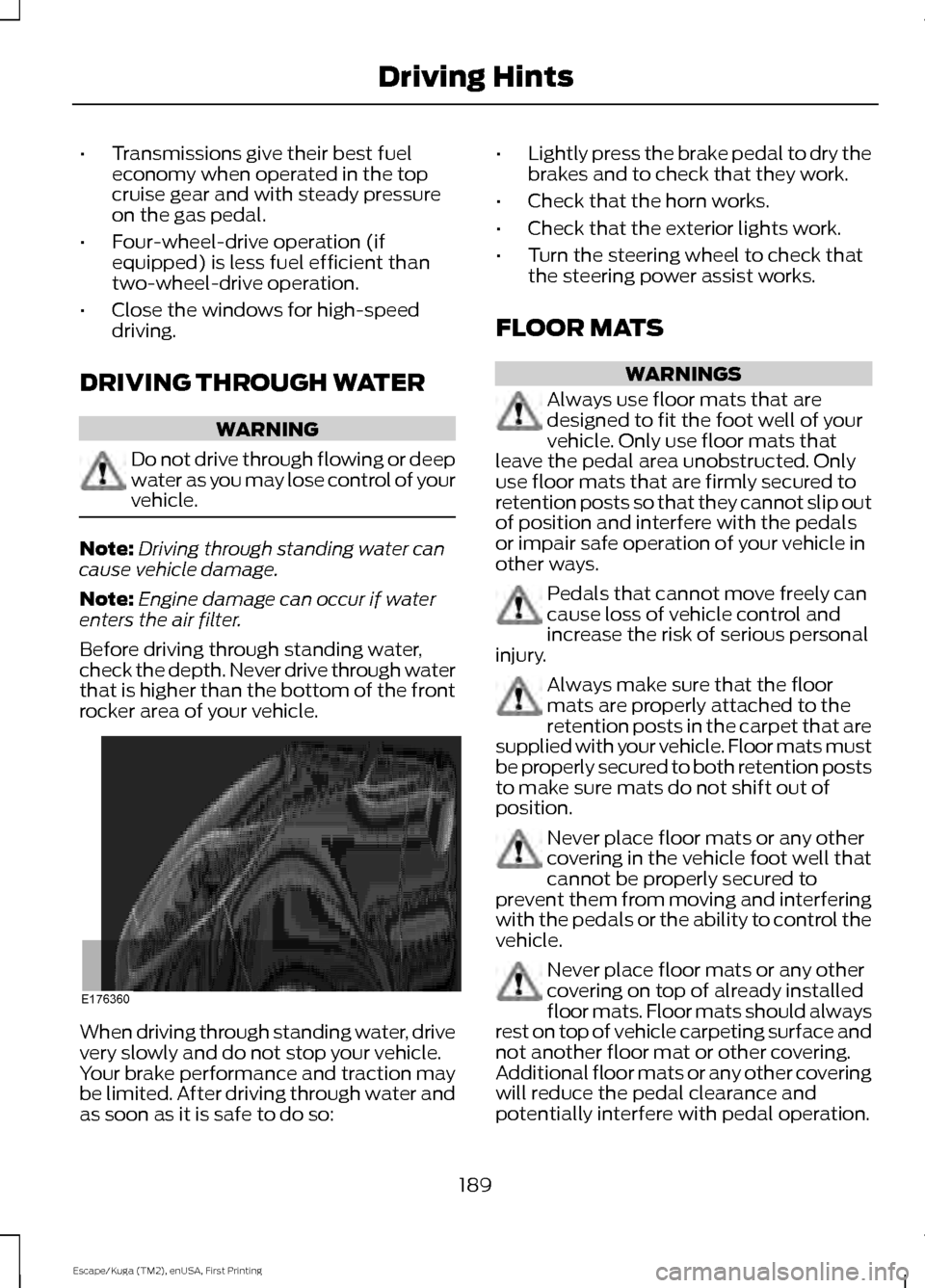
Before driving through standing water,
check the depth. Never drive through water
that is higher than the bottom of the front
rocker area of your vehicle. When driving through standing water, drive
very slowly and do not stop your vehicle.
Your brake performance and traction may
be limited. After driving through water and
as soon as it is safe to do so: •
Lightly press the brake pedal to dry the
brakes and to check that they work.
• Check that the horn works.
• Check that the exterior lights work.
• Turn the steering wheel to check that
the steering power assist works.
FLOOR MATS WARNINGS
Always use floor mats that are
designed to fit the foot well of your
vehicle. Only use floor mats that
leave the pedal area unobstructed. Only
use floor mats that are firmly secured to
retention posts so that they cannot slip out
of position and interfere with the pedals
or impair safe operation of your vehicle in
other ways. Pedals that cannot move freely can
cause loss of vehicle control and
increase the risk of serious personal
injury. Always make sure that the floor
mats are properly attached to the
retention posts in the carpet that are
supplied with your vehicle. Floor mats must
be properly secured to both retention posts
to make sure mats do not shift out of
position. Never place floor mats or any other
covering in the vehicle foot well that
cannot be properly secured to
prevent them from moving and interfering
with the pedals or the ability to control the
vehicle. Never place floor mats or any other
covering on top of already installed
floor mats. Floor mats should always
rest on top of vehicle carpeting surface and
not another floor mat or other covering.
Additional floor mats or any other covering
will reduce the pedal clearance and
potentially interfere with pedal operation.
189
Escape/Kuga (TM2), enUSA, First Printing Driving HintsE176360
Page 206 of 393
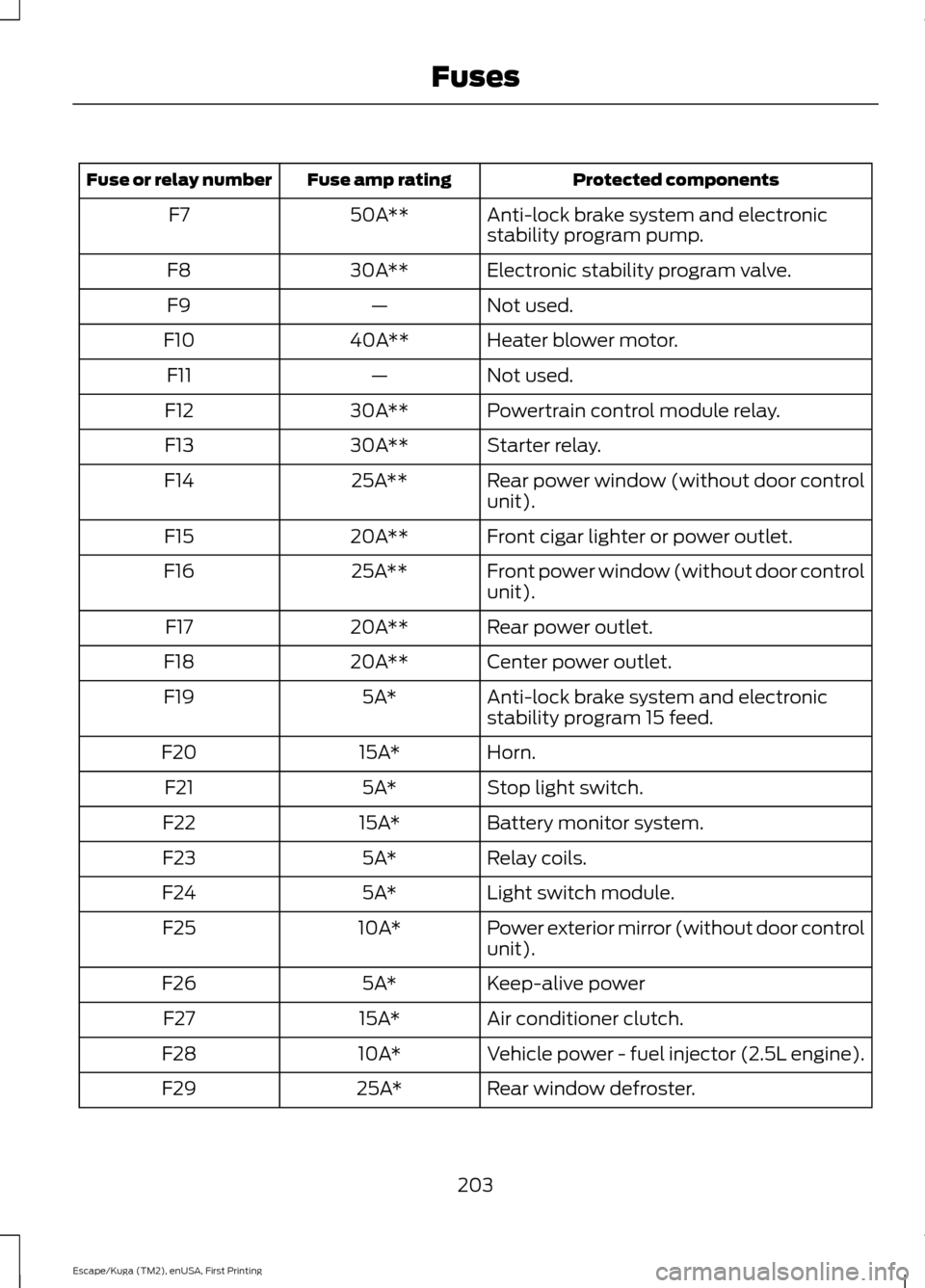
Protected components
Fuse amp rating
Fuse or relay number
Anti-lock brake system and electronic
stability program pump.
50A**
F7
Electronic stability program valve.
30A**
F8
Not used.
—
F9
Heater blower motor.
40A**
F10
Not used.
—
F11
Powertrain control module relay.
30A**
F12
Starter relay.
30A**
F13
Rear power window (without door control
unit).
25A**
F14
Front cigar lighter or power outlet.
20A**
F15
Front power window (without door control
unit).
25A**
F16
Rear power outlet.
20A**
F17
Center power outlet.
20A**
F18
Anti-lock brake system and electronic
stability program 15 feed.
5A*
F19
Horn.
15A*
F20
Stop light switch.
5A*
F21
Battery monitor system.
15A*
F22
Relay coils.
5A*
F23
Light switch module.
5A*
F24
Power exterior mirror (without door control
unit).
10A*
F25
Keep-alive power
5A*
F26
Air conditioner clutch.
15A*
F27
Vehicle power - fuel injector (2.5L engine).
10A*
F28
Rear window defroster.
25A*
F29
203
Escape/Kuga (TM2), enUSA, First Printing Fuses
Page 207 of 393
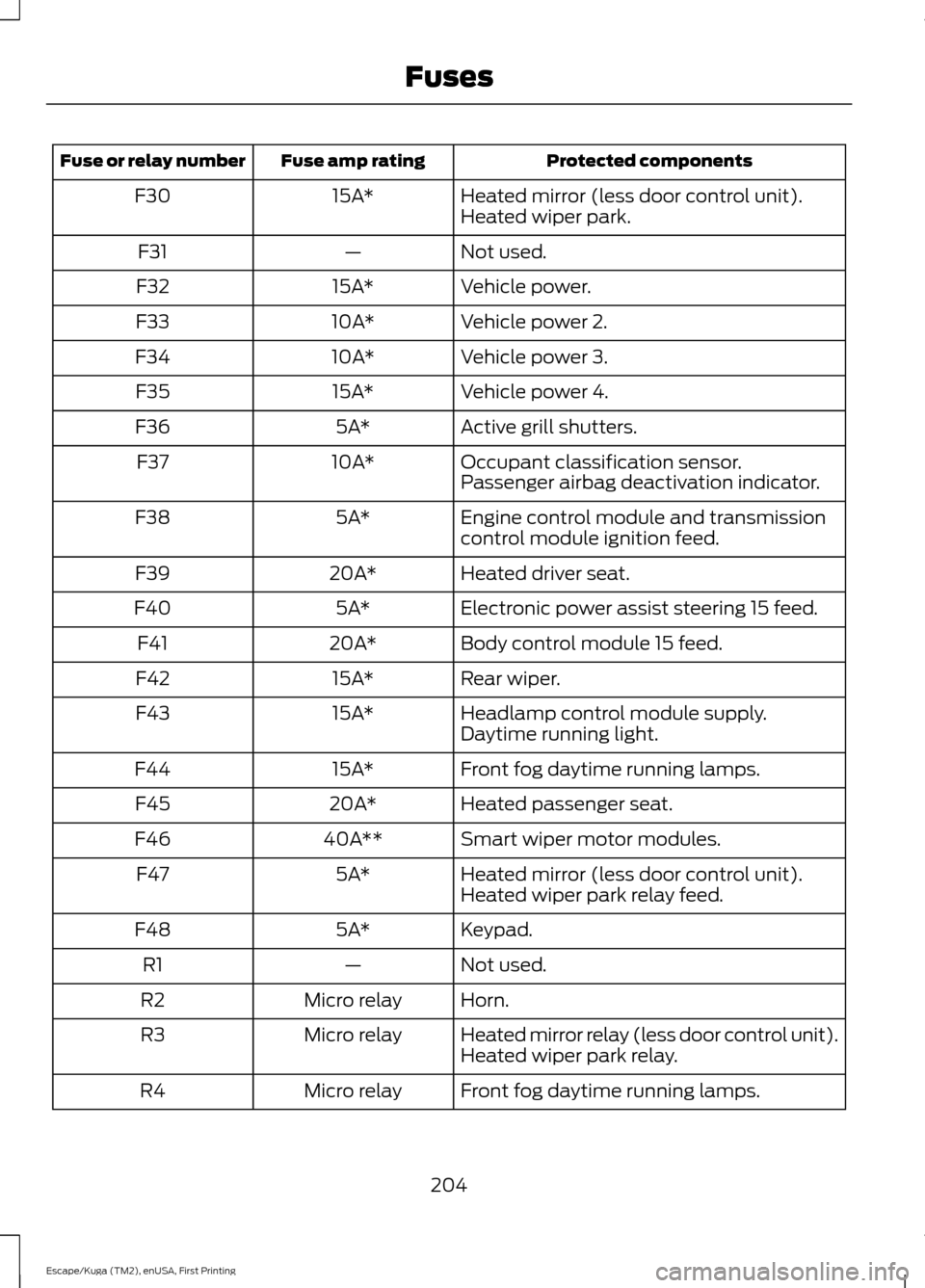
Protected components
Fuse amp rating
Fuse or relay number
Heated mirror (less door control unit).
15A*
F30
Heated wiper park.
Not used.
—
F31
Vehicle power.
15A*
F32
Vehicle power 2.
10A*
F33
Vehicle power 3.
10A*
F34
Vehicle power 4.
15A*
F35
Active grill shutters.
5A*
F36
Occupant classification sensor.
10A*
F37
Passenger airbag deactivation indicator.
Engine control module and transmission
control module ignition feed.
5A*
F38
Heated driver seat.
20A*
F39
Electronic power assist steering 15 feed.
5A*
F40
Body control module 15 feed.
20A*
F41
Rear wiper.
15A*
F42
Headlamp control module supply.
15A*
F43
Daytime running light.
Front fog daytime running lamps.
15A*
F44
Heated passenger seat.
20A*
F45
Smart wiper motor modules.
40A**
F46
Heated mirror (less door control unit).
5A*
F47
Heated wiper park relay feed.
Keypad.
5A*
F48
Not used.
—
R1
Horn.
Micro relay
R2
Heated mirror relay (less door control unit).
Micro relay
R3
Heated wiper park relay.
Front fog daytime running lamps.
Micro relay
R4
204
Escape/Kuga (TM2), enUSA, First Printing Fuses
Page 209 of 393

Protected components
Fuse amp rating
Fuse or relay number
Fuel pump supply, Air mass meter.
20A
F56
Not used.
—
F57
Not used (spare).
5A
F58
Passive anti-theft transceiver.
5A
F59
Interior light.
10A
F60
Driver door switch pack.
Glove box light.
Overhead console switch bank.
206
Escape/Kuga (TM2), enUSA, First Printing FusesE129926
Page 210 of 393
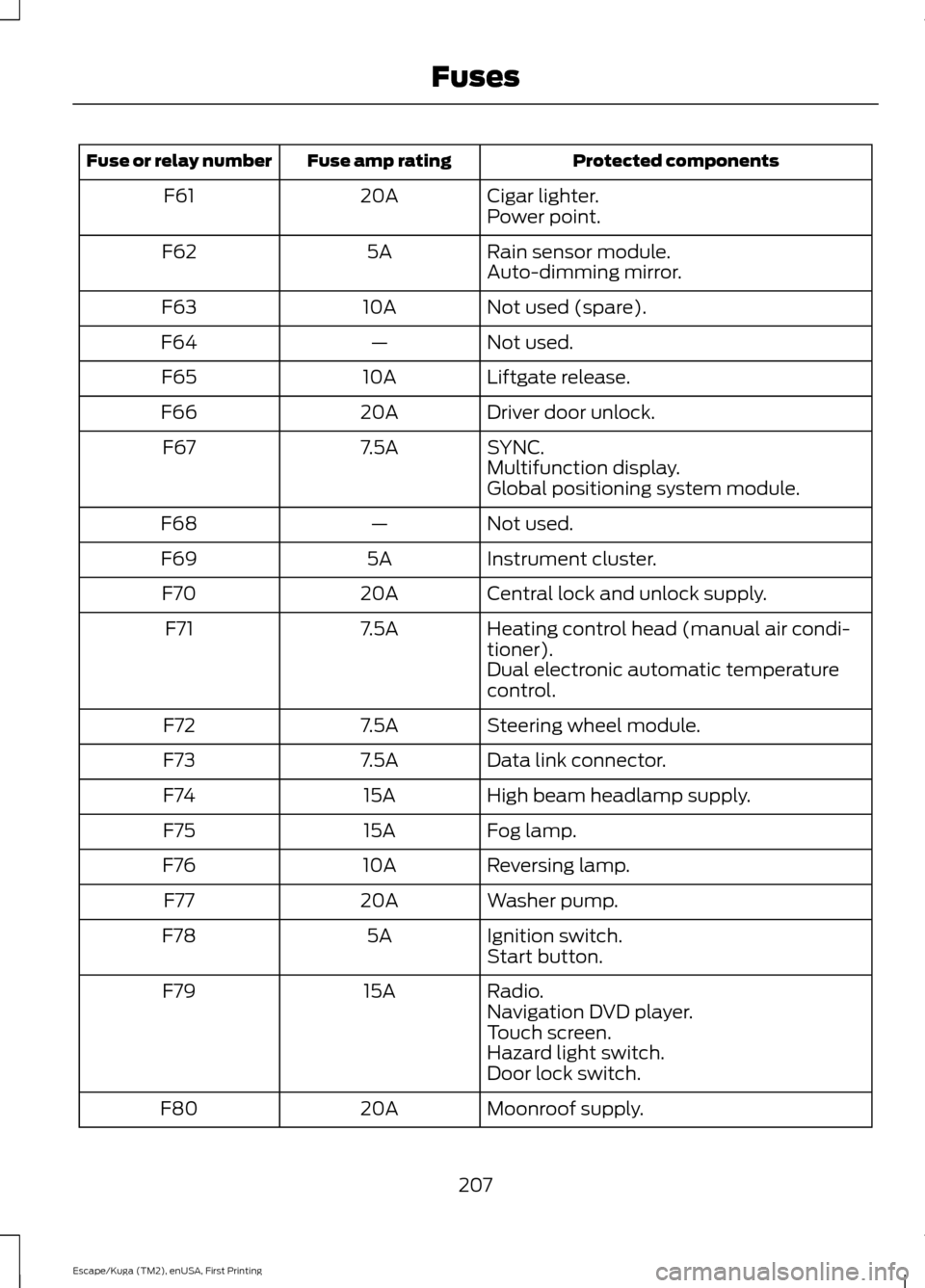
Protected components
Fuse amp rating
Fuse or relay number
Cigar lighter.
20A
F61
Power point.
Rain sensor module.
5A
F62
Auto-dimming mirror.
Not used (spare).
10A
F63
Not used.
—
F64
Liftgate release.
10A
F65
Driver door unlock.
20A
F66
SYNC.
7.5A
F67
Multifunction display.
Global positioning system module.
Not used.
—
F68
Instrument cluster.
5A
F69
Central lock and unlock supply.
20A
F70
Heating control head (manual air condi-
tioner).
7.5A
F71
Dual electronic automatic temperature
control.
Steering wheel module.
7.5A
F72
Data link connector.
7.5A
F73
High beam headlamp supply.
15A
F74
Fog lamp.
15A
F75
Reversing lamp.
10A
F76
Washer pump.
20A
F77
Ignition switch.
5A
F78
Start button.
Radio.
15A
F79
Navigation DVD player.
Touch screen.
Hazard light switch.
Door lock switch.
Moonroof supply.
20A
F80
207
Escape/Kuga (TM2), enUSA, First Printing Fuses