fuse FORD ESCAPE 2022 User Guide
[x] Cancel search | Manufacturer: FORD, Model Year: 2022, Model line: ESCAPE, Model: FORD ESCAPE 2022Pages: 585, PDF Size: 6.15 MB
Page 327 of 585
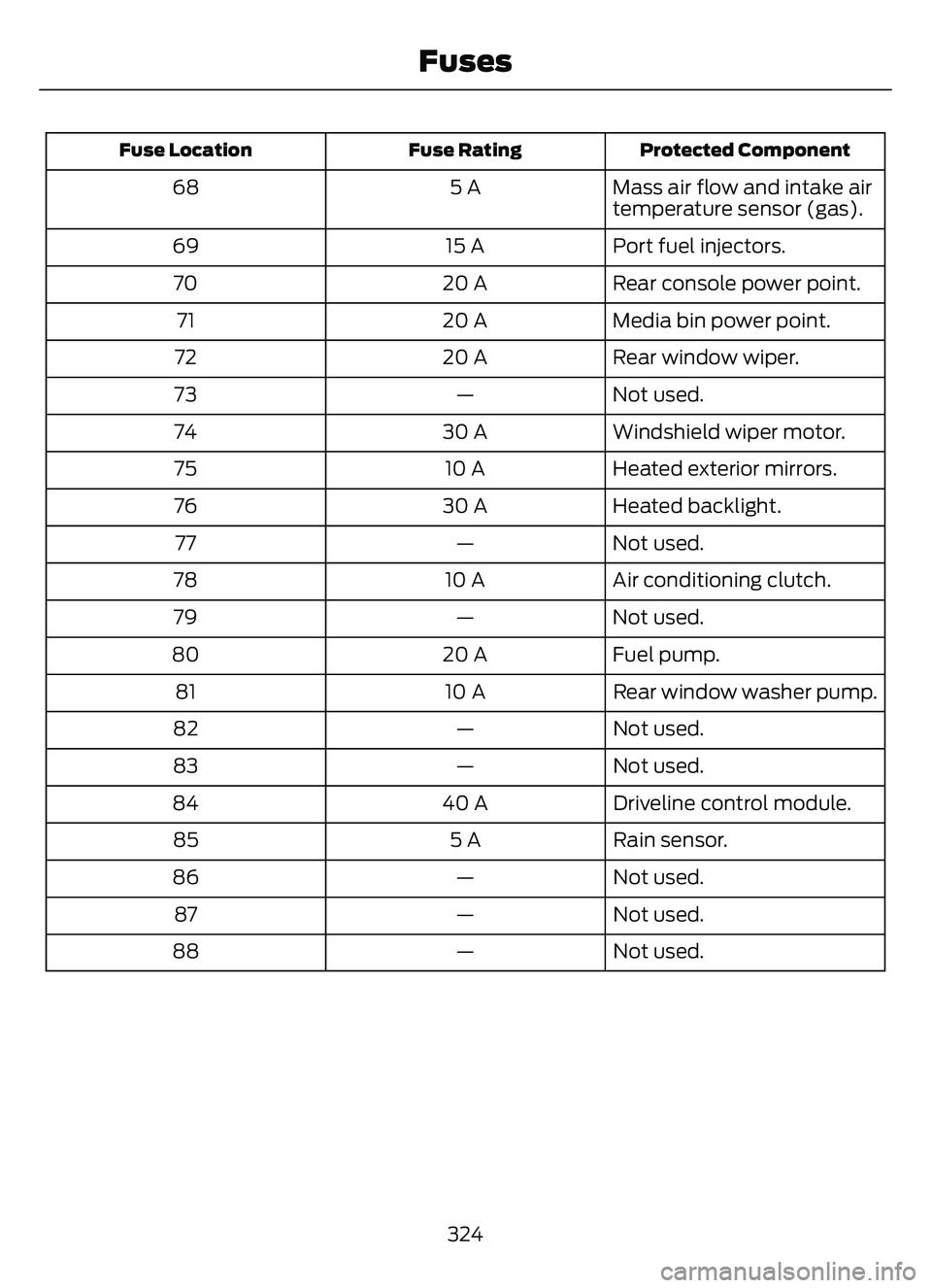
Protected Component
Fuse Rating
Fuse Location
Mass air flow and intake air
temperature sensor (gas).
5 A
68
Port fuel injectors.
15 A
69
Rear console power point.
20 A
70
Media bin power point.
20 A
71
Rear window wiper.
20 A
72
Not used.
—
73
Windshield wiper motor.
30 A
74
Heated exterior mirrors.
10 A
75
Heated backlight.
30 A
76
Not used.
—
77
Air conditioning clutch.
10 A
78
Not used.
—
79
Fuel pump.
20 A
80
Rear window washer pump.
10 A
81
Not used.
—
82
Not used.
—
83
Driveline control module.
40 A
84
Rain sensor.
5 A
85
Not used.
—
86
Not used.
—
87
Not used.
—
88
324
Fuses
Page 328 of 585
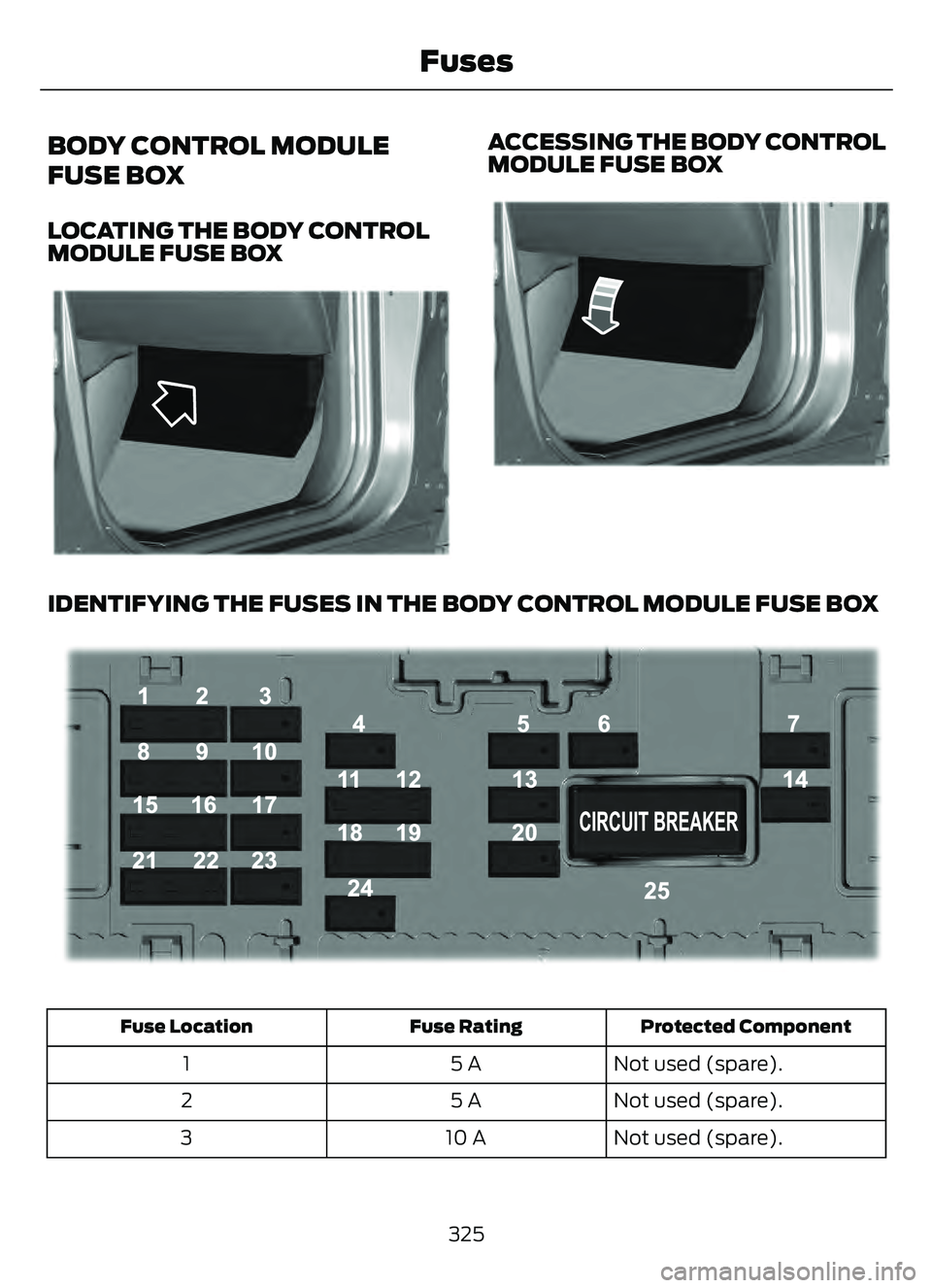
BODY CONTROL MODULE
FUSE BOX
LOCATING THE BODY CONTROL
MODULE FUSE BOX
E329070E329070
ACCESSING THE BODY CONTROL
MODULE FUSE BOX
E329071E329071
IDENTIFYING THE FUSES IN THE BODY CONTROL MODULE FUSE BOX
E293328
Protected Component
Fuse Rating
Fuse Location
Not used (spare).
5 A
1
Not used (spare).
5 A
2
Not used (spare).
10 A
3
325
Fuses
Page 329 of 585
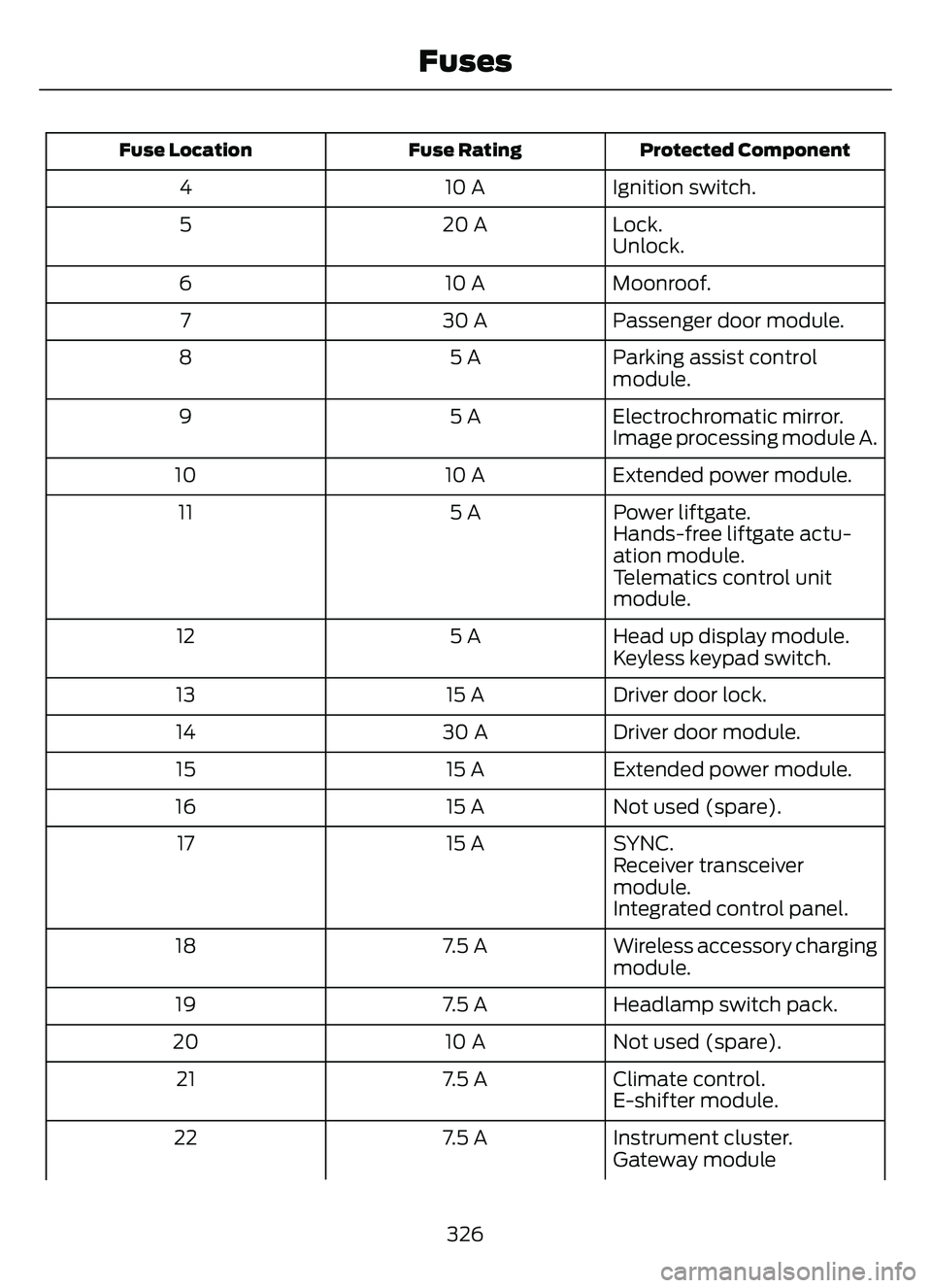
Protected Component
Fuse Rating
Fuse Location
Ignition switch.
10 A
4
Lock.
20 A
5
Unlock.
Moonroof.
10 A
6
Passenger door module.
30 A
7
Parking assist control
module.
5 A
8
Electrochromatic mirror.
5 A
9
Image processing module A.
Extended power module.
10 A
10
Power liftgate.
5 A
11
Hands-free liftgate actu-
ation module.
Telematics control unit
module.
Head up display module.
5 A
12
Keyless keypad switch.
Driver door lock.
15 A
13
Driver door module.
30 A
14
Extended power module.
15 A
15
Not used (spare).
15 A
16
SYNC.
15 A
17
Receiver transceiver
module.
Integrated control panel.
Wireless accessory charging
module.
7.5 A
18
Headlamp switch pack.
7.5 A
19
Not used (spare).
10 A
20
Climate control.
7.5 A
21
E-shifter module.
Instrument cluster.
7.5 A
22
Gateway module
326
Fuses
Page 330 of 585
Protected Component
Fuse Rating
Fuse Location
Steering column control
module.
Audio unit.
20 A
23
Not used (spare).
20 A
24
Power windows.
30 A
25
Exterior mirrors.
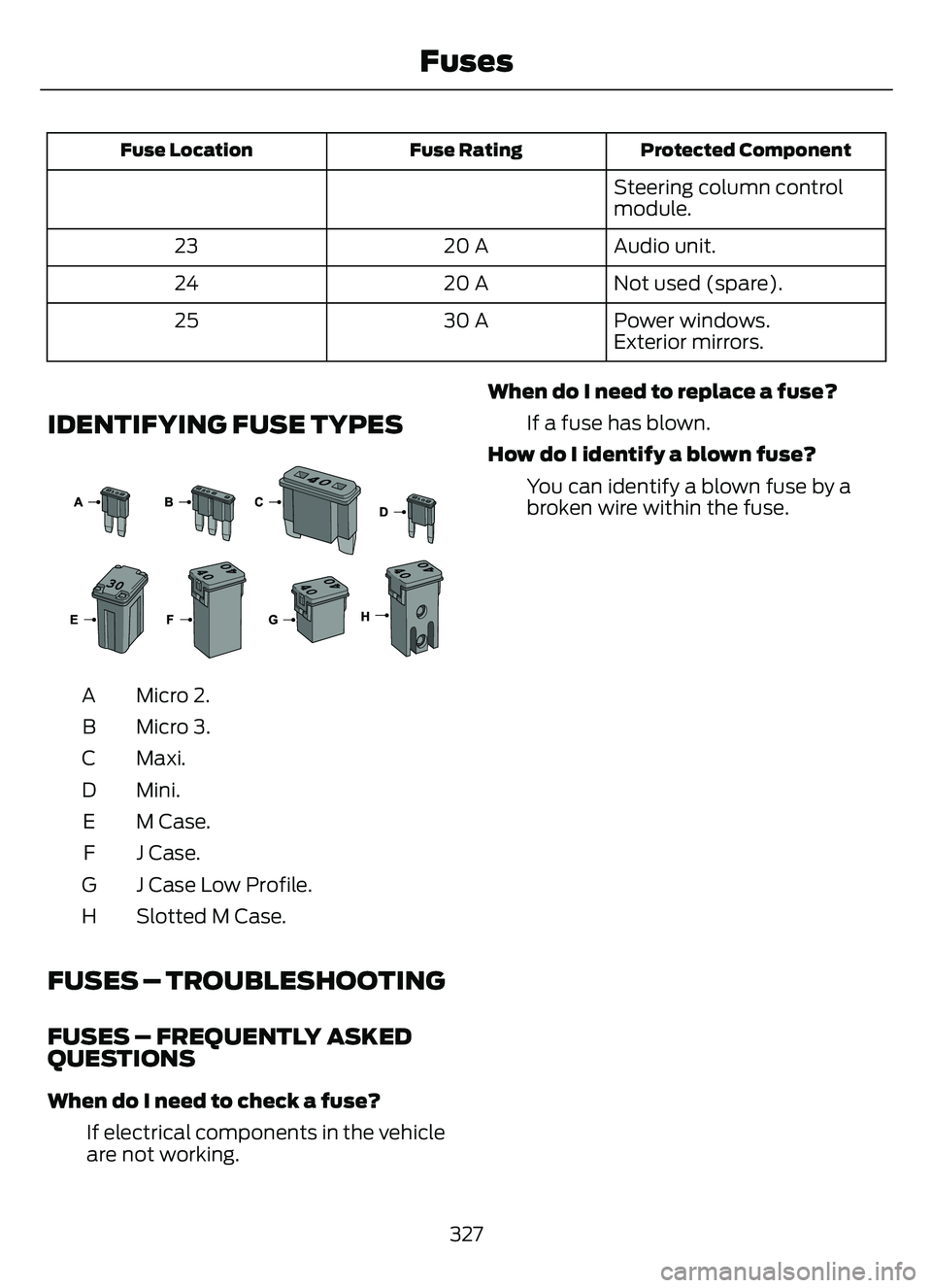
IDENTIFYING FUSE TYPES
E267379E267379
Micro 2.
A
Micro 3.
B
Maxi.
C
Mini.
D
M Case.
E
J Case.
F
J Case Low Profile.
G
Slotted M Case.
H
FUSES – TROUBLESHOOTING
FUSES – FREQUENTLY ASKED
QUESTIONS
When do I need to check a fuse?
If electrical components in the vehicle
are not working. When do I need to replace a fuse?
If a fuse has blown.
How do I identify a blown fuse? You can identify a blown fuse by a
broken wire within the fuse.
327
Fuses
Page 333 of 585
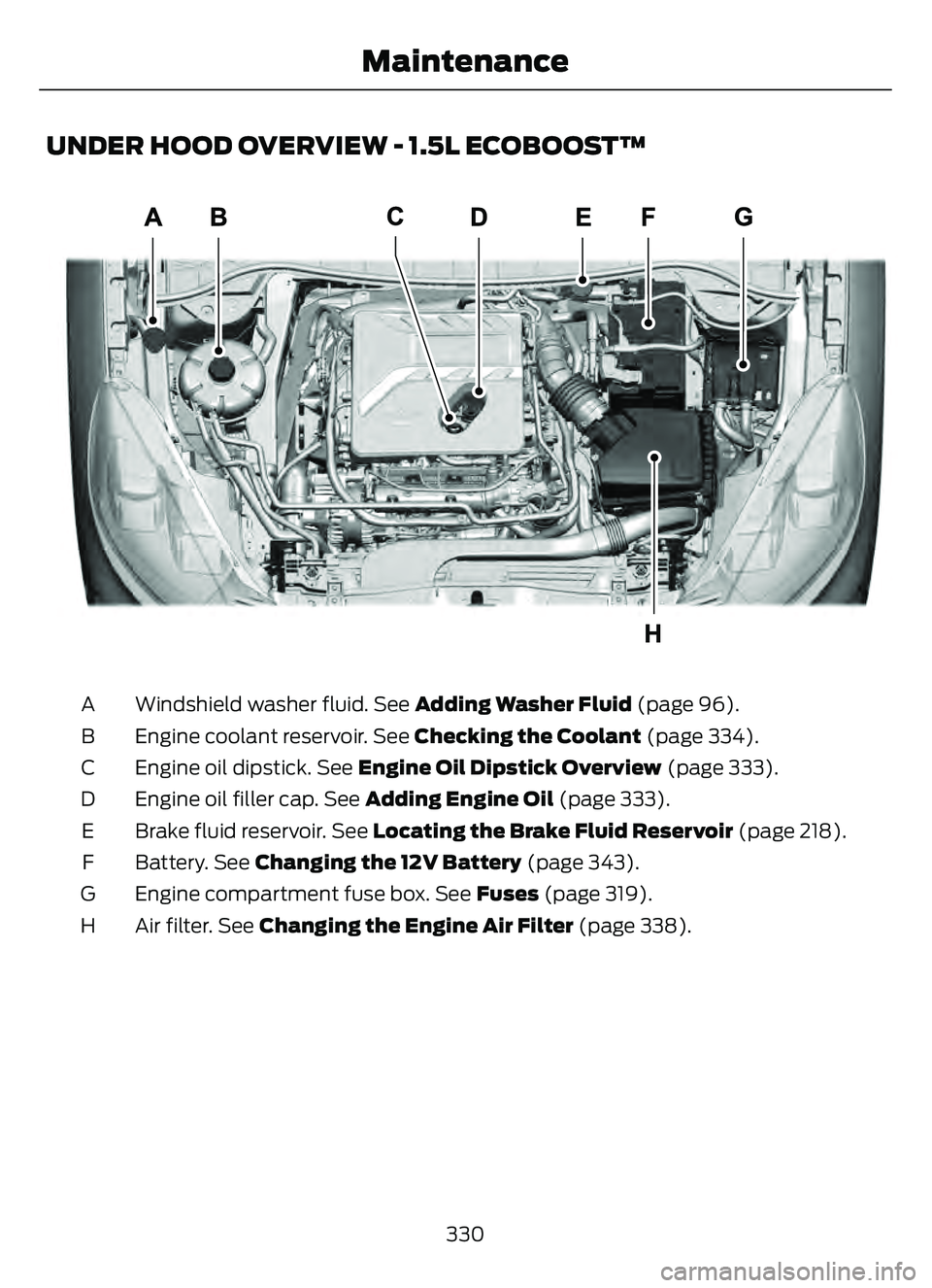
UNDER HOOD OVERVIEW - 1.5L ECOBOOST™
308 93E308193
Windshield washer fluid. See Adding Washer Fluid (page 96).
A
Engine coolant reservoir. See Checking the Coolant (page 334).
B
Engine oil dipstick. See Engine Oil Dipstick Overview (page 333).
C
Engine oil filler cap. See Adding Engine Oil (page 333).
D
Brake fluid reservoir. See Locating the Brake Fluid Reservoir (page 218).
E
Battery. See Changing the 12V Battery (page 343).
F
Engine compartment fuse box. See Fuses (page 319).
G
Air filter. See Changing the Engine Air Filter (page 338).
H
330
Maintenance
Page 334 of 585
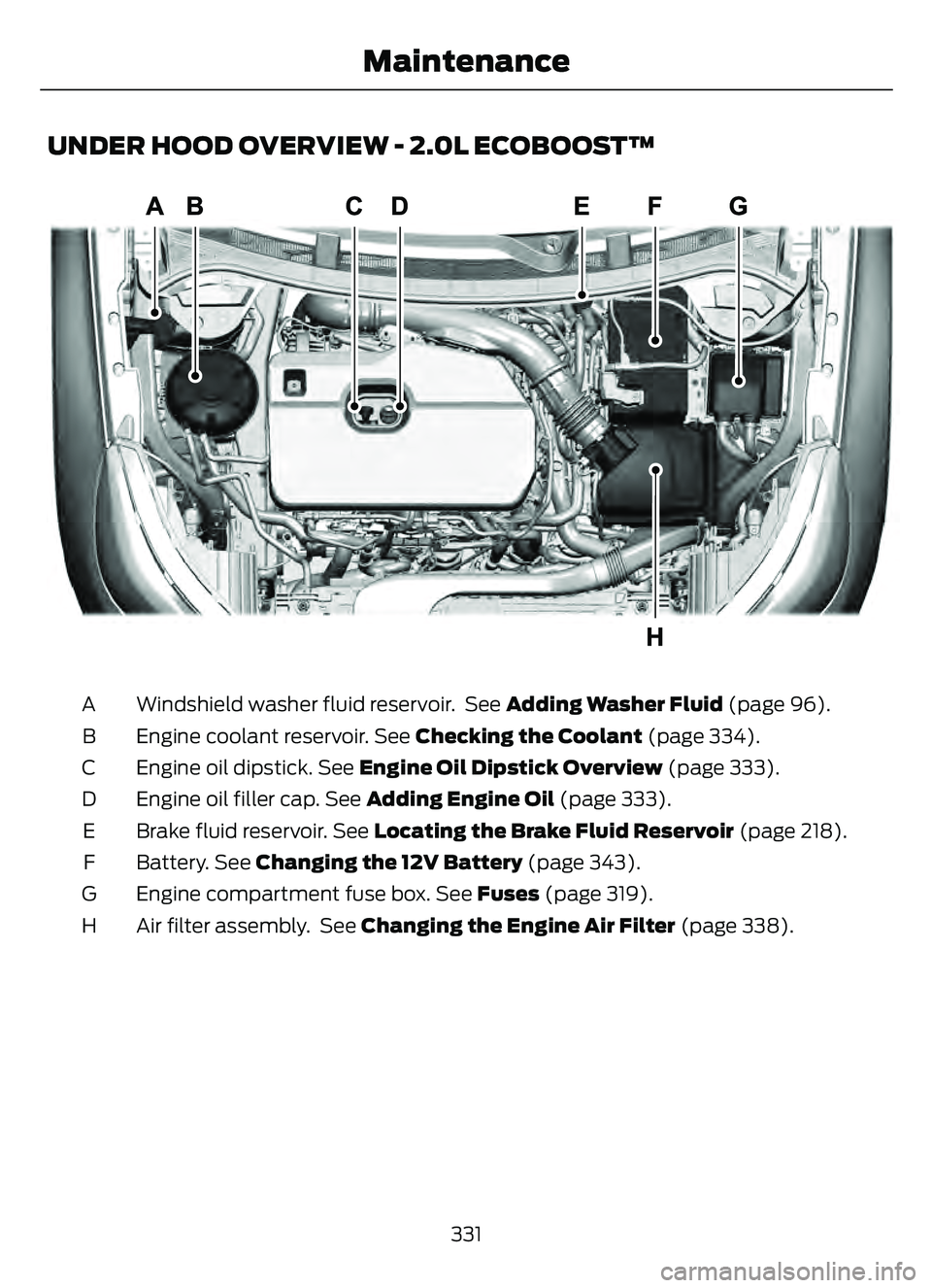
UNDER HOOD OVERVIEW - 2.0L ECOBOOST™
30 05E307705
Windshield washer fluid reservoir. See Adding Washer Fluid (page 96).
A
Engine coolant reservoir. See Checking the Coolant (page 334).
B
Engine oil dipstick. See Engine Oil Dipstick Overview (page 333).
C
Engine oil filler cap. See Adding Engine Oil (page 333).
D
Brake fluid reservoir. See Locating the Brake Fluid Reservoir (page 218).
E
Battery. See Changing the 12V Battery (page 343).
F
Engine compartment fuse box. See Fuses (page 319).
G
Air filter assembly. See Changing the Engine Air Filter (page 338).
H
331
Maintenance
Page 335 of 585
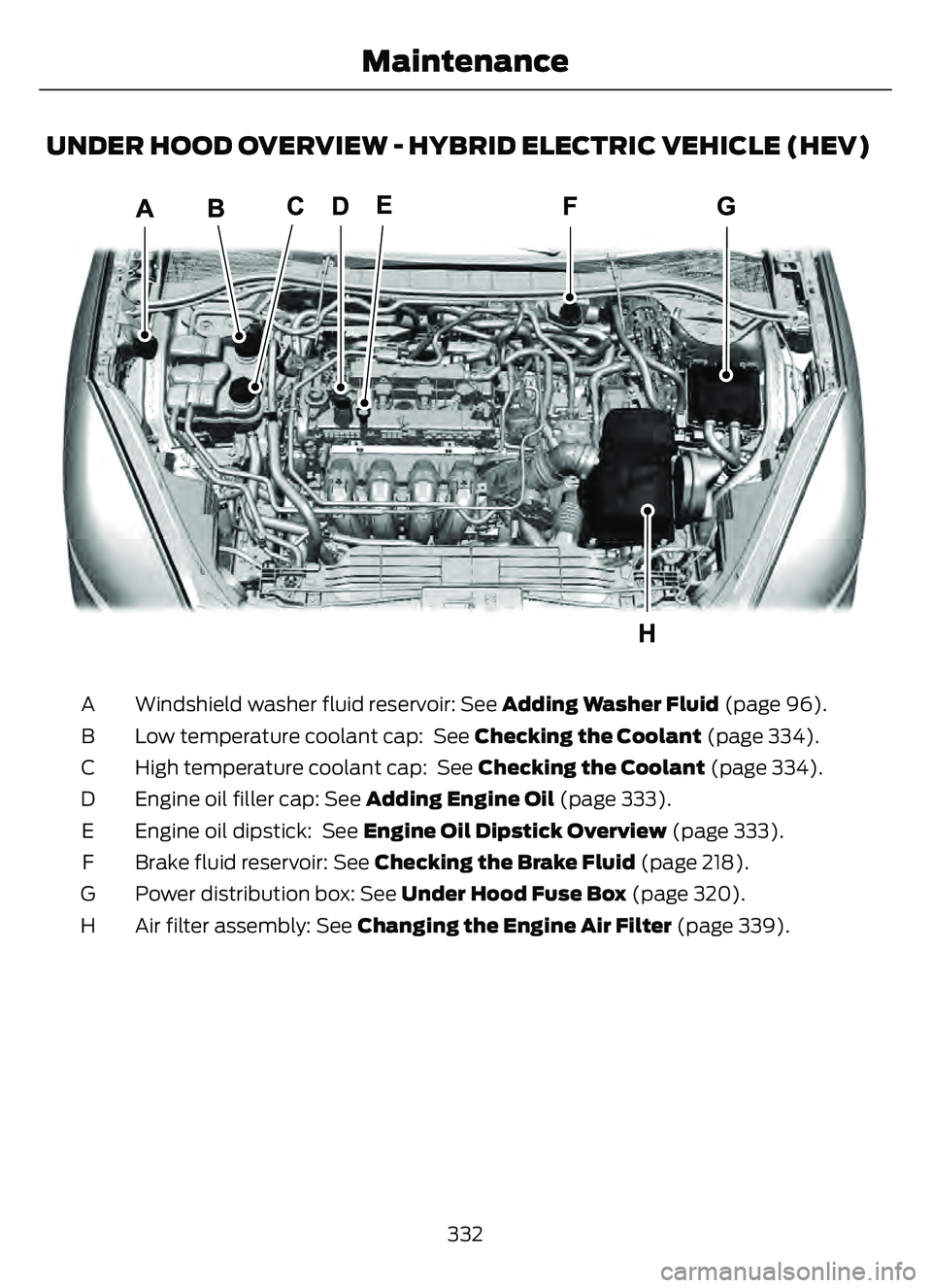
UNDER HOOD OVERVIEW - HYBRID ELECTRIC VEHICLE (HEV)
E337414E337414
Windshield washer fluid reservoir: See Adding Washer Fluid (page 96).
A
Low temperature coolant cap: See Checking the Coolant (page 334).
B
High temperature coolant cap: See Checking the Coolant (page 334).
C
Engine oil filler cap: See Adding Engine Oil (page 333).
D
Engine oil dipstick: See Engine Oil Dipstick Overview (page 333).
E
Brake fluid reservoir: See Checking the Brake Fluid (page 218).
F
Power distribution box: See Under Hood Fuse Box (page 320).
G
Air filter assembly: See Changing the Engine Air Filter (page 339).
H
332
Maintenance
Page 339 of 585
Water alone, without engine coolant, can
cause engine damage from corrosion,
overheating or freezing.
Do not use the following as a coolant
substitute, as they can cause engine
damage from overheating or freezing:
• Alcohol.
• Methanol.
• Brine.
• Any coolant mixed with alcohol ormethanol antifreeze.
Do not add extra inhibitors or additives to
the coolant. These can be harmful and
compromise the corrosion protection of
the coolant.
Severe Climates
If you drive in extremely cold climates, you
may need to increase the coolant
concentration above 50%.
Note: A coolant concentration of 60%
provides improved freeze point protection.
Coolant concentrations above 60%
decrease the overheat protection
characteristics of the coolant and could
cause engine damage.
If you drive in extremely hot climates, you
may need to decrease the coolant
concentration to 40%.
Note: A coolant concentration of 40%
provides improved overheat protection.
Coolant concentrations below 40%
decrease the overheat and corrosion
protection characteristics of the coolant and
could cause engine damage.
Coolant Change
WARNING: Do not dispose of
coolant in the household refuse or the
public sewage system. Use an authorized
waste disposal facility. Change the coolant at specific mileage
intervals. Refer to the scheduled
maintenance information. See Normal
Scheduled Maintenance (page 485).
Note:
Dispose of used coolant in the
appropriate manner.
Follow your community's regulations and
standards for recycling and disposing of
automotive fluids.
Fail-Safe Cooling
Fail-safe cooling allows you to temporarily
drive your vehicle before any incremental
component damage occurs. The fail-safe
distance depends on ambient
temperature, vehicle load and terrain.
How Fail-Safe Cooling Works
If the engine begins to overheat,
the coolant temperature gauge
moves toward the red zone:
A warning lamp illuminates and
a message may appear in the
information display.
If the engine reaches a preset
over-temperature condition, the engine
automatically switches to alternating
cylinder operation. Each disabled cylinder
acts as an air pump and cools the engine.
When this occurs, your vehicle still
operates, however:
• Engine power is limited.
• The air conditioning system turns off.
Continued operation increases the engine
temperature, causing the engine to
completely shut down. Your steering and
braking effort increases in this situation.
When the engine temperature cools, you
can re-start the engine. Have your vehicle
checked as soon as possible to minimize
engine damage.
336
Maintenance
Page 549 of 585
NOTICE OF USE
CONTRACTOR (MANUFACTURER/SUPPLIER) NAME: HERE
CONTRACTOR (MANUFACTURER/
SUPPLIER) ADDRESS: c/o Nokia, 425
West Randolph Street, Chicago, Illinois 60606
This Data is a commercial item as
defined in FAR 2.101 and is subject to
these End-User Terms under which this Data was provided.
© 1987 – 2014 HERE – All rights reserved.
If the Contracting Officer, federal
government agency, or any federal official
refuses to use the legend provided herein,
the Contracting Officer, federal
government agency, or any federal official
must notify HERE prior to seeking
additional or alternative rights in the Data. I. US/Canada Territory A. United States Data. The End-User
Terms for any Application containing
Data for the United States shall contain
the following notices: “HERE holds a non-exclusive license
from the United States Postal
Service® to publish and sell ZIP+4®
information.”
“©United States Postal Service®
20XX. Prices are not established,
controlled or approved by the United
States Postal Service®. The following
trademarks and registrations are
owned by the USPS: United States
Postal Service, USPS, and ZIP+4.” B. Canada Data. The following provi-
sions apply to the Data for Canada,
which may include or reflect data from
third party licensors (“Third Party
Data”), including Her Majesty the Queen
in Right of Canada (“Her Majesty”),
Canada Post Corporation (“Canada
Post”) and the Department of Natural
Resources of Canada (“NRCan”):
1. Disclaimer and Limitation: Client
agrees that its use of the Third Party
Data is subject to the following provi-
sions: a. Disclaimer: The Third Party Data
is licensed on an “as is” basis. The
licensors of such data, including Her
Majesty, Canada Post and NRCan,
make no guarantees, representa-
tions or warranties respecting such
data, either express or implied,
arising by law or otherwise, including
but not limited to, effectiveness,
completeness, accuracy or fitness
for a particular purpose.
b. Limitation on Liability: The Third
Party Data licensors, including Her
Majesty, Canada Post and NRCan,
shall not be liable: (i) in respect of
any claim, demand or action, irre-
spective of the nature of the cause
of the claim, demand or action
alleging any loss, injury or damages,
direct or indirect, which may result
from the use or possession of such
Data; or (ii) in any way for loss of
revenues or contracts, or any other
consequential loss of any kind
resulting from any defect in the
Data.
546
Customer Information
Page 568 of 585
Automatic High Beam ControlLimitations........................................................101
Automatic High Beam Control Precautions.......................................................101
Automatic High Beam Control Requirements..................................................101
How Does Automatic High Beam Control Work...................................................................100
Overriding Automatic High Beam Control............................................................... 102
Switching Automatic High Beam Control On and Off........................................................101
Automatic High Beam Control –Trouble shooting.........................................102
Automatic High Beam Control –
Information Messages.................................102
Automatic Locking Mode.............................41Disengaging Automatic Locking Mode.........41
Engaging Automatic Locking Mode...............41
What Is Automatic Locking Mode..................41
Automatic Return to Park (P)...................211Automatic Return to Park (P)Limitations........................................................212
How Does Automatic Return to Park (P) Work....................................................................212
What Is Automatic Return to Park (P).........211
Automatic Transmission Audible Warnings.......................................................214
Automatic Transmission..........................209
Automatic Return to Park (P).........................211
Automatic Transmission Positions............209
Automatic Transmission –
Troubleshooting .............................................214
Grade Assist - Hybrid Electric Vehicle (HEV)..................................................................212
Manual Park Release - Gasoline...................212
Temporary Neutral Mode..................................211
Automatic Transmission Position Indicator s...................................................... 210
Automatic Transmission Positions......................................................209
Drive (D).................................................................210
Low (L).................................................................\
..210
Neutral (N)............................................................210
Park (P)...............................................................\
..209
Reverse (R)..........................................................209
Automatic TransmissionPrecautions................................................209 Automatic Transmission –
Troubleshooting .........................................214
Automatic Transmission – Information
Messages..........................................................214
Auto-Start-Stop...........................................184Auto-Start-Stop – Troubleshooting...........185Auto-Start-Stop Indicators......................184
Auto-Start-Stop Precautions..................184
Auto-Start-Stop –Troubleshooting.........................................185
Auto-Start-Stop – Frequently Asked
Questions.........................................................186
Auto-Start-Stop – Information Messages..........................................................185
Autounlock.......................................................70Autounlock Requirements................................70
Switching Autounlock On and Off.................70
What Is Autounlock.............................................70
Autowipers........................................................92Adjusting the Sensitivity of the RainSensor.................................................................93
Autowipers Settings............................................92
What Are Autowipers.........................................92
AW DSee: All-Wheel Drive.........................................216
B
BatterySee: Changing the 12V Battery.....................343Blind Spot Information System.............268Blind Spot Information System – Troubleshooti ng............................................270
Blind Spot Information System
Indicator s.....................................................269
Blind Spot Information System Limitations..................................................268
Blind Spot Information System Precautions................................................268
Blind Spot Information System Requirements............................................268
Blind Spot Information System – Troubleshooting ........................................270
Blind Spot Information System –
Information Messages................................270
Body Control Module Fuse Box..............325Accessing the Body Control Module FuseBox......................................................................325
565
Index