towing FORD ESCAPE 2022 Owners Manual
[x] Cancel search | Manufacturer: FORD, Model Year: 2022, Model line: ESCAPE, Model: FORD ESCAPE 2022Pages: 585, PDF Size: 6.15 MB
Page 13 of 585
Driver Alert
What Is Driver Alert ....................................282
How Does Driver Alert Work ...................282
Driver Alert Precautions ...........................282
Driver Alert Limitations .............................282
Switching Driver Alert On and Off ........282
Driver Alert Indicators ...............................283
Driver Alert – Troubleshooting ..............283
Speed Sign Recognition
What Is Speed Sign Recognition ..........284
How Does Speed Sign Recognition Work........................................................................\
284
Speed Sign Recognition Precautions ........................................................................\
284
Speed Sign Recognition Limitations ........................................................................\
284
Speed Sign Recognition Indicators ......284
Setting the Speed Sign Recognition Speed Warning ........................................285
Setting the Speed Sign Recognition Speed Tolerance .....................................285
Speed Sign Recognition – Troubleshooting ......................................285
Load Carrying
Load Carrying Precautions ......................287
Locating the Safety ComplianceCertification Labels ...............................288
What Is the Gross Axle Weight Rating ........................................................................\
288
What Is the Gross Vehicle Weight Rating ........................................................................\
288
What Is the Gross Combined Weight Rating .........................................................288
Calculating Payload ..................................290
Calculating the Load Limit .....................290
Roof Rack ......................................................292
Luggage Compartment
Installing and Removing the Luggage Compartment Cover.............................294
Connecting a Trailer
Connecting a Trailer Precautions .........296
Connecting a Trailer ..................................296
Towing a Trailer
Towing a Trailer Precautions ..................298
Trailer Brake Precautions ........................298
Towing a Trailer Limitations ...................299
Loading Your Trailer ...................................299
Trailer Towing Hints ...................................299
Launching or Retrieving a Boat or
Personal Watercraft .............................300
Towing Weights and Dimensions ..........301
Trailer Sway Control
How Does Trailer Sway Control Work ........................................................................\
303
Trailer Sway Control Precautions .........303
Switching Trailer Sway Control On and Off ................................................................303
Driving Hints
Cold Weather Precautions ......................304
Breaking-In ...................................................304
Driving Economically ................................304
Driving in Special Conditions .................304
Driving Through Shallow Water ............306
Floor Mats .....................................................306
Crash and BreakdownInformation
Roadside Assistance ................................308
High Voltage Battery Vehicle Precautions- Hybrid Electric Vehicle (HEV) ........309
Switching the Hazard Flashers On and Off .................................................................310
Jump Starting the Vehicle ........................310
Post-Crash Alert System ..........................313
Automatic Crash Shutoff .........................314
Transporting the Vehicle ...........................314
10
Table of Contents
Page 14 of 585
Towing Your Vehicle
Towing Your Vehicle Precautions ..........316
Recreationally Towing Your Vehicle -Gasoline, AWD ..........................................316
Recreationally Towing Your Vehicle - Gasoline, FWD ..........................................316
Recreationally Towing Your Vehicle - Hybrid Electric Vehicle (HEV)/Plug-In
Hybrid Electric Vehicle (PHEV) ..........316
Emergency Towing - Hybrid Electric Vehicle (HEV)/Plug-In Hybrid Electric
Vehicle (PHEV) .........................................317
Emergency Towing - 8-Speed Automatic Transmission – 8F24 ..............................317
Emergency Towing - 8-Speed Automatic Transmission – 8F35 .............................318
Towing Your Vehicle – Troubleshooting ........................................................................\
.318
Fuses
Fuse Precautions .........................................319
Under Hood Fuse Box ................................319
Body Control Module Fuse Box .............325
Identifying Fuse Types ..............................327
Fuses – Troubleshooting ..........................327
Maintenance
Maintenance Precautions .......................328
Opening and Closing the Hood .............328
Under Hood Overview - 1.5L EcoBoost™........................................................................\
330
Under Hood Overview - 2.0L EcoBoost™ ........................................................................\
.3 3 1
Under Hood Overview - Hybrid Electric Vehicle (HEV) ...........................................332
Engine Oil .......................................................333
Checking the Coolant ...............................334
Changing the Engine Air Filter - 1.5L EcoBoost™/2.0L EcoBoost™ ..........338
Changing the Engine Air Filter - 2.5L, Hybrid Electric Vehicle (HEV)/Plug-In
Hybrid Electric Vehicle (PHEV) .........339 Changing the Fuel Filter - Gasoline,
Hybrid Electric Vehicle (HEV) ...........340
Drive Belt Routing Overview - 1.5L EcoBoost™ ..............................................340
Drive Belt Routing Overview - 2.0L EcoBoost™ ................................................341
12V Battery .....................................................341
Changing the 12V Battery ........................343
Adjusting the Headlamps .......................344
Exterior Bulbs ...............................................345
Interior Bulbs ................................................348
Vehicle Care
Cleaning Products ......................................349
Cleaning the Exterior .................................349
Cleaning the Interior ...................................351
Repairing Minor Paint Damage ..............353
Waxing Your Vehicle ..................................353
Body Styling Kits
Body Styling Kit Precautions ..................354
Storing Your Vehicle
Preparing Your Vehicle for Storage ......355
Removing Your Vehicle From Storage ........................................................................\
356
Wheel and Tire Information
Locating the Tire label ..............................357
Department of Transportation UniformTire Quality Grades ................................357
Information on the Tire Sidewall ..........358
Glossary of Tire Terminology .................363
Tire Replacement Requirements .........364
Using Snow Chains ....................................366
Tire Care
Checking the Tire Pressures ...................368
Inflating the Tires .......................................368
Inspecting the Tire for Wear ...................369
11
Table of Contents
Page 173 of 585
CUP HOLDERS
CUP HOLDER PRECAUTIONS
WARNING: Use caution when
stowing items or hot drinks in the cup
holders. Items could become loose or
spill during hard braking, acceleration or
crashes. Failure to follow this instruction
could result in personal injury.
GLASSES HOLDER
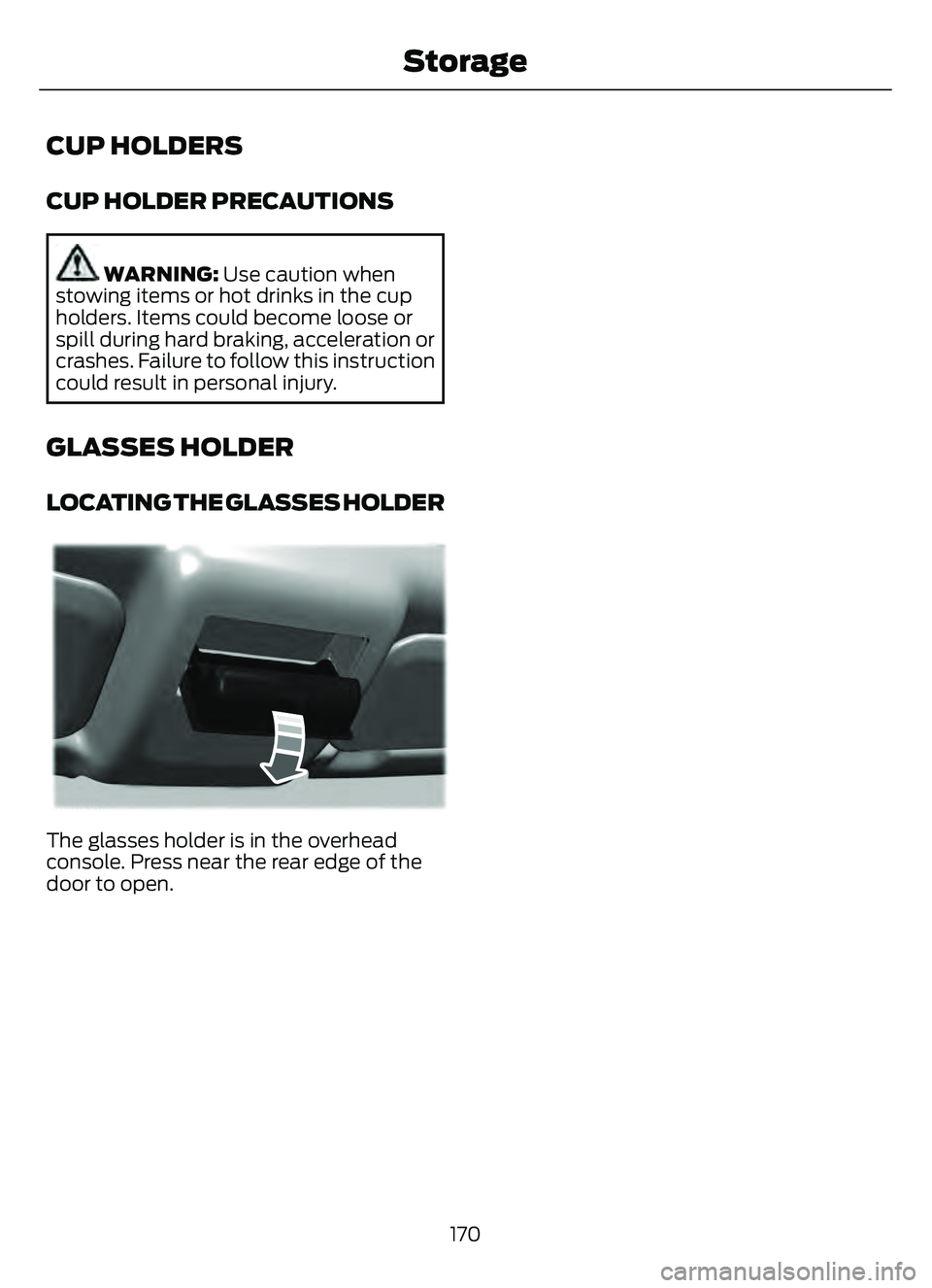
LOCATING THE GLASSES HOLDER
E361535E361E361E361E361E361361361E361E361E3E361E361E3535535535535535535355355335535
The glasses holder is in the overhead
console. Press near the rear edge of the
door to open.
170
Storage
Page 182 of 585
WHAT IS A HYBRID ELECTRIC
VEHICLE
A hybrid vehicle has an electric motor and
a high voltage battery combined with a
gasoline engine.
HOW DOES A HYBRID
ELECTRIC VEHICLE WORK
The hybrid vehicle combines electric and
gasoline propulsion to provide optimal
performance and improved efficiency.
HYBRID ELECTRIC VEHICLE
DRIVING CHARACTERISTICS
The gasoline engine starts and stops to
provide power when required and to save
fuel when not needed. When coasting at
low speeds, coming to a stop or standing,
the gas engine normally shuts down and
your vehicle operates in electric-only
mode.
Conditions that may cause the gasoline
engine to start or remain running include:
• Considerable vehicle acceleration.
• Driving uphill.
• The high voltage battery charge levelis low.
• Heating or cooling the vehicle interior in high or low outside temperatures.
• The gasoline engine is below normal operating temperature.
• Towing a trailer.
• Certain selectable drive modes could cause the engine to run. See Selecting
a Drive Mode (page 257). Your hybrid vehicle also comes with
standard hydraulic braking and
regenerative braking. Regenerative braking
is performed by your transmission and
captures brake energy and stores it in the
high voltage battery.
You could also notice that your engine
continues to run instead of shutting off
during extended downhill driving. The
engine stays on during this engine braking
but is not using any fuel.
You could also hear a slight whine or
whistle when operating your vehicle. This
is the normal operation of the electric
motor in the hybrid system.
HYBRID ELECTRIC VEHICLE
INDICATORS
E293827
When you start your vehicle, a
green READY indicator light
appears in the instrument cluster
letting you know that your vehicle is ready
for driving.
The engine may not start because your
vehicle has a silent key start feature. This
fuel saving feature allows your vehicle to
be ready to drive without requiring the gas
engine to be running.
The indicator remains on when your vehicle
is on, whether the engine is running or not,
to indicate your vehicle is capable of
movement using the electric motor, gas
engine or both.
Typically, the engine does not start unless
the vehicle is cold, a climate control
change is requested or you press the
accelerator pedal.
179
Hybrid Electric Vehicle Information (If Equipped)
Page 184 of 585
PLUG-IN HYBRID ELECTRIC
VEHICLE INFORMATION
WHAT IS A PLUG-IN HYBRID
ELECTRIC VEHICLE
A plug-in hybrid electric vehicle combines
a gasoline engine with an electric motor
and rechargeable high voltage battery
allowing you to use only electricity to
power your vehicle.
HOW DOES A PLUG-IN HYBRID
ELECTRIC VEHICLE WORK
Charging your vehicle adds electrical
energy that propels the vehicle. Regularly
plug in your vehicle to get optimal
electric-only range capability from the high
voltage battery. The system maximizes the
use of electric-only operation in normal
drive mode whenever possible. System
conditions could require the engine to
operate when necessary.
When the electric-only range reaches zero,
the powertrain system switches to hybrid
operation. This means that you have
depleted the energy you gained from
plugging in and charging your vehicle. Both
the gasoline engine and electric motor
power your vehicle and maximize fuel
economy during hybrid operation. You
receive some electric-only driving with
hybrid operation as the powertrain system
maintains the high voltage battery charge
within functional limits.
PLUG-IN HYBRID ELECTRIC
VEHICLE DRIVING
CHARACTERISTICS
The gasoline engine starts and stops to
provide power when required and to save
fuel when not needed. Restarting your
vehicle is not required. Simply step on the
accelerator when you are ready to drive.
When coasting at low speeds, coming to
a stop or standing, the gas engine normally
shuts down and your vehicle operates in
electric-only mode.
Conditions that may cause the gasoline
engine to start or remain running include:
• Considerable vehicle acceleration.
• Driving uphill.
• The high voltage battery charge levelis low.
• Heating or cooling the vehicle interior in high or low outside temperatures.
• The gasoline engine is below normal operating temperature.
• Towing a trailer.
• Certain drive modes could cause the engine to run. See Drive Mode
Control (page 257).
Note: Having your engine running is not
always an indication of inefficiency. In some
cases, it is actually more efficient than
driving in electric mode.
Your plug-in hybrid electric vehicle has
several EV drive modes to enhance your
driving experience. See Selecting a
Plug-In Hybrid Electric Vehicle Drive
Mode (page 259).
Your hybrid vehicle also comes with
standard hydraulic braking and
regenerative braking. Regenerative braking
is performed by your transmission and
captures brake energy and stores it in the
high voltage battery.
181
Hybrid Electric Vehicle Information (If Equipped)
Page 191 of 585
FUEL QUALITY
SELECTING THE CORRECT FUEL
Choosing the Right Fuel
E161513E161513
Your vehicle operates on regular unleaded
gasoline with a minimum pump (R+M)/2
octane rating of 87.
Some fuel stations, particularly those in
high altitude areas, offer fuels posted as
regular unleaded gasoline with an octane
rating below 87. The use of these fuels
could result in engine damage that will not
be covered by the vehicle warranty.
For best overall vehicle and engine
performance, premium fuel with an octane
rating of 91 or higher is recommended. The
performance gained by using premium fuel
is most noticeable in hot weather as well
as other conditions, for example when
towing a trailer.
Do not be concerned if the engine
sometimes knocks lightly. However, if the
engine knocks heavily while using fuel with
the recommended octane rating, contact
an authorized dealer to prevent any engine
damage.
We recommend Top Tier detergent
gasolines, where available to help minimize
engine deposits and maintain optimal
vehicle and engine performance. For
additional information, refer to
www.toptiergas.com. Note:
Use of any fuel for which the vehicle
was not designed can impair the emission
control system, cause loss of vehicle
performance, and cause damage to the
engine which may not be covered by the
vehicle Warranty.
Do not use:
• Diesel fuel.
• Fuels containing kerosene or paraffin.
• Fuel containing more than 15% ethanol or E85 fuel.
• Fuels containing methanol.
• Fuels containing metallic-based additives, including manganese-based
compounds.
• Fuels containing the octane booster additive, methylcyclopentadienyl
manganese tricarbonyl (MMT).
• Leaded fuel, using leaded fuel is prohibited by law.
The use of fuels with metallic compounds
such as methylcyclopentadienyl
manganese tricarbonyl (commonly known
as MMT), which is a manganese-based
fuel additive, will impair engine
performance and affect the emission
control system.
Choosing the Right Fuel - Flex Fuel
Vehicles
Flex fuel vehicles have one of the following
identifiers:
• Yellow fuel filler cap.
• Yellow bezel around the fuel filler inlet.
• Yellow fuel filler housing.
• Yellow E85 label on the fuel tank filler door.
188
Fuel and Refueling
Page 192 of 585
E161513E161513
Your vehicle operates on regular unleaded
gasoline with a minimum pump (R+M)/2
octane rating of 87 or regular unleaded
gasoline blended with a maximum of 85%
ethanol (E85).
Some fuel stations, particularly those in
high altitude areas, offer fuels posted as
regular unleaded gasoline with an octane
rating below 87. The use of these fuels
could result in engine damage that will not
be covered by the vehicle warranty.
For best overall vehicle and engine
performance, premium fuel with an octane
rating of 91 or higher is recommended. The
performance gained by using premium fuel
is most noticeable in hot weather as well
as other conditions, for example when
towing a trailer.
Do not be concerned if the engine
sometimes knocks lightly. However, if the
engine knocks heavily while using fuel with
the recommended octane rating, contact
an authorized dealer to prevent any engine
damage.
We recommend Top Tier detergent
gasolines, where available to help minimize
engine deposits and maintain optimal
vehicle and engine performance. For
additional information, refer to
www.toptiergas.com.
Note: Use of any fuel for which the vehicle
was not designed can impair the emission
control system, cause loss of vehicle
performance, and cause damage to the
engine which may not be covered by the
vehicle Warranty. Do not use:
• Diesel fuel.
• Fuels containing kerosene or paraffin.
• Fuels containing more than 85%
ethanol or E100 fuel.
• Fuels containing methanol.
• Fuels containing metallic-based additives, including manganese-based
compounds.
• Fuels containing the octane booster additive, methylcyclopentadienyl
manganese tricarbonyl (MMT).
• Leaded fuel, using leaded fuel is prohibited by law.
The use of fuels with metallic compounds
such as methylcyclopentadienyl
manganese tricarbonyl (commonly known
as MMT), which is a manganese-based
fuel additive, will impair engine
performance and affect the emission
control system.
LOCATING THE FUEL FILLER
FUNNEL
The fuel filler funnel is under the luggage
compartment floor covering.
RUNNING OUT OF FUEL
FILLING A PORTABLE FUEL
CONTAINER
WARNING: Flow of fuel through a
fuel pump nozzle can produce static
electricity. This can cause a fire if you are
filling an ungrounded fuel container.
189
Fuel and Refueling
Page 216 of 585
WARNING: If the parking brake is
fully released, but the brake warning
lamp remains illuminated, the brakes
may not be working properly. Have your
vehicle checked as soon as possible.
WARNING: Do not drive your
vehicle until you verify that the
stoplamps are working.
USING MANUAL PARK RELEASE
Activating the Manual Park Release
Cable
1. Apply the parking brake. See What Is
the Electric Parking Brake (page 220).
Note: If the vehicle battery is dead, for
example, no electrical power is available,
you could use an external power source to
apply the parking brake.
E307867E307867
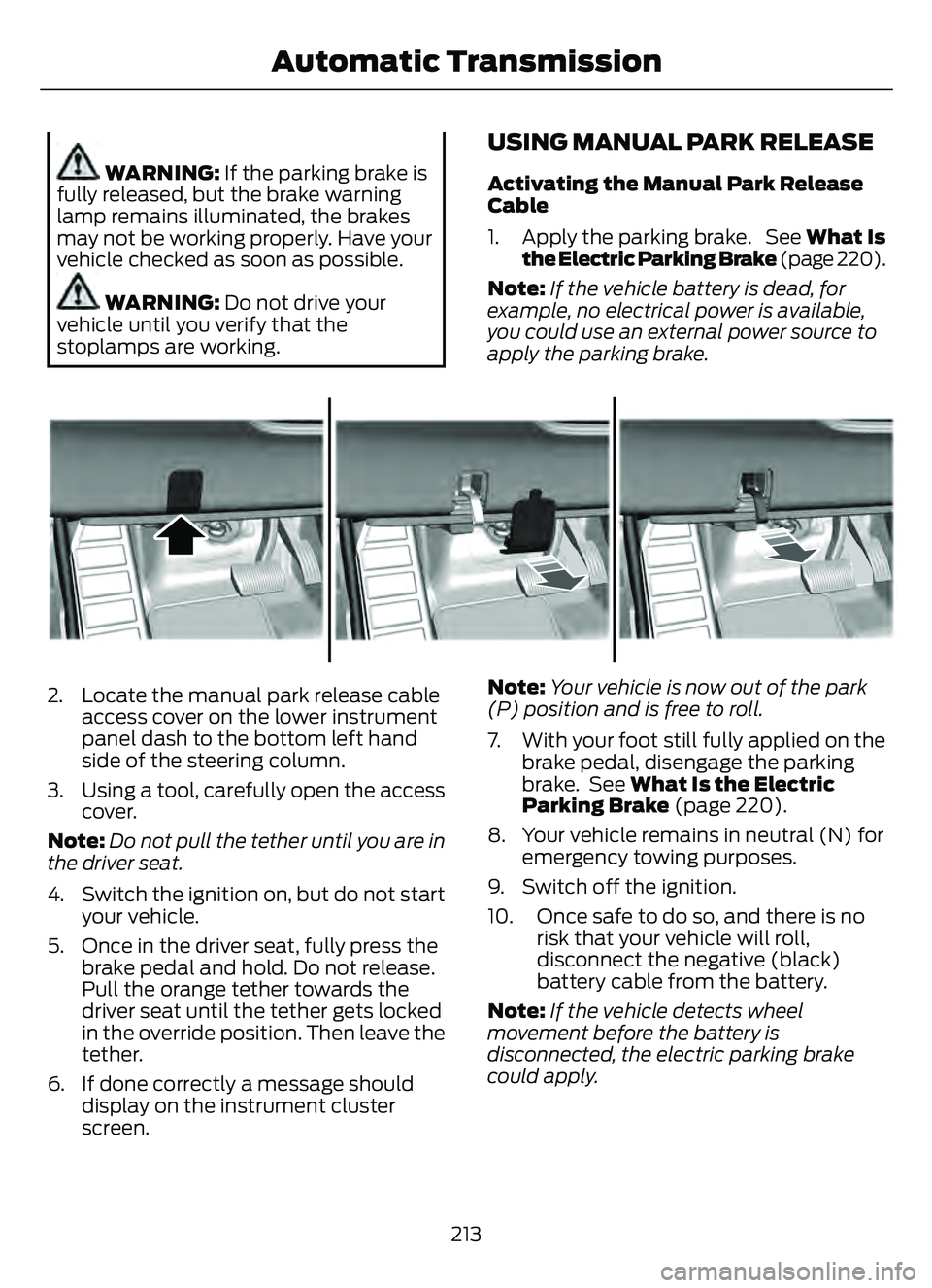
2. Locate the manual park release cable access cover on the lower instrument
panel dash to the bottom left hand
side of the steering column.
3. Using a tool, carefully open the access cover.
Note: Do not pull the tether until you are in
the driver seat.
4. Switch the ignition on, but do not start your vehicle.
5. Once in the driver seat, fully press the brake pedal and hold. Do not release.
Pull the orange tether towards the
driver seat until the tether gets locked
in the override position. Then leave the
tether.
6. If done correctly a message should display on the instrument cluster
screen. Note:
Your vehicle is now out of the park
(P) position and is free to roll.
7. With your foot still fully applied on the brake pedal, disengage the parking
brake. See What Is the Electric
Parking Brake (page 220).
8. Your vehicle remains in neutral (N) for emergency towing purposes.
9. Switch off the ignition.
10. Once safe to do so, and there is no risk that your vehicle will roll,
disconnect the negative (black)
battery cable from the battery.
Note: If the vehicle detects wheel
movement before the battery is
disconnected, the electric parking brake
could apply.
213
Automatic Transmission
Page 223 of 585
WHAT IS THE ELECTRIC
PARKING BRAKE
The electric parking brake is used to hold
your vehicle on slopes and flat roads.
APPLYING THE ELECTRIC
PARKING BRAKE
WARNING: Always fully apply the
parking brake and make sure you shift
into park (P). Failure to follow this
instruction could result in personal injury
or death.
WARNING: If you drive extended
distances with the parking brake applied,
you could cause damage to the brake
system.
WARNING: The electric parking
brake does not operate if the vehicle
battery has run out of charge.
E267156The electronic parking brake
switch is on the center console.
1. Pull the switch up.
The red warning lamp flashes during
operation and illuminates when the parking
brake is applied.
Note: You can apply the electric parking
brake when the power is off.
Note: The electric parking brake could
apply when you shift into park (P). See Park
(P) (page 209).
APPLYING THE ELECTRIC
PARKING BRAKE IN AN
EMERGENCY
You can use the electric parking brake to
slow or stop your vehicle in an emergency.
1. Pull the switch up and hold it.
The electric parking brake continues to
slow your vehicle down unless you release
the switch.
The red warning lamp illuminates, a tone
sounds and the stoplamps turn on when
you use the electric parking brake in an
emergency.
Note: Do not apply the electric parking
brake when your vehicle is moving, except
in an emergency. If you repeatedly use the
electric parking brake to slow or stop your
vehicle, you could cause damage to the
brake system.
MANUALLY RELEASING THE
ELECTRIC PARKING BRAKE
1. Switch the ignition on.
2. Press and hold the brake pedal.
3. Push the switch down.
The red warning lamp turns off.
Pulling Away on a Hill When Towing a
Trailer
1. Press and hold the brake pedal.
2. Pull the switch upward and hold it.
3. Shift into gear.
4. Press the accelerator pedal until engine has developed sufficient torque to
prevent your vehicle from rolling down
the hill.
5. Release the switch and pull away in a normal manner.
220
Electric Parking Brake
Page 238 of 585
WHAT IS THE REAR VIEW
CAMERA
The rear view camera provides a video
image of the area behind your vehicle when
the transmission is in reverse (R).
REAR VIEW CAMERA
PRECAUTIONS
WARNING: The rear view camera
system is a reverse aid supplement
device that still requires the driver to use
it in conjunction with the interior and
exterior mirrors for maximum coverage.
WARNING: Objects that are close
to either corner of the bumper or under
the bumper, might not be seen on the
screen due to the limited coverage of the
camera system.
WARNING: Reverse your vehicle
slowly. Failure to follow this instruction
could result in the loss of control of your
vehicle, personal injury or death.
WARNING: Use caution when the
rear cargo door is ajar. If the rear cargo
door is ajar, the camera will be out of
position and the video image could be
incorrect. All guide lines disappear when
the rear cargo door is ajar. Failure to
follow this instruction could result in
personal injury.
WARNING: Use caution when
turning camera features on or off when
the transmission is not in park (P). Make
sure your vehicle is not moving. Note:
When towing, the camera only sees
what you are towing. This might not provide
adequate coverage and you might not see
some objects. In some vehicles, the guide
lines may disappear when you connect the
trailer tow connector.
LOCATING THE REAR VIEW
CAMERA
The rear view camera is located on the
cargo door. It provides a video image of the
area behind your vehicle.
REAR VIEW CAMERA GUIDE
LINES
Note: Active guide lines and fixed guide
lines are only available when the
transmission is in reverse (R).
Note: The centerline is only available if the
active or fixed guide lines are on.
235
Rear View Camera