transmission fluid FORD ESCAPE 2022 Owners Manual
[x] Cancel search | Manufacturer: FORD, Model Year: 2022, Model line: ESCAPE, Model: FORD ESCAPE 2022Pages: 585, PDF Size: 6.15 MB
Page 10 of 585
Catalytic Converter
What Is the Catalytic Converter ............198
Catalytic Converter Precautions ...........198
Catalytic Converter – Troubleshooting........................................................................\
1 9 8
High Voltage Battery
What Is the High Voltage Battery ..........199
High Voltage Battery Precautions .........199
Charging Your Vehicle - Plug-In Hybrid Electric Vehicle
(PHEV)
What is AC Charging .................................200
Charging Your Vehicle Precautions ......200
Charging Equipment .................................200
Locating the Charge Port ........................203
Charge Port Indicators .............................204
AC Charging ..................................................205
Setting the Charging Schedule andPreferences ..............................................206
Charging Your Vehicle – Troubleshooting ........................................................................\
207
Automatic Transmission
Automatic Transmission Precautions.......................................................................2\
0 9
Automatic Transmission Positions ......209
Shifting Your Vehicle Into Gear ..............210
Automatic Transmission Position Indicators ....................................................210
Temporary Neutral Mode ...........................211
Automatic Return to Park (P) ..................211
Grade Assist - Hybrid Electric Vehicle (HEV) ...........................................................212
Manual Park Release - Gasoline ............212
Automatic Transmission Audible Warnings .....................................................214
Automatic Transmission – Troubleshooting .......................................214
All-Wheel Drive
How Does All-Wheel Drive Work ...........216
All-Wheel Drive Precautions ...................216
All-Wheel Drive Limitations ....................216
All-Wheel Drive – Troubleshooting ......216
Brakes
Brake Precautions ........................................217
Anti-Lock Braking System ........................217
Brake Over Accelerator ..............................217
Locating the Brake Fluid Reservoir ........218
Checking the Brake Fluid ..........................218
Brake Fluid Specification ..........................218
Brakes – Troubleshooting ........................219
Electric Parking Brake
What Is the Electric Parking Brake .......220
Applying the Electric Parking Brake ......220
Applying the Electric Parking Brake in anEmergency ................................................220
Manually Releasing the Electric Parking Brake ...........................................................220
Automatically Releasing the Electric Parking Brake .............................................221
Electric Parking Brake Audible Warning ........................................................................\
.2 2 1
Releasing the Electric Parking Brake if the Vehicle Battery Has Run Out of
Charge ..........................................................221
Electric Parking Brake – Troubleshooting ........................................................................\
.2 2 1
Hill Start Assist
What Is Hill Start Assist ............................223
How Does Hill Start Assist Work ...........223
Hill Start Assist Precautions ...................223
Hill Start Assist – Troubleshooting ......223
Auto Hold
How Does Auto Hold Work .....................224
Switching Auto Hold On and Off ..........224
7
Table of Contents
Page 221 of 585
stop. Move the transmission to park (P),
switch the engine off and apply the parking
brake. Inspect the accelerator pedal for
any interference. If none are found and the
condition persists, have your vehicle towed
to the nearest authorized dealer.
LOCATING THE BRAKE FLUID
RESERVOIR
See Under Hood Overview (page 330).
CHECKING THE BRAKE FLUID
WARNING: Do not use any fluid
other than the recommended brake fluid
as this will reduce brake efficiency. Use
of incorrect fluid could result in the loss
of vehicle control, serious personal injury
or death.
WARNING: Only use brake fluid
from a sealed container. Contamination
with dirt, water, petroleum products or
other materials may result in brake
system damage or failure. Failure to
adhere to this warning could result in the
loss of vehicle control, serious personal
injury or death.
WARNING: Do not allow the fluid
to touch your skin or eyes. If this
happens, rinse the affected areas
immediately with plenty of water and
contact your physician.
WARNING: The brake system
could be affected if the brake fluid level
is below the MIN mark or above the MAX
mark on the brake fluid reservoir.
E170684
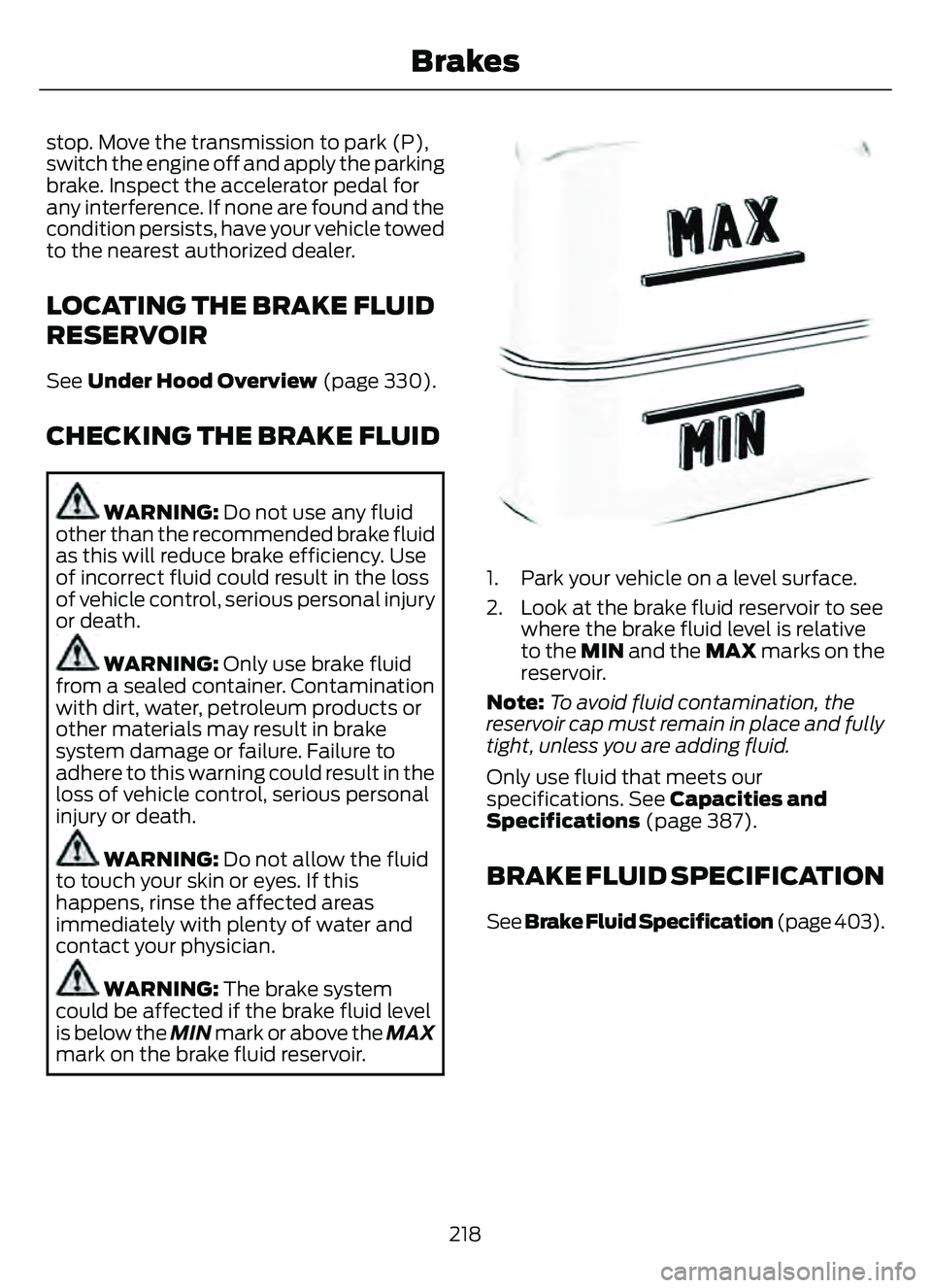
1. Park your vehicle on a level surface.
2. Look at the brake fluid reservoir to see where the brake fluid level is relative
to the MIN and the MAX marks on the
reservoir.
Note: To avoid fluid contamination, the
reservoir cap must remain in place and fully
tight, unless you are adding fluid.
Only use fluid that meets our
specifications. See Capacities and
Specifications (page 387).
BRAKE FLUID SPECIFICATION
See Brake Fluid Specification (page 403).
218
Brakes
Page 331 of 585
MAINTENANCE PRECAUTIONS
Service your vehicle regularly to help
maintain its roadworthiness and resale
value. There is a large network of
authorized dealers that are there to help
you with their professional servicing
expertise. We believe that their specially
trained technicians are best qualified to
service your vehicle properly and expertly.
They are supported by a wide range of
highly specialized tools developed
specifically for servicing your vehicle.
If your vehicle requires professional service,
an authorized dealer can provide the
necessary parts and service. Check your
warranty information to find out which
parts and services are covered.
Use only recommended fuels, lubricants,
fluids and service parts conforming to
specifications.
• Do not work on a hot engine.
• Make sure that nothing gets caught inmoving parts.
• Do not work on a vehicle with the engine running in an enclosed space,
unless you are sure you have enough
ventilation.
• Keep all open flames and other burning material, such as cigarettes, away from
the battery and all fuel related parts.
• Set the parking brake, shift the transmission to park (P) and block the
wheels.
OPENING AND CLOSING THE
HOOD
Opening the Hood
E263274
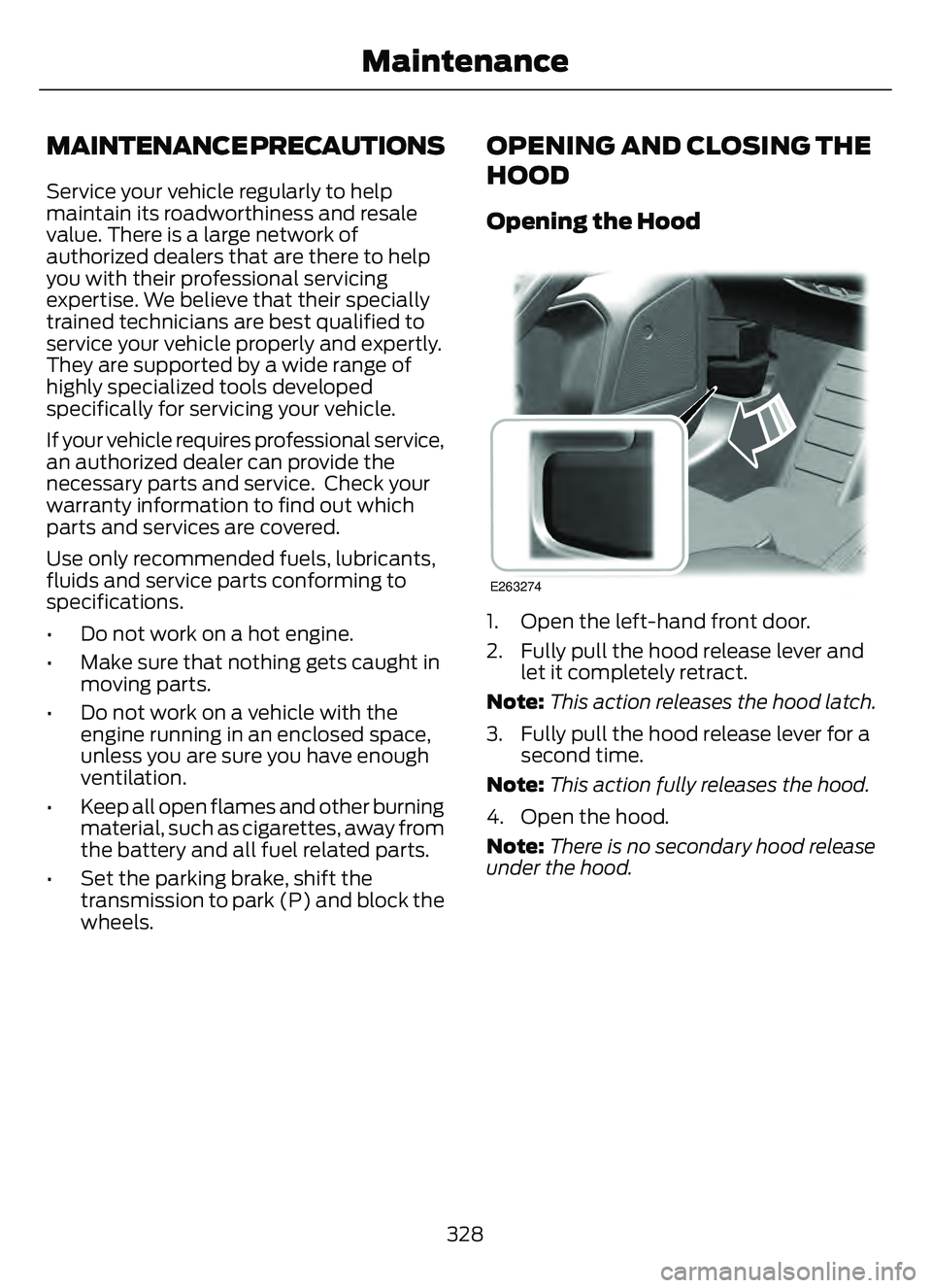
1. Open the left-hand front door.
2. Fully pull the hood release lever andlet it completely retract.
Note: This action releases the hood latch.
3. Fully pull the hood release lever for a second time.
Note: This action fully releases the hood.
4. Open the hood.
Note: There is no secondary hood release
under the hood.
328
Maintenance
Page 487 of 585
Check Every Six Months
The door weatherstrips for wear. Lubricate if necessary.
The hinges, latches and outside locks for proper operation. Lubricate if necessary. The parking brake for proper operation.
The seatbelts and seat latches for wear and function.
Safety warning lamps, brake, ABS, airbag and seatbelt for operation.
The washer spray and wiper operation. Clean or replace blades as necessary.
Multi-Point Inspection
It is important to have the systems on your
vehicle regularly checked. This can help
identify potential issues and prevent major
problems. We recommend having the
following multi-point inspection performed
at every scheduled maintenance interval
to help make sure your vehicle keeps
running great.
Multi-Point Inspection
Hazard warning system operation
Accessory drive belt or belts
Horn operation
Battery performance
Radiator, cooler, heater and air conditioninghoses
Engine air filter
Suspension components for leaks ordamage
Exhaust system
Steering and linkage
Exterior lamps operation
Tires including the spare for wear andproper pressure
2Fluid levels1; fill if necessary
Windshield for cracks, chips or pits
For oil and fluid leaks
Washer spray and wiper operation
Half-shaft dust boots
1 Brake, coolant re covery reservoir, automatic transmission and window washer.2If your vehicle has a temporary mobility kit, check the tire sealant expiration Use By date
on the canister. Replace as needed.
484
Scheduled Maintenance
Page 489 of 585
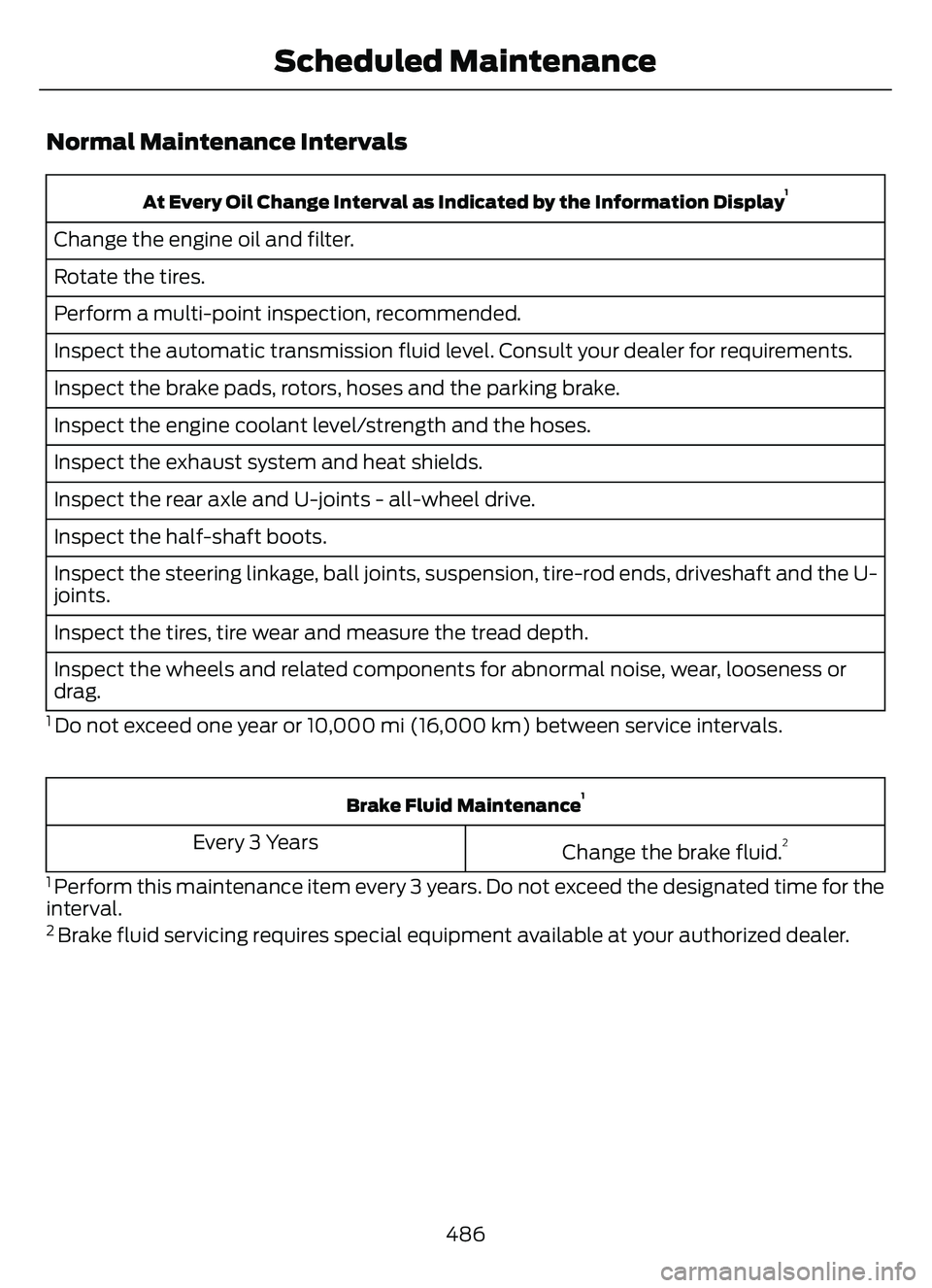
Normal Maintenance Intervals
At Every Oil Change Interval as Indicated by the Information Display1
Change the engine oil and filter.
Rotate the tires.
Perform a multi-point inspection, recommended.
Inspect the automatic transmission fluid level. Consult your dealer for requirements.
Inspect the brake pads, rotors, hoses and the parking brake.
Inspect the engine coolant level/strength and the hoses.
Inspect the exhaust system and heat shields.
Inspect the rear axle and U-joints - all-wheel drive.
Inspect the half-shaft boots.
Inspect the steering linkage, ball joints, suspension, tire-rod ends, driveshaft and the U-
joints.
Inspect the tires, tire wear and measure the tread depth.
Inspect the wheels and related components for abnormal noise, wear, looseness or
drag.
1 Do not exceed one year or 10,000 mi (16,000 km) between service intervals.
Brake Fluid Maintenance1
Change the brake fluid.2Every 3 Years
1 Perform this maintenance item every 3 years. Do not exceed the designated time for the
interval.
2 Brake fluid servicing requires special equipment available at your authorized dealer.
486
Scheduled Maintenance
Page 490 of 585
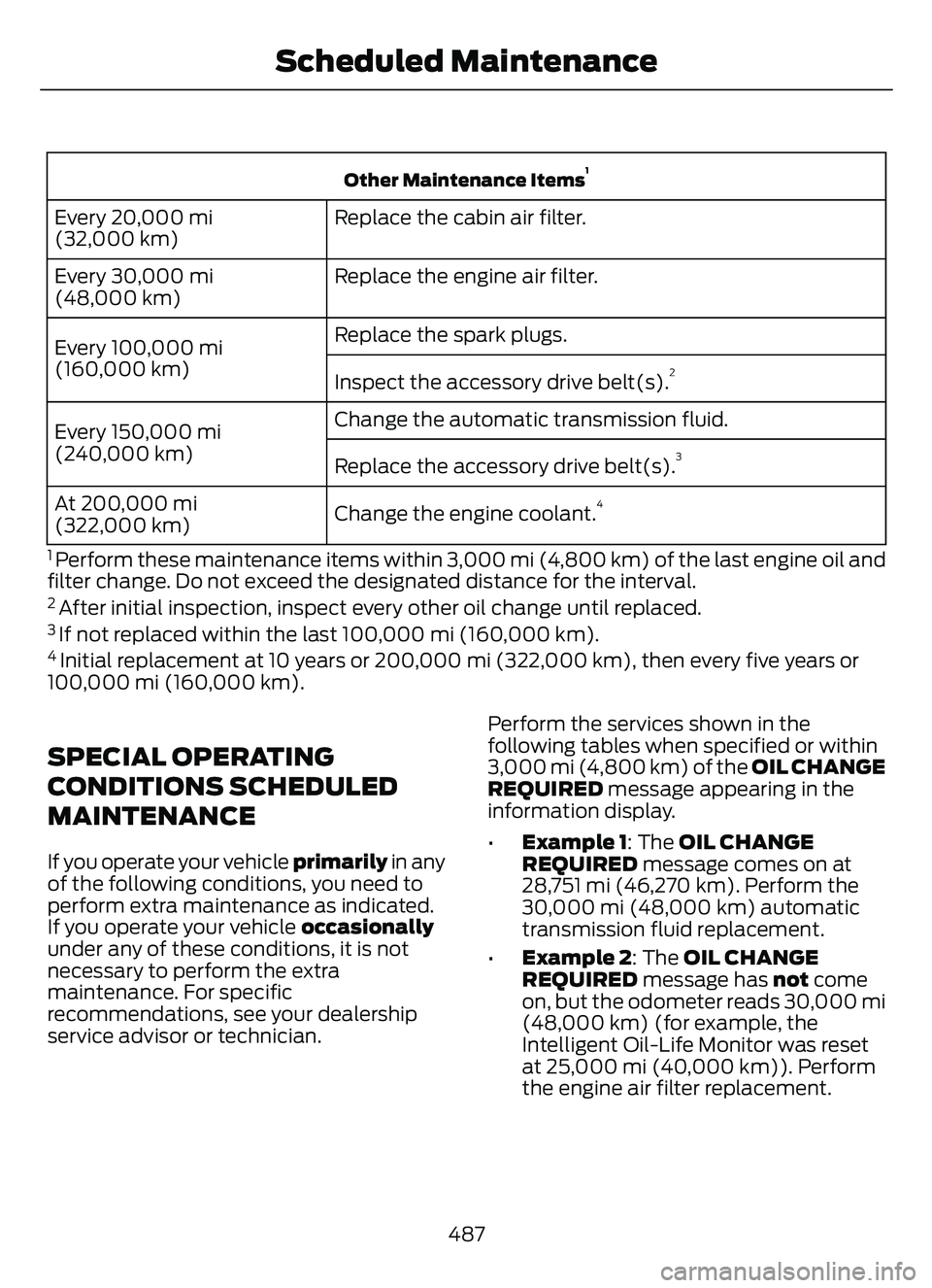
Other Maintenance Items1
Replace the cabin air filter.
Every 20,000 mi
(32,000 km)
Replace the engine air filter.
Every 30,000 mi
(48,000 km)
Replace the spark plugs.
Every 100,000 mi
(160,000 km) Inspect the accessory drive belt(s).
2
Change the automatic transmission fluid.
Every 150,000 mi
(240,000 km) Replace the accessory drive belt(s).
3
Change the engine coolant.4At 200,000 mi
(322,000 km)
1 Perform these maintenance items within 3,000 mi (4,800 km) of the last engine oil and
filter change. Do not exceed the designated distance for the interval.
2 After initial inspection, inspect every other oil change until replaced.3 If not replaced within the last 100,000 mi (160,000 km).4 Initial replacement at 10 years or 200,000 mi (322,000 km), then every five years or
100,000 mi (160,000 km).
SPECIAL OPERATING
CONDITIONS SCHEDULED
MAINTENANCE
If you operate your vehicle primarily in any
of the following conditions, you need to
perform extra maintenance as indicated.
If you operate your vehicle occasionally
under any of these conditions, it is not
necessary to perform the extra
maintenance. For specific
recommendations, see your dealership
service advisor or technician. Perform the services shown in the
following tables when specified or within
3,000 mi (4,800 km) of the OIL CHANGE
REQUIRED
message appearing in the
information display.
• Example 1: The OIL CHANGE
REQUIRED message comes on at
28,751 mi (46,270 km). Perform the
30,000 mi (48,000 km) automatic
transmission fluid replacement.
• Example 2: The OIL CHANGE
REQUIRED message has not come
on, but the odometer reads 30,000 mi
(48,000 km) (for example, the
Intelligent Oil-Life Monitor was reset
at 25,000 mi (40,000 km)). Perform
the engine air filter replacement.
487
Scheduled Maintenance
Page 491 of 585
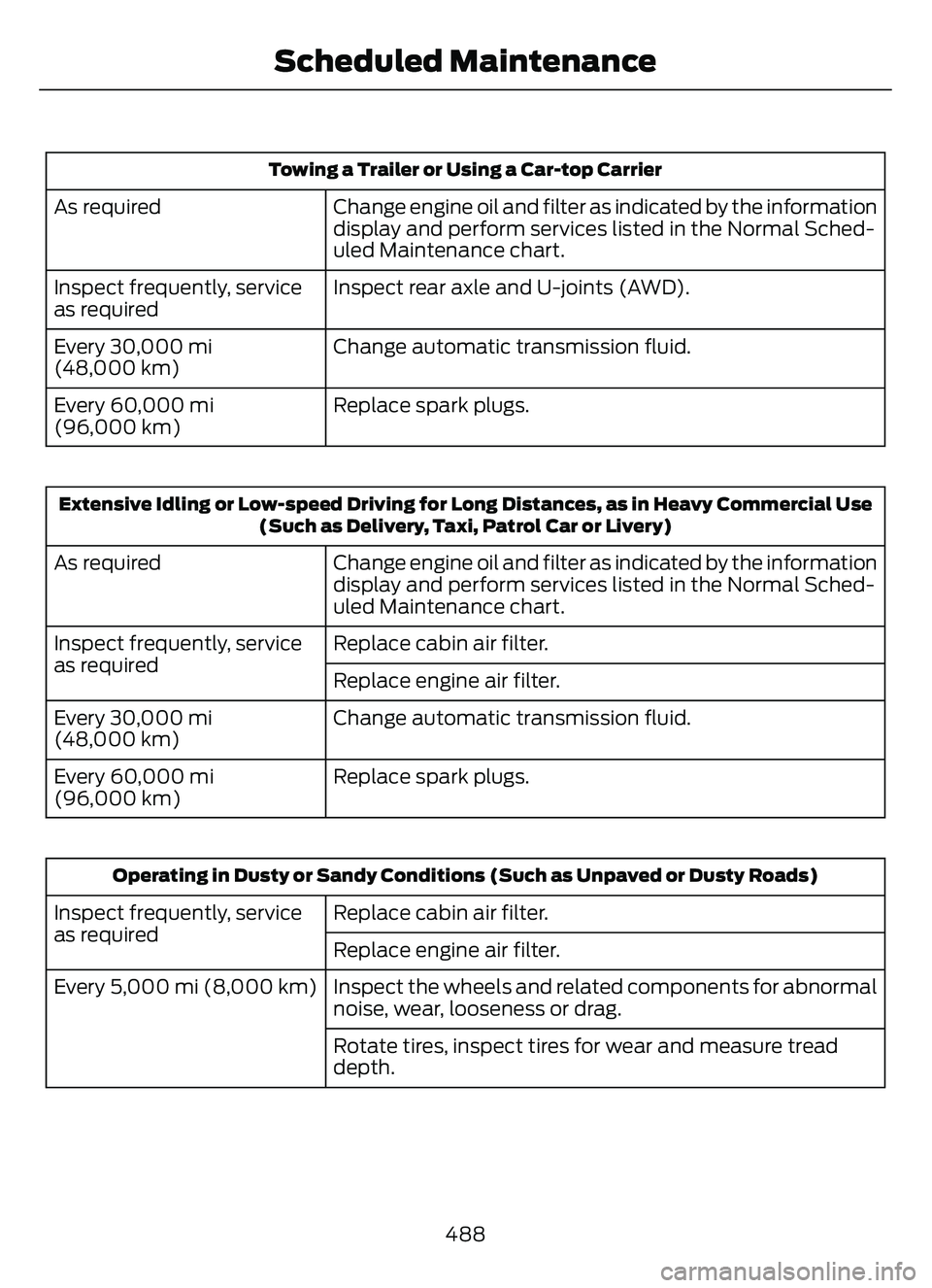
Towing a Trailer or Using a Car-top Carrier
Change engine oil and filter as indicated by the information
display and perform services listed in the Normal Sched-
uled Maintenance chart.
As required
Inspect rear axle and U-joints (AWD).
Inspect frequently, service
as required
Change automatic transmission fluid.
Every 30,000 mi
(48,000 km)
Replace spark plugs.
Every 60,000 mi
(96,000 km)
Extensive Idling or Low-speed Driving for Long Distances, as in Heavy Commercial Use
(Such as Delivery, Taxi, Patrol Car or Livery)
Change engine oil and filter as indicated by the information
display and perform services listed in the Normal Sched-
uled Maintenance chart.
As required
Replace cabin air filter.
Inspect frequently, service
as required
Replace engine air filter.
Change automatic transmission fluid.
Every 30,000 mi
(48,000 km)
Replace spark plugs.
Every 60,000 mi
(96,000 km)
Operating in Dusty or Sandy Conditions (Such as Unpaved or Dusty Roads)
Replace cabin air filter.
Inspect frequently, service
as required
Replace engine air filter.
Inspect the wheels and related components for abnormal
noise, wear, looseness or drag.
Every 5,000 mi (8,000 km)
Rotate tires, inspect tires for wear and measure tread
depth.
488
Scheduled Maintenance
Page 492 of 585
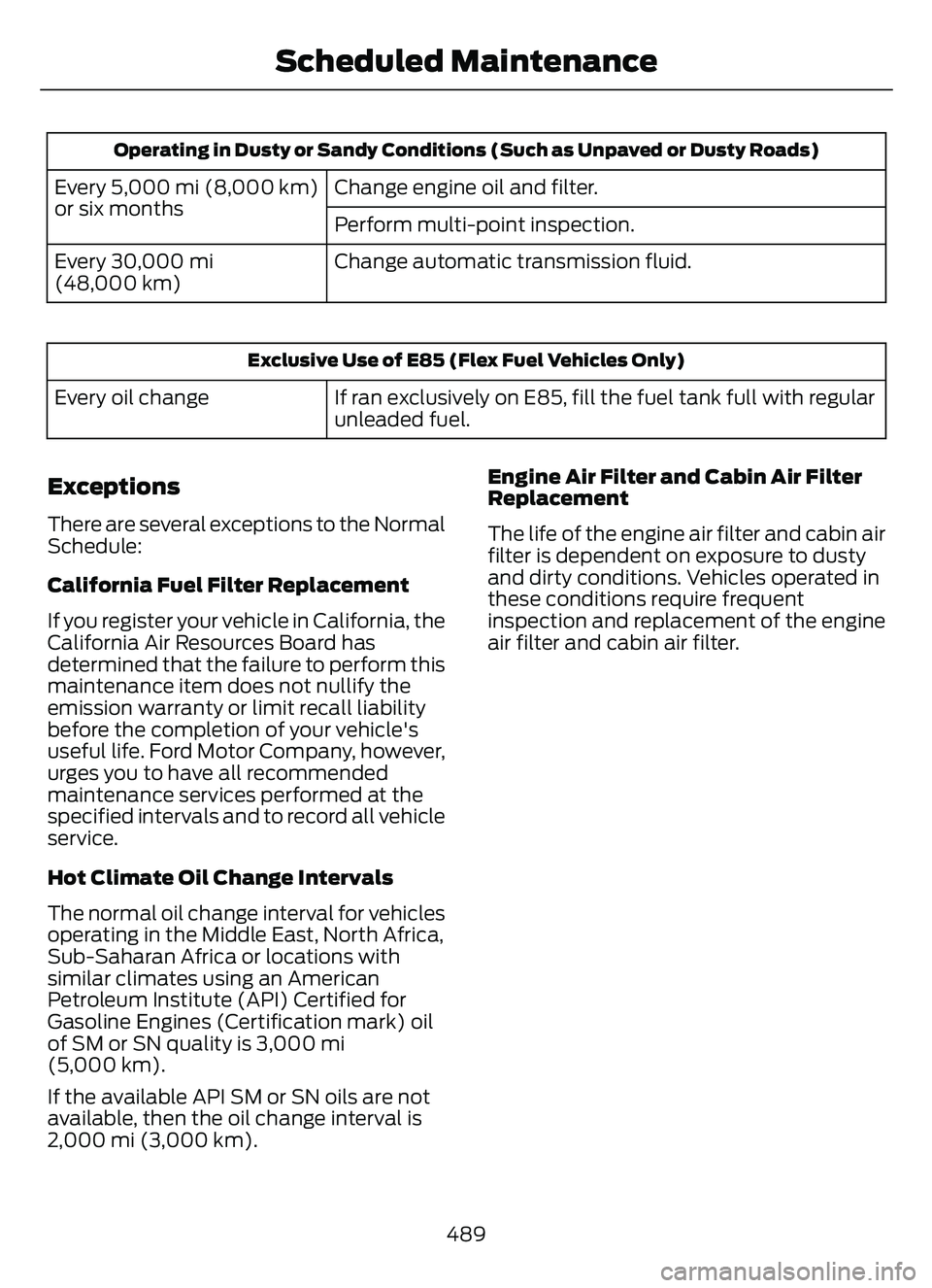
Operating in Dusty or Sandy Conditions (Such as Unpaved or Dusty Roads)
Change engine oil and filter.
Every 5,000 mi (8,000 km)
or six months
Perform multi-point inspection.
Change automatic transmission fluid.
Every 30,000 mi
(48,000 km)
Exclusive Use of E85 (Flex Fuel Vehicles Only)
If ran exclusively on E85, fill the fuel tank full with regular
unleaded fuel.
Every oil change
Exceptions
There are several exceptions to the Normal
Schedule:
California Fuel Filter Replacement
If you register your vehicle in California, the
California Air Resources Board has
determined that the failure to perform this
maintenance item does not nullify the
emission warranty or limit recall liability
before the completion of your vehicle's
useful life. Ford Motor Company, however,
urges you to have all recommended
maintenance services performed at the
specified intervals and to record all vehicle
service.
Hot Climate Oil Change Intervals
The normal oil change interval for vehicles
operating in the Middle East, North Africa,
Sub-Saharan Africa or locations with
similar climates using an American
Petroleum Institute (API) Certified for
Gasoline Engines (Certification mark) oil
of SM or SN quality is 3,000 mi
(5,000 km).
If the available API SM or SN oils are not
available, then the oil change interval is
2,000 mi (3,000 km). Engine Air Filter and Cabin Air Filter
Replacement
The life of the engine air filter and cabin air
filter is dependent on exposure to dusty
and dirty conditions. Vehicles operated in
these conditions require frequent
inspection and replacement of the engine
air filter and cabin air filter.
489
Scheduled Maintenance