brakes FORD EXCURSION 2004 1.G User Guide
[x] Cancel search | Manufacturer: FORD, Model Year: 2004, Model line: EXCURSION, Model: FORD EXCURSION 2004 1.GPages: 272, PDF Size: 1.82 MB
Page 173 of 272
Mud and water
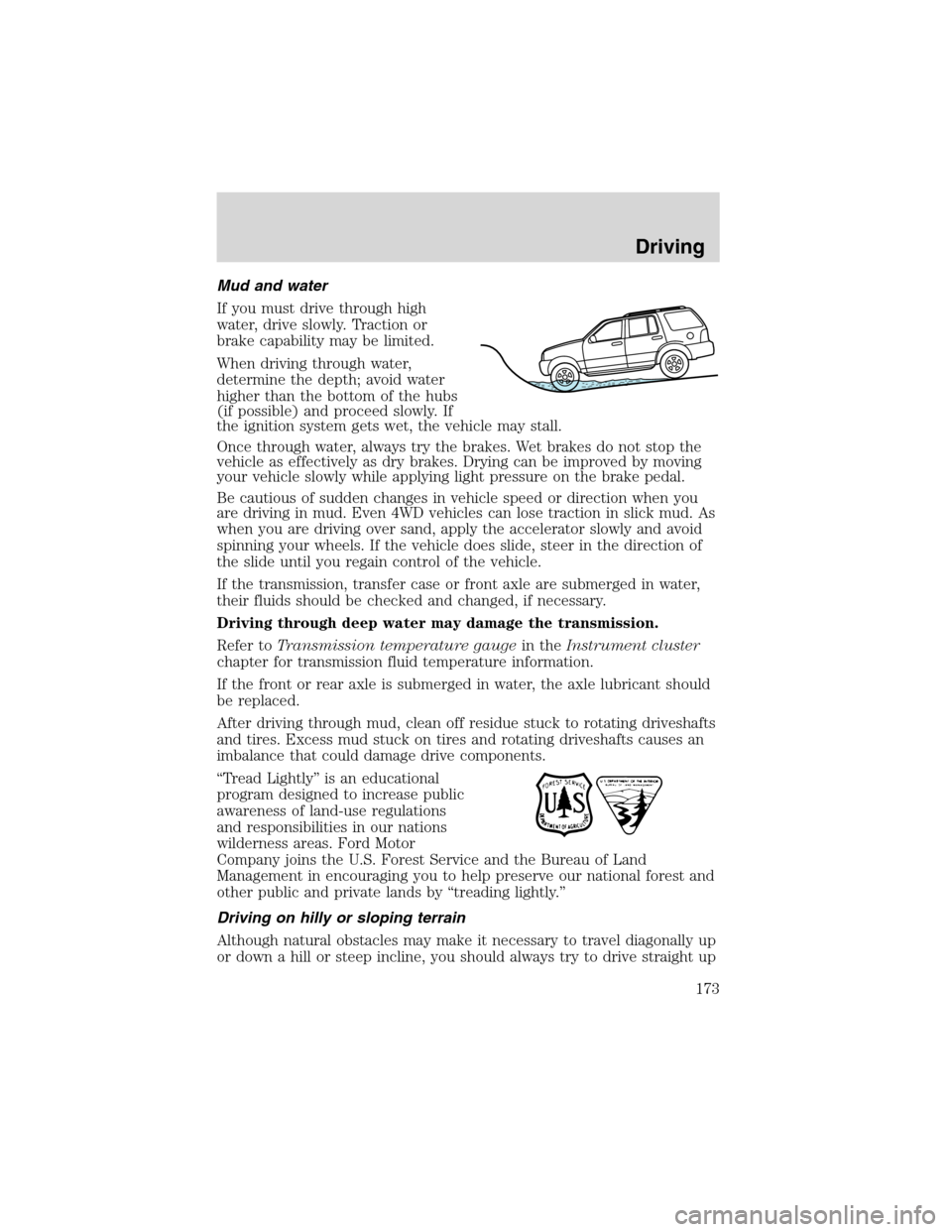
If you must drive through high
water, drive slowly. Traction or
brake capability may be limited.
When driving through water,
determine the depth; avoid water
higher than the bottom of the hubs
(if possible) and proceed slowly. If
the ignition system gets wet, the vehicle may stall.
Once through water, always try the brakes. Wet brakes do not stop the
vehicle as effectively as dry brakes. Drying can be improved by moving
your vehicle slowly while applying light pressure on the brake pedal.
Be cautious of sudden changes in vehicle speed or direction when you
are driving in mud. Even 4WD vehicles can lose traction in slick mud. As
when you are driving over sand, apply the accelerator slowly and avoid
spinning your wheels. If the vehicle does slide, steer in the direction of
the slide until you regain control of the vehicle.
If the transmission, transfer case or front axle are submerged in water,
their fluids should be checked and changed, if necessary.
Driving through deep water may damage the transmission.
Refer toTransmission temperature gaugein theInstrument cluster
chapter for transmission fluid temperature information.
If the front or rear axle is submerged in water, the axle lubricant should
be replaced.
After driving through mud, clean off residue stuck to rotating driveshafts
and tires. Excess mud stuck on tires and rotating driveshafts causes an
imbalance that could damage drive components.
“Tread Lightly” is an educational
program designed to increase public
awareness of land-use regulations
and responsibilities in our nations
wilderness areas. Ford Motor
Company joins the U.S. Forest Service and the Bureau of Land
Management in encouraging you to help preserve our national forest and
other public and private lands by “treading lightly.”
Driving on hilly or sloping terrain
Although natural obstacles may make it necessary to travel diagonally up
or down a hill or steep incline, you should always try to drive straight up
Driving
173
Page 174 of 272
or straight down.Avoid driving crosswise or turning on steep
slopes or hills. A danger lies in losing traction, slipping sideways and
possibly rolling over. Whenever driving on a hill, determine beforehand
the route you will use. Do not drive over the crest of a hill without
seeing what conditions are on the other side. Do not drive in reverse
over a hill without the aid of an observer.
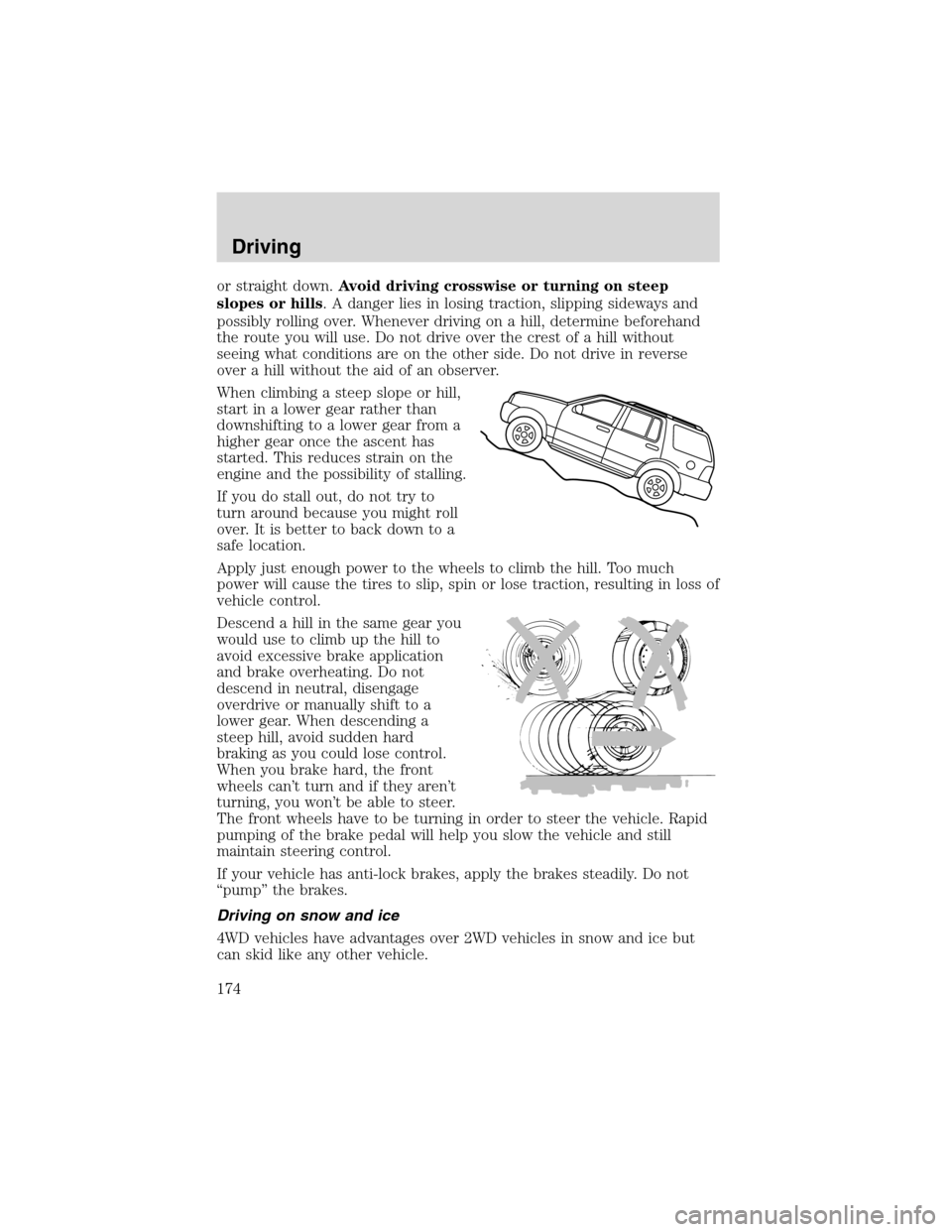
When climbing a steep slope or hill,
start in a lower gear rather than
downshifting to a lower gear from a
higher gear once the ascent has
started. This reduces strain on the
engine and the possibility of stalling.
If you do stall out, do not try to
turn around because you might roll
over. It is better to back down to a
safe location.
Apply just enough power to the wheels to climb the hill. Too much
power will cause the tires to slip, spin or lose traction, resulting in loss of
vehicle control.
Descend a hill in the same gear you
would use to climb up the hill to
avoid excessive brake application
and brake overheating. Do not
descend in neutral, disengage
overdrive or manually shift to a
lower gear. When descending a
steep hill, avoid sudden hard
braking as you could lose control.
When you brake hard, the front
wheels can’t turn and if they aren’t
turning, you won’t be able to steer.
The front wheels have to be turning in order to steer the vehicle. Rapid
pumping of the brake pedal will help you slow the vehicle and still
maintain steering control.
If your vehicle has anti-lock brakes, apply the brakes steadily. Do not
“pump” the brakes.
Driving on snow and ice
4WD vehicles have advantages over 2WD vehicles in snow and ice but
can skid like any other vehicle.
Driving
174
Page 175 of 272
Should you start to slide while driving on snowy or icy roads, turn the
steering wheel in the direction of the slide until you regain control.
Avoid sudden applications of power and quick changes of direction on
snow and ice. Apply the accelerator slowly and steadily when starting
from a full stop.
Avoid sudden braking as well. Although a 4WD vehicle may accelerate
better than a two-wheel drive vehicle in snow and ice, it won’t stop any
faster, because as in other vehicles, braking occurs at all four wheels. Do
not become overconfident as to road conditions.
Make sure you allow sufficient distance between you and other vehicles
for stopping as well as drive slower than usual and consider using one of
the lower gears. In emergency stopping situations, avoid locking of the
wheels. Use a “squeeze” technique, push on the brake pedal with a
steadily increasing force which allows the wheels to brake yet continue
to roll so that you may steer in the direction you want to travel. If you
lock the wheels, release the brake pedal and repeat the squeeze
technique. If your vehicle is equipped with a Four Wheel Anti-Lock
Brake System (ABS), apply the brake steadily. Do not “pump” the
brakes. Refer to theBrakessection of this chapter for additional
information on the operation of the anti-lock brake system.
Never drive with chains on the front tires of 4WD vehicles without also
putting them on the rear tires. This could cause the rear to slide and
swing around during braking.
Tires, Replacement Requirements
Do not use a size and type of tire and wheel other than that
originally provided by Ford Motor Company because it can affect
the safety and performance of your vehicle, which could lead to loss of
vehicle control or roll over and serious injury.
Make sure all tires and wheels on the vehicle are of the same size, type,
tread design, brand and load-carrying capacity. If you have questions
regarding tire replacement, see an authorized Ford or Lincoln/Mercury
dealer.
If you nevertheless decide to equip your 4WD for off-road use with tires
larger than what Ford Motor Company recommends, you should not use
these tires for highway driving.
If you use any tire/wheel combination not recommended by Ford Motor
Company, it may adversely affect vehicle handling and could cause
steering, suspension, axle or transfer case failure.
Driving
175
Page 177 of 272
Any modifications to a vehicle that raise the center of gravity can make
it more likely the vehicle will roll over as a result of a loss of control.
Ford Motor Company recommends that caution be used with any vehicle
equipped with a high load or device (such as ladder racks or pickup box
cover).
Failure to maintain your vehicle properly may void the warranty, increase
your repair cost, reduce vehicle performance and operational capabilities
and adversely affect driver and passenger safety. Frequent inspection of
vehicle chassis components is recommended if the vehicle is subjected to
heavy off-road usage.
DRIVING THROUGH WATER
Do not drive quickly through standing water, especially if the depth is
unknown. Traction or brake capability may be limited and if the ignition
system gets wet, your engine may stall. Water may also enter your
engine’s air intake and severely damage your engine.
If driving through deep or standing water is unavoidable, proceed very
slowly. Never drive through water that is higher than the bottom of the
hubs (for trucks) or the bottom of the wheel rims (for cars).
Once through the water, always try the brakes. Wet brakes do not stop the
vehicle as effectively as dry brakes. Drying can be improved by moving
your vehicle slowly while applying light pressure on the brake pedal.
Driving through deep water where the transmission vent tube is
submerged may allow water into the transmission and cause
internal transmission damage. Have the fluid checked and, if
water is found, replace the fluid.
VEHICLE LOADING
Before loading a vehicle, familiarize yourself with the following terms:
•Base Curb Weight:Weight of the vehicle including any standard
equipment, fluids, lubricants, etc. It does not include occupants or
aftermarket equipment.
•Payload:Combined maximum allowable weight of cargo, occupants
and optional equipment. The payload equals the gross vehicle weight
rating minus base curb weight.
•GVW (Gross Vehicle Weight):Base curb weight plus payload
weight. The GVW is not a limit or a specification.
•GVWR (Gross Vehicle Weight Rating):Maximum permissible total
weight of the base vehicle, occupants, optional equipment and cargo.
The GVWR is specific to each vehicle and is listed on the Safety
Certification Label on the driver’s door pillar.
Driving
177
Page 180 of 272
TRAILER TOWING
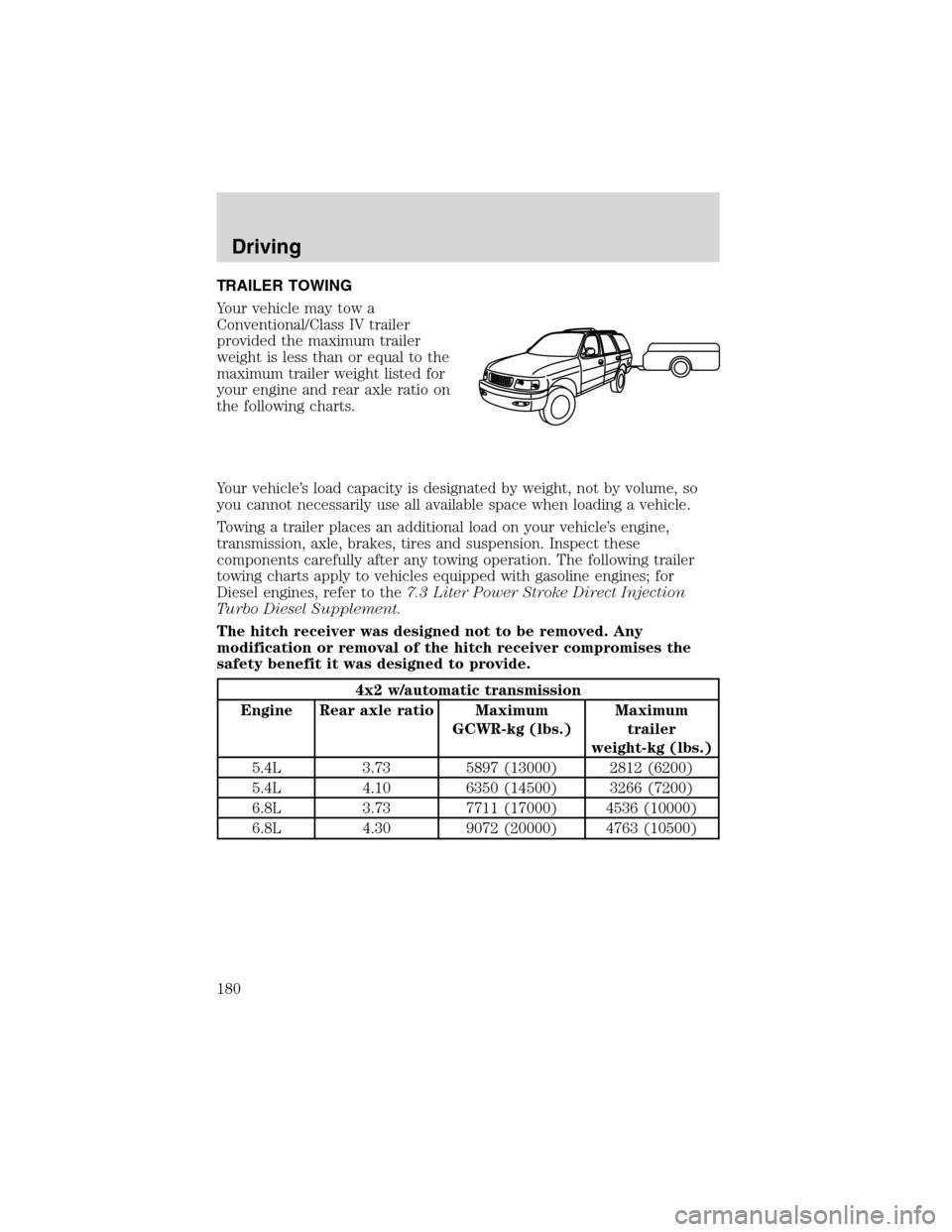
Your vehicle may tow a
Conventional/Class IV trailer
provided the maximum trailer
weight is less than or equal to the
maximum trailer weight listed for
your engine and rear axle ratio on
the following charts.
Your vehicle’s load capacity is designated by weight, not by volume, so
you cannot necessarily use all available space when loading a vehicle.
Towing a trailer places an additional load on your vehicle’s engine,
transmission, axle, brakes, tires and suspension. Inspect these
components carefully after any towing operation. The following trailer
towing charts apply to vehicles equipped with gasoline engines; for
Diesel engines, refer to the7.3 Liter Power Stroke Direct Injection
Turbo Diesel Supplement.
The hitch receiver was designed not to be removed. Any
modification or removal of the hitch receiver compromises the
safety benefit it was designed to provide.
4x2 w/automatic transmission
Engine Rear axle ratio Maximum
GCWR-kg (lbs.)Maximum
trailer
weight-kg (lbs.)
5.4L 3.73 5897 (13000) 2812 (6200)
5.4L 4.10 6350 (14500) 3266 (7200)
6.8L 3.73 7711 (17000) 4536 (10000)
6.8L 4.30 9072 (20000) 4763 (10500)
Driving
180
Page 182 of 272
Adjusting an equalizing hitch so the rear bumper of the vehicle
is higher than it was unloaded will defeat the function of the
load equalizing hitch and may cause unpredictable handling.
Safety chains
Always connect the trailer’s safety chains to the frame or hook retainers
of the vehicle hitch. To connect the trailer’s safety chains, cross the
chains under the trailer tongue and allow slack for turning corners.
If you use a rental trailer, follow the instructions that the rental agency
gives to you.
Do not attach safety chains to the bumper.
Trailer brakes
Electric brakes and manual, automatic or surge-type trailer brakes are
safe if installed properly and adjusted to the manufacturer’s
specifications. The trailer brakes must meet local and Federal
regulations.
Do not connect a trailer’s hydraulic brake system directly to your
vehicle’s brake system. Your vehicle may not have enough
braking power and your chances of having a collision greatly increase.
The braking system of the tow vehicle is rated for operation at the
GVWR not GCWR.
Trailer lamps
Trailer lamps are required on most towed vehicles. Make sure your
trailer lamps conform to local and Federal regulations. See your dealer or
trailer rental agency for proper instructions and equipment for hooking
up trailer lamps.
Using a step bumper (if equipped)
The rear bumper is equipped with an integral hitch and only requires a
ball with a 25.4 mm (one inch) shank diameter. The bumper hasa2270
kg (5 000 lb.) trailer weight and 227 kg (500 lb.) tongue weight capacity.
If it is necessary to relocate the trailer hitch ball position, a
frame-mounted trailer hitch must be installed.
Driving
182
Page 244 of 272
BRAKE FLUID
Checking and adding brake fluid
Brake fluid should be checked and
refilled as needed. Refer to the
scheduled maintenance guide for
the service interval schedules.
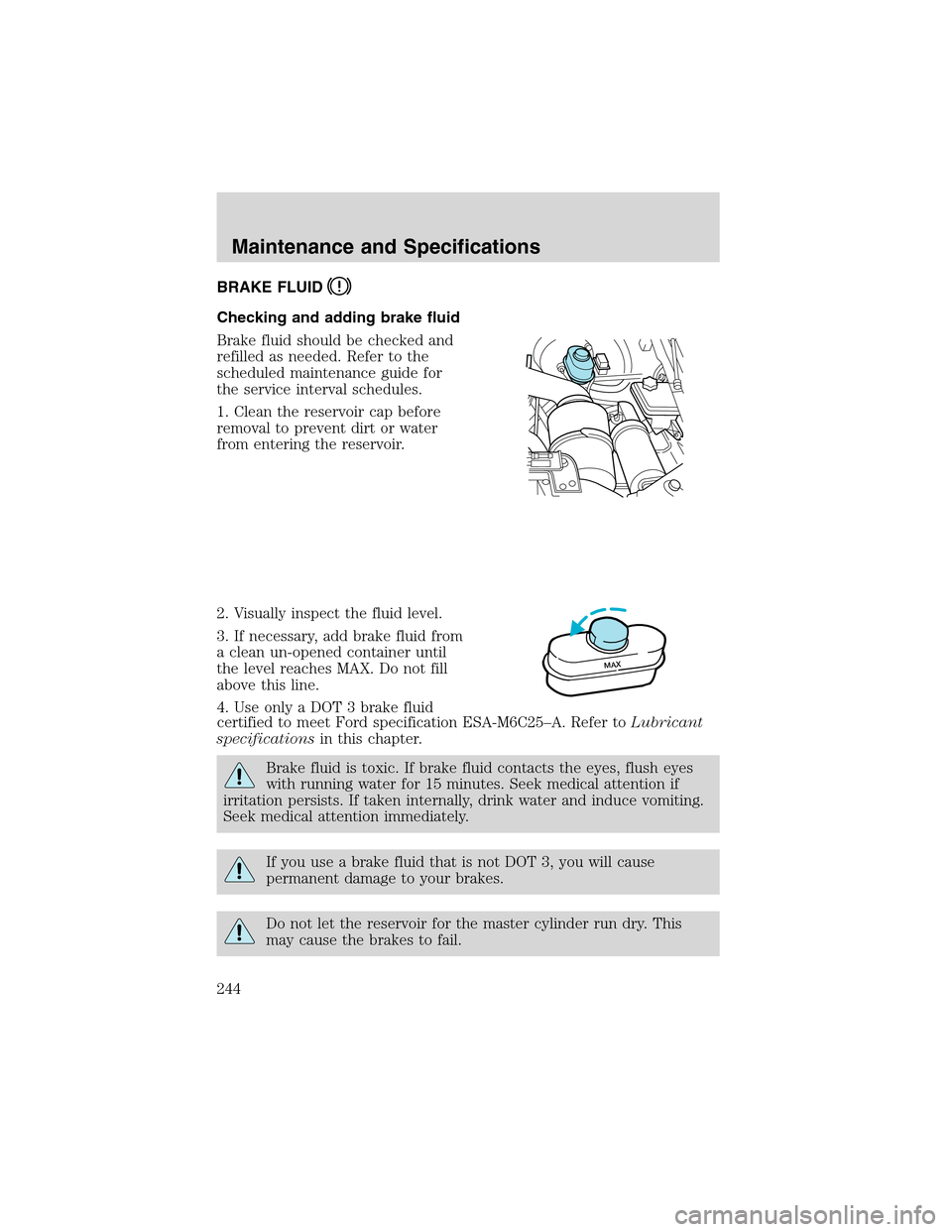
1. Clean the reservoir cap before
removal to prevent dirt or water
from entering the reservoir.
2. Visually inspect the fluid level.
3. If necessary, add brake fluid from
a clean un-opened container until
the level reaches MAX. Do not fill
above this line.
4. Use only a DOT 3 brake fluid
certified to meet Ford specification ESA-M6C25–A. Refer toLubricant
specificationsin this chapter.
Brake fluid is toxic. If brake fluid contacts the eyes, flush eyes
with running water for 15 minutes. Seek medical attention if
irritation persists. If taken internally, drink water and induce vomiting.
Seek medical attention immediately.
If you use a brake fluid that is not DOT 3, you will cause
permanent damage to your brakes.
Do not let the reservoir for the master cylinder run dry. This
may cause the brakes to fail.
MAX
Maintenance and Specifications
244
Page 266 of 272
A
ABS (see Brakes) .....................157
Accessory delay ..........................86
Air bag supplemental restraint
system ........................................140
and child safety seats ............142
description ..............................140
disposal ....................................144
driver air bag ..........................142
indicator light ...................12, 144
operation .................................142
passenger air bag ...................142
Air cleaner filter ...............248, 254
Air conditioning ..........................60
auxiliary heater and air
conditioner ................................68
manual heating and air
conditioning system .................57
Antifreeze (see Engine
coolant) .....................................227
Anti-lock brake system
(see Brakes) ..............................157
Anti-theft system
warning light .............................14
Audio system (see Radio) ...19, 27
Automatic transmission
driving an automatic
overdrive .................................161
fluid, adding ............................245
fluid, checking ........................245
fluid, refill capacities ..............254
fluid, specification ..................259
Auxiliary power point .................83
Axle
lubricant specifications ..257, 259
refill capacities ........................254
traction lok ..............................159B
Battery .......................................225
acid, treating emergencies .....225
charging system warning
light ............................................12
jumping a disabled battery ....197
maintenance-free ....................225
replacement, specifications ...254
servicing ..................................225
BeltMinder .................................135
Brakes ........................................156
anti-lock ...................................157
anti-lock brake system (ABS)
warning light .....................12, 157
brake warning light ..................11
fluid, checking and adding ....244
fluid, refill capacities ..............254
fluid, specifications .........257, 259
lubricant specifications ..257, 259
parking ....................................158
pedals (see Power adjustable
foot pedals) ...............................89
shift interlock ..........................160
Break-in period .............................5
Bulbs ............................................75
C
Capacities for refilling fluids ....254
Cargo net ...................................102
CD-6 disc .....................................27
CD-single premium .....................19
Certification Label ....................261
Changing a tire .........................192
Child safety restraints ..............145
child safety belts ....................145
Child safety seats ......................145
Index
266
Page 269 of 272
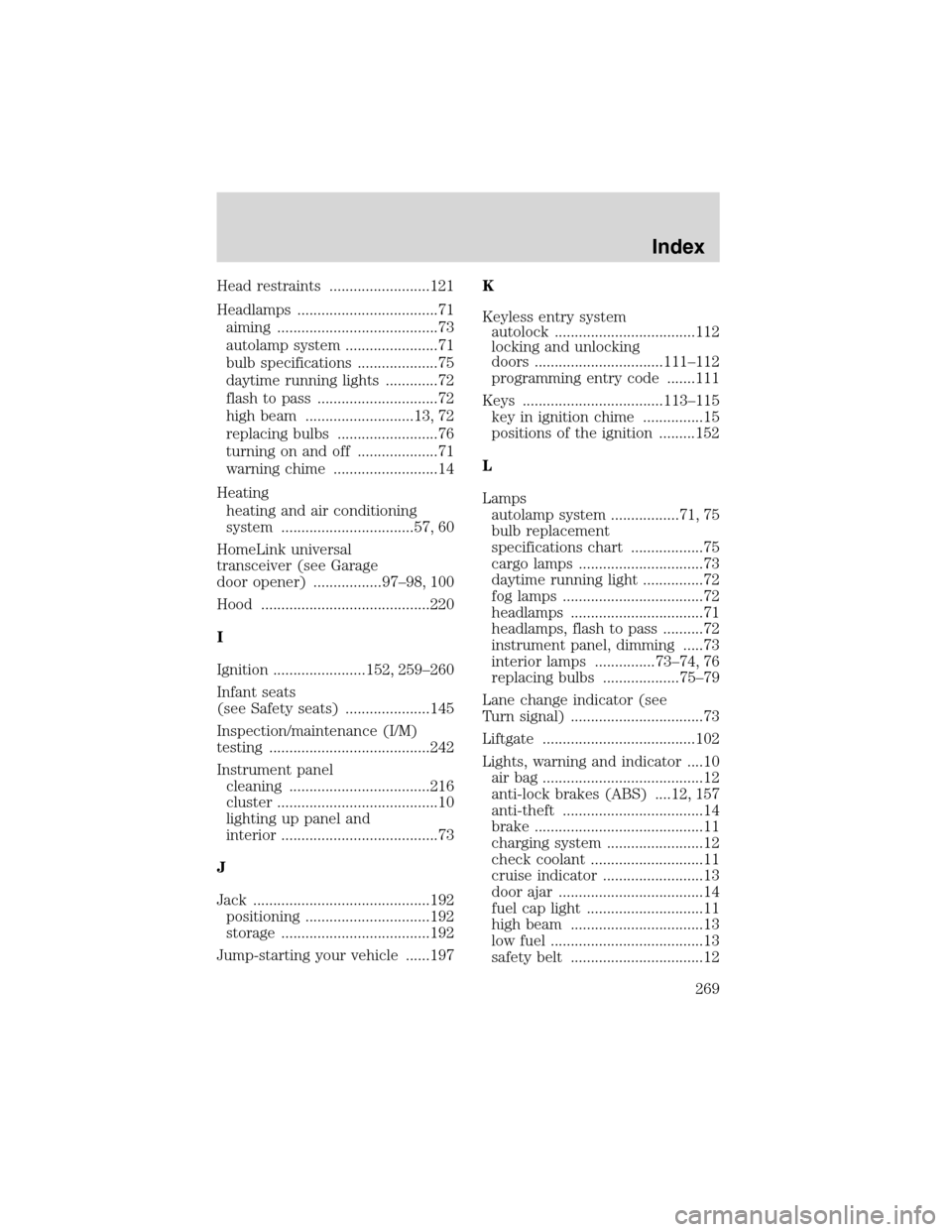
Head restraints .........................121
Headlamps ...................................71
aiming ........................................73
autolamp system .......................71
bulb specifications ....................75
daytime running lights .............72
flash to pass ..............................72
high beam ...........................13, 72
replacing bulbs .........................76
turning on and off ....................71
warning chime ..........................14
Heating
heating and air conditioning
system .................................57, 60
HomeLink universal
transceiver (see Garage
door opener) .................97–98, 100
Hood ..........................................220
I
Ignition .......................152, 259–260
Infant seats
(see Safety seats) .....................145
Inspection/maintenance (I/M)
testing ........................................242
Instrument panel
cleaning ...................................216
cluster ........................................10
lighting up panel and
interior .......................................73
J
Jack ............................................192
positioning ...............................192
storage .....................................192
Jump-starting your vehicle ......197K
Keyless entry system
autolock ...................................112
locking and unlocking
doors ................................111–112
programming entry code .......111
Keys ...................................113–115
key in ignition chime ...............15
positions of the ignition .........152
L
Lamps
autolamp system .................71, 75
bulb replacement
specifications chart ..................75
cargo lamps ...............................73
daytime running light ...............72
fog lamps ...................................72
headlamps .................................71
headlamps, flash to pass ..........72
instrument panel, dimming .....73
interior lamps ...............73–74, 76
replacing bulbs ...................75–79
Lane change indicator (see
Turn signal) .................................73
Liftgate ......................................102
Lights, warning and indicator ....10
air bag ........................................12
anti-lock brakes (ABS) ....12, 157
anti-theft ...................................14
brake ..........................................11
charging system ........................12
check coolant ............................11
cruise indicator .........................13
door ajar ....................................14
fuel cap light .............................11
high beam .................................13
low fuel ......................................13
safety belt .................................12
Index
269