ignition FORD EXPEDITION 1998 1.G Owner's Guide
[x] Cancel search | Manufacturer: FORD, Model Year: 1998, Model line: EXPEDITION, Model: FORD EXPEDITION 1998 1.GPages: 216, PDF Size: 1.51 MB
Page 114 of 216

ACCEL button (to resume speeds
over 50 km/h (30 mph).
Automatic transmission may shift
frequently while driving up steep
grades. Eliminate frequent shifting
by shifting out of
(Overdrive)
into D (Drive).
Driving on snow and ice
A 4WD vehicle has advantages
over 2WD vehicles in snow and ice
but can skid like any other vehicle.
Avoid sudden applications of
power and quick changes of
direction on snow and ice. Apply
the accelerator slowly and steadily
when starting from a full stop.
When braking, apply the brakes as
you normally would. In order to
allow the anti-lock brake system
(ABS) to operate properly, keep
steady pressure on the brake
pedal.
Allow more stopping distance and
drive slower than usual. Consider
using one of the lower gears.
DRIVING THROUGH WATER
Do not drive quickly through
standing water, especially if the
depth is unknown. Traction or
brake capability may be limited
and if the ignition system gets wet,
your engine may stall. Water may
also enter your engine's air intake
and severely damage your engine.
If driving through deep or standing
water is unavoidable, proceed very
slowly. Never drive through water
that is higher than the bottom of
Driving
114
Page 121 of 216

is properly attached to your
vehicle. See your dealer or a
reliable trailer dealer if you require
assistance.
If your vehicle is not equipped
with the factory heavy duty trailer
tow option, auxiliary coolers are
recommended for the automatic
transmission system if you are
planning on:
²traveling farther than 80 km
(50 miles)
²towing in hilly terrain
²towing frequently
Hitches
Do not use hitches that clamp onto
the vehicle's bumper or attach to
the axle. You must distribute the
load in your trailer so that 10 to
15% of the total weight of the
trailer is on the tongue.
Load equalizing hitch
When hooking up a trailer using a
load equalizing hitch, always use
the following procedure:
1. Park the unloaded vehicle on a
level surface. With the ignition on
and all doors closed, allow the
vehicle to stand for several
minutes so that it can level.
2. Turn the air suspension (if
equipped) control to OFF.
3. Measure the height of a
reference point on the front and
rear bumpers at the center of the
vehicle.
Driving
121
Page 127 of 216
HAZARD LIGHTS CONTROL
Use only in an emergency to warn
traffic of vehicle breakdown,
approaching danger, etc. The
hazard flashers can be operated
when the ignition is off.
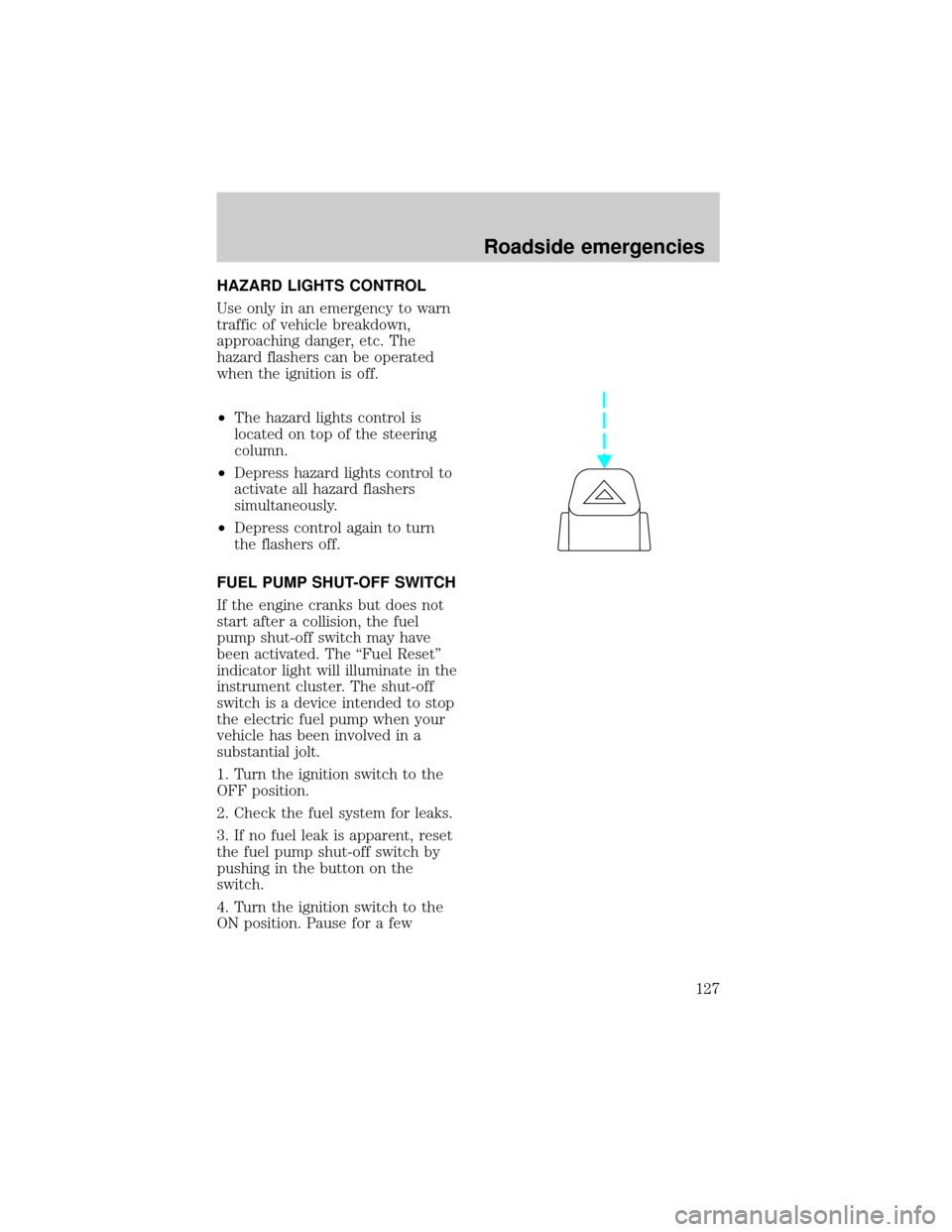
²The hazard lights control is
located on top of the steering
column.
²Depress hazard lights control to
activate all hazard flashers
simultaneously.
²Depress control again to turn
the flashers off.
FUEL PUMP SHUT-OFF SWITCH
If the engine cranks but does not
start after a collision, the fuel
pump shut-off switch may have
been activated. The ªFuel Resetº
indicator light will illuminate in the
instrument cluster. The shut-off
switch is a device intended to stop
the electric fuel pump when your
vehicle has been involved in a
substantial jolt.
1. Turn the ignition switch to the
OFF position.
2. Check the fuel system for leaks.
3. If no fuel leak is apparent, reset
the fuel pump shut-off switch by
pushing in the button on the
switch.
4. Turn the ignition switch to the
ON position. Pause for a few
Roadside emergencies
127
Page 133 of 216
Fuse/Relay
LocationFuse Amp
RatingDescription
26 10A Daytime Running Lamps (DRL)
Module, Right Headlamp (Power
supplied through Multi-Function
Switch)
27 5A Main Light Switch, Fog Lamp
Relay
28 10A Left Headlamp
29 5A Autolamp Module, Instrument
Cluster, Transmission Control
Switch (TCS)
30 30A Radio Noise Capacitor, Ignition
Coil, PCM Power Diode, Coil On
Plugs
31 Ð Not Used
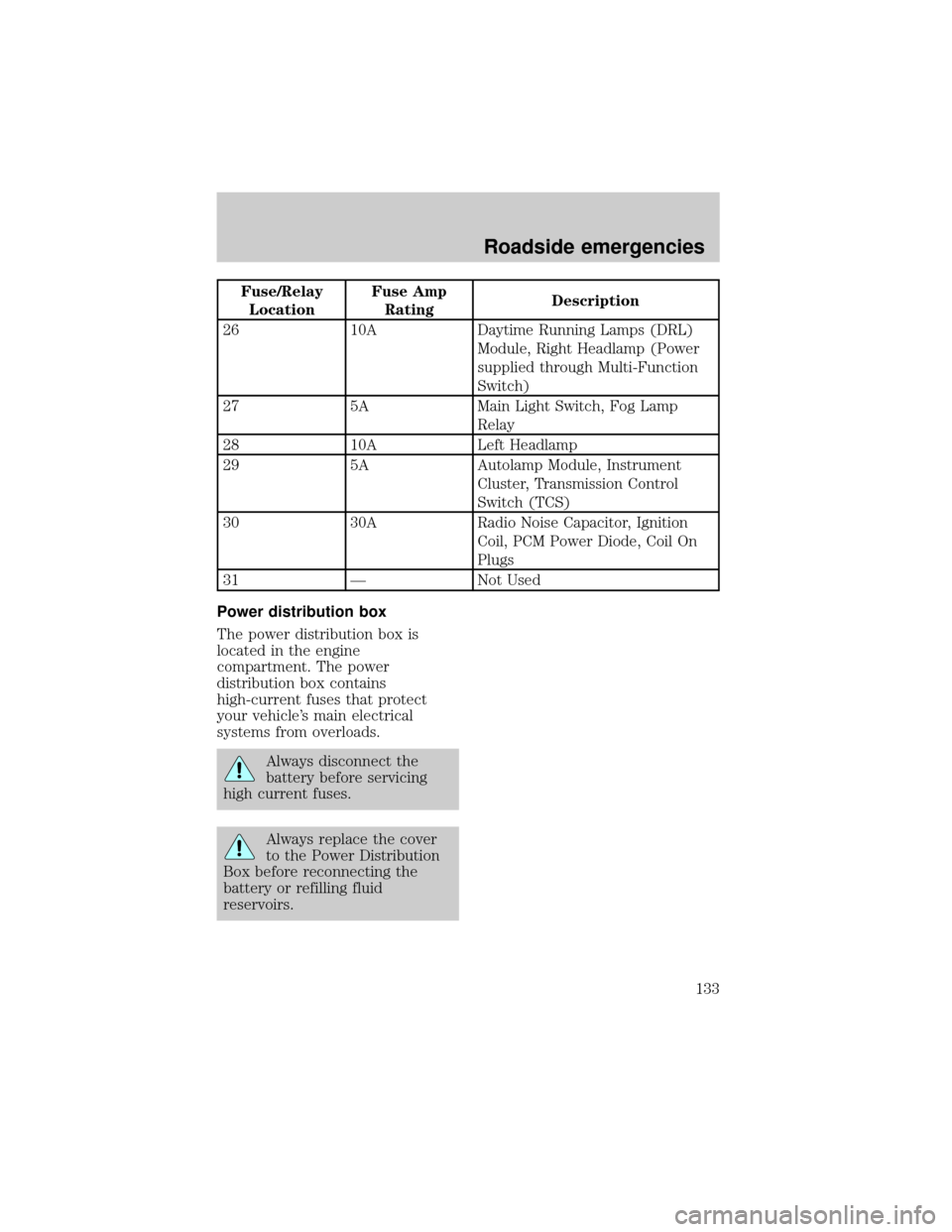
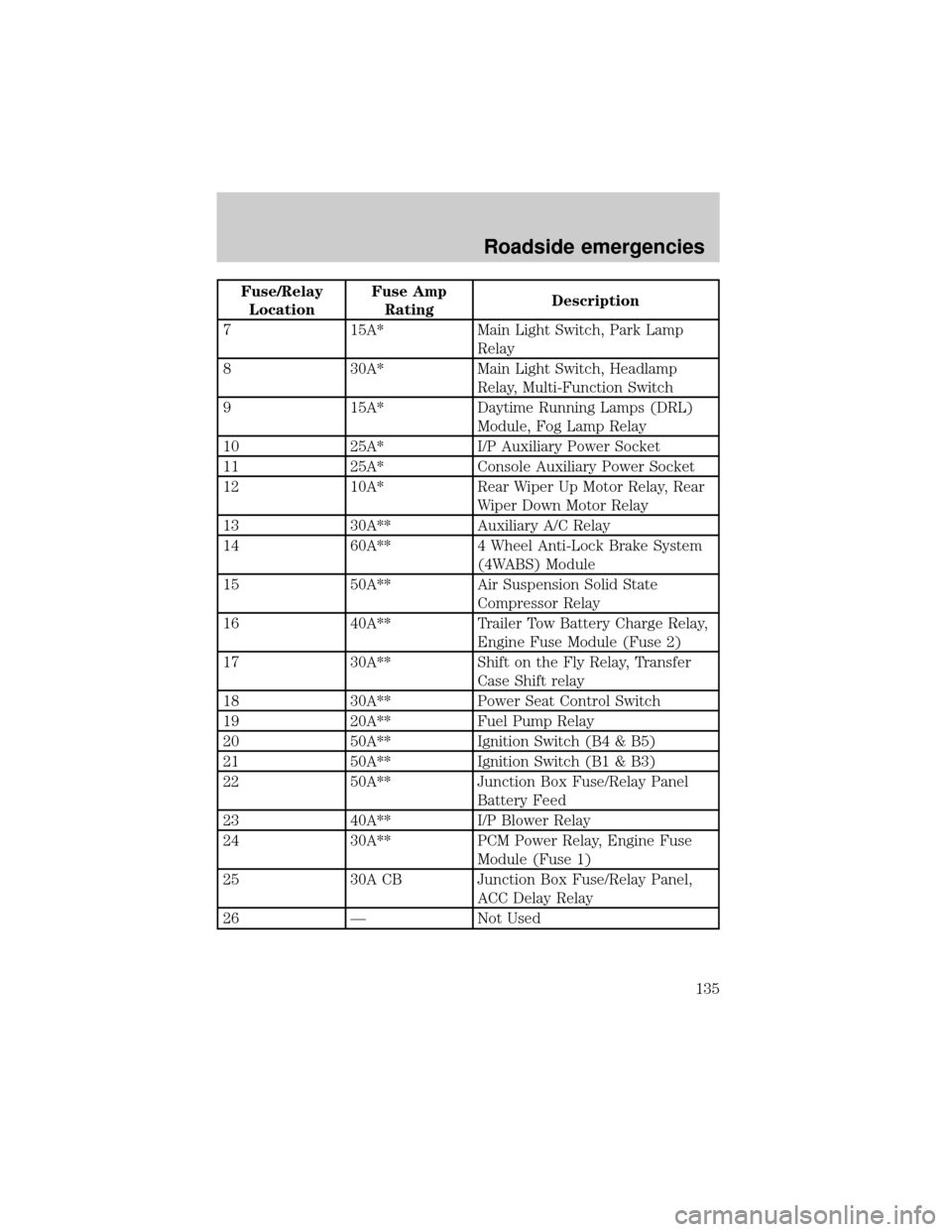
Power distribution box
The power distribution box is
located in the engine
compartment. The power
distribution box contains
high-current fuses that protect
your vehicle's main electrical
systems from overloads.
Always disconnect the
battery before servicing
high current fuses.
Always replace the cover
to the Power Distribution
Box before reconnecting the
battery or refilling fluid
reservoirs.
Roadside emergencies
133
Page 135 of 216
Fuse/Relay
LocationFuse Amp
RatingDescription
7 15A* Main Light Switch, Park Lamp
Relay
8 30A* Main Light Switch, Headlamp
Relay, Multi-Function Switch
9 15A* Daytime Running Lamps (DRL)
Module, Fog Lamp Relay
10 25A* I/P Auxiliary Power Socket
11 25A* Console Auxiliary Power Socket
12 10A* Rear Wiper Up Motor Relay, Rear
Wiper Down Motor Relay
13 30A** Auxiliary A/C Relay
14 60A** 4 Wheel Anti-Lock Brake System
(4WABS) Module
15 50A** Air Suspension Solid State
Compressor Relay
16 40A** Trailer Tow Battery Charge Relay,
Engine Fuse Module (Fuse 2)
17 30A** Shift on the Fly Relay, Transfer
Case Shift relay
18 30A** Power Seat Control Switch
19 20A** Fuel Pump Relay
20 50A** Ignition Switch (B4 & B5)
21 50A** Ignition Switch (B1 & B3)
22 50A** Junction Box Fuse/Relay Panel
Battery Feed
23 40A** I/P Blower Relay
24 30A** PCM Power Relay, Engine Fuse
Module (Fuse 1)
25 30A CB Junction Box Fuse/Relay Panel,
ACC Delay Relay
26 Ð Not Used
Roadside emergencies
135
Page 145 of 216
JUMP STARTING YOUR
VEHICLE
The gases around the
battery can explode if
exposed to flames, sparks, or lit
cigarettes. An explosion could
result in injury or vehicle
damage.
Do not push start your
vehicle. You could damage
the catalytic converter.
Batteries contain sulfuric
acid which burns skin,
eyes, and clothing.
Preparing your vehicle
Also see the label on the battery.
1. Use only a 12±volt supply to
start your vehicle. If you connect
your battery to a 24±volt power
supply you can damage your
starter, ignition system and other
electrical components.
2. Do not disconnect the battery of
the disabled vehicle as this could
damage the vehicle's electrical
system.
3. Park the booster vehicle close to
the hood of the disabled vehicle
making sure theydo nottouch.
Set the parking brake on both
vehicles and stay clear of the
engine cooling fan and other
moving parts.
Roadside emergencies
145
Page 171 of 216

For information on replacement air
filter elements, refer to the
Capacities and specifications
chapter.
WINDSHIELD WIPER BLADES
Check the wiper blades at least
twice a year or when they seem
less effective. Substances such as
tree sap and some hot wax
treatments used by commercial car
washes reduce the effectiveness of
wiper blades.
Checking the wiper blades
If the wiper blades do not wipe
properly, clean both the windshield
and wiper blades using undiluted
windshield wiper solution or a mild
detergent. Rinse thoroughly with
clean water. To avoid damaging the
blades, do not use fuel, kerosene,
paint thinner or other solvents.
Changing the wiper blades
When replacing wiper blade
assemblies, always use a
Motorcraft part or equivalent. To
make replacing the wipers easy,
turn the ignition to ACC, then turn
the wipers on. When the wipers
reach the vertical position, turn
the ignition to LOCK.
To replace the wiper blades:
Maintenance and care
171
Page 183 of 216

3. After at least three to five fuel
tank fill-ups, fill the fuel tank and
record the current mileage
reading.
4. Use one of the following
equations to calculate fuel
economy.
Liters used x 1004Total
kilometers traveled
Total miles traveled4Total
gallons used
Keep a record for at least one
month. This will provide an
accurate estimate of the vehicle's
fuel economy.
EMISSION CONTROL SYSTEM
Your vehicle is equipped with
various emission control
components and a catalytic
converter which will enable your
vehicle to comply with applicable
exhaust emission standards. To
make sure that the catalytic
converter and other emission
control components continue to
work properly:
²Use only unleaded fuel.
²Avoid running out of fuel.
²Do not turn off the ignition
while your vehicle is moving,
especially at high speeds.
²Have the services listed in your
ªService Guideº performed
according to the specified
schedule.
The Scheduled Maintenance
Services listed in the ªService
Maintenance and care
183
Page 204 of 216
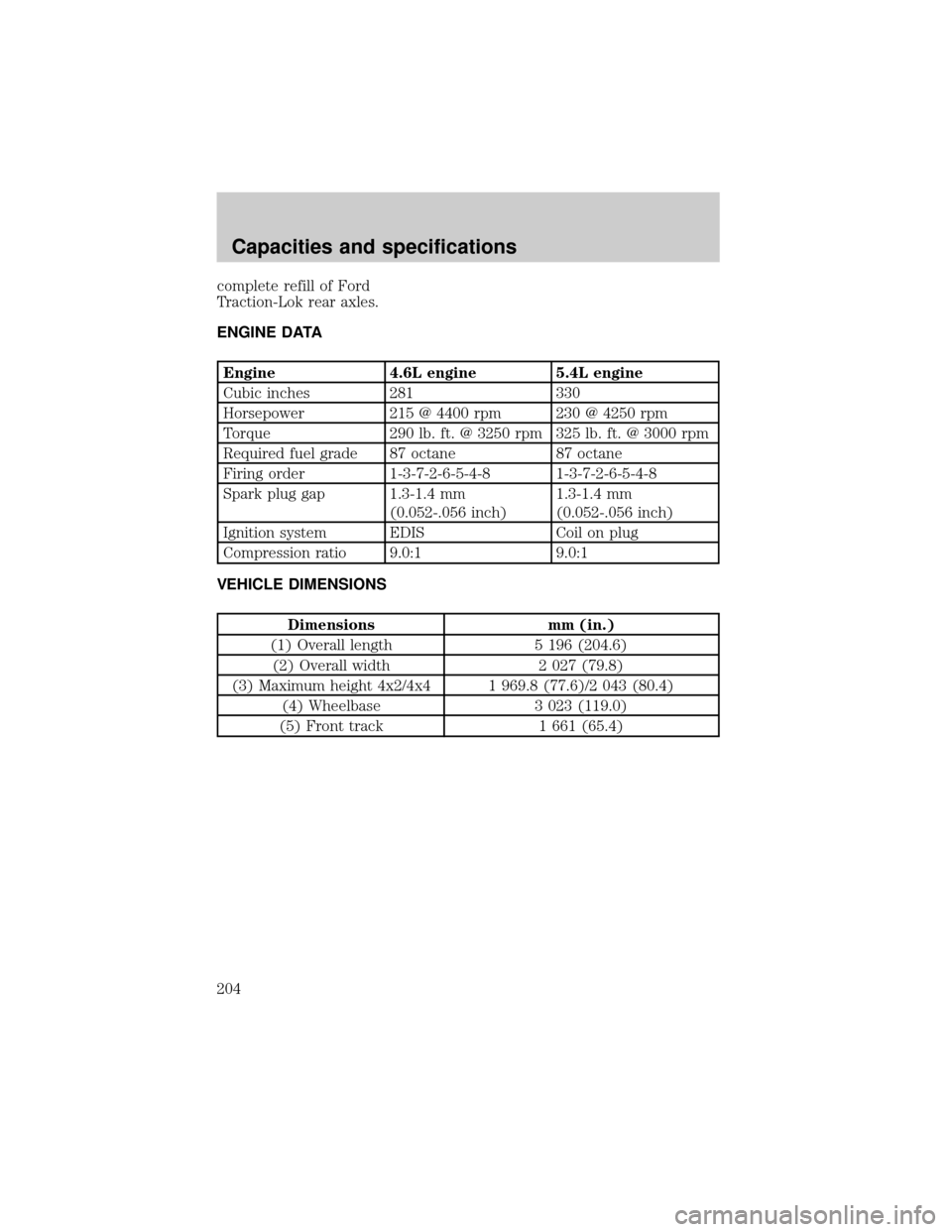
complete refill of Ford
Traction-Lok rear axles.
ENGINE DATA
Engine 4.6L engine 5.4L engine
Cubic inches 281 330
Horsepower 215 @ 4400 rpm 230 @ 4250 rpm
Torque 290 lb. ft. @ 3250 rpm 325 lb. ft. @ 3000 rpm
Required fuel grade 87 octane 87 octane
Firing order 1-3-7-2-6-5-4-8 1-3-7-2-6-5-4-8
Spark plug gap 1.3-1.4 mm
(0.052-.056 inch)1.3-1.4 mm
(0.052-.056 inch)
Ignition system EDIS Coil on plug
Compression ratio 9.0:1 9.0:1
VEHICLE DIMENSIONS
Dimensions mm (in.)
(1) Overall length 5 196 (204.6)
(2) Overall width 2 027 (79.8)
(3) Maximum height 4x2/4x4 1 969.8 (77.6)/2 043 (80.4)
(4) Wheelbase 3 023 (119.0)
(5) Front track 1 661 (65.4)
Capacities and specifications
204
Page 209 of 216

Fuel
calculating fuel economy .......182
improving fuel economy ........126
octane rating ...........................180
quality ......................................180
safety information relating to
automotive fuels .....................177
Fuel gauge ...................................13
Fuel pump shut-off switch .......127
Fuse panels
instrument panel ....................129
power distribution box ....133,137
Fuses ............................128,129,136
Gauges, Mechanical ....................13
engine coolant temperature
gauge .........................................14
Hazard flashers .........................127
Head restraints ...........................63
Headlamps
autolamp system .......................21
flashing ......................................39
high beam .................................39
turning on and off ....................20
Heating ........................................23
High beams
indicator light .............................9
Hood
release lever ............................152
Ignition
positions of the ignition ...........32
Instrument panel
lighting up panel and interior .21
Jump-starting your vehicle 145,147
attaching cables ......................146
disconnecting cables ..............147
Keys
key in ignition chime ...............13
Lamps
interior lamps .........................193
map lamps ...............................193
parking lamps .........................189
Liftgate ........................................53Lights, warning and indicator
air bag ..........................................8
anti-lock brakes (ABS) ..............9
anti-theft ...................................10
brake ............................................9
charging system ........................10
check engine ............................6,7
door ajar ....................................12
engine oil pressure ...................10
four-wheel drive ........................11
fuel reset ................................6,12
safety belt ...................................8
turn signal indicator ...................9
Load limits
trailer towing ..........................117
Lubricant specifications ...........202
Luggage rack .............................126
Message center ......................16,42
english/metric button ...............17
menu button .............................17
Mirrors
automatic dimming rearview
mirror ........................................46
heated ........................................51
side view mirrors (power) .......50
Moon roof ....................................42
Odometer .....................................15
Off road driving, 4-wheel drive 110
Overdrive ................................39,40
Overhead console
compass/temperature display ..40
storage compartment ...............41
Panic alarm feature, remote
entry system ................................56
Parking brake ............................100
Parts (see Motorcraft parts) ....200
Power door locks ........................48
Power steering
fluid, checking and adding ....163
Rear window
wiper ..........................................38
Refill capacities for fluids ........200
Index
209