fuel FORD EXPEDITION 2003 2.G Owner's Manual
[x] Cancel search | Manufacturer: FORD, Model Year: 2003, Model line: EXPEDITION, Model: FORD EXPEDITION 2003 2.GPages: 320, PDF Size: 3.67 MB
Page 205 of 320
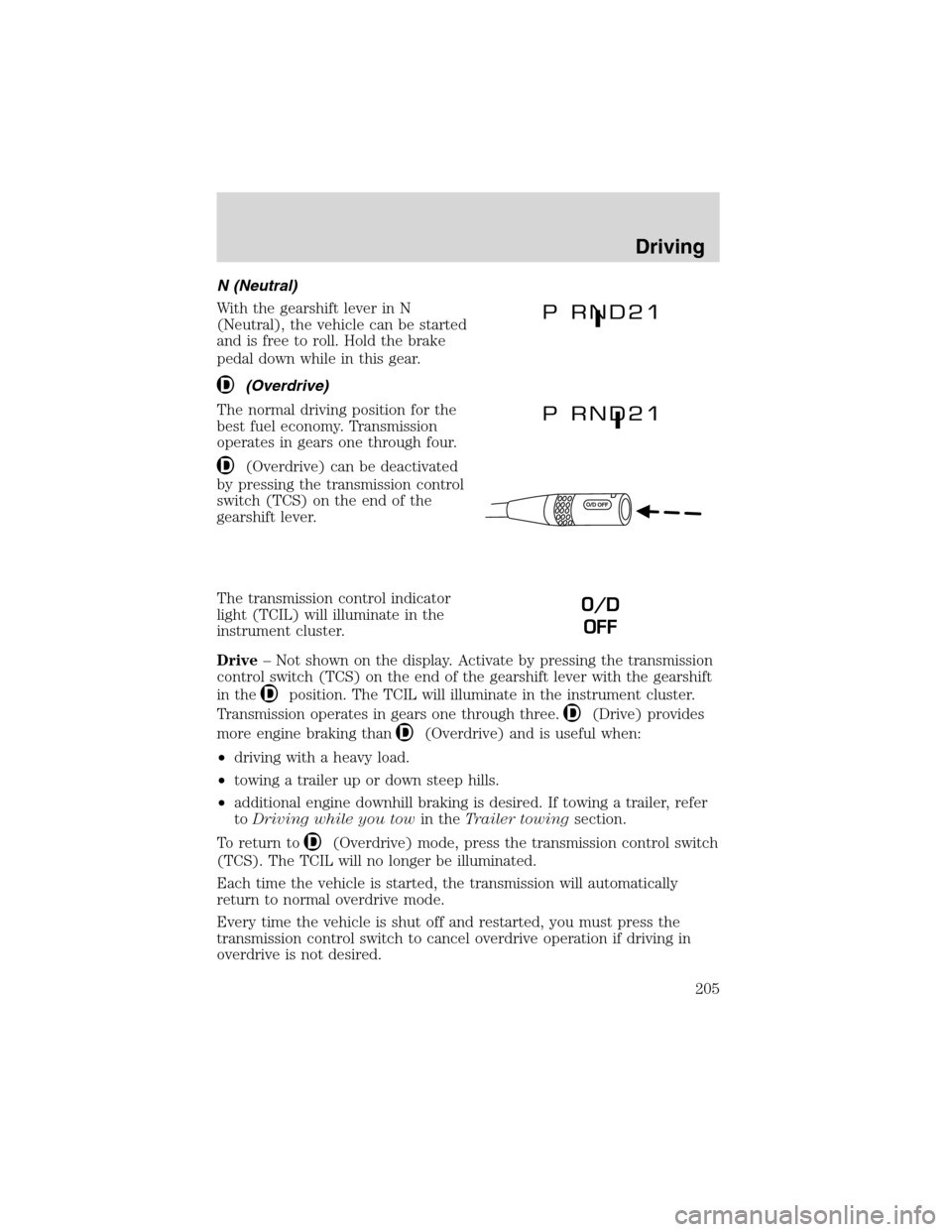
N (Neutral)
With the gearshift lever in N
(Neutral), the vehicle can be started
and is free to roll. Hold the brake
pedal down while in this gear.
(Overdrive)
The normal driving position for the
best fuel economy. Transmission
operates in gears one through four.
(Overdrive) can be deactivated
by pressing the transmission control
switch (TCS) on the end of the
gearshift lever.
The transmission control indicator
light (TCIL) will illuminate in the
instrument cluster.
Drive–Not shown on the display. Activate by pressing the transmission
control switch (TCS) on the end of the gearshift lever with the gearshift
in the
position. The TCIL will illuminate in the instrument cluster.
Transmission operates in gears one through three.
(Drive) provides
more engine braking than
(Overdrive) and is useful when:
•driving with a heavy load.
•towing a trailer up or down steep hills.
•additional engine downhill braking is desired. If towing a trailer, refer
toDriving while you towin theTrailer towingsection.
To return to
(Overdrive) mode, press the transmission control switch
(TCS). The TCIL will no longer be illuminated.
Each time the vehicle is started, the transmission will automatically
return to normal overdrive mode.
Every time the vehicle is shut off and restarted, you must press the
transmission control switch to cancel overdrive operation if driving in
overdrive is not desired.
O/D
OFF
Driving
205
Page 208 of 320
Always keep the sensors (located on the rear bumper/fascia) free
from dirt, snow and ice (do not clean the sensors with sharp
objects). These elements may cause the system to operate
inaccurately.
If the vehicle sustains damage to the rear bumper/fascia, leaving
it misaligned or bent, the sensing zone may be altered causing
inaccurate measurement of obstacles or false alarms.
CONTROL TRAC FOUR-WHEEL DRIVE (4X4) OPERATION
(IF EQUIPPED)
For important information regarding safe operation of this type
of vehicle, seePreparing to drive your vehiclein this chapter.
If equipped with the Control Trac 4x4 System, and 4L (4x4 LOW)
is selected while the vehicle is moving, the system will not
engage. This is normal and should be no reason for concern.
Before 4L (4x4 LOW) can be engaged, the vehicle must be
brought to a complete stop, the brake pedal depressed and the
transmission placed in N (Neutral).
The vehicle should not be operated in 4H (4x4 HIGH) or 4L (4x4 LOW)
on dry pavement. Doing so could result in difficult disengagement of the
transfer case, increased tire wear, decreased fuel economy and may
damage driveline components.
Your 4x4 features the heavy-duty Control Trac system which includes a
computer-operated transfer case. This unique system is interactive with
the road, continually monitoring and adjusting torque delivery to the
front and rear wheels to optimize vehicle control.
System indicator lights
The Control Trac system indicator lights illuminate only under the
following conditions. If these lights illuminate when driving in 2H or
A4WD, contact your Ford dealer as soon as possible.
•4X4 HIGH- momentarily
illuminates when the vehicle is
started. Illuminates when 4H is
selected.
4x4
HIGH
Driving
208
Page 218 of 320
front door latch post pillar (a label may also be found on the fuel cap
filler door). Failure to follow tire pressure recommendations can
adversely affect the way your vehicle handles. Do not exceed the Ford
Motor Company recommended pressure even if it is less than the
maximum pressure allowed for the tire.
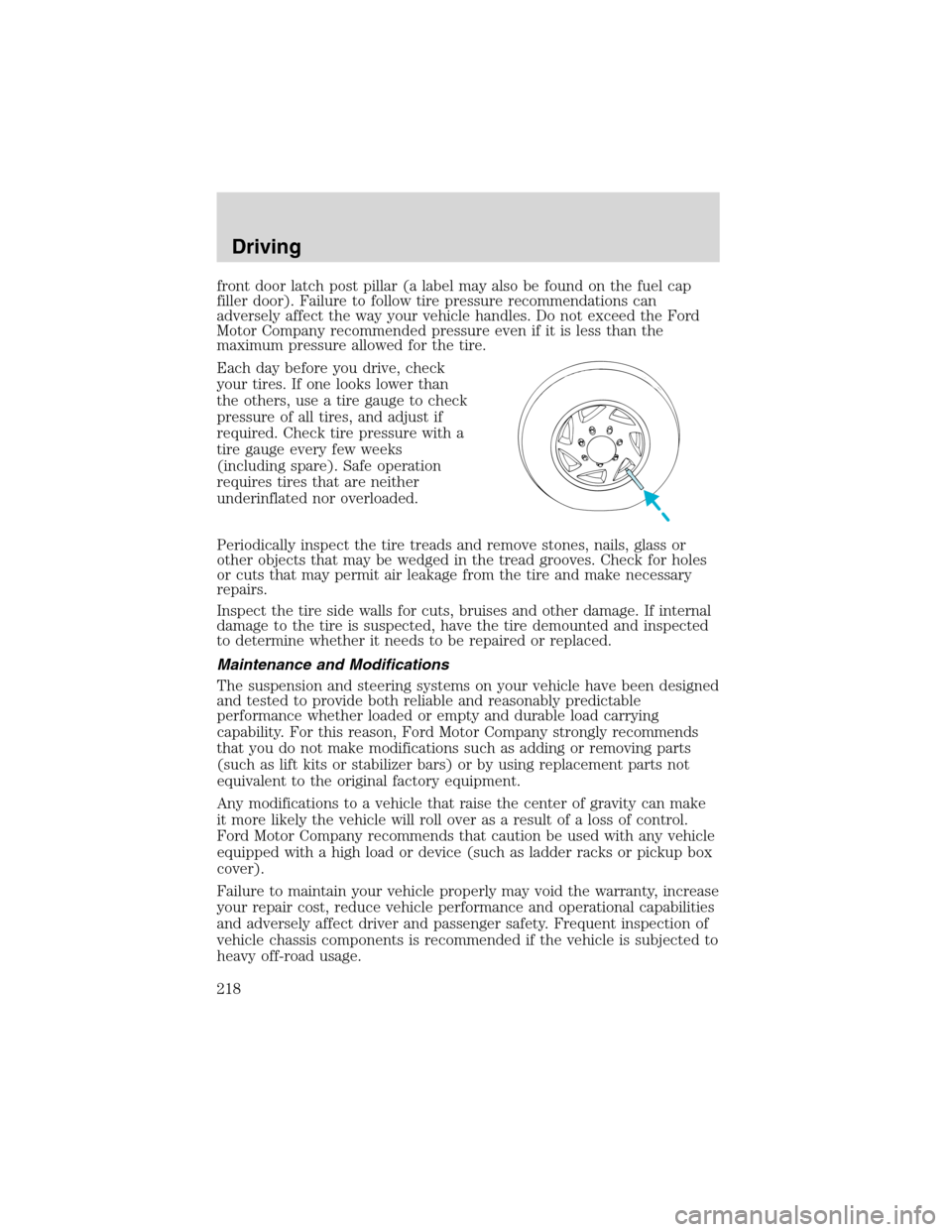
Each day before you drive, check
your tires. If one looks lower than
the others, use a tire gauge to check
pressure of all tires, and adjust if
required. Check tire pressure with a
tire gauge every few weeks
(including spare). Safe operation
requires tires that are neither
underinflated nor overloaded.
Periodically inspect the tire treads and remove stones, nails, glass or
other objects that may be wedged in the tread grooves. Check for holes
or cuts that may permit air leakage from the tire and make necessary
repairs.
Inspect the tire side walls for cuts, bruises and other damage. If internal
damage to the tire is suspected, have the tire demounted and inspected
to determine whether it needs to be repaired or replaced.
Maintenance and Modifications
The suspension and steering systems on your vehicle have been designed
and tested to provide both reliable and reasonably predictable
performance whether loaded or empty and durable load carrying
capability. For this reason, Ford Motor Company strongly recommends
that you do not make modifications such as adding or removing parts
(such as lift kits or stabilizer bars) or by using replacement parts not
equivalent to the original factory equipment.
Any modifications to a vehicle that raise the center of gravity can make
it more likely the vehicle will roll over as a result of a loss of control.
Ford Motor Company recommends that caution be used with any vehicle
equipped with a high load or device (such as ladder racks or pickup box
cover).
Failure to maintain your vehicle properly may void the warranty, increase
your repair cost, reduce vehicle performance and operational capabilities
and adversely affect driver and passenger safety. Frequent inspection of
vehicle chassis components is recommended if the vehicle is subjected to
heavy off-road usage.
Driving
218
Page 227 of 320

GETTING ROADSIDE ASSISTANCE
To fully assist you should you have a vehicle concern, Ford Motor
Company offers a complimentary roadside assistance program. This
program is separate from the New Vehicle Limited Warranty. The service
is available:
•24–hours, seven days a week
•for the New Vehicle Limited Warranty period of three years or 60,000
km (36,000 miles), whichever occurs first on Ford and Mercury
vehicles, and four years or 80,000 km (50,000 miles) on Lincoln
vehicles.
Roadside assistance will cover:
•changing a flat tire.
•jump-starts.
•lock-out assistance.
•limited fuel delivery.
•towing of your disabled vehicle to the nearest Ford Motor Company
dealership, or your selling dealer if within 56.3 km (35 miles) of the
nearest Ford Motor Company dealership (one tow per disablement).
Even non-warranty related tows, like accidents or getting stuck in the
mud or snow, are covered (some exclusions apply, such as impound
towing or repossession).
Canadian customers refer to your Owner Information Guide for
information on:
•Coverage period
•Exact fuel amounts
•Towing of your disabled vehicle
•Emergency travel expense reimbursement
•Travel planning benefits
USING ROADSIDE ASSISTANCE
Complete the roadside assistance identification card and place it in your
wallet for quick reference. In the United States, this card is found in the
Owner Guide portfolio in the glove compartment in Ford vehicles and is
mailed to you if you own a Mercury or Lincoln. In Canada, the card is
found in the Owner Information Guide in the glove compartment.
U.S. Ford or Mercury vehicle customers who require roadside assistance,
call 1–800–241–3673; Lincoln vehicle customers call 1–800–521–4140.
Roadside Emergencies
227
Page 228 of 320
Canadian customers who require roadside assistance, call
1–800–665–2006.
If you need to arrange roadside assistance for yourself, Ford Motor
Company will reimburse a reasonable amount. To obtain reimbursement
information, U.S. Ford or Mercury vehicles customers call
1-800-241-3673; Lincoln vehicle customers call 1–800–521–4140.
Canadian customers who need to obtain reimbursement information, call
1–800–665–2006.
ROADSIDE COVERAGE BEYOND BASIC WARRANTY
In the United States, you may purchase additional roadside assistance
coverage beyond this period through the Ford Auto Club by contacting
your Ford or Lincoln Mercury dealer.
Similarly in Canada, for uninterrupted Roadside Assistance coverage, you
may purchase extended coverage prior to your Basic Warranty’s Roadside
Assistance expiring. For more information and enrollment, contact
1–877–294–2582 or visit our website at www.ford.ca.
HAZARD FLASHER
Use only in an emergency to warn traffic of vehicle breakdown,
approaching danger, etc. The hazard flashers can be operated when the
ignition is off.
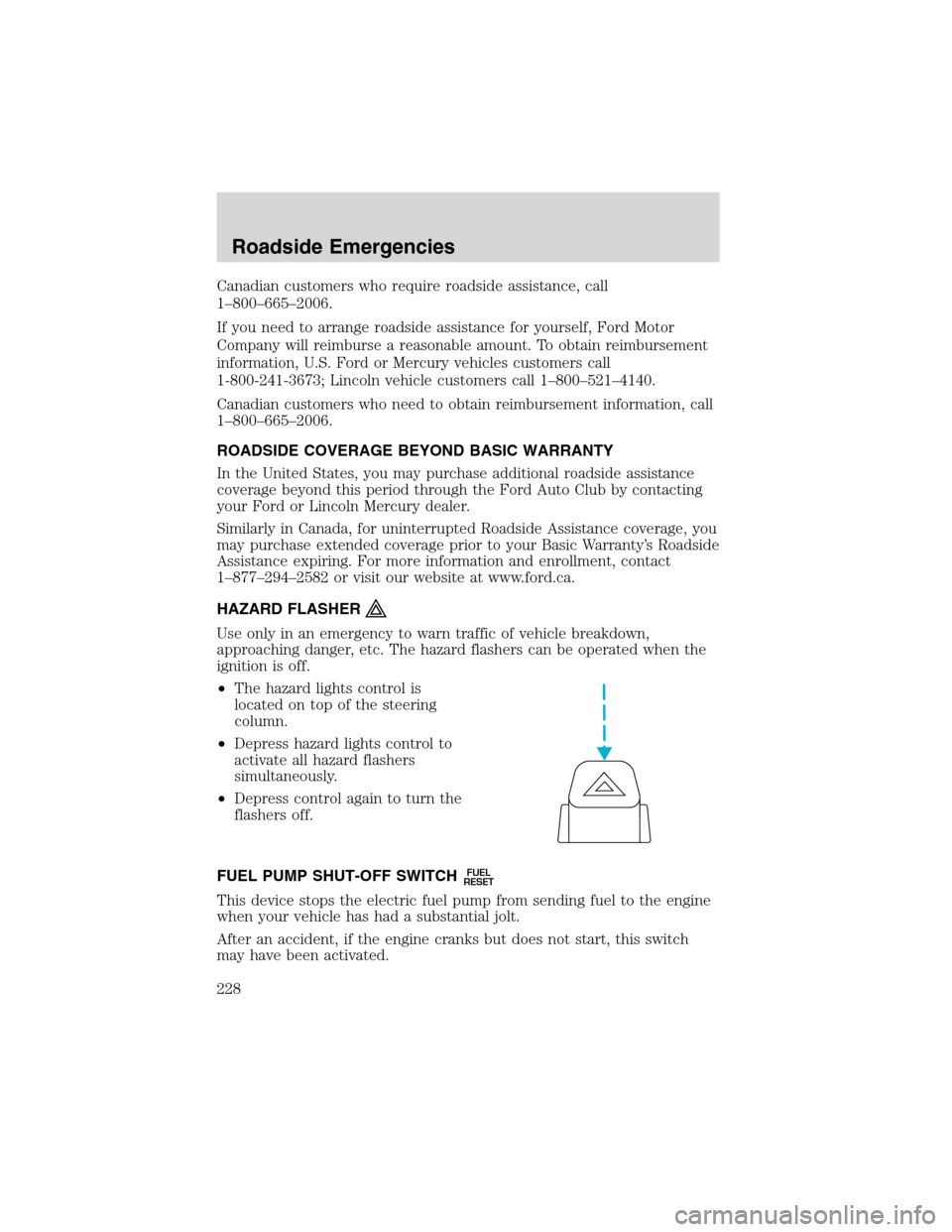
•The hazard lights control is
located on top of the steering
column.
•Depress hazard lights control to
activate all hazard flashers
simultaneously.
•Depress control again to turn the
flashers off.
FUEL PUMP SHUT-OFF SWITCH
FUEL
RESET
This device stops the electric fuel pump from sending fuel to the engine
when your vehicle has had a substantial jolt.
After an accident, if the engine cranks but does not start, this switch
may have been activated.
Roadside Emergencies
228
Page 229 of 320
The fuel pump shut-off switch is
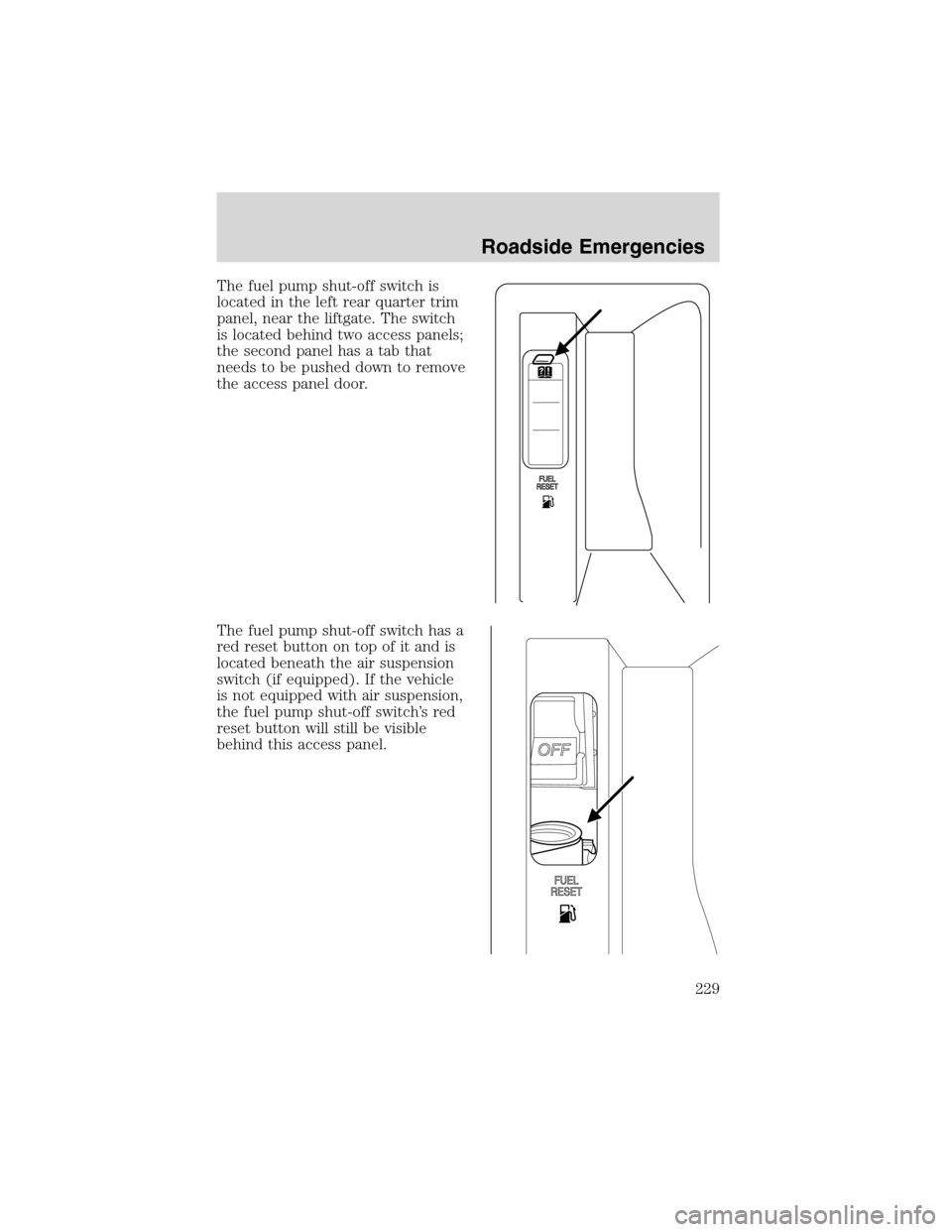
located in the left rear quarter trim
panel, near the liftgate. The switch
is located behind two access panels;
the second panel has a tab that
needs to be pushed down to remove
the access panel door.
The fuel pump shut-off switch has a
red reset button on top of it and is
located beneath the air suspension
switch (if equipped). If the vehicle
is not equipped with air suspension,
the fuel pump shut-off switch’s red
reset button will still be visible
behind this access panel.
Roadside Emergencies
229
Page 230 of 320
Use the following procedure to reset the fuel pump shut-off switch.
1. Turn the ignition to the OFF position.
2. Check the fuel system for leaks.
3. If no fuel leak is apparent, reset the fuel pump shut-off switch by
pushing in on the reset button.
4. Turn the ignition to the ON position. Pause for a few seconds and
return the key to the OFF position.
5. Make a further check for leaks in the fuel system.
FUSES AND RELAYS
Fuses
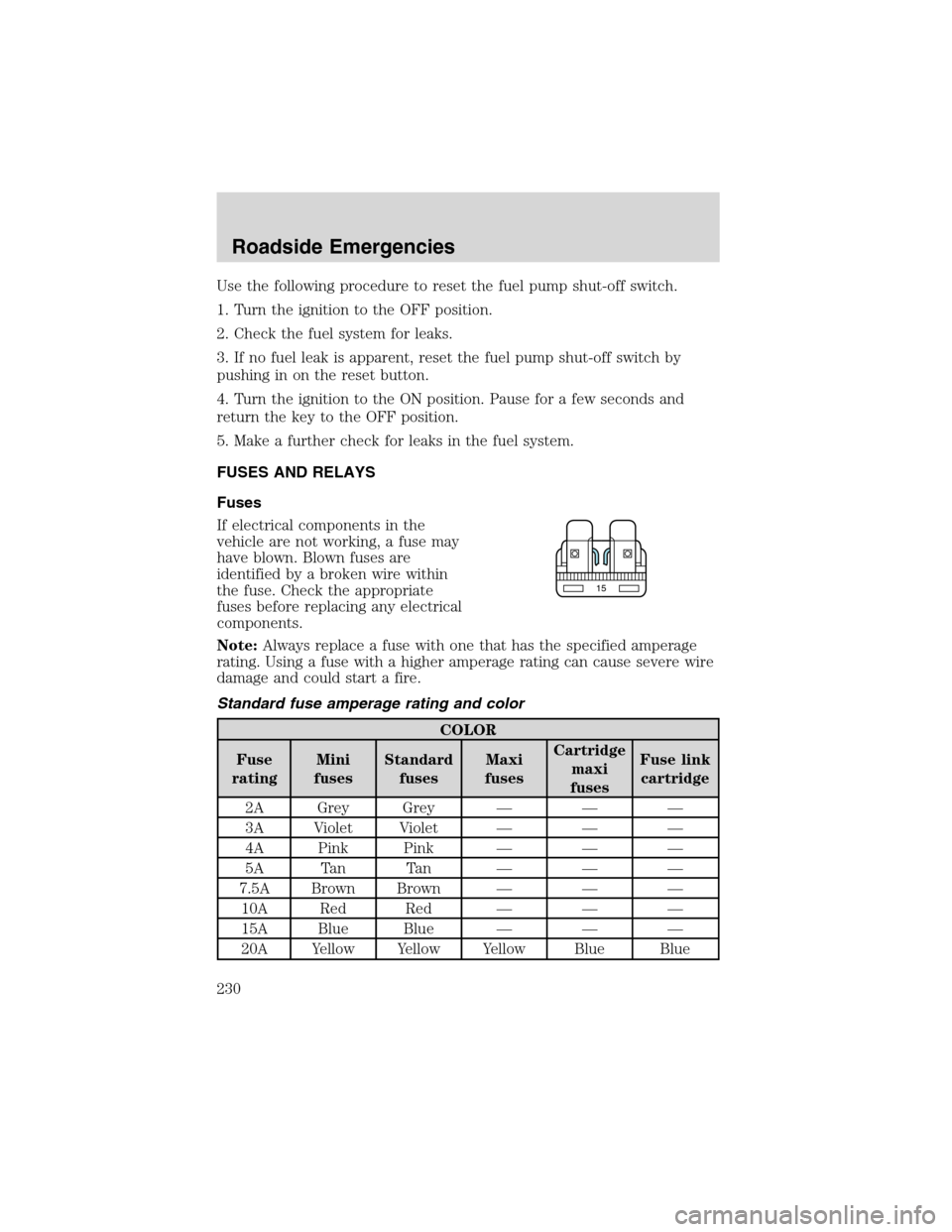
If electrical components in the
vehicle are not working, a fuse may
have blown. Blown fuses are
identified by a broken wire within
the fuse. Check the appropriate
fuses before replacing any electrical
components.
Note:Always replace a fuse with one that has the specified amperage
rating. Using a fuse with a higher amperage rating can cause severe wire
damage and could start a fire.
Standard fuse amperage rating and color
COLOR
Fuse
ratingMini
fusesStandard
fusesMaxi
fusesCartridge
maxi
fusesFuse link
cartridge
2A Grey Grey———
3A Violet Violet———
4A Pink Pink———
5A Tan Tan———
7.5A Brown Brown———
10A Red Red———
15A Blue Blue———
20A Yellow Yellow Yellow Blue Blue
15
Roadside Emergencies
230
Page 234 of 320
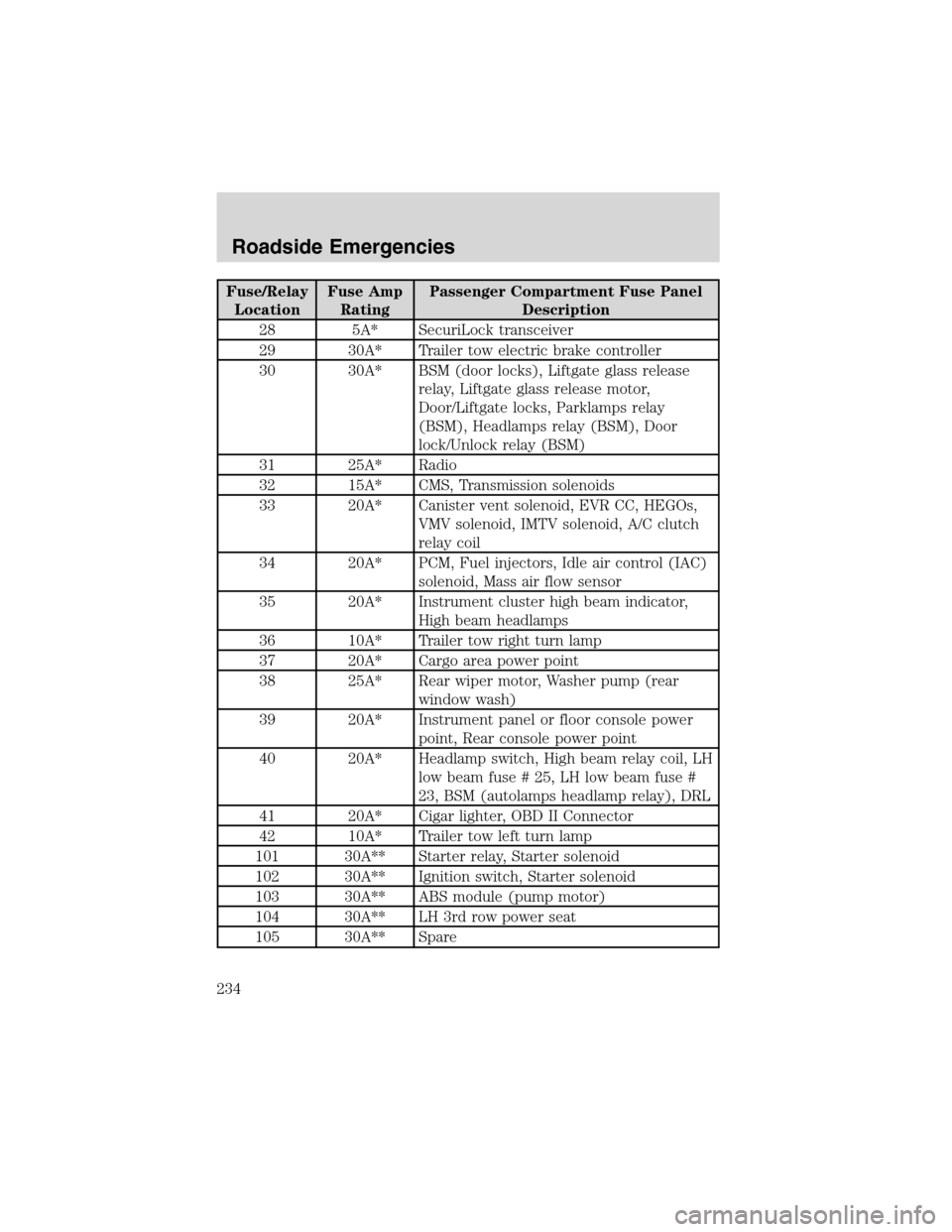
Fuse/Relay
LocationFuse Amp
RatingPassenger Compartment Fuse Panel
Description
28 5A* SecuriLock transceiver
29 30A* Trailer tow electric brake controller
30 30A* BSM (door locks), Liftgate glass release
relay, Liftgate glass release motor,
Door/Liftgate locks, Parklamps relay
(BSM), Headlamps relay (BSM), Door
lock/Unlock relay (BSM)
31 25A* Radio
32 15A* CMS, Transmission solenoids
33 20A* Canister vent solenoid, EVR CC, HEGOs,
VMV solenoid, IMTV solenoid, A/C clutch
relay coil
34 20A* PCM, Fuel injectors, Idle air control (IAC)
solenoid, Mass air flow sensor
35 20A* Instrument cluster high beam indicator,
High beam headlamps
36 10A* Trailer tow right turn lamp
37 20A* Cargo area power point
38 25A* Rear wiper motor, Washer pump (rear
window wash)
39 20A* Instrument panel or floor console power
point, Rear console power point
40 20A* Headlamp switch, High beam relay coil, LH
low beam fuse # 25, LH low beam fuse #
23, BSM (autolamps headlamp relay), DRL
41 20A* Cigar lighter, OBD II Connector
42 10A* Trailer tow left turn lamp
101 30A** Starter relay, Starter solenoid
102 30A** Ignition switch, Starter solenoid
103 30A** ABS module (pump motor)
104 30A** LH 3rd row power seat
105 30A** Spare
Roadside Emergencies
234
Page 236 of 320
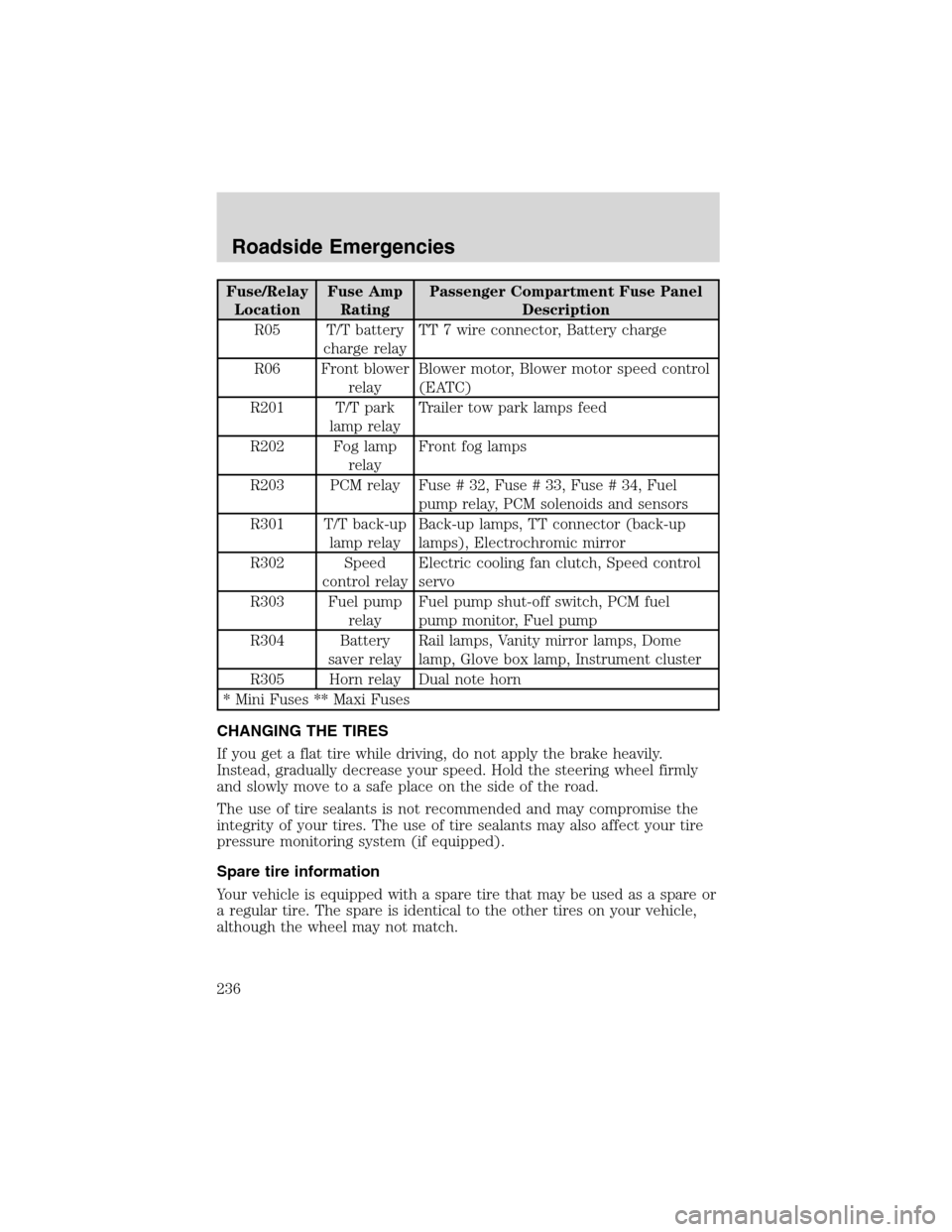
Fuse/Relay
LocationFuse Amp
RatingPassenger Compartment Fuse Panel
Description
R05 T/T battery
charge relayTT 7 wire connector, Battery charge
R06 Front blower
relayBlower motor, Blower motor speed control
(EATC)
R201 T/T park
lamp relayTrailer tow park lamps feed
R202 Fog lamp
relayFront fog lamps
R203 PCM relay Fuse # 32, Fuse # 33, Fuse # 34, Fuel
pump relay, PCM solenoids and sensors
R301 T/T back-up
lamp relayBack-up lamps, TT connector (back-up
lamps), Electrochromic mirror
R302 Speed
control relayElectric cooling fan clutch, Speed control
servo
R303 Fuel pump
relayFuel pump shut-off switch, PCM fuel
pump monitor, Fuel pump
R304 Battery
saver relayRail lamps, Vanity mirror lamps, Dome
lamp, Glove box lamp, Instrument cluster
R305 Horn relay Dual note horn
* Mini Fuses ** Maxi Fuses
CHANGING THE TIRES
If you get a flat tire while driving, do not apply the brake heavily.
Instead, gradually decrease your speed. Hold the steering wheel firmly
and slowly move to a safe place on the side of the road.
The use of tire sealants is not recommended and may compromise the
integrity of your tires. The use of tire sealants may also affect your tire
pressure monitoring system (if equipped).
Spare tire information
Your vehicle is equipped with a spare tire that may be used as a spare or
a regular tire. The spare is identical to the other tires on your vehicle,
although the wheel may not match.
Roadside Emergencies
236
Page 244 of 320
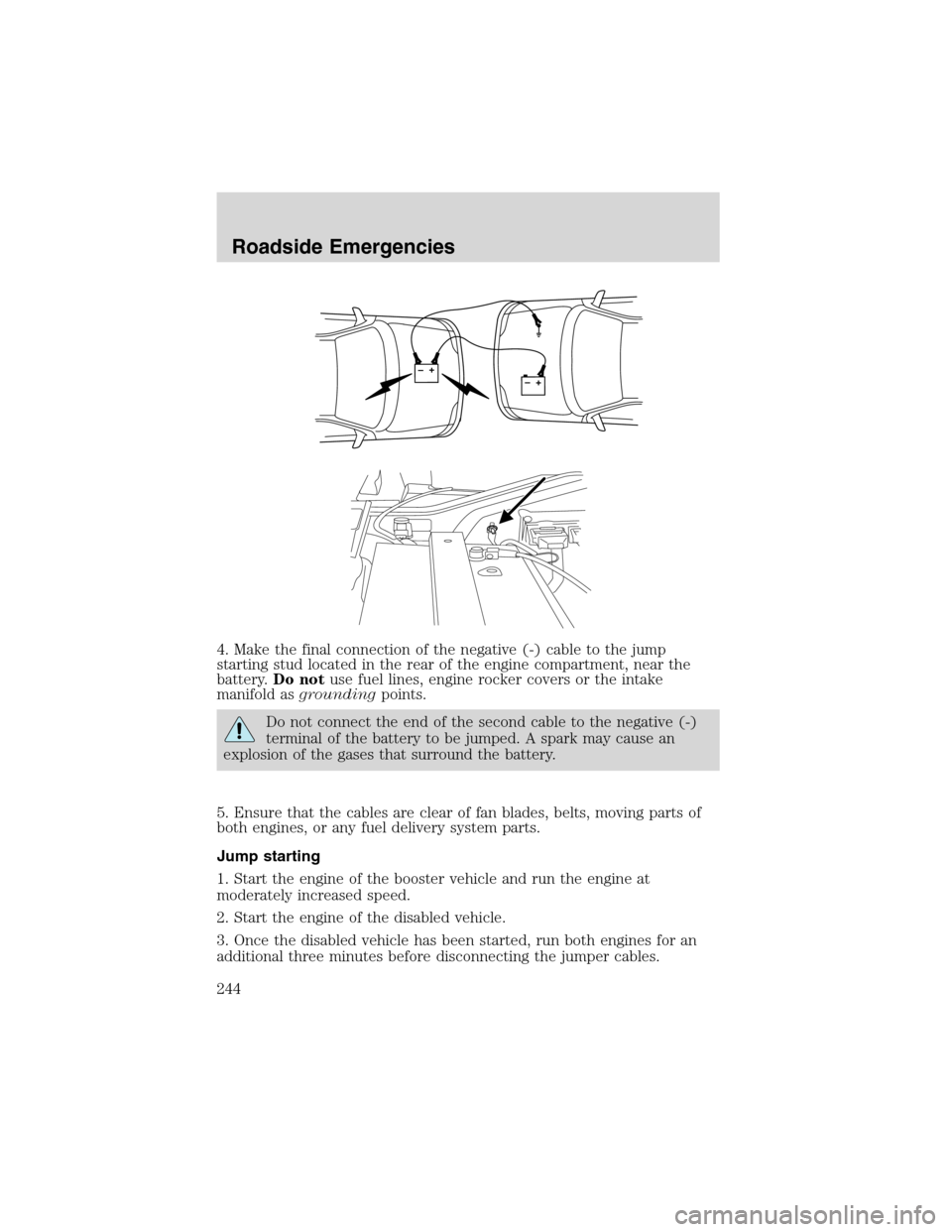
4. Make the final connection of the negative (-) cable to the jump
starting stud located in the rear of the engine compartment, near the
battery.Do notuse fuel lines, engine rocker covers or the intake
manifold asgroundingpoints.
Do not connect the end of the second cable to the negative (-)
terminal of the battery to be jumped. A spark may cause an
explosion of the gases that surround the battery.
5. Ensure that the cables are clear of fan blades, belts, moving parts of
both engines, or any fuel delivery system parts.
Jump starting
1. Start the engine of the booster vehicle and run the engine at
moderately increased speed.
2. Start the engine of the disabled vehicle.
3. Once the disabled vehicle has been started, run both engines for an
additional three minutes before disconnecting the jumper cables.
+–+–
Roadside Emergencies
244