light FORD EXPLORER 1997 2.G Owner's Manual
[x] Cancel search | Manufacturer: FORD, Model Year: 1997, Model line: EXPLORER, Model: FORD EXPLORER 1997 2.GPages: 236, PDF Size: 2.43 MB
Page 86 of 236
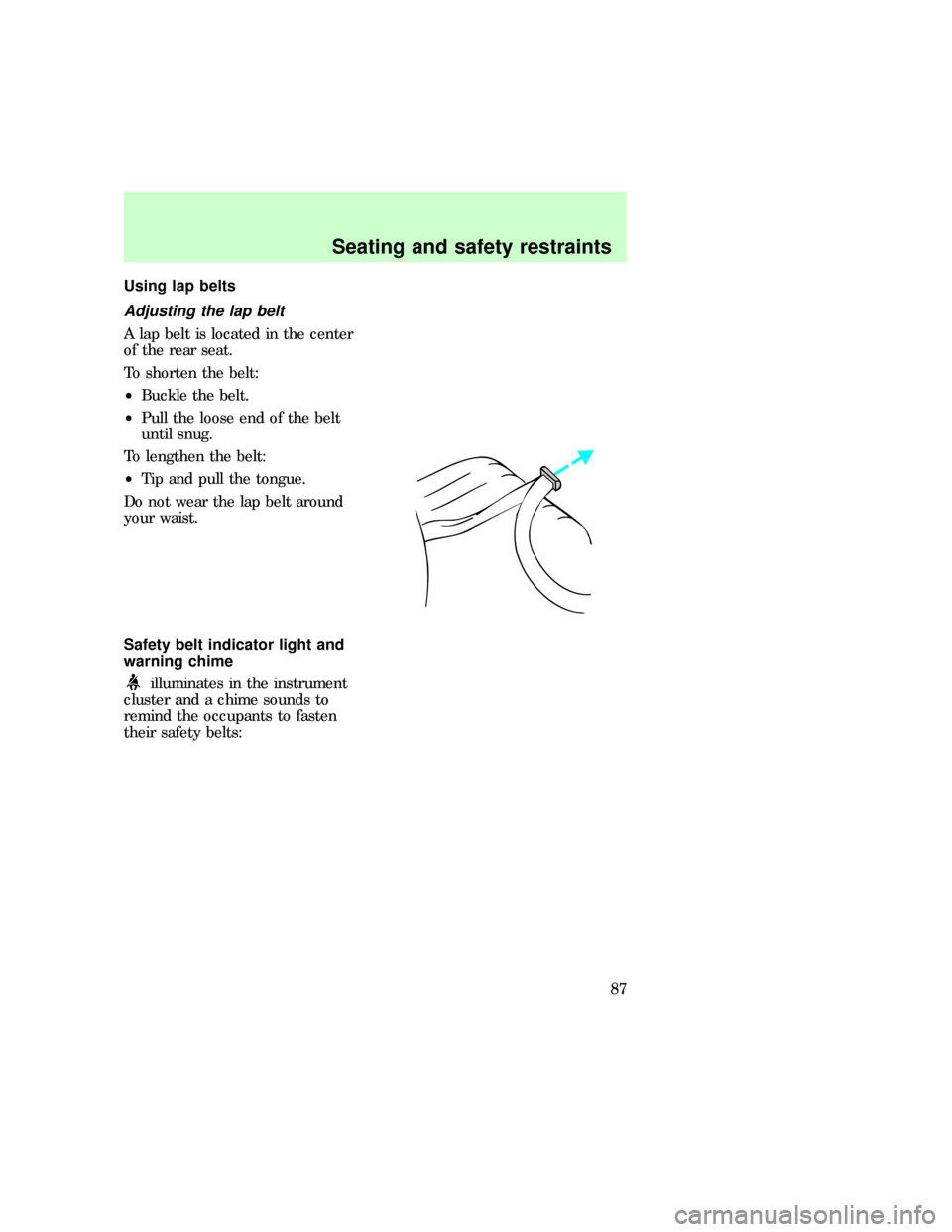
Using lap belts
Adjusting the lap belt
A lap belt is located in the center
of the rear seat.
To shorten the belt:
²Buckle the belt.
²Pull the loose end of the belt
until snug.
To lengthen the belt:
²Tip and pull the tongue.
Do not wear the lap belt around
your waist.
Safety belt indicator light and
warning chime
illuminates in the instrument
cluster and a chime sounds to
remind the occupants to fasten
their safety belts:
uno_adjusting_lap_belts
uno_indicator_light
Seating and safety restraints
87
Page 87 of 236
Conditions of operation
If......Then.....
The driver's safety belt is not
buckled before the ignition key
is turned to On. .The safety belt indicator illuminates
for 1-2 minutes and the warning
chime sounds for 4- 8 seconds.
The driver's safety belt is
buckled while the indicator
light is illuminated and the
reminder chime is sounding . .
.The safety belt indicator light and
reminder chime turn off.
The driver's safety belt is
buckled before the ignition key
is turned to On. . .The safety belt indicator light and
reminder chime remain off.
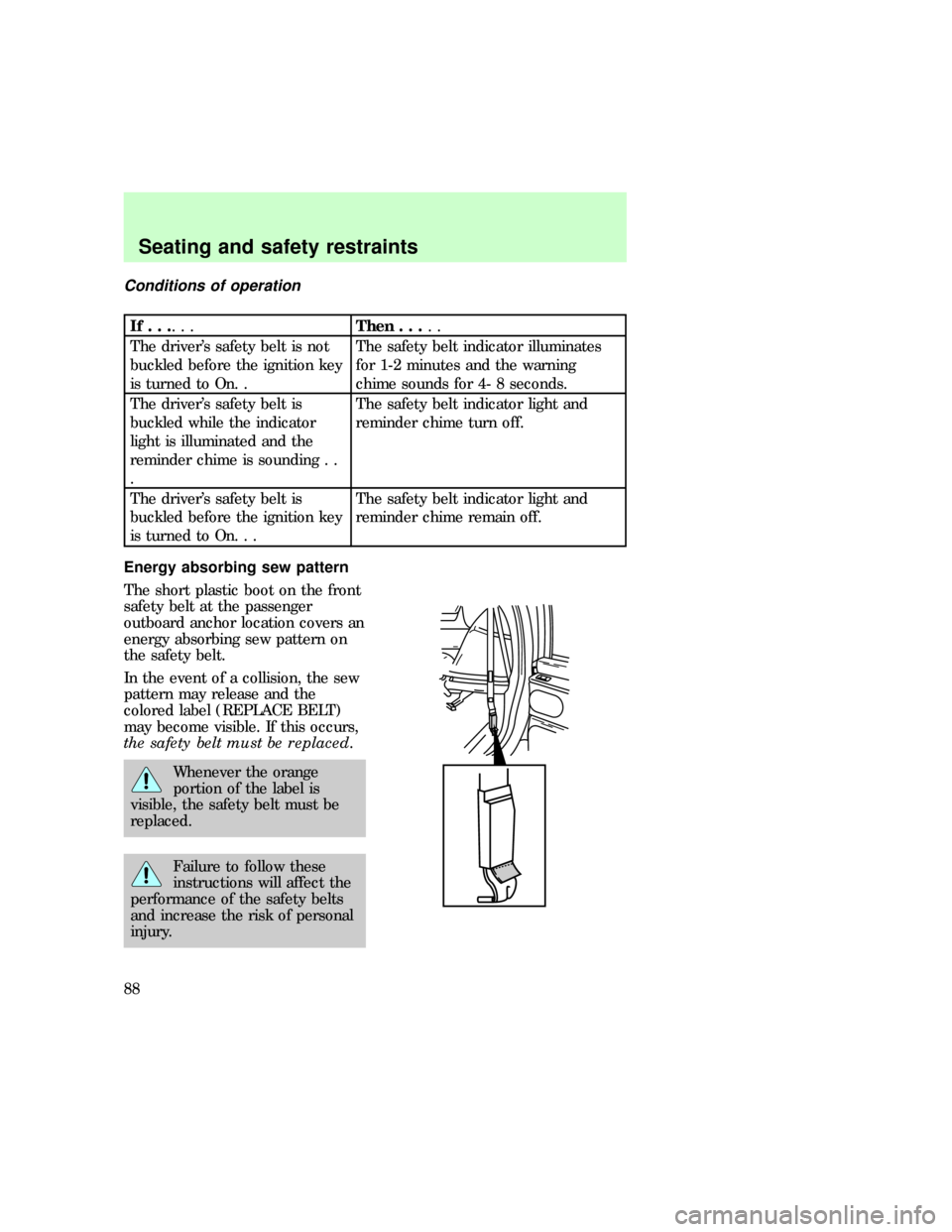
Energy absorbing sew pattern
The short plastic boot on the front
safety belt at the passenger
outboard anchor location covers an
energy absorbing sew pattern on
the safety belt.
In the event of a collision, the sew
pattern may release and the
colored label (REPLACE BELT)
may become visible. If this occurs,
the safety belt must be replaced.
Whenever the orange
portion of the label is
visible, the safety belt must be
replaced.
Failure to follow these
instructions will affect the
performance of the safety belts
and increase the risk of personal
injury.
uno_sbelt_maint
uno_sbelt_extension
Seating and safety restraints
88
Page 91 of 236
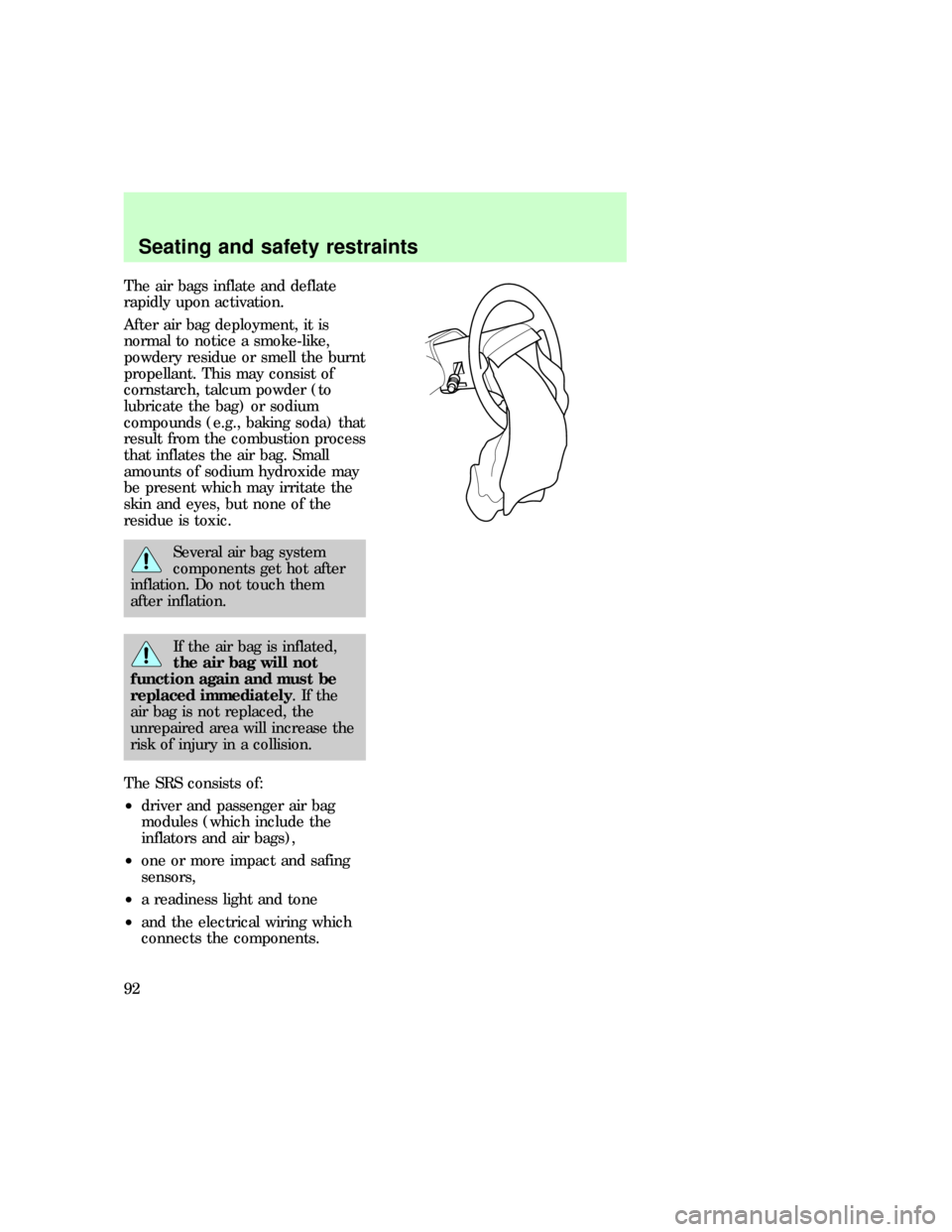
The air bags inflate and deflate
rapidly upon activation.
After air bag deployment, it is
normal to notice a smoke-like,
powdery residue or smell the burnt
propellant. This may consist of
cornstarch, talcum powder (to
lubricate the bag) or sodium
compounds (e.g., baking soda) that
result from the combustion process
that inflates the air bag. Small
amounts of sodium hydroxide may
be present which may irritate the
skin and eyes, but none of the
residue is toxic.
Several air bag system
components get hot after
inflation. Do not touch them
after inflation.
If the air bag is inflated,
the air bag will not
function again and must be
replaced immediately.Ifthe
air bag is not replaced, the
unrepaired area will increase the
risk of injury in a collision.
The SRS consists of:
²driver and passenger air bag
modules (which include the
inflators and air bags),
²one or more impact and safing
sensors,
²a readiness light and tone
²and the electrical wiring which
connects the components.
Seating and safety restraints
92
Page 92 of 236

The diagnostic module monitors its
own internal circuits and the
supplemental air bag electrical
system readiness (including the
impact sensors), the system wiring,
the air bag system readiness light,
the air bag back up power and the
air bag ignitors.
Determining if the system is
operational
The SRS uses a readiness light in
the instrument cluster or a tone to
indicate the condition of the
system. Refer to theAir bag
readinesssection in the
Instrumentationchapter. Routine
maintenance of the air bag is not
required.
A difficulty with the system is
indicated by one or more of the
following:
²The readiness light will either
flash or stay lit.
²The readiness light will not
illuminate immediately after
ignition is turned on.
²A group of five beeps will be
heard. The tone pattern will
repeat periodically until the
problem and light are repaired.
If any of these things happen, even
intermittently, have the SRS
serviced at your dealership or by a
qualified technician immediately.
Unless serviced, the system may
not function properly in the event
of a collision.
uno_determing_operational
com_disposal.01
Seating and safety restraints
93
Page 114 of 236
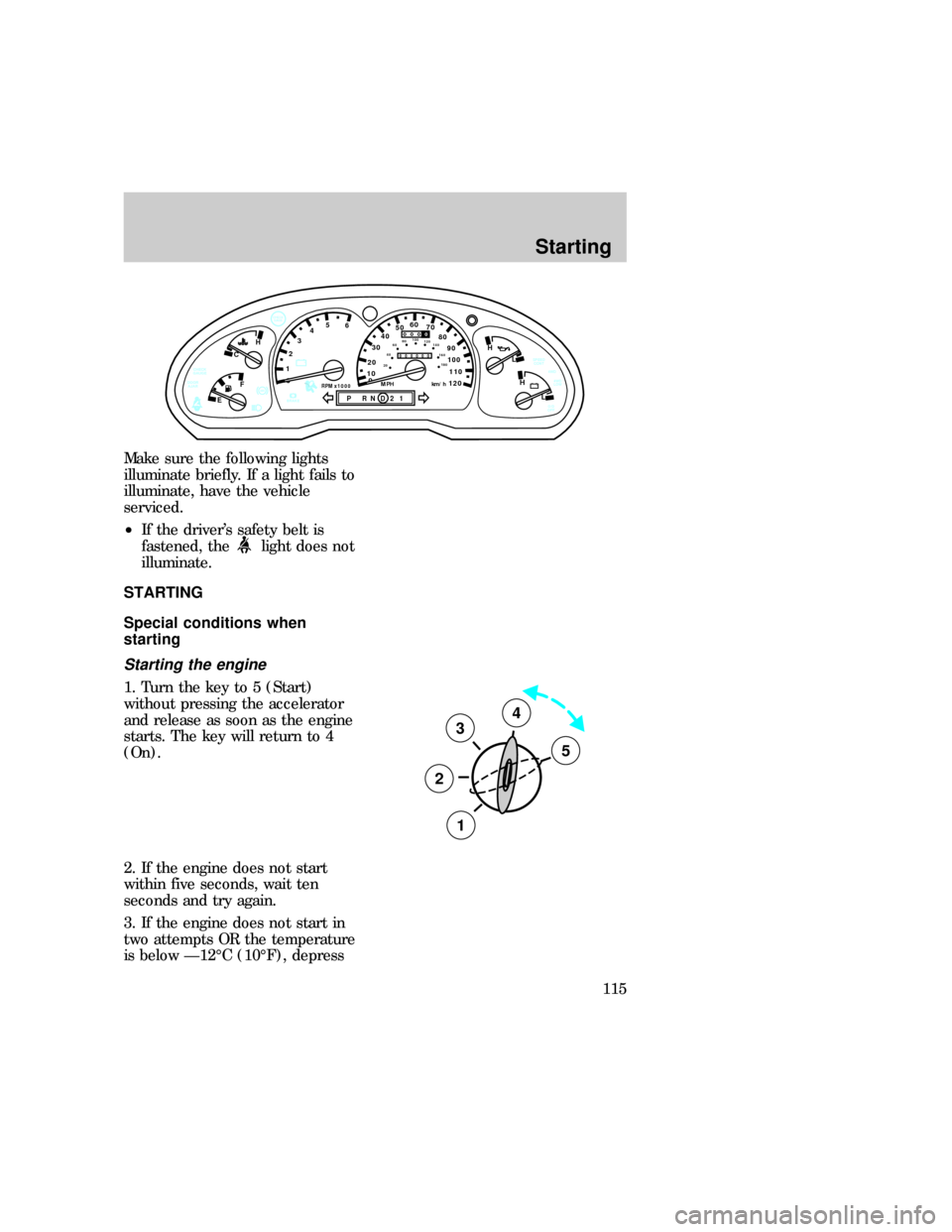
Make sure the following lights
illuminate briefly. If a light fails to
illuminate, have the vehicle
serviced.
²If the driver's safety belt is
fastened, the
light does not
illuminate.
STARTING
Special conditions when
starting
Starting the engine
1. Turn the key to 5 (Start)
without pressing the accelerator
and release as soon as the engine
starts. The key will return to 4
(On).
2. If the engine does not start
within five seconds, wait ten
seconds and try again.
3. If the engine does not start in
two attempts OR the temperature
is below Ð12ÉC (10ÉF), depress
0ABS
- +
P RND21RPM x 1000
12345
6- +
H
H
L LH
C
F
E
!BRAKE
CHECK
GAGE
0
20
1030405060
70
80
90
110
120000000
oooo
10020406080100
120
140
160
180
MPH km/hDOOR
AJARCHECK
GAUGE
O/D
OFF4WD
LOW 4WD SPEED
CONT
3
2
1
5
4
uno_special_conditions_title
uno_starting_vehicle
Starting
115
Page 121 of 236

the brake pedal is depressed. If
you cannot move the gearshift
lever from P (Park) with the brake
pedal depressed:
1. Apply the parking brake.
2. Turn the ignition key to Lock,
then remove the key.
3. Insert the key and turn the
ignition off.
4. Apply the brake pedal and shift
into N (Neutral).
5. Start the vehicle.
If it is necessary to use this
procedure to move the gearshift
lever , it is possible that a fuse
may have blown and the vehicle's
brakelamps may not be working.
Refer toFuses and relaysin the
Roadside emergencieschapter.
Driving (4R70W
transmission-5.0L engines only)
DOverdriveThe normal driving
position for the best fuel economy.
Transmission operates in gears one
through four.
Dcan be deactivated by pressing
the switch selector lever. The
O/D
OFFlight will illuminate.
D DriveNot shown on the display.
Activate by pressing the
transmission control switch.
O/D
OFFwill illuminate in the
instrument cluster. Transmission
operates in gears one through
three. D (Drive) provides more
engine braking than
D(Overdrive) and is useful when
uno_4r70w
Driving
122
Page 128 of 236

Using the Control Trac system
Shifting between 4WD AUTO
and 4WD HIGH
Either shift can be done at a stop,
or at any forward speed.
²The 4WD HIGH light will
illuminate when you switch the
control to 4WD HIGH or turn off
if you switch to 4WD AUTO.
Shifting from 4WD AUTO or
4WD HIGH to 4WD LOW
To perform this shift, complete the
following steps:
1. Stop the vehicle and depress the
brake.
2. Place the automatic
transmission in N (Neutral) or
depress the manual transmission
clutch.
3. Rotate the 4WD control to 4WD
LOW.
Shifting from 4WD LOW to 4WD
AUTO or 4WD HIGH
To perform this shift, complete the
following steps:
1. Bring the vehicle to a stop.
2. Depress and hold the brake.
3. Place the automatic
transmission gearshift lever in N
(Neutral) or depress the manual
transmission clutch.
4. Move the 4WD control to the
4WD AUTO or 4WD HIGH position.
uno_2h_to_4h
uno_4h_to_2h
uno_4h_to_4l
uno_driving_off_road
Driving
129
Page 130 of 236

accelerator slowly and avoid
spinning the wheels.
Driving through mud and water
After driving through mud, clean
off residue stuck to rotating
driveshafts and tires. Excess mud
stuck on tires and rotating
driveshafts causes an imbalance
that could damage drive
components.
If you must drive through high
water, drive slowly. Traction or
brake capability may be limited.
When driving through water,
determine the depth; avoid water
higher than the bottom of the hubs
(if possible) and proceed slowly. If
the ignition system gets wet, the
vehicle may stall.
Once through water, always try the
brakes. Wet brakes do not stop the
vehicle as effectively as dry brakes.
Drying can be improved by moving
your vehicle slowly while applying
light pressure on the brake pedal.
If the transmission and transfer
case are submerged in water, their
fluids should be checked and
changed, if necessary.
If the rear axle is submerged in
water, the rear axle lubricant
should be checked and changed, if
necessary. The rear axle is filled
with a synthetic lubricant and does
not normally require a lubricant
change for the life of the vehicle.
Rear axle lubricant quantities
should not need to be checked
unless a leak is suspected.
uno_driving_mud_water
uno_driving_hill
Driving
131
Page 131 of 236

Driving Through Water
Do not drive quickly through
standing water, especially if the
depth is unknown. Traction or
brake capability may be limited
and if the ignition system gets wet,
your engine may stall. Water may
also enter your engine's air intake
and severely damage your engine.
If driving through deep or standing
water is unavoidable, proceed very
slowly. Never drive through water
that is higher than the bottom of
the hubs (truck) / wheel rims
(car).
Once through the water, always try
the brakes. Wet brakes do not stop
the vehicle as effectively as dry
brakes. Drying can be improved by
moving your vehicle slowly while
applying light pressure on the
brake pedal.
Driving on hill or slope terrain
When driving on a hill, avoid
driving crosswise or turning on
steep slopes. You could lose
traction and slip sideways. Drive
straight up, straight down or avoid
the hill completely. Know the
conditions on the other side of a
hill before driving over the crest.
When climbing a steep hill, start in
a lower gear rather than
downshifting to a lower gear from
a higher gear once the ascent has
started. This reduces strain on the
engine and the possibility of
stalling.
Driving
132
Page 133 of 236

Allow more stopping distance and
drive slower than usual. Consider
using one of the lower gears.
Control trac system indicator
lights
4WD and 4WD LOW indicator
lights are located in the instrument
cluster. If either light flashes, see
your dealer or qualified service
technician.
The indicator lights will also
illuminate under the following
conditions:
²4WD AUTO modeÐ Neither
light will illuminate.
²4WD HIGH modeÐ Only the
4WD high light illuminates.
²4WD LOW modeÐ The 4WD
LOW light illuminates.
ALL WHEEL DRIVE (AWD)
SYSTEM (5.0L ENGINES ONLY)
Your vehicle is equipped with an
all wheel drive (AWD) transfer
case. Power is constantly supplied
to all four wheels through the
transfer case. The AWD system is
full time and has no external
controls.
Like all utility type vehicles, your
AWD vehicle has special design
and equipment features that make
it capable of performing in a
variety of off-road applications.
Specific design characteristics give
these vehicles higher centers of
gravity than ordinary passenger
cars.
4WD
4WD
LOW
uno_indicator_lights
uno_awd
Driving
134