engine FORD EXPLORER 1997 2.G Owner's Guide
[x] Cancel search | Manufacturer: FORD, Model Year: 1997, Model line: EXPLORER, Model: FORD EXPLORER 1997 2.GPages: 236, PDF Size: 2.43 MB
Page 137 of 236

TRAILER TOWING
Trailer towing with your vehicle
may require the use of a trailer
tow option package.
Trailer towing puts additional loads
on your vehicle's engine,
transmission, axle, brakes, tires,
and suspension. For your safety
and to maximize vehicle
performance, be sure to use the
proper equipment while towing.
Follow these guidelines to ensure
safe towing procedure:
²Stay within your vehicle's load
limits.
²Thoroughly prepare your vehicle
for towing. Refer toPreparing
to towin this chapter.
²Use extra caution when driving
while trailer towing. Refer to
Driving while towingin this
chapter.
²Service your vehicle more
frequently if you tow a trailer.
Refer to the severe duty
schedule in the ªService Guideº.
²Do not tow a trailer until your
vehicle has been driven at least
800 km (500 miles).
²Refer to the instructions
included with towing accessories
for the proper installation and
adjustment specifications.
²Speed control may shut off if
you are towing on long, steep
grades.
Driving
138
Page 138 of 236
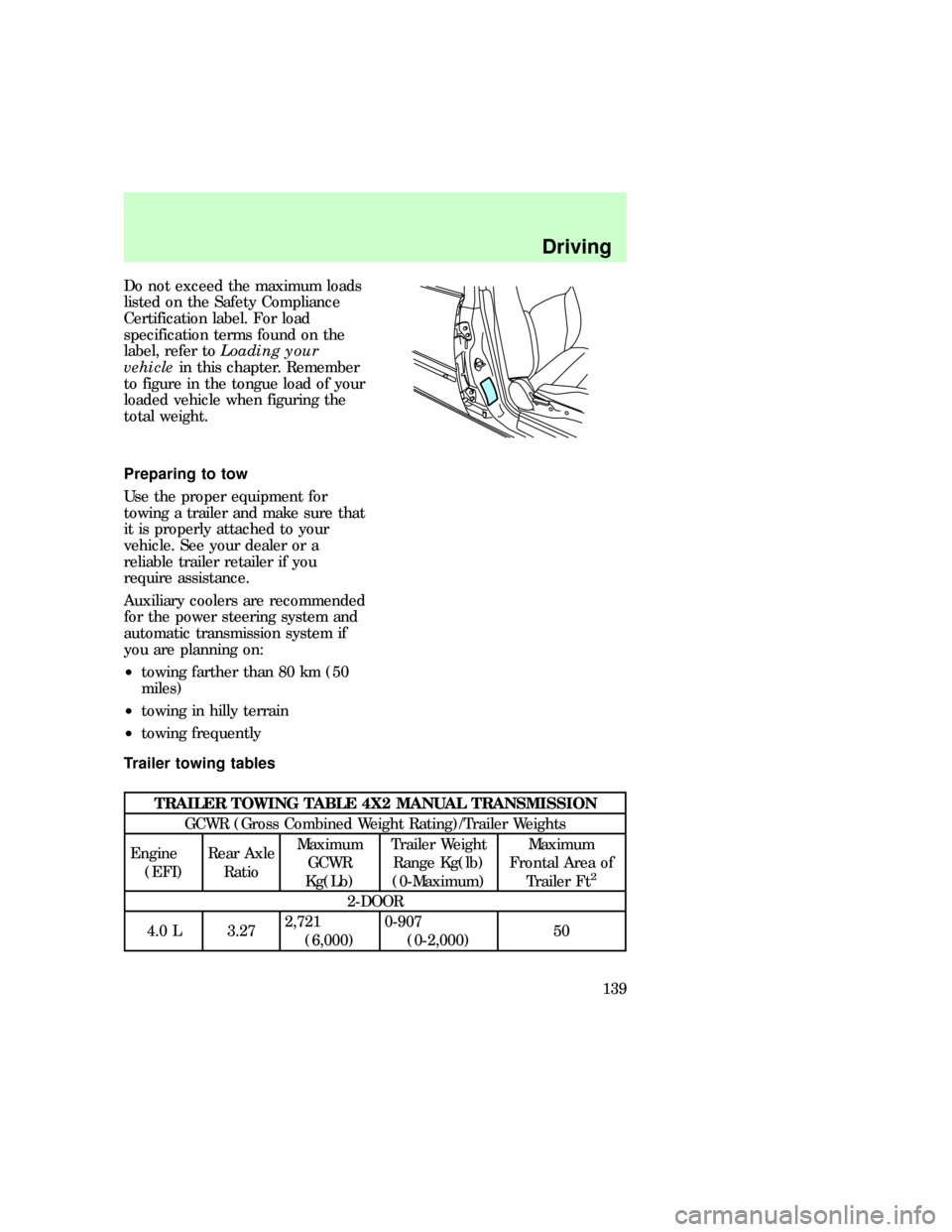
Do not exceed the maximum loads
listed on the Safety Compliance
Certification label. For load
specification terms found on the
label, refer toLoading your
vehiclein this chapter. Remember
to figure in the tongue load of your
loaded vehicle when figuring the
total weight.
Preparing to tow
Use the proper equipment for
towing a trailer and make sure that
it is properly attached to your
vehicle. See your dealer or a
reliable trailer retailer if you
require assistance.
Auxiliary coolers are recommended
for the power steering system and
automatic transmission system if
you are planning on:
²towing farther than 80 km (50
miles)
²towing in hilly terrain
²towing frequently
Trailer towing tables
TRAILER TOWING TABLE 4X2 MANUAL TRANSMISSION
GCWR (Gross Combined Weight Rating)/Trailer Weights
Engine
(EFI)Rear Axle
RatioMaximum
GCWR
Kg(Lb)Trailer Weight
Range Kg(lb)
(0-Maximum)Maximum
Frontal Area of
Trailer Ft
2
2-DOOR
4.0 L 3.272,721
(6,000)0-907
(0-2,000)50
uno_preparing_to_tow_title
uno_tables_towing
Driving
139
Page 140 of 236

TRAILER TOWING TABLE 4X2 AUTOMATIC TRANSMISSION
GCWR (Gross Combined Weight Rating)/Trailer Weights
Engine
(EFI)Rear Axle
RatioMaximum
GCWR
Kg(Lb)Trailer Weight
Range Kg(Lb)
0-MaximumMaximum
Frontal Area of
Trailer Ft
2
2-DOOR
4.0 L3.27 3,175
(7,000)0-1,360
(0-3,000)50
4.0 L3.55 3,628
(8,000)0-1,814
(0-4,000)50
4.0 L3.73 4,082
(9,000)0-2,267
(0-5,000)50
4-DOOR
4.0 L 3.554,082
(9,000)0-2,177
(0-4800)50
4.0 L 3.734,535
(10,000)0-2,630
(0-5,800)50
4.0 L 4.104,535
(10,000)0-2,630
(0-5,800)50
5.0 L 3.734,990
(11,080)0-3,039
(0-6,700)50
TRAILER TOWING TABLE 4X4 AUTOMATIC TRANSMISSION
GCWR (Gross Combined Weight Rating)/Trailer Weights
2-DOOR
4.0 L3.27 3,175
(7,000)0-1,270
(0-2,800)50
4.0 L3.55 3,628
(8,000)0-1,723
(0-3,800)50
4.0 L3.73 4,082
(9,000)0-2,177
(0-4,800)50
4-DOOR
4.0 L 3.554,082
(9,000)0-2,086
(0-4,600)50
Driving
141
Page 146 of 236
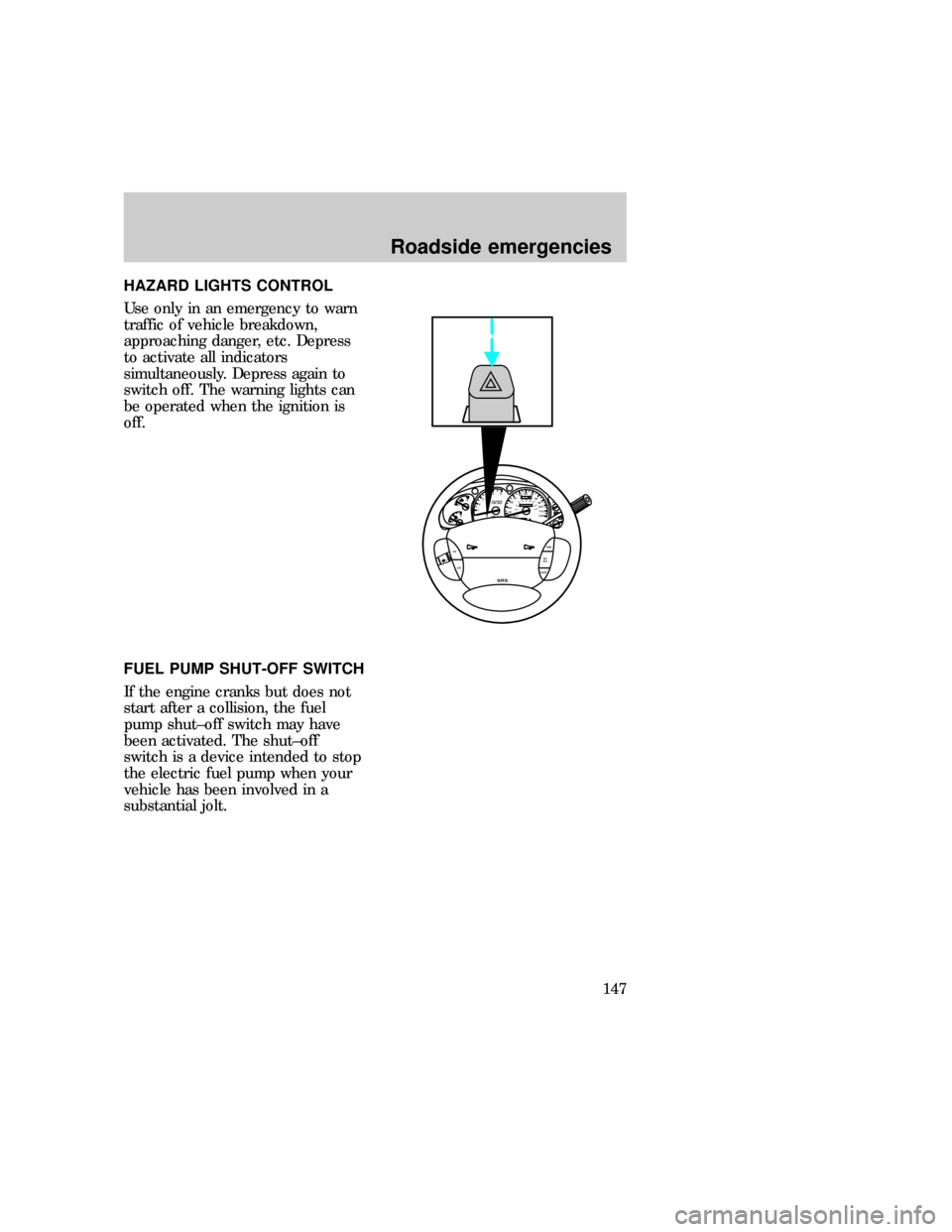
HAZARD LIGHTS CONTROL
Use only in an emergency to warn
traffic of vehicle breakdown,
approaching danger, etc. Depress
to activate all indicators
simultaneously. Depress again to
switch off. The warning lights can
be operated when the ignition is
off.
FUEL PUMP SHUT-OFF SWITCH
If the engine cranks but does not
start after a collision, the fuel
pump shut±off switch may have
been activated. The shut±off
switch is a device intended to stop
the electric fuel pump when your
vehicle has been involved in a
substantial jolt.
0P RND21
UNLEADED
FUEL ONLY
RPM x 100012345
6H
C
F
E
RSM
SET
ACC
COAST OFF ON
SRS
- +H
H
L L020
1030405060
70
80
90
110
120000000oooo
km/h10020406080100
120
140
160
180
uno_hazard_switch uno_fuel_shut-off
Roadside emergencies
147
Page 160 of 236
Do not push-start your
vehicle. You could damage
the catalytic converter. For
further information, seeJumper
Cablesin the Index.
Batteries contain sulfuric
acid which burns skin,
eyes, and clothing.
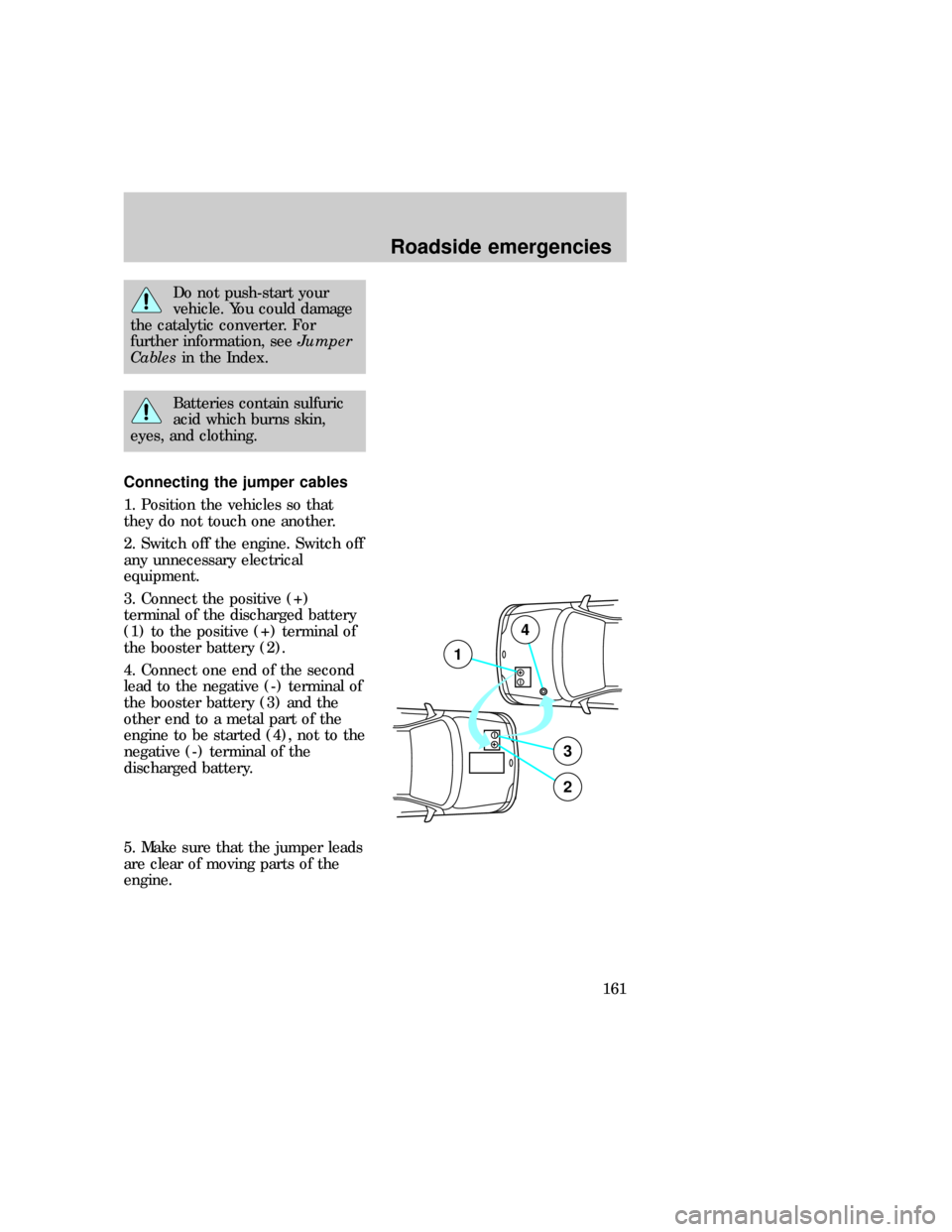
Connecting the jumper cables
1. Position the vehicles so that
they do not touch one another.
2. Switch off the engine. Switch off
any unnecessary electrical
equipment.
3. Connect the positive (+)
terminal of the discharged battery
(1) to the positive (+) terminal of
the booster battery (2).
4. Connect one end of the second
lead to the negative (-) terminal of
the booster battery (3) and the
other end to a metal part of the
engine to be started (4), not to the
negative (-) terminal of the
discharged battery.
5. Make sure that the jumper leads
are clear of moving parts of the
engine.
+–
+–
3
2
1
4
uno_connecting_cables
Roadside emergencies
161
Page 161 of 236
![FORD EXPLORER 1997 2.G Owners Guide Do not connect the end of
the second cable to the
negative ([-]) terminal of the
battery to be jumped. A spark
may cause an explosion of the
gases that surround the battery.
Jump starting
1. Start the](/img/11/4954/w960_4954-160.png "FORD EXPLORER 1997 2.G Owners Guide Do not connect the end of
the second cable to the
negative ([-]) terminal of the
battery to be jumped. A spark
may cause an explosion of the
gases that surround the battery.
Jump starting
1. Start the")
Do not connect the end of
the second cable to the
negative ([-]) terminal of the
battery to be jumped. A spark
may cause an explosion of the
gases that surround the battery.
Jump starting
1. Start the booster vehicle and
run the engine at moderately
increased speed.
2. Start the engine of the vehicle
with the discharged battery.
3. Once the engine has been
started, run both vehicles for a
further three minutes before
disconnecting the cable leads.
Removing the jumper cables
1. Remove the jumper cables in
reverse order. Take the cable off
the metallic surface (1) first,
followed by the cable on the
negative (-) booster battery
terminal (2).
2. Remove the cable from the
positive (+) terminal of the booster
battery (3) and then the
discharged battery (4).
3. After the disabled vehicle has
been started, allow it to idle for a
while so the engine can ªrelearnº
its idle conditions.
+–
+–
2
3
4
1
uno_jump_starting
com_removing_cables.01
uno_wrecker_towing
Roadside emergencies
162
Page 164 of 236

SERVICE RECOMMENDATIONS
To help you service your vehicle:
²We highlight do-it-yourself items
in the engine compartment for
easy location.
²As possible, we design parts that
can be replaced without tools.
²We provide you with a ªService
Guideº which makes tracking
routine service for your vehicle
easy.
If your vehicle requires
professional service, your
dealership can provide necessary
parts and service. Check your
ªWarranty Information Bookletº to
find out which parts and services
are covered.
Use only recommended fuels,
lubricants, fluids and service parts
conforming to specifications.
Motorcraft parts are designed and
built to provide the best
performance in your vehicle.
Steps to take before performing
maintenance
Precautions when servicing
your vehicle
Be especially careful when
inspecting or servicing your
vehicle. Here are some general
precautions for your safety:
²Do not work on a hot engine.
²If you must work with the
engine running, avoid wearing
loose clothing or jewelry that
com_service_recommendations.01
uno_servicing_title
com_precautions_servicing.01
Maintenance and care
165
Page 165 of 236
could get caught in moving
parts. Take precautions with
long hair.
²Do not work on a vehicle with
the engine running in an
enclosed space, unless you are
sure you have enough
ventilation.
²Keep all lit cigarettes, open
flames and other lit material
away from the battery and all
fuel related parts.
If you disconnect the battery, the
engine must ªrelearnº its idle
conditions before your vehicle will
drive properly, as explained in
Batteryin this chapter.
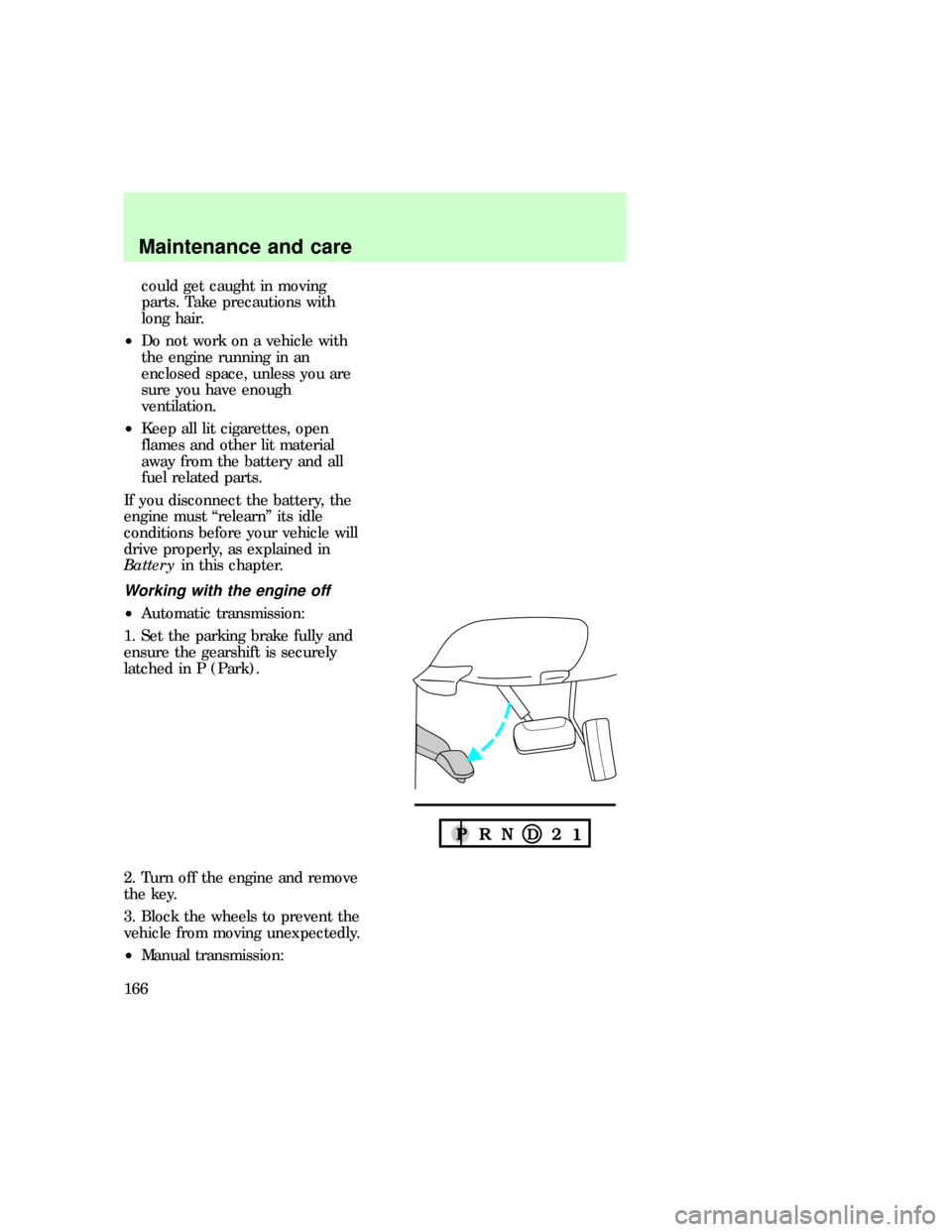
Working with the engine off
²Automatic transmission:
1. Set the parking brake fully and
ensure the gearshift is securely
latched in P (Park).
2. Turn off the engine and remove
the key.
3. Block the wheels to prevent the
vehicle from moving unexpectedly.
²Manual transmission:
uno_working_off
Maintenance and care
166
Page 166 of 236
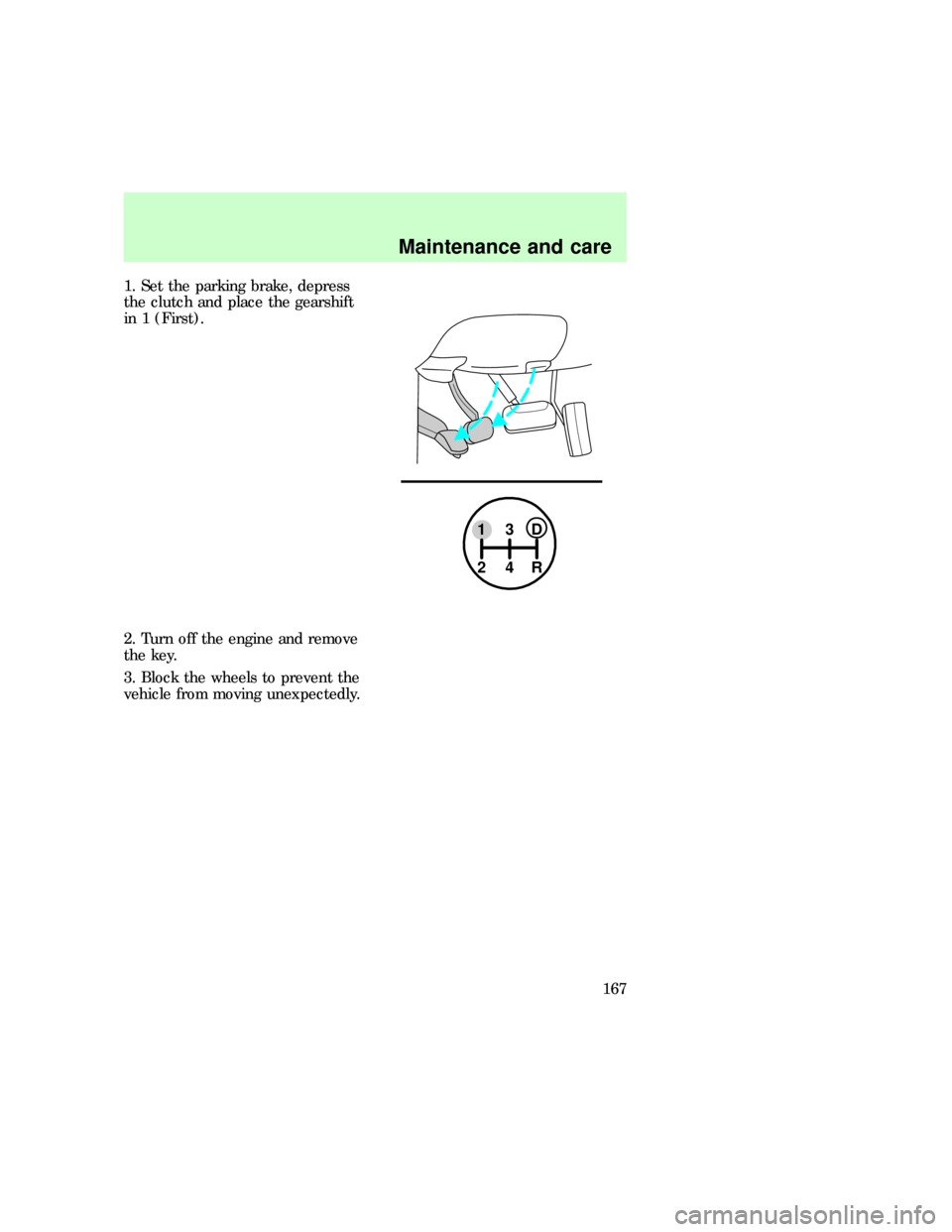
1. Set the parking brake, depress
the clutch and place the gearshift
in 1 (First).
2. Turn off the engine and remove
the key.
3. Block the wheels to prevent the
vehicle from moving unexpectedly.
13D
24R
uno_working_on
Maintenance and care
167
Page 167 of 236
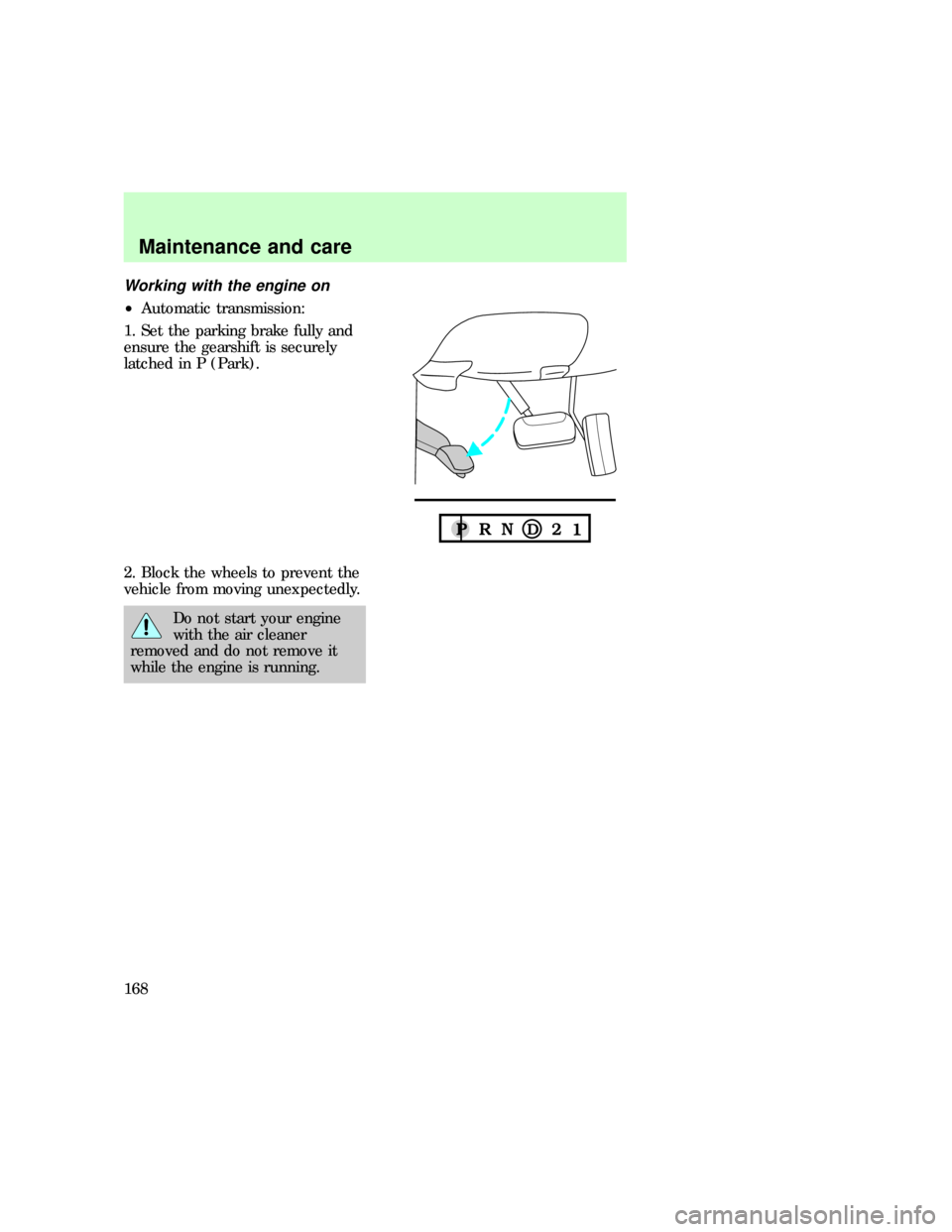
Working with the engine on
²Automatic transmission:
1. Set the parking brake fully and
ensure the gearshift is securely
latched in P (Park).
2. Block the wheels to prevent the
vehicle from moving unexpectedly.
Do not start your engine
with the air cleaner
removed and do not remove it
while the engine is running.
Maintenance and care
168