engine FORD EXPLORER 1997 2.G Repair Manual
[x] Cancel search | Manufacturer: FORD, Model Year: 1997, Model line: EXPLORER, Model: FORD EXPLORER 1997 2.GPages: 236, PDF Size: 2.43 MB
Page 205 of 236

though your engine will perform
adequately on other gasolines, the
performance of the emission
control devices and systems may
be adversely affected. Repair of
damage caused by using a fuel that
your vehicle was not designed for
may not be covered by your
warranty.
Calculating fuel economy
To accurately calculate your
vehicle's fuel economy:
1. Fill the tank completely and
record the initial odometer
reading.
2. Each time you fill the tank,
record the amount of fuel added
(in liters or gallons).
3. After at least three to five fuel
tank fill-ups, fill the fuel tank and
record the current mileage
reading.
4. Use one of the following
equations to calculate fuel
economy.
Liters used x 1004Total
kilometers traveled
Total miles traveled4Total
gallons used
Keep a record for at least one
month. This will provide an
accurate estimate of the vehicle's
fuel economy.
EMISSION CONTROL SYSTEM
Your vehicle is equipped with
various emission control
com_calculating_economy.01
com_emission.ses
Maintenance and care
206
Page 206 of 236

components and a catalytic
converter which will enable your
vehicle to comply with applicable
exhaust emission standards. To
make sure that the catalytic
converter and other emission
control components continue to
work properly:
²Use only unleaded fuel.
²Avoid running out of fuel.
²Do not turn off the ignition
while your vehicle is moving,
especially at high speeds.
²Have the services listed in your
ªService Guideº performed
according to the specified
schedule.
The Scheduled Maintenance
Services listed in the ªService
Guideº are required because they
are considered essential to the life
and performance of your vehicle
and to its emissions system.
If other than Ford, Motorcraft or
Ford authorized parts are used for
maintenance replacements or for
service of components affecting
emission control such non-Ford
parts should be equivalent to
genuine Ford Motor Company
parts in performance and
durability.
Do not park, idle, or drive
your vehicle in dry grass
or other dry ground cover. The
emission system heats up the
engine compartment and exhaust
system, which can start a fire.
Maintenance and care
207
Page 207 of 236
Watch for fluid leaks, strange
odors, smoke, loss of oil pressure,
the charging system warning light,
the ªService Engine Soonº light or
the temperature warning light.
These events could indicate that
the emission control system is not
working properly.
If you smell exhaust fumes
of any kind inside your
vehicle, have the dealer inspect
and fix your vehicle immediately.
Do not drive if you smell exhaust
fumes. These fumes are harmful
and could kill you.
Do not make any unauthorized
changes to your vehicle or engine.
By law, vehicle owners and anyone
who manufactures, repairs,
services, sells, leases, trades
vehicles, or supervises a fleet of
vehicles are not permitted to
intentionally remove an emission
control device or prevent it from
working. Information about your
vehicle's emission system is on the
Vehicle Emission Control
Information Decal located on or
near the engine. This decal
identifies engine displacement and
gives some tune up specifications.
Please consult your ªWarranty
Guideº for complete emission
warranty information.
Readiness for
inspection/maintenance testing
In some localities, it may be a legal
requirement to pass an I/M test of
com_ready-test
Maintenance and care
208
Page 208 of 236
the on-board diagnostic (OBD-II)
system. If your ªcheck
engine/service engine soonº light is
on, reference the applicable light
description in theWarning Lights
and Gaugessection of your
owners guide. Your vehicle may
not pass the I/M test with the
ªcheck engine/service engine soonº
light on.
If the vehicle's powertrain system
or its battery has just been
serviced, the OBD-II system is
reset to a ªnot ready for I/M testº
condition. To ready the OBD-II
system for I/M testing, a minimum
of 30 minutes of city and highway
driving is necessary as described
below:
²First, at least ten minutes of
driving on an expressway or
highway.
²Next, at least twenty minutes
driving in stop and go, city type
traffic with at least four idle
periods.
Allow the vehicle to sit for at least
8 hours without starting the
engine. Then, start the engine and
complete the above driving cycle.
The engine must warm up to it's
normal operating temperature.
Once started, do not turn off the
engine until the above driving
cycle is complete.
Maintenance and care
209
Page 215 of 236

any bugs and tar before waxing
vehicle. Use cleaning fluid or
alcohol with a clean cloth to
remove. Use tar remover to
remove any tar spots.
Repairing paint chips
Minor scratches or paint damage
from road debris may be repaired
with touch-up paint, paint repair
foil or aerosol paint spray from the
Ford accessory line. Observe the
application instructions on the
products.
Remove particles such as bird
droppings, tree sap, insect
remains, tar spots, road salt and
industrial fallout immediately.
Cleaning the wheels
Wash the wheels with the same
detergent you use to clean the
body of your vehicle. Do not use
acid-based wheel cleaners, steel
wool, fuel or strong detergents.
Never use abrasives that will
damage the finish of special wheel
surfaces. Use a tar remover to
remove grease and tar.
Cleaning the engine
Engines are more efficient when
they are clean because grease and
dirt buildup act as insulators and
keep the engine warmer than
normal. Follow these guidelines to
clean your engine:
²Take care when using a power
washer to clean the engine. The
com_repairing_chips
uno_wheels_cleaning
com_engine_cleaning.01
Maintenance and care
216
Page 216 of 236
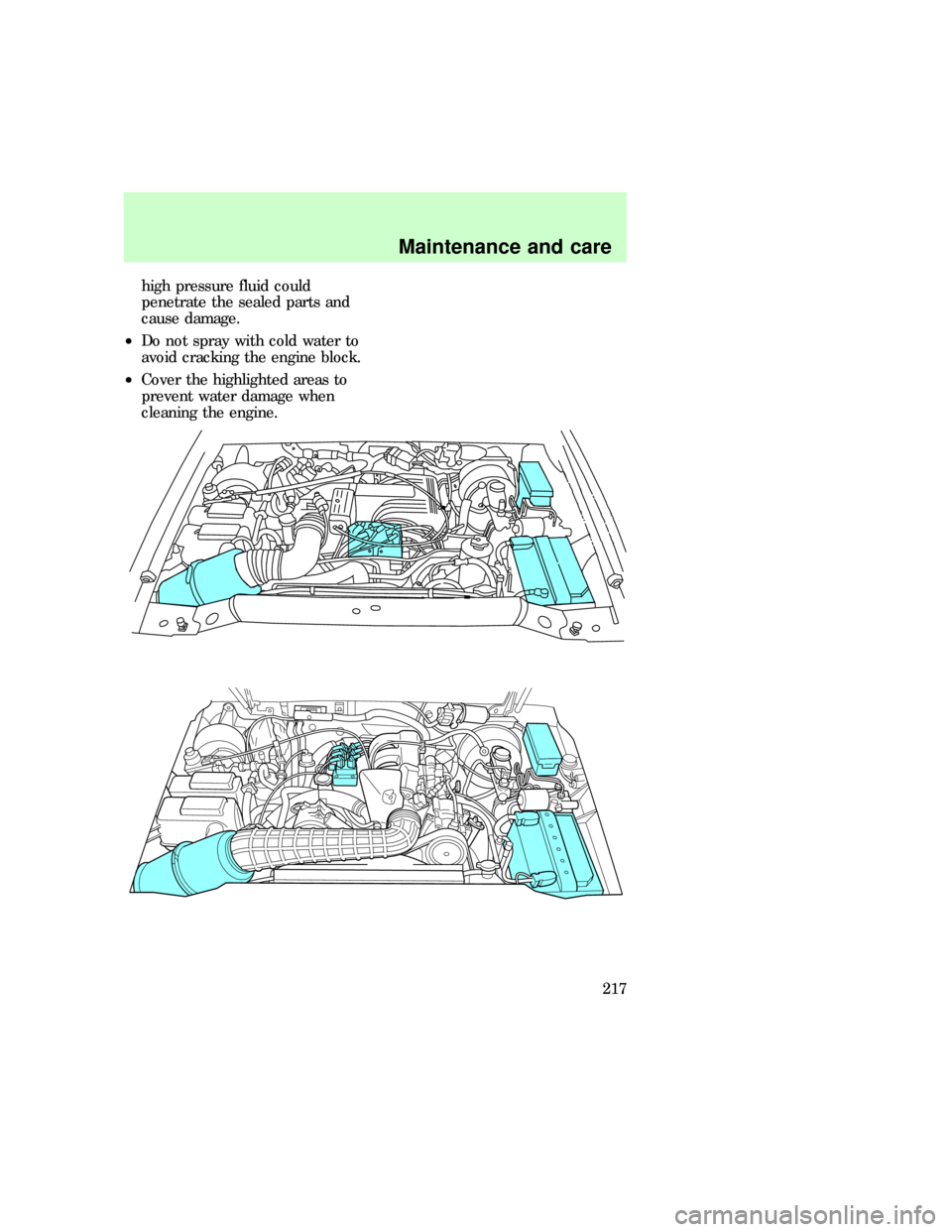
high pressure fluid could
penetrate the sealed parts and
cause damage.
²Do not spray with cold water to
avoid cracking the engine block.
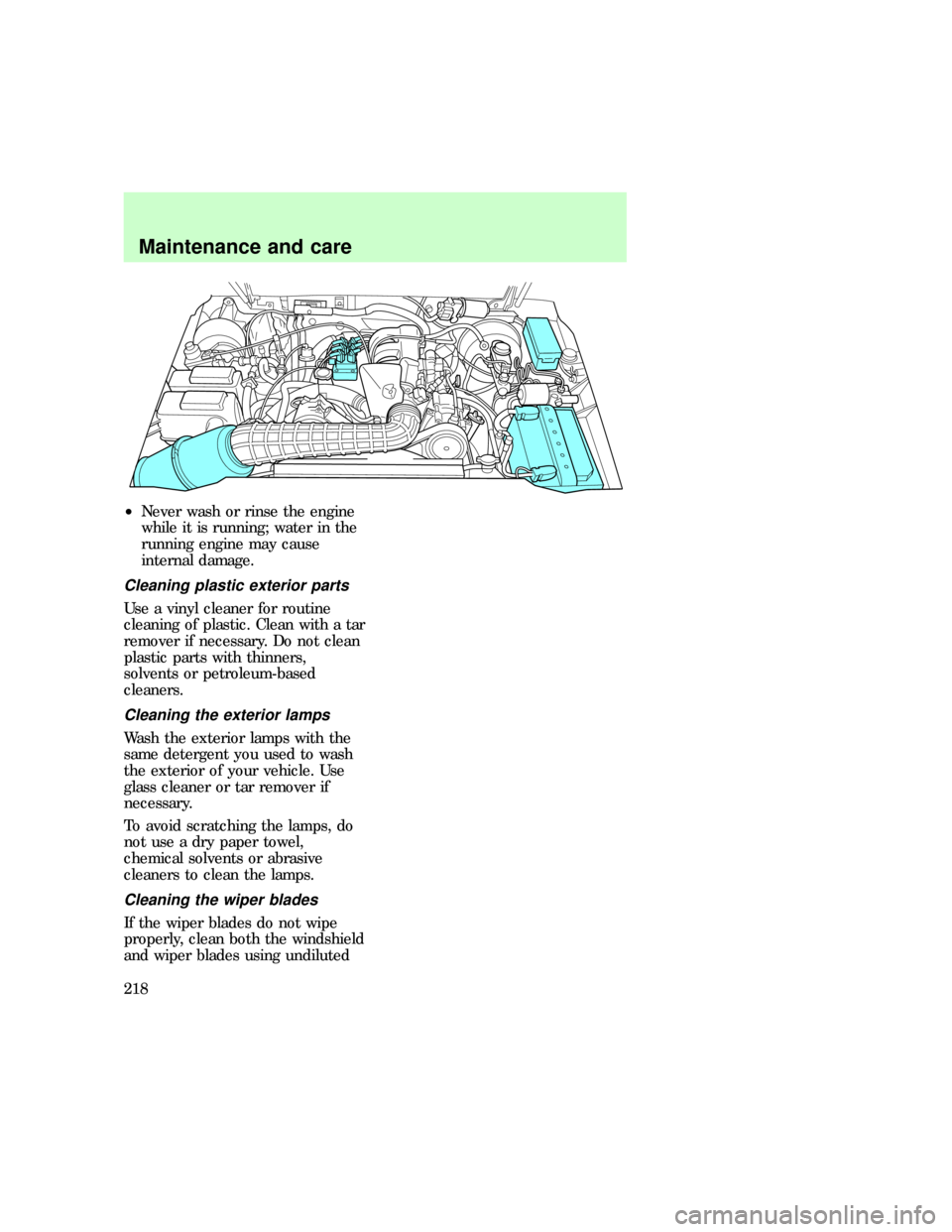
²Cover the highlighted areas to
prevent water damage when
cleaning the engine.
Maintenance and care
217
Page 217 of 236
²Never wash or rinse the engine
while it is running; water in the
running engine may cause
internal damage.
Cleaning plastic exterior parts
Use a vinyl cleaner for routine
cleaning of plastic. Clean with a tar
remover if necessary. Do not clean
plastic parts with thinners,
solvents or petroleum-based
cleaners.
Cleaning the exterior lamps
Wash the exterior lamps with the
same detergent you used to wash
the exterior of your vehicle. Use
glass cleaner or tar remover if
necessary.
To avoid scratching the lamps, do
not use a dry paper towel,
chemical solvents or abrasive
cleaners to clean the lamps.
Cleaning the wiper blades
If the wiper blades do not wipe
properly, clean both the windshield
and wiper blades using undiluted
com_plastic_exterior.01
uno_exterior_lamps
uno_wiper_cleaning
Maintenance and care
218
Page 221 of 236
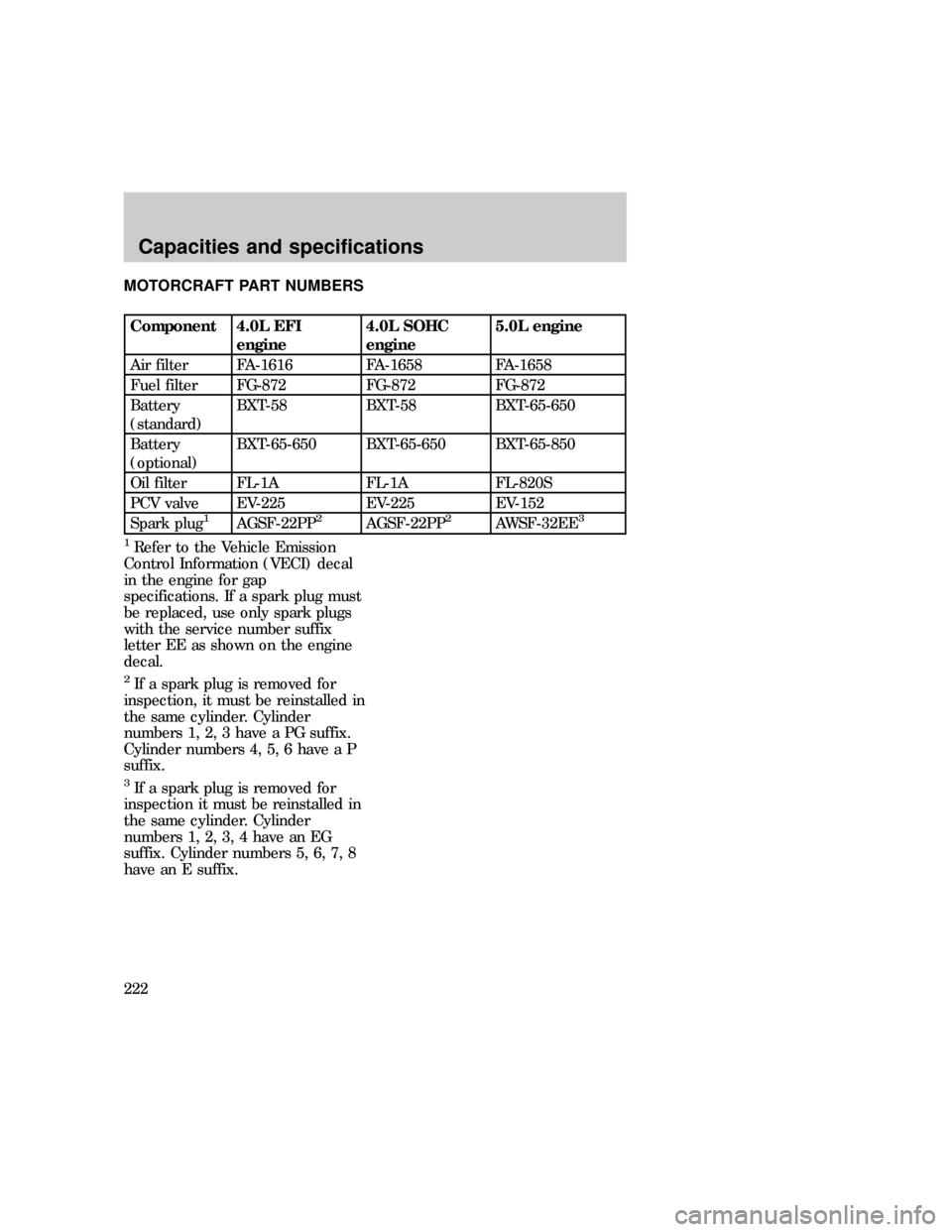
MOTORCRAFT PART NUMBERS
Component 4.0L EFI
engine4.0L SOHC
engine5.0L engine
Air filter FA-1616 FA-1658 FA-1658
Fuel filter FG-872 FG-872 FG-872
Battery
(standard)BXT-58 BXT-58 BXT-65-650
Battery
(optional)BXT-65-650 BXT-65-650 BXT-65-850
Oil filter FL-1A FL-1A FL-820S
PCV valve EV-225 EV-225 EV-152
Spark plug
1AGSF-22PP2AGSF-22PP2AWSF-32EE3
1
Refer to the Vehicle Emission
Control Information (VECI) decal
in the engine for gap
specifications. If a spark plug must
be replaced, use only spark plugs
with the service number suffix
letter EE as shown on the engine
decal.
2If a spark plug is removed for
inspection, it must be reinstalled in
the same cylinder. Cylinder
numbers 1, 2, 3 have a PG suffix.
Cylinder numbers 4, 5, 6 have a P
suffix.
3If a spark plug is removed for
inspection it must be reinstalled in
the same cylinder. Cylinder
numbers 1, 2, 3, 4 have an EG
suffix. Cylinder numbers 5, 6, 7, 8
have an E suffix.
com_explorer-part-numbers
Capacities and specifications
222
Page 222 of 236
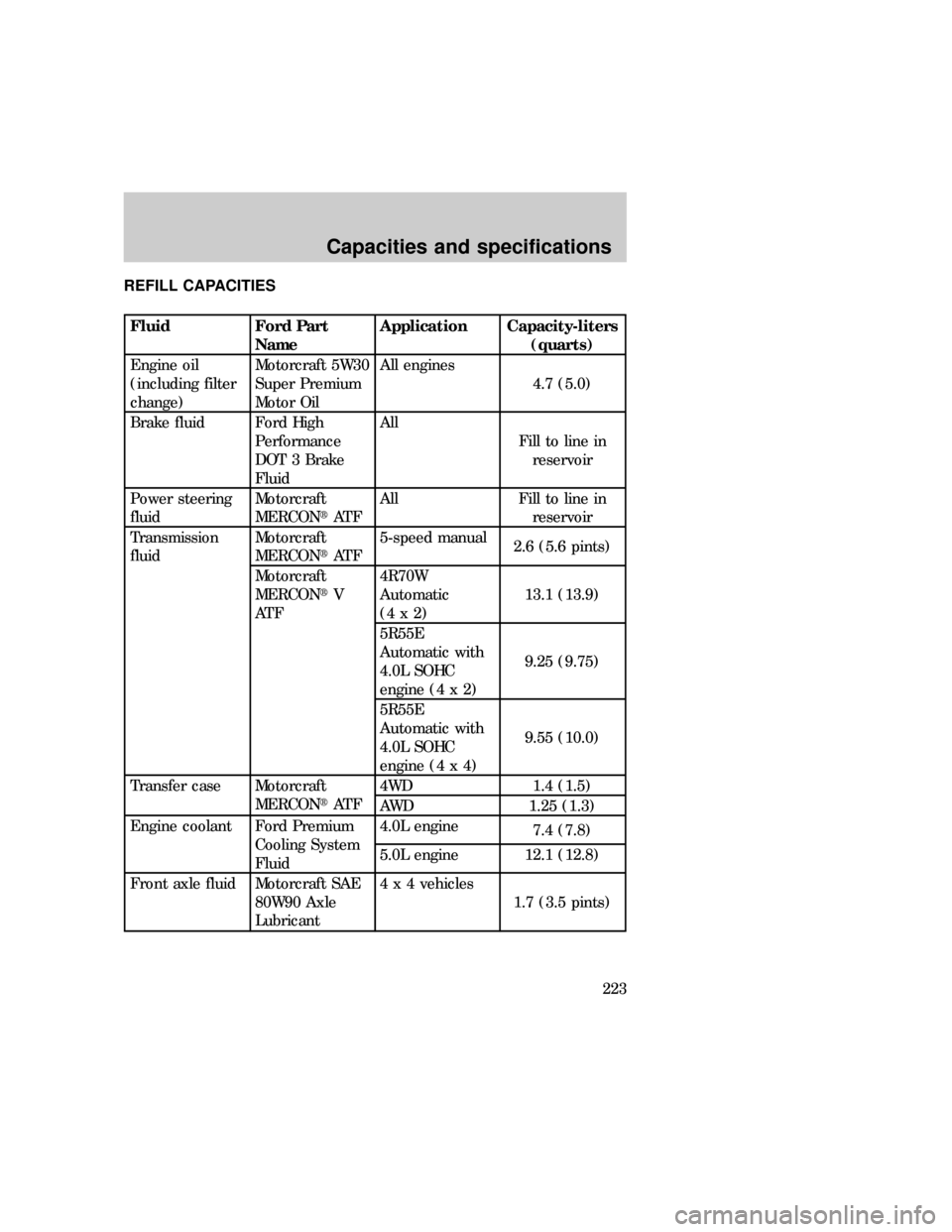
REFILL CAPACITIES
Fluid Ford Part
NameApplication Capacity-liters
(quarts)
Engine oil
(including filter
change)Motorcraft 5W30
Super Premium
Motor OilAll engines
4.7 (5.0)
Brake fluid Ford High
Performance
DOT 3 Brake
FluidAll
Fill to line in
reservoir
Power steering
fluidMotorcraft
MERCONtAT FAll Fill to line in
reservoir
Transmission
fluidMotorcraft
MERCONtAT F5-speed manual
2.6 (5.6 pints)
Motorcraft
MERCONtV
AT F4R70W
Automatic
(4x2)13.1 (13.9)
5R55E
Automatic with
4.0L SOHC
engine (4 x 2)9.25 (9.75)
5R55E
Automatic with
4.0L SOHC
engine (4 x 4)9.55 (10.0)
Transfer case Motorcraft
MERCONtAT F4WD 1.4 (1.5)
AWD 1.25 (1.3)
Engine coolant Ford Premium
Cooling System
Fluid4.0L engine
7.4 (7.8)
5.0L engine 12.1 (12.8)
Front axle fluid Motorcraft SAE
80W90 Axle
Lubricant4 x 4 vehicles
1.7 (3.5 pints)
com_explorer-refills
Capacities and specifications
223
Page 223 of 236
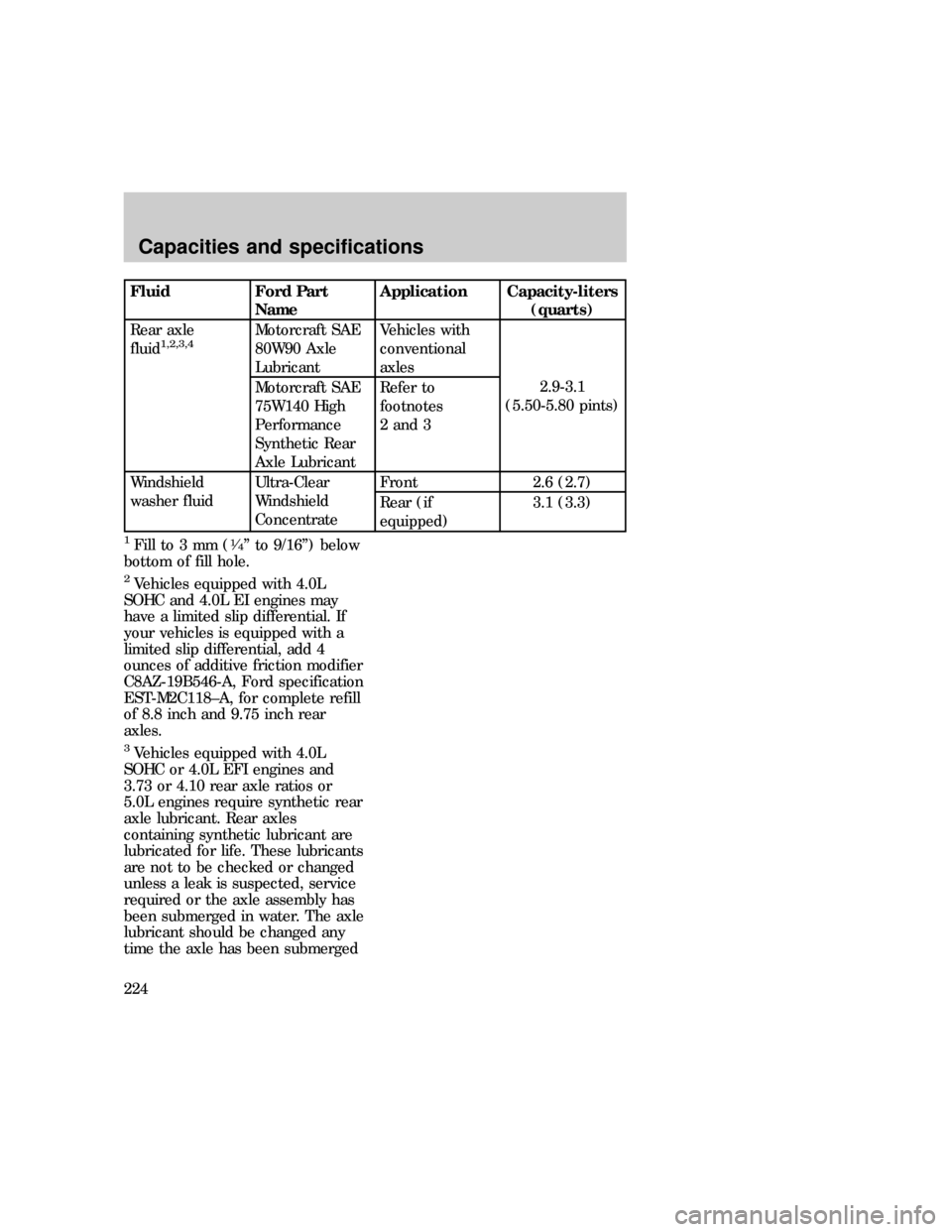
Fluid Ford Part
NameApplication Capacity-liters
(quarts)
Rear axle
fluid
1,2,3,4Motorcraft SAE
80W90 Axle
LubricantVehicles with
conventional
axles
2.9-3.1
(5.50-5.80 pints) Motorcraft SAE
75W140 High
Performance
Synthetic Rear
Axle LubricantRefer to
footnotes
2 and 3
Windshield
washer fluidUltra-Clear
Windshield
ConcentrateFront 2.6 (2.7)
Rear (if
equipped)3.1 (3.3)
1Fill to 3 mm (1¤4º to 9/16º) below
bottom of fill hole.
2Vehicles equipped with 4.0L
SOHC and 4.0L EI engines may
have a limited slip differential. If
your vehicles is equipped with a
limited slip differential, add 4
ounces of additive friction modifier
C8AZ-19B546-A, Ford specification
EST-M2C118±A, for complete refill
of 8.8 inch and 9.75 inch rear
axles.
3Vehicles equipped with 4.0L
SOHC or 4.0L EFI engines and
3.73 or 4.10 rear axle ratios or
5.0L engines require synthetic rear
axle lubricant. Rear axles
containing synthetic lubricant are
lubricated for life. These lubricants
are not to be checked or changed
unless a leak is suspected, service
required or the axle assembly has
been submerged in water. The axle
lubricant should be changed any
time the axle has been submerged
Capacities and specifications
224