engine FORD EXPLORER 1997 2.G Workshop Manual
[x] Cancel search | Manufacturer: FORD, Model Year: 1997, Model line: EXPLORER, Model: FORD EXPLORER 1997 2.GPages: 236, PDF Size: 2.43 MB
Page 180 of 236
When adding engine coolant
Ford recommends Ford Premium
Cooling System Fluid, which is an
optimized formula that will protect
all metals and rubber elastomers
used in Ford engines for four years
or 80,000 km (50,000 miles).
It is neither necessary nor
recommended to use supplemental
coolant additives in your
gasoline-powered vehicle. These
additives may harm your engine
cooling system.
When you change or add engine
coolant, it is important to maintain
engine coolant concentration
between 40% (-24ÉC [-11ÉF]) and
60% (-52ÉC [-62ÉF]), depending on
your local climate conditions.
A coolant concentration below 40%
will result in a loss of freeze
protection. A concentration above
60% may cause the engine to
overheat on a warm day.
Refer toLubricant specifications
in theSpecifications and
capacitieschapter. Use only a
premium nationally-recognized
brand name engine coolant or
equivalent.
Always dispose of used
automotive fluids in a responsible
manner. Follow your community's
standards for disposing of these
types of fluids. Call your local
recycling center to find out more
about recycling automotive fluids.
com_recycled_coolant.01
Maintenance and care
181
Page 181 of 236

Recycled engine coolant
Ford Motor Company recommends
that Ford and Lincoln-Mercury
dealers use recycled engine
coolant produced by
Ford-approved processes. Not all
coolant recycling processes
produce coolant which meets Ford
specification ESE-M97B44±A, and
use of such coolant may harm
engine and cooling system
components.
Always dispose of used
automotive fluids in a responsible
manner. Follow your community's
regulations and standards for
recycling and disposing of
automotive fluids.
Coolant refill capacity
To find out how much fluid your
vehicle's cooling system can hold,
refer toRefill capacitiesin the
Capacities and specifications
chapter.
Have your dealer check the engine
cooling system for leaks if you
have to add more than a liter
(quart) of engine coolant per
month.
Severe winter climate
If you drive in extremely cold
climates [less than ±36ÉC (±34ÉF)],
it may be necessary to increase the
coolant concentration above 50%.
Refer to the chart on the coolant
container to ensure the coolant
concentration in your vehicle is
such that the coolant will not
com_refill_capacity.01
com_winter_climate.01
Maintenance and care
182
Page 182 of 236
freeze at the temperature level in
which you drive during winter
months. Never increase the engine
coolant concentration above 60%.
Leave a 50/50 mixture of engine
coolant and water in your vehicle
year-round in non-extreme
climates.
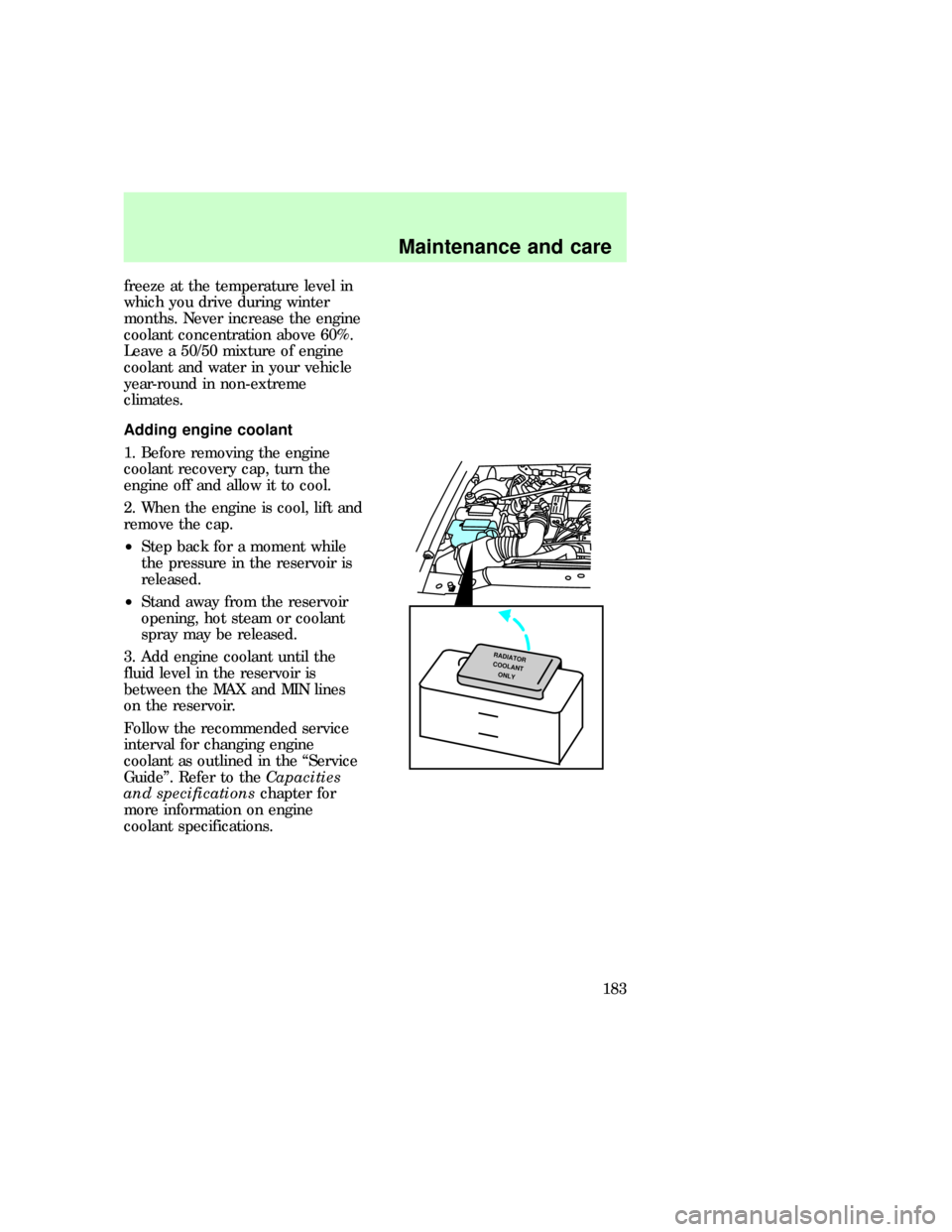
Adding engine coolant
1. Before removing the engine
coolant recovery cap, turn the
engine off and allow it to cool.
2. When the engine is cool, lift and
remove the cap.
²Step back for a moment while
the pressure in the reservoir is
released.
²Stand away from the reservoir
opening, hot steam or coolant
spray may be released.
3. Add engine coolant until the
fluid level in the reservoir is
between the MAX and MIN lines
on the reservoir.
Follow the recommended service
interval for changing engine
coolant as outlined in the ªService
Guideº. Refer to theCapacities
and specificationschapter for
more information on engine
coolant specifications.
RADIATOR
COOLANT
ONLY
uno_adding_engine_coolant
com_checking_hoses.01
Maintenance and care
183
Page 183 of 236
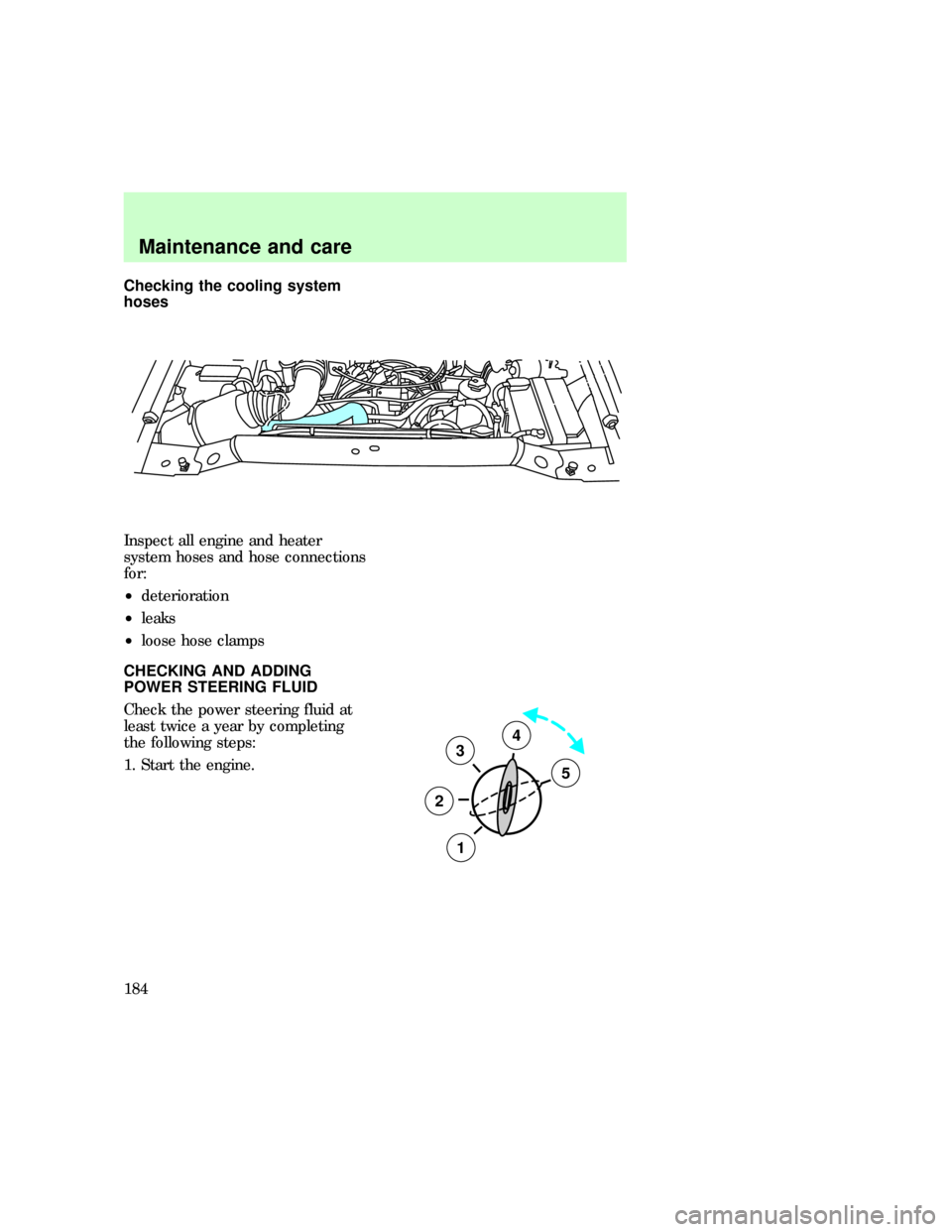
Checking the cooling system
hoses
Inspect all engine and heater
system hoses and hose connections
for:
²deterioration
²leaks
²loose hose clamps
CHECKING AND ADDING
POWER STEERING FLUID
Check the power steering fluid at
least twice a year by completing
the following steps:
1. Start the engine.
3
2
1
5
4
uno_checking_adding_power_st
Maintenance and care
184
Page 184 of 236
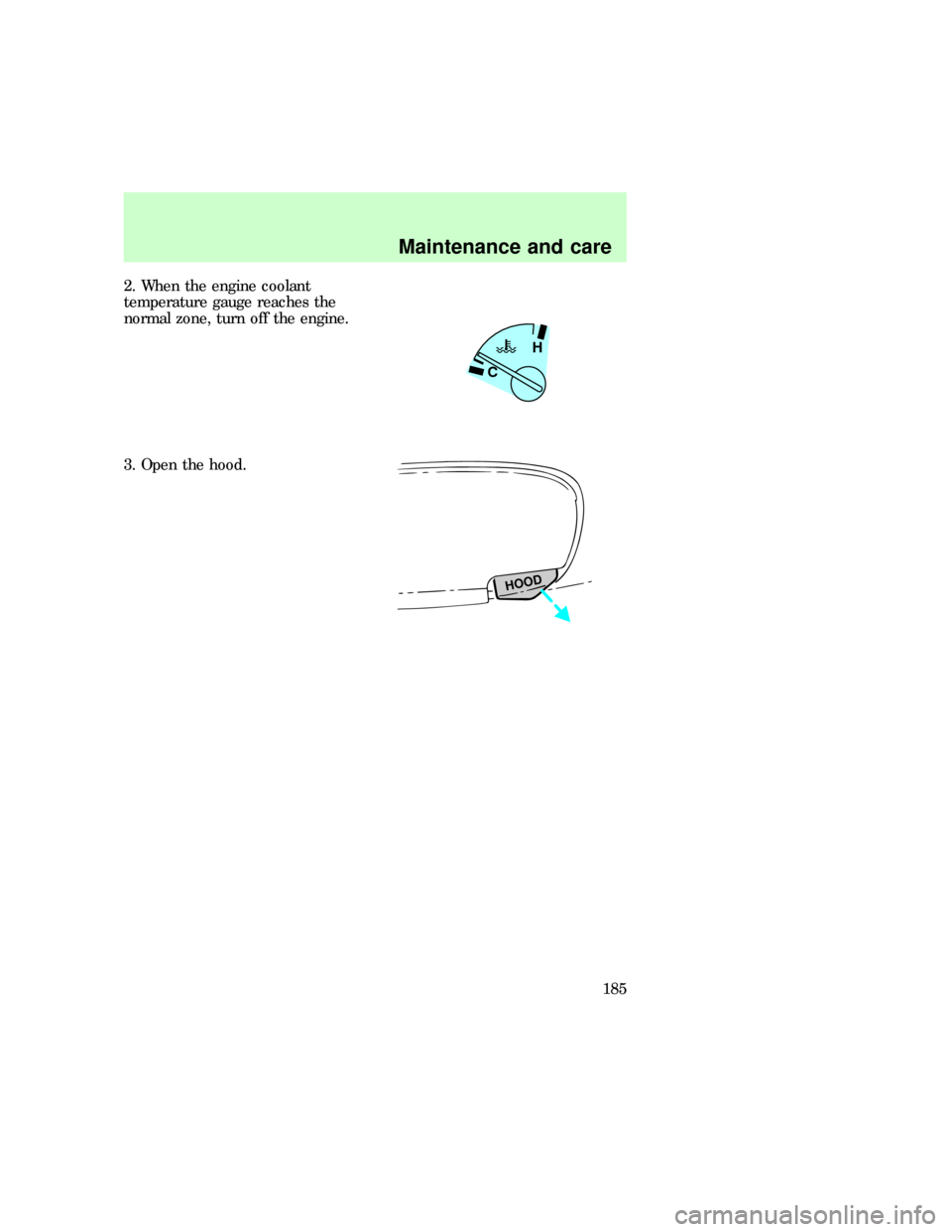
2. When the engine coolant
temperature gauge reaches the
normal zone, turn off the engine.
3. Open the hood.
H
C
HOOD
Maintenance and care
185
Page 189 of 236

water. If necessary, distilled water
may be substituted with tap water
that is not hard and does not have
high mineral or alkali content. If
the battery needs water often,
have the charging system checked
for a possible malfunction.
Relearning the idle function
Because your vehicle's engine is
electronically controlled, some
control conditions are maintained
by power from the battery. When
the battery is disconnected or a
new battery is installed, the
computer must ªrelearnº its idle
conditions before your vehicle can
drive properly. To begin this
process:
Maintenance and care
190
Page 190 of 236
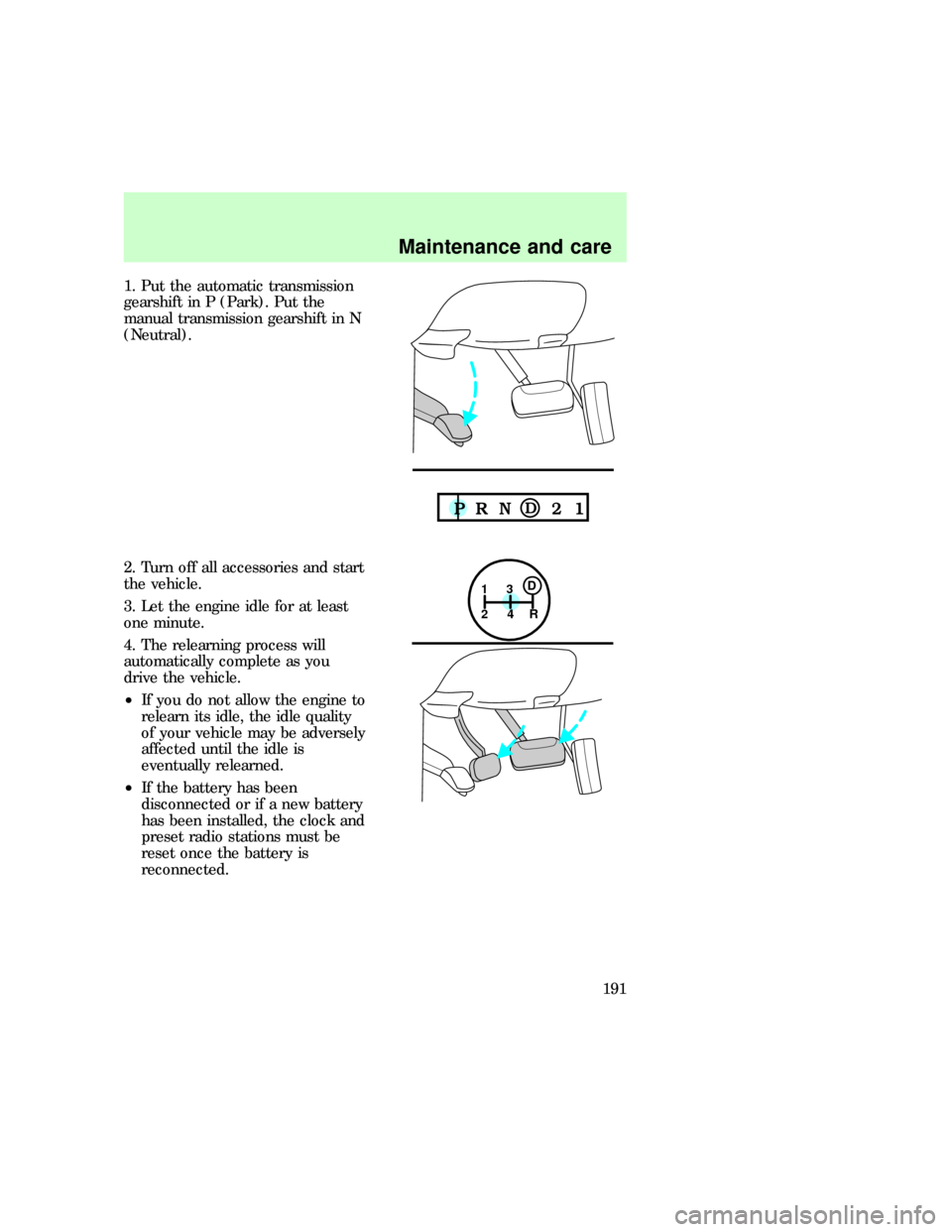
1. Put the automatic transmission
gearshift in P (Park). Put the
manual transmission gearshift in N
(Neutral).
2. Turn off all accessories and start
the vehicle.
3. Let the engine idle for at least
one minute.
4. The relearning process will
automatically complete as you
drive the vehicle.
²If you do not allow the engine to
relearn its idle, the idle quality
of your vehicle may be adversely
affected until the idle is
eventually relearned.
²If the battery has been
disconnected or if a new battery
has been installed, the clock and
preset radio stations must be
reset once the battery is
reconnected.
1
24R3D
Maintenance and care
191
Page 191 of 236
Always dispose of automotive
batteries in a responsible manner.
Follow your community's local
standards for disposal. Call your
local recycling center to find out
more about recycling automotive
batteries.
Battery saver control feature
Your vehicle is equipped with a
battery saver control feature
designed to prevent your battery
from accidental wear down due to
doors left ajar. For information on
the system and its function, refer
to theControls and features
chapter.
AIR CLEANER FILTER
MAINTENANCE
Refer to the ªService Guideº for
the appropriate intervals for
changing the air cleaner filter.
Do not start your engine
with the air cleaner
removed and do not remove it
while the engine is running.
uno_saver_battery_feature
uno_air_filter_maint
uno_changing_air_filter
Maintenance and care
192
Page 192 of 236
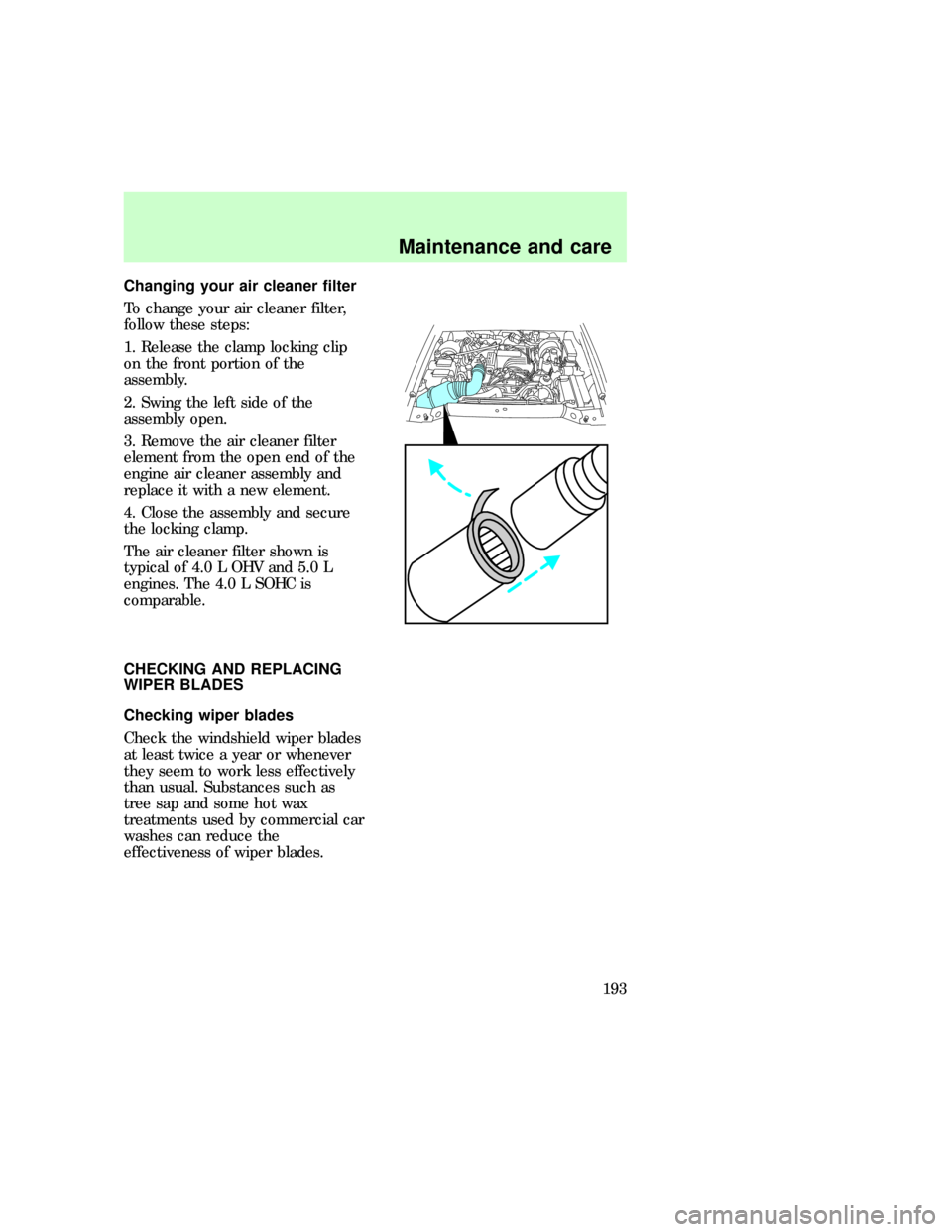
Changing your air cleaner filter
To change your air cleaner filter,
follow these steps:
1. Release the clamp locking clip
on the front portion of the
assembly.
2. Swing the left side of the
assembly open.
3. Remove the air cleaner filter
element from the open end of the
engine air cleaner assembly and
replace it with a new element.
4. Close the assembly and secure
the locking clamp.
The air cleaner filter shown is
typical of 4.0 L OHV and 5.0 L
engines. The 4.0 L SOHC is
comparable.
CHECKING AND REPLACING
WIPER BLADES
Checking wiper blades
Check the windshield wiper blades
at least twice a year or whenever
they seem to work less effectively
than usual. Substances such as
tree sap and some hot wax
treatments used by commercial car
washes can reduce the
effectiveness of wiper blades.
uno_wipers_title
uno_checking_wipers
Maintenance and care
193
Page 203 of 236
forms of disulfiram for the
treatment of alcoholism.
Breathing gasoline vapors or
skin contact could cause an
adverse reaction. Consult a
physician immediately.
Cleaner air
Ford approves the use of gasolines
to improve air quality, including
reformulated gasolines, that
contain oxygenates such as a
maximum of 10% ethanol or 15%
MTBE. There should be no more
than 5% methanol with cosolvents
and additives to protect the fuel
system.
Octane recommendations
Your vehicle is designed to use
regular gasoline with an (R+M)/2
octane rating of 87. We do not
recommend gasolines labeled as
ªregularº in high altitude areas that
are sold with octane ratings of 86
or even less.
Do not be concerned if your
vehicle sometimes knocks lightly.
However, if it knocks heavily under
most driving conditions on the
recommended octane fuel, see
your dealer or a qualified service
technician to prevent any engine
damage.
87
com_cleaner_air.01
com_octane_recommendations.01
com_fuel_quality.01
Maintenance and care
204