battery FORD EXPLORER 1998 2.G User Guide
[x] Cancel search | Manufacturer: FORD, Model Year: 1998, Model line: EXPLORER, Model: FORD EXPLORER 1998 2.GPages: 210, PDF Size: 1.65 MB
Page 159 of 210
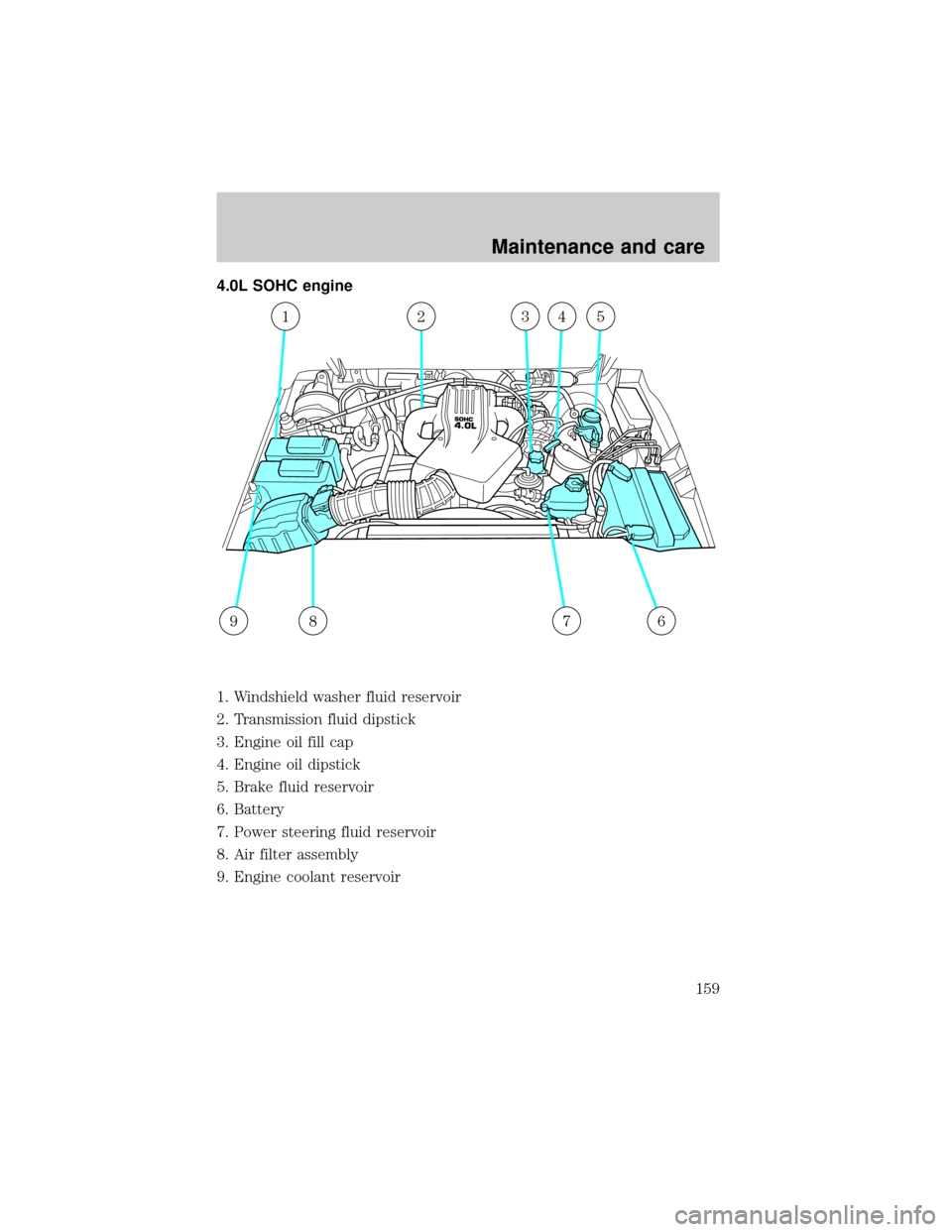
4.0L SOHC engine
1. Windshield washer fluid reservoir
2. Transmission fluid dipstick
3. Engine oil fill cap
4. Engine oil dipstick
5. Brake fluid reservoir
6. Battery
7. Power steering fluid reservoir
8. Air filter assembly
9. Engine coolant reservoir
9
13425
867
Maintenance and care
159
Page 160 of 210
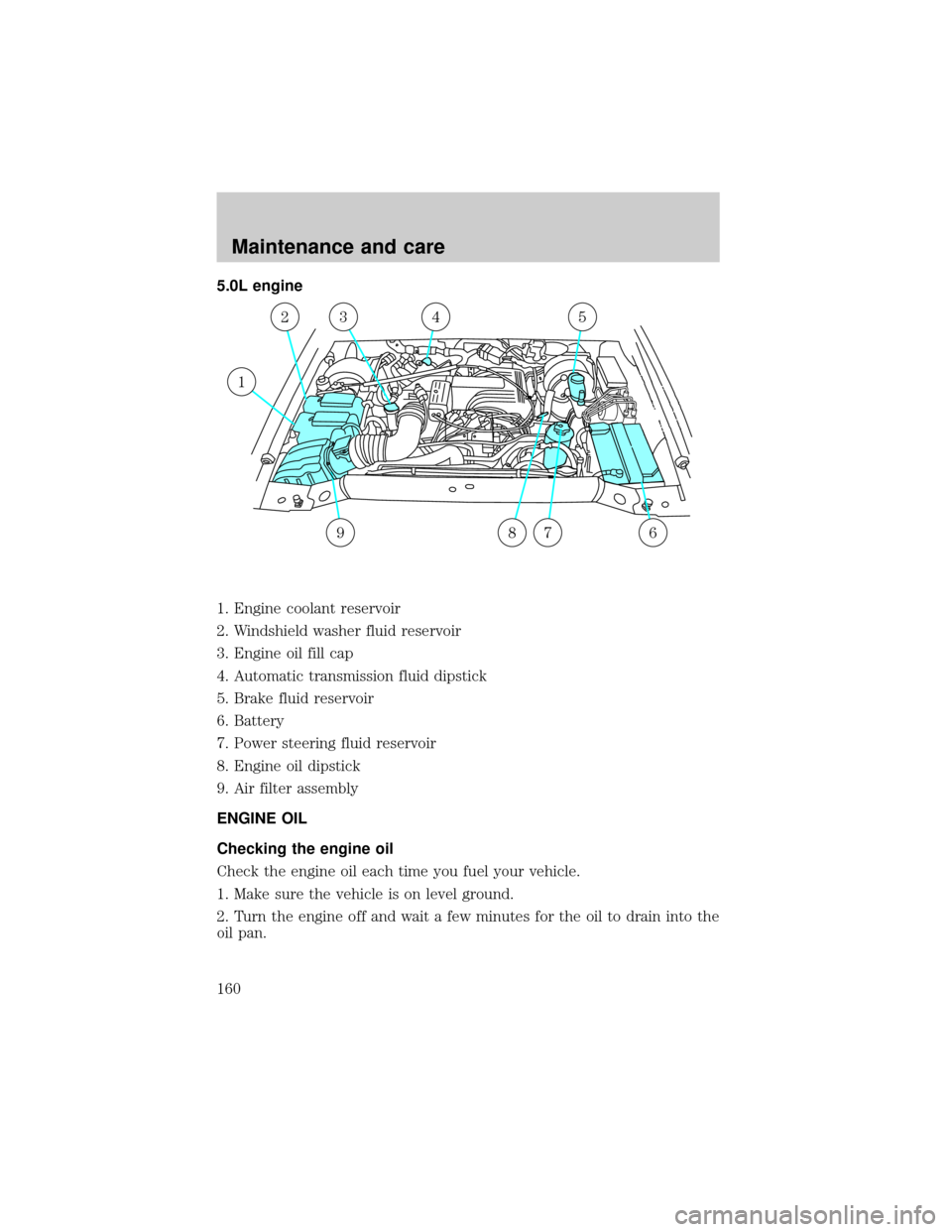
5.0L engine
1. Engine coolant reservoir
2. Windshield washer fluid reservoir
3. Engine oil fill cap
4. Automatic transmission fluid dipstick
5. Brake fluid reservoir
6. Battery
7. Power steering fluid reservoir
8. Engine oil dipstick
9. Air filter assembly
ENGINE OIL
Checking the engine oil
Check the engine oil each time you fuel your vehicle.
1. Make sure the vehicle is on level ground.
2. Turn the engine off and wait a few minutes for the oil to drain into the
oil pan.
1
23
6
54
879
Maintenance and care
160
Page 175 of 210
DRIVELINE UNIVERSAL JOINT AND SLIP YOKE
The universal joints standard with your vehicle do not require
lubrication. If the original universal joints are replaced with universal
joints equipped with grease fittings, lubrication will be necessary.
BATTERY
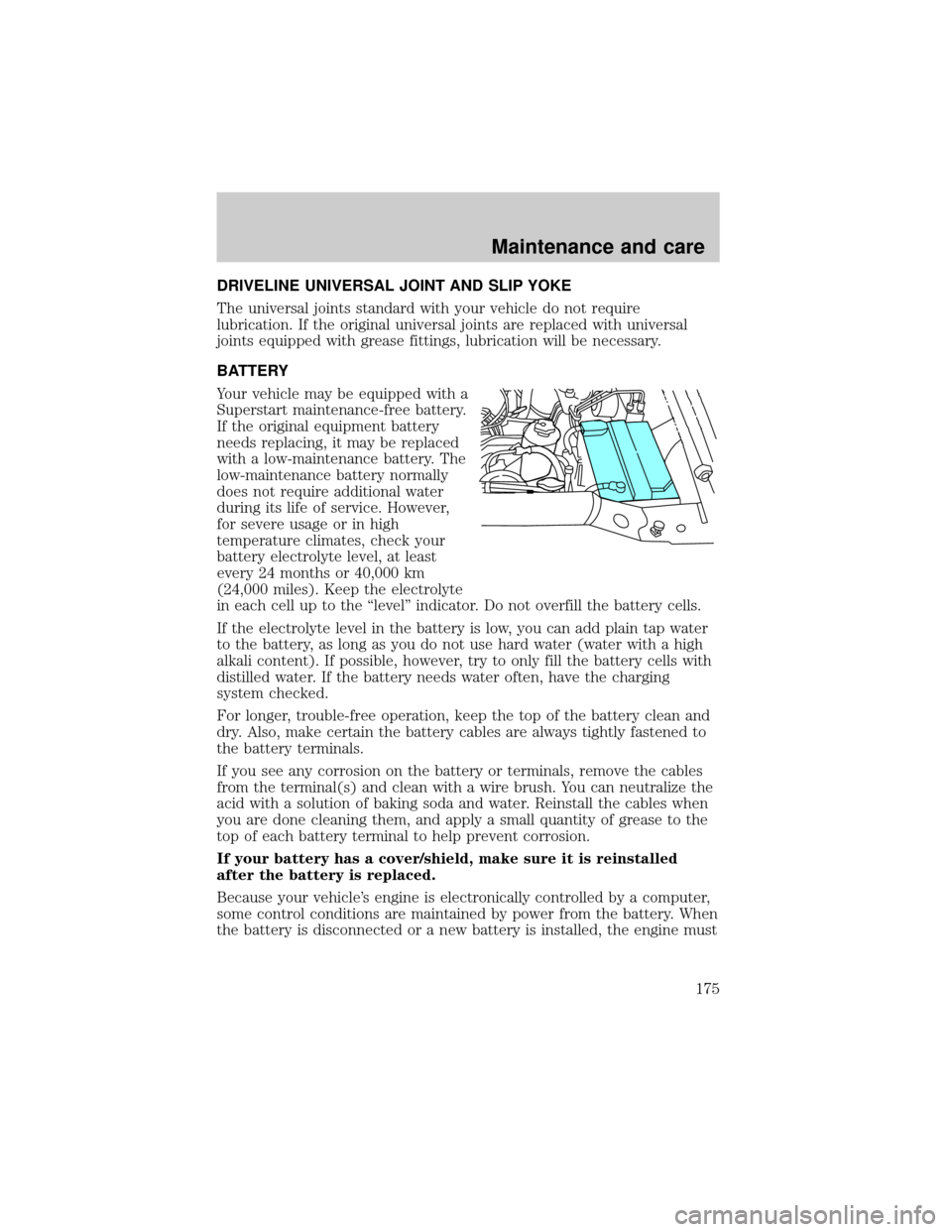
Your vehicle may be equipped with a
Superstart maintenance-free battery.
If the original equipment battery
needs replacing, it may be replaced
with a low-maintenance battery. The
low-maintenance battery normally
does not require additional water
during its life of service. However,
for severe usage or in high
temperature climates, check your
battery electrolyte level, at least
every 24 months or 40,000 km
(24,000 miles). Keep the electrolyte
in each cell up to the ``level'' indicator. Do not overfill the battery cells.
If the electrolyte level in the battery is low, you can add plain tap water
to the battery, as long as you do not use hard water (water with a high
alkali content). If possible, however, try to only fill the battery cells with
distilled water. If the battery needs water often, have the charging
system checked.
For longer, trouble-free operation, keep the top of the battery clean and
dry. Also, make certain the battery cables are always tightly fastened to
the battery terminals.
If you see any corrosion on the battery or terminals, remove the cables
from the terminal(s) and clean with a wire brush. You can neutralize the
acid with a solution of baking soda and water. Reinstall the cables when
you are done cleaning them, and apply a small quantity of grease to the
top of each battery terminal to help prevent corrosion.
If your battery has a cover/shield, make sure it is reinstalled
after the battery is replaced.
Because your vehicle's engine is electronically controlled by a computer,
some control conditions are maintained by power from the battery. When
the battery is disconnected or a new battery is installed, the engine must
Maintenance and care
175
Page 176 of 210
relearn its idle conditions before your vehicle will drive properly. To
begin this process:
1. Put the gearshift in P (Park) (automatic transmissions) or the neutral
position (manual transmissions), turn off all accessories and start the
vehicle.
2. Let the engine idle for at least one minute.
3. The relearning process will automatically complete as you drive the
vehicle.
²If you do not allow the engine to relearn its idle, the idle quality of
your vehicle may be adversely affected until the idle is eventually
relearned.
²If the battery has been disconnected or a new battery has been
installed, the clock and the preset radio stations must be reset once
the battery is reconnected.
²Always dispose of automotive
batteries in a responsible manner.
Follow your community's
standards for disposal. Call your
local recycling center to find out
more about recycling automotive
batteries.
WINDSHIELD WIPER BLADES
Check the wiper blades at least twice a year or when they seem less
effective. Substances such as tree sap and some hot wax treatments used
by commercial car washes reduce the effectiveness of wiper blades.
Checking the wiper blades
If the wiper blades do not wipe properly, clean both the windshield and
wiper blades using undiluted windshield wiper solution or a mild
detergent. Rinse thoroughly with clean water. To avoid damaging the
blades, do not use fuel, kerosene, paint thinner or other solvents.
Changing the wiper blades
When replacing wiper blade assemblies, always use a Motorcraft part or
equivalent. To make replacing the wipers easy, turn the ignition to ACC,
then turn the wipers on. When the wipers reach the vertical position,
turn the ignition to LOCK.
Maintenance and care
176
Page 186 of 210

the Vehicle Emission Control Information Decal located on or near the
engine. This decal identifies engine displacement and gives some tune up
specifications.
Please consult your ``Warranty Guide'' for complete emission warranty
information.
Readiness for inspection/maintenance (I/M) testing
In some localities, it may be a legal requirement to pass an I/M test of
the on-board diagnostic (OBD-II) system. If your ``check engine/service
engine soon'' light is on, reference the applicable light description in the
Warning Lights and Chimessection of your owners guide. Your vehicle
may not pass the I/M test with the ``check engine/service engine soon''
light on.
If the vehicle's powertrain system or its battery has just been serviced,
the OBD-II system is reset to a ``not ready for I/M test'' condition. To
ready the OBD-II system for I/M testing, a minimum of 30 minutes of city
and highway driving is necessary as described below:
²First, at least 10 minutes of driving on an expressway or highway.
²Next, at least 20 minutes driving in stop and go, city type traffic with
at least four idle periods.
Allow the vehicle to sit for at least eight hours without starting the
engine. Then, start the engine and complete the above driving cycle. The
engine must warm up to its normal operating temperature. Once started,
do not turn off the engine until the above driving cycle is complete.
EXTERIOR BULBS
Replacing exterior bulbs
Check the operation of the following lamps frequently:
²headlamps
²foglamps
²high-mount brakelamp
²brakelamps
²turn signals
²license plate lamp
²tail lamps
Maintenance and care
186
Page 187 of 210
²back-up lamps
Do not remove lamp bulbs unless they can be replaced immediately with
new ones. If a bulb is removed for an extended period of time,
contaminants may enter the lamp housings and affect lamp performance.
Replacing headlamp bulbs
Handle a halogen headlamp bulb carefully and keep out of
children's reach. Grasp the bulb only by its plastic base and do
not touch the glass. The oil from your hand could cause the bulb to
break the next time the headlamps are operated.
If the bulb is accidentally touched, it should be cleaned with rubbing
alcohol before being used.
To remove the headlamp bulb:
1. Make sure headlamp switch is in OFF position, then open the hood. If
you are replacing the driver side headlamp, unclip the electronic module
on the right side of the battery and move it out of the way.
2. Locate the headlamp bulb through the hole in the upper radiator
support assembly.
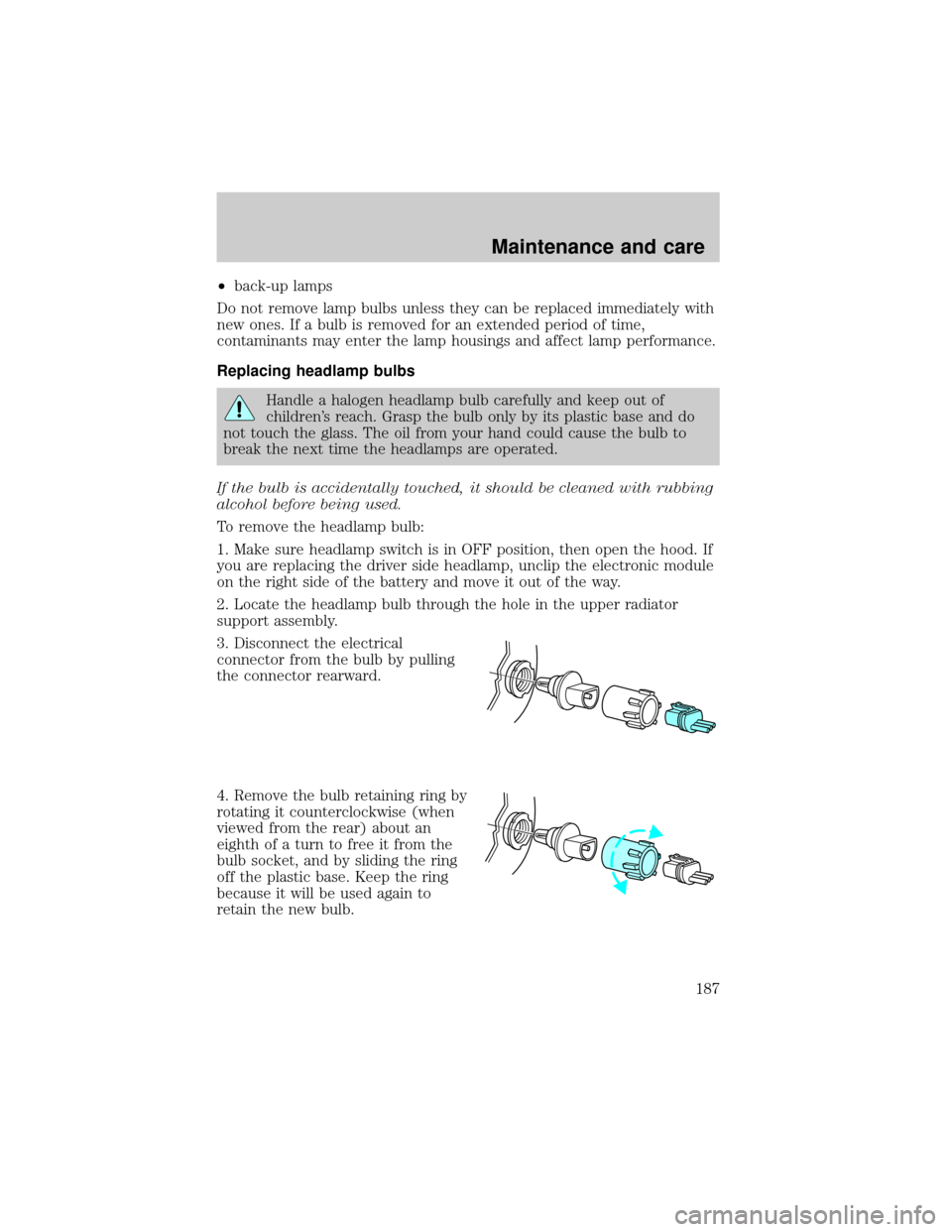
3. Disconnect the electrical
connector from the bulb by pulling
the connector rearward.
4. Remove the bulb retaining ring by
rotating it counterclockwise (when
viewed from the rear) about an
eighth of a turn to free it from the
bulb socket, and by sliding the ring
off the plastic base. Keep the ring
because it will be used again to
retain the new bulb.
Maintenance and care
187
Page 197 of 210

MOTORCRAFT PART NUMBERS
Component 4.0L EFI
engine4.0L SOHC
engine5.0L engine
Air filter FA-1616 FA-1658 FA-1658
Fuel filter FG-872 FG-872 FG-872
Battery BXT-65-650 BXT-65-650 BXT-65-650
Oil filter FL-1A FL-1A FL-820S
PCV valve EV-225 EV-225 EV-152
Spark plugs* AGRF-22P AGRF-22P AWSF-32EE
* Refer to Vehicle Emissions Control Information (VECI) decal for
spark plug gap information.
Capacities and specifications
197
Page 206 of 210

Air bag supplemental
restraint system ........................82
and child safety seats ..............83
description ................................82
disposal ......................................86
indicator light ...........................85
passenger air bag .....................84
Air conditioning
manual heating and air
conditioning system ............23,25
Air suspension
description ..............................106
All wheel drive (AWD) .............121
Ambulance packages ....................3
Anti-lock brake system (ABS)
description ..............................104
Anti-theft system ........................67
Autolamp system (see
Headlamps) .................................48
Automatic dimming mirror ...48,49
Battery .......................................175
voltage gauge ............................14
Brake fluid
checking and adding ..............164
Brakes ........................................104
anti-lock ...................................104
anti-lock brake system (ABS)
warning light ...........................104
fluid, checking and adding ....164
Brake-shift interlock .................107
Break-in period .............................2
Bulbs, replacing ........................186
headlamps ...............................187
specifications ..........................188
Cargo cover .................................57
Changing a tire .........................144
Child safety seats ........................87
built-in child seat ......91,92,96,97
Childproof locks ..........................52
Chime
headlamps on ............................11
Cleaning your vehicle ...............191built-in child seat ...................195
engine compartment ..............192
fabric ........................................194
instrument panel ....................194
plastic parts ............................194
safety belts ..............................194
tail lamps .................................194
washing ....................................191
waxing .....................................192
wheels ......................................194
windows ..................................196
woodtone trim ........................196
Climate control system
automatic temperature
control .........26,27,28,29,30,31,32
Clutch
fluid ..........................................165
Compass, electronic ...............45,46
calibration .................................48
set zone adjustment .................47
Console, description ...................54
Control trac 4WD system .........116
Controls ..................................53,54
Cupholder (s) .............................55
Defrost
rear window ..............................34
Driving under special
conditions .........................120,122
high water ........................120,123
slippery roads ....120,121,123,124
Emission control system ..........185
Engine ........................................202
service points ............158,159,160
Engine block heater .................102
Engine coolant
checking and adding .......166,167
disposal ....................................168
refill capacities ........................168
Engine oil ...........................160,163
changing oil and oil filter .......163
checking and adding .......160,162
Exhaust fumes ..........................103
Index
206