steering wheel FORD EXPLORER 1999 2.G User Guide
[x] Cancel search | Manufacturer: FORD, Model Year: 1999, Model line: EXPLORER, Model: FORD EXPLORER 1999 2.GPages: 264, PDF Size: 1.83 MB
Page 148 of 264
²underinflated tire(s) on any wheel(s)
²high crown in center of road
²high crosswinds
²wheels out of alignment
²loose or worn components in steering linkage
AIR SUSPENSION SYSTEM (IF EQUIPPED)
The load leveling feature of the air suspension automatically keeps the
vehicle at a constant level if a load is added or removed from the vehicle.
This system maintains the vehicle height at a constant level by
automatically adding air or releasing air from the springs to offset
changes in vehicle loads.
When ever a door is opened (including the liftgate) the system
memorizes and maintains the height of the vehicle until all doors are
closed.
It is normal to hear a buzz or clicking from the air compressor on the
vehicle when the ignition is turned off. The system stays energized for 40
minutes after the ignition is turned off to compensate for any load
changes made after the vehicle is parked.
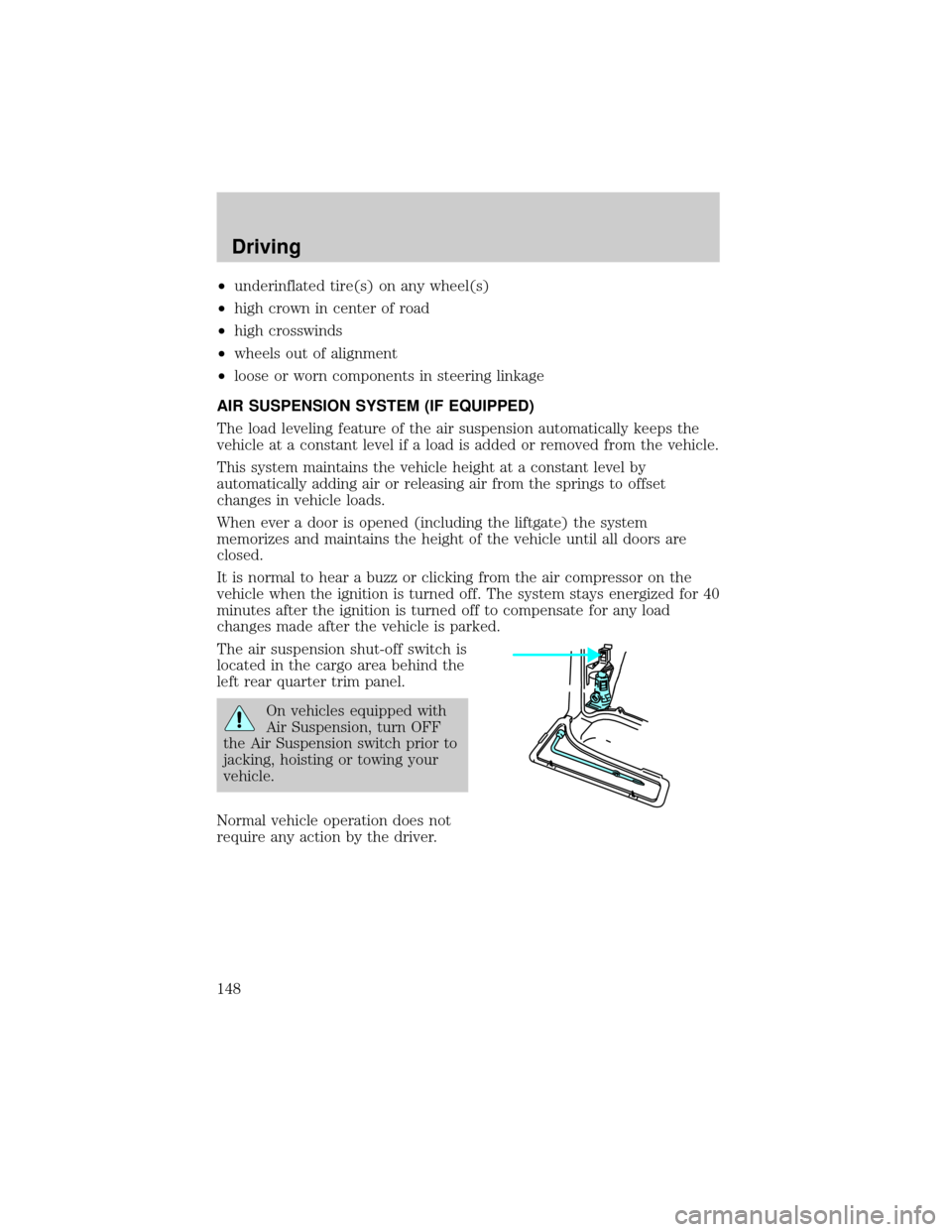
The air suspension shut-off switch is
located in the cargo area behind the
left rear quarter trim panel.
On vehicles equipped with
Air Suspension, turn OFF
the Air Suspension switch prior to
jacking, hoisting or towing your
vehicle.
Normal vehicle operation does not
require any action by the driver.
Driving
148
Page 160 of 264
Driving off-road with 4WD
Your vehicle is specially equipped for driving on sand, snow, mud and
rough terrain and has operating characteristics that are somewhat
different from conventional vehicles, both on and off the road.
Maintain steering wheel control at all times, especially in rough terrain.
Since sudden changes in terrain can result in abrupt steering wheel
motion, make sure you grip the steering wheel from the outside. Do not
grip the spokes.
Drive cautiously to avoid vehicle damage from concealed objects such as
rocks and stumps.
You should either know the terrain or examine maps of the area before
driving. Map out your route before driving in the area. For more
information on driving off-road, read the ªFour Wheelingº supplement in
your owner's portfolio.
If your vehicle gets stuck
If the vehicle is stuck in mud or snow it may be rocked out by shifting
from forward and reverse gears, stopping between shifts, in a steady
pattern. Press lightly on the accelerator in each gear.
Do not rock the vehicle for more than a few minutes. The
transmission and tires may be damaged or the engine can
overheat.
Do not spin the wheels at over 56 km/h (35 mph). The tires may
fail and injure a passenger or bystander.
Sand
When driving over sand, try to keep all four wheels on the most solid
area of the trail. Do not reduce the tire pressures but shift to a lower
gear and drive steadily through the terrain. Apply the accelerator slowly
and avoid spinning the wheels.
Mud and water
If you must drive through high water, drive slowly. Traction or brake
capability may be limited.
When driving through water, determine the depth; avoid water higher
than the bottom of the hubs (if possible) and proceed slowly. If the
ignition system gets wet, the vehicle may stall.
Driving
160
Page 162 of 264
Driving on snow and ice
A 4WD vehicle has advantages over 2WD vehicles in snow and ice but
can skid like any other vehicle.
Avoid sudden applications of power and quick changes of direction on
snow and ice. Apply the accelerator slowly and steadily when starting
from a full stop.
When braking, apply the brakes as you normally would. In order to allow
the anti-lock brake system (ABS) to operate properly, keep steady
pressure on the brake pedal.
Allow more stopping distance and drive slower than usual. Consider
using one of the lower gears.
ALL WHEEL DRIVE (AWD) SYSTEM (IF EQUIPPED)
(5.0L ENGINES ONLY)
Your vehicle is equipped with a full-time All Wheel Drive (AWD) transfer
case. Power is supplied to all four wheels all the time with no need to
shift between two-wheel drive and four-wheel drive.
For the lubricant specification and refill capacity of the AWD transfer
case refer toCapacities and specificationschapter.
Utility and four-wheel drive vehicles arenotdesigned for
cornering at speeds as high as passenger cars any more than
low-slung sports cars are designed to perform satisfactorily under
off-road conditions. Avoid sharp turns or abrupt maneuvers in these
vehicles.
Driving off-road with AWD
Your vehicle is specially equipped for driving on sand, snow, mud and
rough terrain and has operating characteristics that are somewhat
different from conventional vehicles, both on and off the road.
Maintain steering wheel control at all times, especially in rough terrain.
Since sudden changes in terrain can result in abrupt steering wheel
motion, make sure you grip the steering wheel from the outside. Do not
grip the spokes.
Drive cautiously to avoid vehicle damage from concealed objects such as
rocks and stumps.
Driving
162
Page 187 of 264
CHANGING THE TIRES
If you get a flat tire while driving, do not apply the brake heavily.
Instead, gradually decrease your speed. Hold the steering wheel firmly
and slowly move to a safe place on the side of the road.
Spare tire information
Your vehicle is equipped with a 15º spare tire that must be used for
emergencies only. Vehicles equipped with 16º tires have a 16º spare tire.
The 15º spare tire is not as wide as a regular tire and is designed for
emergency use only. Replace this tire with a full-size tire as soon as
possible. The 16º spare tire is not equipped with wheel ornaments. The
wheel ornaments from the original wheel/tire may be used on the spare.
If your vehicle is equipped with 4WD or AWD, a spare tire of a
different size than the road tires should not be used. Such a tire
could result in damage to driveline components and make the
vehicle difficult to control.
Location of the spare tire and tools
The spare tire and tools for your vehicle are stowed in the following
locations:
Tool Location
Spare tire Under the vehicle, just in front of the rear
bumper
Jack, lug nut wrench Left rear quarter panel behind interior access
cover
Jack handle (2 door models) behind rear seat under carpet
in the cargo floor (4 door models) on the
lower rear seat base
Roadside emergencies
187
Page 201 of 264
²Manual transmission:
1. Set the parking brake.
2. Depress the clutch and place the gearshift in 1 (First).
3. Turn off the engine and remove the key.
4. Block the wheels to prevent the vehicle from moving unexpectedly.
Working with the engine on
²Automatic transmission:
1. Set the parking brake and ensure the gearshift is securely latched in P
(Park).
2. Block the wheels to prevent the vehicle from moving unexpectedly.
Do not start your engine with the air cleaner removed and do
not remove it while the engine is running.
²Manual transmission:
1. Set the parking brake, depress the clutch and place the gearshift in N
(Neutral).
2. Block the wheels to prevent the vehicle from moving unexpectedly.
Do not start your engine with the air cleaner removed and do
not remove it while the engine is running.
OPENING THE HOOD
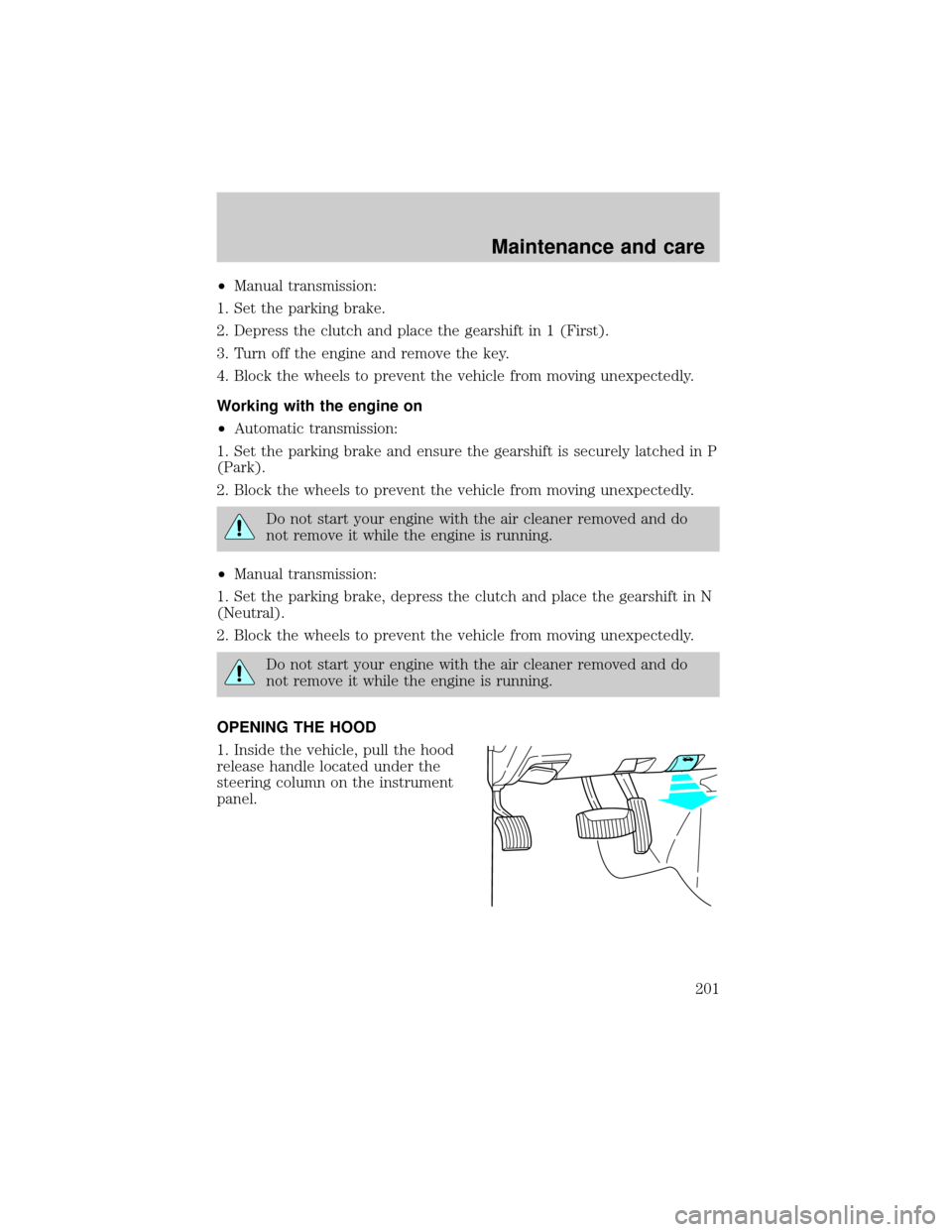
1. Inside the vehicle, pull the hood
release handle located under the
steering column on the instrument
panel.
Maintenance and care
201
Page 215 of 264

1. Start the engine and let it run until it reaches normal operating
temperature (the engine coolant temperature gauge indicator will be
near the center of the normal area between H and C).
2. While the engine idles, turn the steering wheel left and right several
times.
3. Turn the engine off.
4.If your vehicle is equipped with a 4.0L OHV V6 engine,check the
fluid level on the dipstick. It should be within the FULL HOT range. Do
not add fluid if the level is within this range.
5.If your vehicle is equipped with a 4.0L SOHC V6 or a 5.0L V8
engine,check the fluid level in the reservoir. It should be between the
MIN and MAX lines. Do not add fluid if the level is within this range.
6. If the fluid is low, add fluid in small amounts, continuously checking
the level until it reaches the correct operating range. Be sure to put the
cap back on the reservoir.
TRANSMISSION FLUID
Checking automatic transmission fluid
Refer to your Scheduled Maintenance Guide for scheduled intervals for
fluid checks and changes. Your transmission does not consume fluid.
However, the fluid level should be checked if the transmission is not
working properly, i.e., if the transmission slips or shifts slowly or if you
notice some sign of fluid leakage.
Automatic transmission fluid expands when warmed. To obtain an
accurate fluid check, drive the vehicle until it is warmed up
(approximately 30 km [20 miles]). If your vehicle has been operated for
an extended period at high speeds, in city traffic during hot weather or
pulling a trailer, the vehicle should be turned off for about 30 minutes to
allow fluid to cool before checking.
1. Drive the vehicle 30 km (20 miles) or until it reaches normal operating
temperature.
2. Park the vehicle on a level surface and engage the parking brake.
3. With the parking brake engaged and your foot on the brake pedal,
start the engine and move the gearshift lever through all of the gear
ranges. Allow sufficient time for each gear to engage.
4. Latch the gearshift lever in P (Park) and leave the engine running.
Maintenance and care
215
Page 251 of 264
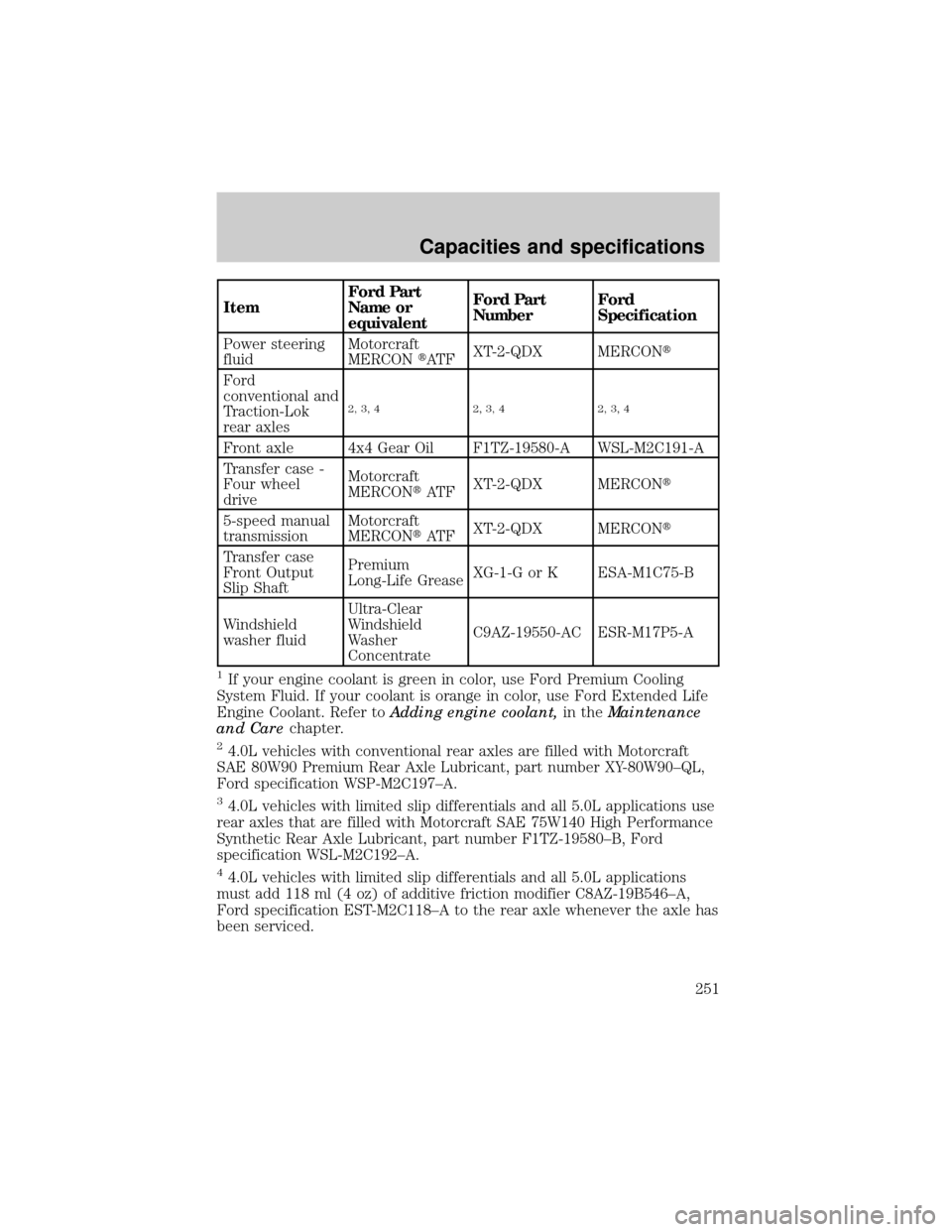
ItemFord Part
Name or
equivalentFord Part
NumberFord
Specification
Power steering
fluidMotorcraft
MERCONtAT FXT-2-QDX MERCONt
Ford
conventional and
Traction-Lok
rear axles
2, 3, 4 2, 3, 4 2, 3, 4
Front axle 4x4 Gear Oil F1TZ-19580-A WSL-M2C191-A
Transfer case -
Four wheel
driveMotorcraft
MERCONtAT FXT-2-QDX MERCONt
5-speed manual
transmissionMotorcraft
MERCONtAT FXT-2-QDX MERCONt
Transfer case
Front Output
Slip ShaftPremium
Long-Life GreaseXG-1-G or K ESA-M1C75-B
Windshield
washer fluidUltra-Clear
Windshield
Washer
ConcentrateC9AZ-19550-AC ESR-M17P5-A
1If your engine coolant is green in color, use Ford Premium Cooling
System Fluid. If your coolant is orange in color, use Ford Extended Life
Engine Coolant. Refer toAdding engine coolant,in theMaintenance
and Carechapter.
24.0L vehicles with conventional rear axles are filled with Motorcraft
SAE 80W90 Premium Rear Axle Lubricant, part number XY-80W90±QL,
Ford specification WSP-M2C197±A.
34.0L vehicles with limited slip differentials and all 5.0L applications use
rear axles that are filled with Motorcraft SAE 75W140 High Performance
Synthetic Rear Axle Lubricant, part number F1TZ-19580±B, Ford
specification WSL-M2C192±A.
44.0L vehicles with limited slip differentials and all 5.0L applications
must add 118 ml (4 oz) of additive friction modifier C8AZ-19B546±A,
Ford specification EST-M2C118±A to the rear axle whenever the axle has
been serviced.
Capacities and specifications
251
Page 259 of 264

speed control ............................84
turn signal indicator ...................8
Locks
childproof ................................100
Lumbar support, seats ......116,118
Manual transmission
reverse .....................................156
Message center ...........................15
economy button ........................16
english/metric button ..........15,16
reset button ..............................16
system check button ...........17,18
Mirrors
automatic dimming rearview
mirror ........................................98
cleaning ...................................246
heated ......................................101
side view mirrors (power) .....100
Moon roof ....................................89
Motorcraft parts ........................231
Octane rating ............................229
Odometer .....................................13
Panic alarm feature, remote
entry system ..............................106
Parking brake ............................146
Power distribution box
(see Fuses) ...............................184
Power door locks ........................99
Power steering ..........................147
fluid, checking and adding ....213
Radio ...33,34,35,36,37,38,40,41,42,
43,44,46,47,48,49,50,51,52,
53,54,56,57,58,59,60,61,62,
63,64,65,66,67,68
Relays ........................................179
Remote entry system .105,113,114
illuminated entry ....................109
locking/unlocking doors .........106
replacement/additional
transmitters .............................109
replacing the batteries ...........108
Reverse sensing system .............31Roof rack ...................................177
Safety belts
(see Safety restraints) ...............11
Safety restraints
cleaning the safety belts .126,246
extension assembly ................125
for children .............................133
warning light and chime ...11,125
Seat belts (see Safety
restraints) ......120,121,122,123,124
Seats ..........................................116
child safety seats ....................134
cleaning ............................245,246
memory seat ....................107,118
Servicing your vehicle .......200,201
Snowplowing .................................3
Spark plugs, specifications .......247
Special notice ................................3
ambulance conversions ..............3
utility-type vehicles ....................3
Specification chart, lubricants .250
Speed control ..............................80
Speedometer ...............................12
Starting your vehicle .........140,142
jump starting ............192,193,195
Steering wheel ............................86
tilting .........................................85
Tachometer .................................13
Tires .............................222,223,224
changing ...........................187,188
checking the pressure ............224
replacing ..................................225
rotating ....................................224
snow tires and chains ............226
tire grades ...............................223
treadwear ................................223
Towing ...........168,173,174,175,176
recreational towing .................176
wrecker ....................................198
Traction-lok rear axle ...............165
Transfer case
fluid checking .........................218
Index
259