air condition FORD EXPLORER 2004 3.G Owner's Manual
[x] Cancel search | Manufacturer: FORD, Model Year: 2004, Model line: EXPLORER, Model: FORD EXPLORER 2004 3.GPages: 296, PDF Size: 5.77 MB
Page 250 of 296
•Revving the engine before turning it off may reduce fuel economy.
•Using the air conditioner or defroster may reduce fuel economy.
•You may want to turn off the speed control in hilly terrain if
unnecessary shifting between third and fourth gear occurs.
Unnecessary shifting of this type could result in reduced fuel
economy.
•Warming up a vehicle on cold mornings is not required and may
reduce fuel economy.
•Resting your foot on the brake pedal while driving may reduce fuel
economy.
•Combine errands and minimize stop-and-go driving.
Maintenance
•Keep tires properly inflated and use only recommended size.
•Operating a vehicle with the wheels out of alignment will reduce fuel
economy.
•Use recommended engine oil. Refer toLubricant specificationsin
this chapter.
•Perform all regularly scheduled maintenance items. Follow the
recommended maintenance schedule and owner maintenance checks
found in your vehicle scheduled maintenance guide.
Conditions
•Heavily loading a vehicle or towing a trailer may reduce fuel economy
at any speed.
•Carrying unnecessary weight may reduce fuel economy (approximately
0.4 km/L [1 mpg] is lost for every 180 kg [400 lb] of weight carried).
•Adding certain accessories to your vehicle (for example bug
deflectors, rollbars/light bars, running boards, ski/luggage racks) may
reduce fuel economy.
•Fuel economy may decrease with lower temperatures during the first
12–16 km (8–10 miles) of driving.
•Driving on flat terrain offers improved fuel economy as compared to
driving on hilly terrain.
•Transmissions give their best fuel economy when operated in the top
cruise gear and with steady pressure on the gas pedal.
•Four-wheel-drive operation (if equipped) is less fuel efficient than
two-wheel-drive operation.
2004 Explorer(exp)
Owners Guide (post-2002-fmt)
USA English(fus)
Maintenance and Specifications
250
Page 258 of 296
The traction grade assigned to this tire is based on
straight-ahead braking traction tests, and does not include
acceleration, cornering, hydroplaning or peak traction characteristics.
Temperature A B C
The temperature grades are A (the highest), B and C, representing the
tire’s resistance to the generation of heat and its ability to dissipate heat
when tested under controlled conditions on a specified indoor laboratory
test wheel. Sustained high temperature can cause the material of the tire
to degenerate and reduce tire life, and excessive temperature can lead to
sudden tire failure. The grade C corresponds to a level of performance
which all passenger car tires must meet under the Federal Motor Vehicle
Safety Standard No. 109. Grades B and A represent higher levels of
performance on the laboratory test wheel than the minimum required by
law.
The temperature grade for this tire is established for a tire that
is properly inflated and not overloaded. Excessive speed,
underinflation, or excessive loading, either separately or in
combination, can cause heat buildup and possible tire failure.
TIRES
Tires are designed to give many thousands of miles of service, but they
must be maintained in order to get the maximum benefit from them.
Glossary of tire terminology
•Tire label:A label showing the OE (Original Equipment) tire sizes,
recommended inflation pressure and the maximum weight the vehicle
can carry.
•Tire Identification Number (TIN):A number on the sidewall of
each tire providing information about the tire brand and
manufacturing plant, tire size and date of manufacturer.
•Inflation pressure:A measure of the amount of air in a tire.
•Standard load:A class of P-metric or Metric tires designed to carry a
maximum load at 35 psi [37 psi (2.5 bar) for Metric tires]. Increasing
the inflation pressure beyond this pressure will not increase the tires
load carrying capability.
•Extra load:A class of P-metric or Metric tires designed to carry a
heavier maximum load at 41 psi [43 psi (2.9 bar) for Metric tires].
2004 Explorer(exp)
Owners Guide (post-2002-fmt)
USA English(fus)
Maintenance and Specifications
258
Page 267 of 296
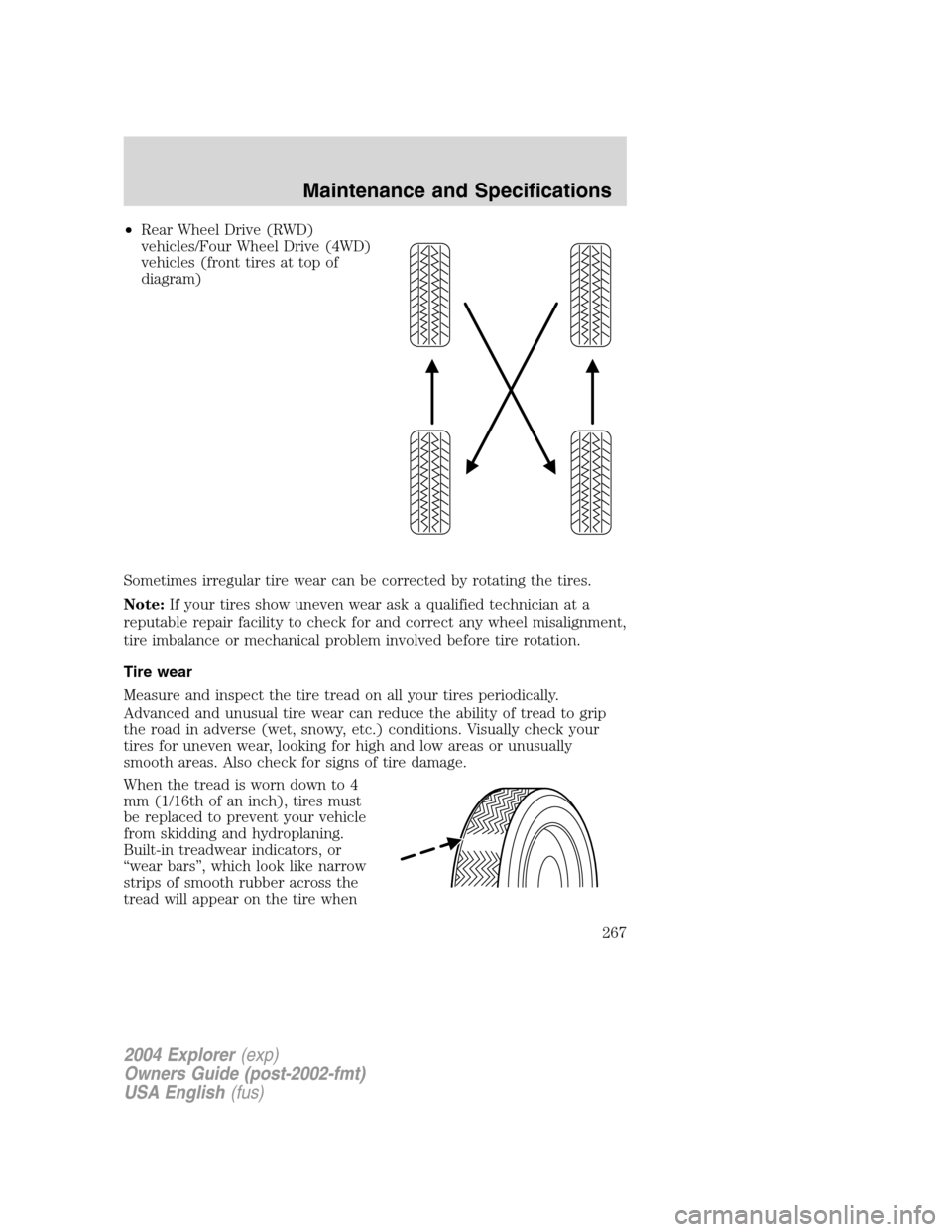
•Rear Wheel Drive (RWD)
vehicles/Four Wheel Drive (4WD)
vehicles (front tires at top of
diagram)
Sometimes irregular tire wear can be corrected by rotating the tires.
Note:If your tires show uneven wear ask a qualified technician at a
reputable repair facility to check for and correct any wheel misalignment,
tire imbalance or mechanical problem involved before tire rotation.
Tire wear
Measure and inspect the tire tread on all your tires periodically.
Advanced and unusual tire wear can reduce the ability of tread to grip
the road in adverse (wet, snowy, etc.) conditions. Visually check your
tires for uneven wear, looking for high and low areas or unusually
smooth areas. Also check for signs of tire damage.
When the tread is worn down to 4
mm (1/16th of an inch), tires must
be replaced to prevent your vehicle
from skidding and hydroplaning.
Built-in treadwear indicators, or
“wear bars”, which look like narrow
strips of smooth rubber across the
tread will appear on the tire when
2004 Explorer(exp)
Owners Guide (post-2002-fmt)
USA English(fus)
Maintenance and Specifications
267
Page 270 of 296
is on, visually check each tire to verify that no tire is flat. If one or more
tires are flat, repair of fix as necessary. If all tires appear to be inflated,
carefully drive the vehicle to the nearest location where air can be added
to the tires. Turn the ignition to the “off” position. Inflate all the tires to
the recommended cold pressure.
The system uses radio-frequency to monitor the tire pressure on all tires
excluding the spare tire. The sensors transmit the tire pressure readings
to the receiver module located in the vehicle. The receiver module then
electronically transmits the status to the message center. For more tire
warning information, refer to theMessage Centerin theDriver controls
chapter.
This device complies with part 15 of the FCC rules and with RS-210 of
Industry Canada. Operation is subject to the following two conditions:
(1) This device may not cause harmful interference, and (2) This device
must accept any interference received, including interference that may
cause undesired operation.
The tire pressure monitoring system is NOT a substitute for
manually checking tire pressure. The tire pressure should be
checked periodically (at least monthly) using a tire gauge, see
Checking the tire pressurein this chapter. Failure to properly
maintain your tire pressure could increase the risk of tire failure, loss
of control, vehicle rollover and personal injury.
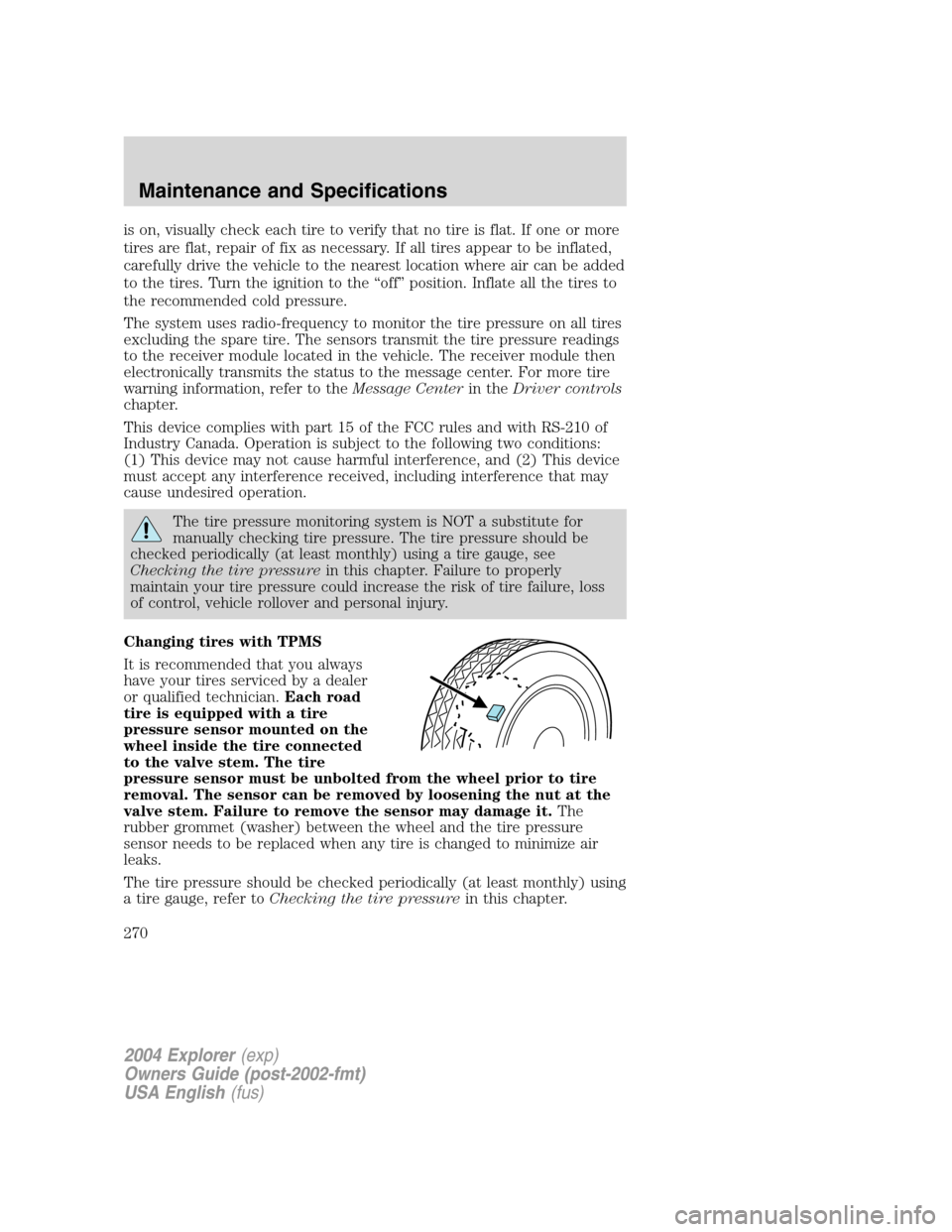
Changing tires with TPMS
It is recommended that you always
have your tires serviced by a dealer
or qualified technician.Each road
tire is equipped with a tire
pressure sensor mounted on the
wheel inside the tire connected
to the valve stem. The tire
pressure sensor must be unbolted from the wheel prior to tire
removal. The sensor can be removed by loosening the nut at the
valve stem. Failure to remove the sensor may damage it.The
rubber grommet (washer) between the wheel and the tire pressure
sensor needs to be replaced when any tire is changed to minimize air
leaks.
The tire pressure should be checked periodically (at least monthly) using
a tire gauge, refer toChecking the tire pressurein this chapter.
2004 Explorer(exp)
Owners Guide (post-2002-fmt)
USA English(fus)
Maintenance and Specifications
270
Page 285 of 296
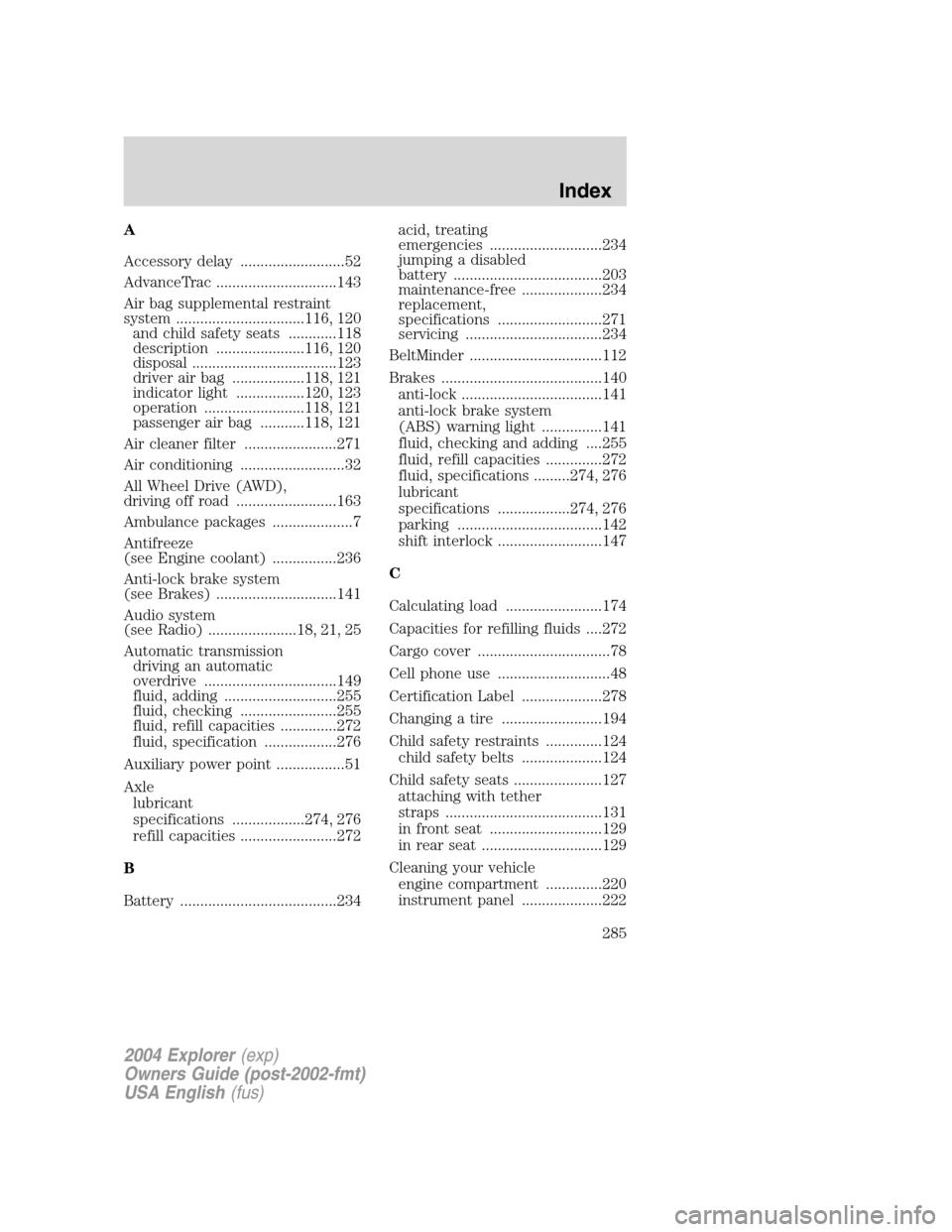
A
Accessory delay ..........................52
AdvanceTrac ..............................143
Air bag supplemental restraint
system ................................116, 120
and child safety seats ............118
description ......................116, 120
disposal ....................................123
driver air bag ..................118, 121
indicator light .................120, 123
operation .........................118, 121
passenger air bag ...........118, 121
Air cleaner filter .......................271
Air conditioning ..........................32
All Wheel Drive (AWD),
driving off road .........................163
Ambulance packages ....................7
Antifreeze
(see Engine coolant) ................236
Anti-lock brake system
(see Brakes) ..............................141
Audio system
(see Radio) ......................18, 21, 25
Automatic transmission
driving an automatic
overdrive .................................149
fluid, adding ............................255
fluid, checking ........................255
fluid, refill capacities ..............272
fluid, specification ..................276
Auxiliary power point .................51
Axle
lubricant
specifications ..................274, 276
refill capacities ........................272
B
Battery .......................................234acid, treating
emergencies ............................234
jumping a disabled
battery .....................................203
maintenance-free ....................234
replacement,
specifications ..........................271
servicing ..................................234
BeltMinder .................................112
Brakes ........................................140
anti-lock ...................................141
anti-lock brake system
(ABS) warning light ...............141
fluid, checking and adding ....255
fluid, refill capacities ..............272
fluid, specifications .........274, 276
lubricant
specifications ..................274, 276
parking ....................................142
shift interlock ..........................147
C
Calculating load ........................174
Capacities for refilling fluids ....272
Cargo cover .................................78
Cell phone use ............................48
Certification Label ....................278
Changing a tire .........................194
Child safety restraints ..............124
child safety belts ....................124
Child safety seats ......................127
attaching with tether
straps .......................................131
in front seat ............................129
in rear seat ..............................129
Cleaning your vehicle
engine compartment ..............220
instrument panel ....................222
2004 Explorer(exp)
Owners Guide (post-2002-fmt)
USA English(fus)
Index
Index
285
Page 286 of 296
interior .....................................223
interior trim ............................222
plastic parts ............................222
safety belts ..............................223
washing ....................................219
waxing .....................................219
wheels ......................................220
wiper blades ............................222
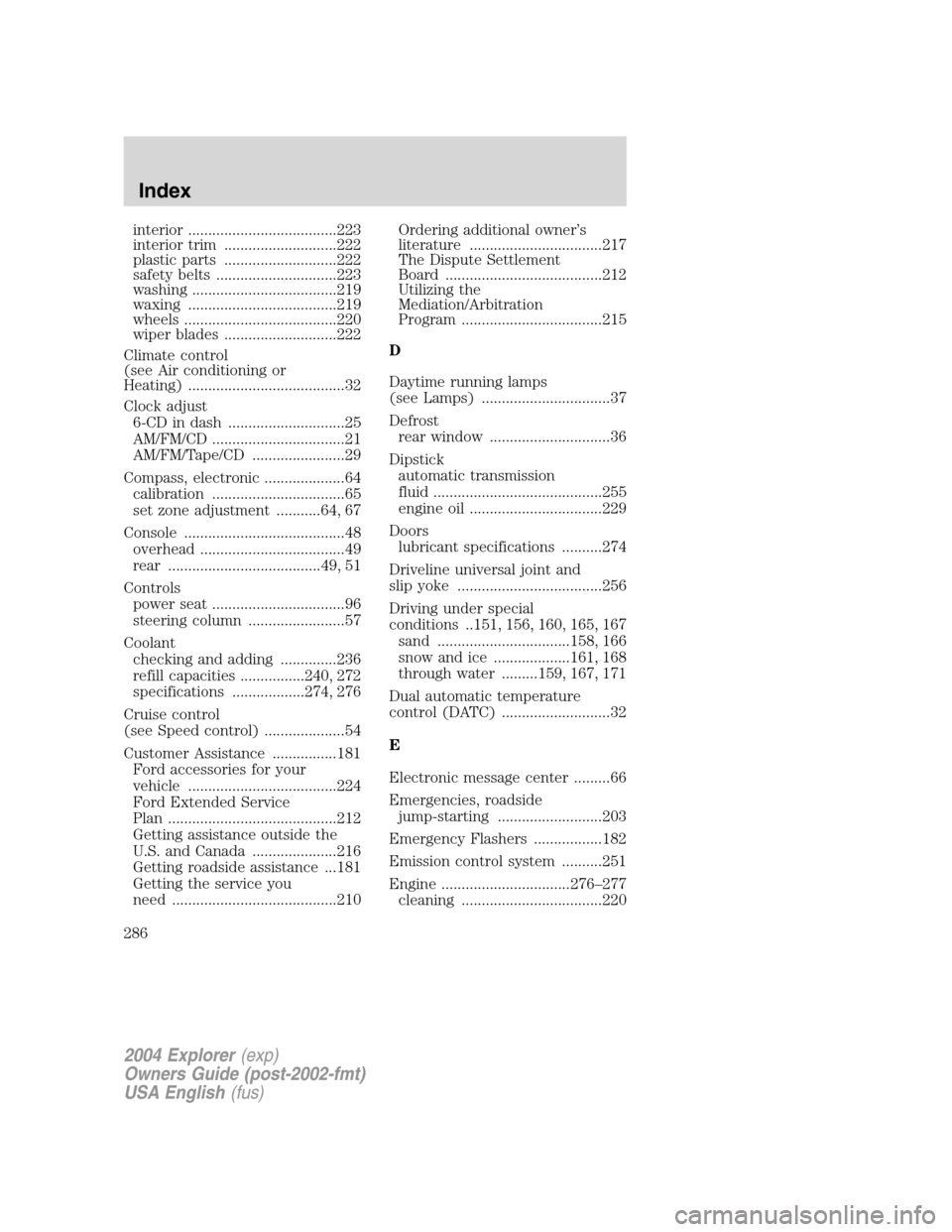
Climate control
(see Air conditioning or
Heating) .......................................32
Clock adjust
6-CD in dash .............................25
AM/FM/CD .................................21
AM/FM/Tape/CD .......................29
Compass, electronic ....................64
calibration .................................65
set zone adjustment ...........64, 67
Console ........................................48
overhead ....................................49
rear ......................................49, 51
Controls
power seat .................................96
steering column ........................57
Coolant
checking and adding ..............236
refill capacities ................240, 272
specifications ..................274, 276
Cruise control
(see Speed control) ....................54
Customer Assistance ................181
Ford accessories for your
vehicle .....................................224
Ford Extended Service
Plan ..........................................212
Getting assistance outside the
U.S. and Canada .....................216
Getting roadside assistance ...181
Getting the service you
need .........................................210Ordering additional owner’s
literature .................................217
The Dispute Settlement
Board .......................................212
Utilizing the
Mediation/Arbitration
Program ...................................215
D
Daytime running lamps
(see Lamps) ................................37
Defrost
rear window ..............................36
Dipstick
automatic transmission
fluid ..........................................255
engine oil .................................229
Doors
lubricant specifications ..........274
Driveline universal joint and
slip yoke ....................................256
Driving under special
conditions ..151, 156, 160, 165, 167
sand .................................158, 166
snow and ice ...................161, 168
through water .........159, 167, 171
Dual automatic temperature
control (DATC) ...........................32
E
Electronic message center .........66
Emergencies, roadside
jump-starting ..........................203
Emergency Flashers .................182
Emission control system ..........251
Engine ................................276–277
cleaning ...................................220
2004 Explorer(exp)
Owners Guide (post-2002-fmt)
USA English(fus)
Index
286
Page 288 of 296
bulb specifications ....................41
daytime running lights .............37
flash to pass ..............................38
high beam .................................38
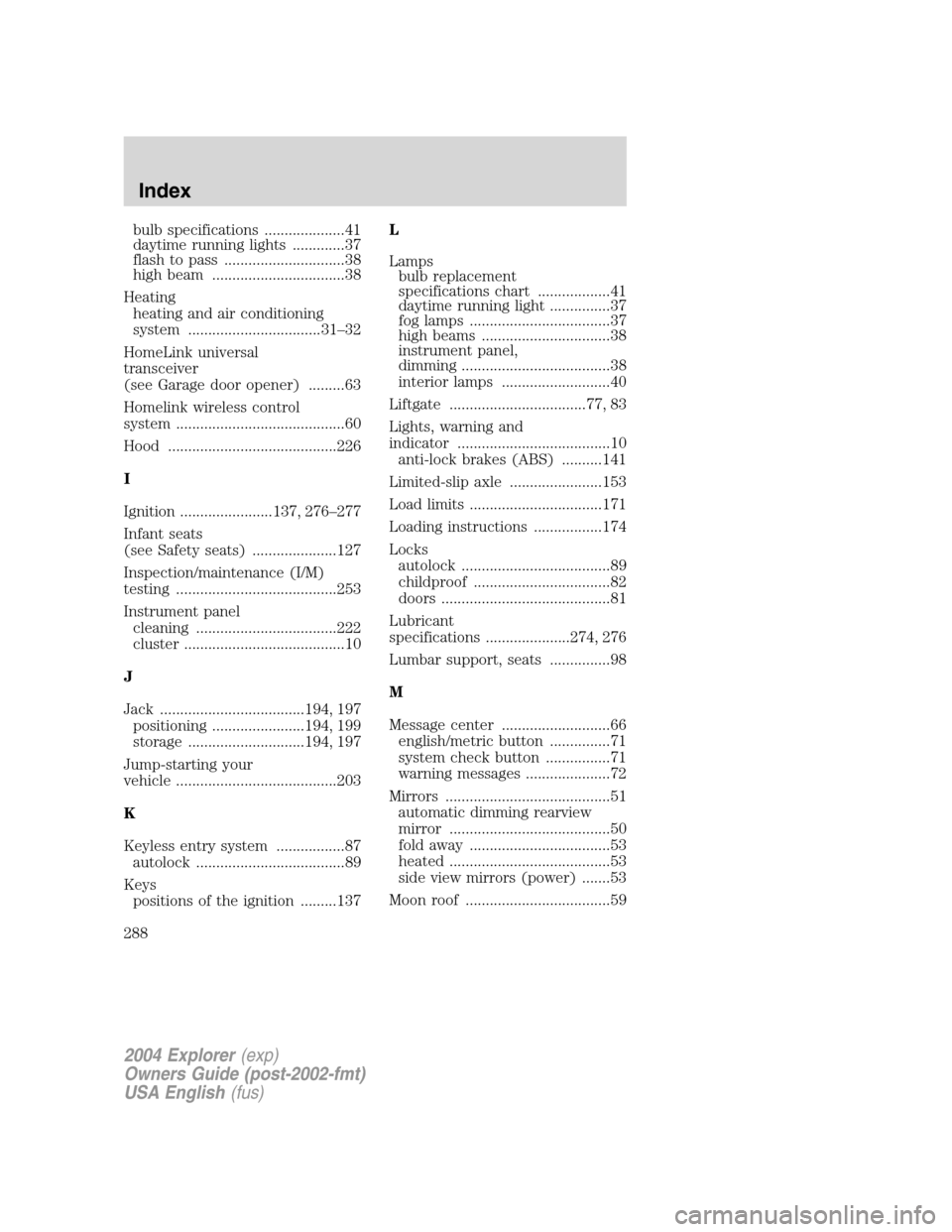
Heating
heating and air conditioning
system .................................31–32
HomeLink universal
transceiver
(see Garage door opener) .........63
Homelink wireless control
system ..........................................60
Hood ..........................................226
I
Ignition .......................137, 276–277
Infant seats
(see Safety seats) .....................127
Inspection/maintenance (I/M)
testing ........................................253
Instrument panel
cleaning ...................................222
cluster ........................................10
J
Jack ....................................194, 197
positioning .......................194, 199
storage .............................194, 197
Jump-starting your
vehicle ........................................203
K
Keyless entry system .................87
autolock .....................................89
Keys
positions of the ignition .........137L
Lamps
bulb replacement
specifications chart ..................41
daytime running light ...............37
fog lamps ...................................37
high beams ................................38
instrument panel,
dimming .....................................38
interior lamps ...........................40
Liftgate ..................................77, 83
Lights, warning and
indicator ......................................10
anti-lock brakes (ABS) ..........141
Limited-slip axle .......................153
Load limits .................................171
Loading instructions .................174
Locks
autolock .....................................89
childproof ..................................82
doors ..........................................81
Lubricant
specifications .....................274, 276
Lumbar support, seats ...............98
M
Message center ...........................66
english/metric button ...............71
system check button ................71
warning messages .....................72
Mirrors .........................................51
automatic dimming rearview
mirror ........................................50
fold away ...................................53
heated ........................................53
side view mirrors (power) .......53
Moon roof ....................................59
2004 Explorer(exp)
Owners Guide (post-2002-fmt)
USA English(fus)
Index
288