radio FORD EXPLORER 2006 4.G Owner's Manual
[x] Cancel search | Manufacturer: FORD, Model Year: 2006, Model line: EXPLORER, Model: FORD EXPLORER 2006 4.GPages: 328, PDF Size: 3.59 MB
Page 146 of 328
For side airbag equipped vehicles, the front passenger sensing system
will turn off the passenger seat side airbag if:
²the seat is empty and safety belt is unbuckled.
²a child or small person occupies the front passenger seat and the child
or small person is unbuckled.
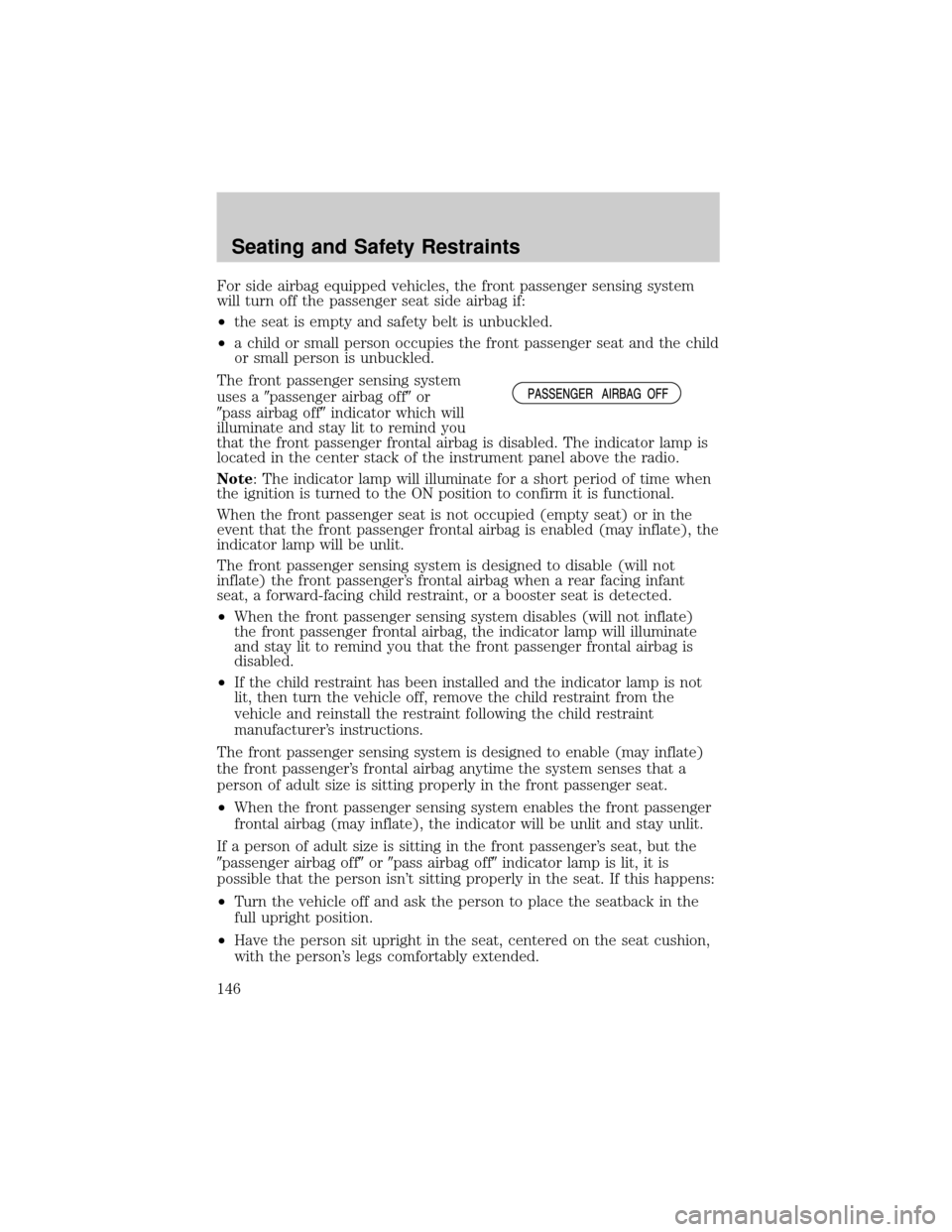
The front passenger sensing system
uses a9passenger airbag off9or
9pass airbag off9indicator which will
illuminate and stay lit to remind you
that the front passenger frontal airbag is disabled. The indicator lamp is
located in the center stack of the instrument panel above the radio.
Note: The indicator lamp will illuminate for a short period of time when
the ignition is turned to the ON position to confirm it is functional.
When the front passenger seat is not occupied (empty seat) or in the
event that the front passenger frontal airbag is enabled (may inflate), the
indicator lamp will be unlit.
The front passenger sensing system is designed to disable (will not
inflate) the front passenger's frontal airbag when a rear facing infant
seat, a forward-facing child restraint, or a booster seat is detected.
²When the front passenger sensing system disables (will not inflate)
the front passenger frontal airbag, the indicator lamp will illuminate
and stay lit to remind you that the front passenger frontal airbag is
disabled.
²If the child restraint has been installed and the indicator lamp is not
lit, then turn the vehicle off, remove the child restraint from the
vehicle and reinstall the restraint following the child restraint
manufacturer's instructions.
The front passenger sensing system is designed to enable (may inflate)
the front passenger's frontal airbag anytime the system senses that a
person of adult size is sitting properly in the front passenger seat.
²When the front passenger sensing system enables the front passenger
frontal airbag (may inflate), the indicator will be unlit and stay unlit.
If a person of adult size is sitting in the front passenger's seat, but the
9passenger airbag off9or9pass airbag off9indicator lamp is lit, it is
possible that the person isn't sitting properly in the seat. If this happens:
²Turn the vehicle off and ask the person to place the seatback in the
full upright position.
²Have the person sit upright in the seat, centered on the seat cushion,
with the person's legs comfortably extended.
Seating and Safety Restraints
146
Page 207 of 328
STARTING
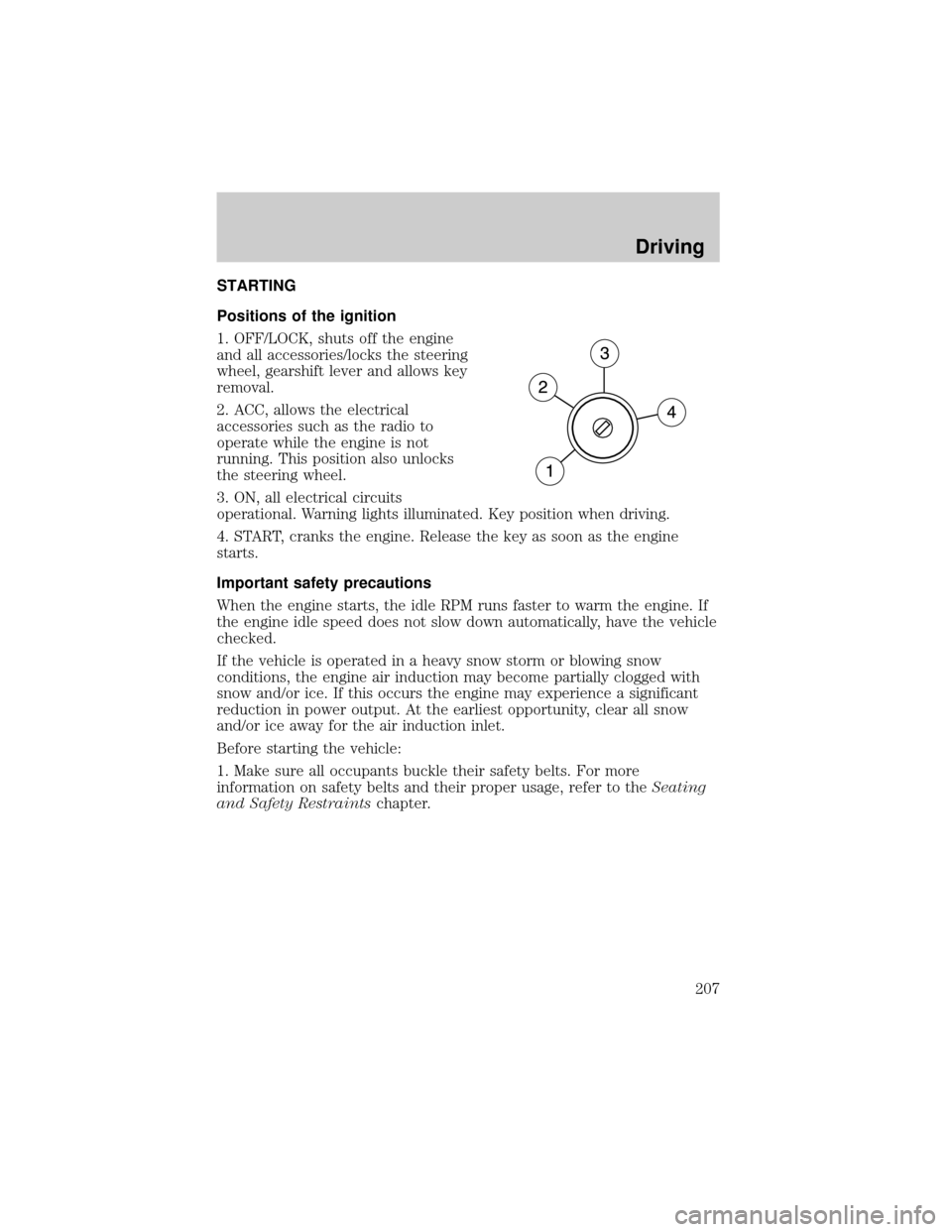
Positions of the ignition
1. OFF/LOCK, shuts off the engine
and all accessories/locks the steering
wheel, gearshift lever and allows key
removal.
2. ACC, allows the electrical
accessories such as the radio to
operate while the engine is not
running. This position also unlocks
the steering wheel.
3. ON, all electrical circuits
operational. Warning lights illuminated. Key position when driving.
4. START, cranks the engine. Release the key as soon as the engine
starts.
Important safety precautions
When the engine starts, the idle RPM runs faster to warm the engine. If
the engine idle speed does not slow down automatically, have the vehicle
checked.
If the vehicle is operated in a heavy snow storm or blowing snow
conditions, the engine air induction may become partially clogged with
snow and/or ice. If this occurs the engine may experience a significant
reduction in power output. At the earliest opportunity, clear all snow
and/or ice away for the air induction inlet.
Before starting the vehicle:
1. Make sure all occupants buckle their safety belts. For more
information on safety belts and their proper usage, refer to theSeating
and Safety Restraintschapter.
Driving
207
Page 218 of 328
If the parking brake is fully released, but the brake warning lamp
remains illuminated, the brakes may not be working properly.
See your authorized dealer.
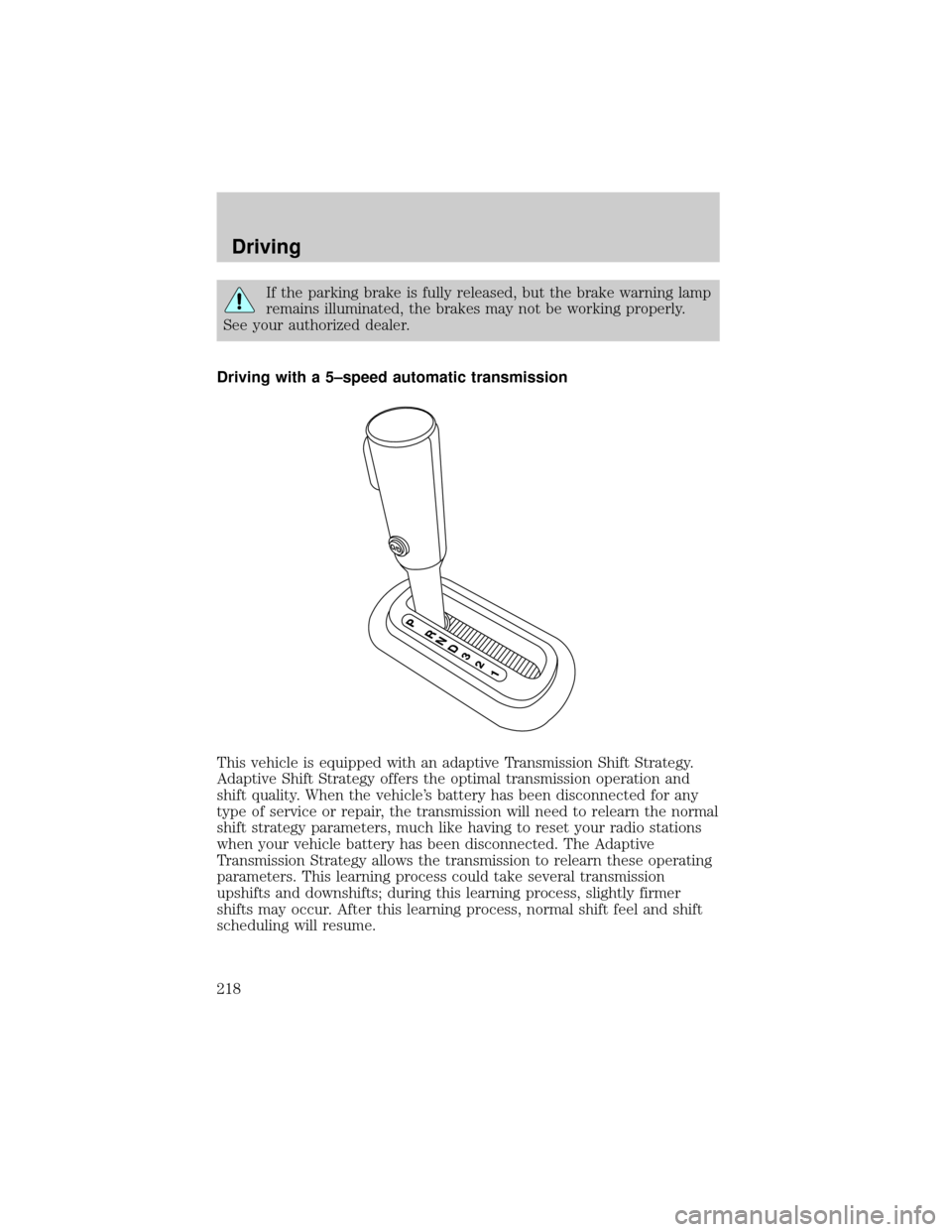
Driving with a 5±speed automatic transmission
This vehicle is equipped with an adaptive Transmission Shift Strategy.
Adaptive Shift Strategy offers the optimal transmission operation and
shift quality. When the vehicle's battery has been disconnected for any
type of service or repair, the transmission will need to relearn the normal
shift strategy parameters, much like having to reset your radio stations
when your vehicle battery has been disconnected. The Adaptive
Transmission Strategy allows the transmission to relearn these operating
parameters. This learning process could take several transmission
upshifts and downshifts; during this learning process, slightly firmer
shifts may occur. After this learning process, normal shift feel and shift
scheduling will resume.
Driving
218
Page 240 of 328
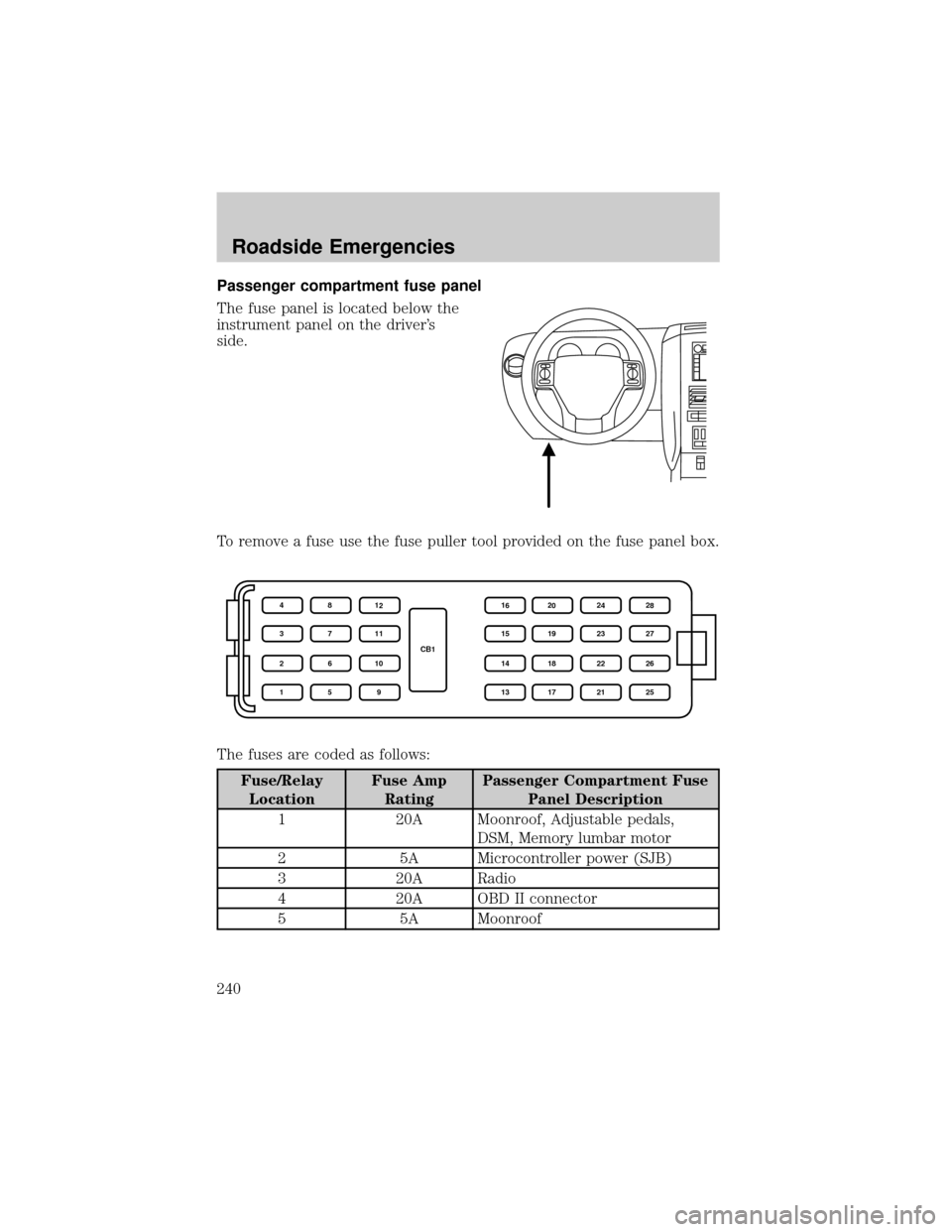
Passenger compartment fuse panel
The fuse panel is located below the
instrument panel on the driver's
side.
To remove a fuse use the fuse puller tool provided on the fuse panel box.
The fuses are coded as follows:
Fuse/Relay
LocationFuse Amp
RatingPassenger Compartment Fuse
Panel Description
1 20A Moonroof, Adjustable pedals,
DSM, Memory lumbar motor
2 5A Microcontroller power (SJB)
3 20A Radio
4 20A OBD II connector
5 5A Moonroof
CB1 4
3
2
18
7
6
512
11
10
916
15
14
1320
19
18
1724
23
22
2128
27
26
25
Roadside Emergencies
240
Page 241 of 328
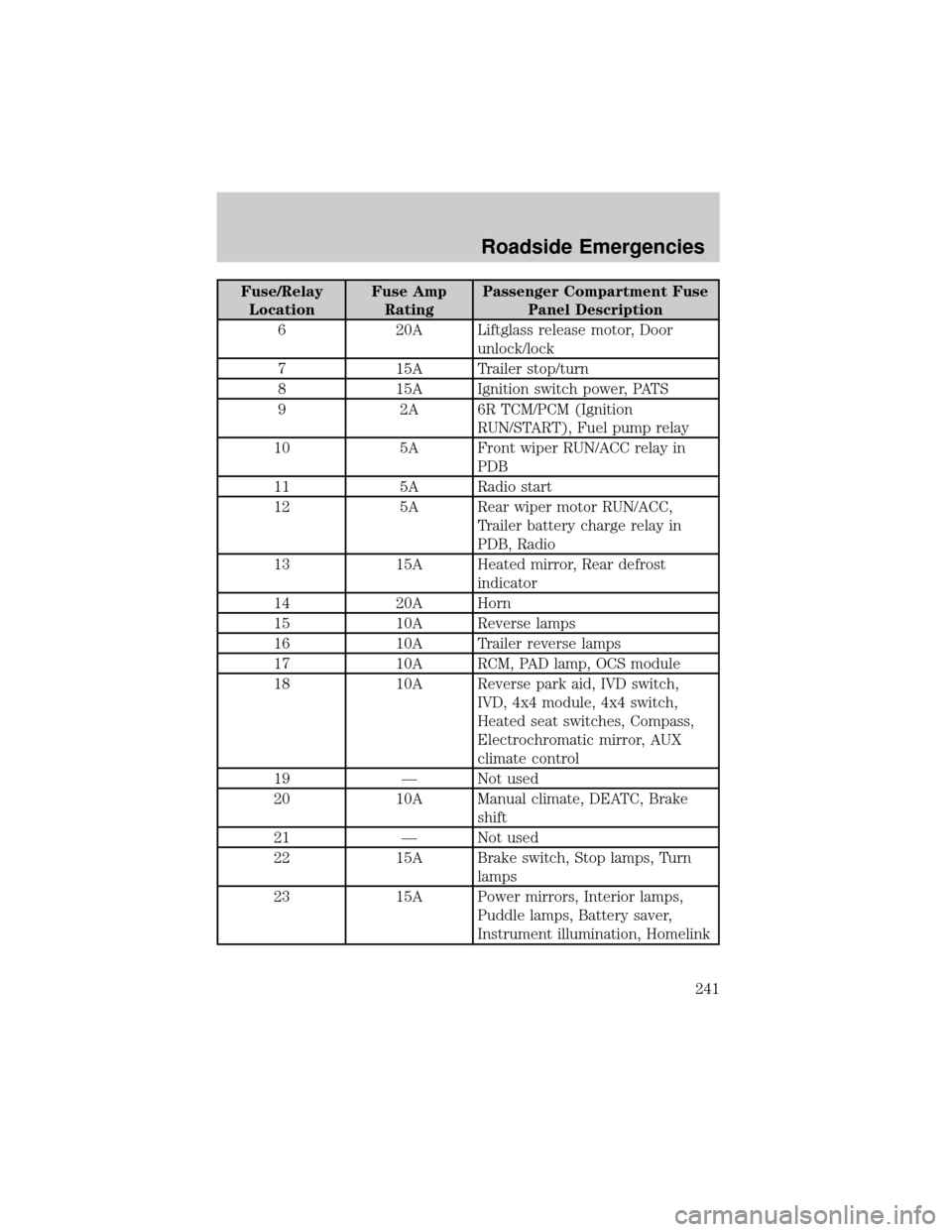
Fuse/Relay
LocationFuse Amp
RatingPassenger Compartment Fuse
Panel Description
6 20A Liftglass release motor, Door
unlock/lock
7 15A Trailer stop/turn
8 15A Ignition switch power, PATS
9 2A 6R TCM/PCM (Ignition
RUN/START), Fuel pump relay
10 5A Front wiper RUN/ACC relay in
PDB
11 5A Radio start
12 5A Rear wiper motor RUN/ACC,
Trailer battery charge relay in
PDB, Radio
13 15A Heated mirror, Rear defrost
indicator
14 20A Horn
15 10A Reverse lamps
16 10A Trailer reverse lamps
17 10A RCM, PAD lamp, OCS module
18 10A Reverse park aid, IVD switch,
IVD, 4x4 module, 4x4 switch,
Heated seat switches, Compass,
Electrochromatic mirror, AUX
climate control
19 Ð Not used
20 10A Manual climate, DEATC, Brake
shift
21 Ð Not used
22 15A Brake switch, Stop lamps, Turn
lamps
23 15A Power mirrors, Interior lamps,
Puddle lamps, Battery saver,
Instrument illumination, Homelink
Roadside Emergencies
241
Page 288 of 328

If the battery has been disconnected or a new battery has been installed,
the clock and the preset radio stations must be reset once the battery is
reconnected.
²Always dispose of automotive
batteries in a responsible manner.
Follow your local authorized
standards for disposal. Call your
local authorized recycling center
to find out more about recycling
automotive batteries.
ENGINE COOLANT
Checking engine coolant
The concentration and level of engine coolant should be checked at the
intervals listed inscheduled maintenance information.The coolant
concentration should be maintained at 50/50 coolant and distilled water,
which equates to a freeze point of -34ÉF (-36ÉC). Coolant concentration
testing is possible with a hydrometer or antifreeze tester (such as the
Rotunda Battery and Antifreeze Tester, 014±R1060). The level of coolant
should be maintained at the ªFULL COLDº level in the coolant reservoir.
If the level falls below, add coolant per the instructions in theAdding
engine coolantsection.
Your vehicle was factory-filled with a 50/50 engine coolant and water
concentration. If the concentration of coolant falls below 40% or above
60%, the engine parts could become damaged or not work properly.A
50±50 mixture of coolant and water provides the following:
²Freeze protection down to -34ÉF (-36ÉC).
²Boiling protection up to 265ÉF (129ÉC).
²Protection against rust and other forms of corrosion.
²Enables calibrated gauges to work properly.
When the engine is cold, check the level of the engine coolant in the
reservoir.
LEAD
RETURN
RECYCLE
Maintenance and Specifications
288
Page 318 of 328

Interior style
Electrochromatic compass/temperature interior mirrors
Floor mats
Scuff plates
Lifestyle
Bike racks
Cargo organization and management
Neutral tow kit
Rear seat entertainment systems
Trailer hitches, wiring harnesses and accessories
Peace of mind
First aid and highway safety kits
Full vehicle covers
Locking gas cap
Remote start
Vehicle security systems
Keyless entry keypad
For maximum vehicle performance, keep the following information in
mind when adding accessories or equipment to your vehicle:
²When adding accessories, equipment, passengers and luggage to your
vehicle, do not exceed the total weight capacity of the vehicle or of
the front or rear axle (GVWR or GAWR as indicated on the Safety
Compliance Certification label). Consult your authorized dealer for
specific weight information.
²The Federal Communications Commission (FCC) and Canadian Radio
Telecommunications Commission (CRTC) regulate the use of mobile
communications systems Ð such as two-way radios, telephones and
theft alarms - that are equipped with radio transmitters. Any such
equipment installed in your vehicle should comply with FCC or CRTC
regulations and should be installed only by a qualified service
technician.
Accessories
318
Page 319 of 328

²Mobile communications systems may harm the operation of your
vehicle, particularly if they are not properly designed for automotive
use.
²To avoid interference with other vehicle functions, such as anti-lock
braking systems, amateur radio users who install radios and antennas
onto their vehicle should not locate the Amateur Radio Antennas in
the area of the driver's side hood.
²Electrical or electronic accessories or components that are added to
the vehicle by the authorized dealer or the owner may adversely affect
battery performance and durability.
Accessories
319
Page 320 of 328

A
Accessory delay ..........................58
AdvanceTrac ..............................212
Air cleaner filter ...............306±307
Air conditioning ..........................37
Airbag supplemental
restraint system ........141, 150, 152
and child safety seats ............143
description ..............141, 150, 152
disposal ....................................155
driver airbag ............143, 151, 153
indicator light .................150, 155
operation .................143, 151, 153
passenger airbag .....143, 151, 153
side airbag ...............................150
Ambulance packages ....................8
Antifreeze
(see Engine coolant) ................288
Anti-lock brake system
(see Brakes) ..............................210
Audio system
(see Radio) ......................21, 25, 29
Automatic transmission
driving an automatic
overdrive .........................218, 221
fluid, adding ............................305
fluid, checking ........................305
fluid, refill capacities ..............308
fluid, specification ..................313
Auxiliary power point .................55
Axle
lubricant specifications ..310, 313
refill capacities ........................308
B
Battery .......................................286acid, treating emergencies .....286
jumping a disabled battery ....256
maintenance-free ....................286
replacement, specifications ...307
servicing ..................................286
BeltMinder .................................136
Brakes ........................................210
anti-lock ...................................210
anti-lock brake system (ABS)
warning light ...........................210
fluid, checking and adding ....305
fluid, refill capacities ..............308
fluid, specifications .........310, 313
lubricant specifications ..310, 313
parking ....................................211
shift interlock ..........................217
C
Calculating load ........................199
Capacities for refilling fluids ....308
Cargo cover ...........................94±95
Cassette tape player .............21, 25
Cell phone use ..............................8
Changing a tire .........................246
Child safety restraints ..............156
child safety belts ....................156
Child safety seats ......................160
attaching with tether straps ..164
in front seat ............................161
in rear seat ..............................161
Cleaning your vehicle
engine compartment ..............270
instrument panel ....................272
interior .....................................273
interior trim ............................273
plastic parts ............................272
washing ....................................269
waxing .....................................269
Index
320
Page 324 of 328

Power mirrors .............................58
Power point .................................55
Power steering ..........................215
fluid, checking and adding ....304
fluid, refill capacity ................308
fluid, specifications .........310, 313
Power Windows ...........................57
Preparing to drive your
vehicle ........................................216
R
Radio ................................21, 25, 29
Rear window defroster ...............41
Relays ........................................238
Remote entry system ...............101
illuminated entry ....................105
opening the trunk ...................102
Reverse sensing system ...........224
Roadside assistance ..................235
Roof rack .....................................97
S
Safety Belt Maintenance ..........140
Safety belts
(see Safety restraints) ............126,
129±134
Safety Canopy ...........150, 152±153
Safety defects, reporting ..........268
Safety restraints ........126, 129±134
belt minder .............................136
extension assembly ................135
for adults .........................130±133
for children .....................155±156
Occupant Classification
Sensor ......................................127safety belt maintenance .........140
warning light and chime ........136
Safety seats for children ..........160
Safety Compliance
Certification Label ....................315
Seat belts
(see Safety restraints) .............126
Seats ..........................................114
child safety seats ....................160
front seats ...............................115
heated ......................................119
memory seat ...................102, 118
Setting the clock
AM/FM/In-dash 6 CD ................29
Snowplowing .................................8
Spark plugs,
specifications .....................307, 313
Special notice
ambulance conversions ..............8
utility-type vehicles ....................8
Specification chart,
lubricants ...........................310, 313
Speed control ..............................60
Starting your vehicle ........207, 209
jump starting ..........................256
Steering wheel
controls ......................................62
tilting .........................................53
T
Tilt steering wheel ......................53
Tire Pressure Monitoring
System (TPMS)
Driving .....................................230
Roadside Emergencies ...........246
Tires, Wheels and Loading ....186
Warning Displays ..........18, 77, 91
Index
324