open FORD EXPLORER 2008 4.G Workshop Manual
[x] Cancel search | Manufacturer: FORD, Model Year: 2008, Model line: EXPLORER, Model: FORD EXPLORER 2008 4.GPages: 384, PDF Size: 3.31 MB
Page 342 of 384
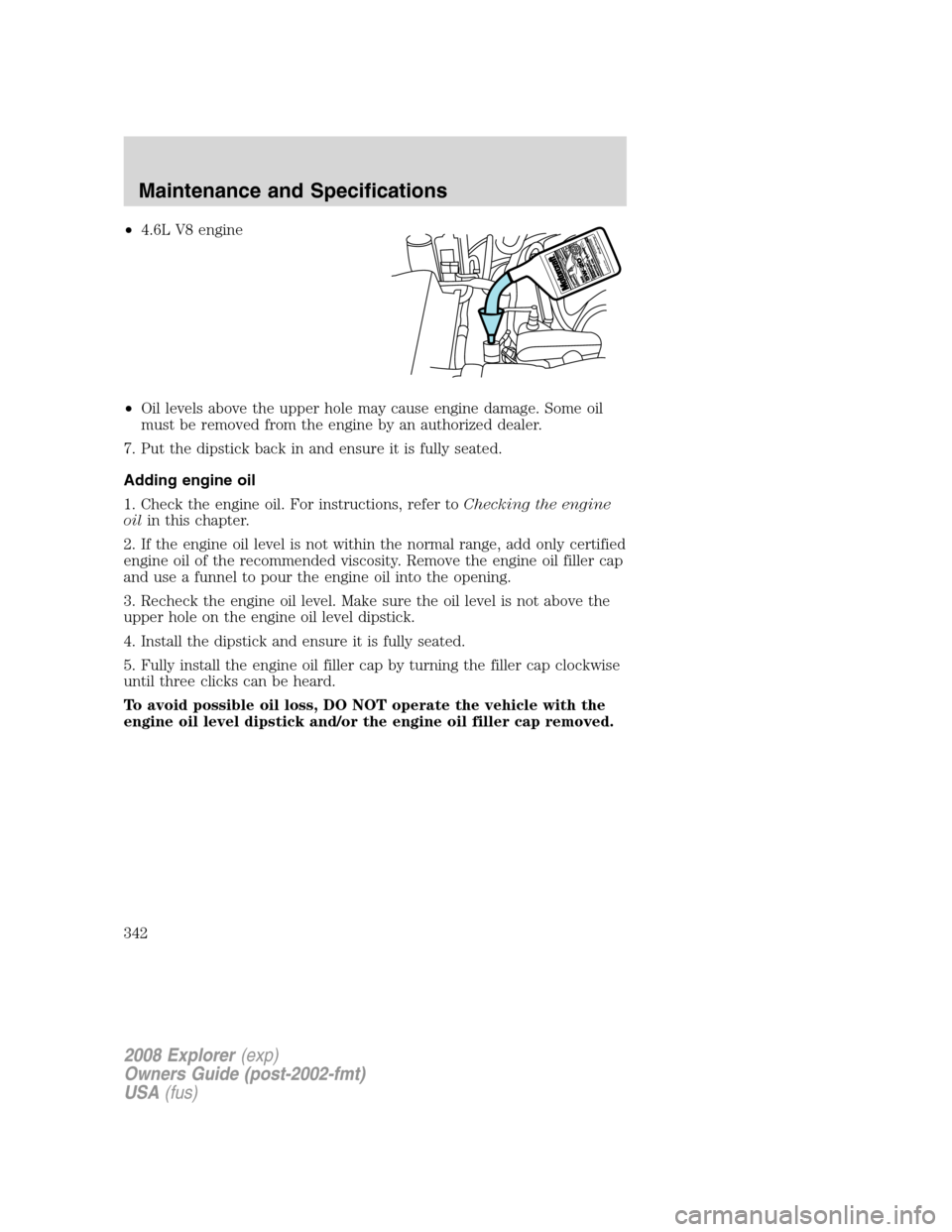
•4.6L V8 engine
•Oil levels above the upper hole may cause engine damage. Some oil
must be removed from the engine by an authorized dealer.
7. Put the dipstick back in and ensure it is fully seated.
Adding engine oil
1. Check the engine oil. For instructions, refer toChecking the engine
oilin this chapter.
2. If the engine oil level is not within the normal range, add only certified
engine oil of the recommended viscosity. Remove the engine oil filler cap
and use a funnel to pour the engine oil into the opening.
3. Recheck the engine oil level. Make sure the oil level is not above the
upper hole on the engine oil level dipstick.
4. Install the dipstick and ensure it is fully seated.
5. Fully install the engine oil filler cap by turning the filler cap clockwise
until three clicks can be heard.
To avoid possible oil loss, DO NOT operate the vehicle with the
engine oil level dipstick and/or the engine oil filler cap removed.
2008 Explorer(exp)
Owners Guide (post-2002-fmt)
USA(fus)
Maintenance and Specifications
342
Page 354 of 384
WHAT YOU SHOULD KNOW ABOUT AUTOMOTIVE FUELS
Important safety precautions
Do not overfill the fuel tank. The pressure in an overfilled tank
may cause leakage and lead to fuel spray and fire.
The fuel system may be under pressure. If the fuel filler cap is
venting vapor or if you hear a hissing sound, wait until it stops
before completely removing the fuel filler cap. Otherwise, fuel may
spray out and injure you or others.
If you do not use the proper fuel filler cap, excessive vacuum in
the fuel tank may damage the fuel system or cause the fuel cap
to disengage in a collision, which may result in possible personal injury.
Automotive fuels can cause serious injury or death if misused or
mishandled.
Gasoline may contain benzene, which is a cancer-causing agent.
Observe the following guidelines when handling automotive fuel:
•Extinguish all smoking materials
and any open flames before
refueling your vehicle.
•Always turn off the vehicle before
refueling.
•Automotive fuels can be harmful
or fatal if swallowed. Fuel such as gasoline is highly toxic and if
swallowed can cause death or permanent injury. If fuel is swallowed,
call a physician immediately, even if no symptoms are immediately
apparent. The toxic effects of fuel may not be visible for hours.
•Avoid inhaling fuel vapors. Inhaling too much fuel vapor of any kind
can lead to eye and respiratory tract irritation. In severe cases,
excessive or prolonged breathing of fuel vapor can cause serious
illness and permanent injury.
2008 Explorer(exp)
Owners Guide (post-2002-fmt)
USA(fus)
Maintenance and Specifications
354
Page 355 of 384
•Avoid getting fuel liquid in your eyes. If fuel is splashed in the eyes,
remove contact lenses (if worn), flush with water for 15 minutes and
seek medical attention. Failure to seek proper medical attention could
lead to permanent injury.
•Fuels can also be harmful if absorbed through the skin. If fuel is
splashed on the skin and/or clothing, promptly remove contaminated
clothing and wash skin thoroughly with soap and water. Repeated or
prolonged skin contact with fuel liquid or vapor causes skin irritation.
•Be particularly careful if you are taking “Antabuse” or other forms of
disulfiram for the treatment of alcoholism. Breathing gasoline vapors,
or skin contact could cause an adverse reaction. In sensitive
individuals, serious personal injury or sickness may result. If fuel is
splashed on the skin, promptly wash skin thoroughly with soap and
water. Consult a physician immediately if you experience an adverse
reaction.
When refueling always shut the engine off and never allow
sparks or open flames near the filler neck. Never smoke while
refueling. Fuel vapor is extremely hazardous under certain conditions.
Care should be taken to avoid inhaling excess fumes.
The flow of fuel through a fuel pump nozzle can produce static
electricity, which can cause a fire if fuel is pumped into an
ungrounded fuel container.
Refueling
Fuel vapor burns violently and a fuel fire can cause severe
injuries. To help avoid injuries to you and others:
•Read and follow all the instructions on the pump island;
•Turn off your engine when you are refueling;
•Do not smoke if you are near fuel or refueling your vehicle;
•Keep sparks, flames and smoking materials away from fuel;
•Stay outside your vehicle and do not leave the fuel pump unattended
when refueling your vehicle — this is against the law in some places;
•Keep children away from the fuel pump; never let children pump
fuel.
2008 Explorer(exp)
Owners Guide (post-2002-fmt)
USA(fus)
Maintenance and Specifications
355
Page 366 of 384
TRANSMISSION FLUID
Checking automatic transmission fluid
The automatic transmission does not have an underhood transmission
fluid dipstick.
Refer to yourscheduled maintenance informationfor scheduled
intervals for fluid checks and changes. Your transmission does not
consume fluid. However, the fluid level should be checked if the
transmission is not working properly, (i.e., if the transmission slips or
shifts slowly) or if you notice some sign of fluid leakage.
Transmission fluid should be checked and, if required, fluid
should be added by an authorized dealer.
Do not use supplemental transmission fluid additives, treatments or
cleaning agents. The use of these materials may affect transmission
operation and result in damage to internal transmission components.
TRANSFER CASE FLUID (IF EQUIPPED)
Turn off the power running
boards, if equipped, before
working under the vehicle, jacking
or placing any object under the
vehicle. Never place your hand
between the extended running
board and the vehicle. A moving
running board may cause injury.
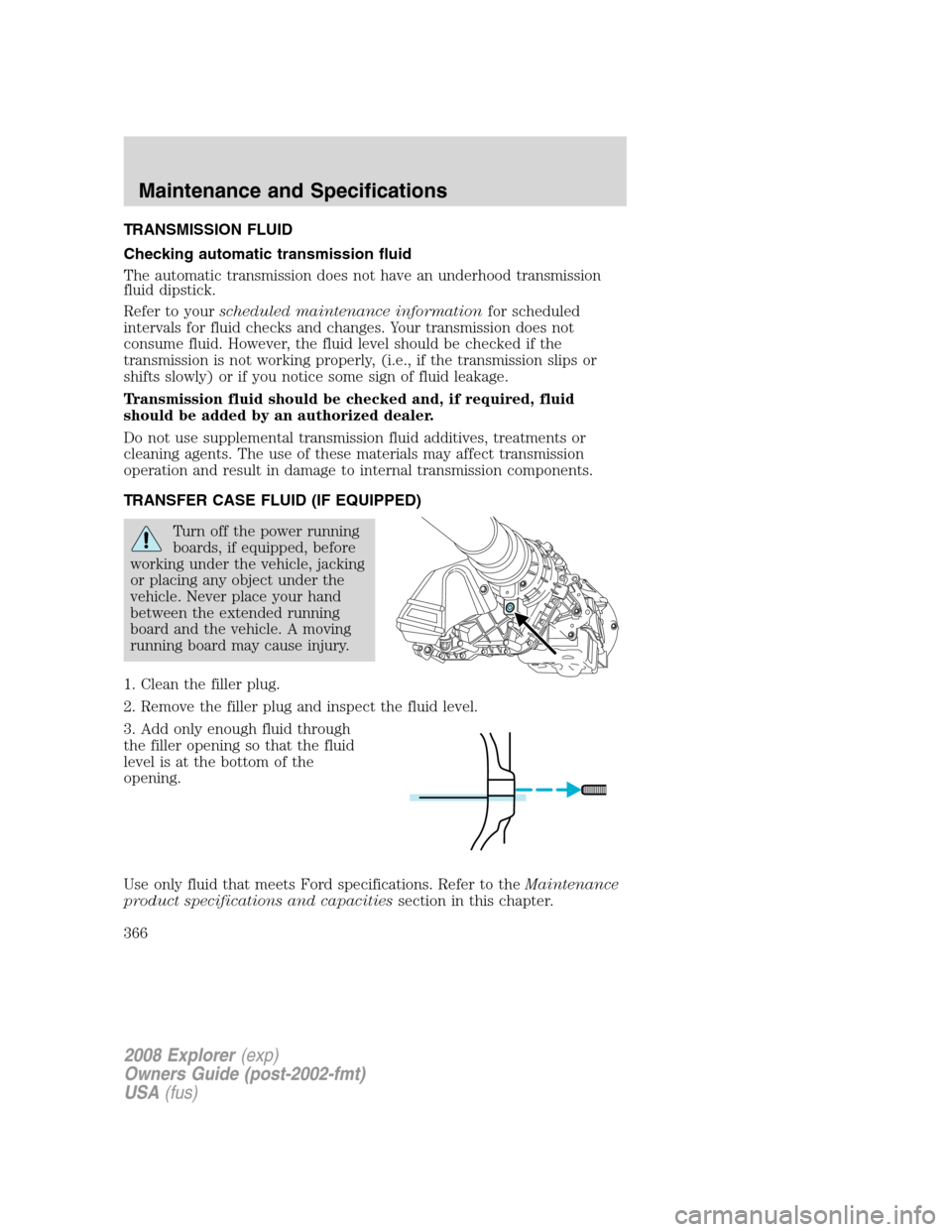
1. Clean the filler plug.
2. Remove the filler plug and inspect the fluid level.
3. Add only enough fluid through
the filler opening so that the fluid
level is at the bottom of the
opening.
Use only fluid that meets Ford specifications. Refer to theMaintenance
product specifications and capacitiessection in this chapter.
2008 Explorer(exp)
Owners Guide (post-2002-fmt)
USA(fus)
Maintenance and Specifications
366
Page 381 of 384
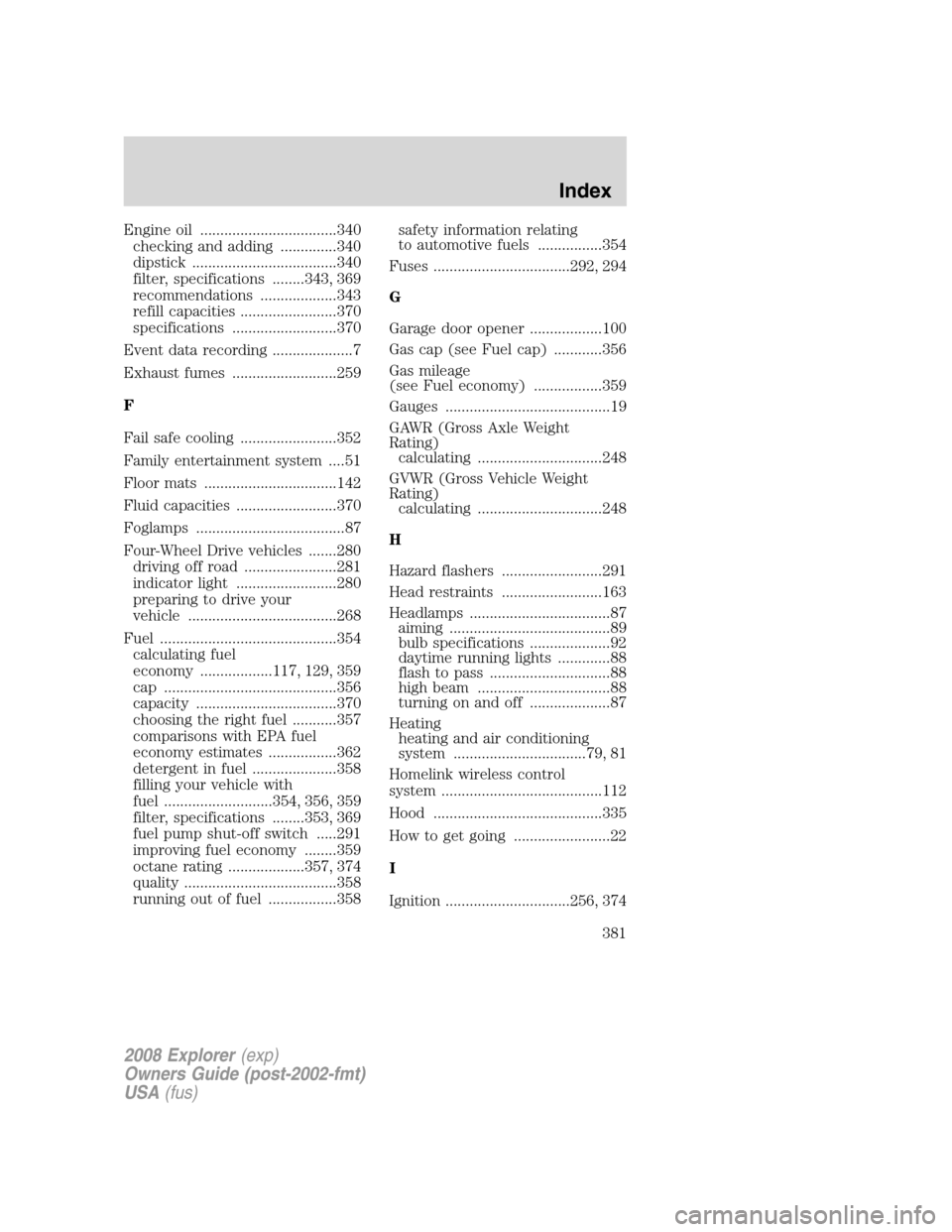
Engine oil ..................................340
checking and adding ..............340
dipstick ....................................340
filter, specifications ........343, 369
recommendations ...................343
refill capacities ........................370
specifications ..........................370
Event data recording ....................7
Exhaust fumes ..........................259
F
Fail safe cooling ........................352
Family entertainment system ....51
Floor mats .................................142
Fluid capacities .........................370
Foglamps .....................................87
Four-Wheel Drive vehicles .......280
driving off road .......................281
indicator light .........................280
preparing to drive your
vehicle .....................................268
Fuel ............................................354
calculating fuel
economy ..................117, 129, 359
cap ...........................................356
capacity ...................................370
choosing the right fuel ...........357
comparisons with EPA fuel
economy estimates .................362
detergent in fuel .....................358
filling your vehicle with
fuel ...........................354, 356, 359
filter, specifications ........353, 369
fuel pump shut-off switch .....291
improving fuel economy ........359
octane rating ...................357, 374
quality ......................................358
running out of fuel .................358safety information relating
to automotive fuels ................354
Fuses ..................................292, 294
G
Garage door opener ..................100
Gas cap (see Fuel cap) ............356
Gas mileage
(see Fuel economy) .................359
Gauges .........................................19
GAWR (Gross Axle Weight
Rating)
calculating ...............................248
GVWR (Gross Vehicle Weight
Rating)
calculating ...............................248
H
Hazard flashers .........................291
Head restraints .........................163
Headlamps ...................................87
aiming ........................................89
bulb specifications ....................92
daytime running lights .............88
flash to pass ..............................88
high beam .................................88
turning on and off ....................87
Heating
heating and air conditioning
system .................................79, 81
Homelink wireless control
system ........................................112
Hood ..........................................335
How to get going ........................22
I
Ignition ...............................256, 374
2008 Explorer(exp)
Owners Guide (post-2002-fmt)
USA(fus)
Index
381