weight FORD EXPLORER 2009 4.G Owner's Manual
[x] Cancel search | Manufacturer: FORD, Model Year: 2009, Model line: EXPLORER, Model: FORD EXPLORER 2009 4.GPages: 407, PDF Size: 3.47 MB
Page 267 of 407
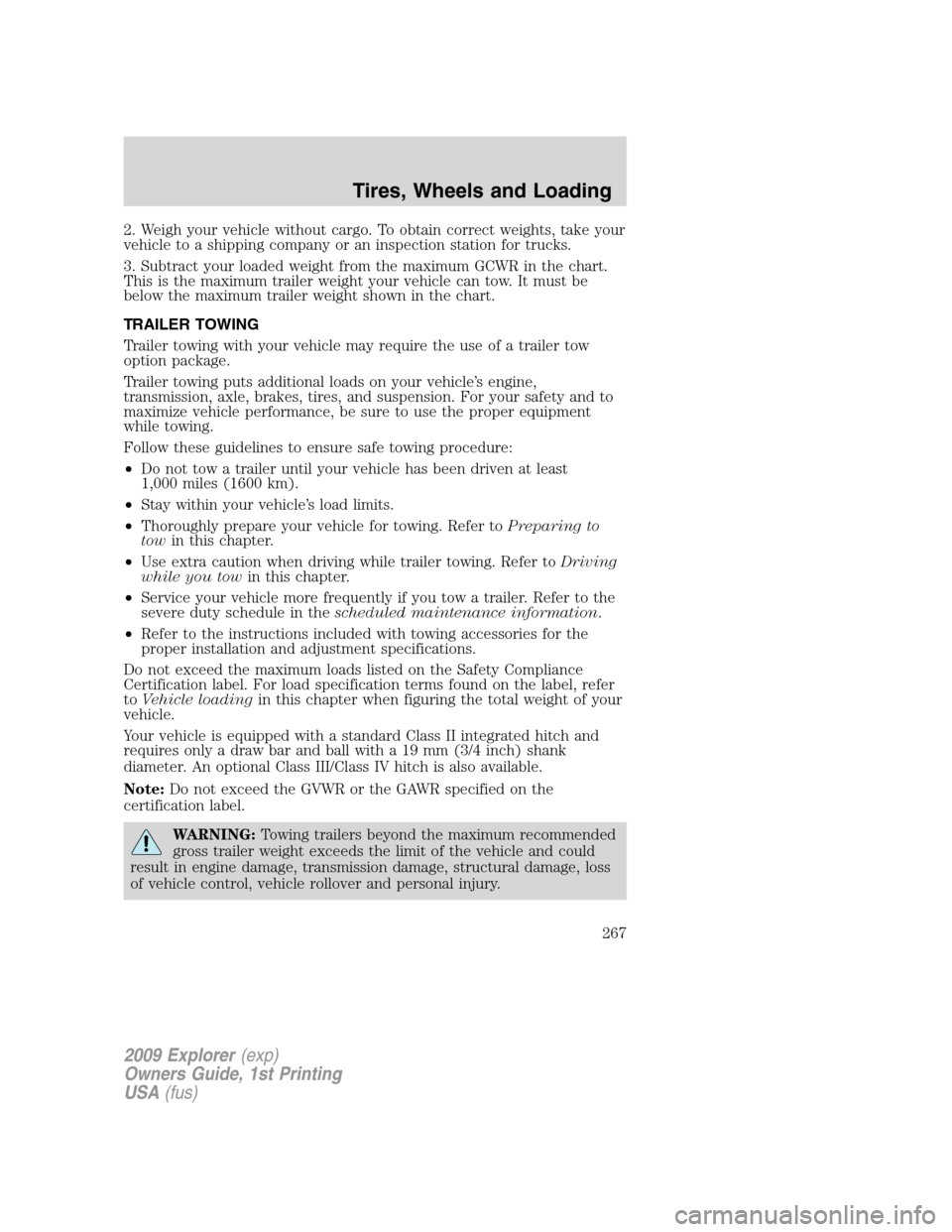
2. Weigh your vehicle without cargo. To obtain correct weights, take your
vehicle to a shipping company or an inspection station for trucks.
3. Subtract your loaded weight from the maximum GCWR in the chart.
This is the maximum trailer weight your vehicle can tow. It must be
below the maximum trailer weight shown in the chart.
TRAILER TOWING
Trailer towing with your vehicle may require the use of a trailer tow
option package.
Trailer towing puts additional loads on your vehicle’s engine,
transmission, axle, brakes, tires, and suspension. For your safety and to
maximize vehicle performance, be sure to use the proper equipment
while towing.
Follow these guidelines to ensure safe towing procedure:
•Do not tow a trailer until your vehicle has been driven at least
1,000 miles (1600 km).
•Stay within your vehicle’s load limits.
•Thoroughly prepare your vehicle for towing. Refer toPreparing to
towin this chapter.
•Use extra caution when driving while trailer towing. Refer toDriving
while you towin this chapter.
•Service your vehicle more frequently if you tow a trailer. Refer to the
severe duty schedule in thescheduled maintenance information.
•Refer to the instructions included with towing accessories for the
proper installation and adjustment specifications.
Do not exceed the maximum loads listed on the Safety Compliance
Certification label. For load specification terms found on the label, refer
toVehicle loadingin this chapter when figuring the total weight of your
vehicle.
Your vehicle is equipped with a standard Class II integrated hitch and
requires only a draw bar and ball with a 19 mm (3/4 inch) shank
diameter. An optional Class III/Class IV hitch is also available.
Note:Do not exceed the GVWR or the GAWR specified on the
certification label.
WARNING:Towing trailers beyond the maximum recommended
gross trailer weight exceeds the limit of the vehicle and could
result in engine damage, transmission damage, structural damage, loss
of vehicle control, vehicle rollover and personal injury.
2009 Explorer(exp)
Owners Guide, 1st Printing
USA(fus)
Tires, Wheels and Loading
267
Page 268 of 407
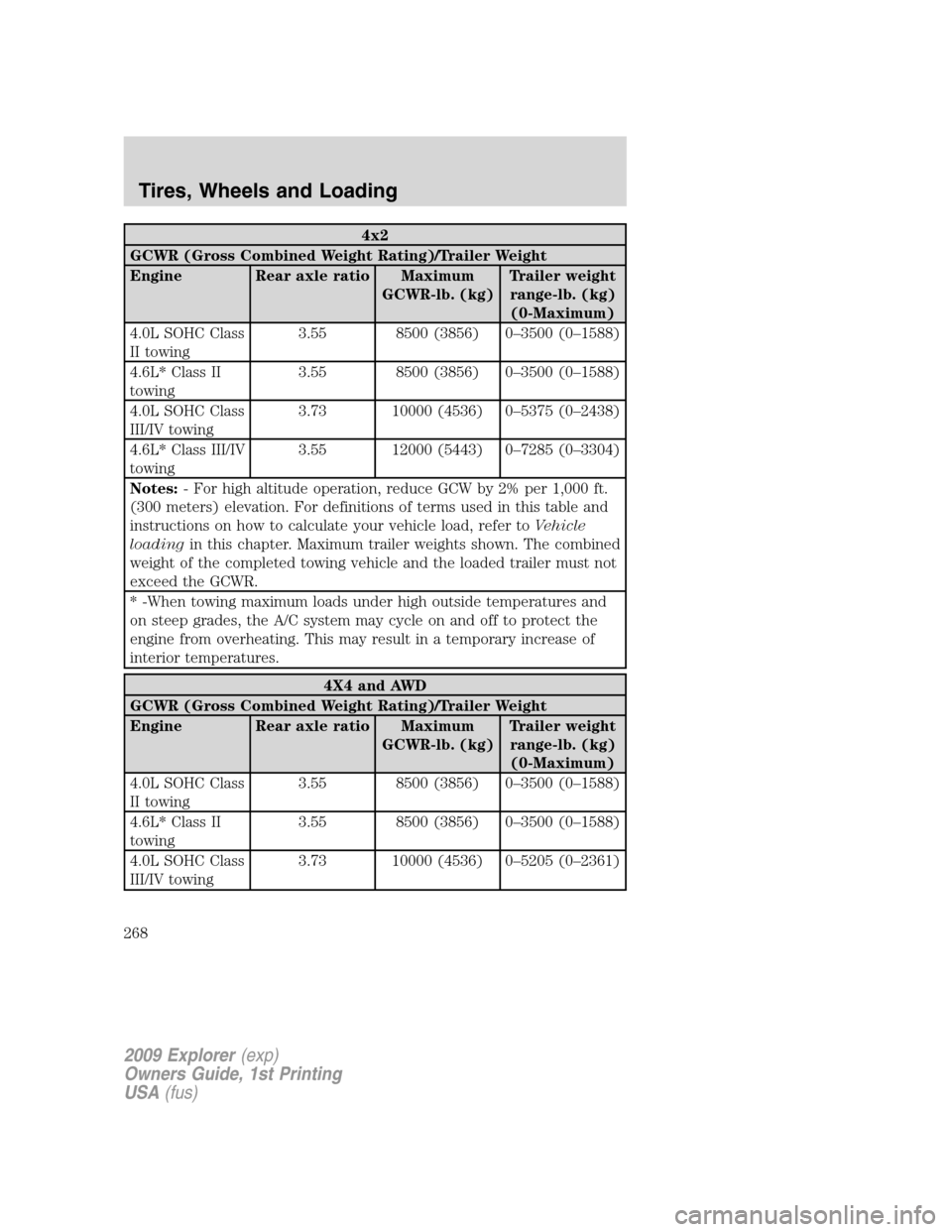
4x2
GCWR (Gross Combined Weight Rating)/Trailer Weight
Engine Rear axle ratio Maximum
GCWR-lb. (kg)Trailer weight
range-lb. (kg)
(0-Maximum)
4.0L SOHC Class
II towing3.55 8500 (3856) 0–3500 (0–1588)
4.6L* Class II
towing3.55 8500 (3856) 0–3500 (0–1588)
4.0L SOHC Class
III/IV towing3.73 10000 (4536) 0–5375 (0–2438)
4.6L* Class III/IV
towing3.55 12000 (5443) 0–7285 (0–3304)
Notes:- For high altitude operation, reduce GCW by 2% per 1,000 ft.
(300 meters) elevation. For definitions of terms used in this table and
instructions on how to calculate your vehicle load, refer toVehicle
loadingin this chapter. Maximum trailer weights shown. The combined
weight of the completed towing vehicle and the loaded trailer must not
exceed the GCWR.
* -When towing maximum loads under high outside temperatures and
on steep grades, the A/C system may cycle on and off to protect the
engine from overheating. This may result in a temporary increase of
interior temperatures.
4X4 and AWD
GCWR (Gross Combined Weight Rating)/Trailer Weight
Engine Rear axle ratio Maximum
GCWR-lb. (kg)Trailer weight
range-lb. (kg)
(0-Maximum)
4.0L SOHC Class
II towing3.55 8500 (3856) 0–3500 (0–1588)
4.6L* Class II
towing3.55 8500 (3856) 0–3500 (0–1588)
4.0L SOHC Class
III/IV towing3.73 10000 (4536) 0–5205 (0–2361)
2009 Explorer(exp)
Owners Guide, 1st Printing
USA(fus)
Tires, Wheels and Loading
268
Page 269 of 407
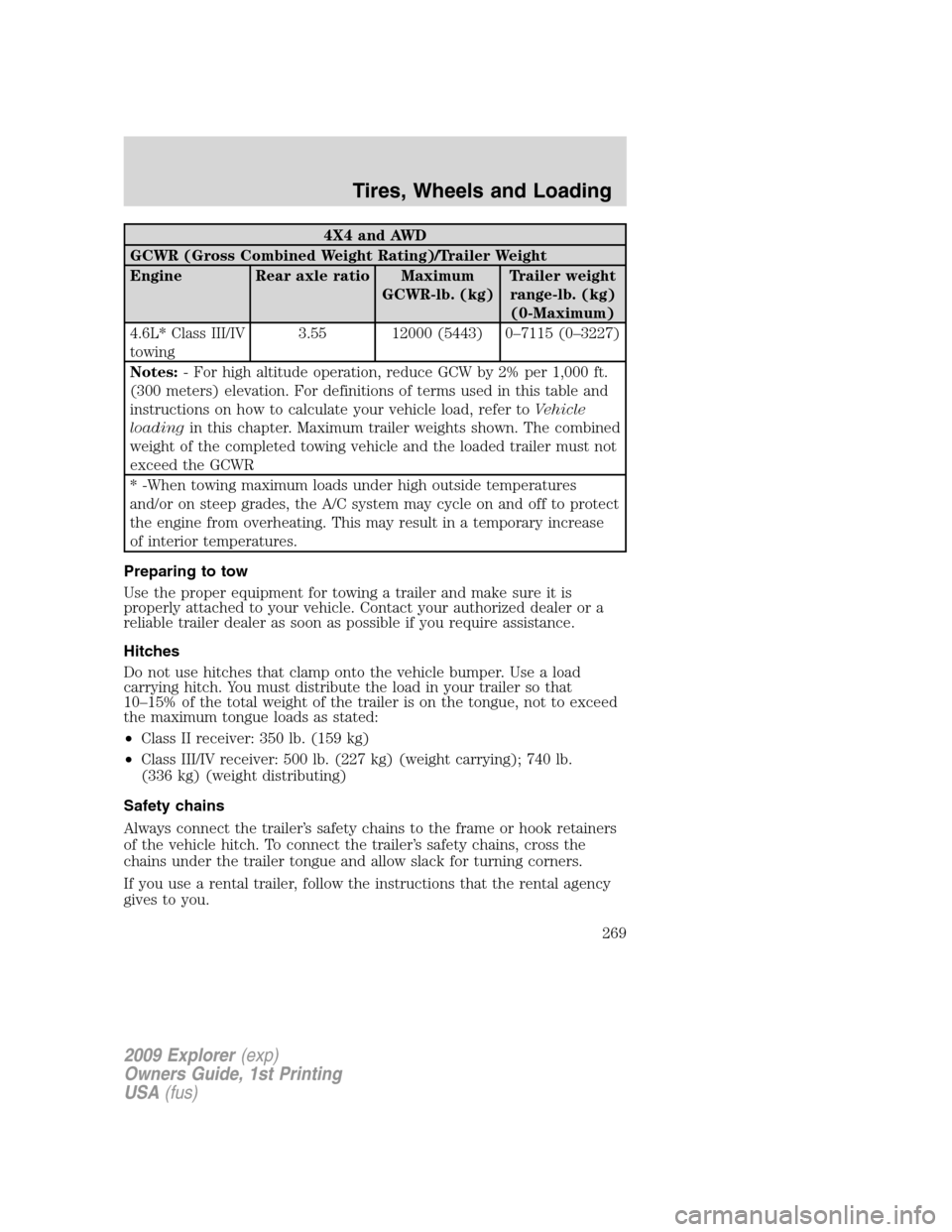
4X4 and AWD
GCWR (Gross Combined Weight Rating)/Trailer Weight
Engine Rear axle ratio Maximum
GCWR-lb. (kg)Trailer weight
range-lb. (kg)
(0-Maximum)
4.6L* Class III/IV
towing3.55 12000 (5443) 0–7115 (0–3227)
Notes:- For high altitude operation, reduce GCW by 2% per 1,000 ft.
(300 meters) elevation. For definitions of terms used in this table and
instructions on how to calculate your vehicle load, refer toVehicle
loadingin this chapter. Maximum trailer weights shown. The combined
weight of the completed towing vehicle and the loaded trailer must not
exceed the GCWR
* -When towing maximum loads under high outside temperatures
and/or on steep grades, the A/C system may cycle on and off to protect
the engine from overheating. This may result in a temporary increase
of interior temperatures.
Preparing to tow
Use the proper equipment for towing a trailer and make sure it is
properly attached to your vehicle. Contact your authorized dealer or a
reliable trailer dealer as soon as possible if you require assistance.
Hitches
Do not use hitches that clamp onto the vehicle bumper. Use a load
carrying hitch. You must distribute the load in your trailer so that
10–15% of the total weight of the trailer is on the tongue, not to exceed
the maximum tongue loads as stated:
•Class II receiver: 350 lb. (159 kg)
•Class III/IV receiver: 500 lb. (227 kg) (weight carrying); 740 lb.
(336 kg) (weight distributing)
Safety chains
Always connect the trailer’s safety chains to the frame or hook retainers
of the vehicle hitch. To connect the trailer’s safety chains, cross the
chains under the trailer tongue and allow slack for turning corners.
If you use a rental trailer, follow the instructions that the rental agency
gives to you.
2009 Explorer(exp)
Owners Guide, 1st Printing
USA(fus)
Tires, Wheels and Loading
269
Page 271 of 407
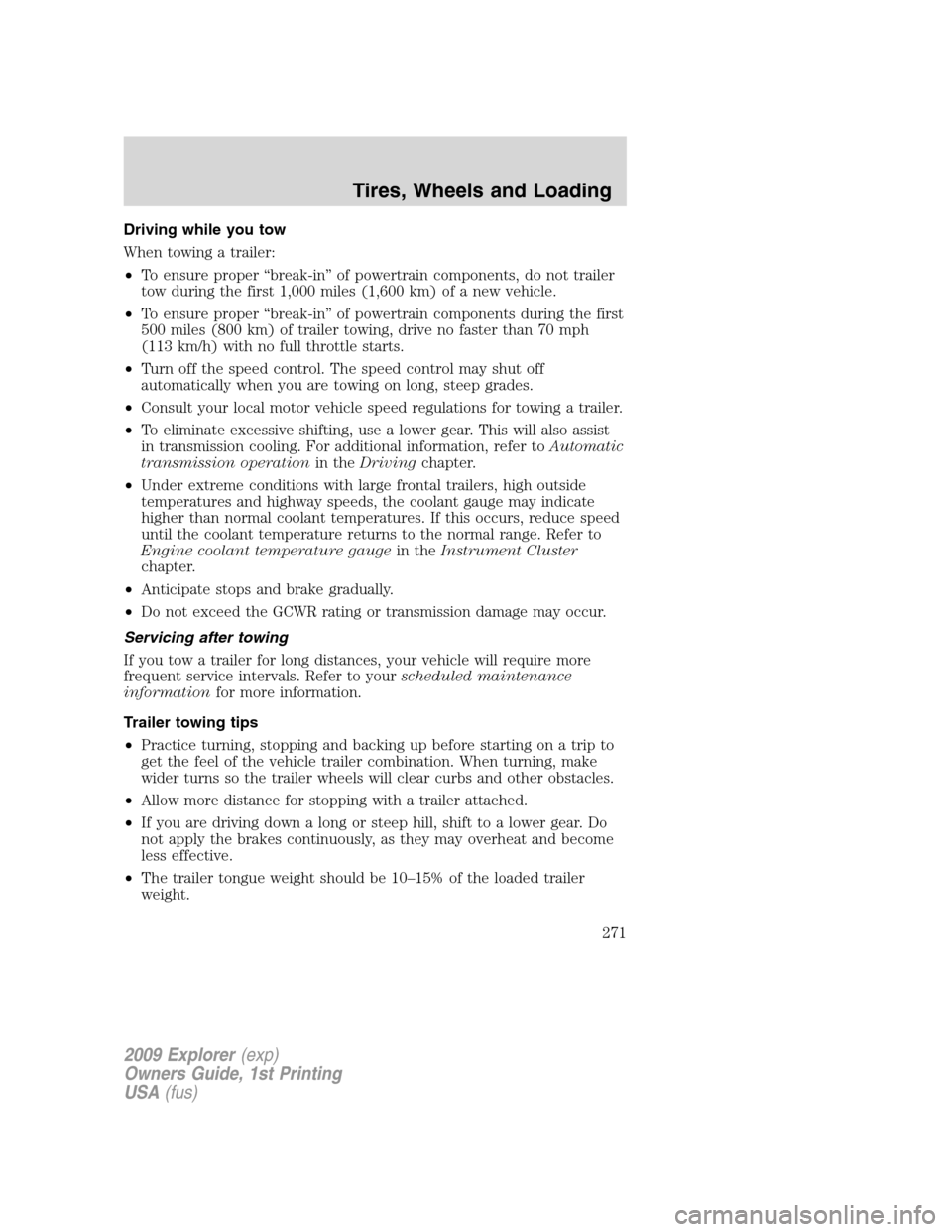
Driving while you tow
When towing a trailer:
•To ensure proper “break-in” of powertrain components, do not trailer
tow during the first 1,000 miles (1,600 km) of a new vehicle.
•To ensure proper “break-in” of powertrain components during the first
500 miles (800 km) of trailer towing, drive no faster than 70 mph
(113 km/h) with no full throttle starts.
•Turn off the speed control. The speed control may shut off
automatically when you are towing on long, steep grades.
•Consult your local motor vehicle speed regulations for towing a trailer.
•To eliminate excessive shifting, use a lower gear. This will also assist
in transmission cooling. For additional information, refer toAutomatic
transmission operationin theDrivingchapter.
•Under extreme conditions with large frontal trailers, high outside
temperatures and highway speeds, the coolant gauge may indicate
higher than normal coolant temperatures. If this occurs, reduce speed
until the coolant temperature returns to the normal range. Refer to
Engine coolant temperature gaugein theInstrument Cluster
chapter.
•Anticipate stops and brake gradually.
•Do not exceed the GCWR rating or transmission damage may occur.
Servicing after towing
If you tow a trailer for long distances, your vehicle will require more
frequent service intervals. Refer to yourscheduled maintenance
informationfor more information.
Trailer towing tips
•Practice turning, stopping and backing up before starting on a trip to
get the feel of the vehicle trailer combination. When turning, make
wider turns so the trailer wheels will clear curbs and other obstacles.
•Allow more distance for stopping with a trailer attached.
•If you are driving down a long or steep hill, shift to a lower gear. Do
not apply the brakes continuously, as they may overheat and become
less effective.
•The trailer tongue weight should be 10–15% of the loaded trailer
weight.
2009 Explorer(exp)
Owners Guide, 1st Printing
USA(fus)
Tires, Wheels and Loading
271
Page 287 of 407
WARNING:Trailer sway control does not prevent a trailer from
swaying, it mitigates the sway from increasing once it has
occurred. If you are experiencing trailer sway it is likely that the trailer
is improperly loaded for the correct tongue weight or the speed of the
vehicle and trailer is too high. Pull the vehicle-trailer over to a safe
location to check the trailer weight distribution and tongue load and
reduce speed to a safe level while towing. If trailer sway is
experienced, SLOW DOWN.
During Trailer Sway Control events, the
icon in the instrument
cluster will flash momentarily. The message center will also display:
TRAILER SWAY REDUCE SPEED. In some cases when trailer sway is
detected, the vehicle speed is too high and may be far above a speed at
which trailer sway will not grow continuously. This may cause the system
to activate multiple times, causing a gradual reduction in speed.
Disabling Trailer Sway Control
Trailer sway control can be disabled during any key cycle. See Trailer
Sway Control underMessage centerin theDriver Controlschapter.
Note that even if it was disabled before turning off the vehicle, Trailer
Sway Control will be re-enabled at each new key cycle.
WARNING:Turning off Trailer Sway Control increases the risk
of loss of vehicle control, serious injury, or death. Ford does not
recommend disabling this feature except in situations where speed
reduction may be detrimental (e.g., hill climbing), the driver has
significant trailer towing experience, and can control trailer sway and
maintain safe operation.
STEERING
To help prevent damage to the power steering system:
•Never hold the steering wheel at its furthest turning points (until it
stops) for more than a few seconds when the engine is running
•Do not operate the vehicle with a low power steering pump fluid level
(below the MIN mark on the reservoir).
•Some noise is normal during operation. If the noise is excessive, check
for low power steering pump fluid level before seeking service by your
authorized dealer.
•Heavy or uneven steering efforts may be caused by low power steering
pump fluid level. Check for low power steering pump fluid level before
seeking service by your authorized dealer.
2009 Explorer(exp)
Owners Guide, 1st Printing
USA(fus)
Driving
287
Page 383 of 407
•You may want to turn off the speed control in hilly terrain if
unnecessary shifting between the top gears occurs. Unnecessary
shifting of this type could result in reduced fuel economy.
•Warming up a vehicle on cold mornings is not required and may
reduce fuel economy.
•Resting your foot on the brake pedal while driving may reduce fuel
economy.
•Combine errands and minimize stop-and-go driving.
Maintenance
•Keep tires properly inflated and use only recommended size.
•Operating a vehicle with the wheels out of alignment will reduce fuel
economy.
•Use recommended engine oil. Refer toMaintenance product
specifications and capacitiesin this chapter.
•Perform all regularly scheduled maintenance items. Follow the
recommended maintenance schedule and owner maintenance checks
found inscheduled maintenance information.
Conditions
•Heavily loading a vehicle or towing a trailer may reduce fuel economy
at any speed.
•Carrying unnecessary weight may reduce fuel economy (approximately
1 mpg [0.4 km/L] is lost for every 400 lb [180 kg] of weight carried).
•Adding certain accessories to your vehicle (for example; bug
deflectors, rollbars/light bars, running boards, ski/luggage racks) may
reduce fuel economy.
•Fuel economy may decrease with lower temperatures during the first
8–10 miles (12–16 km) of driving.
•Driving on flat terrain offers improved fuel economy as compared to
driving on hilly terrain.
•Transmissions give their best fuel economy when operated in the top
cruise gear and with steady pressure on the gas pedal.
•Four-wheel-drive operation (if equipped) is less fuel efficient than
two-wheel-drive operation.
•Close windows for high speed driving.
2009 Explorer(exp)
Owners Guide, 1st Printing
USA(fus)
Maintenance and Specifications
383
Page 398 of 407
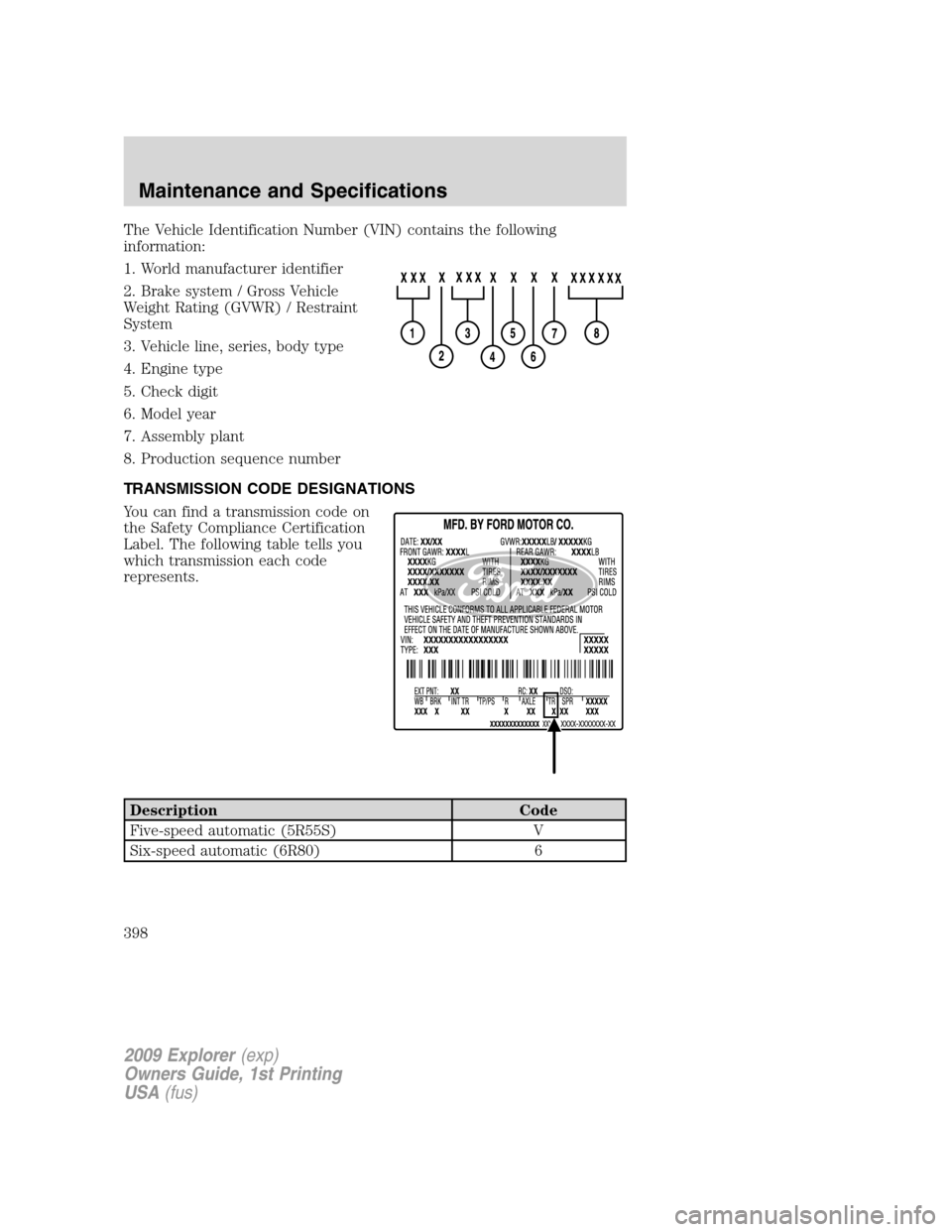
The Vehicle Identification Number (VIN) contains the following
information:
1. World manufacturer identifier
2. Brake system / Gross Vehicle
Weight Rating (GVWR) / Restraint
System
3. Vehicle line, series, body type
4. Engine type
5. Check digit
6. Model year
7. Assembly plant
8. Production sequence number
TRANSMISSION CODE DESIGNATIONS
You can find a transmission code on
the Safety Compliance Certification
Label. The following table tells you
which transmission each code
represents.
Description Code
Five-speed automatic (5R55S) V
Six-speed automatic (6R80) 6
2009 Explorer(exp)
Owners Guide, 1st Printing
USA(fus)
Maintenance and Specifications
398
Page 400 of 407
Roof rail cross bars
Trailer hitch drawbars, wiring harnesses and accessories
TripTunes™ Advanced portable audio connection
Peace of mind
Mobile-Ease™ hands-free communication system
Remote start
Vehicle security systems
Wheel locks
For maximum vehicle performance, keep the following information in
mind when adding accessories or equipment to your vehicle:
•When adding accessories, equipment, passengers and luggage to your
vehicle, do not exceed the total weight capacity of the vehicle or of
the front or rear axle (GVWR or GAWR as indicated on the Safety
Compliance Certification label). Consult your authorized dealer for
specific weight information.
•The Federal Communications Commission (FCC) and Canadian Radio
Telecommunications Commission (CRTC) regulate the use of mobile
communications systems — such as two-way radios, telephones and
theft alarms - that are equipped with radio transmitters. Any such
equipment installed in your vehicle should comply with FCC or CRTC
regulations and should be installed only by a qualified service
technician.
•Mobile communications systems may harm the operation of your
vehicle, particularly if they are not properly designed for automotive
use.
•To avoid interference with other vehicle functions, such as anti-lock
braking systems, amateur radio users who install radios and antennas
onto their vehicle should not locate the Amateur Radio Antennas in
the area of the driver’s side hood.
•Electrical or electronic accessories or components that are added to
the vehicle by the authorized dealer or the owner may adversely affect
battery performance and durability.
2009 Explorer(exp)
Owners Guide, 1st Printing
USA(fus)
Accessories
400
Page 403 of 407
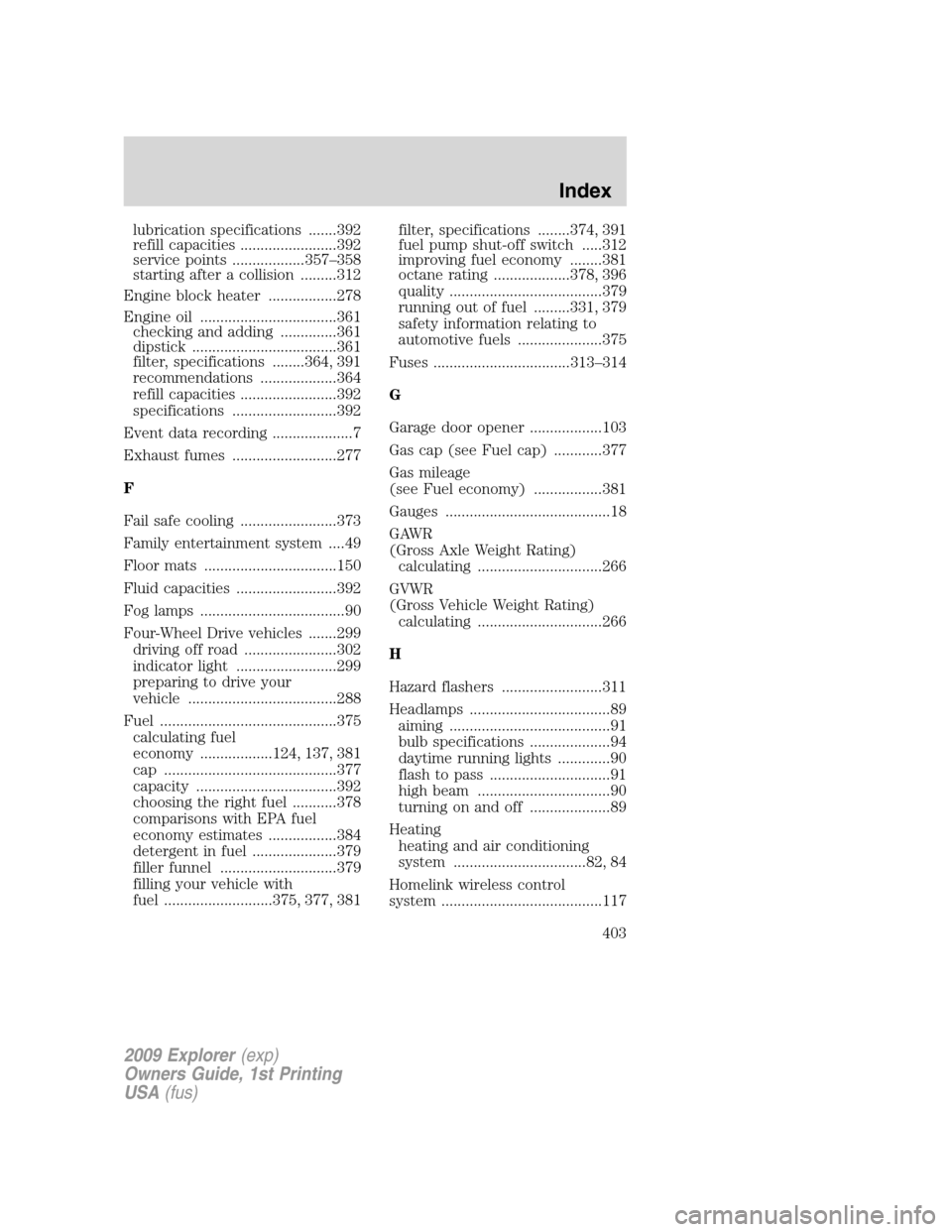
lubrication specifications .......392
refill capacities ........................392
service points ..................357–358
starting after a collision .........312
Engine block heater .................278
Engine oil ..................................361
checking and adding ..............361
dipstick ....................................361
filter, specifications ........364, 391
recommendations ...................364
refill capacities ........................392
specifications ..........................392
Event data recording ....................7
Exhaust fumes ..........................277
F
Fail safe cooling ........................373
Family entertainment system ....49
Floor mats .................................150
Fluid capacities .........................392
Fog lamps ....................................90
Four-Wheel Drive vehicles .......299
driving off road .......................302
indicator light .........................299
preparing to drive your
vehicle .....................................288
Fuel ............................................375
calculating fuel
economy ..................124, 137, 381
cap ...........................................377
capacity ...................................392
choosing the right fuel ...........378
comparisons with EPA fuel
economy estimates .................384
detergent in fuel .....................379
filler funnel .............................379
filling your vehicle with
fuel ...........................375, 377, 381filter, specifications ........374, 391
fuel pump shut-off switch .....312
improving fuel economy ........381
octane rating ...................378, 396
quality ......................................379
running out of fuel .........331, 379
safety information relating to
automotive fuels .....................375
Fuses ..................................313–314
G
Garage door opener ..................103
Gas cap (see Fuel cap) ............377
Gas mileage
(see Fuel economy) .................381
Gauges .........................................18
GAWR
(Gross Axle Weight Rating)
calculating ...............................266
GVWR
(Gross Vehicle Weight Rating)
calculating ...............................266
H
Hazard flashers .........................311
Headlamps ...................................89
aiming ........................................91
bulb specifications ....................94
daytime running lights .............90
flash to pass ..............................91
high beam .................................90
turning on and off ....................89
Heating
heating and air conditioning
system .................................82, 84
Homelink wireless control
system ........................................117
2009 Explorer(exp)
Owners Guide, 1st Printing
USA(fus)
Index
403