cooling FORD EXPLORER 2011 5.G Owner's Manual
[x] Cancel search | Manufacturer: FORD, Model Year: 2011, Model line: EXPLORER, Model: FORD EXPLORER 2011 5.GPages: 449, PDF Size: 4.03 MB
Page 406 of 449
4. Latch the gearshift lever in P (Park) and leave the engine running.
5. Remove the dipstick, wiping it clean with a clean, dry lint free rag. If
necessary, refer toIdentifying components in the engine compartment
in this chapter for the location of the dipstick.
6. Install the dipstick making sure it is fully seated in the filler tube by
turning it to the locked position.
7. Remove the dipstick and inspect the fluid level. The fluid should be in
the designated areas for normal operating temperature.
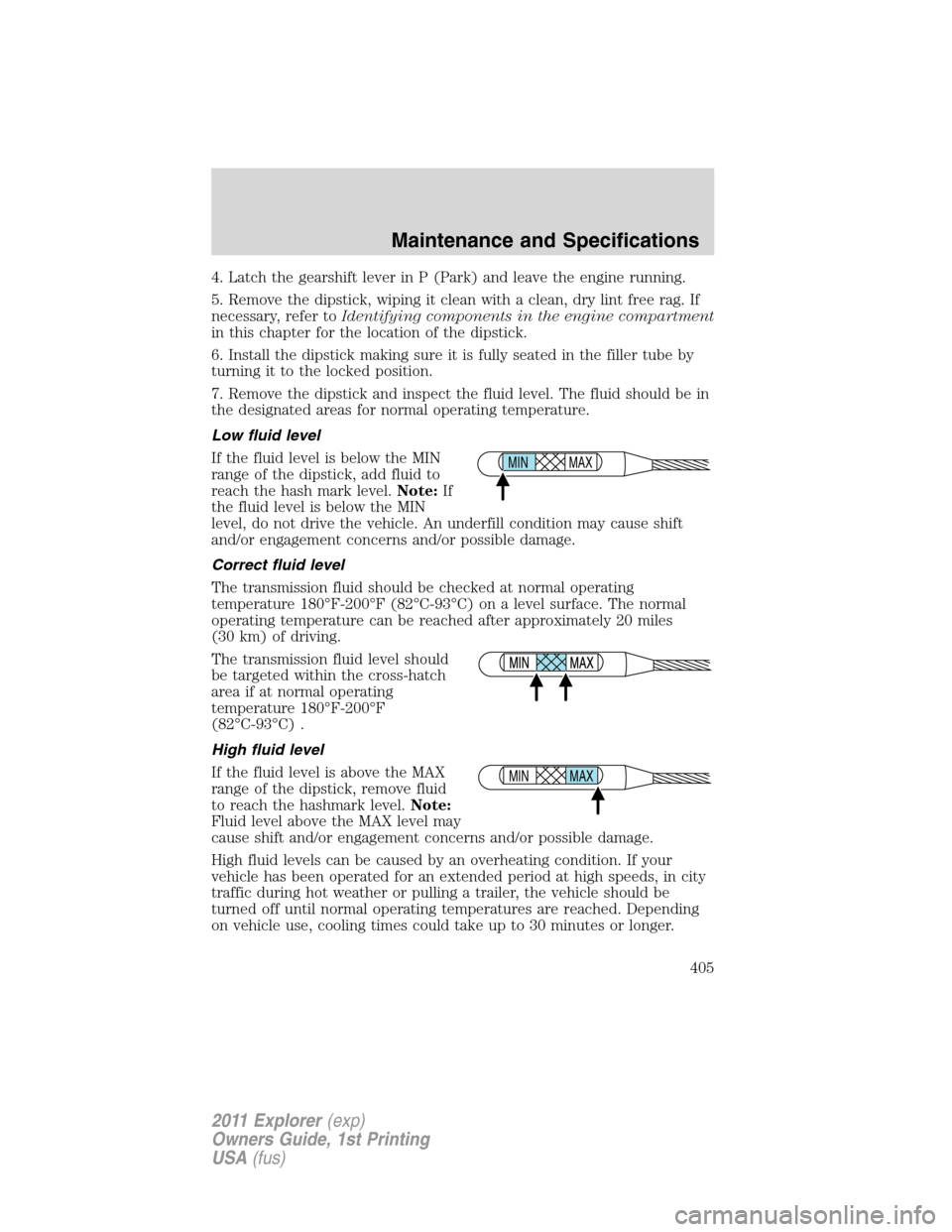
Low fluid level
If the fluid level is below the MIN
range of the dipstick, add fluid to
reach the hash mark level.Note:If
the fluid level is below the MIN
level, do not drive the vehicle. An underfill condition may cause shift
and/or engagement concerns and/or possible damage.
Correct fluid level
The transmission fluid should be checked at normal operating
temperature 180°F-200°F (82°C-93°C) on a level surface. The normal
operating temperature can be reached after approximately 20 miles
(30 km) of driving.
The transmission fluid level should
be targeted within the cross-hatch
area if at normal operating
temperature 180°F-200°F
(82°C-93°C) .
High fluid level
If the fluid level is above the MAX
range of the dipstick, remove fluid
to reach the hashmark level.Note:
Fluid level above the MAX level may
cause shift and/or engagement concerns and/or possible damage.
High fluid levels can be caused by an overheating condition. If your
vehicle has been operated for an extended period at high speeds, in city
traffic during hot weather or pulling a trailer, the vehicle should be
turned off until normal operating temperatures are reached. Depending
on vehicle use, cooling times could take up to 30 minutes or longer.
MAX MIN
MAX MIN
Maintenance and Specifications
405
2011 Explorer(exp)
Owners Guide, 1st Printing
USA(fus)
Page 410 of 449
Cooling system
•Protect against freezing temperatures.
•When removing vehicle from storage, check coolant fluid level.
Confirm there are no cooling system leaks, and fluid is at the
recommended level.
Battery
•Check and recharge as necessary. Keep connections clean.
•If storing your vehicle for more than 30 days without recharging the
battery, it may be advisable to disconnect the battery cables to ensure
battery charge is maintained for quick starting.
Note:If battery cables are disconnected, it will be necessary to reset
memory features.
Brakes
•Make sure brakes and parking brake are fully released.
Tires
•Maintain recommended air pressure.
Miscellaneous
•Make sure all linkages, cables, levers and pins under vehicle are
covered with grease to prevent rust.
•Move vehicles at least 25 feet (8 m) every 15 days to lubricate
working parts and prevent corrosion.
Removing vehicle from storage
When your vehicle is ready to come out of storage, do the following:
•Wash your vehicle to remove any dirt or grease film build-up on
window surfaces.
•Check windshield wipers for any deterioration.
•Check under the hood for any foreign material that may have collected
during storage (mice/squirrel nests).
•Check the exhaust for any foreign material that may have collected
during storage.
•Check tire pressures and set tire inflation per the Tire Label.
•Check brake pedal operation. Drive the vehicle 15 ft (4.5 meters) back
and forth to remove rust build-up.
Maintenance and Specifications
409
2011 Explorer(exp)
Owners Guide, 1st Printing
USA(fus)
Page 427 of 449
Owner checks and services
Certain basic maintenance checks and inspections should be performed
by the owner or a service technician at the intervals indicated. Service
information and supporting specifications are provided in this owner’s
guide.
Any adverse condition should be brought to the attention of your dealer
or qualified service technician as soon as possible for the proper service
advice. The owner maintenance service checks are generally not covered
by warranties so you may be charged for labor, parts or fluids used.
Engine oil/coolant change intervals
Engine oilAs indicated by the message center (can be up
to one year or 10,000 miles [16,000 km])
Engine coolant,
initial change6 years or 100,000 miles (160,000 km)
(whichever comes first)
Engine coolant,
after initial changeEvery 3 years or 50,000 miles (80,000 km)
Check every month
Engine oil level
Function of all interior and exterior lights
Tires for wear and proper pressure, including spare
Windshield washer fluid level
Check every six months
Battery connections; clean if necessary
Body and door drain holes for obstructions; clean if necessary
Cooling system fluid level and coolant strength
Door weatherstrips for wear; lubricate if necessary
Hinges/latches/outside locks for proper operation; lubricate if necessary
Parking brake for proper operation
Safety belts and seat latches for wear and function
Safety warning lamps (brake, ABS, airbag, safety belt) for operation
Washer spray/wiper operation; clean or replace blades as necessary
Scheduled Maintenance Guide
426
2011 Explorer(exp)
Owners Guide, 1st Printing
USA(fus)
Page 431 of 449
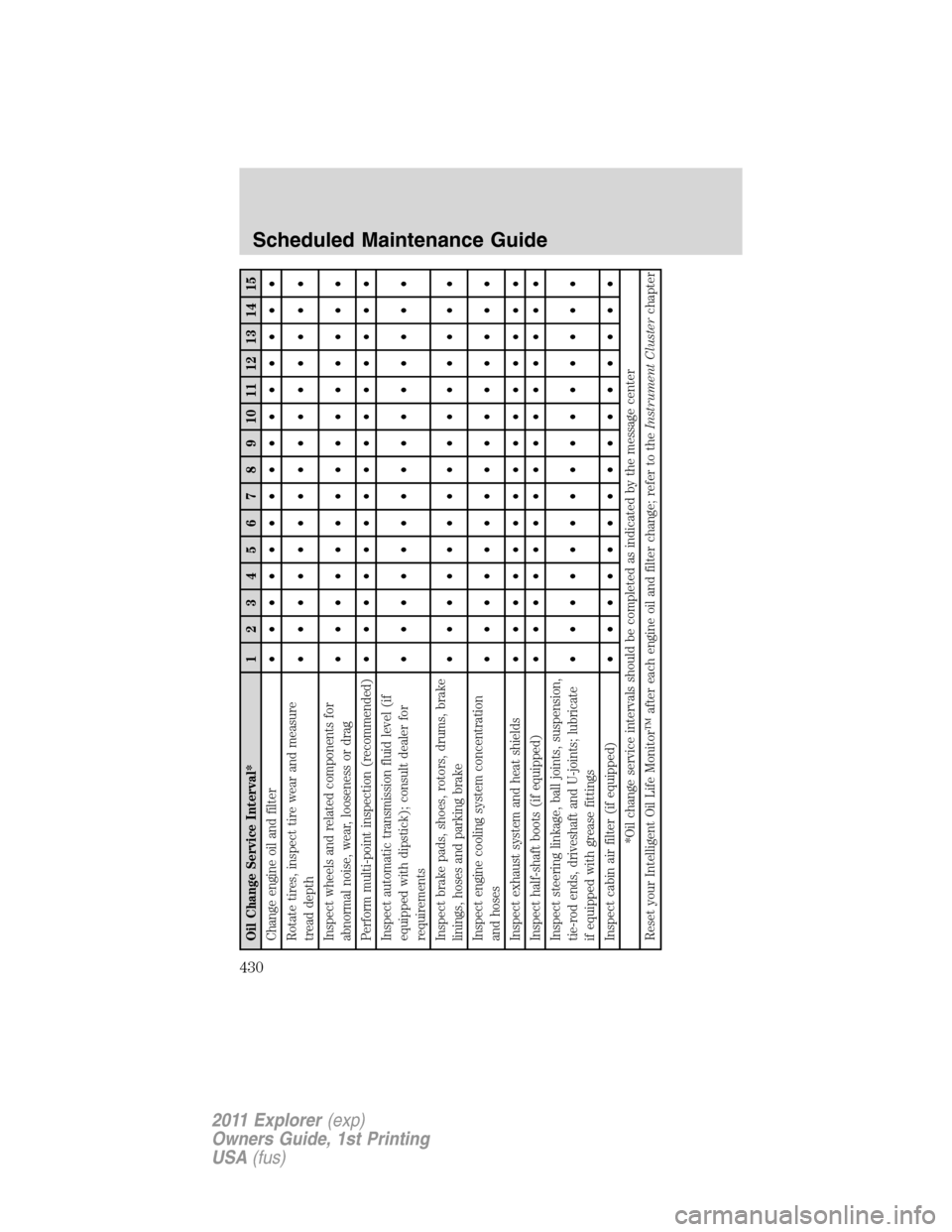
Oil Change Service Interval* 123456789101112131415
Change engine oil and filter• ••••••••••••••
Rotate tires, inspect tire wear and measure
tread depth• ••••••••••••••
Inspect wheels and related components for
abnormal noise, wear, looseness or drag• ••••••••••••••
Perform multi-point inspection (recommended)• ••••••••••••••
Inspect automatic transmission fluid level (if
equipped with dipstick); consult dealer for
requirements• ••••••••••••••
Inspect brake pads, shoes, rotors, drums, brake
linings, hoses and parking brake• ••••••••••••••
Inspect engine cooling system concentration
and hoses• ••••••••••••••
Inspect exhaust system and heat shields• ••••••••••••••
Inspect half-shaft boots (if equipped)• ••••••••••••••
Inspect steering linkage, ball joints, suspension,
tie-rod ends, driveshaft and U-joints; lubricate
if equipped with grease fittings• ••••••••••••••
Inspect cabin air filter (if equipped)• ••••••••••••••
*Oil change service intervals should be completed as indicated by the message center
Reset your Intelligent Oil Life Monitor™ after each engine oil and filter change; refer to theInstrument Clusterchapter
Scheduled Maintenance Guide
430
2011 Explorer(exp)
Owners Guide, 1st Printing
USA(fus)
Page 444 of 449
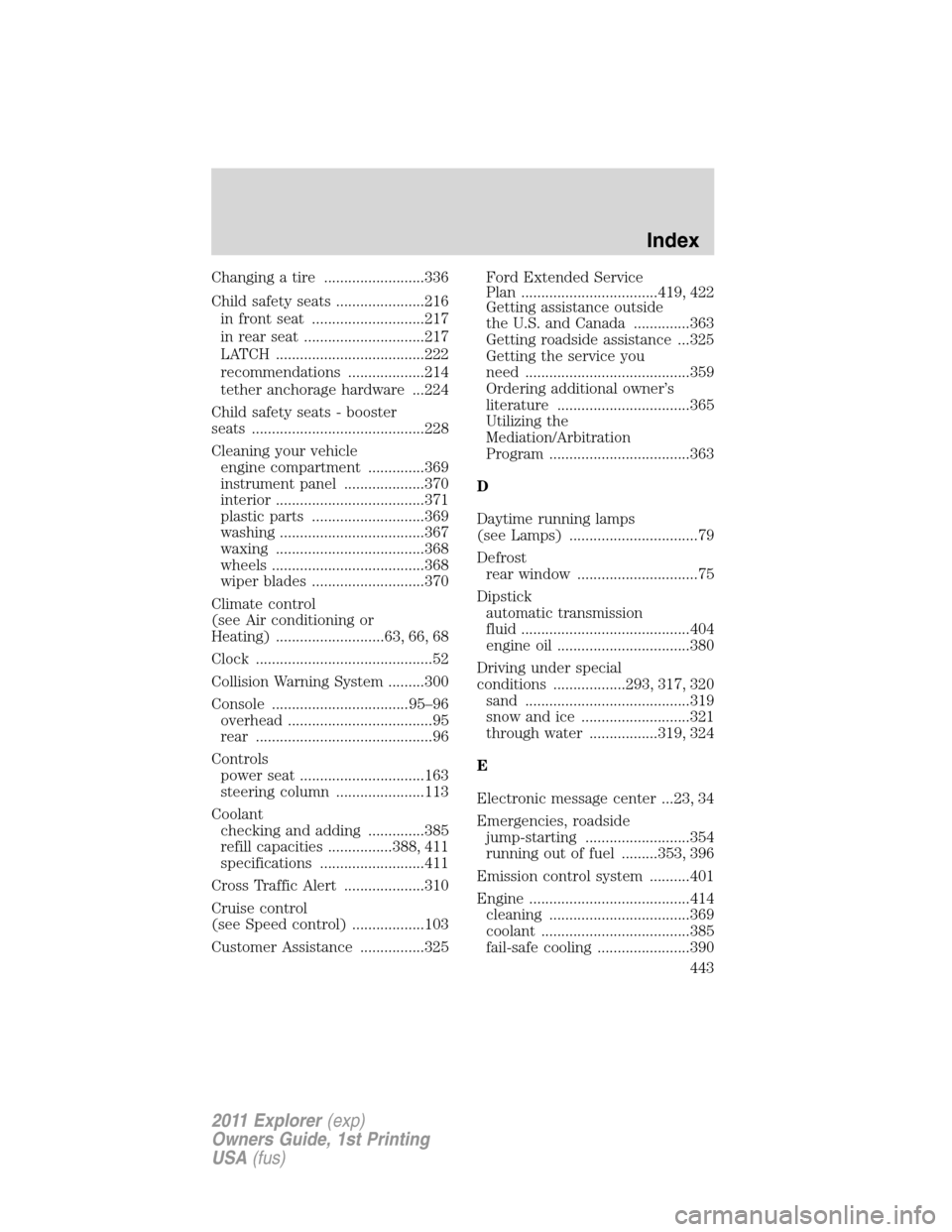
Changing a tire .........................336
Child safety seats ......................216
in front seat ............................217
in rear seat ..............................217
LATCH .....................................222
recommendations ...................214
tether anchorage hardware ...224
Child safety seats - booster
seats ...........................................228
Cleaning your vehicle
engine compartment ..............369
instrument panel ....................370
interior .....................................371
plastic parts ............................369
washing ....................................367
waxing .....................................368
wheels ......................................368
wiper blades ............................370
Climate control
(see Air conditioning or
Heating) ...........................63, 66, 68
Clock ............................................52
Collision Warning System .........300
Console ..................................95–96
overhead ....................................95
rear ............................................96
Controls
power seat ...............................163
steering column ......................113
Coolant
checking and adding ..............385
refill capacities ................388, 411
specifications ..........................411
Cross Traffic Alert ....................310
Cruise control
(see Speed control) ..................103
Customer Assistance ................325Ford Extended Service
Plan ..................................419, 422
Getting assistance outside
the U.S. and Canada ..............363
Getting roadside assistance ...325
Getting the service you
need .........................................359
Ordering additional owner’s
literature .................................365
Utilizing the
Mediation/Arbitration
Program ...................................363
D
Daytime running lamps
(see Lamps) ................................79
Defrost
rear window ..............................75
Dipstick
automatic transmission
fluid ..........................................404
engine oil .................................380
Driving under special
conditions ..................293, 317, 320
sand .........................................319
snow and ice ...........................321
through water .................319, 324
E
Electronic message center ...23, 34
Emergencies, roadside
jump-starting ..........................354
running out of fuel .........353, 396
Emission control system ..........401
Engine ........................................414
cleaning ...................................369
coolant .....................................385
fail-safe cooling .......................390
Index
443
2011 Explorer(exp)
Owners Guide, 1st Printing
USA(fus)
Page 445 of 449
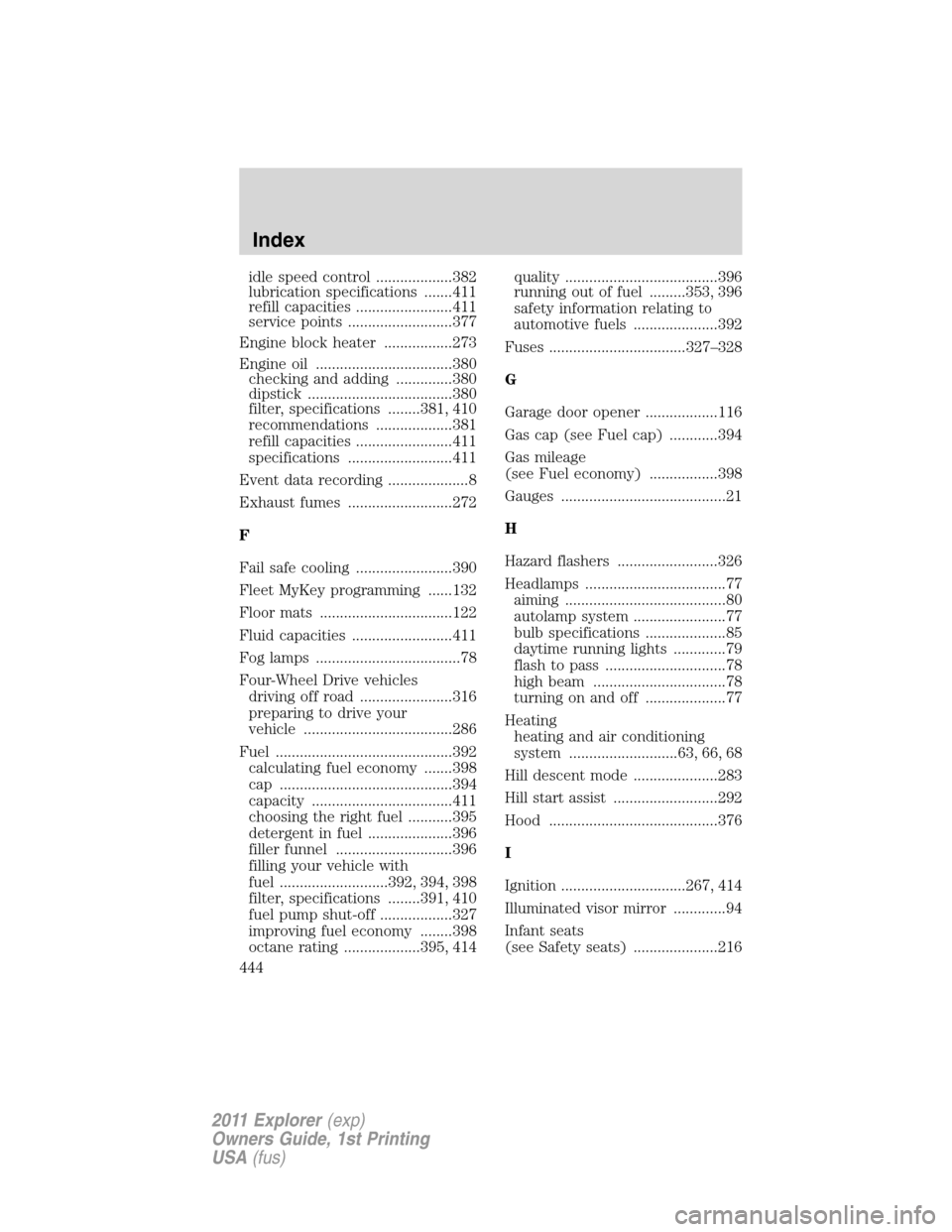
idle speed control ...................382
lubrication specifications .......411
refill capacities ........................411
service points ..........................377
Engine block heater .................273
Engine oil ..................................380
checking and adding ..............380
dipstick ....................................380
filter, specifications ........381, 410
recommendations ...................381
refill capacities ........................411
specifications ..........................411
Event data recording ....................8
Exhaust fumes ..........................272
F
Fail safe cooling ........................390
Fleet MyKey programming ......132
Floor mats .................................122
Fluid capacities .........................411
Fog lamps ....................................78
Four-Wheel Drive vehicles
driving off road .......................316
preparing to drive your
vehicle .....................................286
Fuel ............................................392
calculating fuel economy .......398
cap ...........................................394
capacity ...................................411
choosing the right fuel ...........395
detergent in fuel .....................396
filler funnel .............................396
filling your vehicle with
fuel ...........................392, 394, 398
filter, specifications ........391, 410
fuel pump shut-off ..................327
improving fuel economy ........398
octane rating ...................395, 414quality ......................................396
running out of fuel .........353, 396
safety information relating to
automotive fuels .....................392
Fuses ..................................327–328
G
Garage door opener ..................116
Gas cap (see Fuel cap) ............394
Gas mileage
(see Fuel economy) .................398
Gauges .........................................21
H
Hazard flashers .........................326
Headlamps ...................................77
aiming ........................................80
autolamp system .......................77
bulb specifications ....................85
daytime running lights .............79
flash to pass ..............................78
high beam .................................78
turning on and off ....................77
Heating
heating and air conditioning
system ...........................63, 66, 68
Hill descent mode .....................283
Hill start assist ..........................292
Hood ..........................................376
I
Ignition ...............................267, 414
Illuminated visor mirror .............94
Infant seats
(see Safety seats) .....................216
Index
444
2011 Explorer(exp)
Owners Guide, 1st Printing
USA(fus)