parking brake FORD F-59 2019 Owner's Manual
[x] Cancel search | Manufacturer: FORD, Model Year: 2019, Model line: F-59, Model: FORD F-59 2019Pages: 176, PDF Size: 9.98 MB
Page 104 of 176
AUTOMATIC TRANSMISSION
FLUID CHECK
WARNING: The dipstick andsurrounding components are hot. Usegloves when moving components andchecking the transmission fluid level.Failure to follow this warning could resultin serious personal injury.
Note:Automatic transmission fluidexpands when warmed. To obtain anaccurate fluid check, drive the vehicle untilit is at normal operating temperature(approximately 20 mi (30 km)). If yourvehicle has been operated for an extendedperiod at high speeds, in city traffic duringhot weather or pulling a trailer, the vehicleshould be turned off for about 30 minutesto allow fluid to cool to normal operatingtemperature 196°F - 215°F (91°C - 102°C)before checking.
Refer to your scheduled maintenanceinformation for scheduled intervals for fluidchecks and changes.
Your transmission does not consume fluid.However, the fluid level should be checkedif the transmission is not working properly,(i.e., if the transmission slips or shiftsslowly) or if you notice some sign of fluidleakage. To check the fluid level:
1.Drive the vehicle 20 mi (30 km) or untilit reaches normal operatingtemperature
2.Park the vehicle on a level surface andengage the parking brake
3.With the engine running, parking brakeengaged and your foot on the brakepedal, move the gearshift lever throughall of the gear ranges. Allow sufficienttime for each gear to engage
4.Latch the gearshift lever in P (Park)and leave the engine running.
5.Remove the dipstick, wiping it cleanwith a clean, dry lint free rag. Ifnecessary, refer to Under HoodOverview in this chapter for thelocation of the dipstick.
6.Install the dipstick making sure it is fullyseated in the filler tube.
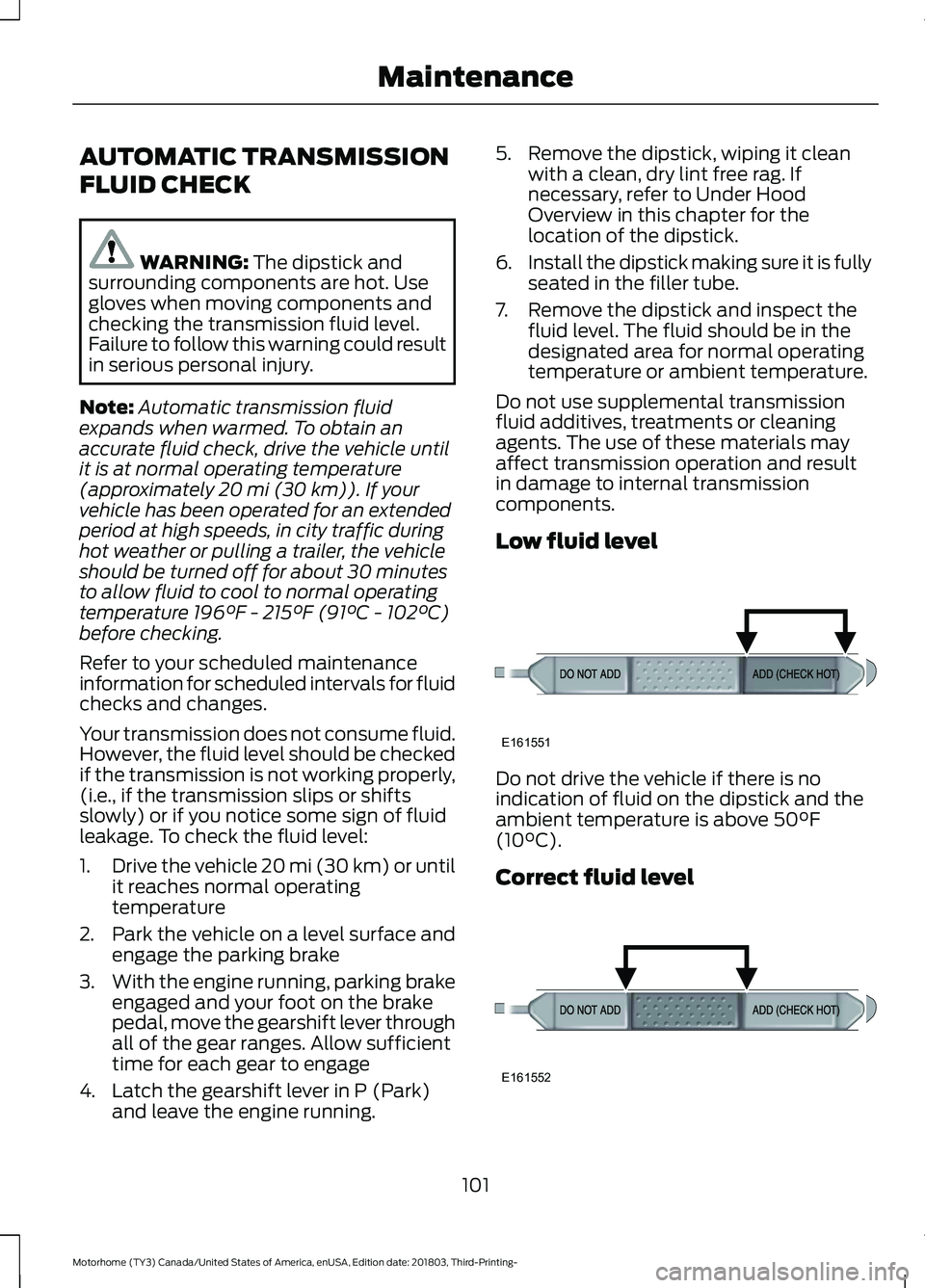
7.Remove the dipstick and inspect thefluid level. The fluid should be in thedesignated area for normal operatingtemperature or ambient temperature.
Do not use supplemental transmissionfluid additives, treatments or cleaningagents. The use of these materials mayaffect transmission operation and resultin damage to internal transmissioncomponents.
Low fluid level
Do not drive the vehicle if there is noindication of fluid on the dipstick and theambient temperature is above 50°F(10°C).
Correct fluid level
101
Motorhome (TY3) Canada/United States of America, enUSA, Edition date: 201803, Third-Printing-MaintenanceE161551 E161552
Page 110 of 176
•The transmission must relearn itsadaptive strategy. As a result of this,the transmission may shift firmly. Thisoperation is considered normal and willnot affect function or durability of thetransmission. Over time the adaptivelearning process will fully updatetransmission operation to its optimumshift feel.
•The clock and the preset radio stationsmust be reset once the battery isreconnected.
•Your vehicle’s engine is electronicallycontrolled by a computer, some controlconditions are maintained by powerfrom the battery, the engine mustrelearn its idle and fuel trim strategy.
When the battery is disconnected or a newbattery is installed, begin the batteryrelearn process:
1.With the vehicle at a complete stop,set the parking brake.
2.Put the gearshift lever in P (Park), turnoff all accessories and start the engine.
3.Run the engine until it reaches normaloperating temperature.
4.Allow the engine to idle for at least oneminute.
5.Turn the A/C on and allow the engineto idle for at least one minute.
6.Drive the vehicle to complete therelearning process.
•The vehicle may need to be drivento relearn the idle and fuel trimstrategy.
CHANGING THE ENGINE AIR
FILTER
WARNING: To reduce the risk ofvehicle damage and personal burninjuries, do not start your engine with theair cleaner removed and do not removeit while the engine is running.
Change the air filter element at the properinterval. See Scheduled Maintenance(page 145).
When changing the air filter element, useonly the air filter element listed. SeeCapacities and Specifications (page134).
Note:Failure to use the correct air filterelement may result in severe enginedamage. The customer warranty may bevoid for any damage to the engine if thecorrect air filter element is not used.
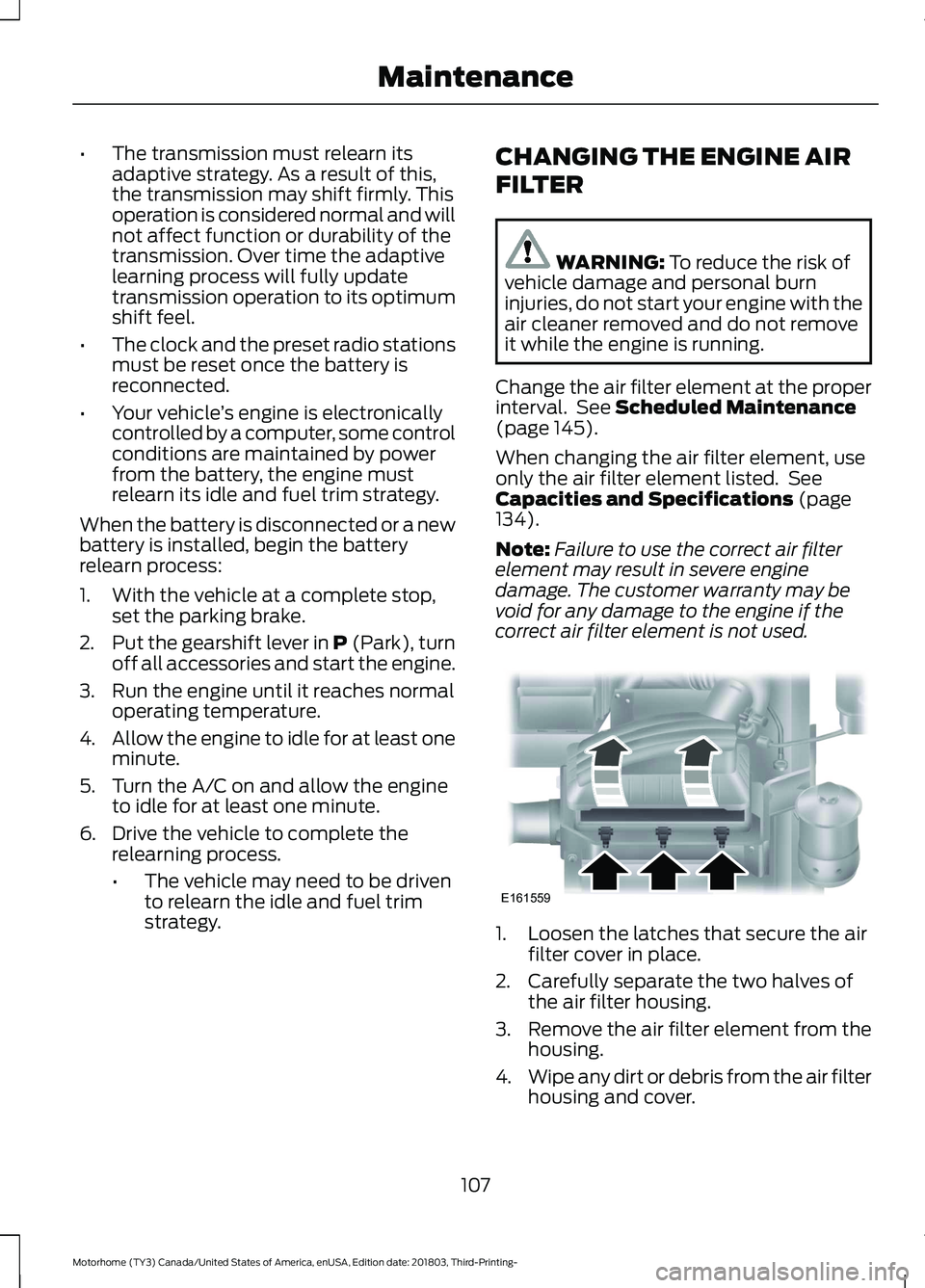
1.Loosen the latches that secure the airfilter cover in place.
2.Carefully separate the two halves ofthe air filter housing.
3.Remove the air filter element from thehousing.
4.Wipe any dirt or debris from the air filterhousing and cover.
107
Motorhome (TY3) Canada/United States of America, enUSA, Edition date: 201803, Third-Printing-MaintenanceE161559
Page 113 of 176
Note:Holding the pressure washer nozzleat an angle to the vehicle's surface maydamage graphics and cause the edges topeel away from the vehicle's surface.
Underbody
Regularly clean the underside of yourvehicle using water. Keep body and doordrain holes free of debris or foreignmaterial.
Under Hood
For removing black rubber marks fromunder the hood we recommend MotorcraftWheel and Tire Cleaner or Motorcraft Bugand Tar Remover.
CLEANING THE ENGINE
Engines are more efficient when they areclean because grease and dirt buildup keepthe engine warmer than normal.
When washing:
•Take care when using a power washerto clean the engine. The high-pressurefluid could penetrate the sealed partsand cause damage.
•Do not spray a hot engine with coldwater to avoid cracking the engineblock or other engine components.
•Spray Motorcraft Engine Shampoo andDegreaser on all parts that requirecleaning and pressure rinse clean. InCanada, use Motorcraft EngineShampoo.
Note:If your vehicle has an engine coverremove the cover before application ofMotorcraft Engine Shampoo and Degreaser.Immediately rinse away any over spray.
•Never wash or rinse the engine while itis hot or running; water in the runningengine may cause internal damage.
•Never wash or rinse any ignition coil,spark plug wire or spark plug well, orthe area in and around these locations.
•Cover the battery, power distributionbox, and air filter assembly to preventwater damage when cleaning theengine.
CLEANING THE WHEELS (IF
EQUIPPED)
1.Regularly clean them with a wheelcleaner. We recommend that you useFord approved wheel cleaner ifavailable.
2.Remove dirt and brake dust with asponge.
3.Remove tar and grease with a bug andtar remover. We recommend that youuse Ford approved bug and tar removerif available.
4.Thoroughly rinse the wheels with waterafter cleaning.
If you intend on parking your vehicle for anextended period after cleaning the wheelswith a wheel cleaner, drive your vehicle fora few minutes before doing so. Thisreduces the risk of corrosion of the brakediscs, brake pads and linings.
Do not clean the wheels when they are hot.
Note: Some car washes could damagewheel rims and covers.
Note: Using non-recommended cleaners,harsh cleaning products, chrome wheelcleaners or abrasive materials coulddamage wheel rims and covers.
110
Motorhome (TY3) Canada/United States of America, enUSA, Edition date: 201803, Third-Printing-Vehicle Care
Page 115 of 176
Brakes
•Make sure the brakes and parking brakerelease fully.
Tires
•Maintain recommended air pressure.
Miscellaneous
•Make sure all linkages, cables, leversand pins under your vehicle are coveredwith grease to prevent rust.
•Move vehicles at least 25 ft (7.5 m)every 15 days to lubricate working partsand prevent corrosion.
Removing Vehicle From Storage
When your vehicle is ready to come out ofstorage, do the following:
•Wash your vehicle to remove any dirtor grease film build-up on windowsurfaces.
•Check windshield wipers for anydeterioration.
•Check under the hood for any foreignmaterial that may have collectedduring storage such as mice or squirrelnests.
•Check the exhaust for any foreignmaterial that may have collectedduring storage.
•Check tire pressures and set tireinflation per the Tire Label.
•Check brake pedal operation. Driveyour vehicle 15 ft (4.5 m) back andforth to remove rust build-up.
•Check fluid levels (including coolant,oil and gas) to make sure there are noleaks, and fluids are at recommendedlevels.
•If you remove the battery, clean thebattery cable ends and check fordamage.
Contact an authorized dealer if you haveany concerns or issues.
112
Motorhome (TY3) Canada/United States of America, enUSA, Edition date: 201803, Third-Printing-Vehicle Care
Page 134 of 176
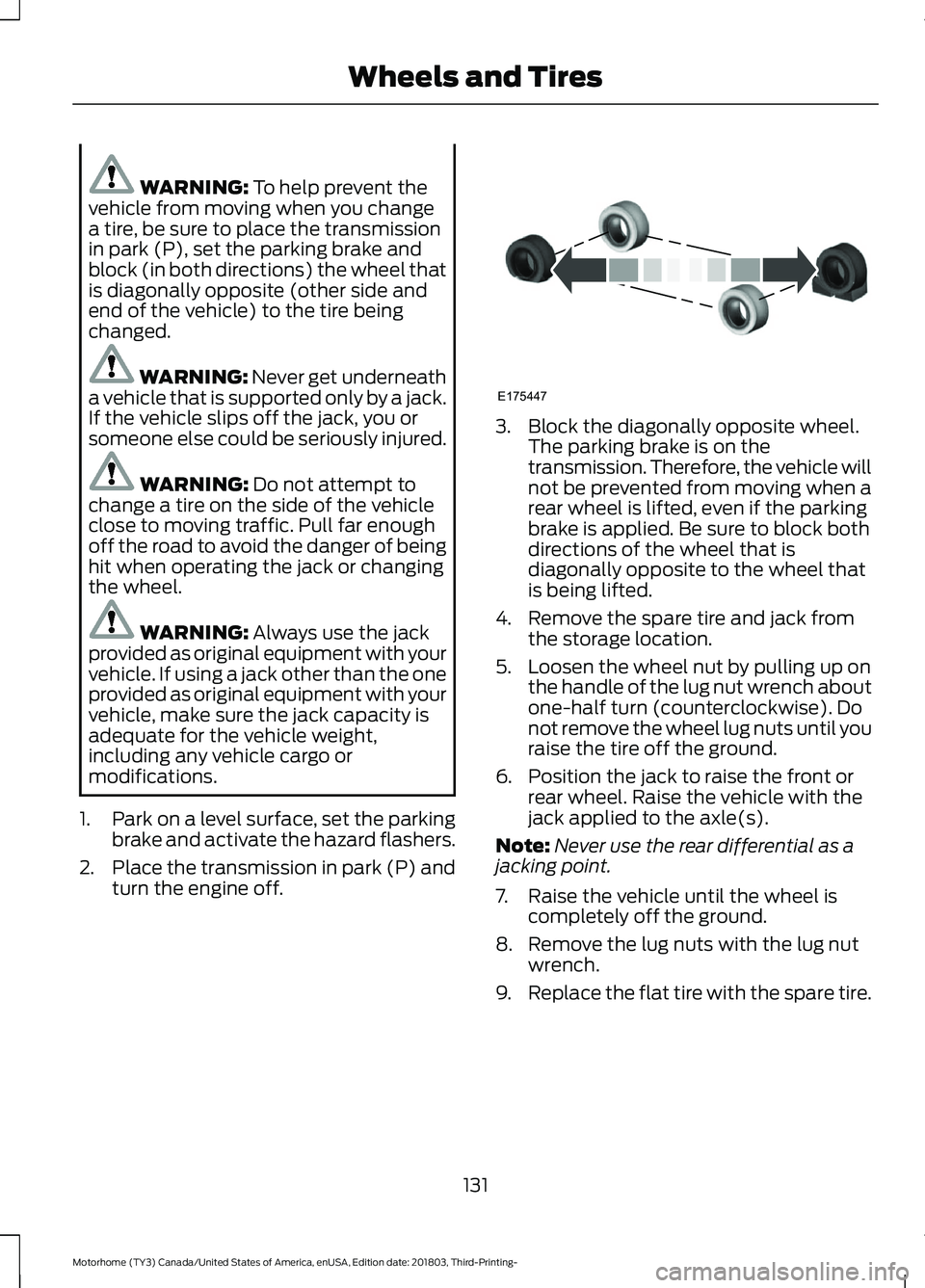
WARNING: To help prevent thevehicle from moving when you changea tire, be sure to place the transmissionin park (P), set the parking brake andblock (in both directions) the wheel thatis diagonally opposite (other side andend of the vehicle) to the tire beingchanged.
WARNING: Never get underneatha vehicle that is supported only by a jack.If the vehicle slips off the jack, you orsomeone else could be seriously injured.
WARNING: Do not attempt tochange a tire on the side of the vehicleclose to moving traffic. Pull far enoughoff the road to avoid the danger of beinghit when operating the jack or changingthe wheel.
WARNING: Always use the jackprovided as original equipment with yourvehicle. If using a jack other than the oneprovided as original equipment with yourvehicle, make sure the jack capacity isadequate for the vehicle weight,including any vehicle cargo ormodifications.
1.Park on a level surface, set the parkingbrake and activate the hazard flashers.
2.Place the transmission in park (P) andturn the engine off.
3.Block the diagonally opposite wheel.The parking brake is on thetransmission. Therefore, the vehicle willnot be prevented from moving when arear wheel is lifted, even if the parkingbrake is applied. Be sure to block bothdirections of the wheel that isdiagonally opposite to the wheel thatis being lifted.
4.Remove the spare tire and jack fromthe storage location.
5.Loosen the wheel nut by pulling up onthe handle of the lug nut wrench aboutone-half turn (counterclockwise). Donot remove the wheel lug nuts until youraise the tire off the ground.
6.Position the jack to raise the front orrear wheel. Raise the vehicle with thejack applied to the axle(s).
Note:Never use the rear differential as ajacking point.
7.Raise the vehicle until the wheel iscompletely off the ground.
8.Remove the lug nuts with the lug nutwrench.
9.Replace the flat tire with the spare tire.
131
Motorhome (TY3) Canada/United States of America, enUSA, Edition date: 201803, Third-Printing-Wheels and TiresE175447
Page 144 of 176

SpecificationName
ESA-M1C75-BTransmission, steering, parking linkages and pivots andbrake pedal shaft grease:Premium Long-Life GreaseXG-1-E1
ESB-M1C93-BMulti-purpose grease:Motorcraft® Multi-Purpose Grease SprayXL-5-A
1 Motorcraft® DOT 3 High Performance Motor Vehicle Brake Fluid is for vehicles withHydroboost brake booster systems. This include chassis with gross vehicle weight ratingsof 16,000 lb (7257 kg), 18,000 lb (8165 kg) and 19,500 lb (8845 kg).2 Motorcraft® DOT 5.1 Motor Vehicle Brake Fluid is for vehicles with Hydromax brakebooster systems. This includes chassis with gross vehicle weight ratings of 19,500 lb(8845 kg), 20,500 lb (9299 kg), 22,000 lb (9979 kg), 24,000 lb (10886 kg) and 26,000lb (11793 kg).
If you use oil and fluids that do not meetthe defined specification and viscositygrade, this may lead to:
•Component damage which is notcovered by the vehicle warranty.
•Longer engine cranking periods.
•Increased emission levels.
•Reduced engine performance.
•Reduced fuel economy.
•Degraded brake performance.
We recommend Motorcraft® motor oil foryour vehicle. If Motorcraft® oil is notavailable, use motor oils of therecommended viscosity grade that meetAPI SN Plus requirements and display theAPI Certification Mark for gasoline engines.Do not use oil labeled with API SN Plusservice category unless the label alsodisplays the API certification mark.
An oil that displays this symbol conformsto current engine, emission system andfuel economy performance standards ofILSAC.
Do not use supplemental engine oiladditives because they are unnecessaryand could lead to engine damage that maynot be covered by your vehicle warranty.
141
Motorhome (TY3) Canada/United States of America, enUSA, Edition date: 201803, Third-Printing-Capacities and SpecificationsE142732
Page 150 of 176
Check every six months
Hinges, latches and outside locks for proper operation. Lubricate if necessary.
Parking brake for proper operation.
Safety belts and seat latches for wear and function.
Safety warning lamps (brake, ABS, airbag and safety belt) for operation.
Washer spray and wiper operation. Clean or replace blades as necessary.
Multi-point Inspection
In order to keep your vehicle running right,it is important to have the systems on yourvehicle checked regularly. This can helpidentify potential issues and prevent majorproblems. We recommend having thefollowing multi-point inspection performedat every scheduled maintenance intervalto help make sure your vehicle keepsrunning great.
Multi-point inspection
Horn operationAccessory drive belt(s)
Radiator, cooler, heater and A/C hosesBattery performance
Suspension component for leaks ordamageEngine air filter
Steering and linkageExhaust system
Tires (including spare) for wear and proper
pressure**Exterior lamps and hazard warning systemoperation
Windshield for cracks, chips or pitsFluid levels*; fill if necessary
Washer spray and wiper operationFor oil and fluid leaks
* Brake, coolant recovery reservoir, automatic transmission, power steering and windowwasher.**If your vehicle is equipped with a temporary mobility kit, check the tire sealant expirationUse By date on the canister. Replace as needed.
147
Motorhome (TY3) Canada/United States of America, enUSA, Edition date: 201803, Third-Printing-Scheduled Maintenance
Page 151 of 176
Be sure to ask your dealership serviceadvisor or technician about the multi-pointvehicle inspection. It is a comprehensiveway to perform a thorough inspection of
your vehicle. Your checklist gives youimmediate feedback on the overallcondition of your vehicle.
NORMAL SCHEDULED MAINTENANCE
Every 7500 miles (12000 km) or six months - whichever occurs first
Change the engine oil and filter.
Rotate the tires, inspect tire wear and measure the tread depth.1
Inspect the wheels and related components for abnormal noise, wear, looseness ordrag.
Perform a multi-point inspection, recommended.
1 Vehicles with dual rear wheels should rotate the front wheels when specified; rearwheels only if you notice unusual wear.
Every 15000 miles (24000 km) or 12 months - whichever occurs first
Inspect the automatic transmission fluid level. Consult dealer for requirements.
Inspect the brake pads, shoes, rotors, drums, brake linings, hoses and the parking brake.
Inspect the engine cooling system strength and hoses.
Inspect the exhaust system and heat shields.
Inspect the steering linkage, ball joints, suspension, tie-rod ends, drive shaft and the U-joints. Lubricate grease fittings, if applicable.
Other maintenance items
Replace the engine air filter.Every 30,000 mi(48,000 km)
Replace the front wheel bearing grease and grease sealif you use non-sealed bearings.Every 60,000 mi(96,000 km)
Replace the spark plugs.Every 97,500 mi(157,000 km)
Change the engine coolant.1At 105,000 mi(168,000 km)
148
Motorhome (TY3) Canada/United States of America, enUSA, Edition date: 201803, Third-Printing-Scheduled Maintenance
Page 172 of 176
A
About This Manual...........................................5ABSSee: Brakes..............................................................41ABS driving hintsSee: Hints on Driving With Anti-LockBrakes...................................................................41AccessoriesSee: Replacement PartsRecommendation..............................................8Adjusting the Steering Wheel.....................12Air FilterSee: Changing the Engine Air Filter..............107Appendices.....................................................163Audible Warnings and Indicators..............19Fail-Safe Cooling Warning Chime..................19Headlamps On Warning Chime......................20Key in Ignition Warning Chime........................20Parking Brake On Warning Chime.................20Shift to Park Warning Chime...........................20Automatic Transmission.............................38Brake-Shift Interlock..........................................40If Your Vehicle Gets Stuck In Mud orSnow....................................................................40Understanding the Positions of YourAutomatic Transmission..............................38Automatic Transmission FluidCheck..............................................................101Adjusting automatic transmission fluidlevels...................................................................102Automatic transmission fluid filter..............102Correct fluid level.................................................101High fluid level.....................................................102Low fluid level.......................................................101
B
BatterySee: Changing the 12V Battery......................105Brake Fluid Check.........................................102Hydroboost...........................................................103Hydromax..............................................................103Brakes..................................................................41General Information.............................................41Breaking-In.......................................................56
C
Capacities and Specifications.................138Alternative Engine Oil for Extremely ColdClimates............................................................142Specifications......................................................139Car WashSee: Cleaning the Exterior...............................109Catalytic Converter........................................35On-Board Diagnostics (OBD-II).....................36Readiness for Inspection and Maintenance(I/M) Testing.....................................................36Changing a Fuse............................................90Fuses........................................................................90Changing a Road Wheel............................129Dissimilar Spare Wheel and Tire AssemblyInformation......................................................129Tire Change Procedure.....................................130Changing the 12V Battery..........................105Battery relearn.....................................................106Changing the Engine Air Filter..................107Cleaning the Engine.....................................110Cleaning the Exterior..................................109Cleaning the Headlamps................................109Exterior Chrome Parts......................................109Exterior Plastic Parts.........................................109Stripes or Graphics............................................109Underbody.............................................................110Under Hood...........................................................110Cleaning the Wheels....................................110Coolant CheckSee: Engine Coolant Check..............................96Cruise Control...................................................12Principle of Operation........................................43Cruise controlSee: Using Cruise Control..................................43Customer Assistance...................................64
D
Daytime Running Lamps..............................15Direction Indicators........................................15Driving Hints.....................................................56Driving Through Water..................................57DRLSee: Daytime Running Lamps..........................15
169
Motorhome (TY3) Canada/United States of America, enUSA, Edition date: 201803, Third-Printing-Index
Page 173 of 176
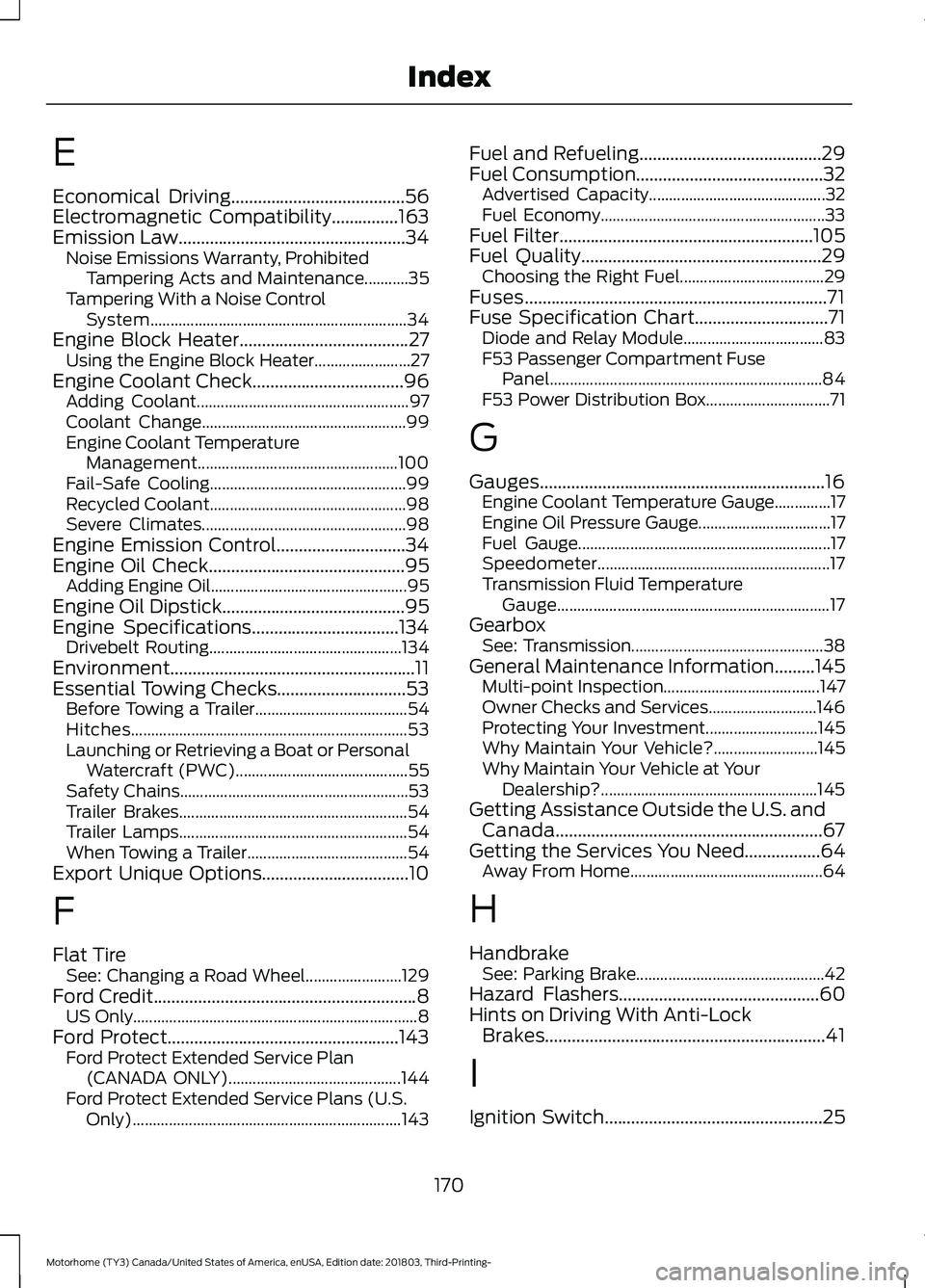
E
Economical Driving.......................................56Electromagnetic Compatibility...............163Emission Law...................................................34Noise Emissions Warranty, ProhibitedTampering Acts and Maintenance...........35Tampering With a Noise ControlSystem................................................................34Engine Block Heater......................................27Using the Engine Block Heater........................27Engine Coolant Check..................................96Adding Coolant.....................................................97Coolant Change...................................................99Engine Coolant TemperatureManagement..................................................100Fail-Safe Cooling.................................................99Recycled Coolant.................................................98Severe Climates...................................................98Engine Emission Control.............................34Engine Oil Check............................................95Adding Engine Oil.................................................95Engine Oil Dipstick.........................................95Engine Specifications.................................134Drivebelt Routing................................................134Environment.......................................................11Essential Towing Checks.............................53Before Towing a Trailer......................................54Hitches.....................................................................53Launching or Retrieving a Boat or PersonalWatercraft (PWC)...........................................55Safety Chains.........................................................53Trailer Brakes.........................................................54Trailer Lamps.........................................................54When Towing a Trailer........................................54Export Unique Options.................................10
F
Flat TireSee: Changing a Road Wheel........................129Ford Credit...........................................................8US Only.......................................................................8Ford Protect....................................................143Ford Protect Extended Service Plan(CANADA ONLY)...........................................144Ford Protect Extended Service Plans (U.S.Only)...................................................................143
Fuel and Refueling.........................................29Fuel Consumption..........................................32Advertised Capacity............................................32Fuel Economy........................................................33Fuel Filter.........................................................105Fuel Quality......................................................29Choosing the Right Fuel....................................29Fuses....................................................................71Fuse Specification Chart..............................71Diode and Relay Module...................................83F53 Passenger Compartment FusePanel....................................................................84F53 Power Distribution Box...............................71
G
Gauges................................................................16Engine Coolant Temperature Gauge..............17Engine Oil Pressure Gauge.................................17Fuel Gauge...............................................................17Speedometer..........................................................17Transmission Fluid TemperatureGauge....................................................................17GearboxSee: Transmission................................................38General Maintenance Information.........145Multi-point Inspection.......................................147Owner Checks and Services...........................146Protecting Your Investment............................145Why Maintain Your Vehicle?..........................145Why Maintain Your Vehicle at YourDealership?......................................................145Getting Assistance Outside the U.S. andCanada............................................................67Getting the Services You Need.................64Away From Home................................................64
H
HandbrakeSee: Parking Brake...............................................42Hazard Flashers.............................................60Hints on Driving With Anti-LockBrakes...............................................................41
I
Ignition Switch.................................................25
170
Motorhome (TY3) Canada/United States of America, enUSA, Edition date: 201803, Third-Printing-Index