display FORD F SERIES MOTORHOME AND COMMERCIAL CHASSIS 2016 13.G Owners Manual
[x] Cancel search | Manufacturer: FORD, Model Year: 2016, Model line: F SERIES MOTORHOME AND COMMERCIAL CHASSIS, Model: FORD F SERIES MOTORHOME AND COMMERCIAL CHASSIS 2016 13.GPages: 154, PDF Size: 3.44 MB
Page 4 of 154
Introduction
About This Manual...........................................3
Symbols Glossary.............................................3
California Proposition 65...............................5
Perchlorate..........................................................5
Ford Credit...........................................................5
Replacement PartsRecommendation........................................6
Special Notices.................................................6
Mobile CommunicationsEquipment.......................................................7
Export Unique Options...................................7
Environment
Protecting the Environment.........................8
Steering Wheel
Adjusting the Steering Wheel......................9
Cruise Control....................................................9
Wipers and Washers
Windshield Wipers.........................................10
Windshield Washers......................................10
Lighting
Lighting Control................................................11
Instrument Lighting Dimmer........................11
Daytime Running Lamps..............................12
Direction Indicators.........................................12
Instrument Cluster
Gauges.................................................................13
Warning Lamps and Indicators..................15
Audible Warnings and Indicators...............17
Information Displays
General Information.......................................18
Information Messages..................................19
Starting and Stopping theEngine
General Information......................................22
Ignition Switch.................................................22
Starting a Gasoline Engine.........................22
Engine Block Heater......................................24
Fuel and Refueling
Safety Precautions........................................25
Fuel Quality......................................................26
Running Out of Fuel......................................26
Refueling............................................................27
Fuel Consumption.........................................28
Emission Control System............................29
Transmission
Automatic Transmission.............................32
Brakes
General Information......................................35
Hints on Driving With Anti-LockBrakes.............................................................35
Parking Brake...................................................36
Cruise Control
Principle of Operation...................................37
Using Cruise Control......................................37
Load Carrying
Load Limit.........................................................38
Towing
Towing a Trailer...............................................44
Recommended Towing Weights..............45
Essential Towing Checks.............................47
Transporting the Vehicle.............................49
Towing the Vehicle on Four Wheels.......50
1Motorhome (TY3) , enUSA, First PrintingTable of Contents
Page 16 of 154
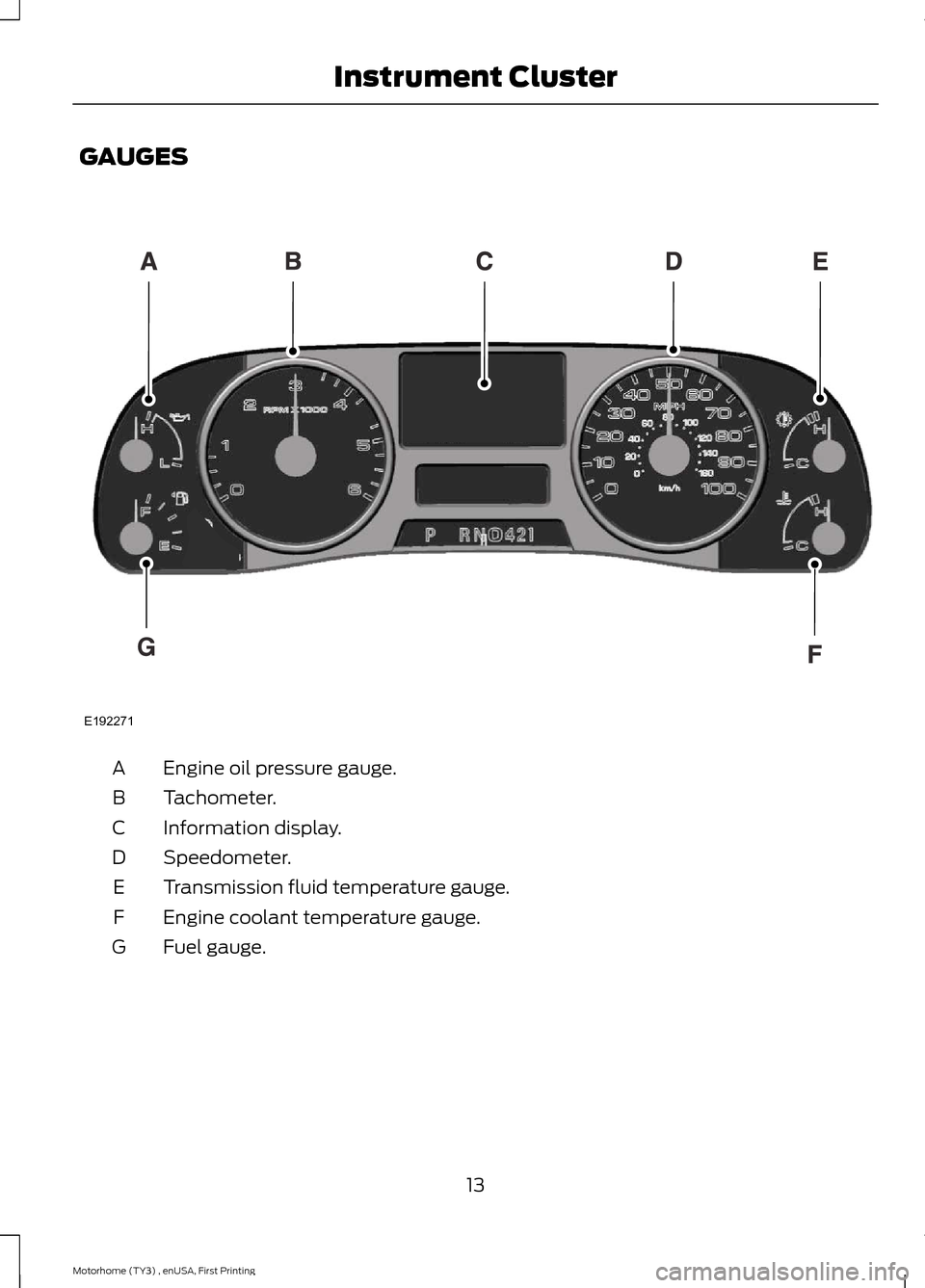
GAUGES
Engine oil pressure gauge.A
Tachometer.B
Information display.C
Speedometer.D
Transmission fluid temperature gauge.E
Engine coolant temperature gauge.F
Fuel gauge.G
13Motorhome (TY3) , enUSA, First PrintingInstrument ClusterE192271
Page 18 of 154
•It may take a short time for the needleto reach F after leaving the gas station.This is normal and depends upon theslope of the pavement at the gasstation.
•The fuel amount dispensed into thetank is a little less or more than thegauge indicated. This is normal anddepends upon the slope of thepavement at the gas station.
•If the gas station nozzle shuts offbefore the tank is full, try a differentgas pump nozzle.
•There is a small reserve left in the tankwhen the fuel gauge reaches empty.
Low Fuel Reminder
A low fuel reminder triggers when the fuelgauge needle is at one-sixteenth or about50 miles (80 km) to empty, whicheveroccurs first.
Variations:
Note:The low fuel warning and distance-to-empty warning can appear at different fuelgauge positions depending on fuel economy conditions. This variation is normal.
Distance-to-emptyFuel gauge positionDriving type (fuel economyconditions)
30 miles to 80 miles (48 kmto 129 km)1/16thHighway driving
10 miles to 35 miles (16 kmto 56 km)1/16th-1/4Severe duty driving (trailertowing, extended idle)
WARNING LAMPS AND
INDICATORS
The following warning lamps andindicators will alert you to a vehiclecondition that may become serious. Somelamps will illuminate when you start yourvehicle to make sure they work. If anylamps remain on after starting your vehicle,refer to the respective system warninglamp for further information.
Note:Some warning indicators appear inthe information display and function thesame as a warning lamp but do not displaywhen you start your vehicle.
Anti-Lock Braking System
If it illuminates when you aredriving, this indicates amalfunction. You will continueto have the normal braking system(without ABS) unless the brake systemwarning lamp is also illuminated. Have thesystem checked by your authorized dealer.
Battery
If it illuminates while driving, itindicates a malfunction. Switchoff all unnecessary electricalequipment and have the system checkedby your authorized dealer immediately.
15Motorhome (TY3) , enUSA, First PrintingInstrument Cluster
Page 21 of 154
GENERAL INFORMATION
WARNING
Driving while distracted can result inloss of vehicle control, crash andinjury. We strongly recommend thatyou use extreme caution when using anydevice that may take your focus off theroad. Your primary responsibility is the safeoperation of your vehicle. We recommendagainst the use of any hand-held devicewhile driving and encourage the use ofvoice-operated systems when possible.Make sure you are aware of all applicablelocal laws that may affect the use ofelectronic devices while driving.
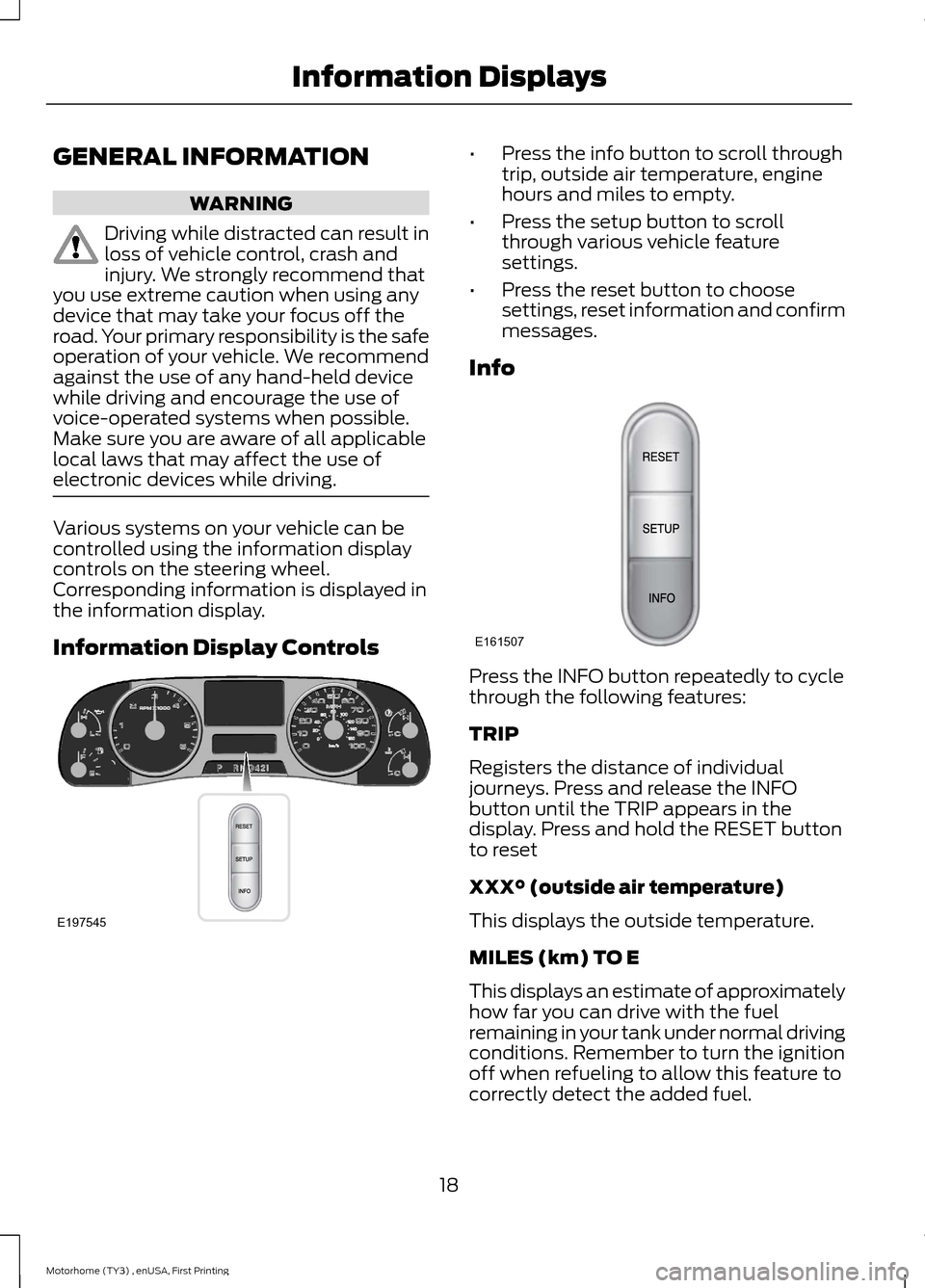
Various systems on your vehicle can becontrolled using the information displaycontrols on the steering wheel.Corresponding information is displayed inthe information display.
Information Display Controls
•Press the info button to scroll throughtrip, outside air temperature, enginehours and miles to empty.
•Press the setup button to scrollthrough various vehicle featuresettings.
•Press the reset button to choosesettings, reset information and confirmmessages.
Info
Press the INFO button repeatedly to cyclethrough the following features:
TRIP
Registers the distance of individualjourneys. Press and release the INFObutton until the TRIP appears in thedisplay. Press and hold the RESET buttonto reset
XXX° (outside air temperature)
This displays the outside temperature.
MILES (km) TO E
This displays an estimate of approximatelyhow far you can drive with the fuelremaining in your tank under normal drivingconditions. Remember to turn the ignitionoff when refueling to allow this feature tocorrectly detect the added fuel.
18Motorhome (TY3) , enUSA, First PrintingInformation DisplaysE197545 E161507
Page 22 of 154
The DTE function will display a messagein the information display when you haveapproximately 50 miles (80 km), to empty.Press RESET to clear this warningmessage. It will return at approximately 25miles (40 km), 10 miles (16 km) and 0miles (0 km) miles to empty.
DTE is calculated using a running averagefuel economy, which is based on yourrecent driving history of 500 miles (800km).
ENG HRS
Registers the accumulated time the enginehas been running.
System check and vehicle featurecustomization
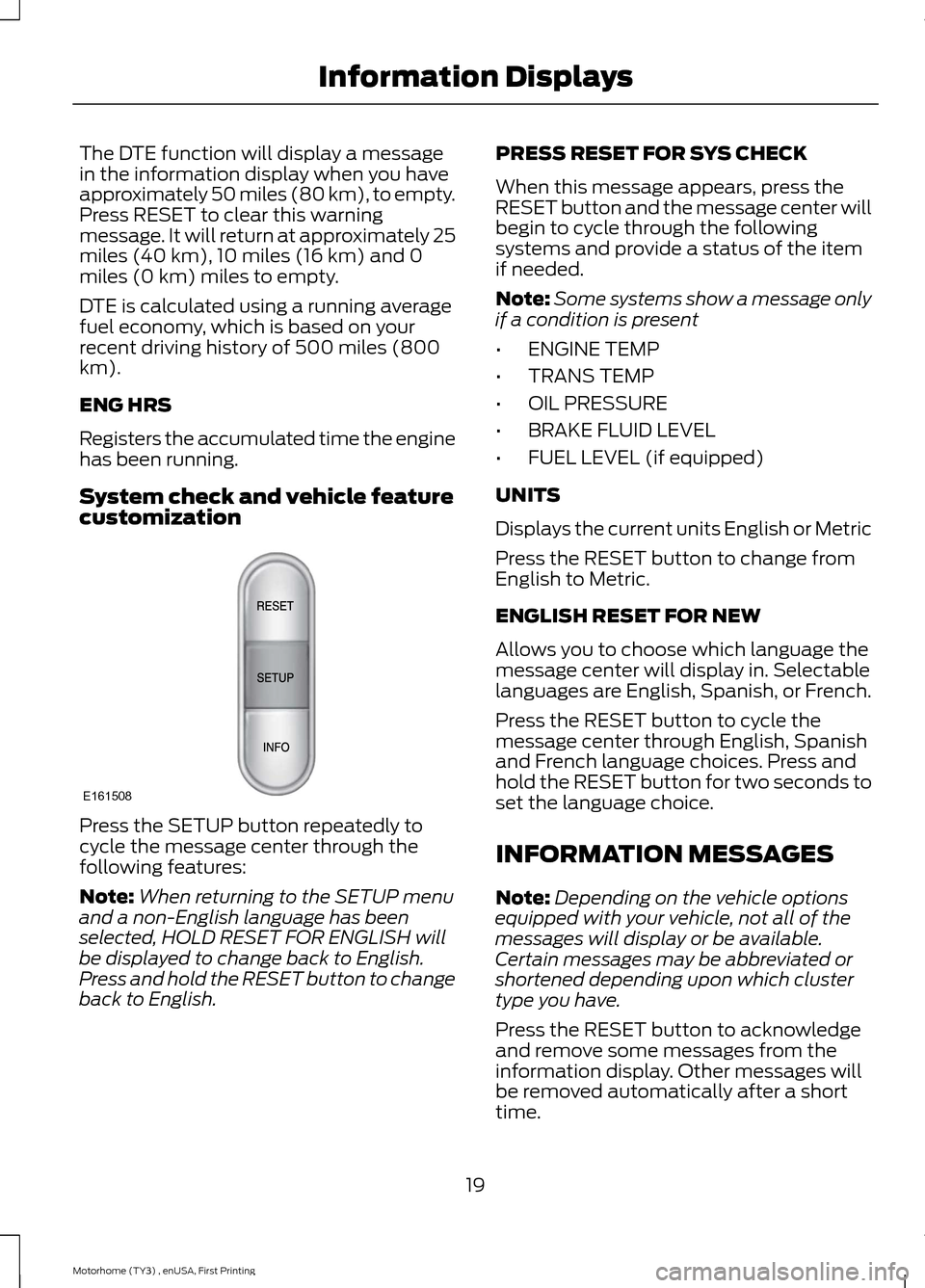
Press the SETUP button repeatedly tocycle the message center through thefollowing features:
Note:When returning to the SETUP menuand a non-English language has beenselected, HOLD RESET FOR ENGLISH willbe displayed to change back to English.Press and hold the RESET button to changeback to English.
PRESS RESET FOR SYS CHECK
When this message appears, press theRESET button and the message center willbegin to cycle through the followingsystems and provide a status of the itemif needed.
Note:Some systems show a message onlyif a condition is present
•ENGINE TEMP
•TRANS TEMP
•OIL PRESSURE
•BRAKE FLUID LEVEL
•FUEL LEVEL (if equipped)
UNITS
Displays the current units English or Metric
Press the RESET button to change fromEnglish to Metric.
ENGLISH RESET FOR NEW
Allows you to choose which language themessage center will display in. Selectablelanguages are English, Spanish, or French.
Press the RESET button to cycle themessage center through English, Spanishand French language choices. Press andhold the RESET button for two seconds toset the language choice.
INFORMATION MESSAGES
Note:Depending on the vehicle optionsequipped with your vehicle, not all of themessages will display or be available.Certain messages may be abbreviated orshortened depending upon which clustertype you have.
Press the RESET button to acknowledgeand remove some messages from theinformation display. Other messages willbe removed automatically after a shorttime.
19Motorhome (TY3) , enUSA, First PrintingInformation DisplaysE161508
Page 23 of 154
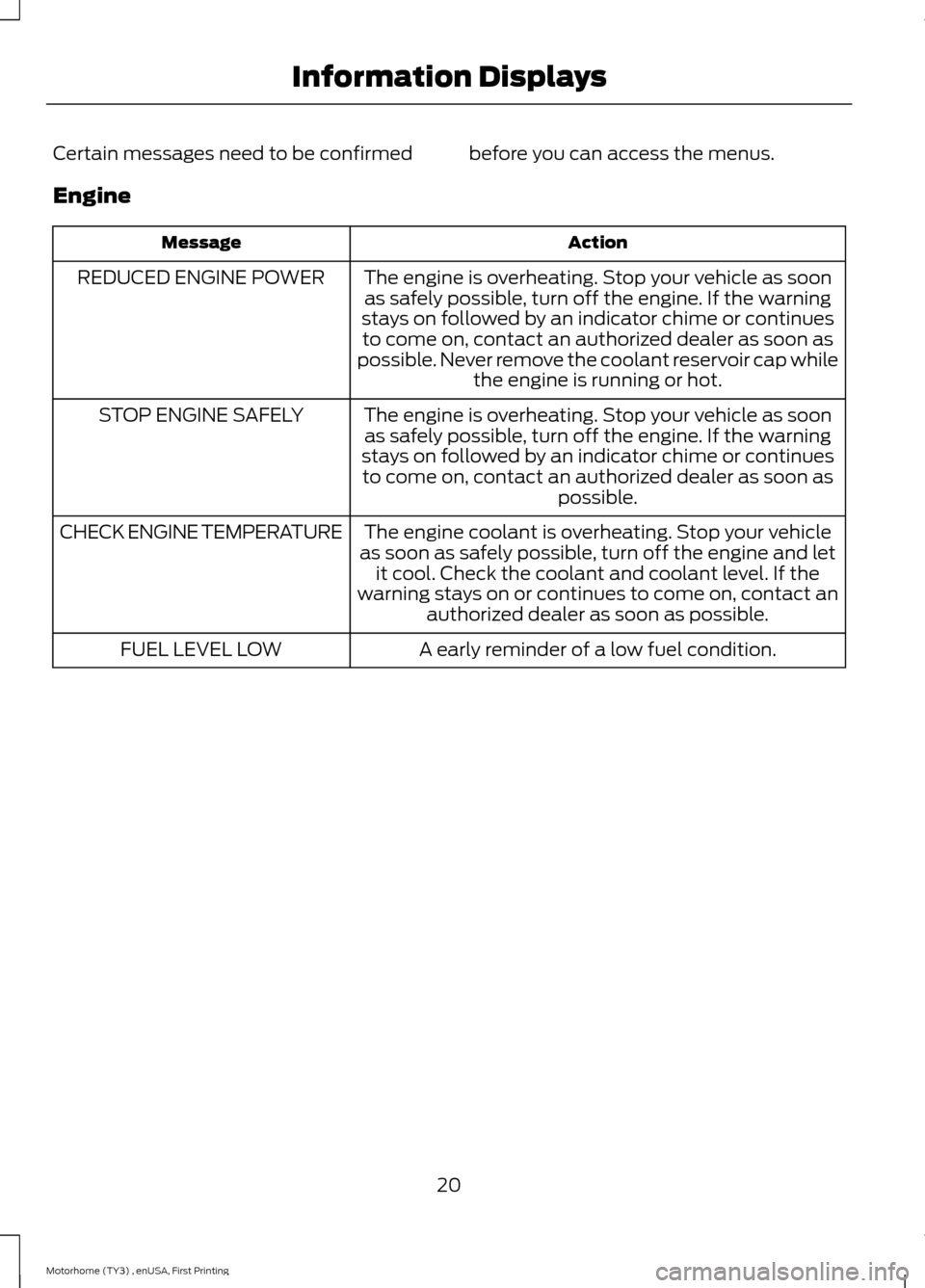
Certain messages need to be confirmedbefore you can access the menus.
Engine
ActionMessage
The engine is overheating. Stop your vehicle as soonas safely possible, turn off the engine. If the warningstays on followed by an indicator chime or continuesto come on, contact an authorized dealer as soon aspossible. Never remove the coolant reservoir cap whilethe engine is running or hot.
REDUCED ENGINE POWER
The engine is overheating. Stop your vehicle as soonas safely possible, turn off the engine. If the warningstays on followed by an indicator chime or continuesto come on, contact an authorized dealer as soon aspossible.
STOP ENGINE SAFELY
The engine coolant is overheating. Stop your vehicleas soon as safely possible, turn off the engine and letit cool. Check the coolant and coolant level. If thewarning stays on or continues to come on, contact anauthorized dealer as soon as possible.
CHECK ENGINE TEMPERATURE
A early reminder of a low fuel condition.FUEL LEVEL LOW
20Motorhome (TY3) , enUSA, First PrintingInformation Displays
Page 24 of 154
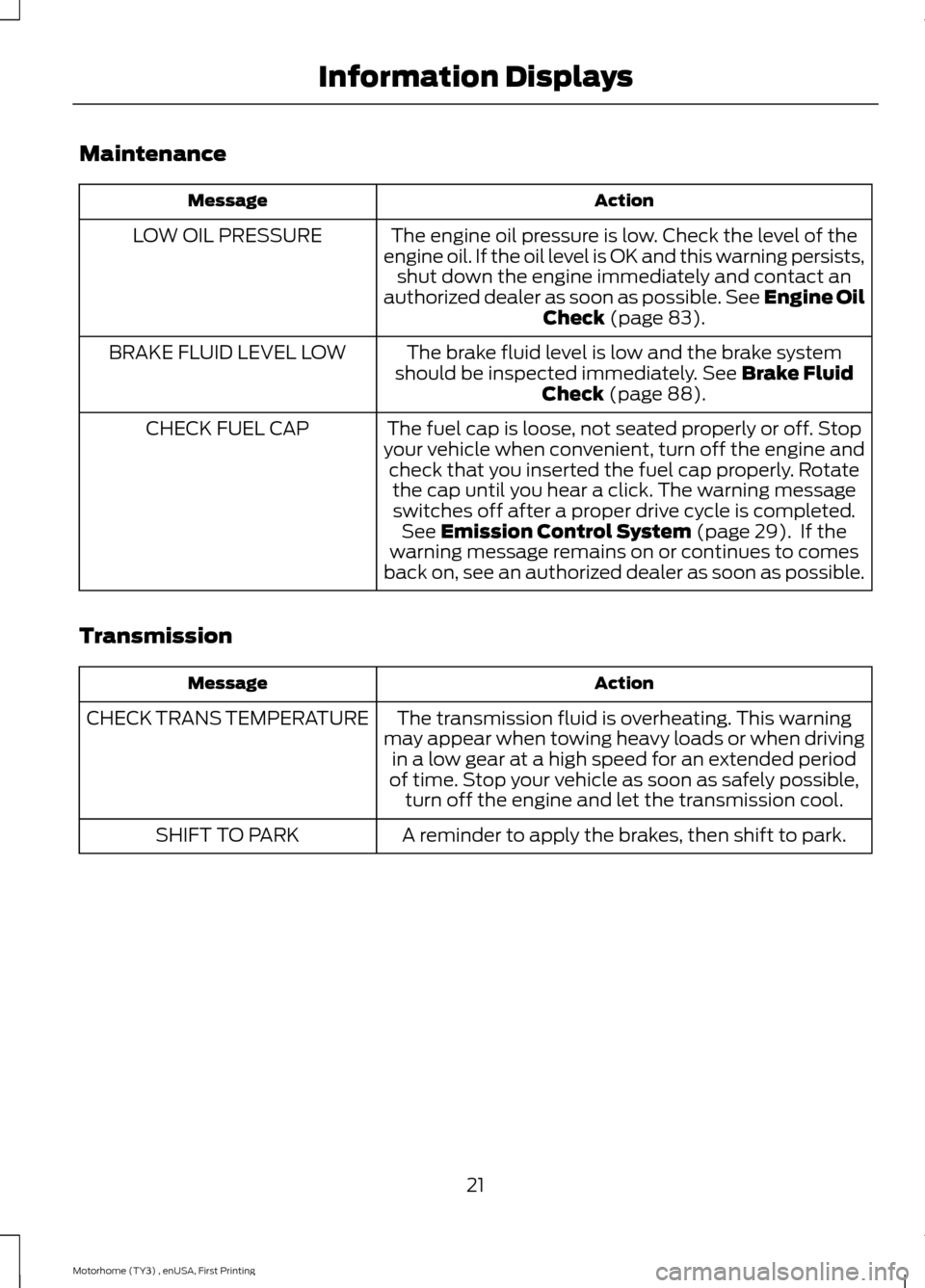
Maintenance
ActionMessage
The engine oil pressure is low. Check the level of theengine oil. If the oil level is OK and this warning persists,shut down the engine immediately and contact anauthorized dealer as soon as possible. See Engine OilCheck (page 83).
LOW OIL PRESSURE
The brake fluid level is low and the brake systemshould be inspected immediately. See Brake FluidCheck (page 88).
BRAKE FLUID LEVEL LOW
The fuel cap is loose, not seated properly or off. Stopyour vehicle when convenient, turn off the engine andcheck that you inserted the fuel cap properly. Rotatethe cap until you hear a click. The warning messageswitches off after a proper drive cycle is completed.See Emission Control System (page 29). If thewarning message remains on or continues to comesback on, see an authorized dealer as soon as possible.
CHECK FUEL CAP
Transmission
ActionMessage
The transmission fluid is overheating. This warningmay appear when towing heavy loads or when drivingin a low gear at a high speed for an extended periodof time. Stop your vehicle as soon as safely possible,turn off the engine and let the transmission cool.
CHECK TRANS TEMPERATURE
A reminder to apply the brakes, then shift to park.SHIFT TO PARK
21Motorhome (TY3) , enUSA, First PrintingInformation Displays
Page 40 of 154
PRINCIPLE OF OPERATION
Cruise control lets you maintain a setspeed without keeping your foot on theaccelerator pedal. You can use cruisecontrol when your vehicle speed is greaterthan 20 mph (30 km/h).
USING CRUISE CONTROL
WARNINGS
Do not use cruise control on windingroads, in heavy traffic or when theroad surface is slippery. This couldresult in loss of vehicle control, seriousinjury or death.
When you are going downhill, yourvehicle speed may increase abovethe set speed. The system will notapply the brakes. Change down a gear toassist the system in maintaining the setspeed. Failure to do so could result in lossof vehicle control, serious injury or death.
Note:Cruise control will disengage if thevehicle speed decreases more than 10 mph(16 km/h) below the set speed while drivinguphill.
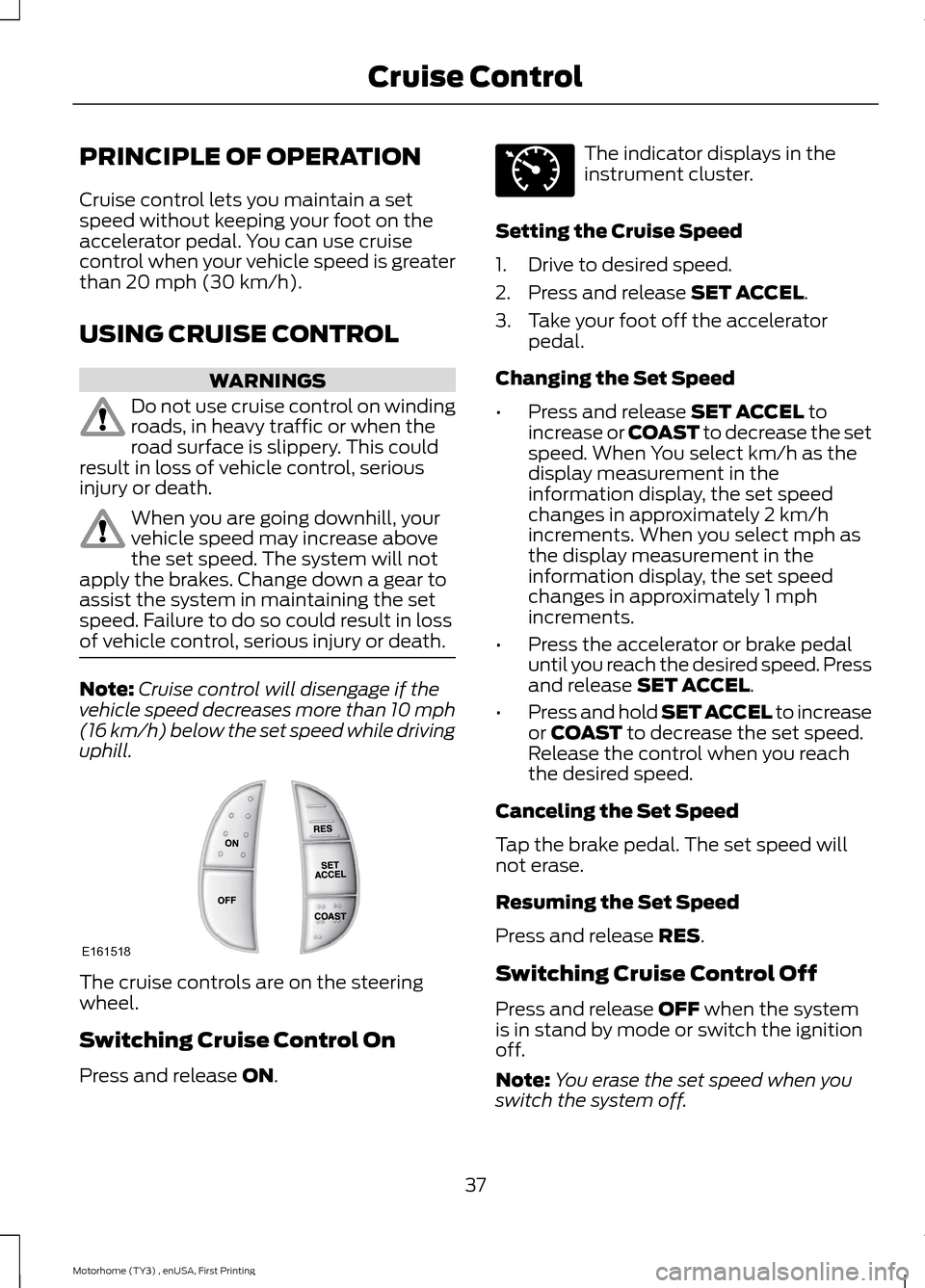
The cruise controls are on the steeringwheel.
Switching Cruise Control On
Press and release ON.
The indicator displays in theinstrument cluster.
Setting the Cruise Speed
1.Drive to desired speed.
2.Press and release SET ACCEL.
3.Take your foot off the acceleratorpedal.
Changing the Set Speed
•Press and release SET ACCEL toincrease or COAST to decrease the setspeed. When You select km/h as thedisplay measurement in theinformation display, the set speedchanges in approximately 2 km/hincrements. When you select mph asthe display measurement in theinformation display, the set speedchanges in approximately 1 mphincrements.
•Press the accelerator or brake pedaluntil you reach the desired speed. Pressand release SET ACCEL.
•Press and hold SET ACCEL to increaseor COAST to decrease the set speed.Release the control when you reachthe desired speed.
Canceling the Set Speed
Tap the brake pedal. The set speed willnot erase.
Resuming the Set Speed
Press and release RES.
Switching Cruise Control Off
Press and release OFF when the systemis in stand by mode or switch the ignitionoff.
Note:You erase the set speed when youswitch the system off.
37Motorhome (TY3) , enUSA, First PrintingCruise ControlE161518 E71340
Page 87 of 154
To reset the oil life monitoring system dothe following:
1.Switch the ignition on. Do not start theengine.
2.Fully press the accelerator and brakepedals at the same time.
3.Keep the accelerator and brake pedalsfully pressed.
4.After three seconds, a messagedisplays confirming the reset procedureis in progress.
5.After 25 seconds, a message displaysconfirming the reset procedure iscomplete.
6.Release the accelerator and brakepedals.
7.Switch the ignition off.
ENGINE COOLANT CHECK
WARNINGS
Do not add engine coolant when theengine is hot. Steam and scaldingliquids released from a hot coolingsystem can burn you badly. Also, spillingcoolant on hot engine parts can burn you.
Do not put engine coolant in thewindshield washer fluid container. Ifsprayed on the windshield, enginecoolant could make it difficult to seethrough the windshield.
To reduce the risk of personal injury,make sure the engine is cool beforeunscrewing the coolant pressurerelief cap. The cooling system is underpressure; steam and hot liquid can comeout forcefully when you loosen the capslightly.
Do not add coolant further than theMAX mark.
When the engine is cold, check theconcentration and level of the enginecoolant at the intervals listed in thescheduled maintenance information. SeeScheduled Maintenance (page 128).
Note:Make sure that the level is betweenthe MIN and MAX marks on the coolantreservoir.
Note:Coolant expands when it is hot. Thelevel may extend beyond the MAX mark
Note:If the level is at the MIN mark, belowthe MIN mark, or empty, add coolantimmediately. See Adding Engine Coolantin this chapter.
The coolant concentration should bemaintained within 48% to 50%, whichequates to a freeze point between -30°F(-34°C) and -34°F (-37°C).
Note:For best results, coolantconcentration should be tested with arefractometer such as Robinair® Coolantand Battery Refractometer 75240. We donot recommend the use of hydrometers orcoolant test strips for measuring coolantconcentrations.
Note:Automotive fluids are notinterchangeable. Do not use engine coolant,antifreeze or windshield washer fluid outsideof its specified function and vehicle location.
Adding Engine Coolant
Note:Do not use stop leak pellets, coolingsystem sealants, or additives as they cancause damage to the engine cooling orheating systems. Your vehicle’s warrantydoes not cover this damage.
84Motorhome (TY3) , enUSA, First PrintingMaintenance
Page 128 of 154
If you use oil and fluids that do not meetthe defined specification and viscositygrade, this may lead to:
•Component damage which is notcovered by the vehicle warranty.
•Longer engine cranking periods.
•Increased emission levels.
•Reduced engine performance.
•Reduced fuel economy.
•Degraded brake performance.
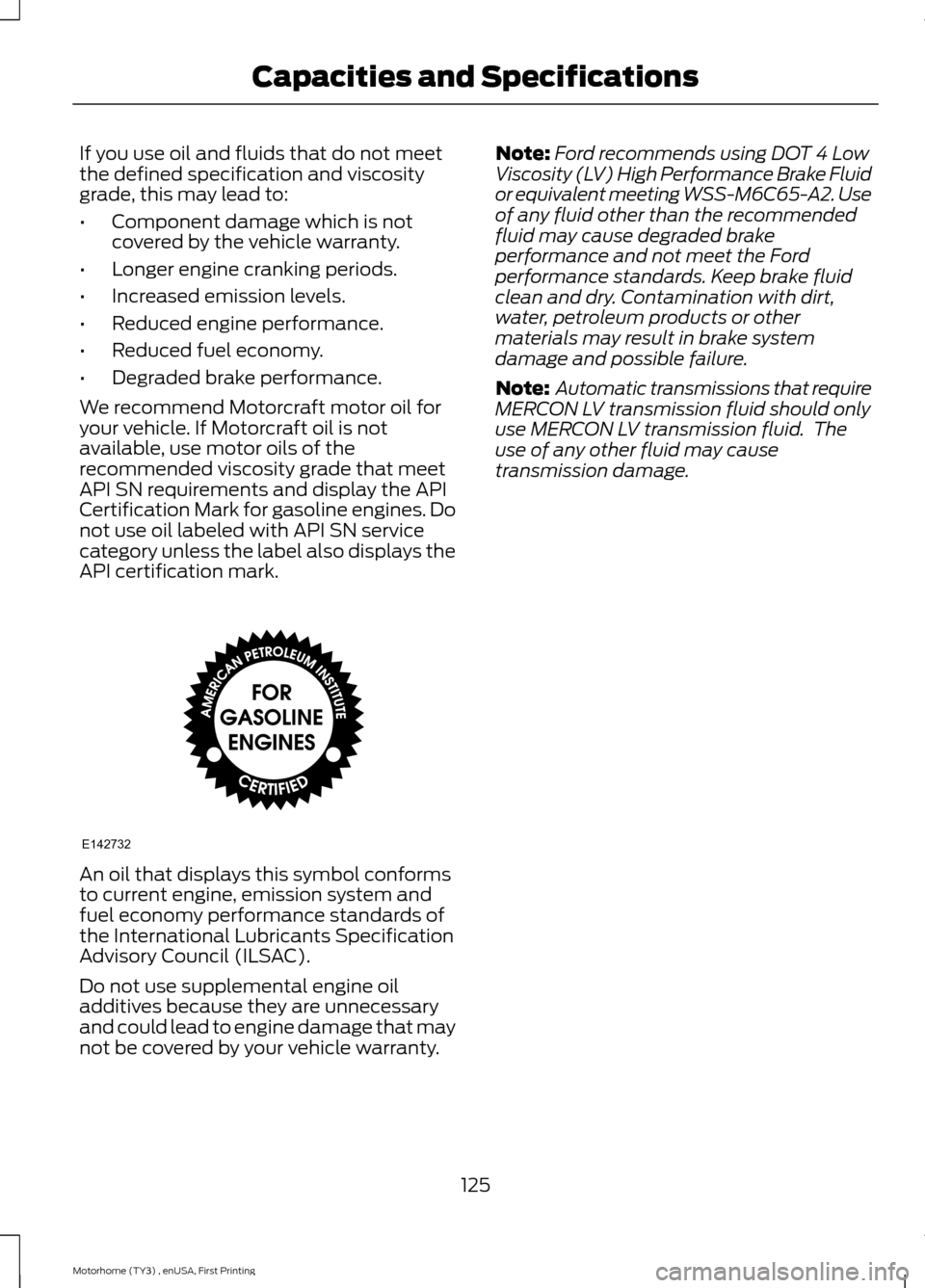
We recommend Motorcraft motor oil foryour vehicle. If Motorcraft oil is notavailable, use motor oils of therecommended viscosity grade that meetAPI SN requirements and display the APICertification Mark for gasoline engines. Donot use oil labeled with API SN servicecategory unless the label also displays theAPI certification mark.
An oil that displays this symbol conformsto current engine, emission system andfuel economy performance standards ofthe International Lubricants SpecificationAdvisory Council (ILSAC).
Do not use supplemental engine oiladditives because they are unnecessaryand could lead to engine damage that maynot be covered by your vehicle warranty.
Note:Ford recommends using DOT 4 LowViscosity (LV) High Performance Brake Fluidor equivalent meeting WSS-M6C65-A2. Useof any fluid other than the recommendedfluid may cause degraded brakeperformance and not meet the Fordperformance standards. Keep brake fluidclean and dry. Contamination with dirt,water, petroleum products or othermaterials may result in brake systemdamage and possible failure.
Note: Automatic transmissions that requireMERCON LV transmission fluid should onlyuse MERCON LV transmission fluid. Theuse of any other fluid may causetransmission damage.
125Motorhome (TY3) , enUSA, First PrintingCapacities and SpecificationsE142732