brakes FORD F150 2003 10.G User Guide
[x] Cancel search | Manufacturer: FORD, Model Year: 2003, Model line: F150, Model: FORD F150 2003 10.GPages: 280, PDF Size: 4.2 MB
Page 163 of 280

Special loading instructions for owners of pickup trucks and
utility-type vehicles
For important information regarding safe operation of this type
of vehicle, see thePreparing to drive your vehiclesection in
this chapter.
Loaded vehicles may handle differently than unloaded vehicles.
Extra precautions, such as slower speeds and increased stopping
distance, should be taken when driving a heavily loaded vehicle.
Your vehicle can haul more cargo and people than most passenger cars.
Depending upon the type and placement of the load, hauling cargo and
people may raise the center of gravity of the vehicle.
Calculating the load your vehicle can carry/tow
1. Use the appropriate maximum GCWR chart (in theTrailer Towing
section in this chapter) for your type of engine and rear axle ratio.
2. Weigh your vehicle without cargo. To obtain correct weights, take your
vehicle to a shipping company or an inspection station for trucks.
3. Subtract your loaded weight from the maximum GCWR in the chart.
This is the maximum trailer weight your vehicle can tow. It must be
below the maximum trailer weight shown in the chart.
TRAILER TOWING
Your vehicle may tow a class I, II or III trailer provided the maximum
trailer weight is less than or equal to the maximum trailer weight listed
for your engine and rear axle ratio on the following charts.
Your vehicle’s load capacity is designated by weight, not by volume, so
you cannot necessarily use all available space when loading a vehicle.
Towing a trailer places an additional load on your vehicle’s engine,
transmission, axle, brakes, tires and suspension. Inspect these
components carefully periodically during, and after any towing operation.
Exceeding the maximum GCWR could result in extensive damage
to your vehicle and personal injury.
Do not exceed the GVWR or the GAWR specified on the
certification label.
Driving
163
Page 168 of 280

Trailer brakes
Electric brakes and manual, automatic or surge-type trailer brakes are
safe if installed properly and adjusted to the manufacturer’s
specifications. The trailer brakes must meet local and Federal
regulations.
Do not connect a trailer’s hydraulic brake system directly to your
vehicle’s brake system. Your vehicle may not have enough
braking power and your chances of having a collision greatly increase.
The braking system of the tow vehicle is rated for operation at the
GVWR not GCWR.
Trailer lamps
Trailer lamps are required on most towed vehicles. Make sure your
trailer lamps conform to local and Federal regulations. See your dealer or
trailer rental agency for proper instructions and equipment for hooking
up trailer lamps.
Using a step bumper (if equipped)
The rear bumper is equipped with an integral hitch and only requires a
ball with a 25.4 mm (one inch) shank diameter. The bumper has a 2,270 kg
(5,000 lb.) trailer weight and 227 kg (500 lb.) tongue weight capacity.
If it is necessary to relocate the trailer hitch ball position, a
frame-mounted trailer hitch must be installed.
Driving while you tow
When towing a trailer:
•Turn off the speed control. The speed control may shut off
automatically when you are towing on long, steep grades.
•Consult your local motor vehicle speed regulations for towing a trailer.
•To eliminate excessive shifting, use a lower gear. This will also assist
in transmission cooling. (For additional information, refer to the
Understanding the positions of the 4–speed automatic
transmissionsection in this chapter.
•Anticipate stops and brake gradually.
•Do not exceed the GCWR rating or transmission damage may occur.
Servicing after towing
If you tow a trailer for long distances, your vehicle will require more
frequent service intervals. Refer to your scheduled maintenance guide for
more information.
Driving
168
Page 244 of 280
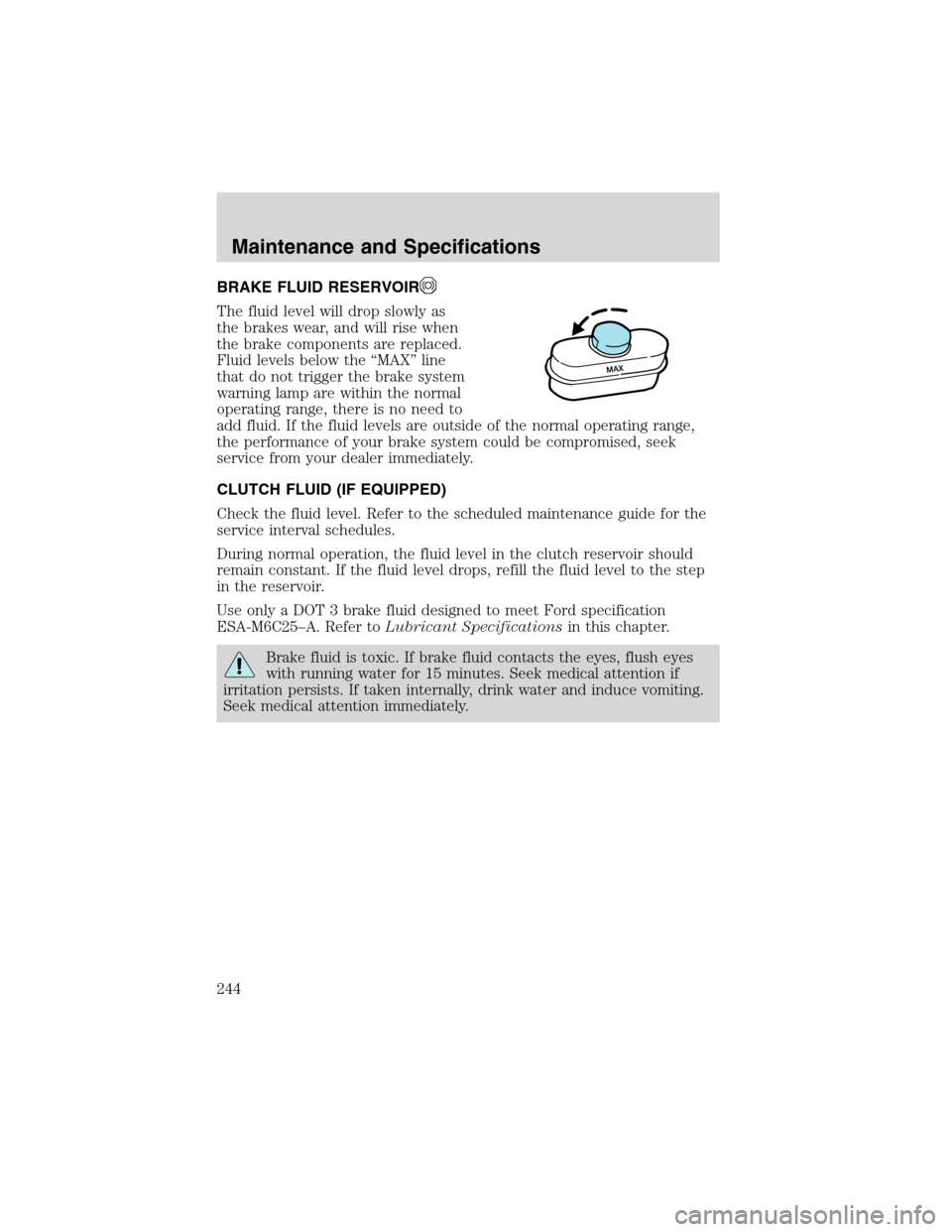
BRAKE FLUID RESERVOIR
The fluid level will drop slowly as
the brakes wear, and will rise when
the brake components are replaced.
Fluid levels below the“MAX”line
that do not trigger the brake system
warning lamp are within the normal
operating range, there is no need to
add fluid. If the fluid levels are outside of the normal operating range,
the performance of your brake system could be compromised, seek
service from your dealer immediately.
CLUTCH FLUID (IF EQUIPPED)
Check the fluid level. Refer to the scheduled maintenance guide for the
service interval schedules.
During normal operation, the fluid level in the clutch reservoir should
remain constant. If the fluid level drops, refill the fluid level to the step
in the reservoir.
Use only a DOT 3 brake fluid designed to meet Ford specification
ESA-M6C25–A. Refer toLubricant Specificationsin this chapter.
Brake fluid is toxic. If brake fluid contacts the eyes, flush eyes
with running water for 15 minutes. Seek medical attention if
irritation persists. If taken internally, drink water and induce vomiting.
Seek medical attention immediately.
Maintenance and Specifications
244
Page 273 of 280
A
Accessory delay ..........................61
Air bag supplemental
restraint system ........................111
and child safety seats ............113
description ..............................111
disposal ....................................115
driver air bag ..........................113
indicator light .........................115
operation .................................113
passenger air bag ...................113
passenger deactivation
switch ......................................116
Air cleaner filter ...............250, 255
Air conditioning ..........................41
Ambulance packages ....................8
Antifreeze (see
Engine coolant) ........................227
Anti-lock brake system
(see Brakes) ..............................140
Armrests ......................................98
Audio system (see
Radio) ........................19, 25, 28, 31
Automatic transmission ............143
driving an automatic
overdrive .................................144
fluid, adding ............................245
fluid, checking ........................245
fluid, refill capacities ..............256
fluid, specification ..................262
Auxiliary power point .................59
Axle
lubricant
specifications ..................259, 262
refill capacities ........................256
traction lok ..............................142B
Battery .......................................225
acid, treating emergencies .....225
jumping a disabled battery ....191
maintenance-free ....................225
replacement, specifications ...255
servicing ..................................225
Bed extender ..............................73
BeltMinder .................................106
Brakes ........................................140
anti-lock ...................................140
anti-lock brake system
(ABS) warning light ...............140
fluid, checking and adding ....244
fluid, refill capacities ..............256
fluid, specifications .........259, 262
lubricant
specifications ..................259, 262
parking ....................................141
shift interlock ..........................143
Bulbs ............................................48
C
Calculating load ........................163
Capacities for refilling fluids ....256
Cassette tape player ...................28
CD-single premium .........19, 25, 31
Cell phone use ............................60
Certification Label ....................267
Changing a tire .........................184
Child safety restraints ..............120
child safety belts ....................120
Child safety seats ......................123
attaching with tether
straps .......................................128
in front seat ............................124
in rear seat ......................124, 127
Index
273
Page 276 of 280
I
Ignition ...............................135, 262
Infant seats (see
Safety seats) .............................123
Inspection/maintenance
(I/M) testing ..............................242
Instrument panel
cleaning ...................................212
cluster ........................................12
lighting up panel and
interior .......................................46
J
Jack ............................................184
positioning ...............................184
storage .....................................184
Jump-starting your vehicle ......191
K
Keyless entry system .................85
Keys
positions of the ignition .........135
L
Lamps
autolamp system .......................44
bulb replacement
specifications chart ..................48
cargo lamps ...............................46
daytime running light ...............45
fog lamps ...................................44
headlamps .................................44
headlamps, flash to pass ..........45
instrument panel, dimming .....46
interior lamps .....................47–48
replacing bulbs ...................48–53Lane change indicator (see
Turn signal) .................................46
Lights, warning and indicator ....12
anti-lock brakes (ABS) ..........140
speed control ............................66
Load limits .................................161
GAWR ......................................161
GVWR ......................................161
trailer towing ..........................161
Loading instructions .................163
Locks
childproof ..................................79
Lubricant specifications ...259, 262
Lumbar support, seats ...............93
M
Manual transmission .................146
fluid capacities ........................256
lubricant specifications ..........262
reverse .....................................149
Mirrors .........................................55
automatic dimming
rearview mirror .........................61
fold away ...................................63
side view mirrors (power) .......62
Moon roof ....................................66
Motorcraft parts ................238, 255
O
Octane rating ............................236
Oil (see Engine oil) ..................221
P
Parking brake ............................141
Parts (see Motorcraft parts) ....255
Index
276